Fighting Disease Pays Dividends

by Dish Staff

Charles Kenny makes the economic case for eradicating Ebola:

There are straightforwardly selfish reasons for rich countries to work with poor countries to eradicate infectious diseases. While Ebola in its current form is an unlikely candidate as a serious health threat to Americans or Europeans, other diseases, from AIDS to West Nile virus, are reminders that infections that start or survive in the developing world can become considerable threats to the health of people in wealthier societies. Reducing the risk of such diseases has a global benefit.

The fight against smallpox is a case in point. Annual expenditure on the global smallpox eradication campaign from 1967 to 1979 was $23 million. Since eradication in 1980, the U.S. has recouped nearly 500-fold the value of its contribution to that effort in saved vaccination and treatment costs. And although smallpox remains the only scourge to have been intentionally wiped off the face of the earth (minus a few refrigerators), global progress against other infections has been dramatic enough to save considerable medical costs the world over. The U.S. doesn’t regularly vaccinate against tuberculosis, typhoid fever, yellow fever, or cholera because rates are low enough at home and in nearby countries that the the threat they pose is minimal.

Meanwhile, Laura Seay and Kim Yi Dionne rip to shreds Newsweek’s fear-mongering Ebola cover story:

The Newsweek story implies increased vulnerability to Ebola in the United States, which psychology research shows will likely amplify negative reactions to people heuristically associated with the disease — in this case, the many African migrants living in the Bronx (and potentially elsewhere in the United States) accused by Newsweek of liking bushmeat (never mind that Newsweek’s investigative reporters were never able to locate any for sale). The negative reactions to increased vulnerability include having more xenophobic attitudes. …

Fear-mongering narratives about Ebola circulating in the popular media can also have a serious effect on knowledge and attitudes about Ebola. Though there are no cases of person-to-person infection in the United States, a recent poll conducted by the Harvard School of Public Health reports 39 percent of Americans think there will be a large Ebola outbreak in the United States and more than a quarter of Americans are concerned that they or someone in their immediate family may get sick with Ebola in the next year.
Israel Gets Into The Demolition Business

by Dish Staff

One of Israel’s air strikes in Gaza this weekend leveled an entire apartment building:

The Israeli military said that it destroyed the building because it contained a Hamas command center, though spokesman Lt. Col. Peter Lerner “could not immediately specify which floor, or floors, of the building were the targets in the attack, or whether the intention had been to destroy the whole tower,” according to the Times. Residents denied that Hamas had been working out of the building. Residents said they received an alert from Israel 20 to 30 minutes before a drone dropped a “warning” rocket on their home. A warplane filled with non-warning weapons arrived shortly after. Text messages, voice mails, and leaflets distributed by Israel also warned that it would target anything “from which terror activities against Israel originate.”

Israel hit several other targets in Gaza over the weekend, including two homes and a commercial center. Ten Palestinians were reportedly killed in those attacks.

Netanyahu is now preparing his public for a war that continues into next month. A new ceasefire proposal may be in the offing, though that won’t be much comfort to the 106 Palestinians or the four-year-old Israeli child killed in the exchange of fire since the previous truce broke down last Tuesday:

Prime Minister Benjamin Netanyahu said Sunday Israel would not be worn down by persistent rocket fire, warning it would hit any place from which militants were firing, including homes. His remarks came as the air force stepped up its campaign against rocket fire, bombarding a 12-storey residential block. But by early Monday, there was increasing talk about a possible new ceasefire agreement which would see the delegations return to Cairo to resume discussions on an Egyptian proposal to broker a more permanent end to the violence.

“There is an idea for a temporary ceasefire that opens the crossings, allows aid and reconstruction material, and the disputed points will be discussed in a month,” a senior Palestinian official said in Cairo. “We would be willing to accept this, but are waiting for the Israeli response to this proposal,” he said, requesting anonymity because of the sensitivity of the negotiations. Another Palestinian official said Egypt might invite Palestinian and Israeli negotiating teams to return to Cairo within 48 hours.

Meanwhile, a new poll of Gazans has come out that illuminates the attitudes of the people who, in Israel’s view, abdicated their status as noncombatants when they voted for Hamas:

More than 90 percent of Gazans surveyed thought that resistance was either “well prepared” or “somewhat prepared” for the Israeli assault, and more than 93 percent opposed the disarmament of Palestinian militant groups, which Israel has said is a condition of any long-term truce. At the same time, despite an Israeli assault that has killed more than 2,100 Palestinians — overwhelmingly civilians — in the last six weeks, nearly 88 percent of those surveyed also supported a long-term truce, and another 10 percent supported an unspecified “medium-term” truce. …

The poll also surveyed opinions in Gaza regarding the Syria-based Wahhabi militant group Islamic State, previously known as the Islamic State of Iraq and the Levant, which Israeli leaders have repeatedly referenced in their offensive against Hamas. More than 85 percent of Gazans surveyed, however, said they oppose the group.

That last finding is particularly salient in light of the new propaganda meme Netanyahu has been pushing:

Max Fisher takes down that facile comparison:

The two groups are totally distinct. It’s not just that there is no known connection, operational or otherwise, between Hamas and ISIS, although there isn’t. They ultimately follow very different ideologies: Hamas will talk about Islamist extremism, but it is ultimately a Palestinian nationalist group first and foremost, one that is fighting to establish its vision of a Palestinian state. One of Hamas’s most important supporters historically has been the government of Iran, which is actively fighting against ISIS in Syria, where it has been sending arms, money, and men. If Hamas and ISIS were really the same thing, then presumably Iran would not fund one half of the group and then send Iranians to die fighting the other half. And Hamas leader Khaled Meshaal publicly rejected any Hamas-ISIS comparison.

ISIS, on the other hand, comes from the same ideological strain as al-Qaeda, a jihadist movement called Salafism, which rejects the idea of nationalism and seeks a pan-Islamic caliphate. Even within Gaza, the Palestinian territory that Hamas rules, there is sometimes-violent tension between Hamas and the local Salafist groups that follow something more akin to the ISIS worldview.

The Next Newspaper Die-Off

by Dish Staff

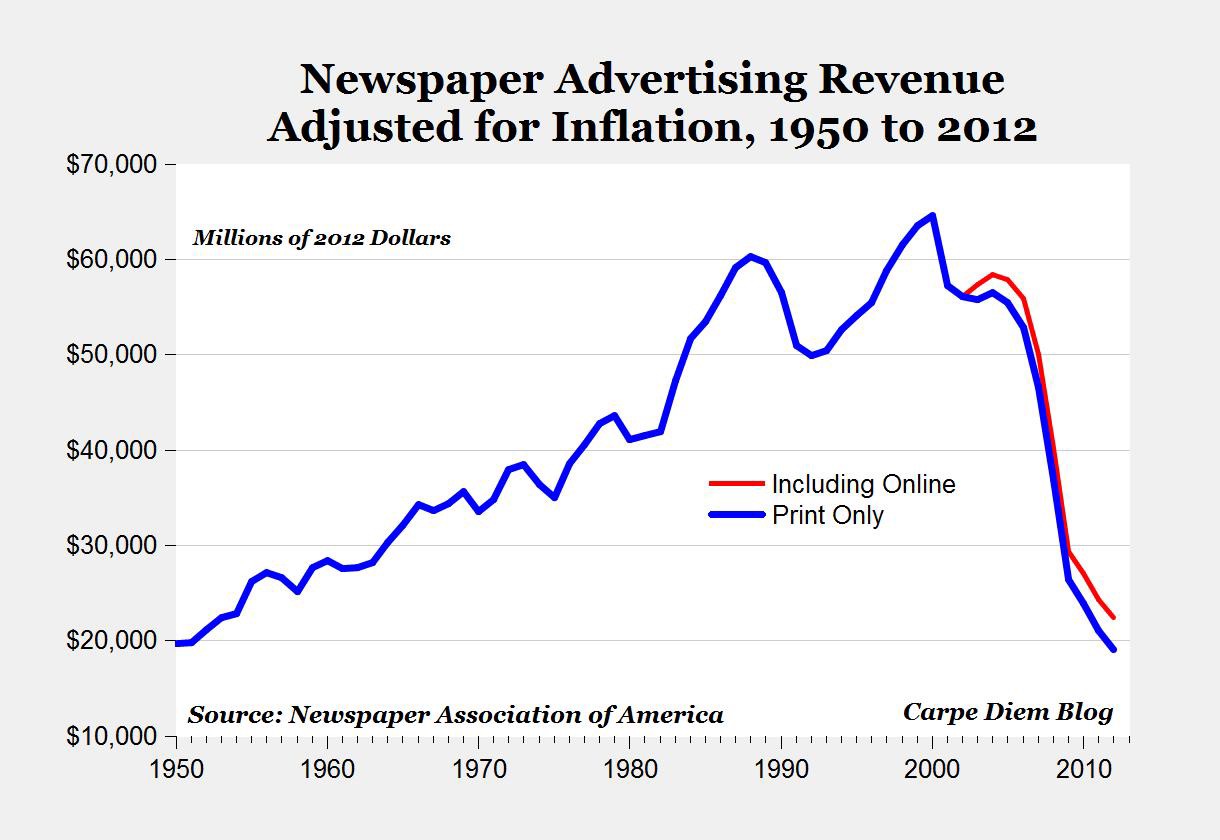
Newspaper Ad Dollars

Clay Shirky predicts that it will hit soon:

As Dick Tofel of ProPublica often points out, newspaper revenue has been shrinking since 2006, but the American economy has been growing since 2009. Between 1970 and now, the US has averaged only six years between recessions; the current period of growth crossed the six year mark this spring. We are statistically much closer to the next recession than to the last one, and in a recession, ad dollars are the first to go. Many papers will go bankrupt the way Hemingway’s Mike Campbell did: Gradually, and then suddenly.

The death of newspapers is sad, but the threatened loss of journalistic talent is catastrophic. If that’s you, it’s time to learn something outside the production routine of your current job. It will be difficult and annoying, your employer won’t be much help, and it may not even work, but we’re nearing the next great contraction. If you want to get through it, doing almost anything will be better than doing almost nothing.

(Chart from Mark Perry.)

Inequality Is Only Growing Worse

by Dish Staff

Net Worth

Drum flags new numbers that put that fact in stark relief:

[N]ew census data shows that when it comes to net worth—which is basically total wealth—the biggest change has been at the bottom. Even after taking some lumps immediately after the recession, the well-off had recovered and even made some gains by 2011. But the poor have been devastated. Their median net worth has always been pretty close to zero, but by 2011 it had plummeted to $-6,029. On average, poor families were in the hole to the tune of $6,000, an astronomical and completely debilitating number to someone with barely poverty-level earnings.

Badger’s analysis:

The Census data suggest that the wealth gap in America has widened over the past decade, regardless of how you slice it. The gap between the bottom and top quintiles in America has widened, as has the gap between blacks and whites, and between workers with only a high school degree and those with much more. This implies that the returns to higher education in America are growing (in 2000, households headed by someone with a bachelor’s degree were worth 2.4 times as much as those with only a high school diploma; by 2011 the ratio was 3.4). And racial inequality in wealth is growing, too (in 2000, white households had a net worth 10.6 times larger than blacks; by 2011 it was 17.5).

Danielle Kurtzleben observes that the report “also found that the median net worth of the top 20 percent divided by the median of the second 20 percent was 39.8 in 2000. Today, it’s 86.8.”


Protests Don’t Make You Popular

by Dish Staff

A recent poll on Ferguson found that “fifty-nine percent of Americans — including 67 percent of whites but just 43 percent of blacks — think the protesters’ actions have gone too far.” Robert Shapiro is unsurprised. Data he compiled shows that “the American public has traditionally responded unfavorably to protesters seen as disruptive, even if nonviolent”:

The majority of Americans felt this way toward the Freedom Riders in the Civil Rights Movement and toward civil right protesters and demonstrators in general. The same was true for the Vietnam antiwar movement and student protests on college campuses. The public clearly supported the Chicago police over the protesters during the 1968 Democratic National Convention, and they favored the police and the National Guard responses to disturbances in colleges and high schools. And a majority of women as well as men, no less, objected to the protests by the women’s movement.

Other historical public opinion data provide more insight.

Although most Americans support the right to protest in general, they prefer other means of achieving political goals — notably, the ballot box.  When asked in an October 1983 Louis Harris & Associates survey about “the most effective way blacks in this country can achieve a better break for themselves — take to the streets in protest, or register and vote in larger numbers to increase their political power, or just be patient and hope things get better for them?” only 1 percent said protest, while 85 percent said register and vote.

That said, he cites evidence “that protests put and keep issues on the political agenda.”

The Case For Undergraduate Law Degrees

by Dish Staff

Brent T. White argues that “the lack of an undergraduate route to legal education is perplexing”:

First, in most countries—including those requiring additional graduate-level training to become a licensed attorney—law is an undergraduate degree. Second, there is little rationale for excluding the study of law from the full range of undergraduate academic subjects. On the contrary, limiting legal education to graduate students has contributed to the mystification of law and created a reality in which too few people are equipped to grapple productively with the complex array of legal issues that are pervasive in business, government, and society.

Third, a law degree would offer many benefits to undergraduates, including the ability to independently research, read, and understand the law, as well as training in critical thinking and problem solving, analytical reasoning, and persuasive writing—all of which are highly marketable skills that translate well into a variety of professions, law-related or not. Finally, undergraduate law degrees would be the best response to the reality that many law-related tasks are performed by people who are not lawyers but who need legal training.

Ally With Assad?

by Dish Staff

Hassan Hassan argues that we shouldn’t, because he hasn’t really been fighting ISIS in the first place:

One might argue that Assad’s strategy was a cynical game and that once he is assured of his survival, he would be well-positioned to fight the group. But even that argument ignores basic dynamics: If Assad genuinely wants to fight ISIS today, he is as capable of doing that as Prime Minister Nouri al-Maliki was when ISIS took over three Iraq provinces. ISIS controls large swathes in rebel-held Syria, areas that have been outside the regime’s control for one to three years. How could the Assad regime fight against ISIS in Raqqa or Deir Ezzor, for example? Would the local population fight side by side with the regime? That is extremely unlikely, given that people have condemned reports that the United States intends to strike against ISIS in Syria while ignoring the regime’s atrocities for more than three years.

A more prudent approach is to look at the rise of ISIS as a long-term menace that can only be addressed through a ground-up pushback. The opposition forces are not only possible partners, they’re essential in the fight against ISIS. After all, they’re the ones who have been fighting ISIS since last summer, and drove it out of Idlib, Deir Ezzor and most of Aleppo and around Damascus. It cost them dearly: more than 7,000 people were killed. Fighting ISIS should be part of a broader political and military process that includes both the regime and the opposition, but not Assad.

Max Abrahms sees the situation differently:

Our national security ultimately depends on crushing ISIS not only in Iraq, but also in Syria. In the past, Assad’s forces were reluctant to engage ISIS directly. But the gloves have come off in the last couple of weeks. If Assad perceives ISIS as an existential threat, he will tolerate — even secretly welcome — U.S. military assistance. This is an opportunity Washington should seize not for him, but for us.

But James Antle seeks out the genuinely “realist” position:

Contrary to the BuzzFeed headline, few foreign-policy experts want a full operational alliance with Syria or Iran. Some have called for what Crocker, Luers, and Pickering have described as “mutually informed parallel action” against ISIS. Others have merely suggested the U.S. not destabilize ISIS’s enemies in the region, while the al-Qaeda offshoot is beheading American journalists and terrorizing religious minorities in Iraq. Even without any practical cooperation, it is hard to see how Syria and Iran wouldn’t to some extent be beneficiaries of any successful military action against ISIS. But for all the tyranny and terror ties of those regimes, ISIS is most directly the progeny of those who toppled with twin towers and attacked the United States on 9/11. After more than a decade at war in Afghanistan in response to the Taliban providing a safe haven for Osama bin Laden, wouldn’t an ISIS state in parts of Iraq and Syria be a worse outcome?

Keating believes Assad has played his cards perfectly and gotten just what he wanted:

There’s been speculation for some time that the Syrian leader would seek to use the crisis in Iraq to his advantage. It’s pretty apparent that Syrian forces tolerated the rise of the group in a bid to divide the rebels and scare off wary Western supporters, and only began attacking it after the Iraq crisis began this summer. It was a high-stakes gamble given that ISIS now reportedly controls about a third of Syrian territory, but one that could finally be paying off for the internationally isolated Syrian leader. …

Even if the U.S. doesn’t coordinate with Assad’s government—the White House position as expressed by Deputy National Security Adviser Ben Rhodes is still that he’s “part of the problem”—the shift in priority to ISIS does make it more likely that the American government is going to accept Assad remaining in power. Or at least it makes it less likely that the U.S. will take any major steps to remove him. Assad played the long game with a pretty weak hand and now appears to be winning.

Although they don’t necessarily make the case for an alliance, Ishaan Tharoor observes that the events of the past three years have sort of proven Vladimir Putin right about the folly of pushing regime change in Syria:

In his New York Times op-ed, Putin reminded readers that from “the outset, Russia has advocated peaceful dialogue enabling Syrians to develop a compromise plan for their own future.” That “plan for the future,” the Russians insisted, had to involve negotiation and talks between the government and the opposition, something which the opposition rejected totally at the time. In November 2011, Putin’s foreign minister Sergei Lavrov criticized other foreign powers, including the United States, for not helping pressure opposition forces to come to the table with the Assad regime. “We feel the responsibility to make everything possible to initiate an internal dialogue in Syria,” Lavrov said at a meeting of APEC foreign ministers in Hawaii.

The Arab Spring was in full bloom and U.S. officials thought regime change in Syria was an “inevitable” fait accompli. That calculus appears to have been woefully wrong. Now, the conflict is too entrenched, too polarized, too steeped in the suffering and trauma of millions of Syrians, for peaceful reconciliation to be an option.

A Hobby Lobby Patch For Obamacare

by Dish Staff

On Friday, the Obama administration proposed a fix to the ACA’s contraceptive mandate that it hopes will render the effects of the Hobby Lobby ruling moot by providing a way for employees of closely-held corporations with religious objections to the mandate to obtain contraception coverage. Sarah Kliff outlines the new rule, on which the administration is now seeking comment:

The Obama administration wants to extend the accommodation for religious non-profits — where the health insurance plan, rather than the employer, foots the bill for birth control — to objecting for-profit organizations. At a company like Hobby Lobby, for example, this would mean that the owners would notify the government of their objection to contraceptives. The Obama administration would then pass that information along to Hobby Lobby’s health insurance plan, which would be responsible for paying for the birth control coverage. …

The White House will also give more leeway to religious non-profits, like hospitals and colleges, that do not want to comply with the contraceptive mandate. These non-profits will no longer be required to notify their health plan that they will not provide contraceptives, as preliminary regulations would have required. Instead, these employers will now only be required to notify the federal government of their objection and the government will have the responsibility of notifying the insurance plan.

But religious organizations that object to the mandate in and of itself are not satisfied:

“Here we go again,” said Russell Moore, president of the policy arm of the Southern Baptist Convention, the largest U.S. Protestant denomination. “What we see here is another revised attempt to settle issues of religious conscience with accounting maneuvers. This new policy doesn’t get at the primary problem.”

The U.S. Conference of Catholic Bishops said it’s worried that the administration’s proposal could limit which for-profit businesses can receive a religious exemption. “By proposing to extend the ‘accommodation’ to the closely held for-profit employers that were wholly exempted by the Supreme Court’s recent decision in Hobby Lobby, the proposed regulations would effectively reduce, rather than expand, the scope of religious freedom,” the group’s statement read.

Charles Pierce expected as much:

After all, the opposition to birth control is not based on the opposition to a government mandate. It’s based on the opposition to the medicine, and the purpose that medicine serves. The question being litigated — in public and, sadly, in the courts — is not constitutional. It’s theological. The essential text is not the Constitution. It’s Humanae Vitae.

Scrutinizing how this rule change will adjust the terms of the debate over the mandate, Marty Lederman argues that the religious objectors have few legal legs left to stand on:

The regulation does not require the organizations to contract with an issuer or a TPA–and if they do not do so, then the government currently has no way of ensuring contraceptive coverage for their employees.  But even if that were not the case–i.e., even if federal law coerced the organizations to contract with such an issuer or TPA–Thomas Aquinas College and the other plaintiffs haven’t offered any explanation for why, according to their religion, the College’s responsibility for this particular match between TPA and employees would render the College itself morally responsible for the employees’ eventual use of contraceptives, when (i) such employees would have the same coverage if Aquinas had contracted with a different TPA; (ii) such employees would continue to have coverage if they left the College; and (iii) the College itself does not provide, subsidize, endorse, distribute, or otherwise facilitate the provision of, its employees’ contraceptive services.

Be that as it may, it appears that this will now be the primary (if not the only) argument the courts will have to contend with in light of the government’s newly augmented accommodation.

And Jonathan Cohn wonders what the Supreme Court will make of it:

With Hobby Lobby, the justices implied strongly that the old workaroundthe one the Administration was already providing churches and the likewas acceptable. With Wheaton, the Court said that, no, asking employers to write a letter to insurers infringed upon their religious freeom. That’s what made Justice Sonya Sotomayor and two of her colleagues angry enough to write a blistering dissent: The second directive seemed to undermine the spirit of the first. With this new regulation, the Administration is basically calling the Court’s bluff, as Ian Millhiser puts it at ThinkProgressto force the Court, once and for all, to decide whether any workaround passes muster or if the contraception requirement itself is simply unacceptable.

Ebola Is Mostly Killing Women

by Dish Staff

Liberia Battles Spreading Ebola Epidemic

Lauren Wolfe wants more attention paid to that fact:

Data show that many infectious diseases affect one gender more than another. Sometimes it’s men, as with dengue fever. Sometimes it’s women generally, as with E. coliHIV/AIDS (more than half the people living with the virus are female), and Ebola in some previous outbreaks. Sometimes it’s pregnant women and mothers, as with H1N1 (an outbreak in Australia is currently infecting women over men by a 25 percent margin).

Yet when women are the primary victims of an epidemic, few are willing to recognize that this is the case, ask why, and build responses accordingly. Indeed, experts say that too little is being done to put even the small amount that is known about gender differences and infectious diseases into practice — to determine in advance of outbreaks, for instance, how understanding gender roles might help in the development of a containment or prevention strategy. Not only that, but there is too little research being done to understand how infectious diseases affect the sexes differently on a biological level. It’s like Groundhog Day each time a disease surges, and people are losing their lives because of it. “We can’t get past the ‘interesting observation’ stage,” says Johns Hopkins University professor Sabra Klein. Public health officials generally gather data on age and sex in a crisis, but “nobody goes somewhere with it.”

(Photo: A West Point slum resident looks from behind closed gates on the second day of the government’s Ebola quarantine in her neighborhood on August 21, 2014 in Monrovia, Liberia. By John Moore/Getty Images)

Framing A Hidden Paris

by Dish Staff

Jonathan Curiel explores photographer Michael Wolf‘s new series capturing the city’s rooftops:

Wolf, whose previous photo series have been mostly centered in China and Japan, wandered along Paris’ rooftops to find an architectural side of Paris that is cracking and atrophying out of public view. Wolf — as he did with his acclaimed “Architecture of Density” series from Hong Kong — squeezes the skyline out of each scene, condensing what could be sprawling vistas into tight layers of metal and cement. Dotting Wolf’s roofs are scores of orange, red, and blueish vents that look like patterns of pottery or even engorged Lego pieces. The title of Wolf’s exhibit, “Paris Abstract,” advertises his photos’ location but also his aim: to disconnect Paris from its idealized reputation — to, in a sense, “de-Paris” Paris.

“When I went up on rooftops, I realized that it’s a perspective that most people don’t see,” says Wolf during a visit to Robert Koch Gallery in downtown San Francisco, where his exhibit is on display through [Sept 6]. “If you see Paris from the foot perspective, it’s all polished and perfect, and there’s nothing improvised or broken or damaged. The rooftops are totally different. The people who work up there say, ‘Oh, no one’s going to see this anyway,’ and they dump something, or the chimney is broken. In that sense, it was a Paris that I found very sympathetic.”

A few more images from the series after the jump:


The Dish previously featured Wolf’s urban-Asia photographs here. His other Paris series, utilizing Google Street View, is here. You can also follow him on Facebook.