Our Government’s Inability To Govern

by Dish Staff

Frum blames it on reform efforts. He argues that “for 50 years, Americans have reformed their government to allow ever more participation, ever more transparency, ever more reviews and appeals, and ever fewer actual results”:

Journalists often lament the absence of presidential leadership. What they are really observing is the weakening of congressional followership. Members of the liberal Congress elected in 1974 overturned the old committee system in an effort to weaken the power of southern conservatives. Instead—and quite inadvertently—they weakened the power of any president to move any program through any Congress. Committees and subcommittees multiplied to the point where no single chair has the power to guarantee anything. This breakdown of the committee system empowered the rank-and-file member—and provided the lobbying industry with more targets to influence. Committees now open their proceedings to the public. Many are televised. All of this allows lobbyists to keep a close eye on events—and to confirm that the politicians to whom they have contributed deliver value.

In short, in the name of “reform,” Americans over the past half century have weakened political authority. Instead of yielding more accountability, however, these reforms have yielded more lobbying, more expense, more delay, and more indecision.

Face Of The Day

by Dish Staff

453943436-MH17

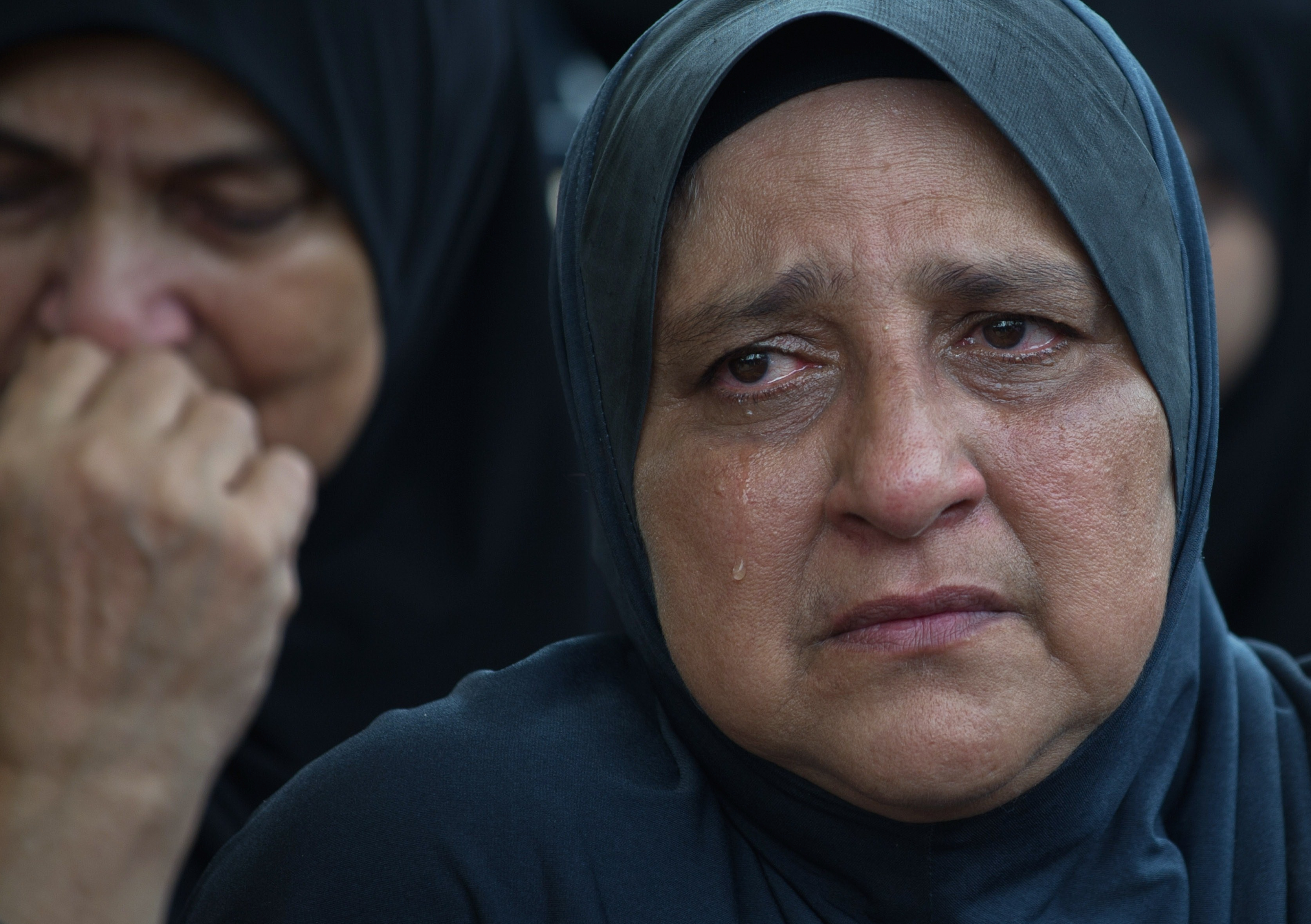
Noriah Daud, the mother of late co-pilot Ahmad Hakimi Hanapi, who perished aboard flight MH17 when it was shot down in eastern Ukraine, attends a burial ceremony in Putrajaya, outside Kuala Lumpur on August 22, 2014. Black-clad Malaysians paused for a minute of silence August 22 on a nationwide day of mourning held to welcome home the first remains of its 43 citizens killed in the MH17 disaster. By Mohd Rasfan/AFP/Getty Images.

Our coverage of the ongoing conflict in Ukraine is here.

What It’s Like To Be Gay In Uganda

by Dish Staff

Brandon Ambrosino interviews Nicholas Opiyo, a Ugandan attorney who helped overturn the country’s infamous anti-gay law. He describes the harassment Ugandan gays face:

You’re not going to see public flogging of gay people in the streets. That would be a rarity, and even if it occurs, because of the nature of our media, it’s not going to get reported widely. What, however, happens is persistent, consistent, daily discrimination of the smallest nature possible. The shopkeeper at the kiosk next to your house, the boda boda guy, they keep heckling at you. People keep telling your family and brothers about you. They tell your family they will not come to your burials. People sneering at you, saying negative things to you. People pointing at your back: you cannot go to public places without being pointed at.

There is also the blackmail and extortion by police and security forces.

If the police know that somebody is gay, they will deliberately frame a charge against you, arrest you, and give you a police bond. A police bond is temporary freedom while your case is being investigated. If they know you are gay, they keep extorting money from you in exchange for your freedom. They say, “Oh, we’ve got evidence against you. We’re going to take you to court, so give us money.”

That is what kills the spirits, the hearts, the minds of gay people in Uganda. The insane discrimination. The insane segregation, and the sense of exclusion that happens every single day in every single place for gay men and lesbian women in Uganda. Just going to the hospital and getting treatment. Going to buy lubricant — you might not even find a place to buy lubricant, to buy condoms. If you have a particular problem, you may never get treatment because of the fear that people are going to keep pointing at you [points], “That one. That one!”

That is what is killing gay people in our country.

The Ebola Outbreak Grows Worse

by Dish Staff

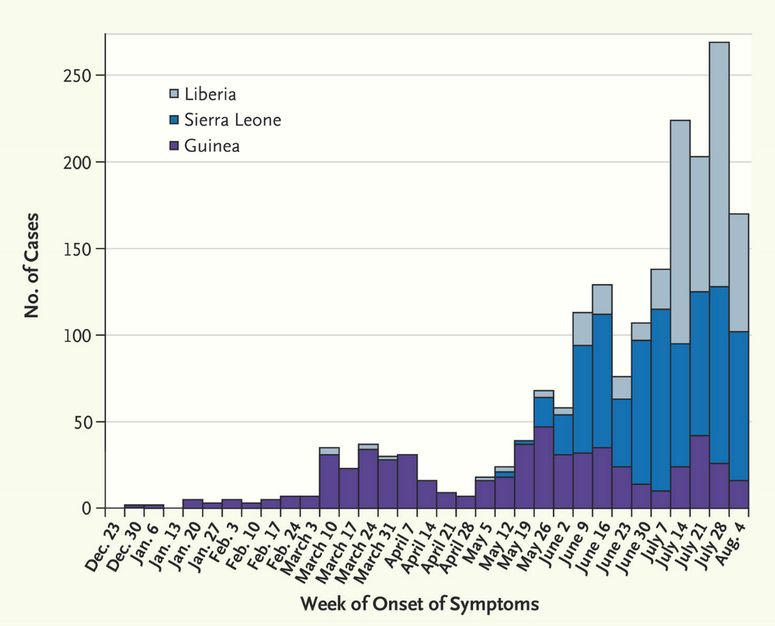
Julia Belluz flags an eye-opening chart on the growing severity of the Ebola crisis:

Ebola Chart

The situation is dire in West Point, a Liberian slum:

Tens of thousands of people are trapped in a slum in Liberia’s capital, Monrovia, after officials put the neighborhood under strict quarantine to prevent the spread of Ebola. Clashes broke out on Wednesday, as riot police and soldiers attempted to barricade angry residents. Days earlier, locals had raided a holding center for suspected Ebola patients, pulling out mattresses covered in blood, which could spread the disease.

Per Liljas provides more details:

On Saturday, a health center was looted and Ebola patients sent running, after a rumor spread that infected people were being brought in from other parts of the country. Others refused to believe the disease existed. “There is no Ebola,” some protesters attacking the clinic shouted. “There is a high level of disbelief in the government in West Point,” Sanj Srikanthan, the International Rescue Committee’s emergency response director in Liberia, tells TIME. “The government has made a concerted effort to reach out to community leaders, youth groups and churches with the message that the only way to contain the disease is to understand it. But some people still believe Ebola is a conspiracy, and those people we need to reach.”

Raphael Frankfurter is unsurprised “that aggressive, opaque public health measures are met with suspicion, resistance, and anger”:

In public health, the emphasis on “harmful behaviors” arising from ignorance fails to acknowledge the complex socioeconomic factors and structural conditions that can lead to poor health.

In the wake of the first Ebola cases in Guinea, the Guinean government and later the Sierra Leonean government launched a massive campaign to persuade people not to hunt and consume bushmeat, which is thought to carry Ebola. Though well-intentioned, these campaigns did not adequately consider that malnutrition is widespread in rural West Africa, and villages in which the population heavily relies on bushmeat are often healthier—in our experience, they even have significantly lower rates of malnourishment. It wasn’t just an issue of people “not knowing” not to eat fruit bats and gorillas—bushmeat was their only source of protein. Continuing to eat it can be understood as a rational decision based on a risk assessment—malnutrition will likely always lead to more deaths in West Africa than an Ebola outbreak.

But I’ve also observed through four years of fieldwork in Sierra Leone that public health interventions that rely on the passive reception of “medical facts” by target communities and that hinge on getting “them” to think like “us,” are simply ineffective. To health workers, taking patients home to die in surrounded by their families, to be collectively buried and remembered in their villages might be considered “irrational” or “contributing to the spread of the disease.” But these practices also allow for a kind of solidarity and resilience in the face of capricious, cruel disease.

Liljas emphasizes the desperation of aid workers as they continue to battle the ebola outbreak in West Africa with limited support from overstretched international organizations:

[T]he biggest unmet need is for additional well-trained health workers. Professionals on the ground are exhausted, and several hundred have died in part because of a lack of training. MSF and other organizations are stretched to breaking point, some of them because of their involvement in other crises. USAID, for example, is responding to four humanitarian crises at the same time: South Sudan, Syria, Iraq and the Ebola outbreak. It must also weigh up whether to put people at risk.

David Francis details how the virus is also endangering the region’s fragile economy:

The outbreak comes at an inopportune time for the region. Prior to the outbreak, the Nigerian economy was being celebrated as the largest in Africa, with a GDP of $510 billion, compared with second-place South Africa, with a GDP of $353 billion. Sierra Leone is attempting to draw foreign investment to its diamond industry and saw its GDP grow 20.1 percent from 2012 to 2013. In 2013, Guinea’s GDP grew a modest 2 percent.

All of these positives are now overshadowed by the bleak prediction of Ebola’s ramifications in the region. The World Bank estimates that Guinea’s GDP will shrink between 3.5 and 4.5 percent this year as Ebola roils the agricultural sector and discourages regional trade. Liberia’s finance minister, Amara Konneh, lowered the country’s GDP estimates by 5.9 percent because of the outbreak. Bismarck Rewane, CEO of the Financial Derivatives Company, a Lagos-based financial advisory and research firm that manages $18 million in assets, told CNBC Africa on Monday, Aug. 18, that Nigeria could lose at least $3.5 billion of its $510 billion GDP. Moody’s has already warned that the virus could hinder the region’s energy sector.

Should ISIS Be Censored? Ctd

by Dish Staff

https://twitter.com/dickc/statuses/502005459067625473

Glenn Greenwald is upset at Twitter for censoring the video of James Foley’s beheading:

Given the savagery of the Foley video, it’s easy in isolation to cheer for its banning on Twitter. But that’s always how censorship functions: it invariably starts with the suppression of viewpoints which are so widely hated that the emotional response they produce drowns out any consideration of the principle being endorsed. It’s tempting to support criminalization of, say, racist views as long as one focuses on one’s contempt for those views and ignores the serious dangers of vesting the state with the general power to create lists of prohibited ideas. That’s why free speech defenders such as the ACLU so often represent and defend racists and others with heinous views in free speech cases: because that’s where free speech erosions become legitimized in the first instance when endorsed or acquiesced to.

The question posed by Twitter’s announcement is not whether you think it’s a good idea for people to see the Foley video. Instead, the relevant question is whether you want Twitter, Facebook and Google executives exercising vast power over what can be seen and read.

Jay Caspian Kang joins the debate, coming down on the same side as Greenwald:

Twitter is not an editorial outfit; it’s odd to think that a company that allows thousands of other gruesome videos, including other ISIS beheadings, would suddenly step in. Twitter, for example, allows creepshot accounts, in which men secretly take photos of women in public. (The sharing of creepshot photos has been banned on Reddit because it tended to target underage girls.) Where, exactly, is the enforcement line? …

Facebook, Twitter, and YouTube have taken an outsize share of the information market, mostly by acting as facilitators. As presently constructed, the policies at each company about what do in these extraordinary situations are still in flux and under-formed. Having families fill out a form on a Web site about a beheading and chalking up the removal of the video to ill-defined company policy does not accurately reflect the power of the image, nor the power of social media. If Facebook, Twitter, and YouTube want to imagine their networks as something of a public square that can, at times, inspire revolutionary movements, they should come up with a more transparent and thoughtful way to deal with the extraordinary footage that is sure to come through their servers.

On the other hand, Emerson Brooking notes, ISIS’s social media propaganda ops are a key element of its war effort:

Social media has proven a powerful tool in the Islamic State’s military offensives. When IS advanced on Mosul beginning June 10, the Iraqi army collapsed immediately. An estimated 60,000 officers and soldiers fled in the first day of fighting. As IS has pushed both south and eastward, threatening to both encircle Baghdad and crush the semiautonomous Kurds, the rout has accelerated. More than 200,000 Iraqi minorities escaped ahead of IS’ early August offensive, abandoning their towns en masse. In total, some 500,000 civilians are thought to have sought refuge in Kurdish-controlled lands. While it is doubtful that more than a fraction of Iraq’s fleeing soldiers and civilians have seen the Islamic State’s postings, it only takes a small handful for the rumors to take hold.

Either way, though, Ben Makuch stresses how futile it is to try and banish ISIS from social media entirely:

I reached out to a Canadian fighter by the nom de guerre Abu Turaab al-Kanadi (“the Canadian”) on Monday, to see what the reaction was among online IS fighters. He’d been booted from Twitter, which I asked him about on Kik messenger. He was very blunt as to what solicited the hand of Twitter officials. “Probably the severed heads,” al-Kanadi said, adding that he was not offered any warning emails or an explanation from Twitter as to why his account was suspended. But al-Kanadi didn’t seem bothered: “It’s whatever. I made a new one.”  … Banning Jihadists from Twitter already seems like an impossible feat, especially when at any moment there’s nothing stopping a banned fighter simply from recreating an account outside the auspices of Twitter officials. Unless you could somehow impose an internet black out on targeted regions of Iraq—even then, the Iraqi government did that with mixed results—it’s a near impossible task.

Is ISIS A Threat To Us?

by Dish Staff

Chuck Hagel thinks so:

The group “is as sophisticated and well-funded as any group that we have seen. They’re beyond just a terrorist group,” Hagel said in response to a question about whether the Islamic State posed a similar threat to the United States as al Qaeda did before Sept. 11, 2001. “They marry ideology, a sophistication of strategic and tactical military prowess. They’re tremendously well-funded. This is beyond anything that we’ve seen,” Hagel said, adding that “the sophistication of terrorism and ideology married with resources now poses a whole new dynamic and a new paradigm of threats to this country.”

Hagel’s comments added to the mismatch between the Obama administration’s increasingly aggressive rhetoric and its current game plan for how to take on the group in Iraq and Syria, which so far involves limited airstrikes and some military assistance to the Kurdish and Iraqi forces fighting the militants. It has also requested from Congress $500 million to arm moderate rebel factions in Syria. But for now, the United States is not interested in an Iraqi offer to let U.S. fighter jets operate out of Iraqi air bases.

Retired Gen. John Allen seconds Hagel’s assessment, arguing that the US has the means to destroy ISIS and a moral and security-based obligation to do so:

IS must be destroyed and we must move quickly to pressure its entire “nervous system,” break it up, and destroy its pieces. As I said, the president was absolutely right to strike IS, to send advisors to Iraq, to arm the Kurds, to relieve the suffering of the poor benighted people of the region, to seek to rebuild functional and non-sectarian Iraqi Security Forces and to call for profound change in the political equation and relationships in Baghdad.

The whole questionable debate on American war weariness aside, the U.S. military is not war weary and is fully capable of attacking and reducing IS throughout the depth of its holdings, and we should do it now, but supported substantially by our traditional allies and partners, especially by those in the region who have the most to give – and the most to lose – if the Islamic State’s march continues. It’s their fight as much as ours, for the effects of IS terror will certainly spread in the region with IS seeking soft spots for exploitation.

Observing how the official rhetoric on ISIS has escalated, Eli Lake picks up on a choice of phrasing by Obama that he interprets as revealing:

In the aftermath of the 2012 attack on the U.S. diplomatic compound in Benghazi, Obama vowed to bring the attackers to justice. This week Obama struck a different tone, saying: “When people harm Americans, anywhere, we do what’s necessary to see that justice is done.” The difference between bringing suspects to justice and seeing that justice is done is roughly the same as the difference between treating terrorism as a crime and as an act of war.

Even though special operations teams were dispatched to Libya after Benghazi to target the jihadists suspected of carrying it out, Obama chose to treat the attack, which cost the lives of four Americans, as a crime. It took until June of this year for the FBI in conjunction with U.S. special operations teams to capture one of the ringleaders of the attack and bring him to the United States to face trial. A different fate likely awaits the leaders of ISIS.

Larison is steaming, of course:

The good news so far is that the administration doesn’t appear to be taking its own rhetoric all that seriously, but the obvious danger is that it will trap itself into taking far more aggressive measures by grossly exaggerating the nature of the threat from ISIS in this way. The truth is that ISIS doesn’t pose an imminent threat to the U.S. and its allies, unless one empties the word imminent of all meaning. Hagel made the preposterous statement today that the group poses an “imminent threat to every interest we have.” That is simply a lie, and a remarkably stupid one at that, and it is the worst kind of fear-mongering. Administration officials are engaged in the most blatant threat inflation with these recent remarks, which is all the more strange since they claim not to favor the aggressive kind of policy that their irresponsible rhetoric supports.

If the group can be contained, as Gen. Dempsey states, then it can be contained indefinitely. If that is the case, then the threat that it poses is a much more manageable one than the other ridiculous claims from administration officials would suggest.

Allahpundit figures it’s only a matter of time before ISIS attempts an attack on American soil:

ISIS has every incentive to do it, too. Nothing would lift their prestige in the jihadiverse more than an attack on American soil. They have nothing to lose at this point by holding off either; quite rightly, we’re going to bomb them whether they do it or not. They have the motive and they most certainly have the means, flush with cash to pay traffickers handsomely for smuggling them across and well supplied with men who can melt into the U.S. population more easily than the average ISIS neckbeard. If you want to knock Perry for something, knock him for understating the threat: Why would ISIS send a jihadi to cross the border, where he might be caught, when they could put one with a British passport on a plane and have him waltz into the United States instead?

By engaging the jihadists in battle, Keating points out, the US creates that incentive:

ISIS and its predecessor organization, al-Qaida in Iraq, have long held hostile views toward the United States and its presence in the Middle East. It has issued threats against the U.S. before, including a promise to “raise the flag of Allah in the White House.” U.S. and European governments have also warned for some time that the large numbers of international fighters who have traveled to Syria to fight with ISIS could return with the means and know-how to carry out attacks in their home countries. So far there hasn’t been much evidence of this actually taking place. … This has arguably been to ISIS’s strategic benefit. It’s hard to believe the U.S. would have taken quite this long to send in the drones had there been evidence that ISIS was actively plotting attacks against the U.S. homeland or even U.S. facilities in the Middle East. Now, that’s obviously changed. With the U.S. bombing its forces in Iraq, there’s no benefit for ISIS in refraining from attacks against Americans.
The Planet Hacking Rules

by Dish Staff

All this week Brian Merchant has been reporting from Berlin’s Climate Engineering Conference. On Monday, he brought word that “Professor Steve Rayner, the co-director of the Oxford Geoengineering Programme, has unveiled a proposal to create the first serious framework for future geoengineering experiments”:

It’s a sign that what are still considered drastic and risky measures to combat climate change, like artificially injecting tiny particles into the Earth’s atmosphere to reflect sunlight back into space, are drifting further into the purview of mainstream science. The august scientific body has issued a call to create “an open and transparent review process that ensures such experiments have the necessary social license to operate.”

In a second post he discusses how, in “the international and academic communities, geoengineering is still something of a scientific non grata” because, for many, “even by floating the idea that climate change can be solved with a techno-fix, it’s presenting humanity with a get-out-of-jail-free card that could erode the impetus for tougher action”:

For better or for worse, we’re talking about hacking the planet.

Let’s be clear: This is fairly terrifying stuff, from every angle. Nearly all of those involved admit that should geonengineering ever be attempted, there will be unintended consequences. Weather patterns could shift, temps might grow too cold; there could be drought. Meanwhile, the fact that humanity has backed itself so far into a carbonic corner as to need to consider these drastic options at all is hellish enough.

In a newer dispatch, Merchant considers the likelihood of geoengineering:

Whether they want it to happen or not, many scientists I interviewed considered geoengineering inevitable, given mankind’s unwillingness to address climate change otherwise. The climate and policy analyst Penehuro Lefale and hydrologist Masahiko Haraguchi each predicted climate engineering was all but guaranteed. Caldeira told me he gave it a 10-30 percent chance of happening. Rayner told me that part of the reason he drafted the Declaration is that some scientist, somewhere, was going to take a stab at geoengineering, with or without a framework.

The consensus seemed to be that climate engineering experiments were on the horizon. So are we going hack the planet?

“I’m pretty sure we will,” Lefale said. “It’s only a matter of time.”

Russia Has Already Invaded Ukraine?

by Dish Staff

NATO claims that Russian artillery have been moved into Ukraine over the past few days and are now firing on Ukrainian forces:

NATO Secretary General Anders Fogh Rasmussen, in a statement from Brussels, said the group has “also seen transfers of large quantities of advanced weapons, including tanks, armoured personnel carriers, and artillery to separatist groups in Eastern Ukraine. Moreover, NATO is observing an alarming build-up of Russian ground and air forces in the vicinity of Ukraine.” Rasmussen condemned Moscow for allowing an ostensibly humanitarian economic convoy to enter Ukraine with no involvement from the International Committee of the Red Cross, which typically coordinates such missions. He went on to blame Russia for escalating tensions with a military buildup along the Ukrainian border.

Brett LoGiurato portrays Russia’s decision to send its suspicious aid convoy across the border without the Ukrainian government’s consent as calling the bluff of Kiev and its backers in the West:

The European Union commission urged Russia to “reverse its decision.” The Pentagon told Russia to “remove its vehicles immediately.” But the “or else” threats from the West have been piling up for months in the Ukrainian crisis. And Putin suspects that Ukraine will not fire on the convoy, which would give Russia a pretext for more direct intervention. Putin also knows the European Union and U.S. are unlikely to directly intervene, as they are looking to calm tensions in the region and for a possible cease-fire. Putin and Ukrainian President Petro Poroshenko are scheduled to meet next week in Minsk, Belarus, the first time the two will have met face-to-face since June. It’s the best chance in a while that European leaders have seen to defuse the crisis.

“Meanwhile, Russia has been losing on the military front in southeast Ukraine. So the advantage to Russia is to get the humanitarian convoy in and sit there, making it much more difficult for the Ukrainian government to defeat the separatists. The separatists, in turn, can take the time to rearm and reorganize,” Bremmer told Business Insider in an email. “Putin just called Ukraine’s bluff … and Ukraine (wisely, in my view) has chosen not to attack the convoy,” Bremmer added. “But that means what we’ve known all along. Putin was never going to allow Ukraine to ‘win’ this conflict. We’re back to the long game.”

Naturally, the Kremlin and its supporters are spinning the situation a bit differently:

But the indispensable Interpreter, which has been documenting Russian military incursions into Ukraine for some time now, clears up a few things about who the aggressor is:

Despite the Russian Foreign Ministry’s statements that Moscow is working to bring peace to eastern Ukraine while Kiev and the West are working to continue the conflict, two things should be noted. The first is that Kiev, with the cooperation of the International Red Cross, have already delivered an aid convoy to Lugansk within the last week. The delivery of that convoy was incident free. Russia, on the other hand, has been pouring weapons and soldiers across the border and has continued to build an invasion force just kilometers from Ukraine (here’s just yesterday’s evidence of that buildup). In the last week Ukrainian positions have been laced with artillery and mortars which are firing from inside Russian territory. Ukrainian soldiers say that they have orders not to fire back, and are taking heavy losses as a result.