by Dish Staff
Highdeas, meet shower thoughts:
Paul Cassell previews the trial of officer Darren Wilson:
[P]roving a crime in the Brown shooting will require close attention to the details, particularly details about the shooting officer’s state of mind. Even if the officer made a mistake in shooting, that will not be enough to support criminal charges so long as his mistake was reasonable — a determination in which the officer will receive some benefit of the doubt because of the split-second judgments that he had to make. And, of course, if it turns out that Michael Brown was in fact charging directly towards the officer (as recent reports have suggested), the officer’s actions will have been justified under state law and no charges should be filed. Trial lawyers know that one thing above all else decides criminal cases: the facts. And that is what we’re waiting for now.
Yishai Schwartz expects Wilson to get off because of Missouri law:
In other states, claims of self-defense need to be proven as more likely than not, or in legal speak, to a “preponderance of the evidence.” It’s still the state’s obligation to prove “beyond a reasonable doubt” that the defendant actually killed the victim. But once that’s established, the prosecution doesn’t also have to prove “beyond a reasonable doubt” that the killing wasn’t justified. That’s because justifications—like self-defense—require the accused to make an active case, called an “affirmative defense,” that the circumstances were exceptional. The logic here is simple: As a rule, homicide is a crime and justification is reserved for extraordinary cases. Once the state has proven that a defendant did in fact kill someone, it should be the accused’s obligation to prove his or her actions were justified.
Not in Missouri. Instead, as long as there is a modicum of evidence and reasonable plausibility in support of a self-defense claim, a court must accept the claim and acquit the accused. The prosecution must not only prove beyond a reasonable doubt that the defendant committed the crime, but also disprove a defendant’s claim of self-defense to the same high standard.
E.W. argues against Twitter and YouTube’s decisions to scrub the video of James Foley’s murder:
Censorship proponents are of the mind that the ISIS video constitutes propaganda and that its dissemination furthers ISIS’s aims. It is true that extremist groups have been known to use social media as a means to circumvent the checks media organisations employ to stop the spread of propaganda. But the video isn’t only propaganda. And since when has that label been sufficient grounds for censorship anyway? The amount of online content that could be wiped from social media if this reasoning was applied uniformly would be staggering. …
Twitter is not television. No one is being forced to view the footage. Evening news shows can decline to show the video because not all their viewers might be comfortable seeing it. But people have to be able to access it on their own if they wish. It’s completely understandable that family members don’t want footage of a loved one’s death to spread, but it’s not clear that that’s their decision to make.
Earlier this week, J.M. Berger noted that support for ISIS on Twitter had been falling since the revelation that the group had massacred some 700 people in the Syrian province of Deir Ezzor:
Negative hashtag references to the Islamic State, using the derogatory Arabic acronym Daash, soared from Aug. 8 to Aug. 18, increasing by 44 percent. When hashtags referring to Daash along with a reference to the massacre specifically were included in the count, the total soared by 85 percent. The surge in negative sentiment toward IS took place concurrently with airstrikes on the self-proclaimed caliphate by both the United States and the Assad regime and during the period during which Iraqi Prime Minister Nouri al-Maliki stepped down, which IS has claimed as a victory. In other words, IS not only managed to completely erase all the goodwill it might have accrued from battling jihadists’ hated enemies, but it added considerable negatives on top of that.
Meanwhile, Keating takes a closer look at ISIS’s video capabilities:
The availability of laptops, editing software, and HD cameras has made it much easier to produce sophisticated-looking videos. The Internet has also made it simple for terror groups to promote them. But as Berger notes, these propaganda videos aren’t new. Rather, they’re part of a tradition of jihadi filmmaking dating back at least to Afghanistan in the 1980s and Bosnia in the 1990s. “Typically productions that jihadi organizations would put out would be, if not quite cutting edge, pretty close to the standards of the day with professional cameras and professional editing. Jihadi media has progressed at the same speed as the rest of the media,” he says. (This has been true of their print efforts as well.) …
But Jarret Brachman, who consults on international terrorism for the U.S. government and is author of the book Global Jihadism: Theory and Practice, says the content of ISIS’s videos is less important than its ability to promote them. “What I think really matters is the informal use of social media—Instagram, Twitter, and Ask.fm being chief among them—not only by IS’ formal media outlets but by this global following of informal advocates, surrogates, and cheerleaders,” he told me via e-mail.
Update from a reader:
As someone who knew Jim in grad school, I say yes, the video—a snuff film—should be censored. I am devastated. I cannot unsee stills of his final moments. Him on his knees in orange, his masked executioner in black, against a barren landscape. It was impossible to be online Tuesday without seeing those images. I recognized Jim instantly, before the media had confirmed that it was him. It’s one thing to see a person, any person, in this situation and think, Oh my god, that’s so horrible. It’s another thing to know that person and really feel the horror.
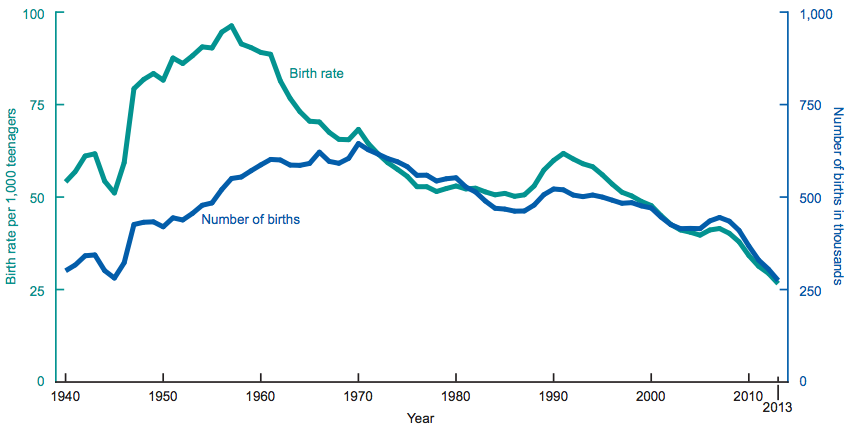
According (pdf) to the CDC:
Jason Millman unpacks the news:
Though the United States lags behind other countries, the CDC says the progress made since 1991 has amounted to 4 million fewer teen births. Citing research from the National Campaign to Prevent Teen and Unplanned Pregnancy, the CDC says this also saved taxpayers an estimated $12 billion alone in 2010 from costs associated with government-funded health care, child welfare and higher incarceration rates of teen moms. And having fewer babies born to teen mothers, the CDC points out, is good for other reasons. Teen motherhood comes with a higher health risk for the baby, educational limits for the mother and limited resources, since about 90 percent of teen births are to unmarried mothers. And babies born to teen mothers are more likely to eventually become teen mothers themselves.
Tara Culp-Ressler has more details:
The steepest declines in the teen birth rate appear to be occurring in the areas where it’s historically been the highest. Southern states — where the teen pregnancy rate has beensignificantly higher for years — have seen the largest drops, although there’s still a noticeable disparity between states in the South and states in the Northeast. Similarly, while teen births have declined across all racial groups, they’ve recently fallen the fastest among Hispanic women, who currently have the highest rate.
But what caused the decline? Jordan Weissmann addresses the question:
For its part, the CDC cites one telling paper from the American Journal of Public Health. Using government survey data on adolescent sexual behavior, it concluded that 86 percent of the decline in teen pregnancy between 1995 and 2002 could be chalked up to increased contraception use; the other 14 percent was due to abstinence. “The decline in U.S. adolescent pregnancy rates appears to be following the patterns observed in other developed countries, where improved contraceptive use has been the primary determinant of declining rates,” the researchers wrote.
Kliff concludes that maybe we’ve “just gotten lucky”:
It’s not an especially scientific answer, but it’s one that seems to describe how teen pregnancy researchers view the dramatic slowdown in the birth rate: a collision of lots of trends that all serendipitously happened in the late 2000s and early 2010s.
The recession, the uptick in IUD use, a hit MTV show that deglamorized teen pregnancy — each of these factors could have have caused a small decline on their own. Taken together, it’s possible they caused a much bigger change.
And if that is the case, that doesn’t portend especially well for the fast decline continuing.
Harry Enten thinks it has been greatly exaggerated:
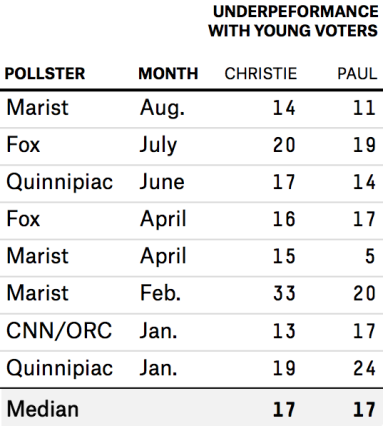
Since the beginning of the year, there have been eight live-interview national polls that detail results among young voters (ages
18 to 29 or 18 to 34), and matched Paul against former Secretary of State Hillary Clinton. Together, these polls give us the views of more than 1,000 young voters. The same polls matched Clinton against Christie. The surveys show that young voters don’t see any difference between Paul and other Republican politicians. …
The median of the eight surveys shows that among young voters, Paul trails by 17 percentage points more than he trails among all voters. That would represent a slight improvement over Romney, who lost young voters by 20 points more than he did voters overall. Still, Paul’s and Romney’s relative performances with young voters are within the margin of error of each other.
Ponnuru points out that Paul’s performance with young voters was underwhelming when he won his Senate seat:
Maybe Paul would do better with young voters as the Republican nominee in 2016 than any of the other possibilities. He makes a plausible case that his brand of politics — skeptical of military intervention, the drug war and domestic surveillance — ought to find favor with them.
In its one electoral test so far, though, Paul’s brand of Republican politics has done roughly the same as the generic version.
Chait adds:
Paul and his allies have won quite a propaganda coup by implanting the notion that he offers a unique appeal to the youngest voters. (Buoyed by the Times Magazine endorsement, and undaunted by the gaping holes in its data, Reason is plunging ahead with its predictions of the libertarian future.) It could happen. There is no reason to think it will.
It’s absurdly expensive:
It costs approximately $249,930 on average for a two-parent, middle-income family to raise an American child from birth until age 18, according to a Department of Agriculture report released on Monday. The data were adjusted for inflation for 2013, and they ultimately show that child-rearing prices have skyrocketed more than many people imagined over the course of the last half-century. The report considers the costs of housing and utilities, food, transportation, clothing and diapers, healthcare expenses, childcare and education, as well as “miscellaneous costs” such as entertainment and personal care products. As Think Progress notes, the report conspicuously fails to include birth-related costs or the costs of lost time, earnings and opportunity that many people give up (overtly or not) by deciding to have kids. Additionally, the report fails to consider the cost of college, which costs parents approximately $30,000 to $40,000 per year.
Josh Zumbrun throws some cold water:
[A] closer look at the methodology casts some of the numbers in a new light.
The report calculates the cost of housing by looking at the expense of buying a home with an additional bedroom. If you’d otherwise planned to live in a one-bedroom condo your entire life, this is an extra cost. But if you planned on buying a 3 or 4 bedroom house anyway, this is not really an additional expense of parenthood. That extra bedroom assumption alone accounts for $4,000 a year in expenses, or about $73,000 of the cost of raising a child until age 18.
The cost of some transportation and other miscellaneous items are calculated on a per-capita basis, in the estimate. So if there’s two parents and a child, spending $3,000 on some item, then $1,000 of that is assumed to go to the child. That assumption may or may not be applicable for your family.
Regardless, McArdle remarks that the “last 50 years have seen a massive shift away from the basic expenses of keeping your kid alive and toward competitive expenses”:
If your kids go to school with other kids who aren’t wearing thrift-school clothing, they’ll be made fun of. They’ll learn to long for all the new toys the other kids have. They’ll want to join expensive activities, and you’ll want to get them tutoring and enrichment programs to increase their shot at getting into a good school. You certainly won’t want to cram them into a three-bedroom house. In other words, raising kids cheaply is only possible if you think there’s something even more important than socializing and getting a good education – or if you’re so poor that you simply lack the cash to help your kids compete in our society’s various status competitions.
Kyle Chayka focuses on the inequality angle:
Structural inequality is growing in the U.S., a fact acknowledged across the political spectrum. But few statistics illustrate that fact as starkly as a graph of how much the highest-income families can spend on their children versus the lowest-income families in a single year. A household earning above $106,540 was able to spend more than double the amount spent by those earning less than $61,530, particularly for young children. When the kids become teenagers, the spending of high-income families also grows faster than the other groups, reaching $25,000, as compared to $15,000 in the middle range and around $10,000 at the bottom.
Yet even that increased spending is less of a burden on wealthier families, who spend the lowest percentage of their income on their children (as measured before taxes). The lowest-income group spent 25 percent of their income on a child, while the middle-income group spent 16 percent and the top bracket just 12.
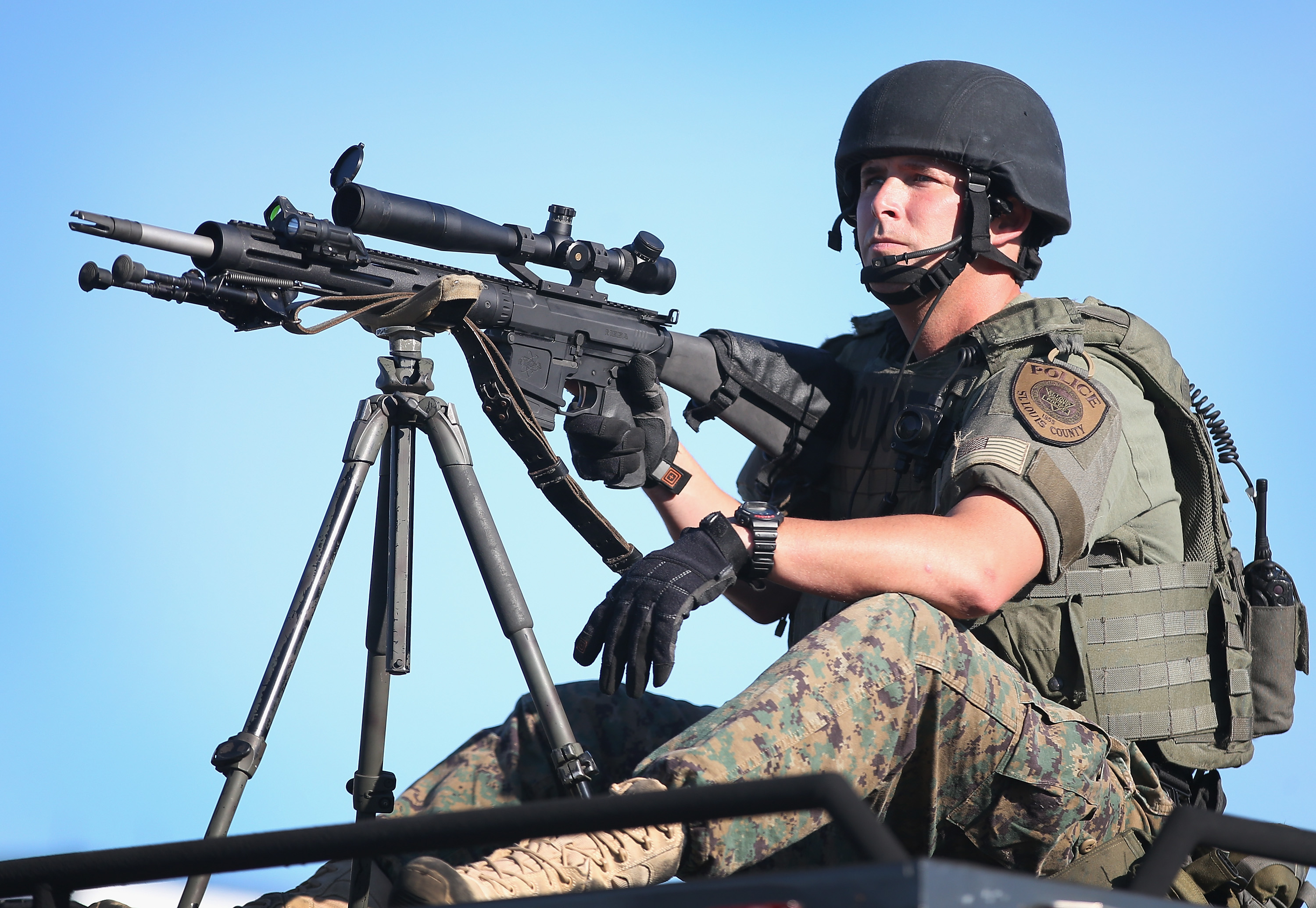
Amanda Taub spells out why militarized small-town police are especially dangerous:
When the ACLU asked officials in the town of Farmington, Missouri (less than a 90 minute drive from Ferguson) to provide a copy of training materials for its Special Response Team, which is roughly like a SWAT team, the town sent only a copy of a single article. The article warned that “preparations for attacks on American schools that will bring rivers of blood and staggering body counts are well underway in Islamic training camps,” and went on to say that “because of our laws we can’t depend on the military to help us … By law, you the police officer are our Delta Force.”
In contrast, SWAT programs in larger cities tend to train extensively, and constantly. The Los Angeles police department’s SWAT teams go through months of intensive training before being brought on, and once there spend at least fifty percent of their on-duty time training, former LAPD Deputy Police Chief Stephen Downing told me. It is effectively impossible, Downing suggested, for small police departments to appropriately train their officers in the use of SWAT-style equipment, because they simply do not have sufficient resources or personnel. Small departments simply do not have the resources to support that type of program, but they do have the guns and trucks and armor, which they use.
Taub also runs down some of the military equipment the Ferguson cops are using:
Mine Resistant Ambush Protected Vehicles, or MRAPs, are heavily armored trucks designed to withstand the detonation of land mines or IEDs. They were first deployed by the US military in 2007, designed specifically for use in Iraq, where al-Qaeda and Iranian-backed Shia militias were using highly developed IEDs. Now the vehicles are being passed down to police departments.
Asked why MRAPS were being used in Ferguson, a place with neither land mines nor IEDs, Ferguson police chief Tom Jackson replied that “people are using bombs now.” However, there have been no reports of bombs being used in Ferguson — he may have been making an existential point about bombs being items that exist in the world.
Gene Healy previews the ghastly dystopian crowd-control weapons DHS is working on:
A Homeland Security report obtained by the Electronic Frontier Foundation in 2013 revealed that the agency has considered outfitting its expanding inventory of drones with “non-lethal weapons designed to immobilize” targets of interest. Meanwhile, both Homeland Security and the Pentagon maintain a keen interest in developing crowd-control weapons for occupations at home and abroad. In 2007, the department’s science and technology arm “contracted for the development of the ‘LED Incapacitator,’ a nauseating strobe” weapon meant to overwhelm and disorient targets with rapid, random pulses of light.
Some have called it the “puke saber,” but the final product won’t necessarily be handheld. As the department noted in a cutesy blogpost entitled “Enough to Make You Sick,” “output and size can easily be scaled up to fit the need; immobilizing a mob, for instance, might call for a wide-angle ‘bazooka’ version.”
(Photo by Scott Olson/Getty Images)
Lanre Akinsiku shares what it’s like:
To be black and interact with the police is a scary thing. The fear doesn’t have to come from any kind of historical antagonism, which, trust me, would be enough; it can also come from many data points of personal experience, collected over time. Almost all black men have these close-call-style stories, and we collect and mostly keep them to ourselves until one of us is killed. You know how the stories go: I was pulled over one day and the cop drew his gun as he approached my window; I was stopped on the street, handcuffed and made to sit on the sidewalk because the cop said I looked like a suspect; I had four squad cars pull up on me for jaywalking. We trade them like currency. And it almost goes without saying that these stops are de facto violent, because even when the officer doesn’t physically harm you, you can feel that you’ve been robbed of something. The thing to remember is that each of these experiences compounds the last, like interest, so that at a certain point just seeing a police officer becomes nauseating. That feeling is fear.
Relatedly, Coates recalls, “A few weeks ago I received an anxious text from my wife informing me that a group of young men were fighting outside of our apartment building”:
My wife wanted to know what she should do. She was not worried about her own safety—boys like this are primarily a threat to each other. What my wife wanted was someone who could save them young men from themselves, some power which would disperse the boys in a fashion that would not escalate things, some power. No such power exists. I told my wife to stay inside and do nothing. I did not tell her to call the police. If you have watched the events of this past week, you may have some idea why.
Among the many relevant facts for any African-American negotiating their relationship with the police the following stands out: The police departments of America are endowed by the state with dominion over your body. This summer in Ferguson and Staten Island we have seen that dominion employed to the maximum ends—destruction of the body. This is neither new nor extraordinary. It does not matter if the destruction of your body was an overreaction. It does not matter if the destruction of your body resulted from a misunderstanding. It does not matter if the destruction of your body springs from foolish policy. Sell cigarettes without proper authority and your body can be destroyed. Resent the people trying to entrap your body and it can be be destroyed. Protect the home of your mother and your body can be destroyed. Visit the home of your young daughter and your body will be destroyed. The destroyers of your body will rarely be held accountable. Mostly they will receive pensions.
Matt Zoller Seitz, who is white, got into a fight with a hispanic man in front of a local deli. The cops took his side:
I said, “Oh, no, he didn’t hit me first. He poked me in the chest.”
“That’s assault,” my cop said. “He hit you first.”
“I don’t think he actually meant to touch me, though,” I said, while a voice deep inside me said, Stupid white boy, he’s making it plain and you’re not getting it.
“It doesn’t matter if he meant to touch you, he hit you first,” he said. He was talking to me warmly and patiently, as you might explain things to a child. Wisdom was being imparted.
“You were in fear of your life,” he added.
By now the adrenaline fog seemed to be lifting. I was seeing things in a more clinical way. The violence I had inflicted on this man was disproportionate to the “assault,” and the tone of this exchange with the cop felt conspiratorial.
And then it dawned on me, Mr. Slow-on-the-Uptake, what was really happening: this officer was helping me Get My Story Straight.
His takeaway:
I’ve never been profiled. I’ve never been stopped and frisked. I’ve never experienced anything of the sort because of the gift that my parents gave me, and that my son’s parents gave him: white skin. I’ve had encounters with police, mostly during my youth, in which I’d done something wrong and thought I was about to get a ticket or go to jail but somehow didn’t, because I managed to take back or apologize for whatever I’d said to a cop in petulance or frustration; these encounters, too, would have likely gone differently, perhaps ended differently, if I hadn’t been white.
Again, I already knew this stuff. But after that night in front of the deli, I understood it.
The tweet above is from Shirin Barghi’s elegant and powerful series on the last words of people shot by police.
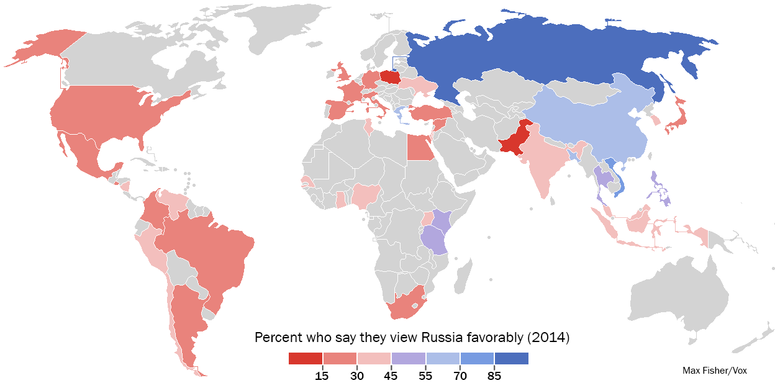
Max Fisher highlights a Pew study (pdf) released last month that documents attitudes toward Russia in countries around the world. As you can see from the map, the erstwhile superpower is not very well liked at the moment:
Russia is most unpopular in Poland, which, as a long-suffering Soviet puppet state, is exceptionally alarmed about Russia’s recent invasion of Crimea and its sponsorship of separatist rebels in eastern Ukraine. In Poland, only 12 percent say they have a favorable view of Russia, with 81 percent holding an unfavorable view. The rates are not much higher in the rest of Europe, which is part of why European leaders are becoming much more willing to impose tough sanctions on Russia, even at some cost to European economies.
But Russia is also deeply unpopular in the Middle East.
This is most true in Turkey, where only 16 percent hold a favorable view of the country, with 73 percent holding an unfavorable view. This may be a result of Russia’s sponsorship of Syrian leader Bashar al-Assad, who has been able to get away with slaughtering thousands of civilians in that country’s civil war in part because Moscow shields him from international action.
Jan Cienski zooms in on how Eastern European countries, most of which are notably absent from the Pew report, are responding to Putin’s aggression in Ukraine—or not responding, as it were:
Despite their common experience of spending a half-century under Moscow’s heel as part of the Soviet bloc, it has proven impossible for Poland to forge a regional alliance against Russia. Some countries are awake to the danger of Russian tanks and green-uniformed troops appearing on their own borders; others are still keen to cut commercial deals that require being in the country’s good graces.
“The Hungarians are still conducting a policy of rapprochement with Russia. The Czechs don’t care what is happening in Eastern Europe. The Bulgarians first joyfully accept, then doubt, then again accept [Russian proposals for the South Stream, a new natural gas pipeline running through Bulgaria to Southern Europe],” said Roman Kuzniar, national security advisor to Polish President Bronislaw Komorowski, in a recent radio interview. “The Baltic countries also do not have a common front. That shows how easily we are divided, even among countries which have a heightened geopolitical awareness.”
Michael Bond criticizes American crowd-control techniques:
One of the most worrying aspects of this drama is what it reveals about US crowd-control methods. In Europe, many police forces have started to accept that the traditional model of public-order policing, which treats all crowds as potentially dangerous, often makes things worse. This model dates back to the French Revolution, which seeded the idea that crowds turn people into primitive, dysfunctional automata, and that the only way to deal with protestors is to attack, disperse or “kettle” them – a draconian form of containment.
Such tactics are slowly being abandoned in Europe because social psychologists have demonstrated time and again that they can have a dramatic and often catastrophic effect on how people in crowds behave. They have found that the way a protest is marshalled has a greater influence on whether it ends peacefully or violently than the actions of any hooligan minority within the crowd. This puts the police in a powerful position, even before they take aim with rubber bullets or tear gas.
He argues that Europe has this figured out. Matt Steinglass finds that Europe is transfixed by the events in Ferguson. One reason why:
The confrontation in Ferguson, as many observers have noticed, looks uncannily like the ones in Ukraine, Gaza and Iraq. There is clearly some kind of a global blowback going on, in which military techniques of forcible population control developed for use at the periphery of states’ areas of sovereignty are now being applied at the centre. Leonid Bershidsky, a brilliant Russian journalist and editor, laid out the similarities in a fascinating column yesterday in Bloomberg View. “Police officers around the world are becoming convinced they are fighting a war on something or other, whether that’s drugs, terrorism, anarchists or political subversion,” Mr Bershidsky writes. “This mindset contrasts with the public’s unchanged perception of what the police should be doing, which is to keep the streets safe, a conceptual clash that can lead to unexpected results.”
The difference between these two kinds of policing, Mr Bershidsky writes, can be modeled as the division between the London Metropolitan Police Force established in 1829, which conceived itself as fighting crime in concert with the populace, and the repressive colonial police forces the British Empire employed in “colonies of rule” such as Ireland and India, who conceived of themselves as keeping potentially hostile local populations in line.
 The Dish