Perry Gets His “Gate”

by Dish Staff

On Friday, a grand jury in Travis County, Texas indicted governor Rick Perry on charges of abuse of official capacity and coercion of a public servant after he threatened to veto funding for a government oversight program, allegedly to pressure the Democratic DA who ran it into resigning, and subsequently made good on the threat:

A special prosecutor spent months calling witnesses and presenting evidence that Perry broke the law when he promised publicly to nix $7.5 million over two years for the public integrity unit run by the office of Travis County Democratic District Attorney Rosemary Lehmberg. Lehmberg was convicted of drunken driving, but refused Perry’s calls to resign. … The unit Lehmberg oversees is the same that led the investigation against former U.S. House Majority Leader Tom DeLay, a Texas Republican who in 2010 was convicted of money laundering and conspiracy to commit money laundering for taking part in a scheme to influence elections in his home state.

The emerging consensus among legal and political commentators is that the indictment is entirely specious. Eugene Volokh lays out the many reasons why:

[T]he Texas Constitution expressly reserves the veto power to the governor. The governor is entitled to decide which laws he “approv[es]” and which he disapproves — without constraint from the legislature, or from county-level district attorneys. The legislature certainly can’t make it a crime for the governor to veto its appropriation bills; that would deny the governor the power that the Texas Constitution gives him.

Nor can the legislature make it a crime, I think, for the governor to veto its appropriation bills as an attempt to influence some government official’s behavior — behavior that is commonplace in the political process, and that is likewise within the governor’s exclusive power to decide which bills to give his “approval.” To be sure, the legislature can make it a crime for the governor to accept bribes in exchange for a veto; but there the crime is the acceptance of the bribe, not the veto itself.

Chait calls it “unbelievably ridiculous”:

The prosecutors claim that, while vetoing the bill may be an official action, threatening a veto is not. Of course the threat of the veto is an integral part of its function. The legislature can hardly negotiate with the governor if he won’t tell them in advance what he plans to veto. This is why, when you say the word “veto,” the next word that springs to mind is “threat.” That’s how vetoes work. The theory behind the indictment is flexible enough that almost any kind of political conflict could be defined as a “misuse” of power or “coercion” of one’s opponents. To describe the indictment as “frivolous” gives it far more credence than it deserves. Perry may not be much smarter than a ham sandwich, but he is exactly as guilty as one.

But Alec MacGillis argues that the charges, though unlikely to hold water, are illustrative of how Perry operates:

[R]egardless of how strong the charges against Perry are, it is worth noting how fitting they are. Put simply, the case against Perry points to an aspect of his political persona that is well known in Texas but has too often been overlooked in the national portrayal of Perry. On the national stage, Perry is alternately depicted as a hardened ideologuethe states’ rights gunslinger who openly flirted with secessionand as a bumbling buffoon who watched his high-octane 2012 presidential campaign flame out in a moment of debate-stage befuddlement. Both of these caricatures miss Perry’s essence. As I argued in a 2011 profile of him for this magazine, Perry is both more conniving and less ideologically-motivated than the national perception of him would have one believe. He is, at heart, a political operator and a striver who has wielded the many levers of power available to him as governor of the second largest state less to advance a coherent conservative agenda than for his own aggrandizement and that of his cronies.

But then, he’s not the only one. The indictment itself is a crystal-clear case of politics in the courtroom, as the Bloomberg View editors lament:

This would be ordinary partisan tit for tat, except that a law enforcement office is involved. Political disputes should be resolved in political venues — legislative bodies and public debates — not in criminal courts. If Perry’s veto is an abuse of power, then the state legislature could impeach him, as it did Texas Governor James “Pa” Ferguson nearly 100 years ago. Impeachment, however, is entirely unnecessary: The legislature could simply vote to override Perry’s line-item veto. For failing to do so, should the entire legislature be indicted? Of course not. Perry is guilty of partisan behavior, not felonious conduct.

Ross Ramsey raises the question of how the indictment might affect Perry’s ambitions in 2016:

This job is ending, but the governor is at the beginning of his next run for office, and the indictment is national news, like Chris Christie’s bridge. The governor’s supporters blame Democratic politics — Travis County is liberal, and the prosecutors are hard on Republicans, they say — but this is catnip for other Republicans. Perry isn’t competing with Democrats, but with other Republicans for the chance to compete with the Democrats.

Maybe his lawyers can get the indictment snuffed before there is a trial. Maybe there will be a trial, and a jury will find nothing criminal has taken place. Meanwhile, the governor and others are already haunting Iowa, the home of the first presidential primaries almost two years from now. This indictment could be to the Perry presidential campaign what a sewer leak is to the opening of a new restaurant: The food might not be the diners’ strongest memory of the meal.

But Harry Enten and Walt Hickey cast some doubt on that suggestion:

A lot of reporters and pundits will spend the next several weeks trying to answer that question, but the truth is we won’t know for quite some time. It looked like Perry would have had a difficult time capturing the nomination even before Friday’s indictment. According to recent polls by NBC/Marist, Perry was at 7 percent in Iowa and 5 percent in New Hampshire. His Iowa numbers are especially depressed from where he was polling when he first declared his candidacy in 2012.

Perhaps more importantly, Perry’s repeated gaffes in 2012 would have made it difficult for the GOP establishment to support him again in 2016. As we’ve noted in the past, establishment support (or at least a lack of opposition) is key to winning a Republican primary. It’s one of the reasons Newt Gingrich lost in 2012. The establishment wants to nominate electable candidates. Perry’s past missteps and misstatements may have rendered him unacceptable to Republican power brokers.

Suicide Leaves Behind Nothing, Ctd

by Dish Staff

A few more readers share their stories:

A close friend – also a funny, intelligent, well-liked guy – killed himself four years ago. One of his (and my) best friends said at his memorial:

Bob was one of the smartest people I ever met. He never did anything without thinking all the way through. I hate his last decision and I don’t agree with it, but I have to believe that he did the right thing – for Bob.

This was a revelation for me. I think when we speak about suicide as a failure of ego, or the end of a losing battle, or a selfish choice, etc. we do a dishonor to the dead. Bob did a thing he chose to do: suicide is a conscious act. In denying the logic of that act we deny the dead the very last agency they had.

I know there are biochemical reasons for depression and in that sense we can say a suicidal person lacks volition, but this seems even harsher to me:

not only can a depressive not control their emotions or thoughts, they can’t control their behavior. Perhaps they can’t, but how does it help them to remind them of the fact? Are they zombies? If they were “fighting” depression, is this how they’d want to be remembered: the depression “won?” A suicidal person is making a choice, and it’s usually not a choice about us, the survivors.

In circumstances where someone seizes the reins of their own death deliberately, publicly, and without the stain of depression – living wills, advance directives, hospice care, denying care, assisted suicide – we don’t beat our chests about their selfishness. Indeed we rarely use the word “suicide,” and often speak about their “brave choices.” People usually disagree about these choices as well, but they seldom deny that the person making them has the appropriate agency to do so. The difference is striking.

Another reader quotes John Tabin:

Those who’ve never been suicidal may not realize how hollow the insistence that “there’s always hope” can sound.  The very essence of depression is the absence of hope.

In my own experience, it’s worse than that.  It’s the conviction that hope itself is poisonous.  That it’s a lie you have to burn your insides to tell yourself.  That it’s every bit as big a lie as hopelessness.

On a different note, another thing people don’t understand about severe depression is that it’s a physical experience.  Aside from the lack of energy, which seems to be universal, the physical aspect is different for different people.  For some people I’ve known, depression physically hurts.  For me, it takes the form of a hollowness in the stomach.  At my worst, in the bout that eventually led to my diagnosis, I could not eat at all.  The very idea of food made me sick.  I ended up in the hospital with an IV, having all sorts of tests done, and losing 20% of my body weight.  It was months before I could eat any but the blandest of foods.

Severe depression is both mentally and physically exhausting.  You just have nothing left for anybody.  No intelligence, no humor, no counsel, no sympathy, no love, no hate, no words, no nothing.  Those things belong to persons, and you have no personhood left.  You are an empty sieve.

Whenever I hear people say suicide is the most selfish act a person can take, I just shake my head.  By the time a “person” has reached the point of realizing — not “thinking,” because that’s not how they experience it —realizing existence is meaningless hurt for which the only solution is nonexistence and they can no longer stand the pain, they have no personhood left.  There’s only the most tiny and shriveled remnants of a self in there: a desiccated pea in an empty cavern.

It’s not selfish at all.  Not in any sense in which we use the word, anyway.

Read the whole thread on depression and suicide here.

Holding Cops Accountable

by Dish Staff

Michael Bell’s powerful article on the shooting of his son demonstrates just how hard it is:

I have known the name of the policeman who killed my son, Michael, for ten years. And he is still working on the force in Kenosha.

Yes, there is good reason to think that many of these unjustifiable homicides by police across the country are racially motivated. But there is a lot more than that going on here. Our country is simply not paying enough attention to the terrible lack of accountability of police departments and the way it affects all of us—regardless of race or ethnicity. Because if a blond-haired, blue-eyed boy — that was my son, Michael — can be shot in the head under a street light with his hands cuffed behind his back, in front of five eyewitnesses (including his mother and sister), and his father was a retired Air Force lieutenant colonel who flew in three wars for his country — that’s me — and I still couldn’t get anything done about it, then Joe the plumber and Javier the roofer aren’t going to be able to do anything about it either.

Ed Krayewski criticizes how “none of the establishment activists who have attached themselves to the situation in Ferguson seem to be doing anything to focus people’s attentions on the systemic problems behind police brutality, starting with the propensity of most fatal police shootings to be ruled justified in a process shrouded in government secrecy and privilege”:

We shouldn’t have to read these kinds of stories and speculate about what happened, there ought to be a transparent process trusted by the public that can come to an understandable conclusion, whether you end up agreeing or not.

 Instead, cops and prosecutors act almost like a team during investigations of police shootings—it shouldn’t be surprising given that they do operate as a team in pretty much every other part of their jobs. And police generally control the narrative of a shooting, painting themselves in the most positive light possible and victims in the most negative light possible. Without an engaged national media they often get away with it.

Suderman examines Missouri’s standard for deadly force:

So, the suspect doesn’t have to be armed, and doesn’t even have to present an immediate threat. Instead, if an officer believes that there’s no other way to make the arrest happen, and also believes that the suspect has attempted to commit a felony, the officer is justified in using deadly force. If a cop wants to arrest someone, and has a “reasonable” belief that the person has even tried to commit a felony, he or she is allowed to kill.

That seems like a rather lax standard, and one that would give a pass to practically any arresting officer who could plausibly claim to have believed that the suspect had attempted or committed a felony offense.

LaDoris Hazzard Cordell wants more restrictions on the use of force:

First, police departments must broaden the definition of reasonable use of force. In 1989 the U.S. Supreme Court in Graham v. Connor defined the reasonable use of force as force “judged from the perspective of a reasonable officer on the scene, and its calculus must embody an allowance for the fact that police officers are often forced to make split-second decisions about the amount of force necessary in a particular situation.” That definition has been interpreted narrowly by law enforcement agencies across the country to mean that the reasonableness of the force is limited to an examination of only the amount of force used in the moment. The conduct of officers right before the use of force is never examined. Under this definition, officers who provoke individuals and officers who escalate situations get a pass.

The definition of what constitutes the reasonable use of force must be expanded to include the circumstances leading up to the use of force, so that the inquiry into the misconduct sweeps in whatever the officer did prior to the decision to  use force, along with the conduct of the victim.

Max Ehrenfreund considers what Obama should do:

Thursday, Rep. Hank Johnson (D-Ga.) proposed a bill that would prohibit the Pentagon from transferring some military-grade equipment under this program. Obama doesn’t have to wait for Congress, though. In the meantime, he has at least two options: instruct the Pentagon to to keep more of its armored vehicles and automatic weapons to itself, and require applicants for Homeland Security grant money to report more precisely how they use the funds.

But Waldman expects such steps to have a relatively minor impact:

The militarization of the country’s police forces is something that has been growing for a couple of decades, fueled first by the War on Drugs and then by the insane idea that the police in every hamlet in every corner of the country needed to be able to wage battles against Al Qaeda strike teams. Congress could turn off the spigot that pours this equipment into these communities, but unless the federal government starts repossessing the equipment it already distributed (highly unlikely, to say the least), police departments all over the country will still be awash in military gear.

And that’s the biggest challenge: the problems the Ferguson case highlights are widely distributed, through thousands of police departments and millions of interaction between cops and citizens. The federal government can respond in a limited way to what we’ve all seen, but its actions will go only so far.

Ferguson From Abroad

by Dish Staff

National news in the US is world news everywhere else, and the continued chaos in Ferguson, MO, is drawing some international attention, including a brief Twitter lecture from the Iranian Supreme Leader on America’s moral bankruptcy. Zack Beauchamp finds that more than a little ironic:

The Iranian government itself does not treat minorities particularly well. Take Iran’s Kurds, for example. About 6.5 million Kurds live in western Iran, but not in peace. A 2009 Human Rights Watch report documents widespread restrictions on Kurdish free speech (like banning books), denial of due process rights to Kurds suspected of political dissidence, and torture of Kurdish detainees. Dozens of Kurds are on death row, often convicted of political offenses.

But here’s the catch: Khamenei, awful as he may be, still has a point about Ferguson. Despite the staggering hypocrisy of his tweet, he’s correct that the police conduct in Ferguson is unconscionable and racist. The United States doesn’t, or shouldn’t, want human rights-abusing enemies to be able to point to things like this to whitewash their own abuses.

It’s not just Iran, either. Josh Kovensky takes note of how Ferguson is being covered in the Russian media:

An RT article, “Protests Against Police Tyranny have Spread Across the Main Cities of the USA,” suggested that the nation is on the brink of chaos as the “rage of Americans … spreads across the entire country.” Sputink i Pogrom, a nationalist newsmagazine, tweeted out, “What do you think? Should Russia grant Obama asylum in Rostov after the Ferguson Maidanites occupy Washington?” And Svobodnaya Pressa, a popular Russian news website, ran an article calling the Ferguson protests “AfroMaidan,” in reference to Euromaidan protests in Kiev, Ukraine, earlier this year. 

In that Svobodnaya Pressa article, Sergei Bespalov, the docent of the humanities division of the Russian Academy of Agriculture and State Service, attributes the events in Ferguson in part to the “fact” that white Americans have “prejudice towards African-Americans … in their blood.” Bespalov predicts further unrest, adding that “if [Obamacare] is cancelled, this could … provoke racial conflicts,” and that “a significant part of African-Americans and Latinos could perceive [Obamacare’s cancellation] as a challenge from the white majority.”

This coverage harkens back to the way Ameircan racism was portrayed in Soviet propaganda during the Cold War, Karoun Demirjian adds:

The United States’ problems with racism have long been a favored topic for Russians, dating back to the heyday of the Soviet Union. During the 1920s and 1930s, Soviet leaders pointed to the existence of Jim Crow laws in the United States as a way of asserting the moral superiority of the Soviet Union. Racism, which was illegal in the Soviet Union, was deemed a systematic byproduct of capitalism. In the civil rights era, especially, the Soviet Union used American anti-black racism as fodder to challenge the United States’ claims to leadership of the “free world.”

Soviet and modern-day Russia alike have had their own problems with racism as well, of course – to the point where Russia was recently rated by one publication as one of the worst countries for people of color to travel in. But that stigma doesn’t cause the Russian government to pull any punches with the United States over the situation in Ferguson – or to refrain from using it as an opportunity to highlight America’s race problems to their fullest extent.

In light of this international scrutiny, Max Fisher’s tongue-in-cheek “if it happened there” version of the Ferguson story is particularly relevant:

Missouri, far-removed from the glistening capital city of Washington, is ostensibly ruled by a charismatic but troubled official named Jay Nixon, who has appeared unable to successfully intervene and has resisted efforts at mediation from central government officials. Complicating matters, President Obama is himself a member of the minority sect protesting in Ferguson, which is ruled overwhelmingly by members of America’s majority “white people” sect.

Analysts who study the opaque American political system, in which all provinces are granted semi-autonomous self-rule, warned that Nixon may seize the opportunity to move against weakened municipal rulers in Ferguson. Missouri’s provincial legislature, a traditional “shura council,” is dominated by the opposition faction. Though fears of a military coup remain low, it is still unknown how Nixon’s allies within the capital will respond should the crisis continue. Now, international leaders say they fear the crisis could spread.

How We Turned Our Cops Into Soldiers

by Dish Staff

The NYT has a great visualization on the surplus military gear being funneled to police departments. Here is one map, of several:

Assault Rifles


Shirley Li provides background on the 1033 program, the “Department of Defense initiative that channels surplus military equipment to state and local police departments.”:

The 1033 program reached as far as it did because of its attractive promise of sophisticated military-grade equipment and easy access, Cato Institute Project on Criminal Justice Director Tim Lynch told The Wire. “Police in these small police departments, they go to their chief and say, ‘Look, the Pentagon’s going to give away this equipment. If we don’t grab it now, the next county will. We need it just in case,'” Lynch said. “No police chief will say no, so they acquire it and put it in a warehouse so most people, even people in the city council, aren’t aware of it.” …

“I think the 1033 program should be shut down,” he told The Wire. “I think that will restore some common sense to these agencies around the country because when they have to spend their own money, it changes the dynamic. They have to decide whether they need a new police car or a new officer or an armored vehicle from the Pentagon.”

Ingraham looks at how the wars have put the program on steroids:

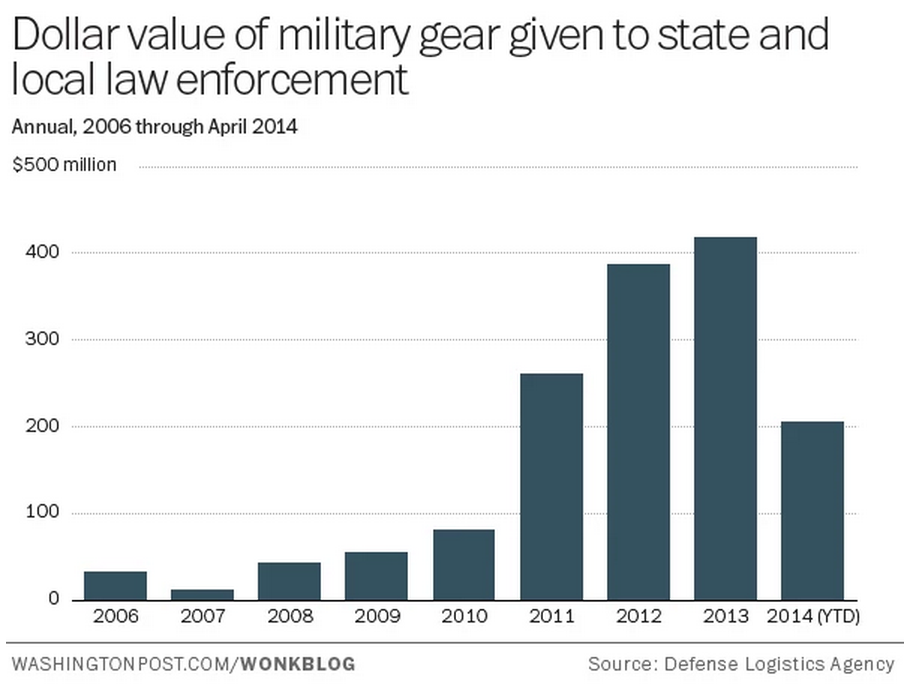
In 2006, the Pentagon transferred roughly $33 million worth of goods to local agencies. By 2013 that number had risen more than tenfold, to at least $420 million. Much of this can be explained by the winding down of wars in Iraq and Afghanistan. As those missions ended, more surplus goods became available for domestic use.

Military Gear

In 2012 the Pentagon transferred 27 mine-resistant vehicles and other armored combat vehicles to local law enforcement agencies. That number jumped more than sevenfold the following year. In 2014 so far, heavy armored combat vehicles account for nearly half of the total dollar value of gear transferred to local agencies.

Annie Lowrey explains why the police were militarized:

It all starts back in 1990, a time when the country found itself with less demand for military equipment abroad and new use for it back home. Within our shores, the drug wars were escalating; gang violence was surging; and sociologists were warning of sociopathic child “superpredators.” At the same time, the military was starting to shrink as the Cold War ended. Put two and two together and you get the 1033 program, which transferred assets from the military to the police. (Here’s a capsule history.) … But here’s the thing. Since 1990, according to Department of Justice statistics, the United States has become a vastly safer place, at least in terms of violent crime.

Drum adds:

We’ve spent the past two decades militarizing our police forces to respond to problems that never materialized, and now we’re stuck with them. We don’t need commando teams and SWAT units in every town in America to deal with either terrorism or an epidemic of crime, so they get used for other things instead. And that’s how we end up with debacles like Ferguson.

Police militarization was a mistake. You can argue that perhaps we didn’t know that at the time. No one knew in 1990 that crime was about to begin a dramatic long-term decline, and no one knew in 2001 that domestic terrorism would never become a serious threat. But we know now. There’s no longer even a thin excuse for arming our police forces this way.

Ezra joins the conversation:

Police get all this equipment and, as a condition of the program, need to use it within a year. What they don’t get is training. The ACLU’s Kara Dansky, who authored an important report on police militarization, told Vox she was “not aware of any training that the government provides in terms of use of the equipment,” or of “any oversight in terms of safeguards regarding the use of the equipment by the Defense Department.”

So police have all this military equipment, very little training on how to use it, and a requirement that they deploy it within a year. But the problems they were supposed to use the equipment against have either eased or vanished.

Ken Snyder, a reader over at Rod Dreher’s place, spotlights the role that the public has played:

[T]he important point is that I think this is what we citizens wanted. We want the police to be ready and able to deal with terrorists and active shooters. So these are the police that we want, but only in very specific situations. So citizens are shocked to see that equipment and, if not tactics, that same mindset applied in situations like Ferguson, and the many examples that are shared across web sites and local media. But once the police have this equipment, training, and mindset, as a practical matter, the citizens of a particular community don’t get to decide when they utilize it. We leave that up to the ‘experts’ who have ‘all of the information’. I think in some ways this is just another facet of the ongoing discussion in our country about NSA spying, etc: we want security, but at what price?


ISIS Driven Out Of Mosul Dam

by Dish Staff

US airstrikes have helped Kurdish forces recapture the Mosul Dam area from ISIS militants:

“Mosul Dam was liberated completely,” Ali Awni, an official from Iraq’s main Kurdish party, told AFP, a statement confirmed by two other Kurdish sources. Early in the day US aircraft, for the first time including land-based bombers, carried out 14 strikes. Later, US Central Command confirmed further strikes had been carried out by “fighter and attack aircraft”.

In a letter to Congress, outlining the rationale and justification for the strikes, Obama said the integrity of the dam was crucial to the security of the US embassy in Baghdad. The US has consistently cited the security of US personnel in Baghdad as cover for its military operation to support the Kurds. Sunday’s first strikes were the first time that bombers as well as fighter jets and drones had been involved in the current air campaign, which began on 8 August alongside drops of humanitarian aid to Yazidi refugees marooned on Mount Sinjar.

If these reports are accurate, they come as a huge relief, considering the mass destruction the jihadists could cause by blowing the dam up. But Azam Ahmed adds (NYT) that ISIS’s mines are still barring access to the dam itself:

 A commander for the Kurdish pesh merga forces in the area, Gen. Omer Ibrahim, said that ISIS fighters had abandoned the dam complex and retreated to a nearby front. But the complex itself was heavily mined, meaning the pesh merga could not fully enter it and prolonging the push to fully occupy the dam. … Although a series of American airstrikes on ISIS positions near the dam had allowed Kurdish forces to reclaim nearby villages and to approach the area, Kurdish officers said the militants had slowed the progress of the military forces by planting roadside bombs.

This CENTCOM statement also appears to imply that the battle is still ongoing:

Bobby Chesney comments on the legal justification the administration is giving for our involvement:

Both humanitarian and force-protection themes appear in today’s Mosul Dam notification, of course, but the context for each is different. The dam is far from Erbil, and its fate poses no direct threat to US personnel there; the force-protection argument instead is linked to US personnel downstream in Baghdad. That’s not wholly unreasonable; my limited understanding is that a failure of the dam would cause significant problems in Baghdad. …

Perhaps more significantly, isn’t all of this argumentation pretty distant from the much more obvious motivation for this operation–i.e., that possession of the Dam was simply intolerable insofar as it substantially bolstered the ability of ISIS to control territory while also serving as a threat that could be held over Iraqi/Kurdish forces should they succeed (when the attempt inevitably comes) in ousting ISIS from Mosul? As the situation continues to unfold, I predict we will see situations in which US air support will be needed and will be provided, but that will be even more remote from the force-protection and humanitarian arguments that currently have been placed front-and-center; there have been many hints, after all, that a more robust US role may be in the offing once al-Maliki is gone.

Cashing In On Convicts?

by Dish Staff

Josh Kovensky evaluates the economics of prison labor, arguing that minimum wage should apply behind bars:

[T]he reason that prison labor saves money is that inmates aren’t treated like the rest of the country’s labor force. [Former prisoner Bob] Sloan, for instance, has seen a shift in prison labor since he left his program. “It’s no longer dedicated to improving skills of inmates but directed to getting the highest profits [prison labor organizations] can get.” These prisoners lack virtually all of the basic rights that Americans “on the outside” take for granted: minimum wage, worker’s compensation if injured in an accident, the right to unionize. It may seem like this is saving us money, but in fact our economy loses out because of it. Estimates vary, but some analyses show that prisoners’ potential economic output could add up to $125 to each US citizen annually, if inmates worked at the minimum wage. So not only does this present problems on basic humanitarian grounds, but the economic benefits of prison labor would be even greater if the prisoners were afforded the same working rights as America’s free population. …

There’s a certain hypocrisy that exists with regard to prison labor. The population is fine to have offenders out of sight and out of mind, so long as the effects are invisible. But there are countless people who want to reform and receive little benefit for doing so, and countless more who remain unemployed even while wanting to learn a skill that might help them break whatever cycle of crime and poverty in which they find themselves trapped. A lot of human potential rots away in our nation’s jail cells. As [economist Tom] Petersik observed, “When a fire is approaching our home, that guy sitting in a cell becomes our best friend. So you sit back and think, are we using these people effectively in the first place?”

“Hogmeat And Hoecake”

by Dish Staff

dish_southernpork

Jennifer Jensen Wallach reviews Sam Bowers Hilliard’s recently reprinted Hog Meat and Hoecake: Food supply in the Old South, 1840–1860, admiring the author for examining “patterns in eight states of the former Confederacy to learn what Southerners ate and how effective they were at producing their own food”:

Swine, he shows, appeared on regional tables in the colonial period, and it remains today one of the most obvious markers of Southern-style cooking. “If the ‘king’ of the antebellum Southern economy was cotton, then the title of ‘queen’ must go to the pig.” And yet, Hilliard explains, the meanings assigned to different foods change over time, and although many relished the meat, antebellum Southerners were sometimes ambivalent about their dependency on pork, deeming it a coarse, indigestible food more appropriate for the beleaguered enslaved population than for the purportedly delicate white Southern belle. Despite the consternation of medical professionals such as John S. Wilson, who despaired in 1860 of the quality of fare served in the “great Hog-eating Confederacy, or the Republic of Porkdom”, nineteenth-century Southerners ate about 150 pounds of the meat annually. Because plantation owners were reluctant to set aside land for grazing cattle that could be used to grow cotton, beef was in short supply and thus rarely eaten by the enslaved population or by poor whites. Mutton served, according to Hilliard, as merely an “occasional diversion” in a pork-focused diet.

Corn was the other foundational element in the Southern diet, and the persistence of cornbread on contemporary Southern menus indicates that this pillar is still intact. Antebellum Southerners grew as much corn as they did cotton, and the grain was a staple across the class and caste spectrum. Although wheat was grown in the Southern hills and rice was cultivated in Louisiana and along the Atlantic Coast, neither grain challenged the South’s identity as “corn country”. Hilliard’s subjects rounded out their meals with garden crops such as sweet potatoes, cowpeas, turnips and watermelon, foods that are still subjected to endless variations in nouveau Southern cooking. Southerners, both enslaved and free, also hunted for venison and smaller game, including possums, raccoons and squirrels, animals yet to be rebranded as sources of “heritage” foods worthy of a place on the menus of high-end restaurants.

Update from a reader: “It has long been a Southern truism that ‘We eat every part of the pig but the oink.'”

(Photo of Central BBQ Sign in Memphis via Southern Foodways Alliance)


Fighting Ebola With … Shoes?  

by Dish Staff

Stephen T. Fomba, who grew up poor in Sierra Leone, suggests it:

I didn’t mind growing up this way, for I didn’t mind work and did not know what I did not have. But I hated having to make these walks barefoot because we could not afford shoes. The injuries were too much. I sustained burns from the hot ground and rocks; wounds from sharp stones, thorns, and even broken bottles; infections from unknown bacteria; and various ailments—red skins, open sores that took very long to heal, fevers. Even when hurt or ill, I had to keep walking, often as many as 20 miles a day, usually under a hot sun.

We rarely think about the perils of walking barefoot. But according to one widely cited estimate, some 300 million children on earth don’t have shoes. Many illnesses and infections come from the ground, caused by stepping on sharp objects or touching saliva, blood, or bodily fluids. And it’s not merely those who can’t afford shoes who have to go barefoot; many millions of people around the world own poor quality shoes, but have to be careful not to overuse them to avoid early wear and tear. Shoes are for special occasions.

Blair Glencorse and Brooks Marmon instead focus on the “clear link between this governance failure and the current health crisis”

 In places where governments are so rarely willing or able act in the interests of their citizens, we can begin to understand why the disease continues to disseminate. Health services, which barely exist in many places, are shunned because the unsanitary conditions of hospitals and heath centers have made them hubs for the spread of the virus. Many hospital staff — already underpaid and ill-equipped — have become victims themselves. Foreign health workers sent to help are ignored and even chased away by scared locals. A group of Liberians explained to us recently that they think Ebola is a ploy by the government to steal even more money from Western donors.

As a result, the Ebola challenges are now evolving into larger problems of instability in the region. Economic activity has ground to a standstill as borders have closed, movement is restricted, and flights are canceled.  This is happening in countries where up to 50 percent of the population already earns less than 50 cents a day. Mistrust, misunderstandings, and ill-will are growing as people continue to die.

Laurie Garrett, who “was in the Ebola outbreak in Kikwit, Zaire (now the Democratic Republic of Congo) in 1995,” lends her perspective:

How long will this state of siege last? Recent statements from WHOMSF, Samaritan’s Purse, and other institutions leading the fight alongside the governments warn the world that it will be at least six months, and quite possibly a year, before Ebola can be defeated. Despite all the brouhaha here in the United States and Canada about application of experimental drugs and vaccines never clinically tested for safety or effectiveness to the African crisis, this siege will end not with magic bullets, but smart, heroic strategies that find infected people swiftly, place them behind cordoned quarantine barriers, and bury the dead rapidly after their demise without families’ contact or viewing. Yes, it is heartless and can seem cruel, but strategic isolations, coupled with vast urban campaigns of capture of the infected constitute the only hopes for ending the state of siege.


Suicide Breeds Suicide

by Dish Staff

Earlier this year, Jennifer Michael Hecht, author of Stay: A History of Suicide and the Philosophies Against It, spelled out how killing yourself makes it more likely that others will take their own lives:

In the wake of Robin Williams’ death, Steven Stack reviews research on suicide contagion:

[T]here have been more than 100 empirical investigations of copycat suicide. A review of 419 findings from the first 55 investigations showed that only 35.8 per cent documented an increase in suicide after media coverage. Given that most evidence is not consistent with a copycat effect, a search for the conditions under which a story may elicit imitative suicides has been a key theme in this work.

The most important factor distinguishing studies that report a copycat effect from the ones that do not is whether or not a celebrity is involved. In particular, copycat effects are most likely to be reported in work focused on two distinct types of celebrities: those in politics and entertainment. The analysis of those 419 findings found that studies based on either or both of these subtypes were 5.27 times more likely to report an increase in suicides following coverage.

But he theorizes that “Williams’s gender could conceivably prevent a record number of copycat deaths”:

The more Williams’s suicide is discussed, if all else is equal, the greater the odds of a copycat effect. It is, however, doubtful that the impact will be as great as that of Monroe or Choi. They killed themselves at the peaks of their careers and popularity. In addition, the review of 419 findings in 55 studies determined that research that focuses on female suicide rates was 4.89 times more likely to find a copycat effect than other research.

Margot Sanger-Katz explains how to ethically cover suicides:

Few of the experts’ recommendations make much sense in the case of Mr. Williams. Studies suggest avoiding repetitive or prominent coverage; keeping the word suicide out of news headlines; and remaining silent about the means of suicide. “How can it not be prominent?” [professor Madelyn] Gould said.

Experts also say articles should include information about how suicide can be avoided (for instance, noting that the National Suicide Prevention Lifeline is available 24 hours a day at 800-273-8255).

They also recommend avoiding coverage that describes death as an escape for a troubled person.

Bill Gardner adds:

So how should journalists report on suicides? The public interest is best served by simply reporting that a person has died by suicide, with no additional details provided. If that’s too much to ask, then at least such details should not be placed in headlines or featured in a way that calls attention to them. This guidance is found in many ethical standards for journalists.

Williams’ suicide has also prompted a lot of constructive journalism about suicide prevention. I am all for that: suicide prevention is one of my research areas. But the most important thing to do is to find more effective treatments for the cause of many suicides: depression. And to find these treatments we need to be conducting more mental health research.

A reader response to Hecht’s video is here. More Dish on suicide contagion here.