Can The Anti-War Movement Defeat Clinton?

by Dish Staff

Probably not. Weigel highlights the hawkishness of Democrats, period:

When Bill Clinton was president, Democrats were far more likely than Republicans to support military action—if Bill Clinton said it was necessary. Not sold yet? Consider that the mainstream left position on Iraq, from 2002 to 2008—from Al Gore to Howard Dean to Barack Obama—was that America needed to focus its might and money on the conflict in Afghanistan. And consider that Democrats voted for Barack Obama over Hillary Clinton after he came out for military actions in Pakistan with or without the approval of the country’s government, and she disagreed.

The evidence, I think, is that the entire country is more skeptical of foreign intervention in the wake of the disastrous Iraq war, but that Democrats have remained generally supportive of foreign intervention if it’s backed by their president and directed toward a stated goal. Clinton’s stances on Iran negotiations and Israel are more problematic. But if you’re wondering whether there’s an anti-war movement ready to beat her, ask yourself when was the last time you saw a left-wing anti-war protest. Who was the president?

Nate Silver figures that “the odds that a challenger will emerge from the left flank of the Democratic Party and overtake Clinton remain low”:

As my colleague Harry Enten pointed out in May, Clinton has generally done as well or better in polls of liberal Democrats as among other types of Democrats. Between September and March, an average of 70 percent of liberal Democrats named her as their top choice for the 2016 nomination as compared to 65 percent of Democrats overall. An ABC News/Washington Post poll conducted more recently showed Clinton with 72 percent of the primary vote among liberal Democrats as compared to 66 percent of all Democrats. And a CNN poll conducted last month gave her 66 percent of the liberal Democratic vote against 67 percent of all Democrats.

The CNN poll is slightly more recent than the others, but if there’s been a meaningful change in how rank-and-file liberal Democrats perceive Clinton, you’d have to squint to see it. Perhaps more important, it’s extremely rare to see a non-incumbent candidate poll so strongly so early. In the earliest stages of the 2008 Democratic nomination race, Clinton was polling between 25 percent and 40 percent of the vote — not between 60 percent and 70 percent, as she is now. Clinton could lose quite a bit of Democratic support and still be in a strong position.

Kilgore seconds Silver:

Now Nate issues all the usual disclaimers about strange things sometimes happening betwixt the lip and the cup, and it’s all true; it’s still very “early” and all. But on the other hand, we’re just seventeen months away from the 2016 Iowa Caucuses, and every day that passes makes the task of knocking off a heavy front-runner there more daunting. At just a few weeks after this point eight years ago, Barack Obama was headlining the Harkin Steak Fry. John Edwards had basically never stopped campaigning in Iowa after running a close second there in 2004. As her deputy campaign manager Mike Henry famously (if unsuccessfully) argued in the spring of 2007, Clinton was walking into a big trap in Iowa, one that snared her fatally (not just because she lost the Caucuses, but because of the vast resources she expended while losing). If there are any such storm clouds on the horizon now, I don’t see them.

Regardless, Clinton’s recent unforced errors made Cassidy call Clinton’s campaign skills into question:

For a professional politician, these are rookie errors. For a politician who has been under intense scrutiny for more than twenty years, they were almost inexplicable.

The benign explanation is that, since leaving the State Department, Clinton’s gotten a bit rusty, and that’s why she went out on book tour: to sharpen up and get her errors in early. As anybody who has seen her perform in public can testify, she is knowledgeable, brimming with energy, personable, and even, on occasion, funny. Once she regains her sea legs, the optimistic argument goes, these attributes will come across to the public at large, and she’ll be fine.

That may well happen. But she’s been “out there” for quite a while now, and this was another self-inflicted blow. Does she still have the self-discipline and determination that it takes to stay on-message twenty-four hours a day, seven days a week, for an entire Presidential campaign? The answer isn’t immediately obvious.


Blaming Lead, Not Hormones

by Dish Staff

Yglesias flags a study that links declining teen pregnancy rates to the decline of leaded gasoline:

What [researcher Jessica Wolpow Reyes] does is take advantage of the fact that leaded gasoline was phased out unevenly across states in the late-1970s and early-1980s to generate some not-quite-experimental data. You can see the results here:

Screen_shot_2014-08-11_at_4.35.03_pm

(Source: Jessica Wolpow Reyes)

Similar results are found for related “risky” behaviors such as the odds of having sex and drinking at an early age.

It’s worth reflecting on the ways in which the political system is rigged to congenitally under-regulate these kind of health hazards. If you, as a politician, take a stand that goes against the financial interests of some group of incumbent industries your reward is that significant social ills are alleviated … Fifteen to 20 years after your proposal is phased into place. No governor or president – and very few senior legislators – sticks around long enough to claim credit for these things.

Kevin Drum, anti-lead advocate, is far from surprised:

This is not a brand-new finding. Rick Nevin’s very first paper about lead and crime was actually about both crime and teen pregnancy, and he found strong correlations for both at the national level. Reyes, however, goes a step further. It turns out that different states adopted unleaded gasoline at different rates, which allows Reyes to conduct a natural experiment. If lead exposure really does cause higher rates of teen pregnancy, then you’d expect states with the lowest levels of leaded gasoline to also have the lowest levels of teen pregnancy 15 years later. And guess what? They do. …

The neurological basis for the lead-crime theory suggests that childhood lead exposure affects parts of the brain that have to do with judgment, impulse control, and executive functions. This means that lead exposure is likely to be associated not just with violent crime, but with juvenile misbehavior, drug use, teen pregnancy, and other risky behaviors. And that turns out to be the case. Reyes finds correlations with behavioral problems starting at a young age; teen pregnancy; and violent crime rates among older children.

Is The Siege On Mount Sinjar Broken?

by Dish Staff

A planned operation to rescue the thousands of Yazidis still camped out on Mount Sinjar in northwestern Iraq has been called off for the moment, with the Pentagon saying that the refugees were fewer in number and in better condition than initially believed:

After a small complement of special forces and US aid workers landed on Mount Sinjar to assess the situation of the Iraqi Yazidis – who for days have received air drops of food, water and medicine – the Pentagon said things were not as bad as initially feared. “An evacuation mission is far less likely,” said Rear Admiral John Kirby, the Pentagon press secretary, late on Wednesday. US humanitarian aid drops would continue, Kirby said, but for now US planes or troops would not come to rescue the remaining Yazidis from the mountaintop terrain that has provided a harsh refuge. …

“There are far fewer Yazidis on Mount Sinjar than previously feared,” Kirby said, crediting “the success of the humanitarian air drops, air strikes on [Isis] targets, the efforts of the Peshmerga [Kurdish guerillas] and the ability of thousands of Yazidis to evacuate from the mountain each night over the last several days”.

An evacuation has not, however, been permanently ruled out. Josh Voorhees weighs how it would play out politically:

The Defense Department’s current airstrike and aid-drop efforts have mainly been received positively from both parties in Congress. A rescue operation, however targeted, might change that, especially if it included a direct confrontation with ISIS fighters.

It could also be particularly difficult to sell given the lengths the White House has gone to to rule one out. “American combat troops will not be returning to fight in Iraq,” President Obama said this past weekend, “because there’s no American military solution to the larger crisis there.” It’s that last clause that the White House will no doubt point to if they do launch a short-term rescue effort.

Gordon Lubold wonders whether Obama will be able to stick to his “no ground troops” pledge:

The Pentagon confirmed late Wednesday that about 20 U.S. special operations forces had been sent to the mountain to assess the needs of the thousands of Iraqi civilians stranded there. They are part of a group of 130 troops Obama authorized Tuesday to go into Iraq to conduct an assessment of the humanitarian crisis. Those U.S. troops, in turn, join an additional 800 service members the Pentagon has deployed to Iraq since June, bringing the total number of troops the Pentagon has announced publicly up to nearly 1,000. The special operations forces returned to their base without incident, but their short time on the mountain could be the beginning of a new, dangerous chapter in Obama’s reluctant use of the military in Iraq. …

But it’s the airstrike campaign that could force the United States to expose more American forces to combat. Central Command has announced a number of airstrikes since the bombing campaign to protect Iraqi civilians, guard American personnel, and weaken IS began last Friday. Typically, such airstrikes would require personnel on the ground to “call in” those attacks. That would require U.S. personnel to operate in areas close to those controlled by the militants.

While a rescue mission is not the same thing as re-invading Iraq, Zack Beauchamp dismisses the administration’s claim that it wouldn’t count as “combat”:

[Deputy National Security Advisor Ben] Rhodes, according to the Times, differentiates between “the use of American forces to help a humanitarian mission and the use of troops in the battle against militants from the Islamic State.” In one sense, this is classic Obama squirrelly language. The administration got around legal limits on the 2011 Libya war by calling it a “kinetic military operation” rather than a “war.” Here, they’re calling what’s clearly a combat mission a “humanitarian” operation. Regardless of what they call it, US troops would almost certainly exchange gunfire with ISIS forces. Sorry, Ben — that’s combat.

But for people worried about mission creep, which is a reasonable thing to worry about, the distinction does matter. Rhodes’ point is that the US still hasn’t changed its decision that US ground troops should not be trying to roll back ISIS. He doesn’t even seem to be open to the idea of US troops, in addition to the ongoing US airstrikes, directly supporting the Kurdish peshmerga trying to drive ISIS out of Kurdistan.

An American War Zone, Ctd

by Dish Staff

Dara Lind recaps last night’s events in Ferguson:

Late Wednesday afternoon, protesters blocked both lanes of West Florissant again. Police began making arrests quickly. A large SWAT team arrived to clear the protesters, as well as a tactical vehicle. Cops continued to push protesters back for several blocks. Those who did not move were detained.

The situation was then calm until around 8:30 p.m. Central Time, when cops began attempting to push protesters back another 25 feet. When bottles (and, police claim, a Molotov cocktail) were thrown at the police, they started firing tear gas at the crowd. After telling them that this was no longer a peaceful protest and ordering them to leave the area, police used sound cannons to disperse the crowd and fired tear gas canisters into the area — including into neighborhood backyards.

One news crew had tear gas fired at them while they were setting up for a shoot. Earlier in the evening, two reporters, Ryan J. Reilly of the Huffington Post and Wesley Lowery of the Washington Post, were arrested in a McDonald’s after a SWAT team ordered residents to clear it out.

It was just announced that St. Louis cops are being removed from Ferguson. Matt Yglesias states the obvious: “It is clear at this point that local officials in the town of Ferguson and St. Louis County don’t know what they are doing”:

Of course cops, like soldiers, must be prepared to use serious weapons from time to time. But there was no rioting last night in Ferguson. No looting. And it’s difficult to imagine any scenario that would call for police officers to be dressed in the kind of military-style camo fatigues that are visible in many pictures from last night. … Quite a few people have been injured over the past few days by rubber bullets and rough handling (although in a Wednesday press conference, a police spokesperson insisted that no one had been injured during the protests). Wednesday night’s outing ended for many protestors in a cloud of tear gas. In my experience, these “nonviolent” crowd-control tactics are a good deal more painful than people who’ve never been at the receiving end appreciate. There’s no real reason they should be inflicted on demonstrators who weren’t hurting anyone or even damaging property. We are lucky, to be honest, that nobody’s been killed yet. But somebody who does know better needs to take charge. And soon.

Shirley Li notes that the Pentagon transferred military-grade weapons to the local police:

According to Michelle McCaskill, media relations chief at the Defense Logistics Agency, the Ferguson Police Department is part of a federal program called 1033, in which the Department of Defense distributes hundreds of millions of dollars of surplus military equipment to civilian police forces across the U.S.  That surplus military equipment doesn’t just mean small items like pistols or automatic rifles; towns like Ferguson could become owners of heavy armored vehicles, including the MRAPs used in Afghanistan and Iraq. “In 2013 alone, $449,309,003.71 worth of property was transferred to law enforcement,” the agency’s website states.

All in all, it’s meant armored vehicles rolling down streets in Ferguson and police officers armed with short-barreled 5.56-mm rifles that can accurately hit a target out to 500 meters hovering near the citizens they’re meant to protect.

Kelsey Atherton’s Storify Veterans on Ferguson deserves to be read in its entirety. Some key tweets:

Adam Serwer is ripshit:

According to the American Civil Liberties Union, the Department of Defense has transferred $4.3 billion in military equipment to local and state police through the 1033 program, first enacted in 1996 at the height of the so-called War on Drugs. The Department of Justice, according to the ACLU, “plays an important role in the militarization of the police” through its grant programs. It’s not that individual police officers are bad people – it’s that shifts in the American culture of policing encourages officers to ”think of the people they serve as enemies.” Since 2001, the Department of Homeland Security has encouraged further militarization of police through federal funds for “terrorism prevention.” The armored vehicles, assault weapons, and body armor borne by the police in Ferguson are the fruit of turning police into soldiers. Training materials obtained by the ACLU encourage departments to “build the right mind-set in your troops” in order to thwart “terrorist plans to massacre our schoolchildren.” It is possible that, since 9/11, police militarization has massacred more American schoolchildren than any al-Qaida terrorist.

Mary Katharine Ham is similarly outraged:

We ask more of police in a free society than creating militarized zones out of tough situations. This requires more bravery, more risk, more patience than being a cop in a society where cops can do what they like when they like with impunity. As a result, many Americans have great respect, sometimes reverence, for law enforcement. But when an official response, even to a tough situation, looks like martial law with federally issued no-fly zones, the state isn’t honoring its part of agreement in a free society. We should be willing to demand that they do, even in the face of immense danger. The deep respect many Americans hold for law enforcement should be a function of a free society asking more from those men and women and getting it, not a reason to excuse them when they give us far less.

Meanwhile, J.D. Tuccille castigates the Ferguson PD for refusing to release the name of the office who killed Michael Brown:

Not naming, or delaying naming, uncharged suspects in crimes may be acceptable practice if it’s applied to everybody. But it also has special risks when practiced with goverment agents, like police officers, since it allows officials to control the flow of information. Ferguson’s Chief Jackson says the officer who killed Brown has facial injuries from an altercation that let to the shooting—but the public has no way of independently checking that claim. His department also says it’s waiting on a toxicology test on Brown, allowing police to insinuate that he may have been high (and to use any positive results in their favor if he was). Meanwhile, Brown’s family, friends, and the public at large can’t so much as Google the name of the officer who shot him.

Considering the arrest (and subsequent release without charge) of WaPo reporter Wesley Lowery, Max Fisher makes a comparison:

According to Lowery’s Twitter account, the two were “assaulted and arrested” because “officers decided we weren’t leaving McDonalds quickly enough, shouldn’t have been taping them.” No charges were filed. Lowery is the second Post reporter to have been arrested in the past few months. The first was three weeks earlier and several thousand miles away in Tehran, the capital city of Iran. On July 22, plainclothes police stormed into the home of Washington Post Tehran bureau chief Jason Rezaian to arrest him and his wife, who is also a journalist. As in Ferguson, no charges have been filed in Tehran.

Lowrey described the experience of being arrested:

Multiple officers grabbed me. I tried to turn my back to them to assist them in arresting me. I dropped the things from my hands. ‘‘My hands are behind my back,’’ I said. ‘‘I’m not resisting. I’m not resisting.’’ At which point one officer said: ‘‘You’re resisting. Stop resisting.’’ That was when I was most afraid — more afraid than of the tear gas and rubber bullets. …

Eventually a police car arrived. A woman – with a collar identifying her as a member of the clergy – sat in the back. Ryan and I crammed in next to her, and we took the three-minute ride to the Ferguson Police Department. The woman sang hymns throughout the ride. Throughout this time, we asked the officers for badge numbers. We asked to speak to a supervising officer. We asked why we were being detained. We were told: trespassing in a McDonald’s.

‘‘I hope you’re happy with yourself,’’ one officer told me. And I responded: ‘‘This story’s going to get out there. It’s going to be on the front page of The Washington Post tomorrow.’’ And he said, ‘‘Yeah, well, you’re going to be in my jail cell tonight.’’

T.C. Sottek reminds readers that it’s legal to record the police:

Here’s the deal: as a US citizen, you have the right to record the police in the course of their public duties. The police don’t have a right to stop you as long as you’re not interfering with their work. They also don’t have a right to confiscate your phone or camera, or delete its contents, just because you were recording them.   Despite some state laws that make it illegal to record others without their consent, federal courts have held consistently that citizens have a First Amendment right to record the police as they perform their official duties in public. (The ACLU has a concise guide to your rights, here.) And the US Department of Justice under Obama has affirmed the court’s stances by reminding police departments that they’re not allowed to harass citizens for recording them.

Carl Franzen asks, “Is Ferguson the moment we as a people look at this situation of escalating force and say ‘enough is enough‘?”

And even if we do, what’s the right way to solve the problem? No American police department seems ready to voluntarily disarm to a more restrained level, including the one active in Ferguson. Few American citizens who have spent money and time collecting their own weapons would join them. And fewer still are the violent criminals who would willing cede their tools of destruction. Politicians concerned about electability also seem disinclined to challenge American’s gun lobby, or to be the ones who cut police resources only to see crime rise. Can the President alone do anything? Would he, distracted as he is by global conflicts that few Americans support, committing more American firepower overseas? The larger question, where do we go from here as a people?, is even more worrisome. Because from the events in Ferguson alone – filled as they are with racial mistrust and a stark power imbalance, the police at least temporarily with the upper hand— it appears that things are going to get worse before they get better.

Previous Dish on the Michael Brown shooting and the chaos in Ferguson here.

Just Another Ceasefire, Or Something More? Ctd

by Dish Staff

The ceasefire between Israel and Hamas fighters in Gaza has been extended for five days, despite an exchange of fire last night that briefly threatened to unravel the truce. Negotiations over a longer-term truce are ongoing in Cairo, but it’s not clear whether they’re going anywhere. Haaretz’s live blog has the latest updates on the situation:

One of spokesmen for the Hamas leadership that resides outside the Gaza Strip asserts that Israel’s responses so far in Cairo have not met the Palestinians’ minimal demands, and no real progress has been made. He did not rule out the possibility that the fighting would be renewed “to force Israel to acquiesce to Palestinian demands.” In contrast, a member of the Hamas delegation, Khalil Al-Hayya, who returned to Gaza from Cairo, said just a little while ago that there is still a chance of reaching an agreement. He expressed hope that the Egyptian mediator would succeed with his intensive efforts to secure a deal.

Lest anyone forget amid Hamas’s bellicose rhetoric, Rami Khouri makes the point that Palestinians, by and large, want peace, too. Only that’s not all they want:

Hamas and other Palestinian militant groups recognize that they will never destroy Israel. In their own way, they’ve even acknowledged the need to coexist peacefully — a reality they express in terms of a “long-term truce,” even while saying they wouldn’t themselves recognize Israel. So what does Hamas expect to achieve through continued fighting, and why does it enjoy, for now, almost unanimous Palestinian support?

It wants to force Israel to do two things: to honor the terms of the 2012 ceasefire agreement that would allow Gazans to live a relatively normal life, with freedom of movement, trade, fishing, marine and air transport, as well as economic development. And it wants to force Israel to address what are in Palestinian eyes the root causes of the conflict: the 1947-48 ethnic cleansing and displacement of the Palestinians.

Israelis are justified in demanding security and acceptance in the region. But that’s only half of the equation. Ending Palestinian refugeehood, occupation and siege is the other. The message Israelis should take away from Gaza is that if the Palestinians don’t see movement toward their reasonable goals within a framework of international legitimacy, the Israelis shouldn’t expect to rest in peace either.

But Daniel Gordis fears that Israelis are taking away another message, that they need to double down on the national security state:

Some Israeli villages surrounding Gaza are now ghost towns; many residents simply refuse to return home. They do not believe the IDF’s assurances that all the tunnels have been found and destroyed, and are beyond frightened that terrorists could pop out of the ground, quite literally, in their backyards. Israelis are united to a degree not seen in a long time, because they feel threatened as they have not in many years. And, many are pointing out, none of this would have happened had Ariel Sharon not pulled out of Gaza in 2005. Many are now convinced that if the pull-out from Gaza was foolish, a parallel move on the West Bank would be suicidal. Once again, as was the case during the Second Intifada a decade ago, Palestinian violence may have dealt the Israeli political left a death blow.

A.B. Yehoshua argues that Israel needs to stop calling Hamas a terrorist organization and start treating it as a legitimate adversary if it wants to talk seriously about peace:

In my own view, Hamas’s frustration derives from a lack of legitimization by Israel and by much of the world. It is this frustration that leads them to such destructive desperation. That’s why we need to grant them status as a legitimate enemybefore we talk about an agreement or, alternatively, about a frontal war. That is how we functioned previously with Arab nations. As long as we label Hamas as a terrorist organization, we cannot achieve a satisfactory cease fire in the south and won’t be able to negotiate with the Gaza government …

The skeptics among us will argue that Hamas would not sit with us for such open negotiations. If so, then we must propose meetings within the framework of the united Palestinian government. And should Hamas reject that proposal, then our war will become a legitimate war in every sense of the word, fought according to the general rules of warfare.

Previous Dish on the latest Gaza ceasefire here and here.

Obama Blocked Clinton On Syria

by Dish Staff

That’s what Rogin reports:

Clinton and her senior staff warned the White House multiple times before she left office that the Syrian civil war was getting worse, that working with the civilian opposition was not enough, and that the extremists were gaining ground. The United States needed to engage directly with the Free Syrian Army, they argued; the loose conglomeration of armed rebel groups was more moderate than the Islamic forces—and begging for help from the United States. According to several administration officials who were there, her State Department also warned the White House that Iraq could fall victim to the growing instability in Syria. It was all part of a State Department plea to the president to pursue a different policy.

“The State Department warned as early as 2012 that extremists in eastern Syria would link up with extremists in Iraq. We warned in 2012 that Iraq and Syria would become one conflict,” said former U.S. ambassador to Syria Robert Ford. “We highlighted the competition between rebel groups on the ground, and we warned if we didn’t help the moderates, the extremists would gain.”

Rogin frames nonintervention in Syria as a mistake by Obama, but Douthat rightly sides with the president:

[T]here is, and will continue to be, an argument that as fraught-with-difficulty as directing arms to more moderate/secular rebels would have been, the upside for American interests still would have been higher than what’s ensued in the absence of such an attempt. But to make the case for that counterfactual, it isn’t enough to say, “look how bad things have ended up without our involvement.” You need a plausible account of how that involvement would have worked, how it could have been made effective enough to matter, and how its significant risks would have been contained. And given what we know about our own capacities, the interests of the region’s powers, and the realities on the ground, a best-case outcome for that counterfactual still seems less likely than two others: One in which we expended a great deal of energy, manpower and resources while making no difference whatsoever, and another in which chaos’s ripples were wider, and we ended up called upon to protect our friends, in Kurdistan and perhaps elsewhere, against an even greater threat.

Drum is on the same page:

It’s human nature to believe that intervention is always better than doing nothing. Liberals tend to believe this in domestic affairs and conservatives tend to believe it in foreign affairs. But it’s not always so. The Middle East suffers from fundamental, longstanding fractures that the United States simply can’t affect other than at the margins. Think about it this way: What are the odds that shipping arms and supplies to a poorly defined, poorly coordinated, and poorly understood rebel alliance in Syria would make a significant difference in the long-term outcome there when two decade-long wars in Afghanistan and Iraq barely changed anything? Slim and none.

An American War Zone

by Dish Staff

Just a handful of scenes last night from Ferguson, Missouri, following the fifth night of protests against the police shooting of unarmed teenager Michael Brown:

More to come shortly.

What El Salvadorians Are Escaping

by Dish Staff

Óscar Martínez makes it clear:

When a family keeps its children out of the gangs, the gangs have a way of still getting to the family. The case of the former residents of San Luis Ranch repeats itself ceaselessly. Every month, you see a newspaper headline announcing a new group abandoning their homes. The families are threatened for all sorts of reasons: because their sons didn’t want to join a gang, because a family member filed a police report, because they won’t let a gang member rape their daughter. Or simply because they visited their grandfather in enemy territory.

Pushed out of their neighborhoods, the families are recast as wanderers, bouncing from house to house until they can find a new community, which will likely be controlled by the same gang that forced them to flee in the first place. Or it will be controlled by the rival, which is just as bad: The 18th Street Gang would never accept an MS-13 family moving into their neighborhood, and vice-versa. The families scatter with the threat chasing closely after. Any day, the clique that runs their new neighborhood will figure out why they left their old one and then, most likely, kill them. Many of these people will never find the safety they sought when they gave up their homes.

It’s only natural that someone who can’t find a corner in which to hide in his own country would consider migrating to the United States to join relatives already there.

Map Of The Day

by Dish Staff

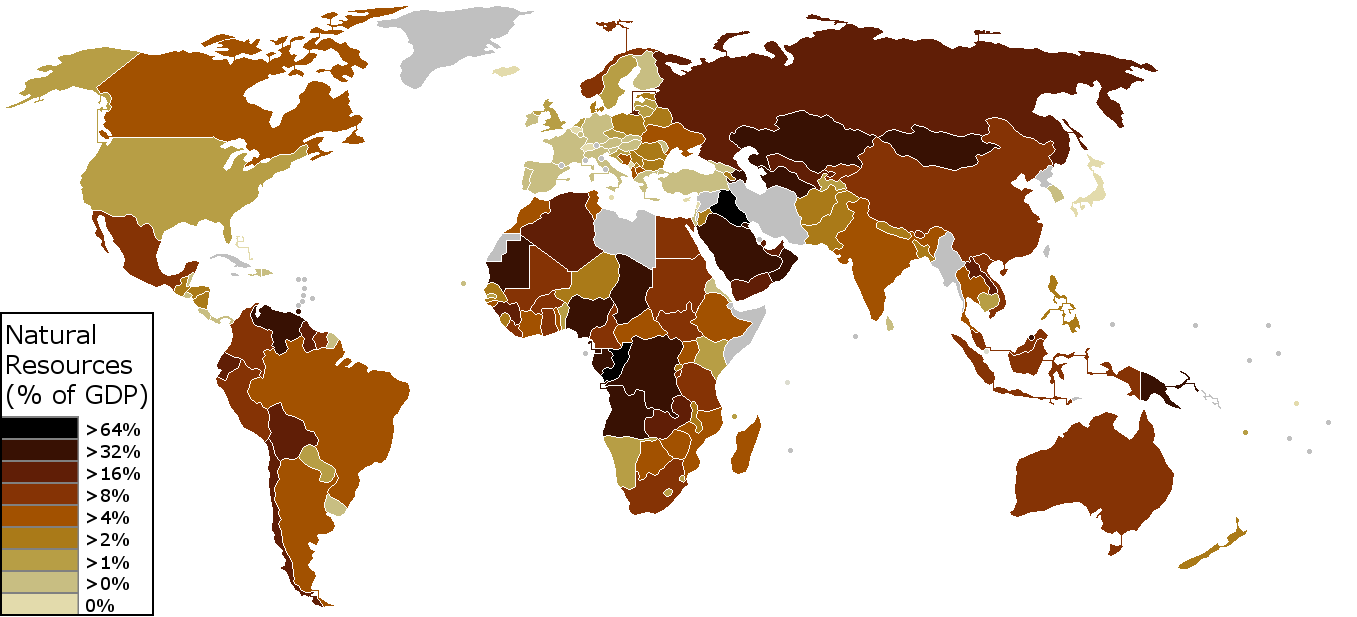
UcQkq0b

Yglesias digs up a creation by Redditor nonmetuammori that maps out, based on World Bank data, how much the economies of different countries depend on natural resources. Matt comments:

The news that, say, Saudi Arabia depends heavily on its oil wealth probably won’t shock you. What really jumps out here, however, is that most of the people who live in countries that have a low resource contribution to GDP live in rich countries (the USA, Japan, Germany, France) not in countries that lack natural resources. Places like Canada and Australia that have high incomes and resource-dependent economies take up a fair amount of space on the map but they have very little population density. There are more people in Italy than in Australia and Canada combined.