Arming The Kurds, Ctd

by Dish Staff

Spencer Ackerman examines the logic behind the Obama administration’s decision to arm Iraq’s Kurds:

The idea of arming the Kurds has been the subject of weeks of internal deliberation and official silence by president Barack Obama’s foreign policy advisers. It is a fateful step in Iraq’s current crisis, one that risks facilitating the long-term disintegration of Iraq. Several administrations over decades have refrained from arming the peshmerga due to concerns about reprisals from Saddam Hussein and his successors. US officials have demurred for days when asked about the deliberations. It provides an opportunity for Obama to use a proxy for confronting Isis on the ground – a step Obama has said he is unwilling to take with US forces – which defense analysts consider the only way to dislodge Isis from territory in north and central Iraq the group has seized since June. …

The danger is that arming the peshmerga will facilitate a permanent fragmentation of Iraq, something the Kurds consider a national aspiration.

Several disputed and multi-ethnic cities in northern Iraq complicate any peaceful cleavage, as do major oil holdings in both Kurdish and contested territory. The Peshmerga used the June disintegration of Iraqi army forces running from Isis as an opportunity to seize disputed areas like oil-rich Kirkuk.

While ISIS’s offensive across northern Iraq has shattered the conventional wisdom of the peshmerga as an unbeatable fighting force, the Kurdish fighters’ recent losses are not quite their fault, either:

Michael Knights, the Lafer fellow at the Washington Institute for Near East Policy and an expert on the military and security affairs of Iraq, dismissed the new conventional wisdom that the Peshmerga have caved. “I wouldn’t put it that way,” he said. “The premise is slightly off. It’s a very easy sell to report it that way. Nothing really crumbled quickly. There’s been nonstop fighting … for a number of weeks. They have been in combat with [the Islamic State] for two to three weeks. This has been a breakpoint.” For instance, from Aug. 1 to 3, the Islamic State launched an offensive in Iraq’s western Nineveh province that forced the Peshmerga to retreat. At the same time, the Peshmerga was fighting the militants for the cities of Jalula and Saadiya in Diyala province — areas that are “very difficult to defend,” according to Knights, stretching forces thin.

In fact, Mohammed Salih suggests, the Kurds are itching to make a comeback with American help:

Abdullah and other Kurdish commanders say that despite recent defeats, they can stop the Islamic State. The successful campaign to take back Makhmour and Gwer may signal that Kurds are able to push the militants back. The Peshmerga are especially counting on U.S. assistance these days. Their morale got a boost after U.S. F/A-18 aircraft bombed Islamic State positions on Friday, Aug. 8. Repeated U.S. airstrikes since have targeted Islamic State positions and convoys around Erbil and in western Nineveh. In parallel, Kurds have been strengthening their positions, and Kurdish reinforcements are coming in from across the region to help.

Peshmerga commanders say they have been outgunned in recent weeks. The Peshmerga have not been in a true battle since helping fight Saddam Hussein’s army during the U.S. invasion in 2003. Even then, most of the fight was carried out from the air by U.S. warplanes and missiles. The Islamic State’s crack fighting force, on the other hand, has been honing its skills over the past two years in Syria and Iraq. Around 150 Peshmerga troops have been killed and 500 others wounded in the latest fighting, according to Kurdish government statistics.

A bit awkward for the US, though, is that some of those “reinforcements … from across the region” are from Turkey’s outlawed PKK:

This initiative doesn’t just involve the pesh merga affiliated with the government of Iraqi Kurdistan, but a whole constellation of Kurdish units drawn from Turkey, Syria, Iraq and Iran. One of the main organizations in the counteroffensive against the Islamic State is the Turkish-based Kurdistan Workers’ Party, known by its acronym, PKK. Because of its history of militancy and violence in Turkey, it is still recognized by the U.S. State Department as a terrorist organization.

That reality echoes awkwardly with the present. Last week, as my colleague Loveday Morris reported, the PKK called for collaboration between an alphabet soup of oft-fractious Kurdish factions. One of the main outfits safeguarding Yazidi escape routes into Syria and retrieving the refugees at the border is the YPG, the armed wing of the Syrian Kurdish PYD party, which is itself an offshoot of the PKK. The YPG has fought both Islamist rebels in Syria, as well as the forces of embattled Syrian President Bashar al-Assad. Portraits of Abdullah Ocalan, the jailed founder of the PKK and a hero to many Kurdish nationalists, are ubiquitous in YPG camps, reports Al-Monitor.

Clinton Out-Hawks Obama

by Dish Staff

How Jeffrey Goldberg characterizes his recent interview with Hillary Clinton:

President Obama has long-ridiculed the idea that the U.S., early in the Syrian civil war, could have shaped the forces fighting the Assad regime, thereby stopping al Qaeda-inspired groups—like the one rampaging across Syria and Iraq today—from seizing control of the rebellion. In an interview in February, the president told me that “when you have a professional army … fighting against a farmer, a carpenter, an engineer who started out as protesters and suddenly now see themselves in the midst of a civil conflict—the notion that we could have, in a clean way that didn’t commit U.S. military forces, changed the equation on the ground there was never true.”

Well, his former secretary of state, Hillary Rodham Clinton, isn’t buying it. In an interview with me earlier this week, she used her sharpest language yet to describe the “failure” that resulted from the decision to keep the U.S. on the sidelines during the first phase of the Syrian uprising.

But Andrew Sprung disagrees with Goldberg’s framing:

I’ve seen more than one tweet this morning to the effect that Hillary Clinton “threw Obama under an ISIS-driven Humvee” in a long, probing, interview with Jeffrey Goldberg.  I think that’s a wrong impression created by Goldberg’s introductory overview, which overstates her actual and implied criticisms of Obama.

It’s no secret that Clinton advocated for early U.S. support of allegedly moderate factions in the Syrian opposition. And it’s necessary and prudent for Hillary to distance herself from Obama, or position herself to do so, in that a) she genuinely is more interventionist, and b) the world could blow up on Obama and doom her chances if she’s seen as a continuation. But it’s also in Hillary’s DNA to hedge, both from a desire to cover both sides and an ability to see complexity (except with regard to Israel, to which she pandered without inhibition). And in at least three instances, Goldberg emphasized just one side of her equation.

Francis Wilkinson seconds Sprung:

The skill and elasticity of her rhetoric was impressive. She spoke at length, and seemingly without restraint, yet it’s hard to find specific acts of the Obama administration that she has clearly renounced or endorsed, or firm positions of her own to which she irrevocably committed. … Clinton drew a clear distinction with Obama on Syria, pointing out that she had wanted more vigorous support for the non-jihadists among the Syrian opposition. But she made no claim that her preferred approach would have succeeded. She also compared herself very favorably with her successor, John Kerry, in moving Israeli and Palestinian leaders toward compromise, casting Kerry’s subsequent efforts in a diminished light. But much of Clinton’s foreign policy analysis fell under the rubric of “time will tell.”

Cillizza sees Clinton’s comments as baldy political:

Clinton wants people to remember she never always agreed with Obama. One of the challenges Clinton will face in 2016 — although not the biggest challenge — is her association with Obama, particularly on foreign policy. (She was, after all, the top diplomat in the Obama Administration for his first term.) What Clinton does not want to do, however, is be forced to own every decision the President made — especially those that she disagreed with. On Afghanistan, Clinton — along with Secretary of Defense Robert Gates — advocated for putting more troops in the country. On Libya , Clinton was a lead voice making the case for a military intervention to topple Muammar Gaddafi. And, in the interview with Goldberg, Clinton calls the U.S.’s decision to not actively involve itself in the early days of the uprising in Syria a “failure”.  There will be plenty on the foreign policy front that Clinton will have to own — “pushing the reset button” with Russia, anyone? — but she also wants to make very clear that had she been president, our foreign policy might have looked very different over the past six years.

Matt K. Lewis calls out-hawking Obama politically brilliant but his argument is relatively flimsy:

Pundits love to say that people vote their pocketbooks, not foreign policy. Well, what Clinton is doing here transcends foreign policy. It’s about restoring America’s swagger. And I think there’s a real hunger for this.

Larison more convincingly argues that Clinton’s hawkishness will backfire:

There are many things one could call Clinton’s recent foreign policy remarks in this Goldberg interview, but politically savvy or brilliant is *not* one of them. The foreign policy she outlined in the interview is one that would replicate all of Obama’s major errors (e.g., intervention in Libya, arming foreign rebels, etc.) while expanding on and adding to them. She is clearly currying favor with foreign policy analysts and pundits that already think Obama has been too passive on Syria, Ukraine, etc., and she is doing that by reciting many of their unpersuasive arguments.

Clinton has “brilliantly” identified herself as the hawk that she has always been, which puts her sharply at odds with most people in her own party and most Americans of all political affiliations. That’s not triangulation at all.

Dougherty fears the worst:

Clinton’s strategy of trying to say that she would have embraced Obama’s foreign policy — But harder! And bigger! — amounts to admitting she would double down on failures, engage in drive-by wars, and get America stuck in confusing entanglements with gun-wielding losers and child-beheaders. Will some Democrat with an ounce of sense speak up and try to defeat Clinton before we get George W. Bush’s third term?

Josh Marshall thinks thinks Hillary is playing a dangerous game:

[T]here’s an element of Hillary’s strategic distancing I’ve not seen widely mentioned. President Obama is not popular at the moment. His popularity is at best in the low 40s. But among the people who choose Democratic nominees – that is, partisan Democrats – he remains quite popular. And even for many Democrats who feel disappointed, let down or just worn out by the whole six year journey, President Obama represents something that transcends how they may feel about him at just this moment.

Quite apart from the pros and cons of particular foreign policy strategies, I believe the great majority of partisan Democrats feel protective of the President. So it’s a delicate, perilous thing to criticize him so publicly, particularly at a politically vulnerable moment, especially when the nature of the criticism mirrors that of many of the President’s most dogged and aggrieved foes.

And, lastly, looking beyond Clinton’s rhetoric, Marc Lynch pushes back on Clinton’s suggestion that we should have armed Syria’s rebels. Among his reasons for rejecting that step:

The idea that these rebel groups could be vetted for moderation and entrusted with advanced weaponry made absolutely no sense given the realities of the conflict in Syria. These local groups frequently shifted sides and formed alliances of convenience as needed. As MIT’s Fotini Christia has documented in cases from Afghanistan to Bosnia, and the University of Virginia’s Jonah Shulhofer-Wohl has detailed in Syria, rebel groups that lack a legitimate and effective over-arching institutional structure almost always display these kinds of rapidly shifting alliances and “blue on blue” violence. A “moderate, vetted opposition” means little when alliances are this fluid and organizational structures so weak.

Andrew’s take on the interview is here.

The Man Who Would Not Be Maliki

by Dish Staff

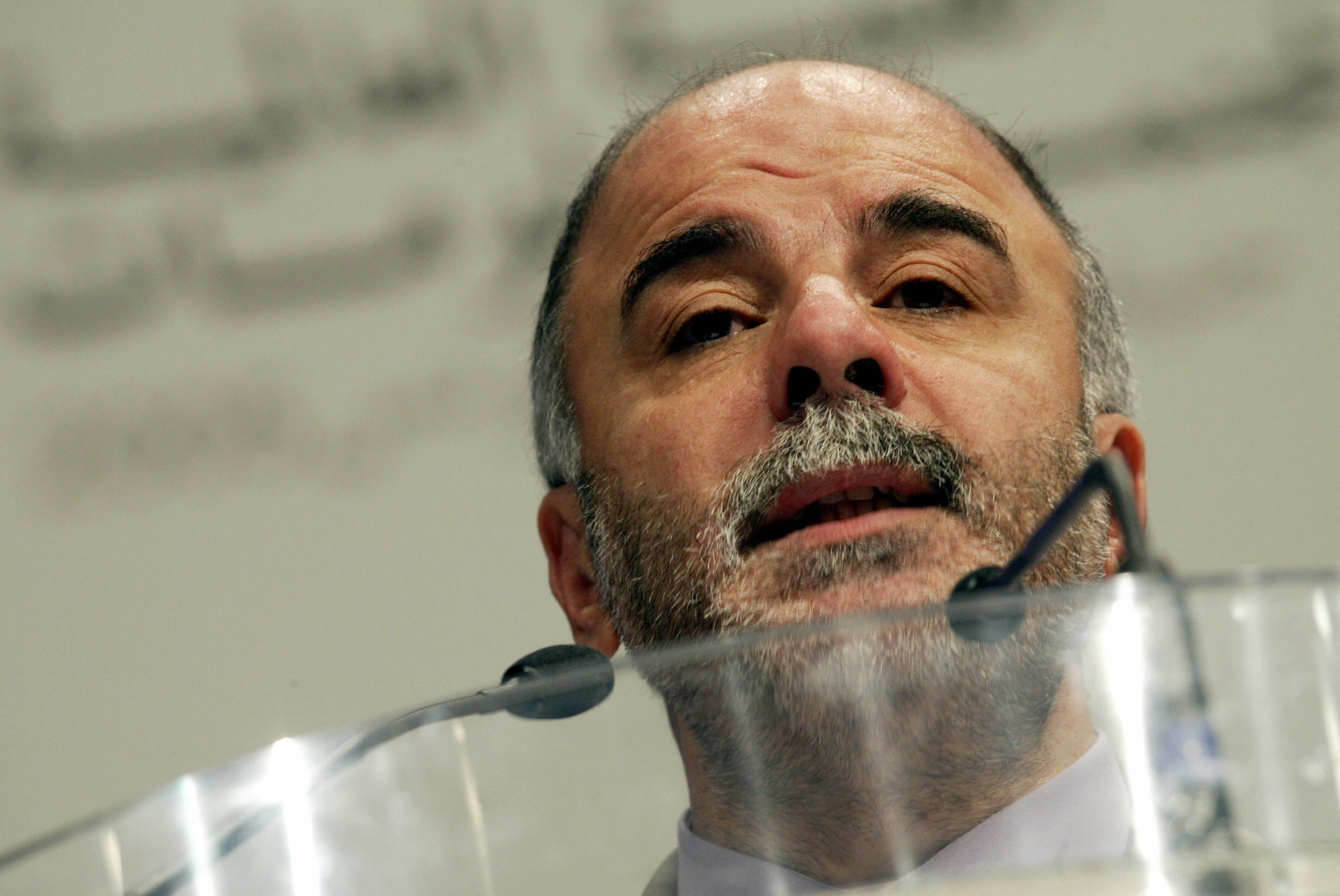
Iraqi Minister of Communication Haider a

Adam Taylor provides some background on Iraqi prime minister-designate Haider al-Abadi:

Born in Baghdad in 1952, Abadi was educated at the University of Baghdad and later received a doctorate from the University of Manchester in Britain. He lived in Britain for many years after his family was targeted by Saddam Hussein’s Baathist regime. He was trained as an electrical engineer, but he entered politics after the U.S.-led invasion of Iraq in 2003. He became minister of communications in the Iraqi Governing Council in September 2003, then was a key adviser to Maliki in Iraq’s first post-invasion elected government. Just weeks ago, he was elected deputy speaker of parliament, and he has been considered a contender for prime minister after the past two elections.

The bigger question, however, is whether Abadi will be able to overcome the challenges confronting Iraq more successfully than Maliki. Like Maliki, he’s a Shiite Muslim and is a member of the ruling State of Law coalition. One of the chief criticisms of Maliki was that he entrenched Iraq’s sectarian politics, filling the government with Shiite politicians and limiting Sunni and Kurdish power.

Eli Lake claims that Abadi’s nomination was the result of an American push for “regime change”:

The American push—which has not been previously reported—wasn’t the only factor that led to al-Abadi’s rise. Iraq’s deterioration in recent months led some of Maliki’s Shi’ite backers to pull their support of him. Last month, Grand Ayatollah Ali Sistani, the most senior cleric of the Shi’ite sect, wrote a letter to Maliki asking him not to seek a third term as prime minister. But al-Abadi has been the United States’ preferred candidate since late June to replace Maliki, a man who Obama himself blamed over the weekend for creating the conditions for the current catastrophe that is engulfing Iraq. U.S. and Iraqi officials tell The Daily Beast that U.S. Ambassador to Iraq Robert Beecroft and Brett McGurk, the deputy assistant secretary of state for Iraq and Iran, have pushed Iraqi politicians behinds the scenes to consider al-Abadi as a new Iraqi head of state.

Of course, the administration rejects that account. But Iran might also have had a hand in Abadi’s ascent, Saeed Kamali Dehghan suggests:

Ali Shamkhani, the secretary of Iran‘s powerful Supreme National Security Council, was quoted by the official IRNA news agency congratulating the Iraqi people and their leaders for choosing Haider al-Abadi as their new prime minister. … Hossein Rassam, a London-based Iranian analyst, said Shamkhani’s statement reflect Tehran’s hand in al-Abadi’s appointment: “His appointment could not have materialised without Iran’s cooperation. This is the result of a series of negotiations and bargaining for the past number of days, it’s not something that has been decided overnight.”

According to Rassam, Iran’s top priority in Iraq has been to avoid a power vacuum in Baghdad and ensure the appointment of a prime minister sympathetic to Tehran. “With Abadi’s appointment, Iran has achieved both,” he said.

Suadad al-Salhy takes the temperature of Iraq’s political parties. While Abadi’s nomination has divided the Shiites in parliament, Sunni Arab politicians see him as a major improvement over Maliki:

Iraq’s Sunni blocs, who are strongly opposed to Maliki, expressed their satisfaction at Ibadi’s nomination. “We are backing this nomination. What happened today was a big change,” said Mohammed Iqbal, a senior Sunni lawmaker. “We are blessed to nominate Ibadi. He is well-educated, efficient and has good relations with everyone, and there is no negative points registered against him with regard to his political history,” Iqbal told Al Jazeera.

Kurdish leaders added, however, that Ibadi must fix persisting problems between the Kurdish region and the central government, particularly arrangements over oil and gas revenues and the annual budget. Meanwhile, Iraqi Kurds, who are fighting Islamic State group fighters who have advanced towards Erbil, capital of the Kurdish region, over the last two weeks, said that they were not opposed to Ibadi.

The threat of a coup by Maliki still hangs over the transition. Josh Voorhees outlines what a disaster that would be:

The situation is unfolding rather quickly, but as of right now it appears that Maliki may do whatever it takes to stay in power, and that could mean a coup. For starters, such a move could throw Iraq back into a bloody civil war at a time when the government is struggling mightily to push back the advances of ISIS in the north. There are a number of factions within the Iraqi military, and it remains to be seen how each would align itself in the event that Maliki does attempt to use the nation’s military to hold on to power. But it is clear that any soldier engaged on either side of such a standoff would be one that wouldn’t be fighting ISIS.

“Maliki’s coup is good news for the Kurds and Yazidis, though,” Allahpundit reckons:

Until now, the White House has clung to the idea that Iraq should remain unified and that all aid, especially military aid, should go through the central government in Baghdad. That’s one reason why the Kurds are undersupplied; Maliki’s going to siphon off whatever he gets from the U.S. for Shiite use. Now that he’s betrayed Iraqi democracy, though, the White House can cut him loose, refuse to recognize his legitimacy, and deal directly with the Kurds.That means arms (and maybe military advisors?), and that means a Kurdistan that’s secure from ISIS. If Maliki wants southern Iraq to be a Iranian protectorate there’s little we can do to stop him, but we can help build a counterweight in the north. Let’s get on with it.

But Douglas Ollivant doubts Maliki will go through with it in the end:

Ollivant, who formerly served as the top Iraq policy official on the National Security Council, said there was “very little” the United States could do to push Maliki out of power, but he said he didn’t think the Iraqi leader would resort to violence to stay in office. “I really think it’s all done but the shouting,” Ollivant said. “He’s going to talk tough and play out his last legal card, but he doesn’t want to be an international pariah. If we pull away, his only friends would be Iran and Syria, and even Maliki doesn’t want that.”

Maliki is losing the support of the Iranian-backed Shiite militias, and has apparently withdrawn his loyalist forces back inside the Green Zone, so a coup attempt is indeed looking less likely. Even so, Kirk Sowell warns of some major political challenges ahead:

More broadly, Sunni provinces will have to deal with the fact that Shiite Islamists have an outright majority in parliament, and the next government, whatever its precise contours, will reflect this. But Nineveh, the heart of the battleground with IS, will be especially difficult: It has been the scene of almost constant violent conflict since 2003, in part due to the fact that under Saddam Hussein’s Baathist regime, the Arab population was both a major recruitment source for the army and taught to view Kurds as an ethnic enemy. The Iraq Oil Report and others have reported that a number of local residents who aren’t Islamic militants are willing to work with IS for reasons of racial and sectarian enmity.

(Photo: Haider al-Abadi by Jean-Philippe Kziazek/AFP/Getty Images)

Taking Rand Paul To Task On Education

by Dish Staff

Math teacher James Goodman eviscerates the author of The School Revolution:

According to Politico, Rand Paul is “planning a major push on education reform, including education choice, school choice, vouchers, charter schools, you name it.” As one specific example for improving education, Paul suggested that “if you have one person in the country who is, like, the best at explaining calculus, that person maybe should teach every calculus class in the country.” He allowed that “You’d still have local teachers to reinforce and try to explain and help the kids, but you’d have some of these extraordinary teachers teaching millions of people in the classroom.” …

Part of the problem with the perpetuity of education reform is that everyone is looking for the answer to the question, “How do we best teach?” as though there is some formula that is ultimately the best.

They see teaching as a science experiment – as though one set of conditions and stimuli will prove to be optimal. That’s not what it is. It is an art. Two great teachers may do things completely differently from each other. Furthermore, no two classes of students are the same. One great teacher may teach the same thing in very different ways to different groups of kids, depending on their strengths, personalities and the real-time feedback that the teacher reads from her class. Again, this is something that requires a talented, knowledgeable classroom teacher (the one directing the instruction and activity at each moment) who cultivates a relationship with each student – anathema to Paul’s description of his own vision of education.

Til Employment Do Us Part

by Dish Staff

Alex Fradera surveys the somewhat counterintuitive findings of new research suggesting that “life satisfaction is higher for couples who share their unemployed predicament, than for couples where only one partner loses their job”:

Maike Luhmann and her colleagues analysed over ten years of longitudinal data from 3000 co-habiting couples in Germany, where one or both partners had gone through an unemployment. … The data supported the shared fate hypothesis [that empathy and support are easier to produce when both parties are in the same boat] – when one partner was unemployed and the second partner remained in work, both parties reported lower life satisfaction than when both partners ended up without a job. The researchers reasoned that when one partner remains in work, it is easier for the unemployed partner to be stigmatised and feel anxiety about abandonment for failing in their duties to the household. In addition, the unemployed person is shunted rapidly out of one life pattern, including a regular routine and social networks, and may find themselves now alone for much of the day, with the obligation to solve their problems and “get back on track”. Moreover, their limited contact with their working partner may be an invitation for friction: just what have you been doing all day?

Luhmann and her colleagues interpreted their results as showing that unemployment “hurts primarily because of its psychological consequences,” rather than being driven by its financial impact

Plusses And Minuses

by Dish Staff

Tyler McCall blames plus-size women for the lack of plus-size options:

[W]hat if the problem with the plus-size industry isn’t with faceless businessmen, but with the customers themselves? “It’s become such an angry section of fashion,” one plus-size blogger, who wishes to remain anonymous, explains. “Everyone has an opinion, and it’s such a negative, negative environment, and it sounds sad, but they want to tear each other apart. Models get it all the time, brands especially. They’ll say, ‘Oh we can’t use that model again because they say that she’s too skinny.'”

McCall – whose piece comes with a provocative “Hold all comments until the end, please” subtitle – points to a range of reasons customers may be limiting their own options:

There is of course a body politic that goes into shopping for women. Everyone I spoke with agreed that women who are told that their body shape should be considered temporary, always in need of a new diet or weight loss plan, aren’t exactly going to plunk down $300 for a dress that, ideally, won’t fit them in a month. “There are so many women who don’t self identify as plus-size, and maybe they just settle for drawstring or elastic waisted pants because they don’t necessarily want to know that they’re a size 16 or an 18,” Mason says.

Robin Williams, RIP, Ctd

by Dish Staff

Some immediate reaction from Twitter, including many clips of Williams’ greatest moments, here. Several more clips after the jump. A reader writes a moving eulogy:

I’m sure that I’m just one of many Dishheads writing in about the horribly sad death of Robin Williams. I’m a child of the ’90s, and he was a constant fixture of my cultural world through childhood and into adulthood. Not only was he a genuine comedic genius – his bit on the invention of golf [seen above] was legendary long before today, as was his 2001 appearance on Inside the Actors Studio, to name a few drops in the bucket. But his joy, sincerity and warmth of personality left a mark that I am now surprised to find was so deep.

He was consistently open about his struggles with depression, addiction and alcoholism, and it sucks that some combination of those demons managed to overpower him, despite all the effort he put into fighting his battles and helping the rest of us fight our own. His approach to humor was so unusual among comics of this era: it was never based on cynicism or complaint, but rather, predominantly, on sharing the things that made him irrepressibly happy. He was such a transparently compassionate person that if he’d had any inkling of the outpouring of collective mourning that took place [last night], things might have gone another way.

I’ve never seen a larger or more visceral mass response to a celebrity death.

On Twitter alone, I follow close to 200 accounts, from a wide range of countries, cultures and sub-cultures, and I swear almost every single one came out of the woodwork, some of whom had been silent for years before tonight. And Twitter’s “trending” topics were completely dominated by subjects related to his life, career and death. It occurred to me that this might have to do with the fact that Robin Williams, whose filmography spans from Mork & Mindy (1978) to Night at the Museum (latest installment in post-production), is one of the few figures who looms just as large for my parents’ generation as he does for mine.

It’s really odd – I didn’t even consider myself a great fan of his, but he was a part of my life all the same, and this gutted emotional state I’m in is clear proof of that. I’ll miss him. Fuck depression.

Another points out:

If you weren’t already aware of it, I thought I would link to a WHO document [pdf] about responsible media coverage of suicide.  I learned about it through this podcast.  It’s being reported that Robin Williams killed himself, and celebrity suicides can cause a string of copycat suicides.  How the suicide is reported can influence how many copycat suicides occur and this is true for famous and not famous alike.  This is known as the Werther Effect. I’m not being critical of your coverage, but thought that you should be made aware of the WHO document.

Jennifer Michael Hecht, author of Stay: A History of Suicide and the Philosophies Against It, discussed the Werther Effect and much more in her “Ask Anything” videos for the Dish. Meanwhile, as another reader notes, Robin Williams’ performance in Bobby McFerrin’s “Don’t Worry Be Happy” music video has a dark irony this week:

A happier ending:

If you’ve never seen the standup bit of Robin Williams simulating cunnilingus, then you haven’t seen the full range of his comic genius.  It makes my cheeks hurt from laughter every time I seen it (and might have a good tie-in with your recent coverage of hirsute men):

Another reader ties in another recent thread:

Last week I was going to send Williams’ and McFerrin’s version of “Come Together”, since it is one of my fave covers, but it didn’t seem quite outre enough. Now it’s a no brainer. No video, but it does have nice pictures of Robin:

And another touches upon another Dish theme:

You covered Robin Williams’ tragic, untimely death, but I think you failed to include a video that has him mentioning a number of favorite Dish topics, including Catholicism and gay marriage:

Hard-Working To A Fault?

by Dish Staff

Patience Schell considers research that says overwork actually makes us dumber:

The authors of Scarcity: Why Having Too Little Means So Much (2013), Sendhil Mullainathan and Eldar Shafir, demonstrate that the chronically busy work less efficiently owing to a profound shortage of cognitive capacity, resulting in poor decision-making. Their research indicates that this shortage of cognitive capacity, caused by extreme lack of time (it can also be caused by extreme lack of money), measurably reduces an individual’s fluid intelligence, hampering performance. Without what they call the mental “slack” of time away from work and away from thinking about work, we will make poor decisions. We’re dumber when we don’t take a break, and it shows.

Reviewing a study published in the Stanford Social Innovation Review (“Reversing burnout,” Winter 2005), Schell finds that even disaster response workers are advised to take breaks while tending to emergencies:

[The study] uses the American Red Cross’ new management approach to highlight the necessity of breaks, even among disaster response workers. Before, Red Cross workers put in as many hours as necessary until the job was finished. Now the Red Cross recognises that workers need breaks in order to be able to respond effectively to the humanitarian crises they face. The new approach follows advice given by the American Psychological Association, whose mental health workers had supported Red Cross disaster response teams. So even the Red Cross, in emergencies, recognises that without breaks, leisure and time off, we don’t work as well as we could, we are less intelligent, we make poor decisions and we are at risk of hurting ourselves and shortening our lives.

Cody Delistraty also condemns the cult of overwork:

Busyness implies hard work, which implies good character, a strong education, and either present or future affluence. The phrase, “I can’t; I’m busy,” sends a signal that you’re not just an homme sérieux, but an important one at that. There is also a belief in many countries, the United States especially, that work is an inherently noble pursuit. Many feel existentially lost without the driving structure of work in their life—even if that structure is neither proportionally profitable nor healthy in a physical or psychological sense.

Everyone would likely agree with Aristotle that “we work to have leisure, on which happiness depends.” The motivation for employees to work hard is the carrot of a relaxing retirement. Yet this cause-and-effect often gets flipped such that we fit our lives into our work, rather than fitting our work into our lives. The widespread belief that happiness and life satisfaction can be found exclusively through hard work is at a heart more a management myth meant to motivate workers than it is a philosophical truism.