How Will The Campaigns Respond To Sandy?

Romney_Sandy_GT

Kornacki believes that “Sandy has for now frozen the race in place – and where the race is right now isn’t good for [Romney]”:

For one thing, it has overtaken the presidential campaign as the top national story and will continue to do so for several days. Obama, as the president, has an obvious place in this story. The actions of the White House and the response of the federal government are integral to the clean-up, and Obama has a platform to showcase his presidential leadership. Romney, though, has no official role, and really can’t force his way into the story. There’s also the matter of unseemliness – it wouldn’t look too good for Romney to keep right on campaigning as the rest of the country takes stock of a natural disaster. Thus did Romney cancel events yesterday and again today.

But he has to do something to stay visible, so Romney is today attending what his campaign is billing as a “storm relief event” in Ohio with Nascar driver Richard Petty and Randy Owen of country music fame. Attendees are being asked to bring canned goods and other disaster relief supplies or to make donations to the Red Cross. Romney may speak but his remarks probably won’t be political in nature. This is probably the best his campaign can do today, just getting images of him showing some concern for the victims of the storm into the news media.

Though images of his supporters aren’t exactly helping:

Ambinder’s take

[I]f you’re President Obama, you probably schedule a visit to New York City on Wednesday, returning to the campaign trail, probably in New Hampshire, on Thursday. You’ve got little to gain from leaving your post until order is restored. In fact, you look better if you stay in D.C. It’s true that in such a tight election everytime Air Force One touches down in Ohio or Colorado you’ll gain votes, but the headlines you’ll get if you assume the mantle of leadership right are better. Another benefit: You’ll get to rest your voice and brain a bit for the last 72 hours of the campaign, when you’l need all the energy you can muster.  

(Photo: Kevin Madden, Senior advisor to Republican presidential candidate, former Massachusetts Gov. Mitt Romney, checks his phone on the Romney campaign bus en route to a campaign rally at Avon Lake High School on October 29, 2012 in Avon Lake, Ohio. Romney canceled campaign events on October 29 and 30 due to Hurricane Sandy. By Justin Sullivan/Getty Images)

Getting Sandy Right

Nate Cohn praises meteorologists’ forecasts:

The models correctly anticipated an unprecedented storm with startling precision, nailing the storm’s unusual path, strength, and character well in [advance]. As predicted, Sandy transformed into a hybrid storm of unprecedented size and intensity, with tropical storm force winds stretching over 1,000 miles across, making it the largest tropical cyclone in the history of the Atlantic. While meteorologists often get a bad rap, they deserve credit for forecasting a historic storm well in advance.

William Hooke adds:

Imagine…if Hurricane Sandy had been forecast to go out to sea, as might have been the case as recently as a decade ago…or un-forecast entirely. Picture hundreds of thousands of people along an unprepared coastline waking up to the sound of surf and wind, the sight of flooding, and the realization that evacuation routes were closed off by the high waters.

Reporting The Weather

Friedersdorf sees no reason to endanger reporters during hurricanes:

There are a lot of journalists I respect for putting themselves in harm's way — journalists who chronicle wars, report on conditions in refugee camps, challenge the lies of repressive political regimes, or otherwise gather information that wouldn't be disseminated save for risking their lives. That isn't what CNN and Velshi were doing. If standing in hurricanes for hours at a time were necessary to report on them, newspaper staffers would do it too. On TV, a camera mounted on a street corner might not be as entertaining. It might lack the drama of a human being in danger. But it would adequately convey all the newsworthy information.

The Business Of Fairness

Why price gouging during crisis doesn't work:

The people [Nobel laureate Daniel Kahneman] surveyed said they would punish businesses that raised prices in ways that seemed unfair. While I would have paid twice the normal price for my groceries yesterday, I would have felt like I was getting ripped off. After the storm passed, I might have started getting my groceries somewhere else. Businesses know this. And, Kahneman argues, when basic economic theory conflicts with peoples' perception of fairness, it's in a firm's long-term interest to behave in a way that people think is fair.

So when my grocery store re-opens after the hurricane, the price of a can of beans will probably be the same as it was last week, even if there's a line out the door and empty shelves inside.

“That Glassy Floods From Rugged Rocks Can Crush”

154993501

Walter Russell Mead meditates on the storm, nature and God. He quotes John Milton’s paraphrase of Psalm 114, which is quoted in this post's title:

Hurricane Sandy is many things; one of those things is a symbol. The day is coming for all of us when a storm enters our happy, busy lives and throws them into utter disarray. The job on which everything depends can disappear. That relationship that holds everything together can fall apart. The doctor can call and say the test results are not good. All of these things can happen to anybody; something like this will happen to us all. Somewhere in the future, each of us has an inescapable appointment with irresistible force. For each one of us, the waters will someday rise, the winds spin out of control, the roof will come off the house and the power will go out for good.

He believes that to "acknowledge and accept weakness is to ground our lives more firmly in truth":

To come to terms with the radical insecurity in which we all live is to find a different and more reliable kind of security. The joys and occupations of ordinary life aren’t all there is to existence, but neither are the great and all-destroying storms. There is a calm beyond the storm, and the same force that sends these storms into our lives offers a peace and security that no storm can destroy. As another one of the psalms puts it, "Weeping may endure for a night, but joy cometh in the morning."

(Photo: Resident Kim Johnson inspects the area around her apartment building (L) which flooded and destroyed large sections of an old boardwalk, on October 30, 2012 in Atlantic City, New Jersey. Johnson fled the area when the water began to rise yesterday. The storm has claimed at least 16 lives in the United States, and has caused massive flooding accross much of the Atlantic seaboard. By Mario Tama/Getty Images)

When Will The Power Come Back On?

154985818

The Guardian’s live-blog notes that “7.5 million people are believed to be without powerincluding nearly 2 million in New York alone.” The NYT’s live-blog has more details for city residents:

The blast knocked out electricity for all of Manhattan below 39th Street on the east side and 31st Street on the west side – with the exception of a few pockets, including Battery Park City. In the two hours before the explosion, Con Edison officials purposefully turned off all power to two small sections of the financial district in Lower Manhattan and in the Brighton Beach section of Brooklyn. Power to those areas could be restored in three or four days after utility crews pump out floodwater and dry and repair equipment below ground, said Bob McGee, a spokesman for Con Edison. But he said it may take longer to restore power to customers whose service was interrupted by the explosion.

The WSJ adds:

On Monday night, a top official from the utility company said it could take up to a week to restore power to the bulk of Manhattan neighborhoods plunged into darkness Monday evening.

TPM is also live-blogging the storm and the aftermath. For all of our hurricane coverage in one place, go here.

(Photo: Power outage seen on October 29, 2012 in Manhattan, New York. By Allison Joyce/Getty Images)

Raging In The Rockaways, Ctd

An update on that six-alarm fire in Breezy Point, Queens:

Officials say the fire was reported at about 11 p.m. Monday and involved about 80 to 100 flooded houses situated in the Zone A area. More than 190 firefighters contained the blaze, but were still putting out some pockets of fire more than nine hours after it erupted.

Firefighters said the water was chest high on the street, and they had to use a boat to make rescues. They said in one apartment home, about 25 people were trapped in an upstairs unit, and the 2-story home next door was ablaze and setting fire to the apartment’s roof. Firefighters climbed an awning to access the trapped people, and took them downstairs to the boat in the street.

Also:

Firefighters were hampered by high winds and the lack of available water. “Once we get there it’s hard to begin fighting it,” a spokesman, Firefighter Danny Glover, said. “The wind is pushing it from house to house; that’s a big factor,” he said. “Another big factor is the difficulty of gaining access to viable water sources.” Seawater cannot be used in firefighting equipment, he added. 

So far there are only reports of a few minor injuries. Here’s what it looks like this morning:

For all of our hurricane coverage in one place, go here.

When Government Works

Ambinder assesses local and federal efforts to minimize Sandy’s damage:

As much as we like to make fun of disaster preparedness, with its acronyms and power points, we also have to acknowledge something profound, which is that these big institutions can actually learn from their mistakes and can make decisions that save millions of lives. If climate change is functionally changing the globe’s weather, then experts in this area have to evolve themselves to catch up. Since Katrina, FEMA has become an incredibly agile and forward-leaning agency and it never gets credit for it. 

So far, at least as I type this, everything is working as it should. Warnings are dire, but people are heeding them. The devastation is potentially crippling, but folks are acting proactively. The person at ConEd who made the call to pre-emptively shut off power to lower Manhattan so that, when the flood waters recede, it can be restarted much more quickly, deserves a prize of some sort. Yes! Do more of that! Be accountable for your decision, but, yes, be smart about stuff. We can cheer for that. The federal government is working well with its state and local partners, as New Jersey Gov. Chris Christie will attest. Utilities pre-mobilized thousands of workers. The stock exchange wisely decided that Howard Roark didn’t have the power to stop storm surges, and that even the economy can take a break to ride out the storm. Will people lose money? Sure. The right call? Totally. 

For all of our hurricane coverage in one place, go here.

A Subway Submerged

3DtTl

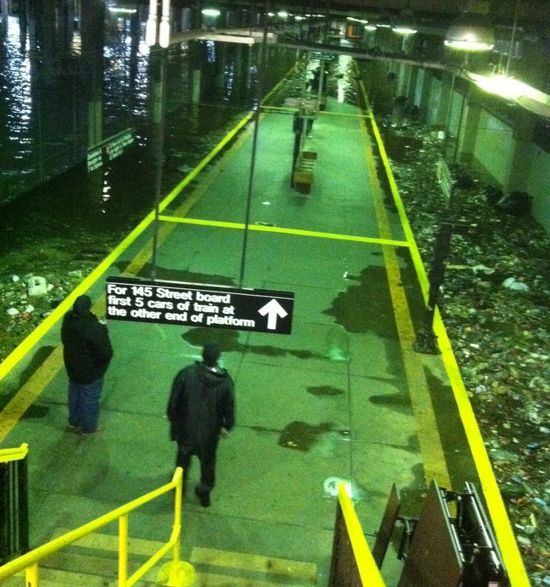
Bill McKibben is crestfallen:

For me, the subways are New York, or at least they’re the most crucial element of that magnificent ecosystem. When I was a young Talk of the Town reporter at the New Yorker, I spent five years exploring the city, always by subway. This was in the 1980s, at the city’s nadir – the graffiti-covered trains would pause for half an hour in mid-flight; the tinny speakers would reduce the explanation of the trouble to gibberish.

It was how I traveled, though – I didn’t even know how to hail a cab. For a dollar, you could go anywhere. And my boast was that I’d gotten out at every station in the system for some story or another. It may not have been quite true: the Bronx is a big and forgotten place, and Queens stretches out forever – but it was my aspiration.

The subways were kind of dangerous, but also deeply democratic. Writing about homelessness, I slept with hundreds of other men on the endless A train to the Rockaways. I convinced motormen to let me ride as they turned trains around through the City Hall station abandoned decades earlier. I hung out in the control room under Grand Central with its Hollywood array of levers and lights.

Imagining all that filled with cold salt water is too much.

(Photo by Twitter user eLone)