Science, Climate And Skepticism

I have to say that one of the most depressing features of the decline of conservative thinking in the US has been the resistance to the overwhelming data behind carbon and climate change. I don’t get it, however much I try. Check out Jon Chait’s takedown of George Will’s and Charles Krauthammer’s “arguments” on the subject. It’s deeply dispiriting. And it helps explain why the GOP is such an extreme outlier among right-of-center parties in the Western world on this issue.

greenpower.jpgThere is an obvious role for conservatism here at every stage. I favor maximal skepticism toward scientific theories that might prompt us to change our lives and societies in radical ways. If there were any use for a conservatism of doubt, it would be to counter such over-reach. The calls for skepticism in this field are absolutely legitimate, given the scale of the consequences. I also favor maximal skepticism in figuring out the best way to deal with such change – a debate well worth having, but which has languished because the US right won’t even agree to the premise.

But the truth is: on this question, scientific skepticism has been abundant, while the data on the core reality continues to mount. In many ways, the skeptics have garnered more media attention than the climate-change consensus-mongers. And of course there’s always a chance that we’ll stumble upon some new evidence or theory that would throw this entire edifice into doubt (it happens). And it would be awesome. But, at this point, the overwhelming scientific consensus is clear enough, and the argument behind it powerful. The world’s climate is changing; and it will mean huge challenges for humanity’s habitat. I simply cannot see why any sane person would not wish to try and mitigate that change or prepare for such an eventuality. It’s not about ideology so much as simple prudence. Even if you view the likelihood of a much warmer planet as small, its huge potential impact still makes it worth confronting. Low-probability-high-impact events are like that. And conservatives, properly understood, attend to such contingent problems prudently; only ideologues or fools decide it would be better to do nothing and hope for the best.

More to the point, the efforts to counter climate change are mainly win-win. If solar power could run the planet, wouldn’t that be great?

So why all the mockery? If we managed to discover a new low-carbon fuel that would provide us with energy at minimal environmental cost, why wouldn’t that also be a wonderful thing? Ditto wind power or carbon capture technologies. Sure there will be waste and dead ends in a green economy. We should be attuned to that as well as the need to mitigate change for the fossil fuel industries, and the people who work in them, as best we can. But there will be lots of technological and economic gains as well. So I just don’t see the core reason for conservative resistance. (Cue the groan chorus from Corey Robin, et al.)

Then there is the fashionable tendency among conservatives to describe the habits of mind of environmentalists as alien or weird: i.e. the Greens are like the early Nazis in their love of nature; enviros treat the planet as a God; it’s all about therapy; or some secular version of sin. These observations can carry some insight, of course (the Nazis were pretty green), as well as some cheap points. Here’s what Krauthammer came up with on that theme:

And you always see that no matter what happens, whether it’s a flood or it’s a drought, whether it’s one — it’s warming or cooling, it’s always a result of what is ultimately what we’re talking about here, human sin with the pollution of carbon. It’s the oldest superstition around. It was in the Old Testament. It’s in the rain dance of the Native Americans. If you sin, the skies will not cooperate. This is quite superstitious, and I’m waiting for science which doesn’t declare itself definitive but is otherwise convincing.

Okaaay. Sure, there may well be patterns of thought among climate change scientists that echo or mimic other social movements. It’s a meme-ridden world. I’m sure some climate change scientists have beards and smoke weed and like “Orange Is The New Black”. Others may love classical music or be crypto-socialists. But that’s not an argument about the data. It’s an argument about style and culture and habits of thought behind the data. The data exist independently of all of that. And no set of evidence declares itself “definitive” either, as Krauthammer asserts. All of the evidence is obviously ongoing and more data will emerge, and more reports will be published and better understanding will result. That’s how science works. And over time, theories that work better prevail. That’s called the scientific method – and skepticism is embedded in it at almost every stage.

And that’s where we are. No amount of denial or distraction can change that fact. Either we adjust or we face the consequences. Or both. But pretending we live on another planet in another era does not seem to me to be a conservative position. It is, in Chait’s words, “absolutely bonkers.”

America’s Game Of Thrones

This embed is invalid


It is the elephant in the room as we approach 2016. Not that the issues of dynasties and oligarchies are not being aired. They are, relentlessly. But have we truly absorbed the sheer national embarrassment that out of a country of more than 300 million people, the two likeliest presidential nominees for the two major parties will be the wife of a former president and the brother and son of two former presidents? It’s impossible to think of any developed Western democracy that could even begin to match this pathetic, incestuous indictment of a democratic system.

Britain – that repository of privilege and class and monarchy? Well, two Miliband brothers did vie to become leader of the opposition quite recently, I suppose. But after that: not so much. France? Well, there is Marine le Pen. Canada? Germany? I’m sure readers can turn up some other dynastic impulses in other Western countries. But I can’t believe they can rival the concentration of family power in the US.

Now of course the US has long been dynastic in its politics. From the Adamses to the Roosevelts and the Tafts to the Kennedys, America’s robust capitalist economy has thrown up wealthy, connected families who have brought entire family trees into office. And it’s not all bad. Some have been motivated by more than power – some even dedicated to noblesse oblige. And the last two elections – in which a previously obscure son of a single mother managed to prevent a dynastic coronation in his own party and then defeated another family political dynasty, the Romneys – show that we’re not Rome yet.

But surely, our new emperors are looking more Roman by the day. The names themselves – like Caesar or Tudor – become brands. The brands create large, sprawling networks of hangers-on, former elected officials, fundraisers, media stars, and all the corporate synergy something like the Clinton Foundation can muster up. Politics becomes at times about daddy issues, or fidelity questions, or succession crises – like the monarchies of old. And outsiders have fewer chances of breaking through the celebrity-pol chatter – because the sheer cost of politics has become so astonishing in an era where there are close to no limits on campaign finance.

Is there anything to be done? Vote for Rand Paul … oh, wait a minute.

He only has his job because of his father as well. When even the mavericks are dynasts, you begin to see the scope of the problem. And what’s striking about American dynasticism is its relative indifference to criticism. In fact, dynasty is often embraced as an advantage. I can’t believe that George W. Bush would have been elected without his family name, for example, and the early fundraising prowess it bestowed on him. It gave him a leg-up in Texas and then the dynasty reassured those who were worried about his, let us say, jejune qualities, that there was a responsible family business to back up the new entrepreneur. And so Cheney was the back-stop. And we know where that ended up. The idea that the dauphin would retain one of the last king’s advisers is so … old Europe. By which I mean circa 1500 – 1900.

And to watch Dubya wax lyrical about his brother without even a trace of embarrassment at the open dynasticism of it all is almost as disturbing as the Clinton family’s prepping of Chelsea for heir apparent. Both the Bushes and the Clintons are shameless about this. Hillary will clasp Bill to her side as an asset for her future administration, just as Jeb could invoke the increasingly fond memories of his father. And no one really protests the fetid privilege and undemocratic spirit of the entire enterprise. I guess it’s just one of those American quirks that keeps getting quirkier.

But one thing I don’t think we’ve really thought through is how this picture of late-American oligarchy and dynasticism affects America’s stature in the world. America’s preaching about equality of opportunity and democratic virtues cannot but be etiolated by the sense that it’s all a scam, that America is one big oligarchy perpetuating its incestuous elites in a manner far more similar to a declining monarchy than a rising, robust democracy. That weakens the soft power America can wield, and undermines the ideals America has previously stood for. All Americans are equal, but a tiny few, by virtue of birth, are far, far more equal than others. I just want to utter a sharp protest – before we forget about it all, all over again.

And Sometimes There Is A Smoking Gun Email

If you were in any way troubled by the idea that a journalist would write a book based on exclusive sources, who are portrayed as uniquely responsible for a breakthrough in civil rights, and then those very lauded sources would throw book-parties and events to promote the book, you’re not alone.

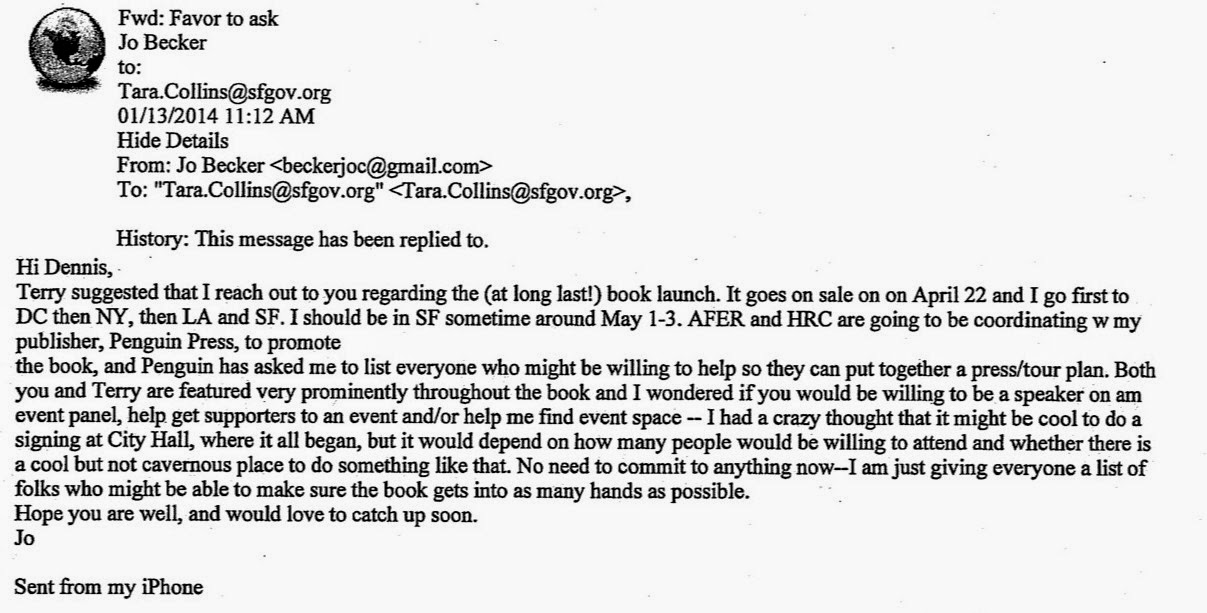
I was a little gob-smacked that Jo Becker’s book tour promotion was aided and abetted by those sources – with book parties by Ken Mehlman and Ted Olson. But we are finding out that this was only the tip of the iceberg. An inkling of this comes with the latest, ethically disturbing news that Becker’s lionized sources in San Francisco’s city government have also been promoting the book. Dennis Herrera, SF City Attorney and his aide, Terry Stewart, heroes of the book, were involved in its promotion. How do we know? Well Herrera was hosting a book event for Becker at San Francisco City Hall last week. But we also have other proof. As city officials, Stewart’s and Herrera’s emails on public business are vulnerable to public disclosure. So intrepid activist/pest/gadfly Michael Petrelis did the leg-work to get all the emails that pertained to Becker’s book. They make for interesting reading:

becker to stewart

A journalist is offering to give her sources an event to celebrate themselves while also promoting the book. Is that what the New York Times would regard as ethical conduct? Then a second email sent by Becker the next day tells us something equally remarkable:

becker to herrera

Note the following: “HRC and AFER are going to be coordinating w/my publisher, Penguin Press, to promote the book, and Penguin has asked me to list everyone who might be willing to help so that can put together a press/tour plan.” Becker wanted to sell books at the City hall event, but this raised ethical issues about using City Hall for a private commercial enterprise. How were those resolved? At Becker’s original suggestion, Herrera was inclined to place a bulk order under his “campaign/office-holder account.”

So to recap. A key and celebrated source in the book is placing bulk orders and holding a reception at City Hall for the tour, at Becker’s request. At the same time, HRC and AFER are integrally involved in the entire book tour. Both groups are part of Chad Griffin’s Hollywood-DC p.r. empire. So the main source and central hero for Becker’s book was integral to its publicity and promotion. While publicly writing that he disowned being called the Rosa Parks of the movement, Griffin has been actively and aggressively promoting the very book that says that in its first paragraph! And he was using HRC’s and AFER’s money – money donated to advance gay equality, not Griffin’s personal profile – to promote his own hagiography.

If you want more evidence that this book was access journalism at its unethical worst, here it is. Quite why the NYT Public Editor has not weighed in on this is beyond me. It’s a disgrace.

Conservatives And Immigration

Pointing_finger_48sheet

It’s not just a problem with the GOP. It’s an increasingly knotty problem for the British Tories, now trying to manage the rise and rise of the anti-immigrant United Kingdom Independence Party (a rough version of the US Tea Party). Alex Massie notes:

As I pointed out yesterday, the Tory share of the BME [Black and Minority Ethnic] vote in 2010 was exactly the same as their share of the vote in Scotland: 16%. True, this was an improvement on 2005 when only 11% of BME voters endorsed Conservative candidates but that’s a matter of only modest solace for Tory modernisers … Immigration is what you might term a Gateway Issue. You need to get past it before you can speak about other issues of more immediate concern to voters’ actual lives. You need to earn the right to be listened to. You need license to be heard. You need standing.

The discomfort of British Conservatives with immigration is not as easily conflated with racism as in the US. UKIP’s focus is as much on European immigrants (4,000 a week – exercizing their right to work and live where they choose in the EU) as on South Asian or Middle Eastern immigrants. And it speaks to something that I think is sometimes crudely over-looked in this debate. Conservatives in general are article-2618288-1D80455300000578-566_634x435more attached to the status quo than liberals, more suspicious of radical change, especially when it seems to be an ideological imposition by empowered elites. And so to live in a small town which has been ethnically and culturally very English for centuries and then to see in a matter of years a sudden and palpable Polish immigrant population that instantly changes the entire cultural dynamic will inevitably lead to bewilderment, anger, loss. It’s also true that Britain, in comparison with the US, is a tiny island, with limited resources and land. Remember also that European immigrants will almost immediately be eligible for treatment in the National Health Service and many other state benefits, and you can see why this is an issue.

And so conservatives are in a bind. They would like, in some ways, to reverse history – to never have had the 1986 amnesty in the US, or to have never agreed to enter the EU. But both those changes are effectively irreversible without incurring further massive subsequent changes which would disturb the status quo even more profoundly. And conservatives have a hard time making their legitimate case for cultural stability without seeming like bigots. It’s the same thorny problem with marriage equality: a discomfort with change but an inability to offer a viable, workable alternative, which leads to an understandable assumption that all opposition to gay marriage is mere rancid KKK-style hate.

And this is an eternal conservative problem.

Conservatism at its best is an imaginative attempt to balance stability and change in a manner which makes a society more coherent, more itself. When change happens swiftly, that balance is all the more necessary but also more difficult. At some point, mass immigration or a multi-cultural society or a gay-integrated world becomes the status quo to which conservatives will become attached. But in the meantime, they are pinioned emotionally between past and future and have not found leaders in either the US or the UK that have risen to the occasion of bridging the two. Fear and anger have thereby increasingly defined the new conservative center. And it’s currently a lose-lose proposition.

In part because I’m an immigrant and gay and live in a historically black city which is increasingly integrated, my own conservatism is of the much more moderate kind. Perhaps because I am not so threatened by racial and cultural change, I saw Obama as a quintessentially small-c conservative, a living blend of black and white, a realist abroad, a pragmatist at home, an integrator rather than a polarizer. I was an outlier, we now know. But at some point, that more moderate conservatism – one that actively celebrates a multi-cultural society as a traditional American value – will win. The question is simply how tortuous the path to that future will be. Which is why we are searching the landscape for a future Republican leader who gets this (and keep bumping into versions of Ted Cruz) and searching for a British Conservative who can do the same (and sussing out Boris).

(Illustrations: two posters for UKIP in the European elections on May 22.)

Letting Go Of Global Hegemony, Ctd

[Re-posted from earlier today]

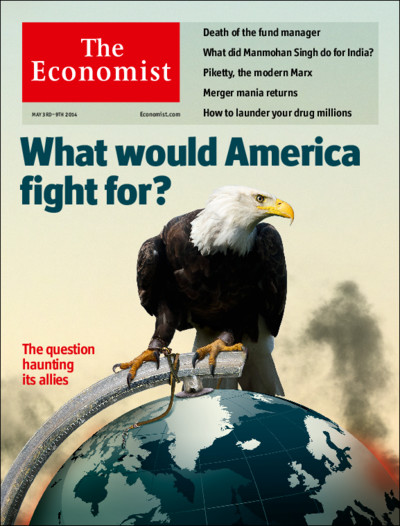
My old friends at The Economist have their nickers in a twist (look it up) about the loss of American “credibility” because there has been no military response to Ukraine, little follow-up in Libya, and a crossed red line in Syria. The leader (look it up) makes some vague and confusing statements along the way. It argues that “international norms, such as freedom of navigation, will be weakened,” if the US doesn’t somehow throw its weight around more, while simultaneously acknowledging that “America towers above all others in military spending and experience.” They concede that on Ukraine, military force would be insane and Germany and Britain have made stronger sanctions impossible as of now; they also misstate what happened in Syria. They claim that “The Syrian dictator [used chemical weapons], and Mr Obama did nothing.” Nothing? So how is it that Syria has now peacefully relinquished almost all of its chemical stockpile? And wasn’t resolving that question – and not the broader problem of Syria’s sectarian implosion – the entire point of the threatened strike? Are we supposed to prefer an option that would have dragged the US into the Syrian vortex and not guaranteed any actual success to a policy that kept us out but largely solved the problem?

The first thing to say about this is that The Economist is fundamentally a British paper. It has a vast US readership, but its DNA is British. And being British for the past several decades has meant being reliant on the US to 20140503_cna400protect its security. Of course the Brits want the US policing every nook and cranny of the world. They don’t have to pay for it; yet they get to enjoy its fruits. They argue, of course, that these are fruits for America as well. And so they are. And if anyone were even thinking of reducing America’s maintenance of international trade routes, for example, they might have a point. But policing the world with the US military is not cost-free at all – either fiscally or in more basic human terms.

Think of the Vietnam War and the Iraq War – both conceived under the influence of the hubristic fumes and the idiocy of the “credibility argument: (see Peter Beinart’s take on that particular fallacy here). Look at the country’s debt – a huge amount of which can be traced to the military-industrial complex that Eisenhower warned us so presciently about, and one that went on steroids in the first decade of this century. And look at average living standards – stagnant for three decades at least in some part because of globalization. You can argue that the US should not withdraw from the world (and I would) – but withdrawal from the world is not the same thing as prudent and sensible recalibration of resources in a debt-racked, over-extended and thereby less effective country on the world stage.

We are not, pace The Economist, still living in the post-Cold War era, when the US ran a surplus. We are living in a post-post-Cold War era where America owes inconceivable sums to China, a soon-to-be-bigger economic power. And if you want to see American influence really decline, then the best way to do that is to maintain unsustainable over-reach. You’d think Brits would have taken this lesson to heart, since that was one core reason they lost their empire as well. And history is littered with the demise of other over-stretched powers, like the Soviet Union or Imperial Spain. The future is littered with other potential over-reach victims, the most obvious of which is Greater Israel, run by many of the same neocons who drove the US into a ditch only a few years ago.

More to the point, it seems increasingly clear to me that this post-post-Cold War era is one destined to last for the foreseeable future. And the fundamentals of that era are increasingly opposed to the concept of American global hegemony.  No one can police the world today as the US did in the 20th Century. The rationale of the world’s policeman has thus radically changed. As Millman notes in a superb piece:

The rise of Japan was followed by the rise of smaller east Asian states and now the rise of the Asian mega-states, China and India. Latin America and the Muslim Middle East have grown into substantial regions, demographically and economically, and are no longer obviously under Western control (or even influence). Africa’s demographic momentum, meanwhile, will carry that continent to far greater prominence by the end of the century than it has ever achieved before.

Not only are these other powers much stronger relative to the US – an inevitable function of the success of US foreign policy in the past – but they don’t accept America’s right to dictate the contours of the global order. Russia is the most obvious example, right now. But that was the deepest lesson of the Iraq catastrophe: the Iraqis didn’t actually want the things that Americans (including me) reflexively thought they wanted. They live by different values and different priorities. The [indigenous] sect beats the [imperial] nation every time; and authoritarianism trumps democracy every time. And our attempt to force them to be live by Bill Kristol’s values only guaranteed the failure.

America’s reflexive belief that its way of the world is superior to everyone else is also increasingly, tragically, attenuated.

It will take decades to recover from the state-authorized torture and detention policies of the Bush administration and the Obama administration’s refusal to adhere to the Geneva Conventions. American democracy is widely seen across the world (and not without reason) as an oligarchy of the super-rich; its Republican hinterlands are regarded as a repository of know-nothingness; its virulent opposition to providing access to healthcare for all is seen a psychosis; its NSA is viewed as a threat to allies; its police-state airport borders the sign of a society less free than many in Western Europe. And there is no Soviet Union to point to when America is challenged on these grounds. The alternative is not obviously much worse.

Now you can go on pretending that this hasn’t happened – and isn’t still happening – as the Economist and the Beltway hand-wringers do. You can topple the Libyan regime on humanitarian grounds, just as in the olden days (except Reagan was much less interventionist). But you’ll leave a nest of Jihadists in your wake. But all this has happened – and America’s collapsing infrastructure has become an emblem of a polity in steep decline. Obama has mitigated this to a heroic extent – but the underlying reality remains. We have to let go of control; we have to stop seeing every crisis in the world as one that America has to resolve; we have to tend to ourselves before we lecture to anyone else. And this the American people understand, as poll after poll tells us. And without the American people squarely behind it, no American foreign policy can succeed.

In the Ukraine crisis you see this most vividly. We supported the Maidan revolution but its practical effect has been to render order and peace throughout the country close to non-existent. Ukraine’s reformers have some responsibility for their predicament. They pissed away the post-Soviet era in rampant corruption, military decline, and economic stagnation. They removed a democratically elected government by violence, something inimical to any hope for democratic reform. They have no coherent plan for resisting Putin’s foul expansionism. Like Morgan Stanley, they expect to be bailed out – and that helped create this crisis. I’m far from exonerating Putin. But if we fail to see the arguments behind the propaganda of the other side, we will fail.

Of course, this process of letting go will be anxiety-producing. Relative decline is never easy for a hegemon, especially one drunk on the fumes of its own self-love. There will be a backlash. But you’ll notice how few of the current critics of Obama’s vastly under-rated foreign policy don’t actually have much to say specifically about how they would better defuse these myriad ructions across the globe (and they are mere ructions compared to the past, it’s worth remembering). At some point they will begin to see that their lack of alternatives is a function of something other than their nemesis in the White House. And at some point, one can only hope, they’ll grow up.

Oh Peggy

She is now comparing Pope John Paul II to Barack Obama in terms of leadership. Guess who wins! For some reason, she fails to acknowledge that under John Paul II, thousands of children were raped by members of the organization John Paul II ran, and the machinery he was in charge of not only failed to stop this, but actively perpetuated it and covered it up. Nowhere in her column does this come up – it’s yet another reality (like American torture) she wants to walk swiftly past (“Some of life has to be mysterious”). Noonan goes on to say:

Great leaders are clear, honest, suffer for their stands and are brave. They conduct a constant dialogue.

Whatever else one can say about the pontificate of John Paul II, the idea that it was about a constant dialogue is absurd. Under John Paul II and his orthodoxy-enforcer, Joseph Ratzinger, the scope for any dialogue within the church was essentially ended. Whole areas of theological debate were ruled impermissible; discussions about faith and morals were also discouraged and any hints of heterodoxy, i.e. thinking, were monitored and punished. John Paul II’s papacy was capable of detecting the most trivial form of theological dissent and punishing it relentlessly, while it found itself miraculously blind when it came to the endless rapes and abuse of children and adolescents that we know now were endemic.

This wasn’t leadership; it was the abdication of basic moral responsibility for the church John Paul II ran. And these were not only crimes of commission but also of omission. A monstrous figure like Marciel Macial was lionized by John Paul II even as he sold drugs, was a bigamist,  abused countless young men, and even raped his own son. Cardinal Bernard Law was rewarded for his own disgusting cover-up of child-rapists with a sinecure in Rome.

Of course, it’s sometimes hard to pin down what the fuck Noonan is saying because her favorite word is “seems.” Never “is” – but “seems.” The world is always described through her own fuzzy, soft-focus lens, where no objective truth can really penetrate. And so you stumble upon the only actual substantive claim she makes in the column:

How wonderful it would be to see an American president appreciate all the possibilities of becoming a great energy-producing nation—all the new technologies and jobs, all the rebound they’d bring. To have a leader who feels and conveys a palpable joy in the transformative nature of this new world.

Here’s what Obama recently said about “becoming a great energy-producing nation—all the new technologies and jobs, all the rebound they’d bring.” It’s from the State of The Union this year:

One of the biggest factors in bringing more jobs back is our commitment to American energy. The all-of-the-above energy strategy I announced a few years ago is working, and today, America is closer to energy independence than we’ve been in decades.

One of the reasons why is natural gas – if extracted safely, it’s the bridge fuel that can power our economy with less of the carbon pollution that causes climate change. Businesses plan to invest almost $100 billion in new factories that use natural gas. I’ll cut red tape to help states get those factories built, and this Congress can help by putting people to work building fueling stations that shift more cars and trucks from foreign oil to American natural gas. My administration will keep working with the industry to sustain production and job growth while strengthening protection of our air, our water, and our communities.

Here is the SOTU from 2013:

Today, no area holds more promise than our investments in American energy. After years of talking about it, we’re finally poised to control our own energy future. We produce more oil at home than we have in 15 years. We have doubled the distance our cars will go on a gallon of gas, and the amount of renewable energy we generate from sources like wind and solar — with tens of thousands of good American jobs to show for it. We produce more natural gas than ever before — and nearly everyone’s energy bill is lower because of it.

Open your eyes, Peggy. There is world outside your 1980s nostalgia-fest. And it’s as different from your reality as “seems” is from “is”.

Letting Go Of Global Hegemony

US-POLITICS-OBAMA

Yesterday’s Wall Street Journal poll on foreign policy made for a stark contrast with the growing consensus among the chattering classes about president Obama’s foreign policy. Here’s MoDo channeling the frustration of many and addressing herself directly to Obama:

You are the American president. And the American president should not perpetually use the word “eventually.” And he should not set a tone of resignation with references to this being a relay race and say he’s willing to take “a quarter of a loaf or half a loaf,” and muse that things may not come “to full fruition on your timetable.”

An American president should never say, as you did to the New Yorker editor, David Remnick, about presidents through history: “We’re part of a long-running story. We just try to get our paragraph right.” Mr. President, I am just trying to get my paragraph right. You need to think bigger.

A great line. Until you ask yourself what exactly does she mean by thinking bigger. The closest MoDo comes is the following:

Especially now that we have this scary World War III vibe with the Russians, we expect the president, especially one who ran as Babe Ruth, to hit home runs.

Home-runs, please is not exactly a productive contribution to the discussion. What on earth would a “home-run” mean in Ukraine, for example? But this analysis misses one core fact: Americans, in polling, really do not want to be policing the world any more. Here’s one take-away from the WSJ poll:

Screen Shot 2014-04-30 at 5.17.17 PMThat’s a record 47 percent favoring a less active foreign policy than Obama has conducted. As for the “scary World War III vibe” MoDo wants reassurance on, only 5 percent of Americans want the US out front alone on Ukraine. A quarter want to delegate the issue to the EU. And almost half want action only in cooperation with other countries. The decidedly non-interventionist public also strongly opposed a strike in Syria; wanted withdrawal from Iraq and Afghanistan; and still prefer, in record numbers, for the US president to focus on domestic affairs. More to the point, this non-interventionist consensus crosses party lines. Obama has, on most issues, stayed in line with popular opinion. That’s one key reason why Rand Paul has traction. And it’s one reason Hillary Clinton will be vulnerable if she appears to want to return to neocon reflexes.

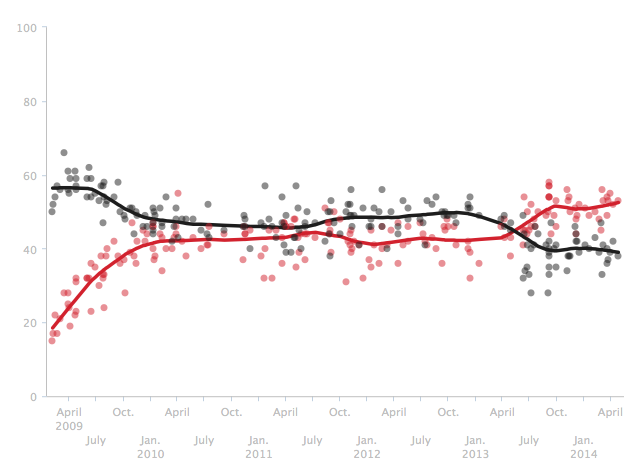
The paradox, it seems to me, is that Americans also miss the glory days. They both want withdrawal from the world but feel nostalgic for the heady post-Cold War days of easy hegemony, a budget surplus and a global reputation not stained by military occupations and torture. Robert Kagan had a shrewd column a month ago on this strange confluence of a president pursuing popular policies and becoming unpopular as a result. Here’s the poll of polls on foreign policy for Obama:

Screen Shot 2014-04-30 at 5.32.58 PM

The switch to disapproval happened about a year ago. Some of the subsequent shift may be due to the harsh criticism Obama received for not striking Syria after seeming to move toward it (even though the public wants to go to war in Syria like they want to abolish social security). Some of it may be due to Putin’s ugly machinations – prompting unreconstructed neocons like McCain to blame Obama for somehow encouraging it. The open wound of the Israel-Palestine question – where Obama has been very very active but without any progress at all – may also be a factor. But I suspect the bigger picture is that we’ve seen both an acceptance of a much more restrained America after the catastrophe of neocon governance and subsequent lingering unease about no longer being the sole superpower whose authoritah is always respected.

My view is that Obama has done about as good a job as possible in managing the core task of his presidency: letting self-defeating global hegemony go. That required a balancing act – of intervention where absolutely necessary and caution elsewhere. He prevented the world economy tipping into a second Great Depression, has maintained overwhelming military superiority and shored up Asian alliances even as he concedes, as we should, that China will be the dominant power in the region in the 21st Century. He rescued us from the Iraq and Afghanistan disasters, without chaos or immediate blowback. He’s successfully coordinating European responses to Russian aggression in Ukraine. It all adds up to the effective tending to a new era in which other countries and regions no longer accept American supremacy, and when US ideals – such as opposing torture – have been revealed as frauds.

This kind of pragmatic balancing act has none of the glory of the Cold War and a dispiriting (to some) element of retreat. But in many ways, this is inevitable. The staggering success of the West’s model in the last two decades is not one that can be sustained at the same pace. You don’t get to liberate Europe twice. And of course the biggest factors behind this new climate are the disastrous wars in Afghanistan and Iraq. They essentially revealed the US military as all-powerful on paper but inevitably insufficient to deal with sectarian hatred in the Muslim world, or running a “country” that cannot be run outside of a dictatorship or authoritarian figure. Even drones reached a point quite quickly at which their costs outweighed their benefits.

This is the essential context which makes sense of Obama’s pragmatic re-calibration of US foreign policy. What this picture reminds me of is the conventional wisdom about George H. W. Bush’s foreign policy at the time. In retrospect, his management of Soviet collapse was deeply under-rated, as was his decision not to invade Iraq. Like Obama, he saw China as a naturally emergent power to be coaxed rather than alienated. Like Obama, he tried and failed to move the Israelis out of their new project of Greater Israel. He was never going to be a Reagan, but in politics and world affairs, timing is everything. The difference, of course, is that Bush followed Reagan, whereas Obama followed the foreign policy equivalent of two terms of Jimmy Carter. So the bathos of pragmatism is all the more vivid this time around.

The one exception to this picture with respect to Obama is the overture to Iran. If he manages to resolve the nuclear issue in the next year, it will be a clear and revolutionary break from the past, as well as being the sanest approach to handling that poisonous but rational regime. But again, his success, if it occurs, will prompt more cat-calls from the neocons and loathing from the hard right. And it will not be greeted with the same relief as the end of the last Cold War, not least because the ayatollahs will remain in power, even if the landscape then shifts against them. Avoiding war is often not as popular as starting one. But it is what this country wants at this juncture in history, and it’s what the world needs. In the end, even queasy Americans may see the pragmatic sense in much of it. But they’ll keep it quiet if they do.

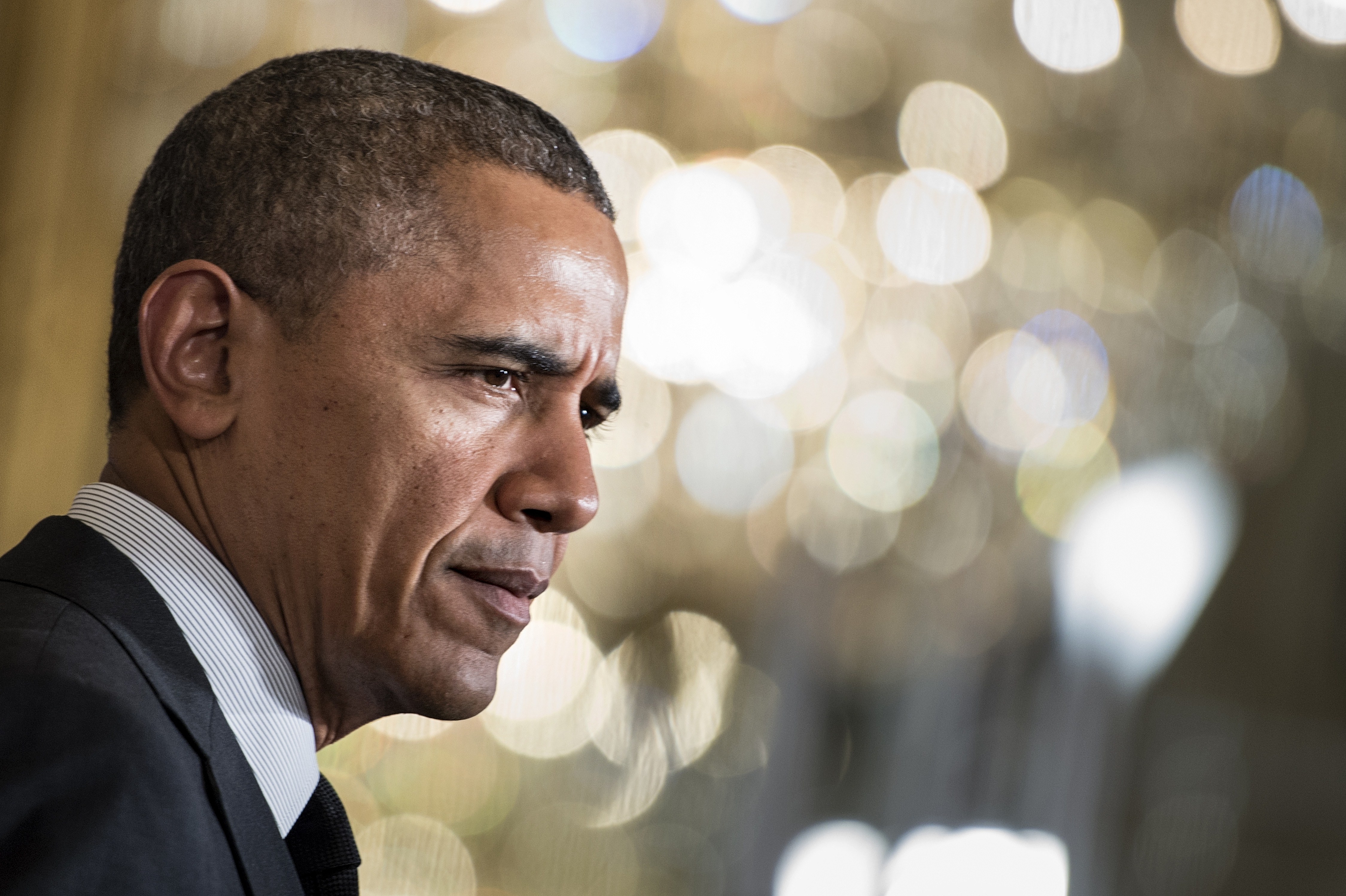
(Photo of Obama yesterday by Brendan Smialowski/Getty)

John Kerry Tells The Truth … Therefore He Has To Apologize, Ctd

The above tweet is not exactly atypical of many supporters of Greater Israel. And David Harsanyi rightly bemoans its absurdly broad brush. But then, rather than responding to the substance of my post on John Kerry’s truth-telling at the Trilateral Commission, he insinuates that I am also anti-Semitic and even links to the poisonous and deranged screed that Leon Wieseltier maliciously penned about me.

Sigh. Harsanyi disputes the term ethnic cleansing to describe what happened in 1948. Maybe that term, along with the invocation of the a-word, inflames more than it enlightens. But it remains true that around 700,000 of the 1.2 million inhabitants of Palestine were either evicted from their homes or fled during the war of independence for Israel. All of them were Arab. In 1946, the Jewish share of the population of Israel was 30 percent. In 1950, it was closer to 50 percent. By the 1970s, it was over 80 percent.

Now we can debate for ever the nuances of this, who was to blame, etc. (and the Arab world definitely shares that responsibility, by its intransigent and violent stand against a Jewish state). But that’s a massive demographic shift along religious and ethnic lines. If today, 700,000 inhabitants of a country were expelled or fled to make way for a population of a different ethnicity, and if the ethnic/religious majority was changed in a matter of a few years, I don’t think we would be debating the question of ethnic cleansing. And it is that history that hangs over the ethnic engineering Israel is attempting on the West Bank. On that occupied land, Israel is settling hundreds of thousands of Jewish Israelis, in order to shift the demography some more. It is my contention that this further act of colonization is completely incompatible with any short- or long-term two-state solution; and that the Israeli refusal to stop it – even during negotiations – is the essential obstacle to any possible peace agreement. And using Occam’s razor, I cannot see any reason for it other than a longstanding commitment to build the Jewish state with a Jewish majority over the entire territory in dispute.

Harsanyi says I single out only Israel for censure. Of course that’s untrue. The very day I wrote that post, we also covered the appalling regime in Egypt. We covered the foul regime in Iran obsessively in 2009. We haven’t shied from the gruesome human toll in Syria, even as I oppose deeper intervention there as well. So to Harsanyi’s point, I favor ending aid to Egypt as well as to Israel, and I’ve written so several times. My own view is that the US should do what it can to get out of meddling in the entire Middle East. It’s a mug’s game, in which the eternal loser is the US.

Harsanyi further insinuates that I regard the Greater Israel lobby as the only force for Israel’s interests vis-a-vis America’s in American politics. Again not true. Yes, the lobby is ferocious and intransigent and disciplined and, in my view, has actively worsened Israel’s global position in the last decade. But it would not have that clout without overwhelming American identification with Israel as opposed to Palestine’s Arabs, or indeed anywhere in the Arab world.

The trouble is that that emotional support can, in my view, prevent Israel from taking necessary steps to salvage its reputation, its morality, and its survival as a Jewish state.

Max Fisher rightly points out that the apartheid metaphor could lead some to infer that a Jewish state should be abolished just as the Afrikaner state was. That’s not my view at all. My view is motivated primarily by frustration at Israeli extremism but also by a view that a Jewish state must survive and prosper as a moral cause. Because I’m so harsh on Israel’s policies right now, that might seem surprising to some. But if I weren’t committed to a Jewish state in existence as a safe harbor for the Jewish people, I wouldn’t even be writing about this much at all. My view – shared, for example, by the current Israeli ambassador to the US, Ron Dermer – is that a Jewish state permanently disenfranchising a hefty proportion of the people it controls is immoral and self-destructive and toxic to the entire enterprise and unworthy of the great civilization that the Jewish people, against hideous odds, have constructed over the centuries. And no amount of insinuation or name-calling is going to make me change my mind.

John Kerry Tells The Truth … Therefore He Must Apologize

The state of Israel controls a large amount of neighboring territory, seized in war, in which the inhabitants are divided by ethnicity, with one group, the original inhabitants of the land or refugees from ethnic cleansing, are systematically disadvantaged compared with the other. They are penned into eight distinct areas from which they have to get through checkpoints to move around. They have no right to vote for the government that controls their lives. This arrangement has now lasted a year longer than the apartheid regime in South Africa – and, unlike John Kerry Makes Statement On Ukraine At U.S. State Departmentthat regime, looks set to continue indefinitely. It also comprises a massive project of ethnic and social engineering in which the dominant ethnic group continues to settle the occupied territory in an attempt – forbidden by the Geneva Conventions – to change its demographic nature.

None of this is in dispute. But when an American secretary of state explains this in private he is forced to recant publicly. And that surreal kabuki dance is an almost perfect symbol of why US engagement with Israel-Palestine is, at this juncture, such an enormous waste of time. The US is barred from telling the truth, which makes a real negotiation impossible. The Israelis know that they will never be subject to real US pressure, because the US Congress stands ever-ready to do whatever Israel asks. And so the beat goes on.

You can, of course, debate for ever who bears the blame for the Israel-Palestine clusterfuck at any specific point in history, and for a while the Palestinians were the more serious obstacle to any kind of settlement. They bear some real responsibility for the nightmare they now live in. You can also point to various moments before and after the violent establishment of the Jewish state when something better might have been achieved, and both sides bear the blame at various junctures. The launching of the second Intifada and the assassination of Rabin, for example, were fateful moments – when extremists seized the initiative. You can also (rightly) note that the occupation of the West Bank Two Palestinian activists sit inside asbegan as a defensive maneuver, and therefore should not be regarded as some kind of naked colonial enterprise, but as a matter of self-preservation. You can also rightly note that, compared with all its neighbors, Israel’s rambunctious democracy is a beacon – if only it weren’t also the means for the permanent suppression and humiliation of an entire people, whose land and homes were taken from them by force of arms.

But what you cannot argue, it seems to me, is that continued American financial and military support for the maintenance of this mess makes any sense at all, and that continued American diplomatic engagement is in any way a rational policy. The US president simply does not have the power to force Israel to stop its illegal, immoral and foul settlement of the West Bank – because the Israel lobby controls this aspect of foreign policy through the Congress, whoever is in the White House; and so we are committed indefinitely to supporting a de facto apartheid regime in perpetuity. That support drives a stake through any attempt to repair relations with the Muslim world, and establish a better diplomatic position with which to isolate and pre-empt Islamist terror. And so we remain trapped in this nightmare – held responsible for everything Israel does (with good reason) and yet unable to stop or affect any of it. If your marriage were like this, your best bet would be a divorce. And it’s coming to the point where America needs to do the same thing with Israel.

My view is that we should therefore end any and all government aid to the Jewish state, and stop using our UN veto to protect it from appropriate international censure.

We should withdraw from any direct negotiating role between the two parties, and try and make the broader international situation more conducive to Israeli withdrawal and Palestinian moderation. At the same time, we should support Palestinian efforts to join international organizations, and be willing to be part of any international force that could police an eventual two-state solution. We should attempt to create a great power coalition, like the one pressuring Iran, to come up with a proposed territorial solution.

Is this an attack on Israel, a Jewish state many of us support in principle but find increasingly difficult in practice? I’d argue not. I’d argue that the dysfunctional relationship between Israel and the US Congress makes American attempts to be an honest broker in the dispute a farce and helps sustain the intolerable occupation indefinitely. The US alienates the Israelis and the Palestinians by this relationship, and the Meeting of Vladimir Putin with Benjamin Netanyahu in Kremlinrest of the world increasingly sees the US as simply an obedient and very powerful poodle for the Israeli government. By disengaging, we at least free ourselves from a lose-lose position, which hobbles US foreign policy in other ways. For Israel to seek both to annex the West Bank permanently and also be allied with the West is not something the West can reciprocate indefinitely without abandoning core democratic values.

No doubt these arguments will mean I will be accused of anti-Semitism or anti-Zionism. I’m resigned to that. That too is part of the dead-end. For my part, I still believe in the dream of a free and Jewish state in the ancestral homeland, democratic and prosperous, and have nothing but profound admiration for its achievements and tenacity and acts of benevolence and entrepreneurship around the world. I just do not believe a friend allows a friend to spiral into self-destruction and the abandonment of its ethical core. I think we’ve done about all we can to help achieve a settlement through direct diplomacy – but the Obama years have proven irrefutably that, at this late stage, it’s worse than useless.

It’s time for a divorce. Which is the only thing that could make a functional relationship with Israel possible again.

(Photos: John Kerry by Alex Wong/Getty; Netanyahu and Putin by Dmitri Azarov/Kommersant via Getty Images; Two Palestinian activists sit inside an Israeli bus as it rides between a bus stop outside the West Bank Jewish settlement of Migron, near Ramallah, and a checkpoint leading to Jerusalem, on November 15, 2011. By Ahmad Gharabli/AFP/Getty; Netanyahu and Putin by Dmitri Azarov/Kommersant via Getty Images.)

John Kerry Tells The Truth

John Kerry Makes Statement On Ukraine At U.S. State Department

The tectonic plates beneath the US-Israel co-dependent relationship have begun to shift in the last few years. One obvious reason is that the traditional notion of the US trying to broker a two-state solution in Israel/Palestine has now become a target of deserved ridicule. I’ve begun to find myself halting even to use the words “peace process” to describe Israel’s relentless de facto annexation of the West Bank. It seems increasingly like an abuse of the English language and a fiction that no honest observer can really attest to as reality.

From George W. Bush’s “road map” onward, the Israeli government has played the US to the point of absurdity. It first waged a brutal air war on Gaza with impunity. Then it resumed its aggressive and relentless expansion of colonial settlements and settlers on the West Bank. Netanyahu has recently shown he’d rather release murderous terrorists from jail than give up an inch of Greater Israel. The Israeli public has no interest or belief in compromise, as the hard right strengthens its grip on the country’s politics and as the settler faction maintains a stranglehold on the central government. The Israeli economy can continue to flourish even as the the Arab subjects of Greater Israel remain mired in a vast de facto holding pattern, without dignity, without a vote, without any leverage in any peace process. They are behind the wall, and kept in fences. And this is perfectly sustainable for the indefinite future with enough force of arms and economic growth, as the indispensable Roger Cohen recently argued.

The Kerry initiative – his frenetic, relentless attempt to make some progress – reveals merely, I’m afraid, that there is no progress to be made. The entire trajectory of Israel’s founding to today, as John Judis has ably demonstrated, has been the continuous resolution to create a Jewish state all across Palestine, and to slowly punish and immiserate any Palestinians caught on the wrong side of the line, in the hope that they will leave. It would be great to believe that this were not so, but that would require wiping the last decade from our collective memory. I used to believe that Israel was desperate for peace and that the main sticking point was Palestinian intransigence. You could plausibly have held that view a decade and a half ago, but surely not any more.

Palestinians on the West Bank remain as they long have been, kept in tightly controlled areas with checkpoints in between, denied the right to vote for the government that controls their every move, and subject to financial and economic leverage from the Israeli state. Meanwhile, privileged Jewish settlers are given incentives to colonize the Palestinian land, and Israel barrels ahead to make sure no part of Jerusalem could ever be the capital of Palestine. I don’t know of any US ally that behaves this way. I don’t know of any ally that keeps whole populations under its control without a right to vote, and does so on ethnic and religious lines. The last one that did so was South Africa.

If we are talking definitions of words, this is of relevance:

According to the 1998 Rome Statute, the “crime of apartheid” is defined as “inhumane acts… committed in the context of an institutionalized regime of systematic oppression and domination by one racial group over any other racial group or groups and committed with the intention of maintaining that regime.”

How does that not describe the West Bank and Gaza? It may offend some to think of the Jewish state as increasingly like the old South African one. But that, alas, is solely because the the hopes of the past still occlude the ugly reality of the present. It seems to me important that if the United States has no real power to change that brutal unending reality, it can at least call it what it is.

(Photo: Alex Wong/Getty)