A Conversation With John Heilemann

The State Funeral Of Former South African President Nelson Mandela

In the craziness of our first renewal push, we put projects for Deep Dish on hold – in part because the workload was already overwhelming and in part because we did not know if we would have the revenue to keep it going this year. The good news is: we are confident enough that we can begin to add content again to our long-form, subscribers-only essays and podcasts. We still don’t have the budget to plan ahead much – help us get there by renewing here or subscribing here for just $1.99 a month or $19.99 a year – but we can definitely start creating content deep-dish-buttonfor it again.

We’ve made one change: we’re not going to create Deep Dish every month in one big content-dump. I realized I’d adopted a classic magazine model for long-form – because that was what I had been used to in legacy journalism. But on the web, we don’t need to have one monthly deadline, and you don’t need to read or listen to the essays and podcasts in one intimidating lump.

So we’re adding Deep Dish items as we go along in more digestible portions. First up: some crack for all you political junkies. It’s a chat with my old friend John Heilemann, New York magazine writer, co-author of two of the best campaign books out there, Game Change and Double Down, and one of the sharpest political minds out there. We cover the gamut of topics, from weed to steroids to the 2012 race and the web. One major focus is the Hillary Clinton campaign – someone John has covered for many years. Here’s a short clip from our discussion of the Clinton juggernaut now rumbling down the track toward us:


And here’s a snippet from our discussion of Obama’s potential legacy as president:


It’s not a TV interview; it’s not a book-plug. It’s just a conversation you’d never be able to have on radio or TV.

Check it out on Deep Dish here. If you’re a Founding Member, and haven’t gotten around to renewing yet, this is, for many of you, the last day you’ll have access to Deep Dish (subscriptions that began February 4, 2013, expire today). So take this as an opportunity – okay, another nudge – for renewing and ensuring you are never shut out of content you’ve already helped to finance.

Renew here! Renew now! Or subscribe here if it’s your first time. It takes just two minutes and can give you full and complete access to the Dish, including Deep Dish, from here on out.

(Photo: Getty Images)

Contraception Defeats Abortion

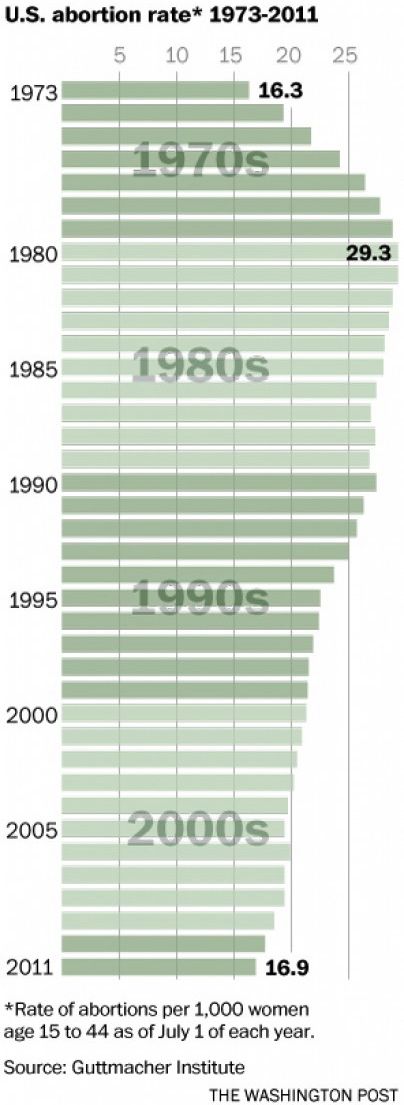
That’s the take from the Guttmacher Institute on the fantastic news that under Obama, abortion rates have fallen yet again. They attribute the decline in abortion rates to newly effective contraception methods such as the IUD as well as the recession. Some pro-lifers are crediting w-Abortion-02the wave of restrictive legislation passed since 2011, but the data only go up to 2011! And besides, the drop has been going on for more than twenty years now, in a huge success for the pro-life movement, and for the pro-choice movement.

Which makes this moment such a telling one. The rate is now roughly where it was in 1973, when Roe went into effect. So without getting rid of the legal regime for abortion, rates are now almost where they were before it came into effect. It seems to me that this somewhat brutally undermines the case for a policy of coercion and criminality going forward. If we can halve the rate of abortion under Roe, and effectively make its impact neutral on abortion rates, without criminalizing abortion, don’t we have a win-win?

And this is surely where the Catholic Church in particular needs to make a choice, it seems to me. If abortion is by far a worse evil than contraception, and if contraception clearly dramatically reduces the chances of abortion, then there is a moral imperative to end the regime of Humanae Vitae (the papal ruling that rendered all sexual activity outside marital, unprotected sex a terrible sin).

The argument of Humanae Vitae made no sense at the time and still doesn’t (and was imposed by Pope Paul VI over the objections of his own commission into the subject). But rigidly sticking to an unpersuasive rule when it may be leading to the far worse evil of abortion, is a function of fundamentalist perversity.

We now have the evidence to support the contraception-vs-abortion argument. Why cannot the church or the religious right (which has historically had no problem with contraception) seize on the near-halving of abortion rates in twenty years and aggressively redouble the contraceptive strategy that has been so successful? Or is their obsession with criminal prohibition related to issues other than the saving of potential human life?

Update from a reader:

I just wanted to mention that while the current iterations of the IUD may be new compared to oral contraceptives, I wouldn’t call the IUD “newly effective.” American women have just been slow on the uptake since the failures of the early versions decades ago. Women in many European countries, for example, have been using the IUD for a lot longer. I mention this as a very satisfied (American) customer who has had one for nearly 8 years.

Also, as you raised the issue of Catholicism and abortion – I don’t know if you’ve looked through the more detailed findings [pdf] from the Guttmacher report, but nearly 30% of women getting abortions identified as Catholic!

Debating Woody Allen On Super Bowl Sunday

188110379ST037_Celebrity_Si

The only thing I can infer with absolute certainty from the anguished letter Dylan Farrow has written to the New York Times is that she is expressing incandescent rage. I cannot know from a distance what exactly is the reason for that rage, but she hates her former step-father adoptive father, Woody Allen, with an intensity completely compatible with child abuse, and hard to explain away entirely without it. You can see how truly she hates him from her opening and closing lines. These are sentences designed to do as much harm to Allen as he allegedly did to her – to pin the crime of child-rape onto every movie he has ever made, to obliterate his legacy as an artist by insisting that his entire oeuvre be viewed through the prism of his monstrousness. I can fully understand the impulse. Can’t you?

At first you think this is melodrama, but then you realize she is simply wielding the most lethal weapon she has:

What’s your favorite Woody Allen movie? Before you answer, you should know: when I was seven years old, Woody Allen took me by the hand and led me into a dim, closet-like attic on the second floor of our house. He told me to lay on my stomach and play with my brother’s electric train set. Then he sexually assaulted me. He talked to me while he did it, whispering that I was a good girl, that this was our secret, promising that we’d go to Paris and I’d be a star in his movies. I remember staring at that toy train, focusing on it as it traveled in its circle around the attic. To this day, I find it difficult to look at toy trains.

I’m not sure how, especially after reviewing the evidence Maureen Orth collected over twenty years ago, you manage not to believe Dylan Farrow – even though in every hugely dysfunctional family, there is more than one side. But the fact that Mia Farrow may be a few sandwiches short of a picnic doesn’t prove that Woody Allen isn’t a monster. And Farrow’s anguished yet vicious letter makes a lot of emotional sense coming after the Golden Globes’ celebration of Allen’s lifetime of achievement. Then there’s what we already know of Farrow’s behavior as a child:

Several times …  while Woody was visiting in Connecticut, Dylan locked herself in the bathroom, refusing to come out for hours. Once, one of the baby-sitters had to use a coat hanger to pick the lock. Dylan often complained of stomachaches and headaches when Woody visited: she would have to lie down. When he left, the symptoms would disappear. At times Dylan became so withdrawn when her father was around that she would not speak normally, but would pretend to be an animal.

These are classic indicators of abuse – along with plenty of other eye-witnesses to Allen’s creepy behavior around the girl.

And yet Dylan Farrow will, I’m afraid, fail in this case.

Not entirely. Re-reading that Orth piece and absorbing that letter definitely impacts my view of Allen as a whole. It reminds me again of who this man is. Like when we’re watching a Polanski or a Gibson movie, there will always be, for most of us, a tinge of guilt, even distant complicity, in admiring the craft of a man whose predilection for relationships was with women utterly under his totalitarian control. But the brutal truth is: we will move on. His art and his craft is so extraordinary in its range and scope and creative integrity that it escapes the twisted psyche that gave birth to it. It does things for us as viewers and as human beings that can eclipse the reality Dylan Farrow wants smack-dab in front of our eyes.

In some ways, I wish this weren’t so. It would be a less fallen and compromised world. But the human mind can, alas, live quite fully in places where the practical moral conscience seems irrelevant. And so it is essential to understand Heidegger’s foul complicity in the Third Reich but impossible to reduce his world-historical genius to it. That T.S Eliot was a rancid anti-Semite does not, frustratingly, dilute the perfection of the Four Quartets, nor does Philip Larkin’s racism alter the triumph of Aubade. Jefferson’s thought and career, for that matter, will always elude the facts of his ownership of human beings and intercourse with some of them. Perhaps with less essential talents, the sins may more adequately define the artist. But that, in many ways, only makes the injustice worse. Those with the greatest gifts can get away with the greatest crimes.

We can and should rail against this, while surely also be realistically resigned to it. It struck me, for example, rather apposite that as the blogosphere is debating whether to boycott Woody Allen’s films in the future because of this horrifying story, exponentially more people are tuning into the Super Bowl to watch a game we now know will render many of its players mentally incapacitated in their middle ages and beyond. We know that this spectacle is based on the premise of brain damage for many of its participants, but we watch anyway. Reforms in the game that might change the number of concussions are resisted by the fans as ferociously as by the owners. And in the excitement of the game, such things are so easy to obliterate from our minds. We forget that this massive industry knew full well what they were doing and yet subjected human beings to this fate for years. They abused people’s bodies and minds for money – and now we are required to celebrate their entire cult en masse for one night.

I imagine the family of a former football player whose brain was turned into swiss cheese by this organization might find it as painful to watch the Super Bowl as Dylan Farrow did to witness the Golden Globes. But we will watch anyway.

Humankind cannot bear very much reality. Or only so much. And only so often.

(Photo: Director Woody Allen is seen on February 1, 2014 in New York City. By NCP/Star Max/GC Images via Getty.)

The Dish, Year 2: Update

David Carr has a column on various models for the future of online journalism and the Dish reader-backed concept is one of the more promising. Here’s why:

Screen Shot 2014-01-30 at 1.50.16 PM

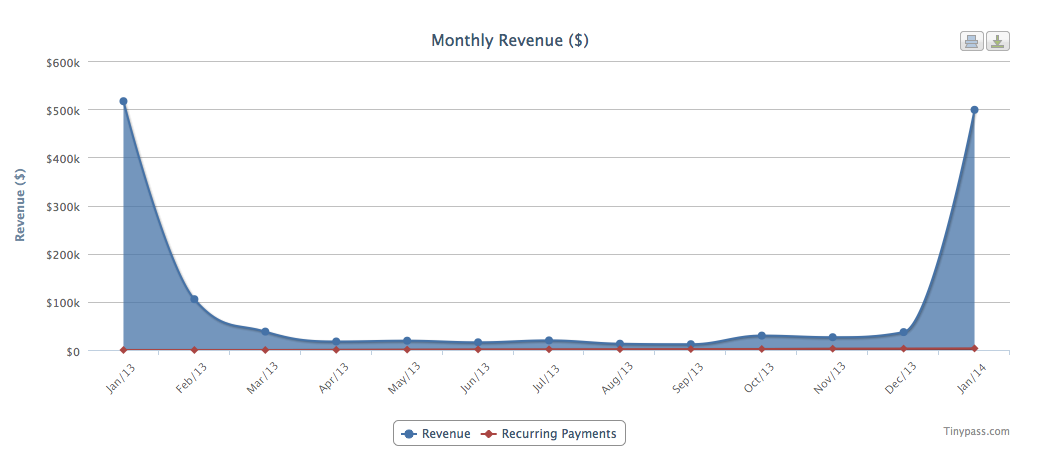
In a little over two weeks, we’ve raised as much new revenue as we did in all of last January. We’re now at $499,000, compared with $516,000 in 2013. And many of you have yet to get around to renewing, since your subscriptions only actually expire for the first Founding Members starting February 4. The reason we’re doing better in money terms despite fewer subscribers is that the average price for a sub has gone up from around $31 to close to $38. If that trend continues with future renewals, we can really start shaking things up.

We had our weekly meeting last night at our regular diner. Here’s what we were talking about: how to develop and innovate and expand Deep Dish, if the resources emerge to do so. After all, our budget last year did not include Deep Dish, which had to remain in prototype for lack of staff, money and simply time. If this year’s budget increases in line with your subscriptions, it opens up far more territory for commissioning and publishing original journalism from the best writers out there. Right now, putting out this blog every day is a full-time task for an editorial staff of six (with three interns). But for the first time, we see glimmers of the revenue that could actually make Deep Dish a part of the rejuvenation of quality journalism on the web.

So help us get there. We’ve got just a day and half to reach last January’s total: a day and a half to add $17,000. If you’ve always intended to subscribe and have never gotten around to it, subscribe for the first time here (for just $1.99 a month or $19.99 a year). If you are already a rampart of this new model: Renew here! Renew now! We’ve already begun to make a difference. If we keep going, we can do much more.

Update from a reader just now:

Perhaps you can remind us how we can purchase gift subscriptions too? I have some extra-cranky Tea Partying in-laws who could use some Dishness in their lives. Or, at the very least, I can sling some more money your way!

The gift subscription link is here.

Who Can Beat Them?

The State Funeral Of Former South African President Nelson Mandela

This is what you call “inevitability”:

Clinton stands at an eye-popping 73 percent in a  hypothetical 2016 primary race with Biden, the sitting vice president, who is the only other candidate in double digits at 12 percent. Massachusetts Sen. Elizabeth Warren, who has signed a letter along with a handful of other Democratic senators urging Clinton to run, is at 8 percent. And that’s it.

That lead is almost three times as large as the one Clinton enjoyed in Post-ABC polling in December 2006, the first time we asked the 2008 Democratic presidential primary ballot question.

Yes, the same was said last time as well, and she still managed to screw it up. But this time, there is no Obama in the wings, and this time, her coronation would follow a humiliation in 2008 and rehabilitation as secretary of state. Obama has also broken the barrier of an African-American president, and Democrats will find the appeal of the first woman president – and the gender gulf that could thereby open up – irresistible.  Even veteran Clinton-skeptics, ahem, find the appeal of a woman president galvanizing – the perfect way to add charisma and excitement to a very establishment and uncharismatic figure. Then there’s the Bill factor – a second Clinton presidency would be a reprise of the two-for-one package of 1992 and 1996. But this time, it would import into the White House the best political salesman in the country, with invaluable foreign policy experience and chops. If Hillary wins, Bill should be secretary of state. A formal role on the world stage is far preferable to an informal role on the inside fucking everything up.

What do her Democratic opponents have that could possibly match this appeal? And whom do the Republicans have? Their centrists are pedestrian, Pawlenty-style Midwesterners with little of the personality and star power that a presidential campaign demands. I mean: Walker? Kasich? They’re solid governors, but … it’s hard to see them in the White House. The base faves – a Ted Cruz or a Rand Paul – could get the nomination pretty quickly, given the new primary calendar and rules. But it would be very hard to frame a race between Clinton and, say, Cruz, as anything but a Johnson-Goldwater moment.

Which leaves Jeb Bush. It would, I guess, be a fitting testimony to the stalling of social mobility in America that a race in 2016 could be between a Clinton and a Bush, just as it was in 1992.

But since American politics is essentially an aristocratic, nepotistic oligarchy pretending to be a meritocratic democracy, many will presumably shrug their shoulders. Bush brings two things to the table: access to the big donor base, and raising the share of the Latino vote for the GOP. But it is hard to see Jeb really being able to unite the establishment and the Tea Party, without some serious internal ructions. And dynasty hurts Bush in a way it doesn’t Clinton.

Bill Clinton’s presidency now appears to have been an elysian time of peace and prosperity. George W Bush’s remains a recurring nightmare for many, especially Independents. And Jeb may not run anyway.

Of course, I may be missing something that throws all of this up in the air – like Christie’s bridge scandal. A scandal could emerge from the shadowy nexus of money, power and influence that comes with the Clinton network. Bill’s zipper could malfunction again. Hillary’s or Bill’s health may conceivably impact the race. Or simply “events, dear boy, events” could shake everything up.

What fascinates me is not just the dynamics of the race that is shaping up, but what could happen after. Imagine the GOP losing to Obama twice, and then losing to their bugaboo of the 1990s in 2016. Wouldn’t that be a shattering blow to morale? Could the GOP be drifting toward its role in the 1950s and 1960s again – a dyspeptic regional party with no ability to win a national majority? Or would a third presidential defeat in a row (and the fifth loss in in the national vote in six elections) lead to a civil war from which a saner Republican party could emerge at last?

I don’t know. But I don’t think this combination of factors will be boring.

Live-Blogging The SOTU 2014

US-POLITICS-STATE OF THE UNION-OBAMA

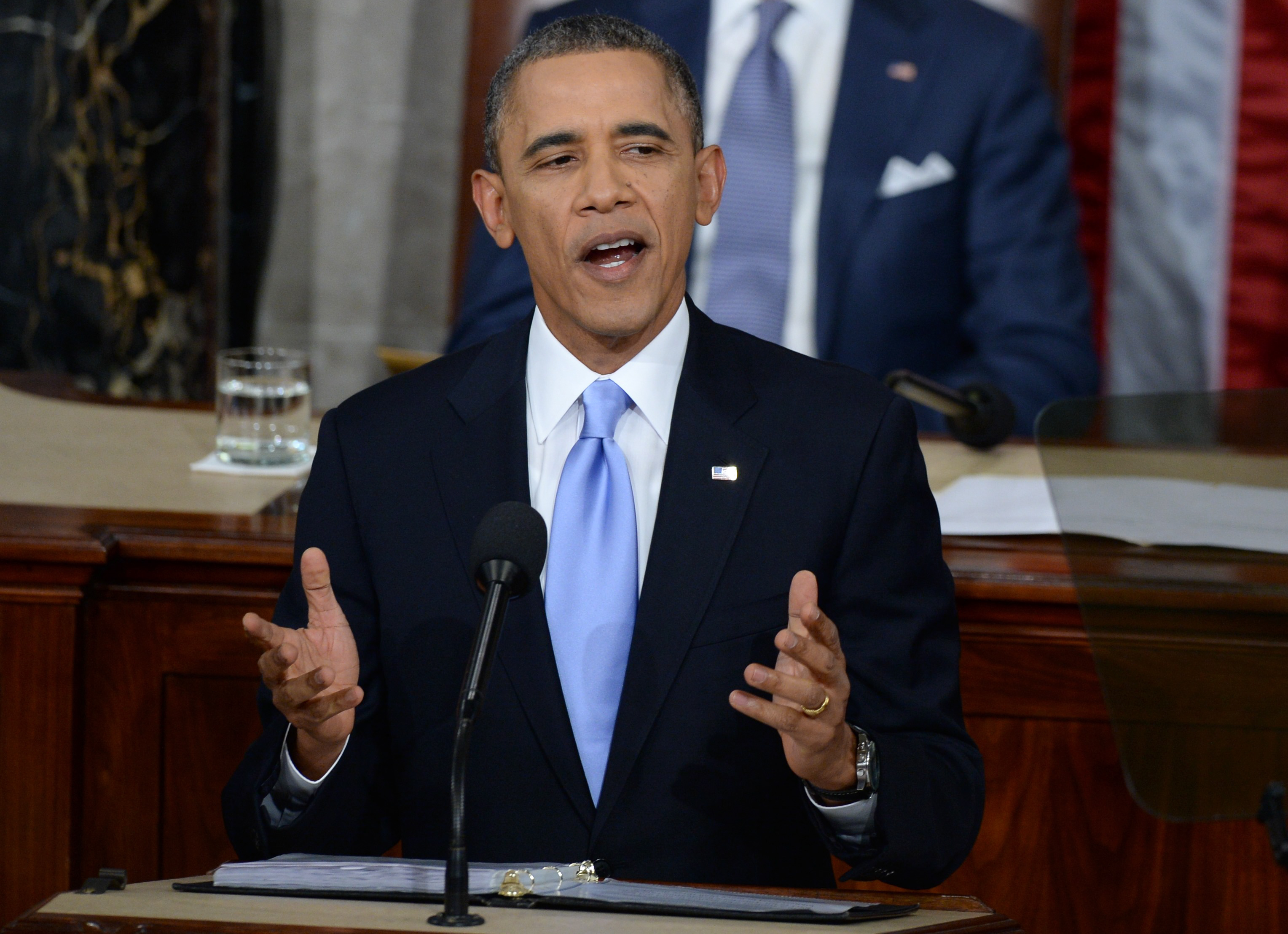
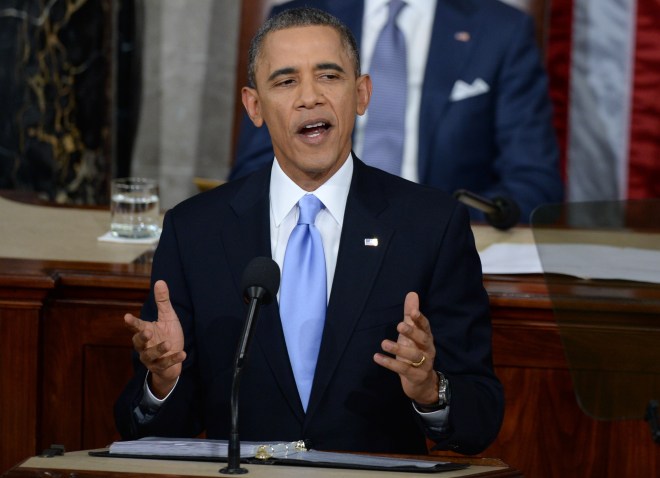
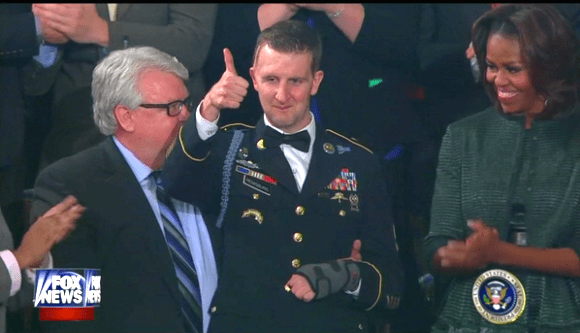
10.22 pm. The metaphor of the soldier slowly, relentlessly, grindingly putting his life back together was a powerful one for America – and Obama pulled off that analogy with what seemed to me like real passion. One aspect of his personality and his presidency is sometimes overlooked – and that is persistence. He’s been hailed as a hero and dismissed as irrelevant many times. But when you take a step back and assess what he has done – from ending wars to rescuing the economy to cementing a civil rights revolution to shifting the entire landscape on healthcare – you can see why he believes in persistence. Because it works. It may not win every news cycle; but it keeps coming back.

If he persists on healthcare and persists on Iran and persists on grappling, as best we can, with the forces creating such large disparities in wealth, he will look far, far more impressive from the vantage point of history than the news cycle of the Twitterverse sometimes conveys.

This was True Grit Obama. And it was oddly energizing.

10.17 pm. Why the fuck do I have tears in my eyes? Because what our servicemembers have sacrificed must never be forgotten. I saw “Lone Survivor” with Mikey Piro last night. Mikey, as some Dish readers will know (listen to the podcast here) served as a commander in Iraq, and now struggles with and overcomes PTSD each day. I was under my seat most of the movie. It’s a brutal combat picture. Mikey was fine, until the very end as the real-life photos of lost soldiers were displayed. Then he sobbed a little. I’ve heard several presidents invoke military heroism in their speeches. I cannot recall one so moving.
unnamed

10.12 pm. Another Obama-supporting reader bucks up a bit:

Does Obama’s shift in tone and confidence on the ACA signal that this could be a mid-term issue that Democrats will run on, not from? Did he intentionally let the Republicans endlessly call for repeals without much fanfare, so that Democrats can hoist them by those votes?

Maybe. But the idea that running on universal health insurance is an inevitable loser has always seemed dumb to me. What the Democrats need to do is stay simple: tell the human stories of those finally getting the care they need; capture the emotion and relief; appeal to a common decency. And demand that the GOP offers an alternative. When they do – and a whole lot of it looks a lot like Obamacare – this debate could turn.

10.10 pm. A reader writes:

This speech tonight reminds me why I voted for Obama.  I think the GOP made a ghastly strategic error in choosing to stand only for obstruction, and Obama is driving them into the mat on it tonight.  He’s clearly channeling the sane middle in the US electorate.  The 47 percent of the nation inside the Fox bubble won’t change their minds.  But Obama is reminding the majority that voted for him just why they did.

10.04 pm. Obama is now channeling his inner Eisenhower who understood better than any neocon the limits of American force. This is why I supported him in 2008:

We counter terrorism not just through intelligence and military action, but by remaining true to our Constitutional ideals, and setting an example for the rest of the world.

This is the money quote on Iran:

These negotiations do not rely on trust; any long-term deal we agree to must be based on verifiable action that convinces us and the international community that Iran is not building a nuclear bomb. If John F. Kennedy and Ronald Reagan could negotiate with the Soviet Union, then surely a strong and confident America can negotiate with less powerful adversaries today.

9.56 pm. This is the strongest defense of the ACA I’ve yet seen him give before a large audience. It’s about time. I don’t think he can still achieve what he wants to achieve without strongly making the case for universal healthcare: morally, economically, ethically. Bringing in the Kentucky governor was a nice touch, and goading the Republicans to offer an alternative appeals to Independents. But you get the sense that he knows – and the Republicans know – that large swathes of the bill will never be repealed, and much of it is approved of, when you isolate any actual part of it. It may be that the defensiveness on this may begin to fade.

9.55 pm. Someone’s attention is wandering:

9.51 pm. Yes, the minimum wage is lower than it was under Reagan. In a far tougher time. What I liked about this section, though, was how it spoke of the private sector as leading the way, and demanding that Congress follow. Announcing his own decision to raise the minimum wage of federal contractors also got out of the dynamic that has the president begging Congress to act. He still is. But not so pathetically.

9.48 pm. The speech is gaining momentum. This is powerful on the minimum wage:

Americans overwhelmingly agree that no one who works full time should ever have to raise a family in poverty.

9.46 pm. He’s not giving up on the gender gap either, is he? Money quote:

This year, let’s all come together – Congress, the White House, and businesses from Wall Street to Main Street – to give every woman the opportunity she deserves. Because I firmly believe when women succeed, America succeeds.

9.44 pm. Arne Duncan got some serious mileage this year, didn’t he?

9.40 pm. That letter from Misty DeMars puts the best possible gloss on the duty for government to help those in need. It also put a female face on it – and a mother’s. No accident either that the example of educational achievement was a young Latino man.

9.37 pm. If you are just tuning in to see how this president looks and feels, this performance must surely give the impression of executive energy, and some new, second term confidence. If you thought Obama had been rattled by that tough fifth year, you might be reassessing your assessment. That challenge to the Congress on expired unemployment insurance was strong. There’s passion in him tonight.

9.33 pm. Finally, some necessary, strong, emphatic dismissal of climate change denialism:

“The debate is settled. Climate change is a fact. And when our children’s children look us in the eye and ask if we did all we could to leave them a safer, more stable world, with new sources of energy, I want us to be able to say yes, we did.”

That’s more like it.

9.29 pm. The theme so far is practical, specific and optimistic. Of course, not much is likely to come of it. But reframing his second term as a renaissance of the American economy is not untrue and breaks out of the rubric that he’s a lame duck going nowhere. But it’s also kind of dry, and listy. But I guess that’s what these always are.

9.27 pm. The tax reform push comes first – another bipartisan nod. This is not the angry go-it-alone populism we were led to expect.

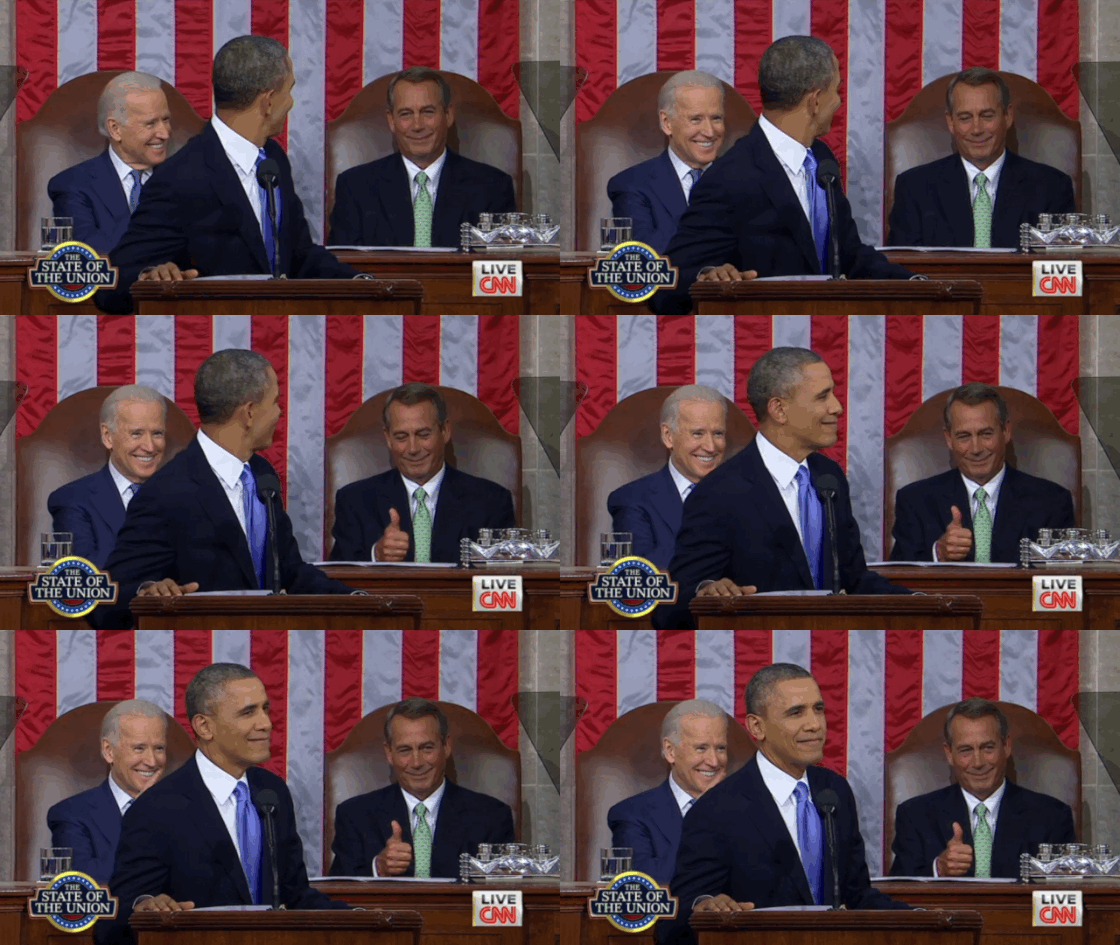
9.25 pm. Money quote: “Here in America, our success should depend not on accident of birth, but the strength of our work ethic and the scope of our dreams.” And a nice gracious nod to John Boehner. Classy and powerful. And then Boehner reciprocates. That may be the full extent of the bipartisanship this year, but it was lovely while it lasted.
thumbs-up

9.21 pm. Opportunity. Action. All the usual optimistic tropes so as not to be too much of a downer when talking about wage stagnation and economic inequality.

9.18 pm. A crisp, different, upbeat start. I like the way he begins with the people of the United States, and then pivots to asking if the Congress will let them down. A Reaganite beginning with an Obama-style end.

9.16 pm. That was just a boast about getting a poor kid some asthma treatment. Why that rather simple and powerful argument in defense of the ACA is not deployed more often I do not know. I guess the Democrats are too easily intimidated.

9.01 pm. I still get a bit of a thrill seeing an African-American First Lady enter the chamber. Even more of a thrill to see Chuck Hagel. He’s still alive!


The Cognitive Dissonance Of The One Percent

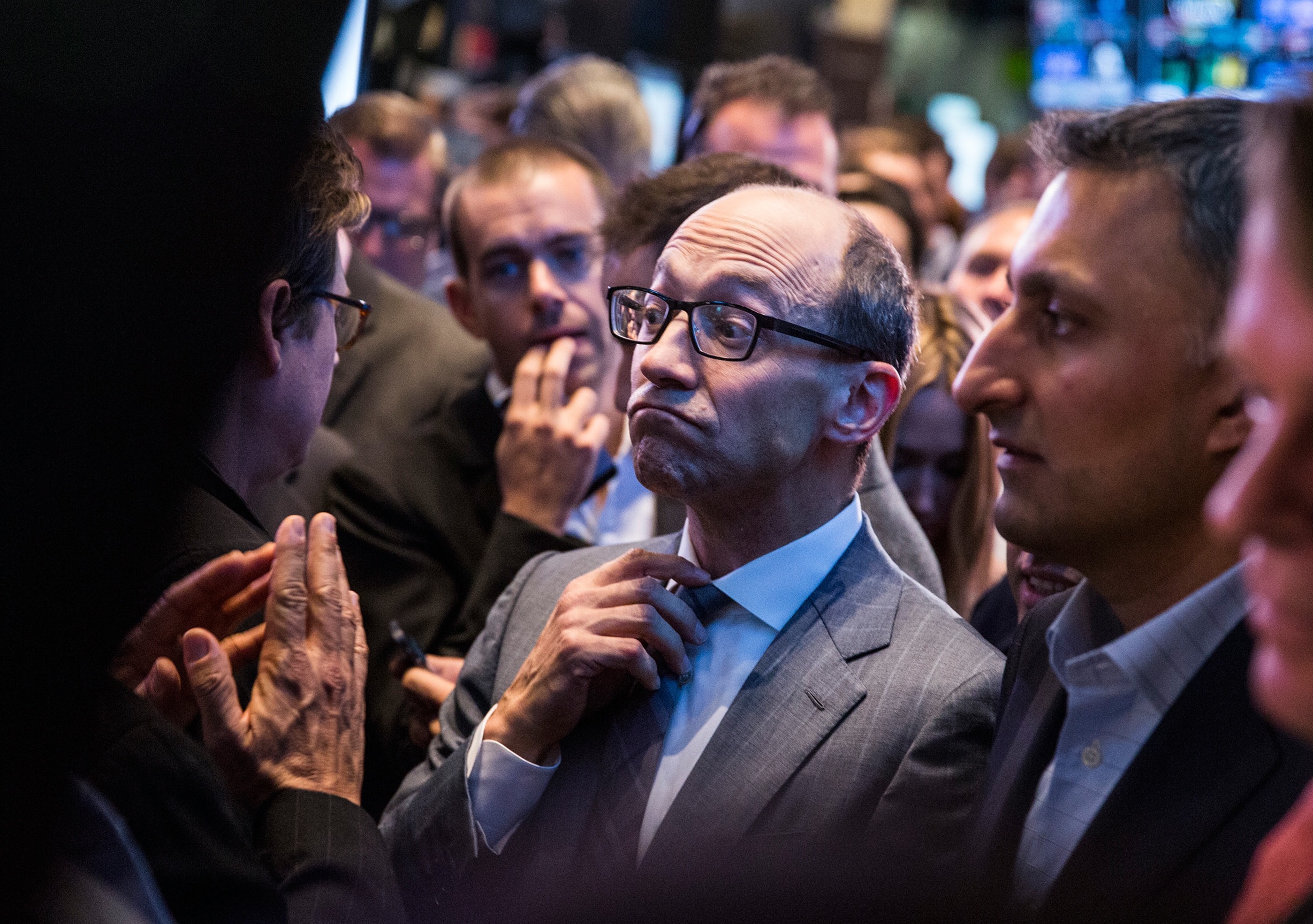
A trader reacts on the floor of the New

There has been plenty of well-deserved derision directed at the billionaire fretting in the Wall Street Journal that the super-duper-rich like him are headed for concentration camps. Paul Krugman fires an AK47 into the world’s smallest barrel here; while Josh Marshall has a must-read. Josh is actually trying to understand rather than simply excoriate the completely bizarre idea that the Obama administration is a populist, socialist threat to a capitalist system it all but saved from itself:

It is that mix of insecurity, a sense of the brittleness of one’s hold on wealth, power, privileges, combined with the reality of great wealth and power, that breeds a mix of aggressiveness and perceived embattlement.

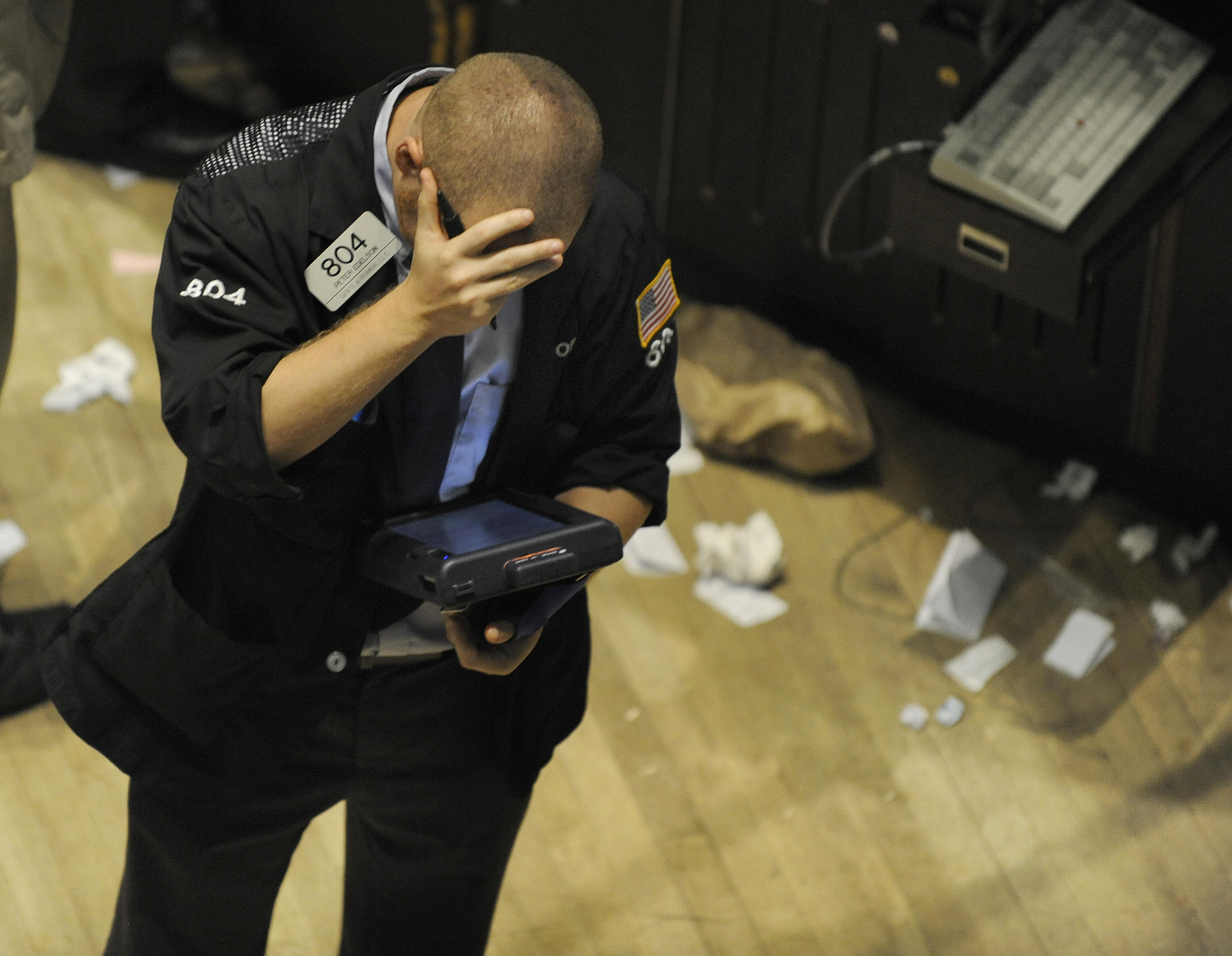
I’ve been a little taken aback too by the attitude of the Wall Street class, after they royally fucked up the entire global economy, were bailed out by the rest of us, still get Dimon-style compensation, and have enjoyed one of the sharpest booms in stock prices since 2009. At some point, you have to ask: WTF? But here’s the empirical data on how hard the one percent have had it over the last few decades:

Average_Federal_Tax_Rates_Top_1_Percent-thumb-615x480-109671

Well, yes, they have returned to pre-Reagan levels of taxation. But the tax take is still roughly where it was in the mid-1990s and I don’t recall Clinton being perceived as a socialist or howls of protest from the wealthy as the economy boomed in the tech boom bubble. Josh notes, for example:

It’s worth remembering that Bill Clinton pushed through a reasonably substantial tax hike on upper income earners in 1993. President Obama meanwhile largely maintained the tax policies of George W. Bush, the guy who had in essence repealed Clinton’s tax increase. These are all facts that are hard to ignore.

So whence the anger and the panic? Josh thinks, as my shrink would say, that it is multi-determined. Is it adjusting to a president who, though he is a pragmatist in his record, is nonetheless more progressive in outlook than any president since the conservative revolution of the late 1970s (of which Carter, in some ways, was a part)? Is it classic in-group isolation that fosters ideological extremism? Yes and yes. But I’d add a couple of factors to the mix.

The first is the triumph of victimology in political discourse. It began on the hard left, of course, in the 1990s, as every member of a minority group was designated a victim, and all were allegedly on the verge of being targeted or discriminated against. Godwin’s Law had to be constantly invoked back then as well. But today, what began on the left is ubiquitous on the right: those denying marriage rights to gays are in fact the real victims of lefty intolerance; whites, not blacks, are the real victims of our racial politics; and men are now the real victims of the feminized, big government left (see Hume; Brit, et al.). If you want to free-base on far right victimology, just track down the rhetoric of Sarah Palin. According to her, Christians now live in constant fear of legions of Obama’s jack-booted thugs, i.e. Wal-Mart greeters wishing them “Happy Holidays.”

The second factor, I’d argue, is actually self-awareness. This is entirely speculative, but many of these extremist plutocrats must surely know, somewhere in their psyches, that they collectively failed – and failed terribly – in self-regulating and thereby protecting the very capitalist system they depend on for so much.

These masters of the universe had to go cap in hand to the federal government to bail out their sorry, incompetent asses. They were revealed not as brilliant engineers of our collective wealth, but as enablers of the debt-mania, tech-hubris and bubble-creating that destroyed so much from 2007 onwards. They were exposed as something much worse than greedy; they were revealed as incompetents whose mistakes and over-reach created untold misery and hardship for countless millions. Their own self-image – again, somewhere deep down – must have shattered a little.

People respond to revelations of their own incompetence in different ways. But the proudest – and this group of people are not exactly renowned for humility – can sometimes respond by internalizing an ever more extreme version of their own previous mindset. They cannot compute the fact that they failed, and so they have to construct a version of reality that insists it was all someone else’s fault, and then build Twitter Goes Public On The New York Stock Exchangeon that an ideology of their own unrelenting heroism, which is now, on their minds, unfairly impugned.

And the only target of blame that can plausibly fill the gap is the federal government. Anything lesser would actually diminish the one-percent’s self-perception as masters of the universe, and require some adjustment in an ideology that has been cast as eternal truth since 1980. Hence the early 2008 myth that the government alone created the economic crisis through too-cushy mortgages – when the vast majority of shady mortgages were in the private sector. And because the one percenters’ collective humiliation has been so great and so public – even the Pope won’t absolve Larry Kudlow of his heresies any longer! – you get the kind of anguished psychology behind Tom Perkins’ absurd paranoia (which makes the neocons’ habitual resort to the anti-Semite card look relatively mild).

You know who they remind me of? Dick Cheney and Don Rumsfeld after 9/11. Both were responsible for the collapse in national security that enabled 9/11 to take place. Both were sold to the public as safe hands behind a jejune young president. And both were anything but safe hands – in fact, they acted like reckless, panicked, and blinkered chickens with their heads cut off. Both simply could not internalize the obvious fact of their own failures – because both had long regarded themselves as national security “masters of the universe.” Their An Emirati trader looks at the prices ofself-understanding could not adjust; it was too fixed by then.

But they are both very intelligent men and knew, deep down, the extent of their incompetence. Their reaction was to up the ante, not unlike Tom Perkins’ crazy. So they did not rationally reflect on the reasons for the failure to protect Americans from 9/11, they assuaged their buried guilt by turning the fight into an even greater battle between good and evil, by putting their previous belief in an unfettered presidency on steroids, authorizing torture on a massive scale, and embracing policies, like the war in Iraq, that could both erase memories of their own incompetence and yet also project that incompetence onto an even larger stage, with even worse results in terms of human life and economic and security costs.

When cornered, the sequestered, guilt-ridden, but psychologically rigid mindset does not reflect. It cannot see the broader picture. It cannot even publicly acknowledge what it must internally understand somewhere: that it played a part in the catastrophe that has now led to public shaming. And they worry deeply that this buried truth, if embraced by the politically influential, could come back to bite them yet. That worry is as rational as their response to it is irrational. If only they could know it, Obama is the best friend they could have in times like these. He wants to defend the capitalist system from its fatal, unregulated flaws. And it’s only by doing that can the one percenters’ wealth-creating dreams have a chance of being realized. If only they could see that. And if only they could adjust.

(Photos: scenes from the crash of 2008 and from Twitter’s IPO from Getty Images.)

The Selective Secrecy Of Bill De Blasio

If you were to describe the Israel lobby as a secretive group that enforces the policies of the Israeli government on American politicians in private gatherings, you would be called an anti-Semite. The idea that the Israel lobby is secretive and underhand plays into ancient anti-Semitic tropes. If you were to say about AIPAC that “a lobby is a night flower, it thrives in the dark and dies in the sun,” you would be regarded as an anti-Semite for the same reasons. If you were to note that an AIPAC official once responded to the idea that the lobby had been weakened by pushing a napkin across a table and said “You see this napkin? In twenty-four hours, we could have the signatures of seventy senators on this napkin,” you would be called an anti-Semite. If you were to claim that AIPAC was “the most effective general interest group … across the entire planet,” you would be suspected of anti-Semitic tendencies. (The source for these varied quotes is here.)

And if you were to say that AIPAC was so powerful it could get a left-liberal mayor of New York to give a speech so fulsome in its cravenness and excess it adds whole universes of meaning to the word “pander” and also insist that it be kept secret, even to the extent of hauling a reporter out of the hall, then all bets would be off. Why, after all, should AIPAC be in any way secretive about its completely legitimate, even civic-minded, lobbying of American public officials on behalf of the interests of a foreign government? The very idea is anti-Semitic, is it not? Why should any defender of Israel want to keep his remarks private? Even if you found nothing in the speech faintly controversial, why on earth the secrecy?

And yet here we are, with the lofty, pizza-challenged mayor of New York City, right after a landslide election, caught keeping a speech to AIPAC off his public itinerary and barring any press coverage of it. Weird, innit? What would he have to hide? Well here’s an audio of the speech that AIPAC, according to De Blasio, asked him to keep top-secret:

I’m not sure if that is the entirety of the speech, but let’s just note a few things. First up:

There is a philosophical grounding to my belief in Israel and it is my belief, it is our obligation, to defend Israel, but it is also something that is elemental to being an American because there is no greater ally on earth, and that’s something we can say proudly.

“No greater ally on earth”.

Just ponder that remark for a bit. How many troops did Israel send to fight with Americans in Iraq? None. Forty other countries did, led by the UK, Australia, and Poland. How many troops did Israel send to fight with Americans in Afghanistan? None. Fifty-nine other countries helped, also led by the UK. In both cases, this “greatest ally on earth” would have been extraordinarily counter-productive if it had been involved. That’s how useful an ally the country is in confronting our common enemies. Which allied defense minister recently publicly said of an internal security plan for the West Bank, shared confidentially among allies, that it was “not worth the paper it was written on” and that “the only thing that can ‘save us’ is for John Kerry to win a Nobel Prize and leave us in peace.” Israel’s. Which allied prime minister in recent years took the extraordinary step of lecturing the American president in front of the world press in the White House itself? Israel’s. I cannot think of any allied prime minister ever thinking about doing the same.

But this preposterous bullshit is what a left-liberal mayor felt obliged to serve up. Then this:

There is no deeper connection across boundaries than this connection we share.

Not with France, the oldest ally of the US? Not with Britain, the mother-country of the US? Not with any of the other countries whose sons have spilt blood on the same battlefields as Americans? Not with those who fought and died alongside Americans on D-Day? Then the astonishing statement that “part of my job description is to be a defender of Israel.” Really? And there I was thinking he was mayor of New York City! Would someone critical, say, of Israel’s continued settlements on the West Bank be barred as unqualified to be mayor of New York City? De Blasio is not taking any chances:

City Hall will always be open to AIPAC. When you need me to stand by you in Washington or anywhere, I will answer the call and I’ll answer it happily ’cause that’s my job.

Let me just leave you with the words of George Washington, who saw things a little differently:

The Nation, which indulges towards another an habitual hatred, or an habitual fondness, is in some degree a slave. It is a slave to its animosity or to its affection, either of which is sufficient to lead it astray from its duty and its interest …

A passionate attachment of one Nation for another produces a variety of evils. Sympathy for the favorite Nation, facilitating the georgewashingtonillusion of an imaginary common interest, in cases where no real common interest exists, and infusing into one the enmities of the other, betrays the former into a participation in the quarrels and wars of the latter, without adequate inducement or justification.

It leads also to concessions to the favorite Nation of privileges denied to others, which is apt doubly to injure the Nation making the concessions; by unnecessarily parting with what ought to have been retained; and by exciting jealousy, ill-will, and a disposition to retaliate, in the parties from whom equal privileges are withheld. And it gives to ambitious, corrupted, or deluded citizens, (who devote themselves to the favorite nation,) facility to betray or sacrifice the interests of their own country, without odium, sometimes even with popularity; gilding, with the appearances of a virtuous sense of obligation, a commendable deference for public opinion, or a laudable zeal for public good, the base or foolish compliances of ambition, corruption, or infatuation.”

The Genius Of AIPAC’s Strategy

Iran Opinion

From this new poll, it appears Americans support both the agreement with Iran and exactly the sort of provisions that would derail it:

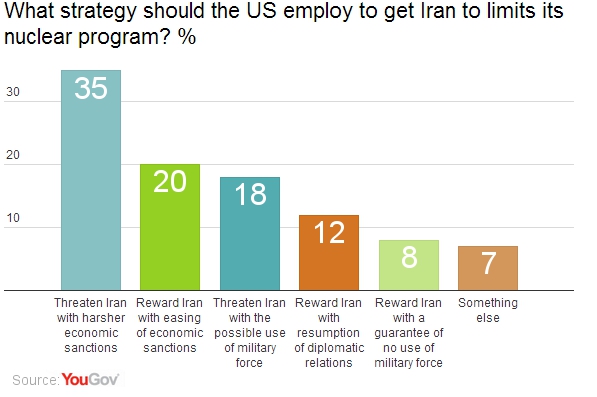
By 58% to 25%, Americans approve of the current international agreement that would freeze Iranian nuclear development in return for the easing of sanctions.  But more than half think the best way to get Iran to limit its nuclear program is to threaten it with consequences – either military or economic – if Iran does not limit its nuclear program.

This is the genius behind AIPAC’s bill to kill in advance any deal with Iran. For those who do not read the actual bill, or have a sketchy memory of the last five years, it seems perfectly rational to increase sanctions until Iran cries uncle. The polling question that got the result above was a non-time-related: “What strategy should the US employ to get Iran to limit its nuclear program?”

But that has been the policy and it brought Iran to the negotiating table. Americans are right about that principle. But there comes a point at which the sanctions have worked and we have the result we said we were looking for: a frozen program and a negotiation. The question now is: would moving the goalposts after we have gotten them to the negotiating table and have already frozen their nuclear program’s advance, help get a solid deal? If you unpack it that way – and it is the only honest way to unpack it – you see how shrewdly duplicitous AIPAC’s strategy is.

And, of course, AIPAC’s bill would not just threaten new sanctions; it has several provisions that open up past actions of Iran to new sanctions; and it raises many broader questions about Iran’s regional power apart from the nuclear issue. In every case, as Edward Levine has definitively shown, moving the goalposts in such a way now would easily wreck the possibility of any deal at all.

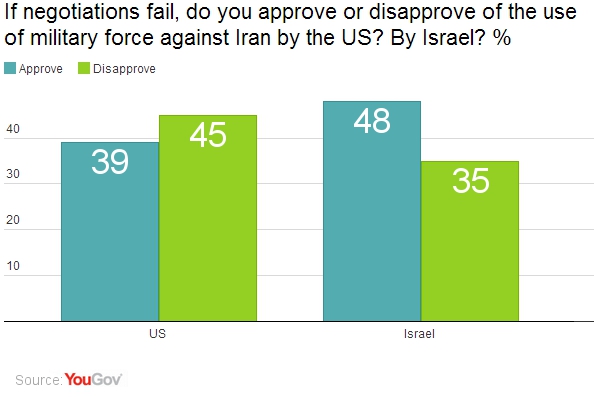
Mercifully, the AIPAC bill seems to be on hold for now. But AIPAC’s fanaticism on this should not be under-estimated. They are determined to get a new war against Iran, however they can, and you can see that when you read the actual bill. For example, take the poll’s finding on what should happen if the talks were to fail, as AIPAC wants:

iran2

You’ll see that a majority is against the US starting a new war in the Middle East (although it’s disturbingly small), although they would not disapprove of Israel’s taking unilateral action. But the new sanctions bill would solder Israel’s war with America’s in advance, and commit the United States to a pre-emptive war if Israel were to decide to launch one. Here’s the key paragraph 2 (b) (5):

It is the sense of Congress that — if the Government of Israel is compelled to take military action in legitimate self-defense against Iran’s nuclear weapon program, the United States Government should stand with Israel and provide, in accordance with the law of the United States and the constitutional responsibility of Congress to authorize the use of military force, diplomatic, military, and economic support to the Government of Israel in its defense of its territory, people, and existence;

Notice the key word “military support” in that instance. AIPAC, it seems to me, is trying to get the US Senate on record now not only to derail any chance of a negotiated settlement but to back any future pre-emptive war by Israel to damage Iran’s nuclear infrastructure. The phrase “legitimate self-defense” is difficult to parse, I’ll grant you. But when one country (Israel) already has a huge nuclear arsenal outside the Non-Proliferation Treaty, and one (Iran) has none, and the country with the nukes attacks the country without them, “legitimate self-defense” is an absurd construction. What the AIPAC bill does is therefore effectively delegate the American president’s and Senate’s deliberation on war and peace to a foreign government. In advance. It effectively makes Israel the arbiter of America’s fate in the world.

I believe that the American people care (rightly) about Israel’s security and survival. But I do not believe that they want the US to contract out its foreign policy – especially in a crucial area of war and peace – to any country other than their own.

Finding

A confession. I have long had an aversion to gay-themed plays, TV shows, movies, etc. I wasn’t born with it. I learned it. I learned it through what can only be called a series of cringes. I cringed at Philadelphia‘s well-intentioned hagiography of the “AIDS victim”; I cringed through Tony Kushner’s view of the plague as a post-script to the heroism of American communists; I winced at the eunuch, the sassy girlfriend, and the witty queen in Will And Grace; I had to look away as Ellen initially over-played her hand (understandably and totally forgivably, but still …). The US version of Queer as Folk was something I could not get out of my recoiling head for weeks – and I barely got through fifteen minutes of it. And please don’t ask me about Jeffrey. Please.

Maybe I should have sucked it up and celebrated each and every portrayal of gay people in any form – after so many decades and centuries of invisibility or minstrelsy. But, like many members of any minority group seeing themselves portrayed for the first time on screen, I felt betrayed when my own life wasn’t depicted, my worldview was ignored, my politics wasn’t acknowledged. In many ways this was utterly irrational. But it was emotionally real. When there are so few cultural expressions of your core identity, the few become weighted with far more cultural baggage than they can hope to uphold. In a fraught time – between liberation and mass extinction, between criminality and civil equality – it was hard to forgive anything that might be conceived as counter-productive or inaccurate or ideologized.

The same dynamic operated the other way on me, as well. When I rather naively became a gay public figure by answering “yes” to the question, “Are you gay?” after I became the editor of The New Republic at the crazy age of 27, the shoe was on the other foot. Suddenly I was supposed to represent all “virtually normal” gay men, because I was one of very, very few out people in the mainstream media in 1991. And boy did I not represent them. I never claimed to, of course, and said so explicitly; but that really didn’t matter. I was out there and not representative of many others. So I had to be knocked off my perch in a period of great exhilaration but also great personal pain. Looking back, the necessary madness of that period, its extraordinary range of sheer emotion as we fought not just for our dignity but for our very lives, seems clearer and more understandable now. But no less painful.

So when the opening scene of the new HBO series, Looking, shows a young gay man cruising for sex in a public park, I tensed up. But almost as quickly I realized that this was the most meta of the show’s moments (I’ve been able to watch all four of the first few episodes). As the dude starts to grope around, his cell phone goes off, the other guy’s hands are freezing on his cock, he tries to answer the phone, then drops it into a ditch. His friends – out for a lark to see if old gay culture still exists in San Francisco – were calling him; and they reunite to talk about the fun in exploring the old world of cruising. And so the circle is complete. Gay culture has evolved into a million-petaled flower, and the old petals are still in there, but ironized for many, if still urgent for others. Gay life in 2014 is … well, finally just life.

I loved the show. It is the first non-cringe-inducing, mass market portrayal of gay life in America since the civil rights movement took off. Well, the first since Weekend, the breakthrough movie of 2011:

For some reason, it wasn’t until Aaron reminded me last night that both Looking and Weekend are by the same Andrew Haigh that I put it all together.

Along with Michael Lannan, Haigh is the first director and writer to actually bring no apparent cultural or ideological baggage to the subject matter. There is no shame here and no shadow of shame. There is simply living – in its complexity, realism, and elusive truth. To get to this point – past being either for or against homosexuality – is a real achievement.

The emotional conflicts, the awkwardness of dating, the mixed feelings about some aspects of gay culture, the workaholism, the weed, the generational divides, the girlfriends and monogamish coupling, the weddings and the fetishes, the bears and the twinks: it’s all here, and served crisply as a well-mixed cocktail on the rocks. Sometimes, its realism becomes mere darkness as the show is filmed in weirdly dark tones. Sometimes there’s a false note: I’ve never heard anyone use the expression “Drug-Disease-Free” in speech, for example. It’s only ever used – with chilling HIV-phobic effect – on the web. And yes, this is not yet what I’d like to be able to watch: a convincing drama about gay men in, say, Houston or Atlanta, in 2014. And it doesn’t have the nuances and writerly quirks of Girls, even as it is close to it in realism (but not as much sex as in Girls). There are also a few frustratingly implausible plot developments and unpersuasive character developments that accumulate as the shows progress.

But I nonetheless recognized the reality of gay life now in this show. And not just mine – but intimations of countless others. The characters are not minstrels; and they are not eunuchs. They are for the first time recognizable human beings who happen to be gay. And that’s enough. Actually, it’s more than enough.

It’s an arrival.


Update: This post continued as a reader thread.