History Can Still Be Made

Earlier this week, Iran suspended its activities on its nuclear program, in accordance with an agreement reached with six great powers – the US, Russia, China, Britain, Germany, and France. And you could have heard a pin drop in the American public discourse in the face of this remarkable turn of events. And that is a bizarre thing.  For the constellation that came together these past twelve months is unlikely to happen ever again. All the major world powers – including Russia and China and the US – are in agreement. The Iranian regime and – most significantly – the Iranian people want a deal that would both restrain Iran’s nuclear capacities to civilian purposes green-peaceand slowly pry open its economy after brutal sanctions have close to extinguished it. A huge amount still needs to be figured out and it will be a formidable task of negotiation to move forward. It may all come to nothing. But surely, surely, it’s worth giving diplomacy a chance.
Why? For my part, it’s for the Iranian people, and global security. Neoconservatives portray their position against any agreement as one of solidarity with the Iranian people against their regime. And I’m sure that’s a genuine as well as admirable motive. But aren’t they engaging in a classic bit of ideological projection? In so far as we can tell anything about the views of the actual Iranian people – especially its younger and more educated generation – it is that they overwhelmingly want both a peaceful civilian nuclear program (in part as a matter of national pride) and re-engagement with the wider world, including the West. So the neocons are in fact either acting against the interests of the Iranian people, or accusing them of false consciousness. Neither seems to me the right response to this moment.

It’s also an ineluctable fact that Iran has acquired the intellectual and material infrastructure to become a nuclear military power if it wants to at any point in the foreseeable future. Let me repeat that: Iran’s potential as a nuclear military power is a fact. The time to prevent that would have been the Bush-Cheney years; but we tragically chose to pursue the control of imaginary weapons of mass destruction in Iraq instead. So the proximate actual choice we have with a regime with a disgusting record of internal repression and a nuclear potential is a) negotiating an internationally-monitored civilian nuclear program with strong inspections, b) a pre-emptive war with unknowable consequences to delay (but not end) the regime’s potential for a viable nuclear weapons program, or c) resume the Cold War stand-off, increase sanctions some more, destroy their economy and contain their military power.

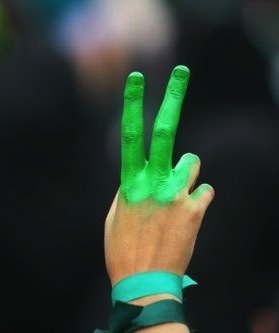
For a long time, I thought c) was probably the least worst, realistic option. That view was entrenched during the Green Revolution. To see such hope and positive energy crushed by merciless regime thugs was a sober reminder of the forces we are dealing with. But here’s the thing: the Iranian people did not despair. Hemmed in by rigged, approved political candidates, they nonetheless voted in 2009 for a clear shift back toward the West and then in 2012 for the most pro-Western candidates there were. The Iranian people told us that engagement – and not continued polarization – was the answer they wanted. This movement – combined with the effect of, yes, “crippling” sanctions – brought the Iranian leadership to the backrooms of diplomacy. It was a perfect constructive storm.

This is where we are. It is not an ideal situation – but after the catastrophe of the Bush-Cheney years in foreign policy, we have no ideal situations. But it is also not the worst situation.

It’s an extraordinary victory, in many ways, for pro-Western forces in the Middle East. A hugely important country – America’s natural ally in the region – is a hotbed of democratic activism and pro-American sentiment among many of its people. That country has declared that it will never use nuclear weapons and, unlike nuclear-armed Israel, is a member of the Non-Proliferation Treaty. Its newly elected government, backed by the theocratic Supreme Leader, openly says it wants to entrench a nuclear-weapon-free Iran in an international agreement. In return, it’s asking for relaxation of sanctions that would allow its economy to grow. And that growth would redound to the credit of the reformers, and perhaps begin a slow thawing of the regime itself.

These moments do not come often in human history. I remain of the view that the greatest single threat to our civilization is the combination of religious extremism with weapons of mass destruction. If we can reliably ensure that the biggest Shiite power does not seek to build or use nuclear weapons and retain that commitment over time, we have made a huge stride toward reducing the greatest danger we face, in the wake of 9/11. The Obama administration has already – by design or accident – managed to secure and begun to dismantle another major global WMD danger in Syria. To get an inspections regime in place to do the same for Iran would be a historic gain for global security in the most volatile region on the planet.

A deal would help Iran’s moderates; it would be a real achievement in a new global partnership between the major world powers; it is our only hope to keep Iran’s actual nuclear capacities restrained to civilian use without a full-scale war; its economic benefits would accrue to the regime – but also, critically, to the moderate path the Iranian people have chosen – in the face of bullets and torture and terror – for the last several years.

Let’s re-appraise the value of this moment, and not let it pass into the ether, because of fear or paranoia or habit, or fail to grasp the full extent of the advance that is now possible. And those Senators actively backing the American sabotage of the process should take a deep breath, put AIPAC on hold, and let diplomacy take its course. This is history. It deserves more than the politics of a domestic lobby. It deserves statesmanship. And prudence. And patience. And time.


The Cognitive Dissonance In West Virginia

PHi_j0073

The state has been drifting red for a while now, but it is still Democratic enough that the governor agreed to the Medicaid expansion in the ACA so many other GOP-led states have turned down. And that’s why it’s so fascinating as a test-case for the appeal of Obamacare throughout red-state America. So far, the results are quite striking: the number of uninsured West Virginians has dropped by a third since the ACA became operational. A third. And the sole reliable statistic we have as to the impact of that event is, appropriately at this early stage, mental health. To be free of terror that you won’t be able to pay your doctor, that you may be turned down for service when you’re sick, or that you have to alternate months between spending on food and on healthcare: wouldn’t that be an indescribable relief? Yes, of course it is, according to the NYT’s report today:

Waitresses, fast food workers, security guards and cleaners described feeling intense relief that they are now protected from the punishing medical bills that have punched holes in their family budgets. They spoke in interviews of reclaiming the dignity they had lost over years of being turned away from doctors’ offices because they did not have insurance. “You see it in their faces,” said Janie Hovatter, a patient advocate at Cabin Creek Health Systems, a health clinic in southern West Virginia. “They just kind of relax.”

But just as interesting to me is how culture still impacts that kind of psychological and real relief from acute, permanent anxiety and sickness. Obama will get no thanks for tangibly improving the lives of poor West Virginians. They may like the new law in practice, but in theory, many loathe it:

Recruiters trying to persuade people to enroll say they sometimes feel like drug peddlers. The people they approach often talk in hushed tones out of earshot of others. Chad Webb, a shy 30-year-old who is enrolling people in Mingo County, said a woman at a recent event used biblical terms to disparage Mr. Obama as an existential threat to the nation.

Mr. Webb said he thought to himself: “This man is not the Antichrist. He just wants you to have health insurance.”

Eventually, though, people’s desperate need for insurance seems to be overcoming their distaste for the president. Rachelle Williams, 25, an uninsured McDonald’s worker from Mingo County, said she had refused to fill out insurance forms on a recent trip to the emergency room for a painful bout of kidney stones. “I wouldn’t do it,” she said. But when she got a letter in the mail saying she qualified for Medicaid, she signed up immediately.

Isn’t that, in some ways, the entire story of this administration? That what it has actually done – from rescuing the auto-industry to ending wars, from the stimulus to universal access to health insurance – is actually popular on the ground, but still powerfully toxic to a vast swathe of Americans. Maybe history will help us understand that critical cognitive dissonance. Or maybe we’re just fucking complicated human beings, whose emotions – primarily fears – alternate and contradict each other with increasing impunity. Obama’s gift is his liability. He sees through the psyches to the actual pressing needs. He does not feel the way his opponents does. Which has made him far more effective and pragmatic in implementing his vision, while losing political altitude in a very emotional and ideological country precisely because of these successes.

(Photo: Kimberly Christian Hackney of Haysi, Virginia, cries after receiving new dentures at the Remote Area Medical clinic in Wise, Virginia, U.S., on Saturday, July 25, 2009. The clinic provides free medical, dental and optical care to people living in the region of south-west Virginia over a three day period. By Joshua Roberts/Bloomberg via Getty Images.)

Exit Ezra, Smiling

The New Yorker's David Remnick Hosts White House Correspondents' Dinner Weekend Pre-Party

The last few years have been fascinating to watch as new media stars have both benefited from and then fallen out with big media companies. Nate Silver is the obvious example. He went from being an independent blogger – heavily linked by the Dish among other new media sites – to becoming the true star of the NYT’s 2012 election coverage. Then he and the NYT could not figure out a mutually beneficial deal, and he quit to run a new 538-style site at ESPN.com. It won’t launch for a bit (maybe March, I hear). But ESPN, as they showed with Bill Simmons’s original blog and now Grantland, is one of the very few big media outlets to find a way to a win-win proposition with Internet stars.

Or think of Glenn Greenwald. First an immediate blogging sensation; then Salon, then the Guardian and now … working on his own news-and-opinion website, with a massive global brand, funded by the founder of eBay. The WSJ’s Kara Swisher and Walt Mossberg are also now exiting the WSJ’s employ to start their own site. The Dish’s story – until last year – was also a story of trying – and failing – to get a win-win arrangement with media companies interested in allying with us.

The truly frustrating thing about all this is that it was surely in everyone’s interests to stick together – legacy media with new media stars is a win-win proposition. And yet almost every time – the one exception I can think of may be Andrew Ross Sorkin’s Dealbook – the deals have unraveled. The egos of legacy media honchos and the energy of new media stars could not quite get along. Mutual resentment, the thorny question of compensation, and the power of personal brands all played a part.

For some, the entire model of individually branded content is a dismaying idea.

Michael Wolff cannot understand it.  His best shot at a description is that we are “less interested in the publishing business per se than in a kind of channel purity and deepness.” But then, Wolff is a big believer in old-school massive media conglomerates, is one of Rupert Murdoch’s primary hagiographers, and with respect to Roger Ailes, makes Mike Allen look like a footnote in the annals of brown-nosing. Today, he’s celebrating the end of net neutrality, so that big media companies – owned by the super-rich – can begin monopolizing again. He finds it mysterious that some writers might actually be in new media not just for the money but also for the freedom to say what they want whenever they want in ways not constrained by highers-up. I’m not so mystified.

Which leads me simply to wish Ezra the best of luck. There are many models going forward, and Ezra may not be content with the Dish’s slow, organic, reader-funded evolution. But we do not exactly have a surplus of trying to find new profitable models for non-listicle, non-sponsored-content journalism. If Ezra can help with that, he can help all of us, but especially readers. Not all of them want to read the stuff that only very, very wealthy corporations think is fit to publish. They might even forgive a few niche interests and quirkiness in the process.

Update from a reader:

You wrote:

The egos of legacy media honchos and the energy of new media stars could not quite get along. Mutual resentment, the thorny question of compensation, and the power of personal brands all played a part.

I think this phenomenon is more general. I have known numerous tech companies that were acquired by behemoths, or spun off as subsidiaries rather than independent companies. I worked for one of them. In every case, the management of the parent swore on a stack of Bibles that they wouldn’t interfere with the entrepreneurial culture of the new venture (as if they knew what the word “entrepreneurial” meant). In each case they couldn’t resist meddling, with serious and sometimes fatal consequences for the spinoff.

There were many reasons, of course: financial straits, changes in corporate strategy, new competitors. But I think the common denominator is the irrevocable human tendency to prefer control over success.

Brilliantly put.

(Photo: Journalist Ezra Klein attends The New Yorker’s David Remnick Hosts White House Correspondents’ Dinner Weekend Pre-Party at W Hotel Rooftop on April 26, 2013 in Washington, DC. By Dimitrios Kambouris/Getty Images for The New Yorker.)

African-Americans And Prohibition Of Weed

A Medical Marijuana Operation In Colorado Run By Kristi Kelly, Co-Founder Of Good Meds Network

The latest poll on legalization of marijuana from ABC News shows an even split – 49 to 48 percent – by Americans on the subject – not a clear majority as some other recent polls have found (Gallup’s in particular). That’s still a record high for the ABC poll, which has the benefit of identical wording over time: “Overall, do you support or oppose legalizing the possession of small amounts of marijuana for personal use?” Support has doubled since the mid-1980s.

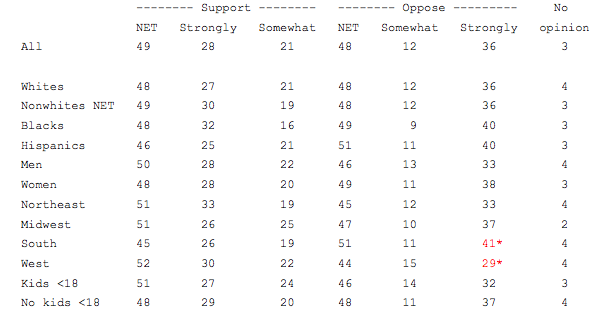
But what’s interesting to me about the poll is its internals. They’re really surprising to me. I asked ABC News for the full data and here it is:

Screen Shot 2014-01-17 at 12.18.19 AM

So one of the most powerful arguments for legalization of marijuana – that Prohibition grotesquely singles out African-Americans for criminal enforcement and spares whites – carries no more weight among African-Americans than it does among whites. Of those African-Americans who feel strongly about the subject, 40 percent oppose legalization and only 32 percent support it. Overall, there’s no statistically significant difference between whites and blacks on this. I’d be fascinated to hear from readers why they think this might be so. It seems on the surface that social conservatism is outweighing civil rights. But I’m genuinely baffled.

The second most striking thing is that having kids in the home doesn’t seem to change views much.

So that’s another perhaps lazy assumption debunked in this poll – that “protecting kids” works either for or against legalization. Even what you’d imagine would be a big regional split – between the West and the South – is pretty much a damp squib. The West favors legalization 52 – 44; the South opposes it by a similar margin. The only statistically significant variation in the regional polling is between the South and the West among those strongly opposing legalization. It’s 41 percent in the South and only 29 percent in the West. That makes more intuitive sense. But the South is far closer to the rest of the country on pot than on gays.

So what factor is statistically significant? It’s age:

Americans 65 or older are half as likely to approve of legalization as are those age 18 to 64 – 27 vs. 54 percent. And 59 percent of the elderly disapprove strongly. Support peaks among 18 – to 39 – year-olds, at 59 percent , including 37 percent who strongly support the idea.

This, in other words, is an issue like marriage equality or president Obama’s base of support. It’s generational. The young cannot see the logic behind criminal prohibition of a pleasurable plant much less dangerous than alcohol or tobacco. The old retain the attitudes and the fears of the past. Perhaps, over time, the young will become more like the old. But the huge shift in favor of this over the last two decades, like the huge shift in favor of marriage equality, suggests precisely otherwise. They all suggest a new, saner, more tolerant America is out there, waiting for one recalcitrant faction of one particular generation to die.

(Photo: Matthew Staver for the Washington Post via Getty Images)

The Dish, Year 2: Renewal Time

[Re-posted from yesterday]

It’s hard to believe now, but it was only a year ago that a handful of us jumped off the cliff to independence and 25,000 of you caught us. After the first six eddy-dusty-rocks years as a one-man blog, and the next seven attached to bigger, corporate media, we decided to become a small independent company in one of the toughest business climates in journalism in memory. It’s been a wild ride – but entirely because of you, we made it through our first year, almost hitting our highly ambitious subscription revenue target of $900K (we amassed around $850K), and gaining 34,000 subscribers in twelve months.

What have we created? Every now and again over the years, I’ve tried to figure it out. A blog? A magazine? A blogazine? A website? But every year, it changes again, as the new media shift, and as the world turns and as small experiments – like the Window Views or the reader threads – become ramparts of the whole thing. Do we, the staffers, write this blog? Sure, we do. But so do you, every day, with emails and testimonies and anecdotes that bring dry news stories to vivid personal life. Do we curate the web? Sure. Every day, we scour the vast Internet for the smart or the funny, the deep and the shallow, the insightful and the abhorrent. But you send us so many links and ideas VATICAN-POPE-AUDIENCE every day that the creators of the Dish are better understood as a community, you and us, correcting, enlightening, harshing and moving each other.

What I hope is that we’ve created an ongoing conversation – about politics and religion and technology and nature and love and life and sex and friendship. And like all conversations, it has no fixed direction, just a desire to keep it going, and never to shut it down. And part of me believes that this spontaneous, free-wheeling but edited conversation is what the Internet is best at. I’m riveted every day by the conversation we continue to have – from the misery of miscarriage to the deaths of pets to the hopes of a new papacy. And it’s a conversation made possible by the simple quality and sincerity and anonymity that all of you bring to the table. It feels at times like a truth-seeking missile, if we only get out of the way of the arguments and insights we collate every day and night.

house-of-turds-SD

But we’ve also pioneered a new business model online, if it qualifies for such a grandiose term. By “new” business model, we mean asking you to pay directly for what we do. Very few other websites do this, because very few websites have the kind of readership we do. And the good news is that we made a small profit in our first year (since I didn’t take a salary); we are indebted to no-one but you; we added staffers to handle business, technology and administration (which was done for us at bigger companies); and we ran a very tight ship, with just six staffers, and now three (amazing) interns, on the payroll.

We also decided everyone should have health insurance, including interns, and that we’d promote everyone from within the team – an often unsung group of some of the most talented young writers, editors and journalists of their generation. They’re all in their twenties and early thirties, and if you ever met them, you’d see why I’m so honored and proud to work with them. More to the point, we ran no “sponsored Supreme Court Hears Arguments On California's Prop 8 And Defense Of Marriage Act content”, no corporate ads, no gimmicks, and also showcased a prototype for publishing long-form journalism (Deep Dish), which we’d love to have the resources to continue and expand. In an era in which media has become desperate for revenues from any source, we decided to stick to the simplest option: asking readers to pay for content they enjoy.

It was a big gamble, but we felt we knew our readers and believed you’d be there for us, when we needed you. And you were. 25,000 of you signed up almost at once in an avalanche of support; another 9,000 of you have subscribed since last March. We remain blown away by the enthusiasm and generosity.

But it remains a fragile achievement. There’s a flip-side to this extraordinary wave of support. More than half of it came in the first week of 2013 – and all those early founding subscriptions are all up for renewal at once at the beginning of next month. None of them was on auto-renewal (which we were only able to execute once we had our own site operating and finessed the Tinypass software).

Here’s an exciting and yet also sobering graph of our total revenues since the day we went independent:

Screen Shot 2014-01-09 at 6.26.31 PM

Check out that massive sum at the very left. That runs out completely at the beginning of next month. After that, we have no assurance that the Dish can survive another year. That’s why the looming renewal moment is absolutely critical. What we’re asking now of our Founding Members is pretty simple: to turn your original membership into a stable, ongoing subscription that will enable us to budget, plan and work every day and night of the year to bring you the Dish for the foreseeable future.

If you renew now, your subscription will still last through your usual twelve months, starting when your current annual subscription expires next month (you can see the precise date you’re up photo(2) for renewal in the little box at the very top right of the page; if your date is 3/21/2014 or later you are already on auto-renew and don’t need to do anything for your subscription to continue).


You can pay what you paid last year if you want and we’d be very grateful to keep you as a subscriber – and the minimum is still only $19.99 a year or $1.99 a month. But we’re asking our Founding Members, if you have the resources, to set your annual subscription price for the coming years as generously as you can. We pulled off this year by the skin of our teeth, but if we are going to retain our staff, if I’m going to get a salary, and if we are to have a chance at getting the resources to get Deep Dish beyond the prototype phase, we need to more than replicate our first year’s budget. And yes, we’ve kept our expenses low: no office, but a weekly dinner at a local diner (that’s us from last week).

Ask yourself what you think the Dish has been worth to you last year and throw in some more if you can. The more you give us, the more we can do. And we’ll keep the promise we made to you this time last year and have kept: maximal transparency and accountability. Think of it not just as a way to keep the Dish alive but as a way also to prove that transparent, reader-supported journalism can survive in an era of listicles, sponsored content, algorithms and endless slideshows.  We believe it can; and we hope over this past year we’ve proved it.

But we need to get this on a stable footing; we need to figure out a budget; we need to plan. So take this as my last pitch for getting the Dish eddybowiefinally off the ground (once everyone is on auto-renew, these annual pitches will mercifully end). You kickstarted us last January and February; we need you just as urgently to put us on a long-term stable footing with one final act: auto-renewing your subscription before it runs out. The average Founding Member subscription price last year was $28. If every one of you added $5 or more to that, we could begin to expand Deep Dish, retain our staffers, pay me, and prove that independent, reader-financed journalism isn’t dead. It’s just beginning to rise from the ashes.

Renew today! Keep us alive. And thank you so much for this past year. You carried us; we hope you feel we deserve another year of your support. We can’t wait to get started. Please don’t wait to help us one more time. Renew here. Renew now.

(Photos of Francis and Edie Windsor from Getty)

The Right Backs Affirmative Action!

Gay Marriage Becomes Legal In California

It’s a surprising move, but perhaps the only possible shred of an argument they have left in the fight to deny marriage equality to gay citizens. In Utah, the state has tried to muster legal arguments as to why they have an interest in marginalizing gay unions as opposed to heterosexual ones. Their first try was to argue that heterosexual-only marriage was important for “responsible procreation.” The Judge agreed, but couldn’t understand why allowing civil marriage for gays would somehow undermine that. In fact, he made the socially conservative counter-point that by mandating that gay couples remain unmarried, “the state reinforces a norm that sexual activity may take place outside of marriage.”

So they came up with a second argument: that by asserting the importance of heterosexual-only marriage, the state was making it more likely that children would be born into stable, two-parent homes, where they would fare better. The judge was puzzled again:

Utah’s ban, he wrote, “does not make it any more likely that children will be raised by opposite-sex couples.” But it certainly demeans and humiliates the thousands of children being raised by same-sex couples in the state, he said.

So Utah tried another tack in appealing to the state Supreme Court (and no, I’m not making this up). They said that having a woman and a man in a marriage was important for … wait for it … diversity. Money quote:

“The state does not contend that the individual parents in same-sex couples are somehow ‘inferior’ as parents to the individual parents who are involved in married, mother-father parenting,” the state said.

But, drawing on Supreme Court decisions endorsing the value of diversity in deciding who may attend public universities, the state now said it was pursuing “gender diversity” in marriages. “Society has long recognized that diversity in education brings a host of benefits to students,” the brief said. “If that is true in education, why not in parenting?”

“Gender diversity” is an argument I haven’t yet heard in the two and a half decades I’ve been debating this question. I have heard that in Catholic teaching, a mother and a father are vital complements to each other because of their differing genders.

But that’s an argument from natural law, and doesn’t actually hold up in the many studies of how well children do in same-sex and opposite-sex households. The idea of diversity like a university is somewhat different. But it begs a further question. If gender diversity is important, why not religious diversity? Or racial diversity? If the state has an interest in providing “diversity” in parenting, should it not privilege inter-racial marriage or religiously mixed ones? That’s an interesting argument in social engineering, but not one, I suspect, that can hold much water in front of a court.

When I first read it, it actually made me laugh out loud it seemed so transparently desperate as an argument. And that’s the core thing about this debate. As it has gone on, the logic of equality has proven far stronger than the logic of exclusion. In the courts, often denigrated, the standard of logic applies more rigorously than in the emotional and human maelstrom of democratic votes. If the arguments just don’t stand up to reasonable inspection – and they sure haven’t – what is even a conservative court supposed to do? And if Utah‘s supreme court cannot provide a convincing case to retain this kind of public discrimination, what hope the others?

This began as a strange outlier. Maybe, as the court deliberates over the next couple of months, it will end up in a much more radical place.

(Photo: Same-sex couple Ariel Owens (R) and his spouse Joseph Barham walk arm in arm after they were married at San Francisco City Hall June 17, 2008 in San Francisco, California. By Justin Sullivan/Getty Images)

A Clinton Never Forgets

The State Funeral Of Former South African President Nelson Mandela

No one should be that shocked that a political dynasty in a major party that has been at the highest levels for decades would keep tabs on their friends and enemies. We’ve all watched House of Cards. Of course, in the white-knuckled campaign of 2008, which the Clintons were hoping would be a coronation, they were hurt, bewildered and betrayed by so many Democrats who saw in Obama something they didn’t always see in the Clintons: a political vision not entirely eclipsed by calculation. And you can see why they might have wanted to keep score of the hurt and the betrayal.

But the comprehensiveness of the list, the care with which it was constructed (on a scale of one to seven, for some reason), and the rawness of the feelings behind it should remind people that the Clintons have not changed:

They carefully noted who had endorsed Hillary, who had backed Obama, and who had stayed on the sidelines—standard operating procedure for any high-end political organization. But the data went into much more nuanced detail. “We wanted to have a record of who endorsed us and who didn’t,” a member of Hillary’s campaign team said, “and of those who endorsed us, who went the extra mile and who was just kind of there. And of those who didn’t endorse us, those who understandably didn’t endorse us because they are [Congressional Black Caucus] members or Illinois members. And then, of course, those who endorsed him but really should have been with her … that burned her.”

The list’s complexity and nuance aren’t shocking. But as Jonathan Allen and Amie Parnes note:

The difference is the Clintons, because of their popularity and the positions they’ve held, retain more power to reward and punish than anyone else in modern politics.

The minute they finished one campaign they were strategizing in minute detail for the next.

But that isn’t what troubles me about the story. What troubles me is the resilience of the entourage. Jake Weisberg long ago framed the Clinton circle of friends, allies, donors, ambassadors, and courtiers as a web of “Clincest” – constantly bubbling with money, networking, favors, back-scratching, threats, charm offenses and old ties. That Clincest remains. And it is a problem.

Notice, for example, the two list-makers, in Politico magazine’s excerpt from HRC: State Secrets and the Rebirth of Hillary Clinton. One, Kris Balderston, has been with them for two decades; the other, Adrienne Elrod, is an almost text-book example of Clincest:

Elrod, a toned 31-year-old blonde with a raspy Ozark drawl, had an even longer history with the Clintons that went back to her childhood in Siloam Springs, a town of 15,000 people in northwestern Arkansas. She had known Bill Clinton since at least the age of five. Her father, John Elrod, a prominent lawyer in Fayetteville, first befriended the future president at Arkansas Boys State, an annual civics camp for high school juniors, when they were teenagers. Like Bill Clinton, Adrienne Elrod had a twinkle in her blue eyes and a broad smile that conveyed warmth instantaneously. She had first found work in the Clinton White House after a 1996 internship there, then became a Democratic Party political operative and later held senior posts on Capitol Hill. She joined the Hillary Clinton for President outfit as a communications aide and then shifted into Balderston’s delegate-courting congressional-relations office in March. Trusted because of her deep ties to the Clinton network, Elrod helped Balderston finalize the list.

My italics. Again, there’s absolutely nothing wrong or that surprising about a politician retaining loyal friends from way-back-when, a coterie of trusted advisers, truth-telling friends and shoulders to cry on, in the glare of public office. But what distinguishes the Clintons is the sheer scale of the enterprise, the meticulousness of the extended family, the way in which money is interlaced with everything, and the remarkable loyalty of the Clinton court through the huge ups and downs of their political careers.

If the Clintons get their third and fourth terms in the White House, they will bring this vast retinue with them, with all the attendant baggage. And by that I mean the paybacks for supporting Obama (man, can you imagine that long list?) and the unhealthy atmosphere of a secluded clique where an open administration should be. Those cliques can lead to insular thinking, the kind of paranoia that led Hillary Clinton into her famous gaffe of a “vast right-wing conspiracy” (which, even if true, needlessly made Matt Drudge’s and Roger Ailes’ year).

It’s what led to all the utterly unnecessary hunkering down over minor “scandals” that, in time, were shown to be largely, if not entirely, in the eye of the beholders (including mine), and could have been defused with a little more transparency and access to those outside the inner circle of flacks and hangers-on.

I should be candid here. I believe Bill Clinton was a very good president, who sabotaged himself needlessly on many occasions. I believe Hillary Clinton was a good, if not spectacular, secretary of state. I believe their public behavior after their defeat has been close to exemplary. And I sure am not going to engage in a constant stream of Clinton-baiting if she decides to run for the presidency again. At this point, she absolutely deserves a fresh look. But it would be equally wrong to forget the patterns that led to their previous acts of self-destruction or the network of friends and dubious money-makers who seem not to have gone away, but to be reassembling in very similar dynamics for the next big push. They were and can be a liability. And it seems the Clintons still don’t see it that way at all.

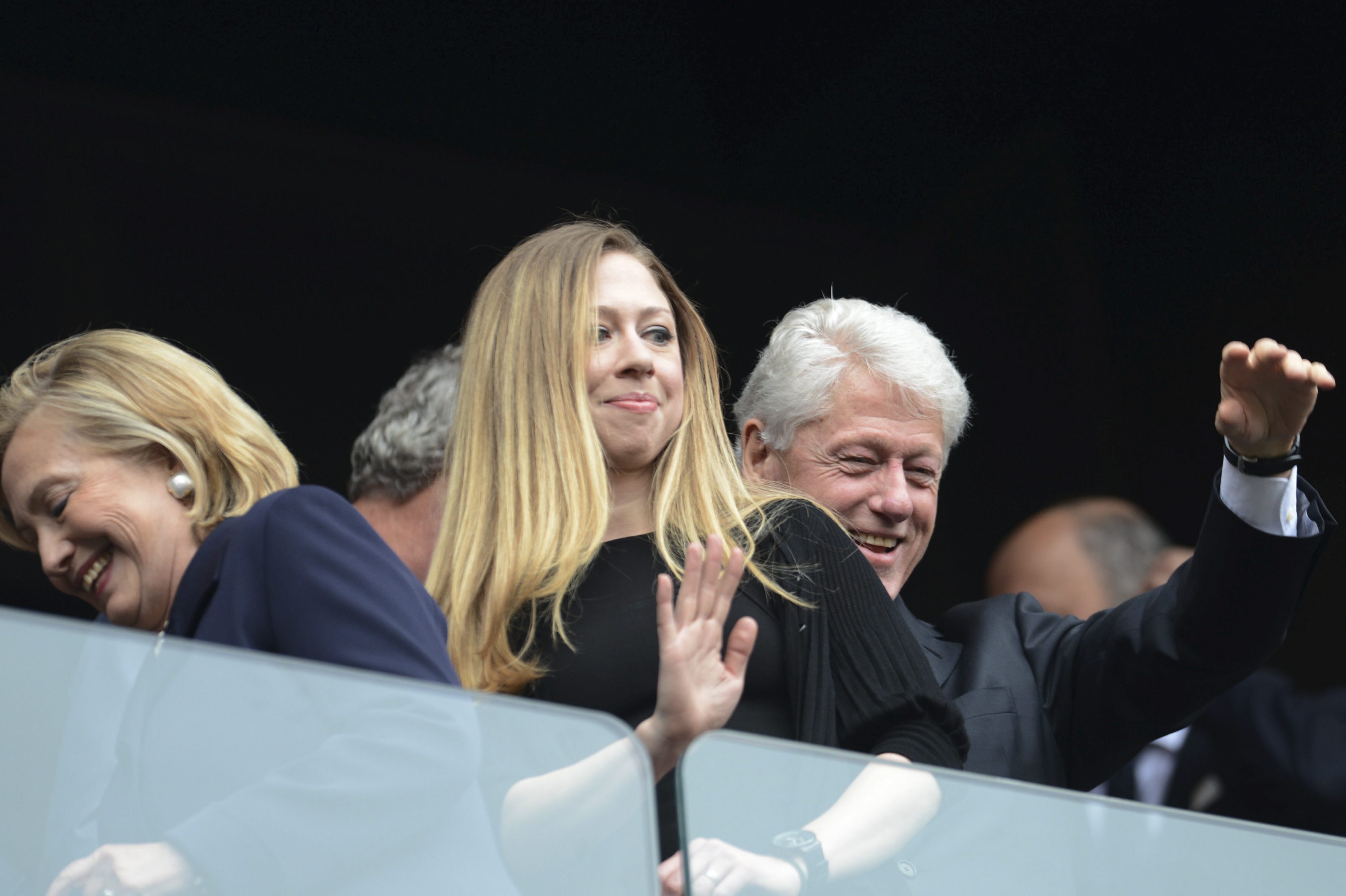
(Photo: Hillary Clinton, Former United States President Bill Clinton and Chelsea Clinton during the official memorial service for former South African President Nelson Mandela at the FNB Stadium on December 10, 2013 in Soweto, South Africa. By Lefty Shivambu/Gallo Images/Getty Images.)

Teetering Between Peace And War

Javad Zarif

The striking thing about the long and delicate rapprochement with newly empowered moderate forces in Iran is how far from the national conversation it is. There are few heated TV debates; Twitter is relatively quiet; the blogosphere sits in two camps of near calcified intellectual hostility; only AIPAC slouches forth from time to time to threaten negotiation-ending new sanctions in the Senate.

And yet we have had two breakthroughs since the last elections in Iran: first the actual interim agreement between the major powers and Iran, and now a secondary practical deal to begin ramping down Iran’s nuclear program starting January 20. That second deal was announced around lunchtime today. All of it appears to be reversible at any point if one of the parties does not appear to be living up to its side of the bargain:

Giving details about the deal, Deputy Foreign Minister Araqchi told state television that each party’s commitments would be implemented “in one day”. “After the first step is taken, then in a short period of time we will again start our contacts for resumption of negotiations for the implementation of the final step.” He added: “We don’t trust them. … Each step has been designed in a way that allows us to stop carrying out our commitments if we see the other party is not fulfilling its commitments.”

It would be foolish to try and glean clues from nuances in public statements, but I don’t find the lack of trust to be a deal-breaker. The honesty about such a lack of trust is what gives the deal a chance to work. But the more fearful and reactionary factions in both countries’ legislatures are doing their best to unravel the detente. In Iran, a big majority of the parliament appears recklessly willing to sanction new uranium enrichment of up to 90 percent (allegedly for powering submarines); in the US, the Senate is also brandishing possible new sanctions that would end the detente if enacted, and require humiliating concessions Iran will never agree to. But neither legislature has yet acted – and the positioning and jockeying may be an inevitable part of what president Obama has claimed is only a 50-50 chance of success.

I don’t have any illusions about parts of the Iranian regime, or about Israeli hopes to scuttle any accord in favor of another unpredictable and polarizing war in the Middle East.

But I do think that this opening – if it is handled right – could avoid an avoidable conflict, open up many new options for US foreign policy in the Middle East, and empower pragmatism in both the US and Iran to mutual advantage. From Afghanistan to Iraq, the US and Iran have cooperated before and can cooperate again. The two peoples are natural allies; and the more the people of Iran get to taste the benefits of ending the brinksmanship and polarization and terror-mongering of their religious extremists, the more possibility there will be for more engagement.

There should be no permanent enemies in world affairs; just the pursuit of permanent interests. This time, we’re close to a rare alignment between Washington and Tehran, Obama and Rouhani. The only serious alternative to this deal, if containment has been ruled out by Obama, is a war. We’d be crazy not to hope it doesn’t come to that.

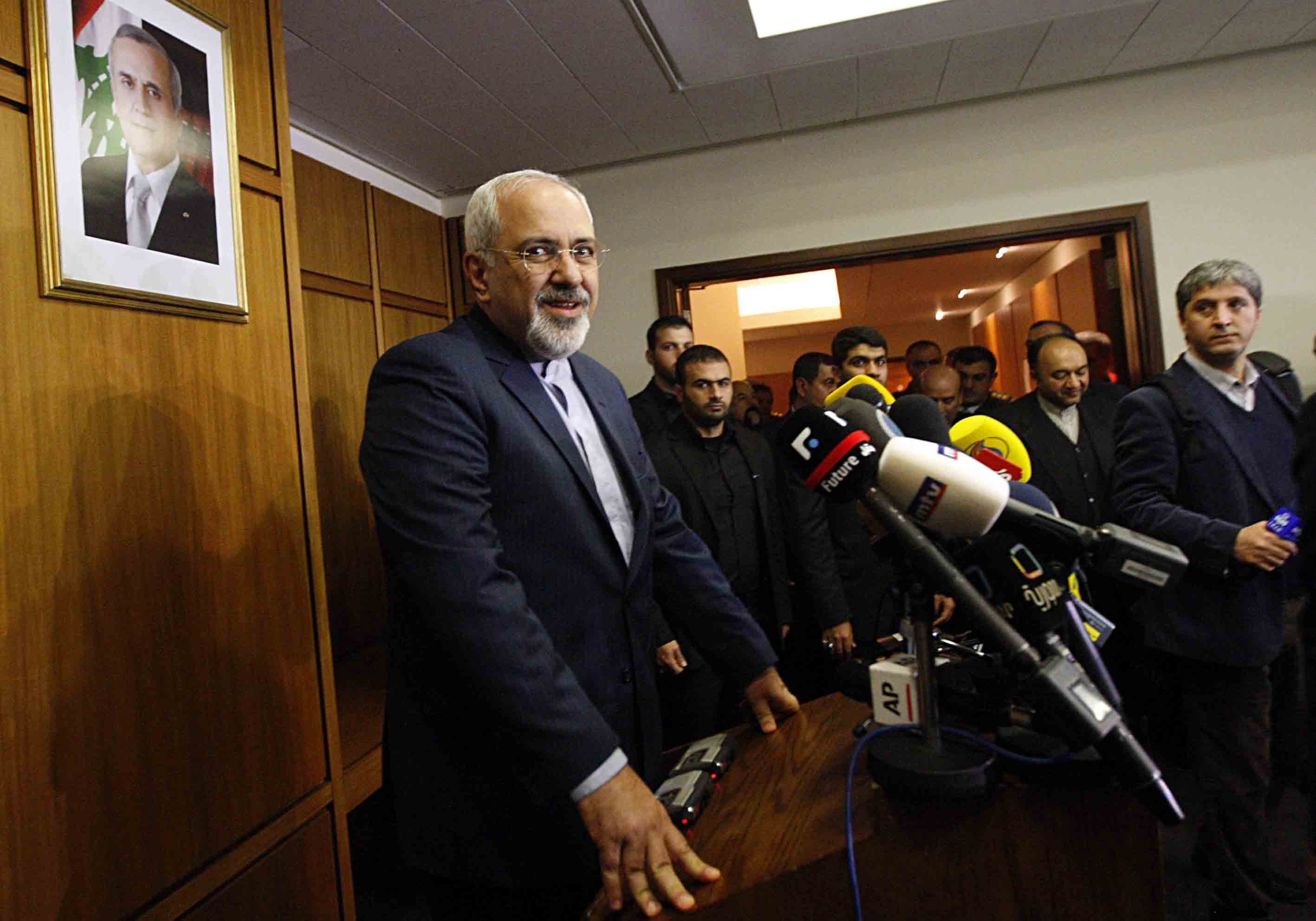
(Photo: Iranian FM Javad Zarif holds a press conference upon his arrival in Beirut, Lebanon, January 12,2014. By Bilal Jawich/Anadolu Agency/Getty Images.)

The NYT Follows Buzzfeed

Screen Shot 2014-01-08 at 2.12.57 PM

The pinnacle of American journalism is now hiring a Dell employee to write its “articles”:

“We wanted to start with someone who we thought really understood how to be a great storyteller,” said Meredith Kopit Levien, evp of advertising for the Times. “And [Dell global communications managing editor] Stephanie Losee was [a writer] at Fortune. She has deep journalistic chops herself. So this was a very deliberate choice to go with Dell.”

Let me get this straight: the New York Times is hiring a copy-writer as a pseudo-journalist because she used to work as a real journalist. Time Inc is now having its “editors” report directly to the business side and the NYT is opening its elegant blue-stocking legs as wide as it decently can to accommodate a computer company. This passage was particularly revealing:

Dell used its launch ad to spotlight stories on topics like millennials in the workplace, marketing tech and women entrepreneurs. The campaign, which is set to run for three months, contains a mix of content from its own newsroom, articles from the Times’ archives and original stories by Times-contracted freelancers on Dell-chosen topics.

My italics. So Dell is now a “newspaper” partnering with the New York Times. By which I mean that the New York Times will actually hire people to write Dell’s ad copy and make it look as close to the rest of the paper as possible. Then this:

After Dell, a handful of other clients whom the Times wouldn’t name have committed to using the product in the coming months. But the labor and cost of creating native ads is a hurdle, and the Times made it clear that it sees the product as suited to only a limited number of advertisers. It won’t come cheap for the Times, either, which is looking to hire a dozen or so people for a “content studio” to staff the effort.

Always follow Orwell to the language. Have you ever heard of a newspaper having a “content studio” before?

Note that the NYT is not simply taking Dell’s ad-copy and gussying it up to deceive casual readers into thinking this advertizing is editorial (with a firm disclosure as a fig leaf). They are creating an in-house team to write the fricking ad-copy and calling it “content”. So what is the rest of the paper? Non-content? What is a newsroom but a content-studio?

Yes, they will add a clear identifier – and better than most. But, as Adweek notes, since the whole point of native advertizing is to deceive the inattentive readers into reading it because it looks an awful lot like regular copy – this is a very wobbly and blurry distinction. And when viral pages get completely disconnected from the rest of a news-site, the clear contrast between ads and journalism is close to invisible.

So look: it’s time to congratulate Jonah Peretti. He sure is winning. The business of journalism is now indistinguishable from the business of public relations. The New York Times has a newsroom. And so does Dell. Dell has an advertizing department – and the New York Times helps staff it. In the future, most big companies will have their own newsrooms (read: propaganda/advertizing outlets) and independent journalistic institutions will just have competing newsrooms, increasingly dependent on the corporate in-house “content studios” and answerable to them. At some point, and certainly at the rate we’re seeing, the distinction will soon evaporate altogether.

We are all in public relations now. Thanks, Mr Sulzberger.

The Morality Of Obama’s Afghan Surge

korengaljohnmooregetty.jpg

I have very little but extreme admiration for Bob Gates, as a human being and as a defense secretary. He has always seemed to me a very level-headed, pragmatic and sane realist – the kind of conservative that would bring me back to the GOP if there were more like him. So why is his book so baffling? Greg Jaffe puts his finger on one core flaw:

[Gates] recounts his thoughts during a tense 2011 meeting with Obama and Gen. David H. Petraeus, then in charge of U.S. and NATO forces in Afghanistan, in the White House Situation Room: “As I sat there I thought: The president doesn’t trust his commander, can’t stand Karzai, doesn’t believe in his own strategy and doesn’t consider the war to be his. For him, it’s all about getting out.” …

Gates’s problem with the president is less about strategy or substance than about heart. “I myself, our commanders, and our troops had expected more commitment to the cause and more passion for it from him,” Gates writes. He compares Obama unfavorably with Bush, who “had no second thoughts about Iraq, including our decision to invade.”

That last formulation is close to deranged. Better to have a true believer pursuing impossible goals than a sober skeptic trying to make the least bad call? Dreher rightly asks why Obama’s skepticism is so scandalous:

Obama’s judgment of the sleazy Karzai was correct, Obama knew the war was unwinnable, Gates thinks Obama made the right calls — but he faults the president for not being a True Believer? As if George W. Bush’s unwillingness to reassess American strategy in light of cold, hard experience is a sign of wisdom and character! I suppose Gates has a point if he’s faulting Obama for pursuing a military strategy that he (the president) didn’t believe in, but does Gates believe that an immediate withdrawal from Afghanistan would have been the better strategy, even if it had been politically feasible (which it may not have been)?

Like almost everyone else, I’m relying on reports about the book, not the thing itself. But here’s my gut sense of where this deeply honorable man is coming from. By the time of Obama’s first inauguration, the only way to describe the Global War On Terror was what David Brooks recently called (about Israel/Palestine) a “tragic situation.” There were no good options. The idea of staying there for ever – the neocon fantasy – was simply inconceivable in a democratic society long appalled by the cost of war. A decision to suddenly get out would have compounded the failure. Obama’s response in Af-Pak was Bush’s in Iraq: a face-saving surge in order to get the fuck out of there without too much collateral damage. The killing of Osama bin Laden made it all a lot easier and the logic of withdrawal all the more compelling.

But there is a deep moral issue behind sending young Americans to die in order for a country to save face. I have to say that the Afghan surge remains to me the most morally disturbing of all Obama’s decisions in office. He knows his Niebuhr, and is clearly aware of the horrible but necessary decisions presidents have to make that can lead to the deaths and brutal injuries of many young patriots. Between 2009 and 2011, over a thousand Americans died in a war to save face. Obama sent many more soldiers to their deaths in Afghanistan than Bush did. I know there are no morally easy calls in wartime, and perhaps this was a defensible move in terms of global strategy and domestic politics (which has to be a part of any national security debate in modern times). But I can very well understand how Bob Gates, knowing all this, felt increasingly emotionally wrung out by sending so many men to die for one last push that, in the end, failed. The emotion in the book and, apparently, raging in his psyche all along, is perhaps best understood in that way. I find it admirable that a human being in such a position can feel that powerfully about the horrors of war.

But, on the broader picture, as Gates concedes, Obama was right.

Amy Davidson points out that Obama was shrewd to be suspicious of Karzai, noting that he has “not yet signed a bilateral security agreement on the status of American forces in Afghanistan after 2014” because he would like to wait, “maybe until after his country’s next Presidential election, in April”:

The arguments about staying in Afghanistan all have to do with not squandering what we have supposedly won there. That might better be protected by going, if it has anything to do with the rule of law. Why, after all, would Karzai want to wait until after the Presidential elections? He can’t run again, because of term limits—so why is he holding on to a bargaining chip in a game he should, by then, no longer be in?  … There are close to a dozen candidates, a number of them Karzai’s allies, among them his brother, Abdul Qayum Karzai. The dread one has is that Karzai wants to make sure that he has leverage to insure we tolerate a fixed election. Is that the sort of player we want to be, and is that why Americans died in Afghanistan? Is that what we can stand?

Ambers ponders Gates’ comments:

The whole project of getting into these wars and staying, leaving a big American footprint — that’s what Obama ran against. He ran to get out of that.

What was up for debate was the mechanism of withdrawal, or how long it would take. Obama’s principle priorities were two: The safety of redeploying American troops and ensuring that al Qaeda could not be reconstituted in the region.

Why Gates should be surprised by this is difficult to tell from the excerpts. He is smart enough to have interpreted Obama’s campaign rhetoric realistically. He is also, funnily enough, convinced that Obama made the right calls.

Memoirs, and memory, are curious things.

Mark Thompson notes that Gates doesn’t spare Congress:

The fact is, Congress as a whole is a far bigger problem than Gates’ dealings with the White House. Executive branch relations can change with an election or new Cabinet secretary, but the congressional modus operandi that Gates cites is pathological. In concert with their uniformed Pentagon allies, lawmakers in key slots on the armed services and appropriations committees block progress and succor sloth through both their action and inaction. It has led to an immensely inefficient defense establishment, flabby in the wrong places and gaunt where it should be muscular.

Sprung flags Thom Shanker’s NYT review of the book:

My impression of Shanker’s review is that systemic dysfunction dominates Gates’ narrative: the book may portray a collective tragedy, a nation that can no longer govern itself effectively. As Shanker notes, Gates does not spare himself from criticism. There’s a dysfunctional Congress, a dysfunctional Pentagon, and two administrations that went severely awry, in his telling, in different ways. Contrast this collective dysfunction with his earlier portrait of five or six administrations that tacked left and right but ultimately hewed to a successful Cold War consensus strategy.

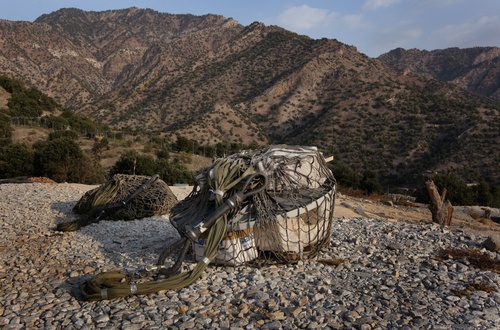
(Photo: A large load of mail sent to soldiers killed or wounded in action sits awaiting transport out of the Korengal Outpost October 29, 2008 in the Kunar Province of eastern Afghanistan. U.S. Army Viper Company of the 1-26 Infantry, based in the battle-scarred Korengal Valley, has had 6 solidiers killed since the unit deployed there in mid-July. Because of the delay in transporting items to such remote outposts, mail for soldiers killed in action often arrives many months after they died. By John Moore/Getty Images.)