Racism And Richard Cohen’s Reality

Richard Cohen is cutting edge for 1988. In fact, a huge amount of the op-ed crap published by Fred Hiatt appears to be frozen from the time liberals decided it was time to move to the center-right. I think they were as right to do so in the late 1980s as they are wrong to cling to that position as if it is embalmed in aspic today.

So Cohen describes what he calls a “uniform” that young black men wear that legitimately tumblr_mpz9xoYIvJ1qz4e1ro1_1280causes fear among whites (and presumably blacks too). For twenty years, as I wrote earlier, I lived on a crime-charged corner in DC, where the 17th and Euclid gang still operates (and I hope to return). For the first ten years, it was sometimes hard to get people to visit me (not that I did much entertaining). And they weren’t crazy. It was a crime-ridden hood. I lived through several murders on my block, a dead body found in my alley way, and a bullet that came through my upstairs neighbor’s window.

But I honestly never felt any real fear simply being around young black men in the hood. And I still don’t. Yes, if I saw drug deals from my window, I took pictures in case the police needed help. Yes, I could see that most of the miscreants were black men – but that could have been said of my neighbors who played basketball, or hung out on the local stoops. I lived by minding my own business, something Zimmerman could have done as well.

I think it may be the fact that I wasn’t born or raised in America; or obliviousness; or a simple, growing awareness of how many young black men are in no way related to that kind of violence – because I lived among them; or aware that I was a familiar face and so in no way a threat. But I never felt fear. Hoodies were not a “uniform”, either, unless there’s been a fashion craze since I left for New York. What Richard Cohen is describing in his attempt at political incorrectness is a vision in his own head that equates all young black men he may come across with the potential to kill. I can’t think of a word to describe lumping everyone of a certain race, gender and clothing into a category of potential murderers other than, yes, racist. Can you?

There’s no question that young urban black men commit a disproportionate number of crimes, compared, say, with young white men.

If you look at homicide, you’ll see, however, that a white person is far, far more likely to be killed by another white person than by a black one. 83 percent of white murders were committed by whites. In 2011, only 448 black men killed a white person in America. In a country of 300 million, that means that Richard Cohen’s fear of the young black men is as unjustified as Zimmerman’s description of Martin as a punk. The percentage odds of Richard Cohen being killed by a young black man is 0.00015 percent. And yet he’s scared. I guess it’s clarifying to have this fact of human nature expressed in a column. But it doesn’t make it any less repugnant.

Elspeth Reeve covers the rest. This is for me her best point:

“Urban crime” is shorthand for young black people committing crimes in big cities on the verge of collapse. But Martin wasn’t killed in Cabrini-Green. He was killed in Sanford, Florida (population 53,570), inside a gated community called the Retreat at Twin Lakes, which has about 260 townhouses. The alleged crime was a suburban crime. And, just for the record, it was not the black kid who was just acquitted of it.

(Photo-image by from the Tumblr “While Seated” by Michael David Murphy.)

When Republicans Stigmatized Moderation

Nearly 50 years after the GOP nominated Barry Goldwater for president, Ed Kilgore considers its shifting legacy:

It’s very interesting to note how memories of the Goldwater candidacy—especially among conservatives—have changed over the years. For some time it was a cautionary tale of what happens to a major political party when it goes on an ideological bender—much like the 1972 McGovern campaign is remembered in certain circles. By 1976 and 1980, with Ronald Reagan’s near-miss and then successful presidential campaigns, Barry’s crusade was retrospectively was viewed on the Right as ahead of its time… [E]ventually, as the rise of the conservative movement became recognized as one of the most important U.S. political phenomena of the second half of the twentieth century, the Goldwater campaign, despite its ostensible futility, was widely hailed as one of the three or four most important landmarks.

And it was. But, in my view, it was the coalition between these libertarian forces and the post-segregation South that, by immortalizing Goldwater and canonizing Reagan, that made extremism a virtue. Goldwater’s extremism was never put to the test in office, but he personally became, over the years, more Western than Southern. Reagan’s radicalism was relative to the challenges of his times – and he was far more pragmatic than today’s GOP would allow any leader to be. But both men in their peak periods represented a symbolic victory for the right against the center-right. There was only one significant push-back: George H. W. Bush. His political demise made moderation a dirty word – or, worse, an electorally negative one among the party faithful.

To respond to Goldwater: moderation in the pursuit of justice is indeed a virtue. And extremism of any sort may occasionally be a necessary corrective to an equal extremism, but if allowed to become a rallying cry, will eventually undercut any party’s ability to govern a country.

When you remove moderation from a conservative movement, and when you ally it with a region and a mindset Republicanism once went to war with, you end up with today’s ever-further ratcheting to the right. Until a centrist Republican wins office again, I fear the ratchet will keep moving further and further into la-la land.

The Warped Logic Of The Immigration Bill Killers

A Surabaya Zoo health worker checks the

Chait claims that Republicans are now incapable of compromise. Waldman feels that Republicans have “reimagined the lawmaking process as a kind of extended ideological performance art piece, one that no longer has anything to do with laws in the “I’m Just a Bill” sense.” Douthat counters:

Take away the legalization-first provisions, and you lose the bill’s unanimous Democratic support; take away its promise of cheap labor, and you lose its key right-of-center constituency (the Chamber of Commerce and business in general); take away both, and the bill starts to look like the kind of much more modest legislation that the House has already passed. And if you prefer that kind of modest, “let’s have more high-skilled workers” reform to what the Senate bill sets out to do, it’s hard to see how an amendment or a conference is going to close the gulf between the two approaches, and simply ridiculous to say that opponents should vote yes now and save their objections till the next debate or “the next generation.” On the contrary: Opposing the central features of a major piece of legislation is pretty much the definition of a good reason to cut bait and just vote “no.”

But since the entire point of the bill is to do something about the plight of millions of illegal aliens already in the country who cannot be rounded up and deported en masse, criticizing it for doing just that is absurd. It’s not a “modest version” of the bill to restrict it to just high-skilled workers. It’s a gutting of the entire point of it. It reminds me of the GOP’s response to healthcare reform. They simply assume that all those who need healthcare can do without it – or besiege emergency rooms as they now do. All they want is their ideologically pure versions of laws … or nothing whatever.

Legislation exists to solve or ameliorate tangible, emergent problems. But for Ross, the uninsured can just disappear and illegal immigrants can be ignored when they are not being deported. This is why this approach is nihilist. It has no intention of doing anything to address these bleedingly obvious problems. It just wishes them away because they require some ideological adjustment or a willingness to work within the system with a duly elected president and Senate and make compromises. And wishing them away consigns millions to radical insecurity in their lives, jobs and health.

It’s also worth noting that Ross is attacking core tenets of Catholic teachings on both universal healthcare and immigration. That would not matter if he didn’t portray himself as an advocate for Catholic policies over all. But believing that the poor can do without healthcare and that illegal immigrants can simply survive as useful outcasts in this country is so counter to the core teachings of the Gospels it’s still striking to see a leading Catholic legitimize them. Why does Ross not acknowledge how opposed he is to the church’s teachings on this issue? And explain why?

Another Catholic, Ramesh Ponnuru, is in no rush to pass an immigration bill:

I think the interests of illegal immigrants have some weight, because they’re people, and if the lot of any group of people can be improved that is, all else equal, worth doing. But offering them legalization is not a requirement of justice, and so it’s fine to haggle over terms.

What’s so striking about this is that the fact that illegal immigrants are human beings is a concession here. It seems to me that in a humane society, let alone for a Catholic, that is a premise, not a concession. And haggling over terms is what legislation is about. It’s precisely what the GOP refuses to do – on anything.

(Photo: A sick elephant by STR/AFP Images.)

No To Comey (And To Torture)

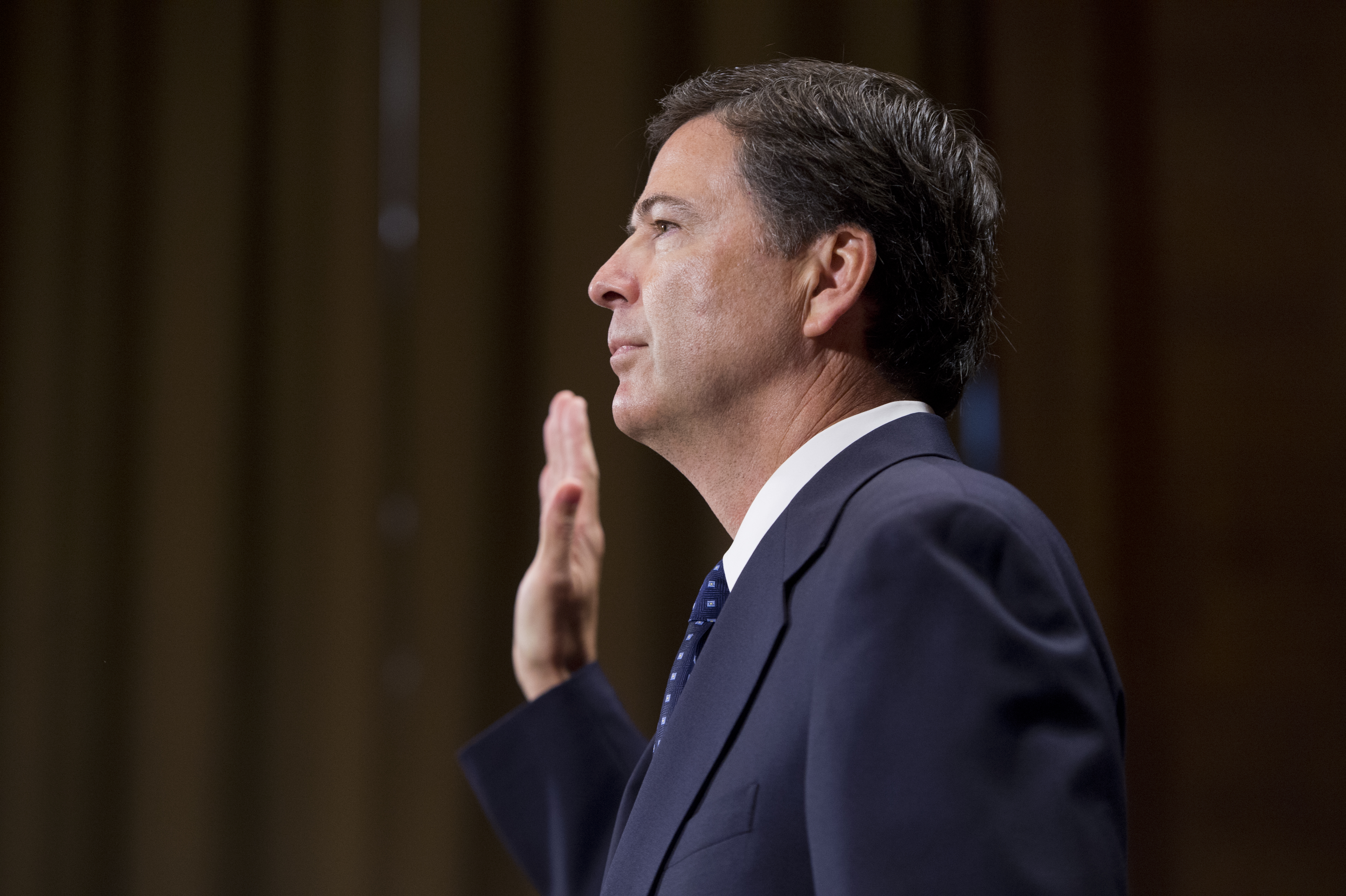
James Comey Hearing

His only claim to fame is that he prevented a completely lawless surveillance program – rooted entirely in the executive branch – from being imposed on a sick attorney-general. That’s not heroism. It’s part of his basic duties. And while he yesterday said he opposes waterboarding, he was an active member of a war criminal administration, with respect to interrogations of prisoners. How on earth does re-appointing him not legitimize those war crimes – and represent the latest sad repudiation of the Geneva Conventions by Obama?

Let us now acknowledge a steaming pile of bullshit:

Mr. Comey said that the government’s statute on the [waterboarding] issue at the time was vague, complicating the ability of government lawyers to determine its legality. He said that despite his authorization of the opinions in 2005, he had urged senior Bush administration officials to end the use of the practice. “Even though I as a person, as a father, as a leader thought, ‘That’s torture — we shouldn’t be doing that kind of thing,’ I discovered that it’s actually a much harder question to interpret this 1994 statute, which I found very vague,” Mr. Comey, 52, said at the hearing.

Give me a break. No court – domestic or foreign – had ever found waterboarding not to be torture in 2005 as surely as 1905. There is nothing vague whatsoever about it. Nor is there anything vague about the very broad anti-torture laws that the US enforced before the war criminals of the last administration got their hands on total power. And Comey has the gall to call himself a leader! He was not a leader; he was following orders. And he has not repudiated the many other torture techniques that were in place before his departure in 2005. Any government figure who has that amount of contempt for the law, that amount of confusion about clear legal rules, and that amount of tolerance for torture has no place in any public office, let alone the FBI.

What worries me most is that this is just the latest evidence of Obama’s weakness in the face of the torture-enforcers of the past. Bringing those complicit with past torture into the Obama administration helps legitimize war crimes. John Brennan, for example, has been promoted and is now doing all he can to prevent the Senate Intelligence Committee from telling the truth about his above-the-law organization’s dark recent past.

If this president refuses to enforce the Geneva Conventions as clearly as his predecessor, he might do better than what is, in this instance, giving the finger to international law and human decency.

(Photo: James Comey, nominee for FBI Director, is sworn in to his conformation hearing before the Senate Judiciary Committee in Dirksen Building. By Tom Williams/CQ Roll Call via Getty.)

A Redder And Bluer World

Protesters In Texas Statehouse Block Texas Lawmakers From Passing Abortion Bill

We used to live on a planet defined by collectivism/communism and individualism/market capitalism. It was a crude way to describe the second half of the 20th Century, but it worked relatively well. Vast, stultified masses were toiling under the disproven theories of dead Victorians in Russia, China, and parts of South America; while the West either endured a kind of socialism (in Western Europe/India) or a more robust capitalism. We know how that struggle played out. What we didn’t know was what would replace it, when India, China and Russia – let alone South America – embraced, in varying degrees, the tangible success of the market in making people’s material lives more pleasant than at any point in post-hunter-gatherer human history.

But we know now. Market capitalism could not be restrained merely to the economic realm. It necessarily empowered individualist challenges to tradition and totalist faith – and, empowered also by the information technology revolution – these challenges could not be TURKEY-POLITICS-UNREST-DEMOgeographically contained any longer. And so in the increasingly fundamentalist Pakistan, one of the most popular Google search terms is “gay sex”. In Nigeria, 30 school children are burned alive for the crime of getting educated outside of religious rote indoctrination. In Tehran, ecstasy is easy to find, while in the Iranian hinterlands, young gay men are hanged in public. In Turkey, middle class secularists are in open revolt against creeping Islamization. In Israel, the once largely secular socialist country is becoming more and more dominated by religious fundamentalists who are now shaping its foreign policy in such a way as to provoke religious war rather than prevent it.

In Egypt, we have just witnessed a key precedent for civil war. The secular pragmatists and liberals – having lost to Islamists in the last election by a landslide – have engineered a counter-coup against the incompetence and fundamentalism of the Morsi government, which showed not the faintest clue of how to run a country. What is particularly striking to me is how each side now has a clearly different set of facts than the other. For the secularists, it is a given that the Muslim Brotherhood started the fracas that became yesterday’s massacre. For the Islamists, and anyone with open eyes, the overwhelming evidence is of a premeditated slaughter of unarmed citizens.

In America, violence, mercifully, is held at bay in these struggles, but the political system has effectively ground to a halt under their weight. Despite getting fewer votes than the Democrats for president, House and Senate, the Republicans are using their gerrymandered majority in the House to block even executive branch appointees from approval. They are determined to destroy universal healthcare. Rick Perry Leads "The Response" Prayer Rally In HoustonThey are launching a national campaign to shut down abortion clinics. They deny climate science. They voted against tax cuts – purely because a Democratic president proposed them.

There are relatively easy compromises to be had right now in a sane republic: short-term stimulus accompanied by long-term structural tax and entitlement reform; reform of universal healthcare to empower individuals rather than burden companies; pricing CO2 more aggressively to abate climate change; investing in infrastructure to help accelerate growth in the long run. There are good arguments to be had in all these areas – how best to tackle climate change? what share of the economy should the welfare state take as boomers age? – but the differences, compared with the crises facing many other countries, are relatively minor.

But the cultural gulf has rarely been as deep or as wide. My view on this is that our division is not really about politics or even ideology. Ideology is an often ill-fitting misnomer for something much more powerful – deep cultural alienation between the two parts of America. That alienation, in my view, is at its core the same alienation we are seeing in countries as diverse as Turkey and Egypt and Iran and Israel. It’s about the response to modernity – a choice between fear/rejection and relish/adoption. It’s between a red world and a blue world. Or rather an increasingly blue world in deadly conflict between an increasingly red one.

David Brooks reviewed Charles Taylor’s masterpiece, “The Secular Age”, today. Money quote:

Taylor’s investigation begins with this question: “Why was it virtually impossible not to believe in God in, say 1500, in our Western society, while in 2000 many of us find this not only easy but even inescapable?” That is, how did we move from the all encompassing sacred cosmos, to our current world in which faith is a choice, in which some people believe, others don’t and a lot are in the middle?

The real question, however, is how societies can retain their coherence and unity when they are caught between the reassuring certainties of fundamentalism and the exhilarating disorientation of modernity. The worldviews are from such different places – and are now penetrating cultures which, before the globalization of information, were able to keep them at bay. And so a mutilated woman in Saudi Arabia can see unfathomable sexual pornography with a click of a mouse. And young, hip Tehran youth look on in disbelief as the crudest forms of religious frenzy guide an economy toward the rocks. If you go from the central cities of these countries and venture further and further into the rural heartlands, you will find not only that the blue parts of these countries are getting bluer, but that, in response, many of the red parts are getting redder. Soon, both parties create a different set of facts, as well as beliefs, about their world. Until they are barely able to communicate with each other at all.

The places where these forces are not as strong are in Western Europe and China – where traditionalist religion has either died or was killed by decades of brutalizing communist atheism. But in those countries where fundamentalism has not lost its power, and where ISRAEL-RELIGION-JUDAISM-WOMENmodernity has not lost its seductive appeal, the conflict is deepening. I thought Barack Obama could somehow transcend this, and help move us forward. He has in many ways, but he is not engaging in an argument with his opponents, because in a religious and cultural war, arguments are just less potent than symbolism, resentment, identity and a divine claim to absolute truth. My fear is that these two forces are intensifying the strength of the other. Egyptians now have their own set of facts about yesterday’s massacre – but we in America have FNC and MSNBC. And the more the fundamentalist forces recoil from a multi-racial, multi-cultural, sexually free society, the more secularists are tempted to move from condescension to outright hostility. Before long, we have atheism in its most unadulterated form banishing people of faith from any role in public discourse – and vice-versa (think of climate denialism among those declaring God in control of the weather).

All of this is an epic struggle for meaning – and the possibility of meaning in any communal sense. That’s why it’s so intractable. That’s why it is tearing countries and cultures apart. That’s why reasoned debate, however vital, is so disarmed right now. Because pride, honor and identity are at stake. The ressentiment in the rural heartland is echoed by the bigotry of liberal, urban Americans when they discuss their fellow citizens in the redder, fundamentalist states.

I’m not sure there can be a political resolution to this in the short term. Obama was as good a try as any – and he has made under-EGYPT-POLITICS-UNRESTappreciated pragmatic progress in reforming America, shifting our foreign policy back toward sanity, saving us from a second Great Depression or the fate of much of Europe, and even winning universal healthcare. But there comes a point at which he simply hits a brick wall, just as the Islamists did in Egypt and the Green Movement did in Iran and the secularists have in Turkey and the liberal individualists in Tel Aviv against the settlers on the West Bank.

The only way through this impasse is through religious reform, in my view. This may take more than my lifetime. But proving the ineptness of theocracy, exposing the fallacies of the fundamentalist psyche, while treasuring varieties of religious experience that include within them a toleration of the conscience of others, is surely the only way forward. It will not be easy getting to a more purple world. But if it is not possible, then we face a century of warfare and social dysfunction. The unanswered question, to my mind, is whether this dynamic has so purged religious institutions of free thinkers and writers and theologians and saints that it has sealed its own – and everyone else’s – demise. As a Christian I refuse to believe that. But as a writer and observer of the world, it becomes harder each day.

(Photos in descending order: Reproductive rights advocates fill the Texas capitol celebrating the defeat of the controversial anti-abortion bill SB5, which was up for a vote on the last day of the legislative special session June 25, 2013 in Austin, Texas. By Erich Schlegel/Getty Images.

A woman protestor plays with a water gun on Taksim square on July 6, 2013 before clashes on Istiklal Avenue in Istanbul. Riot police fired tear gas and water cannon on July 6 to disperse some 3,000 demonstrators who tried to enter flashpoint protest spot Taksim Square in Istanbul. By Bulent Cilic/AFP/Getty Images.

Donna George of Houston, TX, stands and prays during the non-denominational prayer and fasting event, entitled ‘The Response’ at Reliant Stadium August 6, 2011 in Houston, Texas. Thousands attended the event organized by Gov. Rick Perry in order to pray for God to help save ‘a nation in crisis’ referring to America. By Brandon Thibodeaux/Getty Images.

An Orthodox Jewish man chants slogans to protest against members of the liberal Jewish religious group Women of the Wall who pray with traditional Jewish prayer apparel for men on June 9, 2013 at the Western Wall in Jerusalem’s Old City marking the first day of the Jewish month of Tamuz. By Gali Tibbon/AFP/Getty Images.

Egyptian supporters of deposed president Mohamed Morsi sit in front of barbed wire fencing that blocks the access to the headquarters of the Republican Guard in Cairo on July 8, 2013.  By Mahmud Hams/AFP/Getty Images.)

How Barbaric Is Force-Feeding? Ctd

You be the judge. Yasiin Bey (aka Mos Def) demonstrates the force-feeding procedure used on Gitmo hunger strikers:

Conor watched the video (I actually found it too painful after a while):

[W]hile I don’t know whether or not forced feeding crosses the line of torture, the exercise reminded me of the late Christopher Hitchens volunteering to be waterboarded.

The Obama Administration is force-feeding numerous Gitmo prisoners twice daily as a response to a hunger strike they launched to protest being held indefinitely without charges or trial.

The standard procedures used include “strapping detainees to a chair, forcing a tube down their throats, feeding them large quantities of liquid nutrients and water, and leaving them in the chair for as long as two hours to keep them from purging the food,” The Washington Post has reported. Detainees say the procedures are abusive, verge on torture, and have “caused them to urinate and defecate on themselves and that the insertion and removal of the feeding tube was painful.”

It’s definitely grotesquely inhumane. Seizing control of a human being’s internal body and organs, painfully forcing instruments inside his sinuses and stomach twice daily to keep him under the total control of the authorities is horrifying enough. But when you consider that, unlike Mos Def, these prisoners, many innocent or falsely charged, have no way to challenge their indefinite detention, and are stuck in an endless purgatory of nothingness, the barbarism is obvious. As is the sadism and “globalized indifference” of the American public and their craven Congress. Steve Chapman wants the force-feedings to stop:

It would be unpleasant for the administration to accept the possibility that these detainees will die by starvation. But it might also force the American public and its elected representatives to wake up to the needless, open-ended suffering that is being inflicted on innocent people. It might induce other nations to accept freed inmates.

It might do none of these things. Then maybe the hunger strikers will conclude they are better off dead. If that choice reflects badly on us, it should.

Amen. Life-long confinement without even due process of any meaningful sort, is so alien to democratic principles and Western jurisprudence, it remains a rebuke to everything America claims to stand for.

Earlier Dish on force-feeding here.

Santo So Subito

I have a feeling that when historians look back at the recent death-spiral of the Catholic hierarchy, they will note the radicalism of Benedict in a couple of respects: his sudden resignation, upending centuries of tradition; and his continuation of the absurd sanctification policies of his predecessor and ally, John Paul II. John Paul II canonized more saints than all the Popes since 1588 put together. Those new, desperate developments – showing how theoconservatism is, like neoconservatism, anti-traditionalist and radical in its new modes of thought and action – are culminating in the canonization of Wojtila just eight years after his death.

I agree with Catholic historian Michael Walsh, who sees corruption in all this:

My doubts are about John Paul being beatified by his successor, Pope Benedict. It appears incestuous and akin to the habit of deifying one’s ancestors.

The whole point of the very long and arduous process of canonization (pre-Wojtila) was to guard against the emotional judgment of contemporaries, and the narrow interests of Vatican factions, in order to wait for the cool reason of historical perspective. And it is far too soon to tell what John Paul II’s ultimate legacy will be. He radically transformed the papacy into a traveling rockstar world-tour, a precedent that made his successor seem even smaller than he was. He reversed the intellectual openness of the Second Vatican Council. The Catholicism he revered was very Polish and very anti-modern, even though his own intellect was considerable. There’s no denying his charisma, his charm or the depth of his faith and power of his example. His role in guiding Europe away from Communism was integral to the miracle of the late 1980s. But he also presaged the collapse of the church in Europe and presided over the worst scandal in the church since the Reformation: the rape of thousands of innocent children and the cover-up that protected priests rather than kids.

Unlike Ratzinger in Munich, Wojtila didn’t have a direct, personal role in enabling the rape of children under his direct supervision. But his refusal to see what was in front of his nose, and, more specifically, his long and passionate support for one the the greatest monsters of the scandal, Marcial Maciel, seem to me to argue for caution and time, rather than impulsiveness and a rush. Maciel was a bigamist and a drug trafficker and a multiple child rapist. He even raped his own children. He ran a cult devised to satiate his sexual appetites and bring in money in massive amounts. John Paul II was the prime obstacle in stopping this man’s corruption and evil – far more protective than even Ratzinger. The sheer amount of money Maciel was able to shake down from the wealthy was undoubtedly salient here, as was his ability to bring countless new, Francoite priest-bots into the Church. I just don’t see how a Pope with this on his record can be made a saint almost instantly.

Or not without putting the hierarchy once again on the side of the powerful – at the expense of the souls of countless children. Does this not merit at least some measure of circumspection rather than a rush to instant judgment? And does this process not feel like a sudden move to protect his legacy before its full details come to light?

Monogamy: Gay Men, Lesbians, And Straights

Gay Marriage Becomes Legal In California

Nathaniel Frank rebuts a Hannah Rosin’s post on same-sex marriage, which cites “decades-old statistics from the counterculture” to argue that married gays won’t likely be monogamous:

[H]ow different are gay and straight couples? Probably different but not that different. Data on straight monogamy are all over the map. One report suggests 70 percent of married men cheat. (OK, that was a Fox News report, but shouldn’t that skew toward idealizing heterosexuality?) A nationally representative survey of 884 men put the number at only 23 percent. A much bigger but unrepresentative MSNBC survey found that nearly half of adults cheat—exactly the same percentage as the San Francisco study found with gay men. Other reports have found the same—that 50 percent of married men cheat—and one also found that the vast majority will not admit to it, perhaps even on surveys.

The gay male culture of nonmonogamy, rooted in gay liberation (and again, not all gay men are part of it), is likely to encourage both nonmonogamy and honest reporting of it, a key difference from the norms and expectations of the heterosexual mainstream.

I’m not so sure, if only because these things tend to be kept private (for good reasons); and because the possibility of a monogamish marriage diminishes very quickly among heterosexuals and lesbians. And gay men are, to my mind, more likely to be influenced by the 99 percent of marriages that adhere to cultural norms than the 99 percent are to be influenced by the 1 percent. Dreher offers a critique of Steve Thrasher’s piece on married non-monogamous gays:

In the piece, someone praises gays for being “honest” about their sexual behavior, unlike hetero hypocrites like “Newt Gingrich.” But that’s just it: Gingrich’s infidelities were an occasion of moral opprobrium and legal consequence for him. If Gingrich and one of his wives had written a prenuptial contract that provided for his desire to wander sexually, there would have been stigma attached to it. That stigma is important to maintain. Of course there are straight people who commit infidelity within marriage, and there are, no doubt, straight people (swingers) who negotiate infidelity within the context of their marriage. The point is that these people are outside the norm, and are seen as outlaws in some sense. On Thrasher’s account, that’s not the case for gay men.

Gingrich is such an outlaw he has just been given a spot on CNN’s Crossfire and had a good run for president as a Catholic Republican! So I think Rod overplays his hand here. That barn door has been swinging wide or at least ajar for quite a while now. Nonetheless: it’s obvious that marriage between two men and between two women will be inherently different in some respects both from each other and from heterosexual marriages. But the core issue isn’t gay or straight, it seems to me; it’s male and female.

We do not hear moral panic around lesbian marriages, for example, because they tend to be more monogamous than straight ones – and more numerous than gay male ones. Hence the net result of marriage equality may be a slight uptick in monogamy as more women enter the institution. Heterosexual men are also constrained powerfully by the woman they are married to – but do break those constraints (often by lies or discretion) as the stats show.

The other core issue, it seems to me, is whether you have kids or not. Again this distinction is much more salient than gay vs straight. Monogamy matters much more insofar as it helps rear children in a clear and settled and stable environment. But childless couples? I would not want to peer into whatever arrangements they might have made with each other (or not). I’d simply hope they protect their own privacy, and be able to forgive one another and communicate with each other.

What’s different about a gay male couple is that extra-marital indiscretions can be – but not always are – negotiated/forgiven/understood – because men understand men and male desire, and the difference between mere sex and major betrayal. Dan Savage and I discussed this here. Does this mean gay male couples should publicly challenge the social norm of monogamy? I don’t believe so. What we can do – and what some straight couples do – is contain the details of our relationships to one another. It’s called discretion. And discretion is not the same as infidelity, which is ultimately and rightly defined by the couple themselves. (By the way, I see no relevance at all in the way any couple meets. Very sleazy hookups can lead to very stable marriages; squeaky-clean introductions can become living hells.)

Is there some hypocrisy here? Of course there is – as there is among straight couples who deal with an infidelity privately while “keeping up appearances”. A little hypocrisy is sometimes the tribute vice pays to virtue. Bottom line: I don’t want to investigate the private details of people’s marriages, straight or gay, but I do think upholding a public norm of fidelity is worthwhile, and more than worthwhile when children are involved. Equally, I think the obsession with sex in marriage mistakes wood for the trees (that was an attempt at a pun). Marriage is about so much more than sex. Fidelity is about much more than monogamy. And the more we appreciate that, the stabler and happier our marriages will be.

More Dish on gays and monogamy here, here, and here.

(Photo: Justin Sullivan/Getty)

The Final Busting Of Cardinal Dolan’s Lies

Pope Benedict XVI Holds Concistory

You know where this man is coming from when he dismissed the organization SNAP – Survivors Network of those Abused by Priests – as having “no credibility“. The records from his old diocese in Milwaukee show he authorized pay-offs to child-rapist priests to encourage them to leave the ministry. (In the Catholic hierarchy, you don’t report rapists to the police; you eventually offer them financial incentives to leave.) Nonetheless, at the time, Dolan insisted that these charges were “false, preposterous and unjust,” whatever the records or even the spokesman for his old diocese said. Now, in another piece of stellar reporting, Laurie Goodstein adds more context to this man’s record:

Files released by the Roman Catholic Archdiocese of Milwaukee on Monday reveal that in 2007, Cardinal Timothy F. Dolan, then the archbishop there, requested permission from the Vatican to move nearly $57 million into a cemetery trust fund to protect the assets from victims of clergy sexual abuse who were demanding compensation.

Cardinal Dolan, now the archbishop of New York, has emphatically denied seeking to shield church funds as the archbishop of Milwaukee from 2002 to 2009. He reiterated in a statement Monday that these were “old and discredited attacks.”

However, the files contain a 2007 letter to the Vatican in which he explains that by transferring the assets, “I foresee an improved protection of these funds from any legal claim and liability.” The Vatican approved the request in five weeks, the files show.

So, twice now, we have been forced to choose between his words and our lyin’ eyes, when it comes to questions of how he handled and cosseted child-rapists under his jurisdiction in Milwaukee. We now know he deliberately sequestered church assets so he could argue he had no more funds to compensate those raped by his subordinates. He was once again putting the institutional church’s interests above those of the raped. And he seems to be able to lie about all of it – in the face of massive evidence – with nary a flicker of hesitation.

(Photo: New cardinal Timothy Michael Dolan, Archbishop of New York, receives the biretta cap from Pope Benedict XVI in Saint Peter’s Basilica on February 18, 2012 in Vatican City, Vatican. By Franco Origlia/Getty Images.)

The Independent Dish: Six Months In

We promised to keep you up to date with the new independent Dish’s progress – and six months seems like a good time to summarize. The current number of subscribers to the Dish now stands at 27,349. I don’t think there’s a purely online site (that isn’t money or porn) that has that kind of subscriber base. That’s your achievement.

More to the point, the number of readers who have used up their five read-ons now stands at 28,000. If you’ve clicked five times on the read-ons, you’re one of them, you really are a dedicated reader, and we’d love you [tinypass_offer text=”to sign up”]. If you did, our subscription tally would double overnight – and we’d be set. So if you still think a reader-supported, ad-free site, free from corporate control is worth supporting, please [tinypass_offer text=”subscribe”]. It won’t just help us, it will, we hope, help generate a new model for good online journalism answerable only to its readership – an almost unique oasis on the web right now.

Our traffic, like many other sites, dipped a little this spring, but has stabilized and even up-ticked a little lately:

Screen Shot 2013-07-01 at 12.40.39 PM

Revenue is now at a gross $715,000 – with our stated goal remaining $900,000 for the entire year. It may seem like we’re well on our way, and we are, with 80 percent of our stated annual goal achieved in only six months. The caveat – and it’s a big one – is that the vast majority of our income came in the very first few days of the launch, and, because we didn’t even have our own site then, none of that was auto-renewable:

Screen Shot 2013-07-01 at 12.47.55 PM

From March onward, everyone is on auto-renewal, which gives us much more stability. But we won’t really know how sustainable we are until we see if we can get all our most devoted Dishheads to give the same amount next February when their subs come due. I’m pretty confident we can – but enough of a worry-wart not to declare success until then. Nonetheless, the good news is that when you look at the revenue after that first money-bomb, it has stabilized since April and shows little sign of declining. Last week was our best since April, for example. The weekly revenue from March 1 to July 1 per week is as follows:

Screen Shot 2013-07-01 at 12.50.00 PM

Here’s the conversion rate – i.e. the percentage of readers who hit the pay-meter and actually pay:

Screen Shot 2013-07-01 at 1.03.55 PM

We’re doing slightly better than the industry average (2.5 percent vs. 2 percent), even after the bulk of our most dedicated readers subscribed in January. Two things have helped – our [tinypass_offer text=”$1.99 a month offer”] and the gift subscriptions. If we sustain this trend, we should have gross revenue of around $815,000 by the end of the year, which is damn close to our entire budget in our last year at the Beast. Only this time, our budget will actually be paid for in full by readers.

I’d like to thank all of you who have made this possible from the depths of my heart, and invite all of you who have enjoyed the Dish but not yet signed up to get all of it, to [tinypass_offer text=”become a subscriber”]. It’s only [tinypass_offer text=”$1.99 a month”] or [tinypass_offer text=”$19.99 a year.”] Or if you’re already a subscriber and want to help us some more, give the gift of the Dish to a friend for a year and see how she or he likes it.

We’re really trying to forge a new path here for online media. [tinypass_offer text=”Help us get there.”] Update from a reader:

For what it’s worth, I thought I’d mention that I’m one of those people who has read your blog for years and just reached my click-through limit in the new subscriber format. So I subscribed. But I did it today because of the six-month report you just posted. Absent that, I probably would have kept perusing without clicking through for who knows how many more months. I admire your transparency about this new thing you all are doing.

Another:

Great idea in today’s blog: giving someone a subscription as gift. I just bought my 23-year-old daughter, a political junkie like her mom, a year’s subscription. You should post the suggestion more often.

Another:

Although a loyal reader for years, I resisted subscribing because I don’t like being hustled, even for the cause, and your meter, to me, seemed somehow unworthy of the enterprise. Sort of like seeing under the bearded lady’s mask. However, anyone who can reference Kenneth Burke and Bobby Bland, two of my all-time picks for “which three people would you like to have dinner with?” (the third being Fritz Perls or JS Bach, alternately.) I admit I am beaten and shall resist no more. I subscribed today.

Another:

After telling me about your blog for years, a good friend borrowed my laptop and “somehow” left my browser open to your site. I’ve been poking around ever since. I finally subscribed today because I can now actually afford to do so. Thanks for the various subscription paths, for the transparency of the journey, for the ethics of your workplace, and for the talents of those you’ve hired.

PS. Two words of constructive criticism: More cowbell.

Done. Another:

Reminding people to buy really does work – I just did it! I’m on my married partner John’s computer and subscribed under my own e-mail address. We got married in Provincetown three years ago, so we’re happy that California now joins the club (we live in Laurel Canyon). Thanks for all your hard work on marriage equality. What a long journey we have all been on.