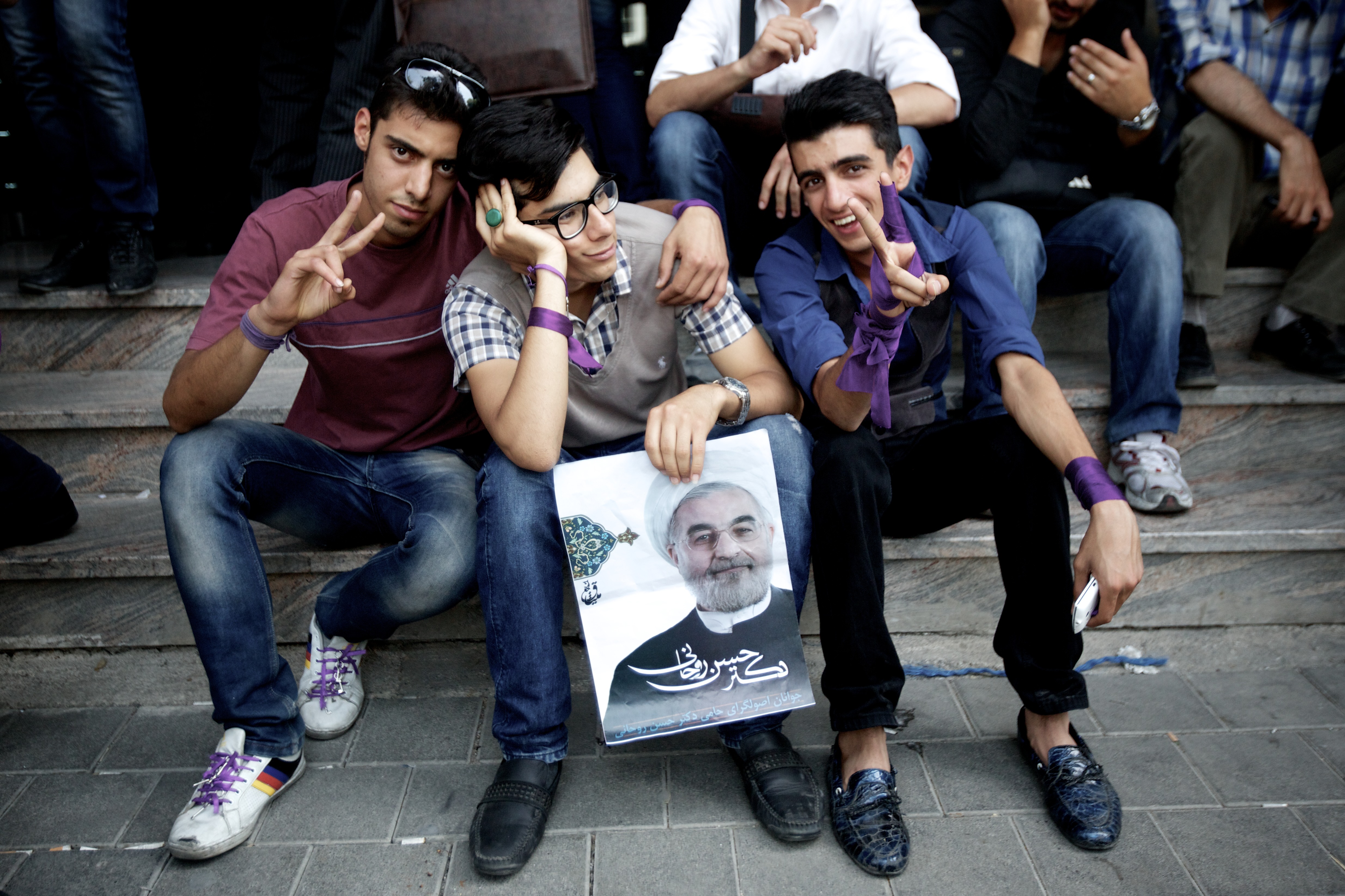
“An Old Wound Which Must Be Healed”

IRAN-VOTE-ROWHANI

That’s what Rouhani said today about the relationship between Iran and the United States. That old wound, one has to remember, really struck deep in 1953, when the CIA ousted Iran’s first democratically elected government, because it nationalized the Anglo-Persian oil company. Even then, Iran’s desire was to control its own energy supply. We know the rest of the story by now, however tone-deaf so many have become to the role of history in determining that country’s psyche and culture.

No, he did not signal a shift toward direct talks with the US, and offered no opening on the nuclear weaponry potential of the theocracy. But it truly was striking how conciliatory he was to the Sunni Saudi regime:

The priority of my government’s foreign policy will be to have excellent relations with all neighboring countries … We are not only neighbors but also brothers. Every year hundreds of thousands of Iranian pilgrims visit Mecca. We have many common points with Saudi Arabia.

And this is surely encouraging:

First, we are ready to increase transparency and clarify our measures within the international framework. Of course our activities are already transparent, but still we increase it. Second, we will increase the trust between Iran and the world.

Yes, I’m well aware that he is not Moussavi or Karoubi – but they also backed the nuclear program (as does the opposition as a whole). And to immediately knock down any hope for some engagement with Iran seems to me to be insulting the perseverance of ordinary Iranians. The fact of US-Iranian governmental distrust and even hatred is, in the face of that country’s great history and youthful energy, a true tragedy. Jon Snow, who was reporting from Tehran over the weekend, offers a succinct portrait of the country as he now sees it, particularly in relation to the Western stereotypes:

[B]eyond the bugs in hotel rooms, the arrests, and strange people taking photographs wherever you go, there is something continuously absorbing and intriguing about Iran that renders the paranoia it provokes entirely unbearable.

The country is spectacular, the people are approachable, friendly and remain westward-looking. Many are highly educated and skilled, and 6,000 years after the country began, they are still building. In short, they are people the west used to and should still do business with.

For all its faults, Iran remains a haven of peace, surrounded by wars in which the West is deeply involved, and set to become more so after Barack Obama announced his intention last week to arm the Syrian rebels. By midnight on Saturday the Chamran highway that leads to the centre of Tehran was sporting a noisy three-car-wide, five-mile queue of families desperate to join the celebrations.

Meanwhile, Golnaz Esfandiari rounds up a collection of recent statements by the newly-elected Rouhani, including, “Using the Internet, I must say, is one of my hobbies regardless of whether I need it.” Along those lines, there are reports that the video-chat services Skype and Oovoo have now been unblocked for the first time in many months, allowing Iranians in and outside of the country to once again speak more freely with each other.

We should have no illusions that Khamenei is still in charge. But in two consecutive elections, the Iranian people have reached out to the world. We can and should find a way to reach back. In my view, that means a pragmatic path toward seeking more and more transparency in return for a very gradual ratcheting down of sanctions. We may have to go one tiny step after another. But the Iranian people deserve a response that is more than cynical. Look at them these past few days or four years’ ago. How can one be cynical in the face of that?

Previous Dish coverage of the Iranian election here.

(Photo: Iranians supporters of moderate presidential candidate, Hassan Rowhani flash the sign of victory holding a portrait of him as they wait for the final results outside his campaign headquarter in downtown Tehran on June 15, 2013. By Behrouz Mehri/AFP/Getty Images)

Obama Caves On Syria

US-POLITICS-OBAMA-LGBT

[Re-posted from earlier today]

Well, we don’t yet quite know what’s in the works – but once you start arming one side of a civil war, you become part of that civil war; the other side may target you; and as this sectarian conflict deepens across the region, the US will be seen as a Sunni power fighting Shiites. I cannot think of a worse policy position for this country – to take stand on the sectarian fault-line of the Muslim world and back one side over another. You think the other side won’t notice? You think Americans wouldn’t be targeted for this kind of meddling? Let Putin get bogged down in this hell, if he remains so 19th Century he feels he must. But we should have zero interest in that ancient religious dispute; zero.

And you can say you’re only arming them with anti-tank weapons and the like. Ben Rhodes was very careful not to say too much. But of course he did say far too much. Once you have committed to one side in a civil war, you have committed. The pressure from the neocons and liberal interventionists to expand this war will only increase – because either you fight to win or you shouldn’t fight at all. Yes, it’s the same coalition that gave us the Iraq catastrophe.

My strong view, vented last night as I absorbed this stunning collapse of nerve, is that we shouldn’t fight at all. We are damn lucky to have gotten every GI out of Iraq, and the notion of being sucked back into that region again – and to join sides in a sectarian conflict – is a betrayal of everything this president has said and stood for. It’s a slap in the face for everyone who backed him because he said he wouldn’t be another Bush or McCain or Clinton. If he intervenes in Syria, he will have no credibility left with those of us who have supported his largely sane and prudent foreign policy so far. Libya was bad enough – and look at the consequences. But Syria? And the entire Middle East? Is he out of his mind?

And can you think of a dumber war than this one?

The man who said he would never engage in a dumb war is apparently preparing to join the dumbest war since … well, Iraq. And by the way: who would you rather have in control of chemical weapons – Assad or the al Nusra brigades? Because it will be the al Nusra brigades who would seize the country if Assad falls. And you think those fanatics have the slightest loyalty to us?

One reason I supported Obama so passionately in 2008 and 2012 was because I thought he understood this and had the spine to stand up to drama queens like McCain and armchair generals like William Jefferson Clinton. But it is beginning to appear that this president isn’t actually that strong. We voted for him … and he’s giving us Clinton’s and McCain’s foreign policy. If Cameron and Hollande want to pull another Suez, for Pete’s sake be Eisenhower – not Kennedy.

My cri de coeur is here. Don’t do it, Mr President. And don’t you dare involve us in another war without a full Congressional vote and national debate. That wouldn’t just be a mistake; it would be a betrayal.

(Photo: Saul Loeb/Getty.)

Obama’s Betrayal On Syria

SYRIA-CONFLICT

This was a president elected to get us out of conflict in the Middle East, not to enmesh us even further in a cycle of sectarian conflict and metastasizing warfare. This was a president who said he didn’t oppose all wars, just dumb ones. Is there a conceivably dumber war to intervene in than Syria’s current civil one? I can’t see one.

You can forgive a president once – even though his misguided, counter-productive and destabilizing war in Libya was almost as nuts as this latest foray. But by deciding to arm the Sunni radicals fighting the Shiites in Syria and Lebanon, the president has caved to the usual establishment subjects who still want to run or control the entire world. I don’t buy the small arms qualifier. You know that’s the foot in the door to dragging the United States into the middle of a civil war we do not understand and cannot control. If it has any effect, it will be to draw out the conflict still longer and kill more people. More staggeringly, he is planning to put arms into the hands of forces that are increasingly indistinguishable from hardcore Jihadists and al Qaeda – another brutal betrayal of this country’s interests, and his core campaign promise not to start dumb wars. Yep: he is intending to provide arms to elements close to al Qaeda. This isn’t just unwise; it’s close to insane.

What to do when a president just reverses course like this? It comes after verification that the Syrian regime has used chemical weapons against civilians. This is, apparently, the “red line”. Indiscriminate shelling that kills tens of thousands wasn’t enough. Of course, I’m not in any way defending the horrifying use of these weapons against civilians – but I am asking what on earth is the American national interest in taking sides militarily? I see precisely none. Do we really want to hand over Syria’s chemical arsenal to al Qaeda? Do we really want to pour fuel on the brushfire in the sectarian bloodbath in the larger Middle East? And can you imagine the anger and bitterness against the US that this will entail regardless? We are not just in danger of arming al Qaeda, we are painting a bulls-eye on every city in this country, for some party in that religious struggle to target.

I understand why the Saudis and Jordanians, Sunni bigots and theocrats, want to leverage us into their own sectarian warfare against the Shiites and Alawites. But why should America take sides in such an ancient sectarian conflict? What interest do we possibly have in who wins a Sunni-Shiite war in Arabia?

I hate to say it but this president looks as if he is worse than weak here. He is being dragged around by events and pressures like a rag doll. And this news that we are entering the war with military supplies is provided by Ben Rhodes, not the president. That’s nothing against Ben, but when a president is effectively declaring war, don’t you think he has a duty to tell the American people why and what he intends to achieve?

But nada. You voted twice for Obama? You’re getting the policies of McCain and the Clintons, the candidates he defeated. I wish I could understand this – but, of course, my worry is that the pincer movement of Rice and Power is already pushing us into a war we do not need, and cannot win.

This is worse than a mistake. It’s a betrayal – delivered casually. Maybe he thinks his supporters will treat this declaration of war just as casually. In which case, he’s in for a big surprise.

(Photo: Syrian rebel fighters belonging to the “Martyrs of Maaret al-Numan” battalion leave their position after a range of shootings on June 13, 2013 in the northwestern town of Maaret al-Numan in front of the army base of Wadi Deif, down in the valley. By Daniel Leal-Olivas/AFP/Getty Images)

HIV Treatment As HIV Protection

I’m a broken record on this, but the second truly important thing about HIV meds (after saving your life if you’re infected) is that they can also save your life and protect your health when you’re not infected. The last group to be tested for pharmaceutical prophylaxis is IV drug users, and they too saw remarkable results:

Drug-injecting addicts who took a daily antiretroviral pill were half as likely to become infected with H.I.V. as those who did not, a major new study has found, providing the final piece of evidence that such treatments can prevent AIDS in every group at risk … According to the C.D.C., when study results are adjusted to include only participants who took their pills most of the time, the protective effects are 92 percent for gay men, nearly 90 percent for couples in which only one partner is infected, 84 percent for heterosexual men and women, and about 70 percent for drug injectors.

AIDS and HIV are no longer terrifying for young gay men – for the good reason that the impact of the disease is so much less devastating than it once was. But it remains a chronic disease, the medications are not without serious side-effects, and infection rates remain stubbornly high. It’s not over, and it should be.

TenofovirMy view is that every doctor who treats a sexually active gay man should put him on a daily retroviral in the same way you might prescribe a daily anti-cholesterol drug for someone with high cholesterol. If 92 percent of gay men can avoid infection this way, then we could truly turn the tide.This is the equivalent of Plan B for pregnant women – except it’s taken every day and prevents infection, rather than trying to contain HIV once the virus has gotten inside.

Using the old tactics of fear and sexual shaming simply will not – does not – work. Men will have sex with other men, period. It’s about as predictable as cold in the winter and warmth in the summer (maybe more predictable these days). The cost is a fraction of what a full anti-retroviral regimen would be after infection.

So what are we waiting for? Unless to get past the stigma that gay sex is something you should keep as scary as possible? And in my view, these pills should also be over the counter. If we really want to bring infection rates down, there is no reason not to use one the most effective weapons we have. Could it generate HIV-resistance if taken irregularly? Not if you don’t have the virus in the first place. Yes, getting people to take this regularly and properly may be a struggle. But if we can get people to take an aspirin today (one of the best and simplest things you can do for your health), why not this?

A Parish Of One

[Re-posted from earlier today]

Well, that’s how Sam Harris has often described me – so I might as well repay the back-handed compliment. But what makes Sam’s work about religion so compelling is that, unlike my old friend, Hitch, he actually grasps what faith can be at its best. He doesn’t dismiss it – or its spiritual aspirations – as somehow inherently absurd. In fact he has spent years of his life exploring the possibility of sublime spirituality without God. And his argument, it seems to me, is mainly with intolerant, fundamentalist forms of religion, of which Islam is easily the most troublesome at this point in history. Glenn Greenwald recently said that Sam could feel no empathy for Muslims, that his worry about Jihadism was a function of not getting their point of view, a sweeping generalization based in tribalism. Sam cannily responds in a post worth reading and listening to at length:

Let us see where the path of empathy actually leads…

First, by way of putting my own empathy on my sleeve, let me say a few things that will most likely surprise many of my readers. Despite my antipathy for the doctrine of Islam, I think the Muslim call to prayer is one of the most beautiful sounds on earth. Take a moment to listen:


I find this ritual deeply moving—and I am prepared to say that if you don’t, you are missing something. At a minimum, you are failing to understand how devout Muslims feel when they hear this. I think everything about the call to prayer is glorious — apart from the fact that, judging by the contents of the Koran, the God we are being asked to supplicate is evil and almost surely fictional. Nevertheless, if this same mode of worship were directed at the beauty of the cosmos and the mystery of consciousness, few things would please me more than a minaret at dawn.

Sam gets it because he’s been there, having engaged in thousands of rituals and countless hours in meditation for much of his adult life. This is why he of all the new atheists was the one I most wanted to have a dialogue with. (You can read it here.)

The whole new post is full of that sum of religious and spiritual experience. But this is what he also gets:

Islam marries religious ecstasy and sectarian hatred in a way that other religions do not. Secular liberals who worry more about “Islamophobia” than about the actual doctrine of Islam are guilty of a failure of empathy. They fail not just with respect to the experience of innocent Muslims who are treated like slaves and criminals by this religion, but with respect to the inner lives of its true believers. Most secular people cannot begin to imagine what a (truly) devout Muslim feels. They are blind to the range of experiences that would cause an otherwise intelligent and psychologically healthy person to say, “I will happily die for this.” Unless you have tasted religious ecstasy, you cannot understand the danger of its being pointed in the wrong direction.

I too understand that ecstasy, having experienced it myself in my life. There was a time as I was cast adrift in my teens when I clung to doctrine even more ferociously as a bulwark against shifts and changes I could not yet master. I see this now. I didn’t then. I believed God was telling me I had to enforce countless tiny things – avoiding cracks in the pavement, painting the Crucifixion repeatedly in art class, annotating my school books with little tiny crosses, praying constantly. I never reached the total subservience demanded by Islam, but I saw enough of why that appeals to be alarmed by it.

Belief, when severed from healthy doubt, when grasped as a psychological crutch to keep reality at bay, reaches inevitably for totalism. In fact, the bewildered and conflicted may need that totalism to keep their lives under any sort of order. Think of those 9/11 mass murderers, attending strip bars, then shaving their entire bodies, then flying planes into building.

Think of the staggering sectarian carnage now metastasizing in the Muslim Middle East. Think of how total your devotion must be to do the things some Jihadists do – like hacking a person down in the street and bragging about it.

To argue that we should not associate those actions with religious extremism, but be more aware of our own alleged Islamophobia, seems simply perverse to me. But – and this is a crucial qualifier – that does not mean that ratcheting up rhetoric against this fundamentalism necessarily helps. Nor does treating their crimes as different. Nor does invading Muslim countries, or torture. We can both recognize the unique threat Jihadism represents as the Muslim world attempts to navigate a modernity beyond their control – and we can be very cool, calm and collected in deciding how best to stymie it, defuse it, prevent it.

But we will not stop it. I suspect this phenomenon – and its concurrent violence – may last as long as the savagery of the European wars of religion in the sixteenth and seventeenth centuries. The difference is that this time, our technological capacity for mass slaughter is exponentially greater than it was four centuries ago. And the likelihood of a mass-casualty catastrophe occurring at some point is extremely high. We must simply hope it happens, if it must, somewhere other than here.

(Thumbnail photo: Minaret at sunset by Flickr user Dingopup)

“Open The Doors!” (And The Closets?)

VATICAN-POPE-AUDIENCE

If you want to understand just how vastly different this Pope is from his predecessor, read the full and best translation of his recent impromptu remarks to the Latin American and Caribbean Confederation of Religious Men and Women. They blew me away. Can you ever imagine the anal-retentive doctrine cop, Ratzinger, ever saying this about the body that dictates doctrine that he once headed, the Congregation For The Doctrine Of The Faith:

They will make mistakes, they will make a blunder [meter la pata], this will pass! Perhaps even a letter of the Congregation for the Doctrine (of the Faith) will arrive for you, telling you that you said such or such thing… But do not worry. Explain whatever you have to explain, but move forward… Open the doors, do something there where life calls for it. I would rather have a Church that makes mistakes for doing something than one that gets sick for being closed up…

The heart swells as the voice of Jesus replaces the voice of the Pharisee. Rocco tartly observes that Pope Francis’ “penchant for veering off-text in open company just reached a whole new planet”. You can say that again. I loved this aside in observing how we are often more obsessed with tiny shifts in stock prices than the human being dying of hypothermia down the street:

Computers are not made in the image and likeness of God; they are an instrument, yes, but nothing more. Money is not image and likeness of God. Only the person is image and likeness of God. It is necessary to flip it over. This is the gospel.

And I loved this dismissal both of the uptight traditionalists who cannot see the forest for the rosaries and of those seeking to substitute the core teaching of the incarnation in favor of a vague spirituality:

There are some restorationist groups. I know some, it fell upon me to receive them in Buenos Aires. And one feels as if one goes back 60 years! Before the Council… One feels in 1940… An anecdote, just to illustrate this, it is not to laugh at it, I took it with respect, but it concerns me; when I was elected, I received a letter from one of these groups, and they said: “Your Holiness, we offer you this spiritual treasure: 3,525 rosaries.” Why don’t they say, ‘we pray for you, we ask…’, but this thing of counting… The second [concern] is for a Gnostic current. Those Pantheisms… Both are elite currents, but this one is of a more educated elite… I heard of a superior general that prompted the sisters of her congregation to not pray in the morning, but to spiritually bathe in the cosmos, things like that …

And then a possible clue as to why Benedict XVI decided to break with centuries of tradition and run into hiding after he read a dossier on abuses in the church:

In the Curia, there are also holy people, really, there are holy people. But there also is a stream of corruption, there is that as well, it is true… The “gay lobby” is mentioned, and it is true, it is there… We need to see what we can do…

Was the former Pope subject to blackmail? Were other Cardinals?

If the Vatican’s screwed-up doctrines about gay people have led to genuine threats of blackmail from within the hierarchy, if a faction of benign or malign homosexuals has really been using that leverage for whatever purposes, then we do indeed have a problem, to which the answer must be more transparency – of the kind Francis seems to endorse. The Vatican is refusing to comment on the content of the “private meeting.” But Mary Elizabeth Williams recognizes an emerging pattern:

The pope’s cryptic statement about a “gay lobby” doesn’t do anything to explain what a “gay lobby” actually is, how it’s gay lobbying and what it’s gay lobbying for — or what the Vatican intends to do about what Francis calls the “difficult” work of reforming the genuinely corrupt aspects of the huge worldwide organization he recently became the leader of. But already his actions have revealed a Hillary-like determination to do it his way, protocol be damned. …

Like his institution itself, Francis still got a long, long, lonnnnnng way to go in terms of broadening the definition of love, humility and tolerance. But a guy who’s been tweeting about “the unemployed, often as a result of a self-centered mindset bent on profit at any cost,” is a guy who’s having a good time shaking things up and making splitting headaches for the big shots around him. A guy who remembers that Jesus was a loudmouth and a troublemaker. [Vatican spokesman] Father Lombardi, I hope you’ve got plenty of Advil. Because I have a feeling your boss is just getting warmed up.

Previous Dish on the rumors of a “gay lobby” in the Vatican here and here.

(Photo: Pope Francis smiles after his weekly general audience in St Peter’s square at the Vatican on June 12, 2013. By Alberto Pizzoli/AFP/Getty Images.)

My “Faith” In Obama

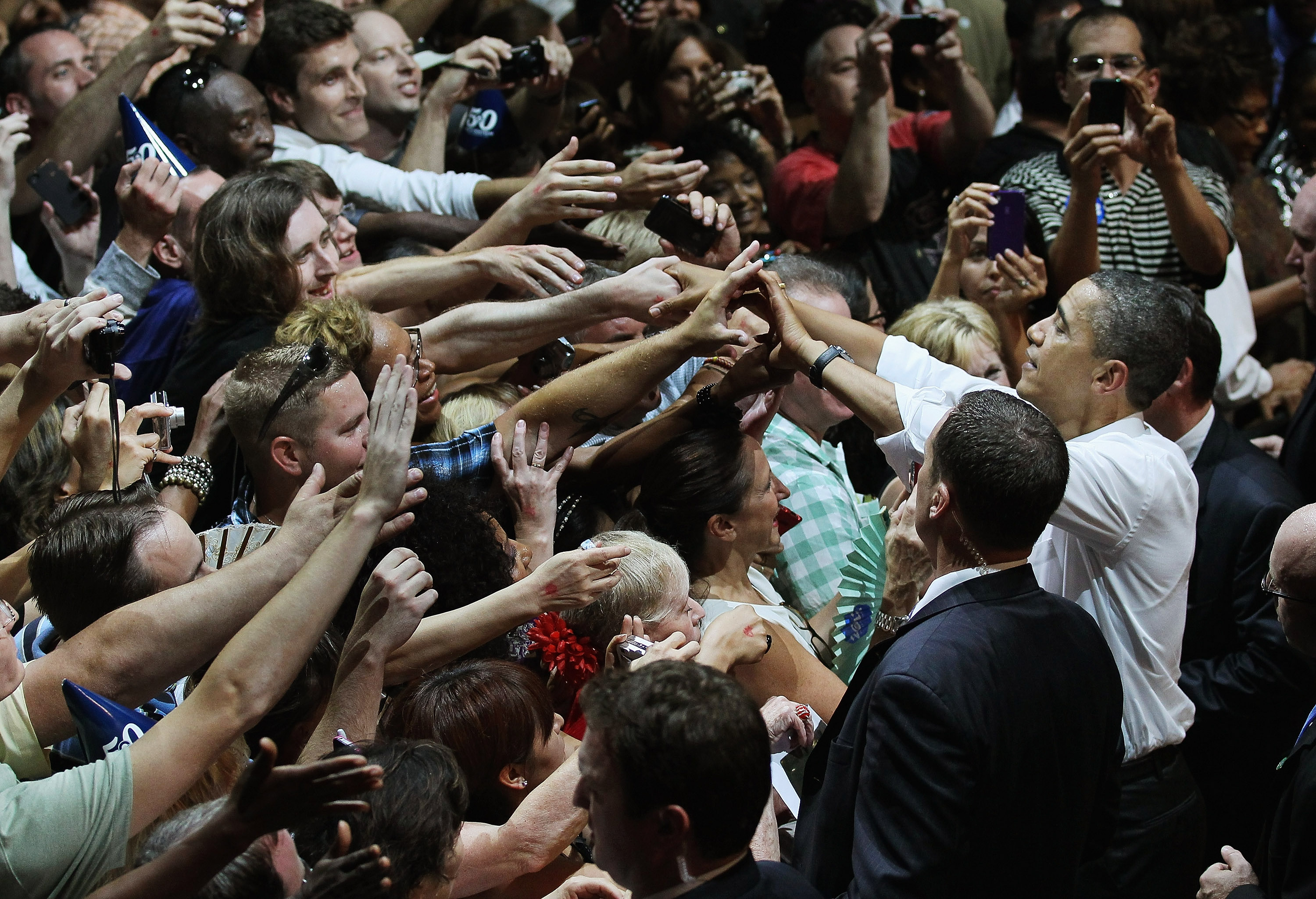
Obama Celebrates His Birthday At DNC Fundraiser In Chicago

Freddie deBoer struggles to reconcile my book with my recent blogging:

If you asked me to define one trait that would be least reconcilable with the conservatism espoused in The Conservative Soul, it would be deference to a particular leader. I cannot square the recognition that all political leadership is subject to corruption and failure with the kind of faith Sullivan regularly shows in Obama. And this becomes a deeper confusion when you see how this trust has filtered down from Obama to the people and programs beneath him.

He asks:

How can a man who admits the elusive nature of prudential judgment trust the judgments of thousands of totally unaccountable government functionaries? How can he believe that a system bent on total secrecy and total denial of oversight or restraint would represent a culture that could instill character? How could he look at this vast, dehumanized and dehumanizing surveillance system and not see a potentially failed solution to a problem that is, in perspective, a fact of life in the modern world? I cannot reconcile the philosophy with the individual commitments. I no longer really know how to read Andrew, at this point.

Well, I am most grateful for Freddie’s deep reading of my book, The Conservative Soul. But I dispute the idea that I have hero-worshiped Obama or failed to apply the same principles against him as I did against Bush, whose offenses were nonetheless immensely greater. The record of my tough criticisms of Obama on various issues is there for all to read. From dragging his feet on gay rights to not prosecuting war criminals to failing to end the war on marijuana to intervening in Libya without Congressional approval to the surge in Afghanistan … it’s a long list.

At the same time, judging political events in real times does require some grip on the character of those in office, and the inevitable compromises that requires, and I remain an admirer of Obama’s temperament, pragmatism and small-c conservatism. And I don’t think that abstract ideological issues can ignore the role of human beings and their prudential judgments over time. A conservative will always recognize that there is no substitute for character in political leaders and that representative government requires some basic form of – sorry – minimal trust if it is to function at all. Skepticism is not anarchism; real conservatives like strong, but limited, government. That’s why, though I have serious libertarian leanings, I still call myself a conservative. That’s why I see more insight in, say, David Brooks’ column today, than many on the libertarian right or civil liberties left.

So, yes, there is a real potential for abuse of a system like PRISM. But are we actually going to prevent government from using Big Data, while Google plumbs its depths even further and Buzzfeed even schedules its content by chasing algorithms? At least there is some minimal check on the government, a judicial court. It almost certainly needs more muscle, as this reader suggests, and that might be a helpful reform. There is also Congressional oversight – another important check. Yes, I remain skeptical and opposed to the state secrets that Obama has maintained which make it impossible for the public even to have a debate about trade-offs or those in Congress to protest publicly. But that doesn’t mean denying the realities of the low-level Jihadist insurgency we and the Muslim world are struggling against. Back to Freddie:

I would like for Sullivan to consider the possibility that he is placing far too much faith in a bureaucratic apparatus that contains a multitude of agendas and all of the potential for mismanagement and bad behavior that engenders… a scary thought, when that apparatus is connected to military power.

These programs are run by people, and people are fallible and frequently immoral. (It’s worth noting that many of the people working in these programs are the same people who worked under the Bush administration that Sullivan has rightfully criticized.) It would take so little for all of this to go wrong.

Yes, I know, and am open to such a debate. In fact, I’d welcome such a debate, as long as we can discuss trade-offs and not absolutes, as so many civil libertarians prefer. And I didn’t criticize Bush for this. So it seems plain weird to say that my position on this kind of meta-data is somehow a function of faith in one leader, rather than a consistent position. And if my position on this is that it may be, in fact, the least worst kind of surveillance, then again, I fail to see where I have gone astray.

From the very beginning of this conflict on 9/11, I argued both for pursuing this lethal fundamentalist insurgency on civilization and for protecting our civil liberties as much as we can in the process. I understood this would require pragmatic judgment and remain very open to the idea that we now may have a chance to seize this moment for a broader and necessary debate. I think Obama has pursued a balance in ways that Bush never fully did until the influence of Cheney receded. Here’s a money quote from the Dish on the very day of the attack:

The one silver lining of this is that we may perhaps be shaken out of our self-indulgent preoccupations and be reminded of what really matters: our freedom, our security, our integrity as a democratic society. This means we must be vigilant not to let our civil liberties collapse under the understandable desire for action. To surrender to that temptation is part of what these killers want… The task in front of us to somehow stay civilized while not shrinking from the face of extinguishing – by sheer force if necessary – the forces that would eclipse us.

I believe that is still the task, that Bush massively over-reached (unforgivably so on torture) and that Obama has improved on Bush immeasurably – no more torture, no more completely unchecked executive power, and a genuine attempt to close Gitmo – and may now be able to lead from behind on civil liberties with cover from parts of the public. At the same time, I’d welcome that. But PRISM? Big Data exists whether we like it or not. Not to use it and use more targeted forms of surveillance would unnerve me more. And yes, of course, there is potential for abuse – which is why I’m delighted it is now out in the open, where it should be. But we may find that the public’s view of the correct balance is not where Rand Paul or Glenn Greenwald or Freddie want it to be. And in the end, it’s their call.

(Photo: Scott Olson/Getty)

Obama’s Liberaltarian Opportunity

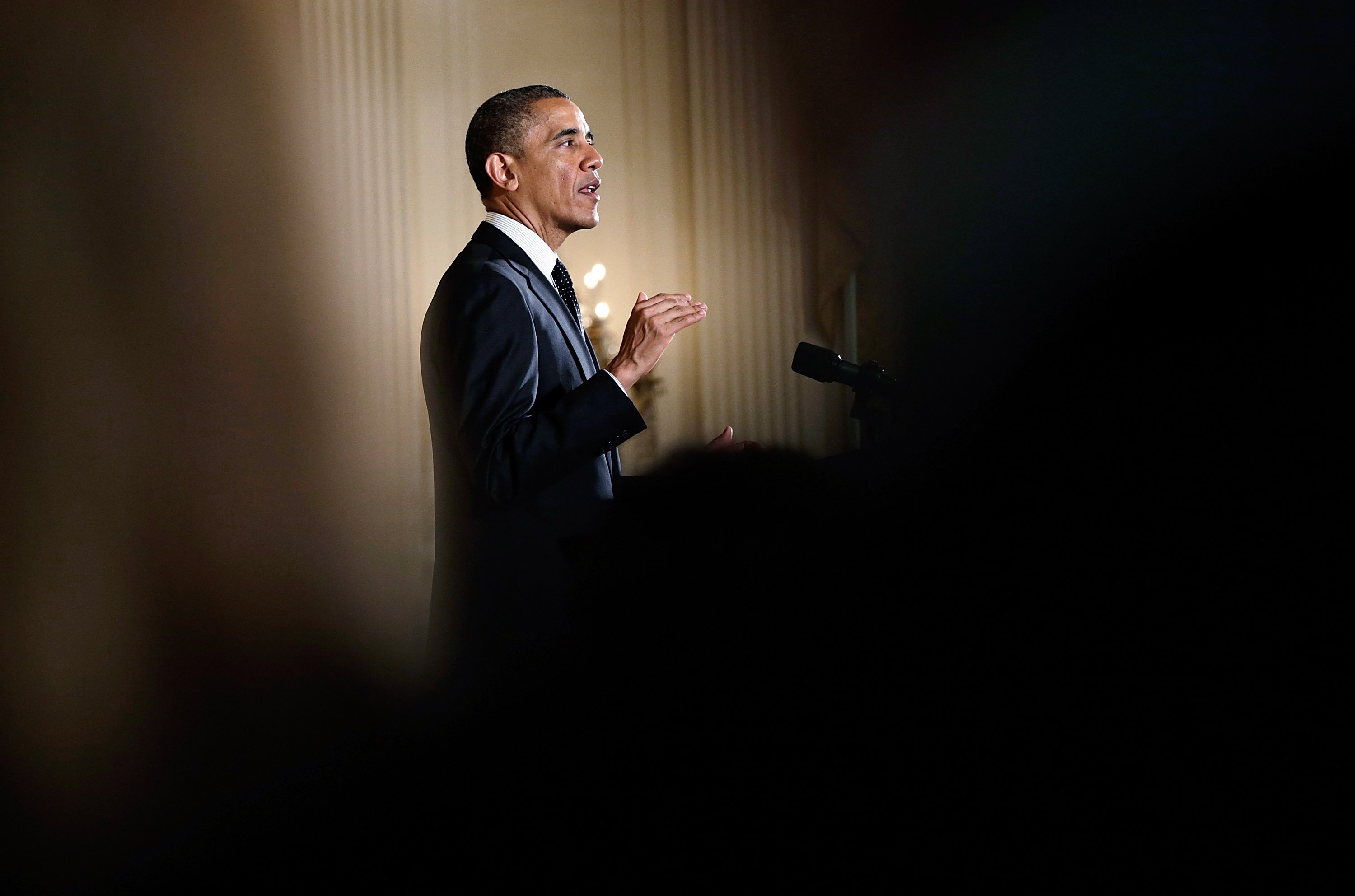
Obama Speaks At White House Conference On Mental Health

What has emerged in the past few days is a fascinating snapshot of a shifting political landscape. On the one side, we have a libertarian-civil liberties left alliance. On the other, a strange world where Bill Kristol and Joe Klein are on the same page. Personally, I think it’s a shame that this alliance has emerged over PRISM because it seems to me to be one of the less worrisome anti-terrorism policies. My general inclination is to back the liberaltarians on these questions, but I have never been a purist, appreciate the political balances required and wish this debate were not also wrapped in accusations of treason and heroism.

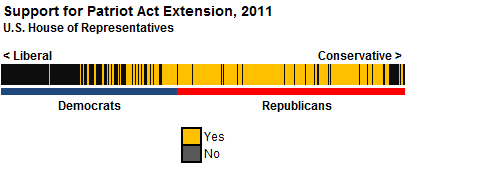
But we have a truly remarkable development here. The president, while defending PRISM, is open to ending it – or debating it more widely. That’s of a piece with his recent speech on terrorism. So he’s inviting more scrutiny of the issue in general – and encouraging, therefore, both Republican and Democratic opposition. Nate Silver gets the strange moment here:

fivethirtyeight-0611-nsa1-blog480

But this is the money graphic:

fivethirtyeight-0611-nsa3-blog480What we’re seeing here is a two-pronged pincer from the liberal conscience and the libertarian mind against the current center – from two years ago. I wonder what this chart would look like today. What we’ve outed this past week is the potential for a serious alliance, led from behind by the president.

Of course, there are two obvious caveats:

Some of the Republican opposition is so brazenly partisan its cynicism almost blows you away. But since they seem only to care about wounding Obama, it’s still a politically potent force, susceptible only to the possibility that Obama might at some point agree. The second caveat is that the public backs the security-over-surveillance center by a hefty margin – for the moment – and so it may not be a propitious moment for this emergent potential realignment to bear fruit.

But it may be the start of something, no? Nate looks at party primaries, where cross currents will shake up both parties from within. And you can imagine this alliance becoming more cohesive if we continue success in foiling terror attacks, withdraw from Afghanistan and ease back to a more conventional pre-9/11 mindset. It is not beyond Obama to be dragged toward this liberaltarian axis, and it is almost certain that Rand Paul may inject this theme very powerfully in the GOP presidential primaries.

I’m not shocked by PRISM. But if the president began to argue that he thinks it may be time to retire such and similar programs – and he already has – then he could leave a civil liberties legacy much better than the one that now seems likely. So while defending his past practice as justifiable, I have two words for those on the right and the left who want to unwind our overweening security state: Make him.

(Photo: Win McNamee/Getty)

The Government Isn’t Out To Get You

Joe Klein calls the NSA leaks a “non-scandal”:

Far too many people get their notions of what our government is all about from Hollywood; the paranoid thrilled is a wonderful form of entertainment, but it’s a fantasy. The idea that our government is some sort of conspiracy, that it’s a somehow foreign body intent on robbing us of our freedoms, is corrosive and dangerous to our democracy. This remains, and always will be, an extremely libertarian country; it’s encoded in our DNA. We now face a constant, low-level terrorist threat that needs to be monitored. A great many lives are potentially at stake…and our national security is more important than any marginal–indeed, mythical–rights that we may have conceded in the Patriot Act legislation. In the end, the slippery slope, all or nothing, arguments advanced by extreme civil libertarians bear an uncomfortable resemblance to the slippery slope, all or nothing, arguments advanced by the National Rifle Association.

There were moments in Snowden’s explanation for his actions when I thought: uh-oh. Much of it seemed sincere; but some of it – an “architecture of oppression” – seemed a little paranoid to me.

Look: I understand the paranoia. For twenty years, I lived on a visa which could have been revoked at any moment because of my health; I had to report my address regularly; I eventually had to give them my blood; I was an object of the immigration security state. At least every three years, I went before nameless officials who could go through any and every aspect of my life and health records and decide whether I should keep my current life in America or lose it. It remains grueling. Even now, I am taken aside and interrogated every time I enter the US where I am now a legal permanent resident. But was anyone as such out to get me? Nah. Just a system based on a false analysis of what HIV is – an analysis originally made by Jesse Helms. In that sense, someone was, I suppose, out to get me. But that was from 1987, as that bigot triumphed over science and the first, humane, Bush administration. What was in place since was just a system staffed by people doing their jobs following rules constitutionally and legally applied.

You have to let go of the idea that this is some architecture of oppression – which suggests an active agency of persecution – and a system of laws (misguided or not) that we the people have endorsed through our representatives. And could repeal at any time. You have to let go of it for one reason alone: it simply is not true.

(Thumbnail photo by Flickr user ctj71081)

Should We Scrap A Zero-Terrorism Policy?

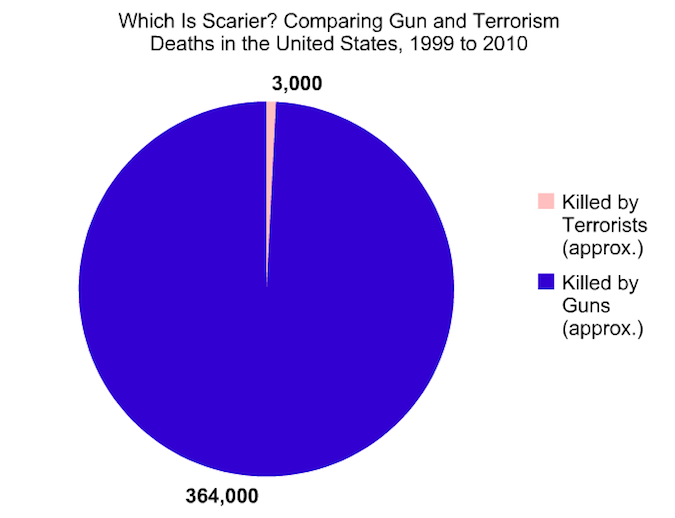
Guns Terrorism Comparison

Conor Friedersdorf posts this chart, and shifts the debate to what seems to me more productive ground. The great opportunity of this moment is to start a debate about how we tackle terrorism as 9/11 gets more distant in the rear-side mirror, as we absorb the fact that the last decade has been far more terror-free than the decade before 9/11, when many of us thought we were living in an elysian fin de siecle. Now may be the moment, in other words, to examine the entire premise of Imaginationland.

Conor argues that “Americans would never welcome a secret surveillance state to reduce diabetes deaths, or gun deaths, or drunk driving deaths by 3,000 per year.” Barro hopes the NSA story will increase pushback against the post-9/11 mindset:

We don’t think about other social ills this way. Nobody says we should have a goal of zero heart disease deaths or zero auto accident deaths, because that would be nuts. We balance the objective of saving lives against other considerations, like cost and individual rights and the fact that bacon is delicious. We should apply this cost-benefit approach to terrorism too. This approach would allow us to say that the phone records dragnet can be a bad idea even if it saves lives. But the big resistance to that analysis doesn’t come from Congress; it comes from the American public.

And the trouble is: you wouldn’t know that from Glenn Greenwald, the Guardian or the NYT editorial board, would you? And yet this is the core issue. Without public support, this war cannot be unwound. Matt Steinglass compares the War on Terror to the Vietnam War:

[C]onventional terrorism poses no major threat to America or to its citizens. But that’s not really what it aims to do. Terrorism is basically a political communications strategy. The chief threat it poses is not to the lives of American citizens but to the direction of American policy and the electoral prospects of American politicians. A major strike in America by a jihadist terrorist group in 2012 would have done little damage to America, but it could have posed a serious problem for Barack Obama’s re-election campaign. For the president the war on terror is what the Vietnam War was to Lyndon Johnson: a vast, tragic distraction in which he must be seen to be winning, lest the domestic agenda he really cares about (health-care, financial reform, climate-change mitigation, immigration reform, gun control, inequality) be derailed. It’s no surprise that he has given the surveillance state whatever it says it needs to prevent a major terrorist attack.

If this contretemps prompts an actual discussion about whether we now need any sort of serious counter-terrorism policy (and anything serious would include searching huge databases for patterns), great. So lets have that debate. Are we now safe enough to end these programs? Are we finally saying we’d be fine with a terror attack that could have been foiled earlier because we prefer that only private businesses collect this kind of Big Data? Are we prepared to back a president who puts liberty before security – especially in the wake of a mass casualty event?

I think Conor has put his finger on the core issue here.

The trouble is that the only way to find out empirically whether the threat is massively over-stated is to reveal intelligence that perforce has to be secret. There is a genuine trap here. But it could be one in which the administration offers some serious answers. Instead of being entirely reactive, the president should make the case for the necessity of this system, and give us the actual trade-offs involved. I’m for transparency in most things; but I’m not so utopian as to believe that our society can function without some government – and personal and corporate – secrecy.

So instead of polarizing on this, lets debate it. Is Jihadist terrorism an overblown threat? If it is, unwind the apparatus slowly. If it isn’t, is this program better or worse than the practical alternatives? If we are not to occupy foreign countries (dumb) or torture prisoners (dumb and evil) or take out Jihadists by drones (increasingly counter-productive), isn’t mass data gathering about as anodyne a remedy for this ill as you can find?