The Resilient Success Of The Obama Presidency

Krugman makes the case:

[T]here’s a theme running through each of the areas of domestic policy I’ve covered. In each case, Obama delivered less than his supporters wanted, less than the country arguably deserved, but more than his current detractors acknowledge. The extent of his partial success ranges from the pretty good to the not-so-bad to the ugly. …

Am I damning with faint praise? Not at all. This is what a successful presidency looks like. No president gets to do everything his supporters expected him to. FDR left behind a reformed nation, but one in which the wealthy retained a lot of power and privilege. On the other side, for all his anti-government rhetoric, Reagan left the core institutions of the New Deal and the Great Society in place. I don’t care about the fact that Obama hasn’t lived up to the golden dreams of 2008, and I care even less about his approval rating. I do care that he has, when all is said and done, achieved a lot. That is, as Joe Biden didn’t quite say, a big deal.
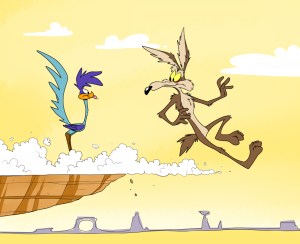
wile_e_coyote_and_road_runner-cliffYes it is. The current indiscriminate pile-on about a “failed presidency” is just bandwagon bullshit. Unlike Krugman, I’ve long had confidence in Obama’s long game, even as I have had several conniptions in his term of office (his early prevarication on gay rights, that phoned-in first debate in 2012, his negligence with healthcare.gov, his caving into hysteria over ISIS). And I see little reason to question its broad thrust now.

Just a year ago, I had a conversation with a friend as the healthcare website was crashing. All that mattered, we agreed, was if, this time next year, the healthcare reform is working and the economy is doing better. Well, both those things have happened – Obamacare is actually a big success so far; the growth and unemployment rates are the envy of much of the Western world – and yet we are now told that he’s a failure. WTF? The architects of the Iraq War – like, yes, Clinton and McCain – somehow believe they have a better grasp of foreign affairs in the twenty-first century than he does. And the party that bankrupted this country in eight short years now has the gall to ignore the fastest reduction in the deficit ever, and a slow-down in healthcare costs that may well be the most important fiscal achievement of a generation.

Add to this two massive social shifts that Obama has coaxed, helped or gotten out the way: marriage equality and the legalization of cannabis. These are not minor cultural shifts. They are sane reforms, change we can absolutely believe in and have accomplished on his watch. Jihadist terrorism? It has murdered an infinitesimal number of Americans in the past six years, compared with almost any other threat. Yes, Americans are still capable of PTSD-driven panic and hysteria over it, and Obama has failed to counter that more aggressively, but to be where we are in 2014 is something few expected after 9/11.

The idea that he has “lost Iraq” is preposterous. We “lost” Iraq the minute we unseated the Sunnis, disbanded the Baathist army and unleashed the dogs of sectarian warfare.

The only sane response to continuing unrest there is to cut our losses, act as an off-shore balancing power, and protect ourselves. And one reason we have this capability is that Obama managed to pivot nimbly last fall to ensure the destruction of Assad’s WMDs. The Panettas and McCains and usual suspects still seem to believe that it would have been better to have bombed Assad, let him keep his WMDs, and … what exactly? Can you imagine ISIS with its hands on those weapons in a failed state with a deposed leader? Think Libya today with poison gas. Who prevented this? Obama. And he is still pilloried for it.

And over six long years, Obama has made it possible – still possible – to put Iran’s nuclear program in a safe box, and avoid another polarizing war in the region. If Obama ends his two terms having rid the Middle East of the threat of nuclear and chemical and biological warfare, he will have advanced our security almost as significantly as Bush and Cheney degraded it. Yes, he failed on Israel. But he has no real power over that. That tail has been madly wagging the dog for a long time now – and in some ways, Obama tried to restrain it more than any president since the first Bush. As long as fundamentalist Christians and even liberal Jews continue to support the ethnic cleansing and de facto apartheid on the West Bank, and do so with a fervor that reaches apoplectic proportions, no president will be able to establish a sane foreign policy with respect to the Jewish state.

Financial reform? Well, if even Krugman says it’s working better than he expected, chalk another one up. Torture? He has acted with more restraint than I would have and deferred far too much to the CIA, but the end-game has yet to be played. It is not unreasonable to believe that we will have established, by the end of his term, a clear and definitive account of the war crimes the last administration perpetrated. That is something. Maybe about as much as a democracy can handle in the time since the atrocities were committed.

Forget the media-click-bait pile-on. Just watch the economic data after the worst depression in many decades (and look at Europe or japan for comparison). Follow the progress in universal health insurance (itself a huge positive change in American life). Measure the greater security from WMDs. And observe the tectonic cultural shifts.

I’m not going to stop bashing him when I think he deserves it. But have I reason to question the long-term achievements of his long game? Fuck no. And we have two years to go.

The Trouble With Islam, Ctd

I cede the floor to Hitch, peace be upon him:

It’s well worth twelve minutes of your time. And I think Hitch’s arguments about what must follow from a religious text still regarded as perfect and pristine and utterly unquestionable, and a caliph or Shi’a theocrat regarded as a “supreme leader”, and a politics saturated in apocalypticism, and a culture marinated in absurd levels of sexual repression, and an endemic suppression of blasphemy and apostasy as unthinkable offenses, stand the test of time.

The totalism of Islam is as dangerous as any other totalism – and liberals better understand that about it.

Yes, it is vital to make distinctions between the various ways in which Islam is practised across the world – which reveals some potential for reform, in the way that Christianity and Judaism have reformed and examined themselves over the past century. But the resilient absence of a collective understanding that religious violence simply is not worth it – the realization that most Christians came to after the Thirty Years War or, as Hitch has it, definitively after the First World War – is a real problem. It is the West’s problem in so far as we have badly mishandled our relation with that part of the world; but in the end, it is Middle Eastern Islam’s problem. Until the Shi’a and Sunni love the future more than they hate each other, until the Koran can be discussed and debated there and around the world the way any other religious text is discussed, until apostasy is respected and not criminalized, we will have more trouble in store.

Does this explain everything? Of course not. Culture, history, politics matter just as powerfully and can lead to different manifestations in time and place. Certainly there was a time in which Islam was far more tolerant than Christianity; and in the Middle East too. But that is no more, and central elements in the doctrine of Islam are all too easily compatible with its modern intolerance, and now post-modern virulence. The defanging of fundamentalism is the duty, in my view, of every person who claims to have faith. I see no reason why that shouldn’t apply to Islam as to an other religion. And it sure hasn’t been defanged enough.

The Trouble With Islam

Refugees Flee Iraq After Recent Insugent Attacks

Well, this debate really does have legs, so allow me to address some of the latest arguments. There seems to be a consensus that Islam in the contemporary Middle East is in a bad way. When you have hundreds of thousands killed in sectarian warfare, ISIS on the rampage, Saudi Arabia fomenting the more virulent flames of Salafism, Iran’s theocrats brutally suppressing peaceful protests, and Hamas cynically relying upon the deaths of innocents for strategic purposes, you can surely see the point. No other region is as violent or as inflamed right now – and since the battles are all on explicitly religious terms, it seems crazy not to see unreconstructed forms of Islam as part of the problem. Last night, I specifically mentioned the absence of any civil space for scholarly or historical examination of the sacred texts of the religion. Without such a space, it is impossible for this current Middle Eastern tragedy to resolve itself. And the lack of such a space is a key tenet of the religion itself. It’s a little amazing to me to watch some liberals who get extremely upset at religious people refusing to bake a cake for someone else’s wedding on religious grounds, suddenly seeing nuance when a religion believes that anyone who leaves it should be executed. If you’re against fundamentalism of the mildest variety here, why are you so forgiving of it elsewhere?

It’s also good to see Nick Kristof note the following today:

Of the 10 bottom-ranking countries in the World Economic Forum’s report on women’s rights, nine are majority Muslim. In Afghanistan, Jordan and Egypt, more than three-quarters of Muslims favor the death penalty for Muslims who renounce their faith, according to a Pew survey.

For me, that last statistic is a key one. Here you do not have a fringe, but a big majority in one of the most important Arab Muslim states, Egypt, believing in absolutely no religious freedom whatsoever. Democracy doesn’t cure this – it may even make it worse. To argue that this majority belief has nothing to do with Islam is also bizarre. The Koran is as complex as the Old Testament, and there are injunctions to respect religious freedom, but also deep currents in favor of suppressing it, for the sake of people’s souls. These latter currents are not unique to Islam, but they are now clearly dominant in one region, and they are a terrible threat to all of us when combined with modern technologies of destruction. It is legitimate to ask why core human rights, such as the right to follow one’s own conscience, are non-existent in much of the Middle East. It is legitimate to point out that Saudi Arabia forbids the free exercise of any religion except its own. It is legitimate to note the sectarian murderousness of the Sunni-Shi’a battle lines and the brutal assault on religious minorities in the region. These excrescences are all defended by the tenets of that religion and in the terms of that religion. Of course religion has something to do with it.

Does it actually help anyone to keep saying this? Here, I think, there is a pragmatic case for non-Muslims like yours truly to shut the fuck up for a change. Ed Kilgore notes regarding the Real Time exchange:

You don’t have to watch the segment in question to understand, a priori, that five non-Muslims, none of whom are in any way experts on Islam, aren’t going to do much of anything other than damage in dissecting a big, complicated, multifaceted World Religion in a single segment of a single television show.

It’s also true, as Reza Aslan argues, that religious identity is not all about the faith itself but embedded in culture and history:

As a form of identity, religion is inextricable from all the other factors that make up a person’s self-understanding, like culture, ethnicity, nationality, gender and sexual orientation. What a member of a suburban megachurch in Texas calls Christianity may be radically different from what an impoverished coffee picker in the hills of Guatemala calls Christianity. The cultural practices of a Saudi Muslim, when it comes to the role of women in society, are largely irrelevant to a Muslim in a more secular society like Turkey or Indonesia.

But is the huge Egyptian majority for the death penalty for apostates merely some kind of cultural identity? Of course not. These people believe that Islam is the only way to achieve happiness, the sole guide for a good life and death, and that nothing should stand in the way of this ultimate goal. Paradise matters. Just because that seems utterly odd to many secular American liberals doesn’t mean it isn’t true. Why should we not take the views of the Muslims of the Middle East at face value? Why are we actually condescending to their sincere beliefs?

Yes, we need to make careful distinctions with respect to Islam in different places at different stages of development. Conflating the Islam of America and the Islam of Malaysia and the Islam of Saudi Arabia is, well, dumb, especially as it relates to foreign policy. But to deny the core religious element of the violence in the Middle East, to ignore the fact that Islam, to a much greater degree than other faiths, is still resistant to some core freedoms of modernity, to ignore the fact that fundamentalism of this kind can do extreme damage to other Muslims and infidels … well this strikes me as another form of denial.

But what I find deeply dismaying is the lazy assumption that understanding these religious teachings and being troubled by them is a form of irrational Islamophobia or racism. I usually admire Max Fisher’s work, but the reflexive notion that any criticism of contemporary Islam in the Middle East is ipso facto bigotry is extremely reductive and toxic to open debate. This is facile:

After cutting to a video, Lemon asked, with a straight face, “Does Islam promote violence?” Imagine if Lemon had demanded a prominent American Rabbi answer “Does Judaism promote greed” or asked a member of the Congressional Black Caucus to acknowledge the merits of the KKK’s arguments. Then you can start to understand how Lemon’s question looks to the 2.6 million Muslim-Americans who have to listen to this every day.

I take the point about the crudeness of the question and the way it can sound to Muslim-Americans. But when incredible violence is being committed throughout the Middle East in the name of Islam, and when Islam’s own texts are purloined to defend such violence and empower it, of course the question is not a function of prima facie bigotry.

(Photo: Iraqi children carry water to their tent at a temporary displacement camp set up next to a Kurdish checkpoint on June 13, 2014 in Kalak, Iraq. Thousands of people have fled Iraq’s second city of Mosul after it was overrun by ISIS (Islamic State of Iraq and Syria) militants. Many have been temporarily housed at various IDP (internally displaced persons) camps around the region including the area close to Erbil, as they hope to enter the safety of the nearby Kurdish region. By Dan Kitwood/Getty Images.)

The Power Of Francis’ Glasnost

Synod On the Themes of Family Is Held At Vatican

Both John Paul II and Benedict XVI understood the power of open dialogue, which is why they did all they could to shut it down within the Catholic church. The sensus fidelium, the insight that ordinary Catholics may have into the Christian life, was all but banished in favor of top-down control and increasingly fastidious theological certitudes. And perhaps the most striking thing so far about the Synod now going on in Rome is simply that: a venting of reality in that airless context, that, while not in opposition to church teaching, is nonetheless frank about its challenges in the modern world.

And language matters. Ed Morrissey notes:

The most intriguing part of that discussion, at least as noted in the briefing, was a call to change the language associated with those teachings [on marriage and sexuality] and find more inclusive and welcoming language instead. The specific terms that some bishops wish to stop using are “living in sin,” “intrinsically disordered,” and “contraceptive mentality.”

Each of these terms is designed to define human beings in ways that can only wound and alienate. A couple co-habiting before marriage cannot be reduced to “sin” without obliterating everything else that may be wonderful about their relationship – and that may well lead to a successful marriage that is perfectly orthodox. Suggesting that all couples who use contraception can be reduced to endorsing a “culture of death” is equally likely to push flawed human beings away from Jesus rather than toward him. And, as for “intrinsically disordered”, Ratzinger’s prissy prose was impossible for a gay Catholic to read without feeling punched in the gut. The key to a renewal of Christianity in our age will be a shift in language, a reintroduction of the core truths of the faith with words that are not designed to wound, hurt or alienate, and that can convey truth in a positive manner for a new generation.

Then there is the remarkable testimony of an Australian married couple – about the central role that sex plays in supporting their marriage vows:

The couple explained that “gradually we came to see that the only feature that distinguishes our sacramental relationship from that of any other good Christ-centred relationship is sexual intimacy and that marriage is a sexual sacrament with its fullest expression in sexual intercourse.” “We believe,” they added, “that until married couples come to reverence sexual union as an essential part of their spirituality it is extremely hard to appreciate the beauty of teachings such as those of Humanae Vitae. We need new ways and relatable language to touch peoples’ hearts.”

Well: good for them. And wouldn’t Catholic marriages be better if more were able to tell their sexual story in ways currently repressed? There is, after all, an obvious and almost painful limitation on the clerisy’s ability to understand sexual intimacy, because they have all taken vows of celibacy. (Another gigantic obstacle, of course, is that of the nearly 200 voting participants in the Synod, only one is a woman. Of the 253 total participants, only 25 are women.) But the Australians had another point to make on the question of homosexuality:

“The domestic church” represented by the family, “has much to offer the wider Church in its evangelizing role,” the couple continued. “For example, the Church constantly faces the tension of upholding the truth while expressing compassion and mercy. Families face this tension all the time.” The couple went on to illustrate this with an example relating to homosexuality. “Friends of ours were planning their Christmas family gathering when their gay son said he wanted to bring his partner home too. They fully believed in the Church’s teachings and they knew their grandchildren would see them welcome the son and his partner into the family. Their response could be summed up in three words, ‘He is our son’.”

This, Ron and Marvis explained, “is a model of evangelization for parishes as they respond  to similar situations in their neighbourhood!” “The Church’s teaching role and its main mission is to let the world know of God’s love.”

This is what so many Catholics are already doing – because Christianity is about, among many things, a defense of human dignity and a love of the family. The hierarchy – which again has no such direct experience of actually navigating the challenges of parenting, and which seems incapable of seeing gay people as “first-class citizens” – has lost sight of this. They are still bound by fear – fear of actual gay people, of our happiness and self-worth, of our living example of the complexity of human love and sexuality. They cling to arid doctrine with little appreciation of how anyone can actually live it and not, in the heterosexual world, be cruel or dismissive or discriminatory or callous, or in the homosexual world, be uniquely alone, isolated, and without the sexual intimacy that the Australian couple celebrated as integral to their relationship.

What were seeing, I think, is how the mere fact of open discussion can shift the very direction of such discussion. We saw this in Vatican II, when new currents in the world and church transformed the meeting in ways no one quite expected. And Francis’ leadership in this contrasts so powerfully with his predecessor’s. He is not telling the church what it should do or how it should change. He has simply made it impossible for the lived reality of most Catholics to be ignored or dismissed any longer.

Some things cannot be unsaid. Some testimony from actual, broken but struggling Christians can never be forgotten. Dialogue shifts minds and hearts from the bottom up, not the top down.

“There is a crack in everything. That’s how the light gets in.”

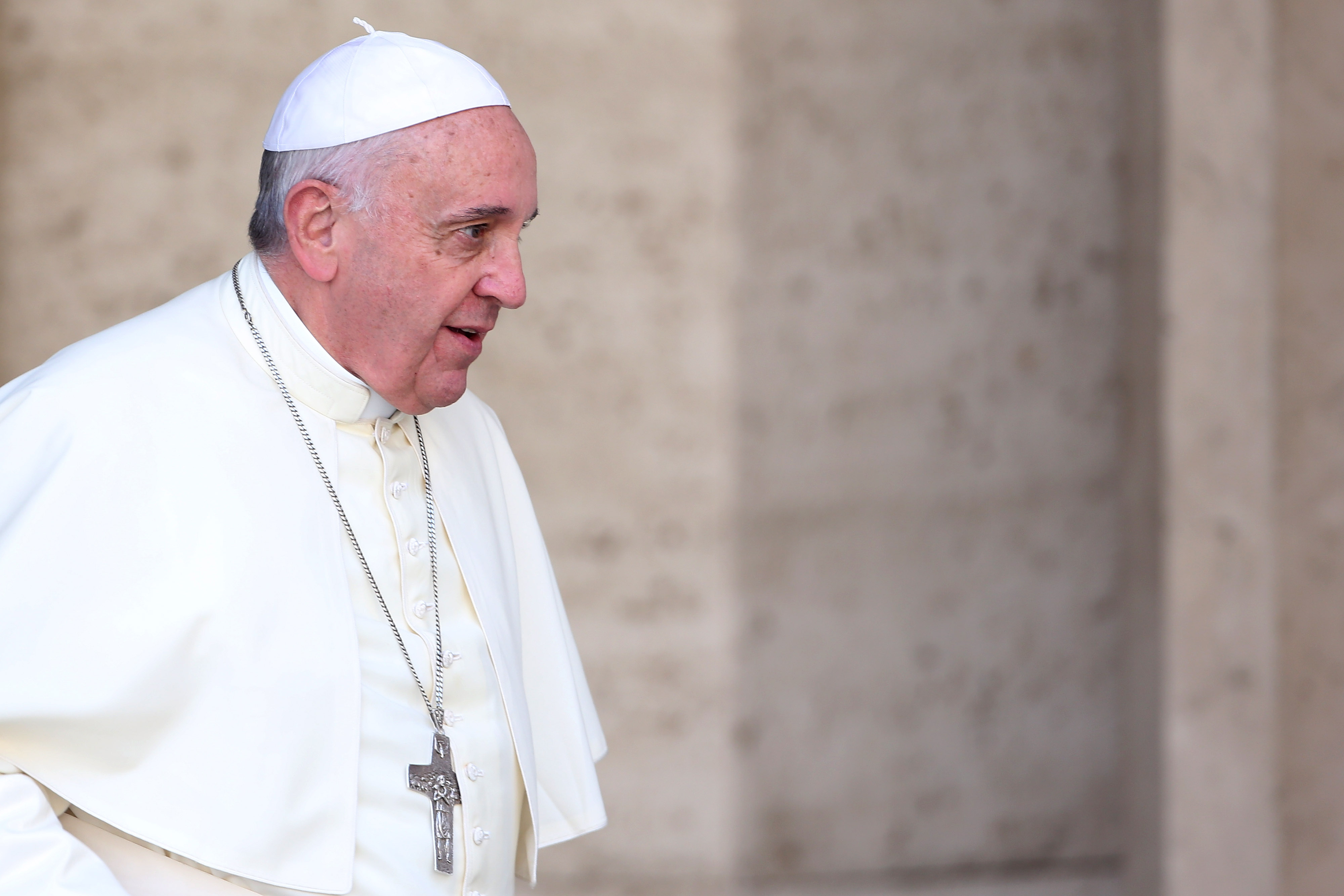
(Photo: Pope Francis leaves the Synod Hall at the end of a session of the Synod on the themes of family on October 7, 2014 in Vatican City, Vatican. By Franco Origlia/Getty Images)

In Defense Of Gordon College

Here’s a possibly troubling story out of Massachusetts:

The regional body that accredits colleges and universities has given Gordon College a year to report back about a campus policy on homosexuality, one that may be in violation of accreditation standards. The higher education commission of the New England Association of Schools and Colleges met last week and “considered whether Gordon College’s traditional inclusion of ‘homosexual practice’ as a forbidden activity” runs afoul of the commission’s standards for accreditation, according to a joint statement from NEASC and Gordon College.

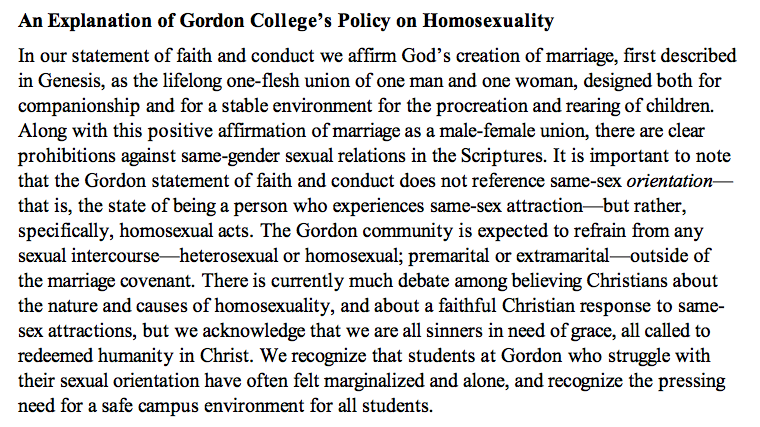
Here is that college’s public statement about its policy on homosexuality:

Screen Shot 2014-10-08 at 10.58.37 AM

They key issue here, it seems to me, is whether the college’s orthodox views about sex are being fairly implemented. If the prohibition against non-marital sex is enforced only on gay students, we have a problem. But there is no evidence that it is. And the college – which implemented its own review of this policy – seems attuned (see the last sentence) to the problems for gay students in such a setting.

In a liberal society, a college should not be denied accreditation because of its religious teachings, as long as they do not endorse double standards for different individuals who are enrolled.

I’ve spent most of my adult life challenging the notion that the distinction between a homosexual person and “homosexual acts” makes sense – but I am not omniscient, and I respect those who sincerely disagree with me. I certainly don’t want them penalized for such religious convictions. This is something called “liberalism” – the toleration of different faiths in a civil society, and the conviction that the best long-term way to discern the truth is not to suppress such faiths but to allow them to flourish (or not) in the free marketplace of ideas and beliefs. You don’t have to agree with Rod Dreher that this is about “hatred” of Christianity, just as you don’t have to agree that all difference of opinion on homosexuality is about “hatred” of gays. But Damon Linker is onto something:

Contemporary liberals increasingly think and talk like a class of self-satisfied commissars enforcing a comprehensive, uniformly secular vision of the human good. The idea that someone, somewhere might devote her life to an alternative vision of the good — one that clashes in some respects with liberalism’s moral creed — is increasingly intolerable. That is a betrayal of what’s best in the liberal tradition.

How To “Contain” A Problem Like Jihadism?

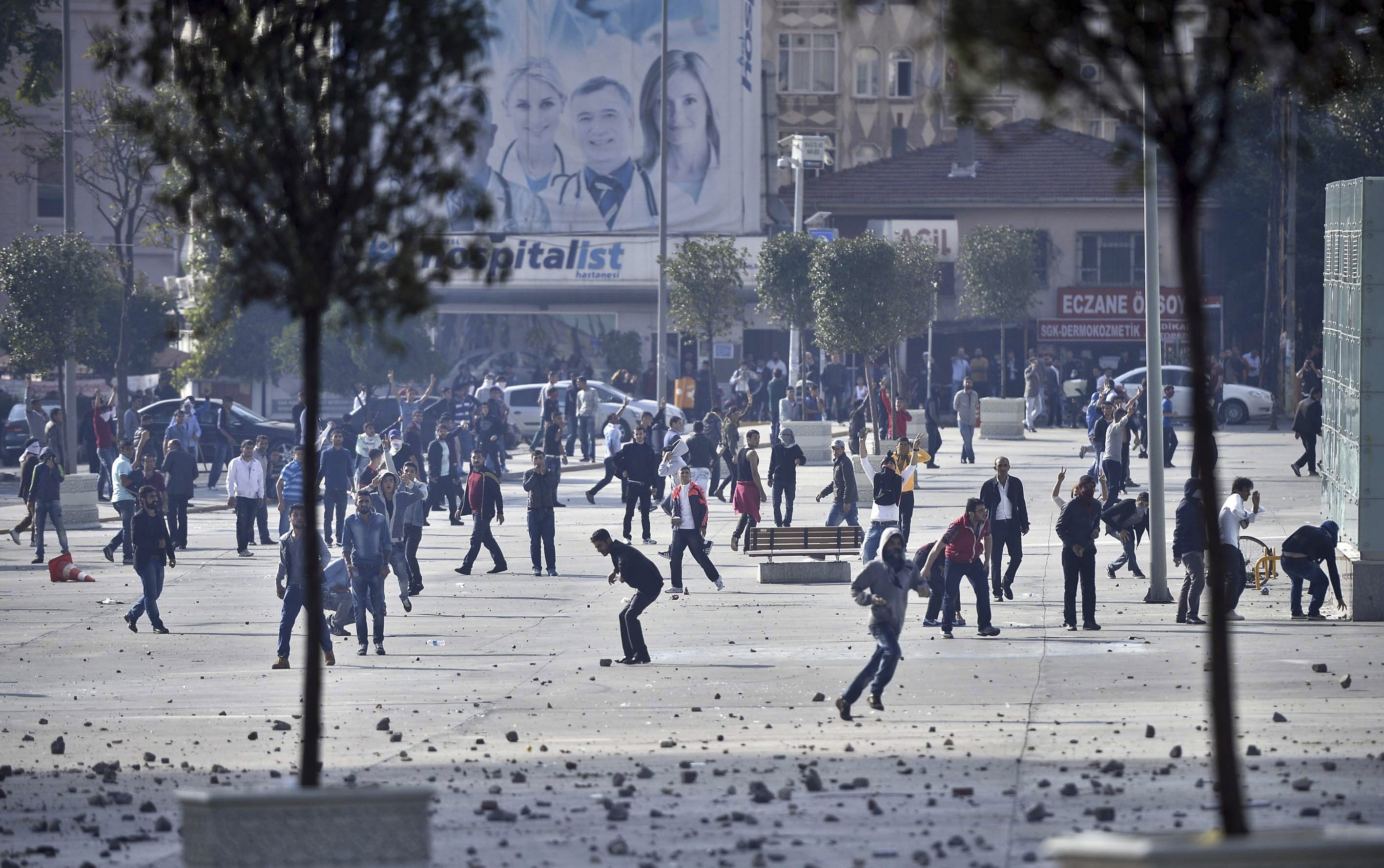
Unauthorized demonstrations against the advance of ISIL in Turkey

A reader quotes me:

Except, of course, it was Kennan’s careful and conservative case for containment that ultimately won the Cold War without the near-Armageddon that the predecessors of today’s chronic interventionists (Kennedy especially) nearly brought us to.

As someone who advocated a continuation of the containment policy towards Saddam Hussein rather than an invasion as you did, I think it needs reminding that “containment” during the Cold War did not mean isolationism, or doing nothing, but instead involved a very complex series of actions and alliances, including using force as an option. Keenan’s containment policy, as actually put into action, was a very active form of engagement with the entire world. It’s during that time that our entire “military-industrial complex” rose to prominence and influence.

So invoking Kennan and Cold War containment makes the opposite case in terms of our foreign policy in the Middle East, or against ISIL or Syria or whomever. Containment is a way of actively engaging these military threats, while being under no illusion that full-scale invasions and occupations are the solution.

I see Obama’s strategy in relation to ISIS and the Iraq to be one, essentially, of the same kind of active containment that our country used during the Cold War. Engagement, not isolationism, is the key. And that includes some use of force, and the arming ofiraq2 various groups, realistically understanding that we are not going to “win” by these means, but that we can at least prevent anyone else from winning either, and by drawing out the conflict over decades, we can ensure that the natural superiority in the underlying cultural and economic conflicts will resolve themselves in our favor.

It’s clear that preventing ISIS or any other radical Islamist group from taking power over a country such as Iraq is in America’s interests. That doesn’t mean that we should re-invade the country, but it does mean that we should remain militarily engaged to make sure it doesn’t happen, without of course going overboard on the idealism and machismo.

It’s of course debatable as to which containment strategies will work best in any given set of circumstances, but I don’t think one of the options is just walking away from the Middle East and assuming all will work out best without our involvement. That’s the first kind of isolationism Keenan described and criticized. The second kind, isn’t even one that Keenan himself advocated, given his endorsement of large US military bases in Europe and around the world, and military engagements in local clashes as Cold War proxies. So don’t go hiding behind Keenan as some sort of shield for advocating that the US should just disengage from these sorts of wars and conflicts.

My reader makes some excellent points, so let me explain why I still do not agree. There is a core difference between the threat we face today and the threat we confronted during the Cold War. The threat today is asymmetrical, whereas the face-off between the US and the USSR was eerily symmetrical. This means that the use of force against our current enemy is much more easily turned back against us – and the zero-sum assumptions of the Cold War can easily splinter into a myriad complications and unintended consequences when confronting global Jihad.

We did not have to worry in the battle against communism that we would somehow create many more spontaneous support for communism by resisting it; and we were confronting a huge multi-nation state, with a unitary command structure and global allies and puppets.

With Jihadism, we are beset by countless more complexities. The entities we are fighting change, melt away, re-group, and are capable of coming back from the near-dead in any anarchic place on earth they can find (and there are many). We are dealing with a world of disorder, not of frozen order. We are not confronting an advanced nation-state seeking to control large swathes of territory by conventional means. We’re dealing with asymmetrical terrorism which cannot be deterred the way the Soviets were, and which can even gain strength by our opposition. This requires a much nimbler, subtler touch – one few statesmen or women can muster for long.

The Jihadists are not suppressing large previously democratic populations with totalitarianism like the Soviets either; they are exploiting deep conflicts within the Muslim world – the Sunni-Shi’a divide pre-eminent among them – which refuels them in a way the bankrupt doctrines of Soviet Communism couldn’t, and in a culture where Western democracy is deeply alien. They are able to exploit all the resentments of those who see the West as a looming tower of decadence and wickedness – a huge f0rce in our modern world.

And they harness (even as they pervert) the immense power of fundamentalist religion, which, unlike communism, has roots deep in many cultures, and is resurgent in part because of the perceived threat of modernity (something that is not going to go away soon). The kind of raw military power that could deter the Soviets – as in the nuclear stand-off – simply does not work against the kinds of insurgencies we have been tackling.

We know this. The Sunni insurgency in Iraq – which I fear may be a permanent feature of that region unless the Sunnis retake control of what’s left of the central government – was bribed and charmed into quiescence for a brief period – while we had tens of thousands of troops in country. Once we left – and even if we had stayed with a residual force – we had no leverage to keep it at bay, as the deeper contradictions of the imperial construct of Iraq unfold. Our allies, unlike in the Cold War, also have many different agendas. Take Turkey, a NATO stalwart against the Soviets. Today, Turkey is beset with a much more complex set of problems – a Rubik’s Cube of how to control Kurdish separatism and depose Assad while resisting ISIS. And we expect an alliance as in the olden days? In the Cold War, moreover, we had no major NATO allies actually funding communist ideology and secretly arming the Soviet Union – while many of our so-called allies in the Middle East, like Saudi Arabia, are both the cause and purported solution to our dilemma.

In my opinion, we have learned these past few years that a conventional attempt to defeat Jihadism – by invasion and occupation – will fail, unless we construct a permanent imperial presence, which we neither want nor can afford. We have learned that drones and air-power can help at times – but also over time hurt, by incurring civilian casualties which emboldens our enemies, or splintering insurgencies into ever-more extreme and fringe groups; we have learned that funneling arms to our supposed allies can easily backfire – as ISIS’ plentiful supply of purloined US hardware attests to; and we have learned – and are fast re-learning – that when local governments lack legitimacy – like Baghdad’s or Kabul’s – the use of air-power against an insurgency is even less effective. In those circumstances, I believe we simply have to accept that, whatever our motives and power, there are some problems we cannot solve. And my concern with the president’s ISIS policy is that he has led Americans to believe that we can “ultimately destroy” something that we simply cannot.

Until Iraq’s Sunnis really believe Baghdad can represent them, there will be no progress against ISIS. The one sliver of hope I see is the current desperation of some Sunni tribes in the face of ISIS’ brutality. There’s a report in the NYT today on those lines. Money quote:

After enduring weeks of abuse by insurgents of the group called Islamic State, members of the Aza tribe struck a secret deal last month with local police and military officials: The authorities would supply weapons to two tribal regiments totaling about 1,150 fighters, and in return the tribe would help government security forces fight Islamic State.

Several days later, the tribal regiments, in collaboration with Iraqi government troops and Shiite militia fighters, liberated 13 villages in Diyala Province from Islamic State, which is also known as ISIS, officials said. “ISIS has humiliated the top sheikhs of Diyala and has done horrible and unforgivable crimes against people here,” said Abu Othman al-Azawi, an Aza sheikh and a member of the provincial council. “They tried to vandalize the tribal system and break its ties.”

But even this is a very tricky business:

The geometry of tribes and tribal loyalties in Iraq is byzantine. Allegiances — even within tribes — can vary from province to province, district to district, village to village. Iraqi officials have also been concerned that arming Sunni tribes could enable the formation of paramilitary organizations that could turn quickly against the Shiite-led government.

But note one essential thing about this potentially good sign. It happened not because we made it happen; it emerged out of a convergence of interest among the relevant parties. That’s the only way this will find some kind of resolution – and our neo-imperial meddling can actually impede it as easily as help it. Less is sometime more; more is sometimes less. But at some point, amid these dizzying complexities in regions the locals know far far better than we do, we have to ask ourselves if this kind of challenge is simply too hard for us to overcome, and whether less intervention can do more to undermine our enemies than more. We may well be better off keeping our heads down, bolstering our defenses (which is why I am not a huge critic of the NSA), and occasionally pivoting to exploit an opening on the ground.

I cannot prove this, no more than the interventionists can prove that more meddling will help. But I cannot look at the past decade and draw the conclusion that more intervention is the real solution to our woes. In fact, I think it is close to madness to believe so.

(Photo: Protesters take streets across Turkey to hold unauthorized demonstrations against the advance of Islamic State of Iraq and the Levant (ISIL) militants toward central Kobani, in Istanbul, Turkey on October 7, 2014.  By Sebnem Coskun/Anadolu Agency/Getty Images.)

Seeing The Mountaintop

US-JUSTICE-GAY-MARRIAGE

[Re-posted and updated from earlier today]

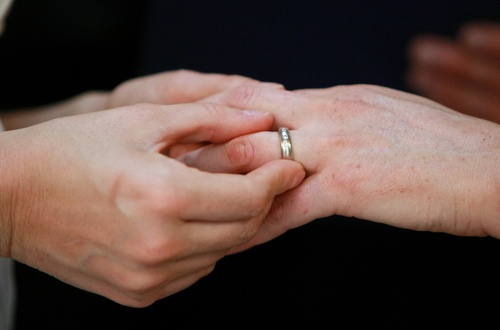
I’ve just been absorbing the news out of the Supreme Court this morning. Unless the composition of the court changes, it now seems close to certain that every American citizen will soon have a right to marry the person they love. An idea that once seemed preposterous now appears close to banal. The legal strategy that Evan Wolfson crafted from the early 1990s onward – a critical mass of states with marriage equality before a definitive Supreme Court ruling – has been vindicated and then some. The political and cultural strategy we pioneered at the same time – shifting public opinion slowly from the ground up, tapping into the deepest longings of gay people to become fully part of their own families and their own country for the first time, talking to so many heterosexual men and women about ourselves for the first time – also succeeded.

There have been many moments when individuals have tried to take credit for all this. No one should. The reason we persuaded so many in sully-wedding-aisle-thumbso short a time is that so many unknown private individuals – from Thanksgiving tables to church meetings to office cubicles to locker rooms – simply told the truth about who we really are. It took immense personal courage at times – and each moment someone came out, more light, more reality, seeped into the debate. The reason so many attempted the apparently impossible was because we had seen at close hand what no marriage rights meant: as spouses were kept from spouses even at the hour of death during the AIDS crisis and as our children were  at risk of being taken away from us, as we grew our families.

These were elemental issues of human dignity – not abstract arguments about federal benefits or “natural law”. And this was a moral movement about the inherent dignity and equality of all of us – tapping into some of the profoundest truths from the founding of this country, and the deeper truths of our religious traditions, still sadly incapable, in many cases, of expanding, rather than constricting, the boundaries of human love. What we have right now in America is the moral majority for the dignity of every person’s capacity to love and be loved. What we have right now is the defeat of fear and fundamentalism – the two most dangerous sirens of our time.

What I also love about this conservative but extraordinary decision from SCOTUS is that it affirms the power of federalism against the alternatives. Marriage equality will not have been prematurely foisted on the country by one single decision; it will have emerged and taken root because it slowly gained democratic legitimacy, from state to state, because the legal and constitutional arguments slowly won in the court of public opinion, and because an experiment in one state, Massachusetts, and then others, helped persuade the sincere skeptics that the consequences were, in fact, the strengthening of families, not their weakening.

Those who wished to circumvent this process, to grab the credit, to condemn all those in dissent as ipso facto bigots, have mercifully been sidelined by the court. And now in thirty states (maybe thirty-five), the reality of this social reform will be seen: the quotidian responsibilities of spouses and parents, the moments of joy and agony that are part of all marriages, the healing of wounds of separation and ostracism. It won’t happen at once, but it will slowly emerge, through a greater collective empathy and inclusion. Every time a father holds back tears as his daughter marries her beloved, every time a child feels secure with her two dads or two moms, every time a young gay kid asks himself if he is really worthy because he is gay and now knows he can one day have a relationship like his mom and dad and feels less tormented and less alone: these are the ways we humans can grow and become what we fully can be. This is an expansion not just of human freedom, but of human love.

It is so easy today to see horror all around, anger surging, hysteria rising, fear spreading. But we see also in this remarkable, unlikely transformation the possibility of something much different: that human beings can put aside fear and embrace empathy, can abandon prejudice in favor of reality, can also see in themselves something they never saw before: an enlargement of the circle of human dignity.

I think of all those who never saw this day, the countless people who lived lives of terror and self-loathing for so, so long, crippled by the deep psychic wound of being told that the very source of your happiness – the love for someone else – was somehow evil, or criminal, or unmentionable. I think of the fathomless oceans of pain we swam through, with no sight of dry land, for so long. I think of the courage of so many who, in far, far darker times than these, summoned up the courage to live with integrity, even at the risk of their lives. And I cherish America, a place where this debate properly began, a place where the opposition was relentless and impassioned, a country which allowed a truly democratic debate over decades to change minds and hearts, where the Supreme Court guided, but never pre-empted, the kind of change that is all the more durable for having taken its time.

Know hope.

(Photo: Supporters of same-sex marriage gather in front of the US Supreme Court on March 26, 2013 in Washington, DC. Same-sex marriage takes center stage at the US Supreme Court on Tuesday as the justices begin hearing oral arguments on the emotionally-charged issue that has split the nation. By Jewel Samad/AFP/Getty Images.)

The Vanishing Idols

VATICAN-POPE-SYNOD FAMILIES

The Synod convened by this remarkable Pope is now in session – and there are some reactionary voices being heard – as there should be. The head of the Polish church just described cohabitation as “the self-mutilation of [a couple’s] love”. He also noted with dismay that “some parents like to teach boys that they should clean up after themselves, and not wait until girls do it for them.” Ed Morrissey just reported that the opening statement by Cardinal Peter Erdo was also uncompromising: “Erdo emphasized that recognition of divorce and remarriage without a church finding of nullity in the first marriage ‘is impossible, while the first spouse is still alive.'”

And this is how it should be. Along with arguments about the need for pastoral change and adjustment – the Pope himself, after all, just married a previously divorced couple in the Vatican! – the arguments for no change at all need to be heard. What’s truly new about this papacy is its endorsement of this very debate – the very thing that John Paul II and Benedict XVI made anathema. Can you imagine this tweet appearing at any time since 1979 until now?

James Alison has taken up that offer. Last Friday he addressed a meeting in Rome for “The Ways of Love,” an international conference on Catholic pastoral care for gay and trans people. It’s not part of the Synod of Bishops on the Family. It’s an off-off-Broadway production, as it were. But it should not be dismissed for those reasons. Some of the most important discussions during the Second Vatican Council occurred informally off-site, and aired issues that emerged eventually as central to the Church’s opening to the modern world. The question of same-sex love and homosexual dignity is not likely to be part of the formal Synod. But it hovers around it – even as the Church in America has intensified its cruelty and unjust discrimination against homosexuals seeking to follow Jesus.

So you may be surprised to find in James’ latest talk in Rome an element of joy and magnanimity. He sees the emergence of gay and trans people’s own self-understanding of our equal worth in the eyes of God as quite simply irreversible, unstoppable – not a breakdown of the church’s teachings but an eruption within it of Catholicity itself:

This has been exactly our experience as LGBT Catholics over the last thirty or so years. It has become clearer and clearer, until it is now overwhelmingly clear, that what used to seem like a self-evident description of us was in fact mistaken. We were characterized as somehow defective, pathological, or vitiated straight people; intrinsically heterosexual people who were suffering from a bizarre and extreme form of heterosexual concupiscence called “same-sex attraction.” That description, which turned us, in practice, into second-class citizens in God’s house, is quite simply false. It turns out that we are blessed to be bearers of a not particularly remarkable non-pathological minority variant in the human condition. And that our daughterhood and sonship of God comes upon us starting as we are, with this variant being a minor but significant stable characteristic of who we are. One, furthermore, which gives gracious shape to who we are to be.

His talk is worth reading in full because it brilliantly analogizes the strictures against gay people to the very early church’s strictures against inclusion of Gentiles. Saint Peter shocked his early followers by insisting that all such categories melted away in the new age of Jesus: “God has shown me that I should not call anyone profane or unclean.” Or in Saint Paul’s words that ring through the ages:

There is neither Jew nor Gentile, neither slave nor free, nor is there male and female, for you are all one in Christ Jesus.

Alison conjures up the radicalness of all this for the Jewish sect then struggling to find its way in the world after the Resurrection:

Well, each one of us was as shocked as the person next to them: the first-class citizens finding themselves on the same level as us, with all their purity and sense of separateness deflated, and having to overcome a certain repugnance about dealing with people like us; and the second class citizens having to get used to taking ourselves seriously and behave as sons and daughters, rather than dirty servant children who had a sort of built in excuse for impurity.

Regardless of where the collective hierarchy is, it is quite clear that Pope Francis does not see gay people as second-class citizens. If they are earnestly seeking the Lord, “who am I to judge?” It is also clear that the moral movement I described earlier today cannot but affect the people of God, as they wrestle with a a new understanding of gay people – which the church itself recognized as long ago as 1975 – and try to do God’s will. But James has moved on already. He sees gay Catholics not as a problem to be solved but as an opportunity to be seized:

We, as well as anyone, know how the Spirit of God humanizes us, not destroying culture, but defanging it from all that is violent and destructive of who humans are called to be. We know that thanks to Jesus there is no such thing as religiously pure or impure food, there are no such things as religiously mandated forms of mutilation, genital or otherwise. We know that only culture, and never God, has demanded the veiling and covering of the glory of the head and hair of women. We know that the same Spirit that taught us these things, making available to us what is genuinely true, has enabled us to discover the graced banality of our minority variant condition, allowing it to be the shape of our love that turns us into witnesses of God’s goodness as we are stretched out towards those who are genuinely suffering from terrible injustice and deprivation.

It may seem bleak for many LGBT people right now, grappling with Christianity and the institutional church’s cruelty and dehumanization. But James sees through this, the way Jesus saw through the exhausted taboos of his time. There is a serenity to him that comes with a faith lived, and not imposed.

(Photo: Pope Francis delivers his speech during  the Synod of the Families, to cardinals and bishops gathering in the Synod Aula, at the Vatican, on October 6, 2014.By Andreas Solaro/AFP/Getty Images.)

“Nothing”

Well, I thought the frankness of that might provoke a response. I was asked whether I was an isolationist (no) and what I actually proposed we do with respect to the latest Sunni insurgency in Iraq – an insurgency I think will continue until the Sunnis regain what they believe is their rightful place running the whole “country”. A reader notes:

George Kennan was asked the same question. His reply (from his diaries) was this: “…there are two kinds of isolationist: those who hold the outside world too unimportant or wholly wicked and therefore not worth bothering about, and those who distrust the ability of the United States Government, so constituted and inspired as it is, to involve itself to any useful effect in most foreign situations. I… belong to the latter school.”

I won’t add to your very large dissent pile on Syria, etc., just to recall the State Dept conventional wisdom back in the day: if you want someone to diagnose a difficult problem, ask Kennan; if you want someone to manage or solve it, never ask Kennan.

Except, of course, it was Kennan’s careful and conservative case for containment that ultimately won the Cold War without the near-Armageddon that the predecessors of today’s chronic interventionists (Kennedy especially) nearly brought us to. So the State Department was wrong.

I favor US military action and leadership in cases where we carefully assess what we can do,iraq2 have a clear strategy, a clear definition of victory and an exit plan. I favored the bombing in the Balkans to end genocide; I favored the Gulf War to get Saddam out of Kuwait; I favored getting the Falklands back. I opposed the intervention in Lebanon under Reagan; I opposed the Somalia intervention under the first Bush; I opposed the Libya intervention under Obama. And then, of course, in the wake of 9/11, I supported the war in Afghanistan and the invasion of Iraq. And I have to say that living through all those events has only helped me better understand the wisdom of Kennan.
Of the two kinds of “isolationists”, I guess I’m around 30 percent who thinks the world is far too fucked up or irrelevant to try to intervene and 70 percent fully aware that the US simply does not have the ability to do anything but make so much so much worse. Almost every intervention in the Middle East – save the Gulf War – has made things worse. And the Gulf War, of course, gave us al Qaeda, in response to bases in Saudi Arabia. Just as the intervention against the Soviets in Afghanistan empowered Islamist terror in the long run as well. As for the CIA deposing Mossadegh, well … look what nightmares came from that. My contention is that the CIA has done more damage to the interests of the United States over the years than any other institution.

Another reader counters my perhaps too melodramatic dismay at Obama’s latest folly:

1. To the extent ISIS etc. hurts Dems in the polls, it will be because Obama is perceived to have let ISIS metastasize, not because he’s striking the group now.

2. No American president could have afforded to sit back and let ISIS overrun Kurdistan or assault Baghdad. And the first strikes in Iraq seem to have been effective. To the extent that minimalists have a beef with Obama, it’s about extending the strikes to Syria and purporting to build up Syrian “moderates.”

3. Just because the threat to the US from ISIS isn’t imminent doesn’t mean it’s not real. If that monstrous quasi-state continues to grow, or even gets equilibrium, it’s a bigger/stronger haven for worse nuts than al Qaeeda ever had in Afghanistan/Pakistan.

4. To “hope both sides will lose” is cruel and nihilist.

5. Both Obama’s rhetoric and his likely course of action are far more restrained than you give him credit for.

6. “Betrayal” is an hysterical term.

Let me respond to each point in turn.

1. My point is not that the Obama won’t get punished in the elections because he is perceived to have let ISIS metastasize; it is simply that by re-starting the war he was elected to end, and arguing that it will not end for years, Obama’s base is likely to stay home. I’m not advocating that, I’m predicting it.

2. We have no reason to believe ISIS can over-run Kurdistan or Baghdad without one hell of a fight. But if the ISIS-led Sunnis could do that – and ISIS is really a product of Sunni disempowerment – then it merely proves that the Shiites cannot really run Iraq, have no experience in doing so, and our propping them up in power will simply mean greater and greater strength for ISIS. We gave the Shiites, a vast, well-trained hugely expensive military and even then, they cannot beat back this insurgency. Hell, the US couldn’t really beat it back over ten years – until we bribed the Anbar tribes. What chance the hapless, militias of the Shiites? Propping up an inherently unstable power structure is not a recipe for pacifying Iraq; it’s a recipe for permanent warfare.

3. There are terror enclaves all over the world. To name one: Saudi Arabia, a state that beheaded more people in the last few months than ISIS, a state that has funded this kind of extremism for a very long time, a state with enormous wealth it has poured into Islamist terrorism and from which the 9/11 attackers hailed. To name another: Pakistan. How many countries do we have to invade to prevent havens for potential Islamist terror? We are now doing this in Yemen and Somalia – and Obama actually called them a success! And in the end, these enclaves can only be defeated by the Arabs and Persians. The moment we take responsibility, the odds of any success collapse. And have we seen a mutli-sectarian government which not so long ago Obama said was a pre-requisite for intervention? Fuck no. Obama has already violated the one condition he placed on intervention. He’s making this shit up as he goes along.

4. Who would you want to have won the Iran-Iraq war? I’m with Kissinger on that one. Between Saddam and Khomeini, who would you have sided with? But in this case, the United States is actually trying to take sides in an ancient Sunni-Shi’a religious civil war! Why on earth should America have any position on that question whatsoever? A plague on both their sectarian houses! And it was not nihilist to see that in similar horrifying religious wars in Europe in the sixteenth and seventeenth centuries, both sides had to lose before either realized they had to get past that kind of insanity. But we keep preventing that outcome from happening in the current Middle East, arresting the very evolution that gave us some kind of Western toleration. It was horrifying, but we are not responsible for the religious hatred and violence of others, and we should stop deluding ourselves that we are.

5. No, we haven’t invaded with a full army. But in the first weeks, we have more than a thousand boots on the ground – and the neocons want more, and under a Republican president, will doubtless ramp it up still further. And as ISIS fails to lose territory, and gains credibility indexbecause they are now fighting the Crusader forces, they may well gain even more support. We have already elevated their status in the crazy Jihadist world; we have already won them at least 6,000 more recruits; we have already turned the Syrian “moderates” against us. And we are told this “mowing the lawn” will continue way past this presidency – and if we get a Clinton or a Cruz in power, it will only intensify. You know what “mowing the lawn” really means? It means the mass killing of civilians – as already seems to be taking place once the easy targets have been hit. ISIS is adapting. They will do to us what Hamas did to the Israelis. And do you really think the Israelis have a winning strategy? “Mowing the lawn” is the real nihilism.

6. Maybe betrayal is too strong. Obama’s in a tough position, in which ISIS and the GOP and the terrified, so-easily panicked American public are demanding action. I don’t envy him. But hey, he asked to be president. I know that standing back and insisting that ISIS is the region’s problem, not ours, is tough to do as president. But avoiding this quicksand is precisely what he was elected to do. He is not up for election again. He has a critical task not to empower the very forces he was elected to defuse. Sometimes a president has to make a tough call – like Eisenhower in Korea – and say no.

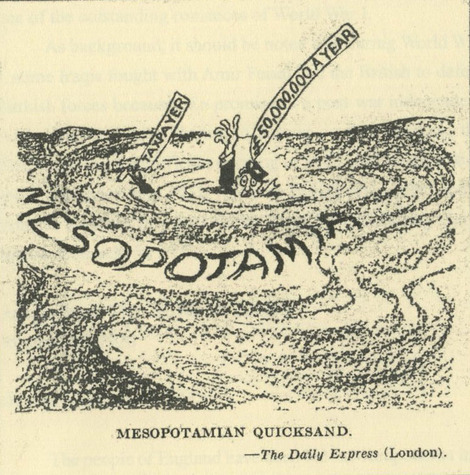
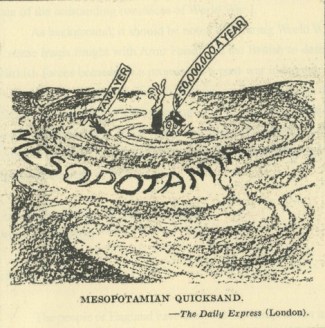
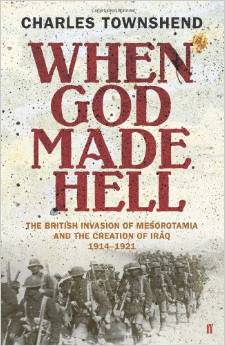
And I would be far less depressed if we had not just spent a decade fighting the very same insurgency, based on the very same fantasies of a multi-sectarian democratic Iraq, and failed so spectacularly. Indeed, every single time a foreign power has attempted to somehow keep Iraq together, it has failed. Every. Single. Time. Just take a look at the British in the 1920s – which prompted the cartoon above. A book just came out on that history, and its title is from an Arab proverb: “When God made Hell he did not think it bad enough so he created Mesopotamia.” To believe that this time, it will work, when Americans are far more incompetent and clueless imperialists than the British once were, is a form of insanity. Some things cannot be solved by outside forces.

I would also be far less depressed if this president hadn’t already done exactly the same thing in Libya – to prevent an alleged impending humanitarian disaster – and created far more deaths, far more chaos and far more disorder than existed before. To repeat this catastrophic error with the same bland notions of this is America’s indispensable role is just madness. In the Middle East, our role has long been to generate chaos and conflict and mayhem. At what point will Americans not realize that they are just not capable of solving problems in places we do not understand, beset by forces more powerful than even the mightiest military in the world can counter?

But maybe this time, I’m wrong. Maybe this time, a new American war in the Middle East will succeed. Maybe this time, history will defy everything that history has proven before. But I remain a conservative, not a utopian. And those who in Elysian fields would dwell do but extend the boundaries of hell.

The Best Of The Dish Today

At a speech the other night, I was asked a direct question: “Are you an isolationist?” I’ve never been asked that question before and I found myself wanting to say yes, just to stir shit up. But in a moment of restraint, I did say yes in the current case, but not always. I’m against isolationism if there is something we can do that actually works. But no amount of moral outrage at outright evil makes any sense if there’s nothing we can really do to stop it. Or indeed if our intervention will actually make things worse. As it has in Iraq and Afghanistan.

Readers have asked me what I would do if I were president in this case. My answer is nothing. I would tell the country that this is a consequence of the Iraq War, and that if we could not really quell a Sunni insurgency with a hundred thousands troops on the ground for nearly a decade, then air-strikes are not going to do a thing now. I’d insist that the neighboring Sunni states will have to deal with this themselves – or allow Iran to handle it. If a regional Sunni-Shi’a war is the result, we can always hope that both sides will lose. Invading Iraq was not Obama’s responsibility; his responsibility was to get us out and to stay out. Once Syria’s WMDs had been taken out of the country, it would be a regional conflagration – like the Syrian civil war that has already cost 200,000 lives, or the Iran-Iraq War of the 1980s.

Yes, we should tighten our defenses; yes, we should deal firmly with any Americans who are going to fight there; yes, we should perhaps intervene from a distance if one side seemed to be gaining the upper hand too much. (Our real interest is in bolstering the one stable power in the region, which is Iran.) But basically: leave these insane, foul, sectarian conflagrations to those who fight them. Above all, do not make this a war between Islam and the West. Let it be what it is: a war of Islam against itself.

The alternative was outlined by George W Bush today. His view is that we should be patient and baby-sit “Iraqi” “democracy” for an indefinite period of time with residual troops. We are now doing that in Afghanistan. The alternative, in other words, is an endless pseudo-empire in failed states to achieve “democracy” where such a thing makes absolutely no sense at all. It’s a form of welfare with no cut-off, creating hatred for the US and thereby anti-Western terror for the foreseeable future and beyond.

We elected Obama precisely to be calm and sane enough to be able to resist what he has now done. He betrayed us. His policy, such as it is, is utterly incoherent and as free from any sane fiscal footing as his predecessor’s. He has launched a war against an entity that even the CIA says poses no threat to the US. And his party will be eviscerated in the coming November elections as a result. If you voted twice for Obama to end these unwinnable, bankrupting, open-ended wars, why on earth would you vote Democrat to enable another one? Yes, the polls show support for the new war right now. But just watch. The easy part is over. The civilian casualties will mount, ISIS and al Qaeda are uniting again, the narrative of Islam against the West is back in the foreground, the completely farcical idea of arming “moderate Syrians” will go nowhere, and the terror risk at home will escalate. There will be no victories. Except for the Republicans.

Today, I took note of how Fox News is seizing on the politics of fear that Obama has now legitimized; we reviewed Marilynne Robinson’s latest installment in her stunning Gilead trilogy; we noted how Hobby Lobby is beginning to prove Ruth Bader Ginsburg right; and noted how our only real allies in Syria now hate us. Plus: more on spanking. And a cat that loves being vacuumed.

Many of today’s posts were updated with your emails – read them all here.  You can always leave your unfiltered comments at our Facebook page and @sullydish. Another reader quotes me regarding what’s quickly becoming our email of the month – a first-person account of child abuse:

“What has long struck me about this almost unique aspect of the Dish is not just the fact that readers feel safe to write us, knowing that their identities will be absolutely confidential, but that the quality of the writing is so high.” I have no doubt that your readership is smarter than the average publication’s (and we’re all damned good-looking, too). But my hunch is that your decision not to have an open comments section also drives up the quality of the emails you get. Every smart email you publish sets the bar that much higher for the rest of us. We know there’s no point in emailing you something half-assed, so we write, rewrite, edit, and re-edit our emails.

And then we throw in a line praising (or trashing) the Pet Shop Boys before we hit send.

What have I, what have I, what have I done to deserve this?

If you appreciate the kind of reader-based journalism we do at the Dish, consider subscribing here to get access to all the rich email content – not to mention all the ReadOns and Deep Dish – for a little as $1.99 month. Gift subscriptions are available here if you want to share the Dish with someone or simply want to further fund our endeavor as an existing subscriber. And please drop us an email if you end up doing so; we always love hearing from new and existing subscribers.

See you in the morning.