Facing Inequality

In the Weekly Standard, Matthew Continetti concedes the reality of income inequality, but concludes that it’s simply not the government’s place to intervene:

Too quick to dismiss the occupiers, too convinced that the bad economy will doom Obama’s reelection, too distracted by the silliness of the Republican primary, too beholden to the egalitarian assumptions of the left, Republicans and conservatives have not responded coherently to the arguments put forward by their newly invigorated opponents. … The way out is to reject the assumption that government’s purpose is to redress inequalities of income. 

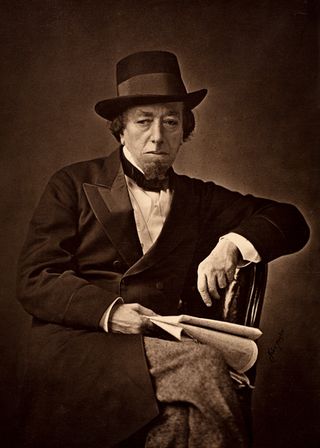
I completely agree as a general principle. But to see the world in purely ideological or ideal terms is to miss something. Political conservatism, as I understand it, is the constant adjustment of government to changing social, economic and moral changes in society, with a preference for stability and limited government. It has principles – fiscal prudence, limited government, strong defense – but it also knows when to adjust those in the face of reality. To give an example, as a Benjamin_Disraeli_by_Cornelius_Jabez_Hughes,_1878principle, I oppose progressive taxation; in practice, I see no way even America will move to it. As a principle, I don’t want to see the wealthy and successful penalized for their success. These people are often, though not always, the job-creators and wealth-creators. You do not help the poor by punishing the rich.
But this is not where we are, is it? We are at decades-high inequality and declining social mobility – two major threats to the social order conservatives want to maintain. The tax code, as Tom Coburn has pointed out, is riddled with loopholes for the perquisites of the very rich, and for their income. Some groups of citizens have become rentier classes, using their expertise and mastery to enrich themselves at the expense of others. The top two categories of these sectors are doctors (vastly overpaid alongside every aspect of US healthcare) and bankers (bordering on criminal in the imbalance between what they contribute to society and what they get out of it). Globalization has accelerated income inequality even beyond our worst fears in the 1990s. And the rich have essentially bought the Congress, which is why healthcare reform and banking reform have become so tough.

Instead of reiterating that conservatism, properly speaking, should be indifferent to these trends, ruling them out of bounds for government action, conservatives should right now be assessing how to adjust these principles to the new reality. Some – like Alan Simpson or David Frum or Bruce Bartlett or Richard Posner – are. There is a tradition in Toryism, One Nation Conservatism, which, in Britain, oscillates in the Conservative Party with its more neo-liberal Thatcherite strand. This One Nation Toryism, innovated by Disraeli, takes national division and inequality seriously as a problem for social stability. My view is that both conservative strains are necessary, and that the GOP needs to revive its moderate, pragmatic identity now, when it is most desperately needed. The point of prudential judgment is knowing when to compromise, not taking pride in never compromising.

That means above all tackling the debt aggressively in the long term while avoiding a debt trap in the near term; that means serious long-term entitlement and defense cuts and a scythe to end as many loopholes and deductions in the tax code as possible. I’d leave only charity as an exception but would scrap that if the alternative was the status quo. The truth is we currently have a golden opportunity to raise revenues and cut rates a little if we tackle the corruption of the tax code. We’d also throw lobbyists, like Herman Cain and Jack Abramoff, out of business. If this isn’t a conservative response to our current crisis, I don’t know what is.

Alas, we have the party of Cantor. Complete indifference to vast economic inequality, no plans or ideas for how to generate middle class growth and jobs, scorched earth partisanship,and a rigid attachment to ideology, conservatism’s age-old nemesis. If the Super-Committee fails, it will be because one party alone refuses to budge on one half of the equation – revenues. That very intransigence destabilizes the US and the whole world.

And since when do conservatives stand for destabilization?

(Photo: Benjamin Disraeli by Cornelius Jabez Hughes, 1878.)
Why Huntsman And Paul Matter

I didn’t watch or live-blog the foreign policy debate – because it was a Saturday evening and I had a rare chance to hang with some of my best friends in LA. And frankly, reading it up since and watching Youtube clips, I am relieved. The sheer ignorance, callowness, narrowness of mind and shallowness of thought was greater than any debate I recall on this subject ever.

The days when the GOP could be credibly seen as having more concrete and solid judgment on foreign affairs than the Democrats have long since disappeared into the memory hole. The last Republican president did more damage to American soft and hard power in eight years than any president in history, and, on top of that, besmirched this country permanently with the scar of torture as an instrument of state, something the West had decisively put behind it centuries ago, something that once helped define the United States as a civilized country. But now we have a motivational speaker who knows nothing about foreign affairs, Herman Cain, telling us that he is against torture but also in favor of torture, and then saying he would defer to the military leaders. Well, torture is barred from the military services, period, so consultation with them would be redundant. And this ignorant creep is at the head of the pack. Michele Bachmann apparently thinks that Obama has allowed the ACLU to run the CIA, which would come as some surprise to both. Her statement is so insane, so utterly removed from reality, that it would disqualify someone from a high school debating tournament. But again, this preposterous woman is a serious candidate for this farce of a party. Then we have Rick Perry saying this:

“For us not to have the ability to try to extract information from them to save our young people’s lives is a travesty. This is war. I am for using those techniques.”

And so you see that Perry is ignorant of the most basic facts of war, i.e. that there are laws of war, and that torture has been anathema to the American government from George Washington until George W. Bush. The idea that war instantly justifies torture is about as anti-American and anti-Western a statement as anyone can make. Ronald Reagan signed the 1984 Convention Against Torture with the following words:

“The United States participated actively and effectively in the negotiation of the Convention . It marks a significant step in the development during this century of international measures against torture and other inhuman treatment or punishment. Ratification of the Convention by the United States will clearly express United States opposition to torture, an abhorrent practice unfortunately still prevalent in the world today.

The core provisions of the Convention establish a regime for international cooperation in the criminal prosecution of torturers relying on so-called ‘universal jurisdiction.’ Each State Party is required either to prosecute torturers who are found in its territory or to extradite them to other countries for prosecution.”

Notice that Reagan was not quibbling about the precise meaning of “torture”. He signed a Convention against anything that could even faintly be considered torture – any “inhuman treatment” of prisoners. This current incarnation of Republicanism is so crude, so un-American, so fascistic in its disdain for the rule of law and its relish for violence that it should have no place in a Western polity. To have leading Republican candidates embrace torture in this way renders it the only political party in the entire Western world to embrace the abuse and torture of prisoners. It is unique in the West in embracing the tactics of totalitarian states throughout the world.

The other man to stand up for America was Jon Huntsman. He was as eloquent as Paul:

“We diminish our standing in the world and the values that we project which include liberty, democracy, human rights, and open markets when we torture. We should not torture. Waterboarding is torture. We dilute ourselves down like a whole lot of other countries. And we lose that ability to project values that a lot of people in corners of this world are still relying on the United States to stand up for them.”

At some point, before the primaries, the Dish will endorse a candidate for the GOP – just because it is important and clarifying to take a stand. The debate on Saturday made our choice relatively simple: between Paul and Huntsman. For they are the only men worthy to represent this country without simultaneously betraying it.

The Tea Party’s Fatal Delusion

Longtime readers will know I’ve long had a theoretical scenario for politics under this president – and the results from the elections yesterday seem to confirm it. To be frank, I was taken aback by the immediate and total obstructionism from the GOP in 2009. I thought it would be a little less crass. But I never thought they’d moderate after 2008. There was always a long-suppressed backlash against the Bush era of massive debt, reckless spending, and unwinnable land-wars. And there was also a cultural panic at a biracial president and the new America he represented. Both these prompted a spasm of ideological abstraction and purism, in which there were only two choices in political life: freedom or slavery. If you think I exaggerate, try reading Mark Levin’s best-seller.

Suddenly, we found the right even more defined and dominated by talk radio, Fox News, and the far right blogosphere (yes, Mr Erickson, that would be you), and its resort to 1980s dogma as a cure-all for its woes. Hence the description of a centrist health insurance reform, based on many Republican ideas, to the right of the Clintons’ and far to the right of Nixon’s, as a form of enslavement. Hence the absurd notion that the stimulus had no impact, simply because it was too small to fill the hole in demand that the statisticians in 2009 did not accurately measure or predict.

Hence the attacks on collective bargaining for public sector workers, and the draconian anti-illegal-immigration initiatives from Arizona to Alabama. Hence the total denial of climate change and a desire to abolish the EPA. Hence a Supreme Court happy to find radical new interpretations of the Constitution, including the unlimited right of corporations to influence elections, and turning the Second Amendment into something more radical than anything previously contemplated. Hence the even more bizarre defenses of the banks who gambled with the country’s core financial stability to make even more grotesque bonuses than they had been earning already. Hence too the total silence when it comes to anything that could not just repeal but “replace” Obamacare. The uninsured simply don’t exist in the mind of the GOP.

The reasons for this pathological pattern are, to my mind, manifold. The first is that, quite simply, much smaller legislative parties tend to include fewer moderates (because they’re the ones likeliest to lose in swing districts) and so the atmosphere skews far right or far left (my two main historical examples of this are British: Labour after Thatcher’s first victory, the Tories after Blair’s). This was intensified by the pre-2010 purge of any moderates and selection of an even more ideological freshman class in the House of Representatives. The second is the dominance in the GOP of what might be called the Media Industrial Complex. When there is so much money to be made from politics-as-entertainment, the dominant public figures on the right tend to be provocative, polarizing media stars. From Limbaugh to Levin to Hannity, the premium is on conflict and provocation for ratings. After a while, this is all you’ve got in the Republican psyche, and no moderating forces acting against it. In that atmosphere, you need talk-show hosts as president, not governors or legislators. Herman Cain is drawn precisely from that media industrial complex. Mitch Daniels and Jon Huntsman are excluded for the exact same reason.

And the recession’s damage to an incumbent president’s party merely put a misleading mid-term gust behind sails rigged for winds that were blowing in the 1970s, not the 2000s. The 2010 mid-terms were what might be called a “fatal success.” Yes, there was a backlash among older, whiter voters against the 2008 tide. But to conclude from that that there was a widespread, general support for further moves to the furthest right in an economy where many are struggling to get by and where economic inequality is still soaring, was a huge over-reach. And so we see the staggering results of last night’s votes.

The Ohio law against collective bargaining rights for public sector workers did not just go down. It went down in a landslide. Yes, the unions poured money into the battle and outspent opponents. But the scale of the victory is hard to gainsay. In a critical swing state, the GOP is in full retreat. In Arizona, the recall of the official who had pioneered the anti-illegal immigration measures is another remarkable event. Ditto even Mississippi’s rejection of a ballot initiative that is a theocon’s wet dream (if theocons are allowed such things), and takes the concept of personhood at conception to new, bizarre heights and exposes the stealth theocon campaign against contraception as well.

We’ve seen the polls showing a shift in Americans’ views of inequality and their support of higher taxes for the wealthiest as part of a debt-reduction package. We’ve seen the accelerating moderation on marriage equality and marijuana. We’ve noticed the Tea Party’s further alienation of minority voters, and now, with the Cain circus, possible intensification of the gender gap. We’ve noticed that increasing numbers of voters, including independents, regard the GOP as potentially sabotaging the economy purely in order to defeat Obama. Now we are seeing the effect of all this in actual elections. And the GOP primary campaign has also underlined just how marginal, ideological and inexperienced many of the presidential candidates are. A party that gives a motivational speaker ten times the support of a two-term governor of Utah, re-elected with 84 percent of the vote, with strong bipartisan credentials and an even stronger tax reform plan … well, it’s a party in free-fall that also doesn’t understand that it is.

Look at PPP’s polling in Ohio right now:

Obama continues to suffer from poor approval ratings in Ohio with only 41% of voters approving of him to 49% who disapprove. But voters don’t seem to consider any of his opponents to be viable alternatives … On our weekend poll, which got the final result of Issue 2 correct to within a point, Obama led all of his Republican opponents in the state by margins ranging from 9-17 points.

Obama led Mitt Romney 50-41 on our poll. He was up 11 points on Herman Cain at 50-39, 13 on Newt Gingrich at 51-38, 14 on Ron Paul at 50-36, 14 on Michele Bachmann at 51-37 and a whooping 17 points on Rick Perry at 53-36. It used to be Sarah Palin’s numbers that we compared to Barry Goldwater, but Perry’s deficit would represent the largest Republican defeat in Ohio since 1964.

For this party, Herman Cain is the perfect nominee (since Palin simply couldn’t overcome her lies and pathologies). Because it is increasingly clear he is the master of complete denial of reality and has no actual experience in any public office.

Meep, meep.

Remember The Arab Spring?

This embed is invalid

Watch Syria Undercover on PBS. See more from FRONTLINE.

It continues, as our attention wanders elsewhere. And in Syria, we have the most hideous example of untrammeled brute force against unarmed civilians since Iran in 2009. The regime has been shelling Homs, bombing it to smithereens, killing countless civilians – around 3,500 so far are dead nationwide – while preposterously blaming everything on unnamed “Salafists” and terrorist groups. The cynicism and evil here rise to new levels. When a regime is reduced to having snipers target soldiers who are ordered to shoot civilians, it has lost legitimacy, authority, or any political status as such. It is simply an army dedicated to the destruction of the bodies and souls of its own people.

We in the West rightly championed the true election victors in Iran and the courage of Egyptians and Tunisians and Libyans. But the Syrians are facing a viler dictatorship than Mubarak or Ben Ali and a more rational one than Qaddafi. And their daily and nightly unarmed marches continue against overwhelming odds. And we’ve been distracted, as the regime intended, after its lie of a ceasefire to the Arab League.

Ramita Navai smuggled the extraordinary footage of the Syrian rebellion, embedded above. She talks about her experience with Anderson Cooper here and describes the process here. But the Frontline special only gets to a fraction of what happens in Syria every day – in Homs, a city whose protests have been met with this response, the street chants continue:

At another protest yesterday in Homs, Syrians chant “how beautiful freedom is:”

In Hama, another city brutalized by Assad, people continue to protest in solidarity with Hama – risking themselves to support fellow protestors:

The protests continue even in Aleppo, a city generally considered more pro-Assad:

This is the Syrian uprising – constant protests, groups gathering every day until Assad’s fall. Lest you think said protests are limited a few cities, PBS has a helpful interactive map charting several major hubs (as noted in the documentary, the uprising has a significant rural base that’s harder to track). The protest movement has also been adept at using social media – Facebook hosts pages like Syria Monitor, Syrian Letters, and Twitter Users for Syria help spread information and firsthand testimony. The twitter hashtags #Syria and #Assad also serve as clearinghouses, linking to Facebook pages and blogs like the Revolting Syrian. Here is a video of a Syrian conscript being beaten for refusing to open fire on innocent people:

Any help translating some of the dialogue above would be most welcome.

Israel’s Threat; Iran’s Danger

Don't you get the feeling that, as we obsess about Herman Cain's sexual harassment and Justin Bieber's paternity test, the world could be headed soon for a new depression, as Europe implodes, and world war, as the Israel-Iran conflict explodes? Shmuel Rosner thinks two factors will influence Israel's decision to attack: the perceived risk of a nuclear Iran and the feasibility of a strike. Walter Russell Mead sees a change in Israeli attitudes on the latter front. Paul Mutter examines the impact of a "super Stuxnet" on Israeli thinking. Marc Tracy does a cost-benefit analysis:

The negative consequences of an Israeli attack—massive war with Hamas and Hezbollah, maybe rockets from Iran itself, God knows what worse forms of retaliation—are essentially known and all but guaranteed. By contrast, the negative consequences of not launching a strike range vastly and unknowably, and if they go all the way up to Armageddon in the Middle East, they also go all the way down to Iran’s never making weapons. I know this is scary, but it’s the way life is lived: you can believe that the worst-case scenario for not striking Iran is worse than the worst-case scenario for striking Iran, and, because of the odds and the contingencies, still oppose striking Iran.

Judah Grunstein is skeptical about both this calculus and the arguments in favor of a strike. Robert Farley sees the idea of war with Iran as flat-out insane. The real question is: for whom? Insanity is relative.

For Israel, you can see how Netanyahu, born and bred into profound but often justifiable paranoia, sees himself as Churchill. You can see how the Jewish people live perpetually in fear of Amalek. But Churchill confronted an enemy equal in military force, greater in industrial strength, and explicitly territorially expansionary. Netanyahu faces an enemy with no record of territorial aggression (unlike Israel), a faltering economy, a divided leadership, massive domestic opposition, and a much inferior military operation. Israel itself is deeply divided over whether risking global war to defeat this country's acquisition of a handful of nuclear weapons (while Israel has well over a hundred), makes sense. I can see why some Israelis and Jews do not consider this literally insane. I cannot see how a rational American can come to the same conclusion.

But for the US, it seems pretty obvious to me that an Israel-prompted regional war in the Middle East would be a disaster, wiping out many of the gains Obama has made in taming and targeting Islamist terror, devastating the Middle East, unleashing terror attacks across the globe, probably pushing Pakistan into open hostility, and pushing an already fragile global economy into the Second Great Depression.

This must be at the center of our foreign policy debate. Are we the instruments of Israel's understandable, if misguided, foreign policy or the masters of our own? Are we governed by our reason or others' panic?

What Happens If Greece Leaves The Euro?

Panic:

[T]he real threat of a Greek default is in the example it would set. Citizens of other European nations would see the chaos; they might figure that their savings would be safer in German, rather than Portuguese (or Italian) banks. Bond investors might feel the same; yields would rise further. Official creditors (including the ECB) might take a hit, making it even more difficult for them to participate in other bailouts.

For all the bluster, one can't help feeling the tough EU stance is a bit of a bluff. They can't view a Greek exit with anything other than fear.

What happened in the last few days is something quite shocking to the Eurocrats. Someone actually asked the people of his own democratic country if they approve of deep and lasting austerity as a worthwhile price to keep the euro. So finally, we have a rogue force in EU decision-making: democracy. I know there are enormous systemic risks in delaying the implementation of the deal made last week; but there are also profound long-term risks in pushing for the deeper European integration required of this crisis without popular, democratic consent.

I'd prefer temporary chaos that can cede to a democratic reality; than a papered-over deal, hated by the southern European population, that could lead to a populist explosion down the line, especially if another recession hits. We're already seeing the paradox of accelerating the loss of sovereignty past the popular national will: you actually increase nationalism and division, rather than ameliorating them. In other words, the EU begins to defeat its own reason for existing.

And, yes, this has already begun to happen. Sarko's and Merkel's thinly veiled contempt for Greece prompted memories of the Nazi occupation to be revived in Athens. Britain's Tory Euro-skeptics are beginning to flex their muscles again in the British parliament. German voters may soon reach the real end of their patience with the Greeks and Italians. And more and more, we keep hearing of the next domino that could fall. France?

The Mark Of Cain?

Polls_of_polls

Politico reports that Cain has been accused of sexual harassment by two women. And it's pretty clear he's going to have to cop to it:

He was then asked, “Have you ever been accused, sir, in your life of harassment by a woman?”

He breathed audibly, glared at the reporter and stayed silent for several seconds. After the question was repeated three times, he responded by asking the reporter, “Have you ever been accused of sexual harassment?”

That's not the answer of a man falsely accused, it seems to me. And the financial payments to two women are a clear indication of impropriety that bordered, if not transgressed, the legal line. Dave Weigel compares the allegations to the Clarence Thomas/Anita Hill brouhaha: 

It's one thing for a movement hero or SCOTUS nominee to get in trouble, because everyone stands to lose if he's taken down. Quite the opposite is true if a presidential candidate is in trouble — countless people stand to gain from the coming dogpile. Two: This isn't a one-day story. Politico protected the names of the sources while leaving a Hansel and Gretel trail for others to follow. 

Noreen Malone analyzes the Republican reaction:

At least so far, the accusations don't appear to be damaging him too much on the right—in fact, conservatives seem to be rallying around Cain."These are nothing more than allegations at the moment; let's not rush to judgment until all the facts are in," went one typical response on TownHall. The Drudge Report linked prominently to one video of Ann Coulter saying"They are terrified of strong, black, conservative men," …

John Cassidy wonders whether Politico's story will hold up:

[I]f more details do emerge, and particularly if either of the women comes into the spotlight and puts a face on the allegations, Cain’s bubble will have popped in spectacular fashion.

The issue here is that sexual harassment is rarely a one-off deal. It's usually a pattern of behavior. This may open a veritable can of accusations. And I should add that respecting the privacy of people's consensual sex lives, in all their messiness, is not the same as alleged sexual harassment. My insta-view, subject to revision after many more details come out, is that this kind of thing is a pretty moral wound for a candidate with this sudden a rise and shallowness of support. But how he handles it will tell us the most. Candor? Apology? Defiance? Here's one thing worth looking out for: any deployment of the race card.

Poll of polls chart from RCP.

Obama On Cannabis

F9nyco05-um-ww_mfbuo9q

He first treated legalization as a joke; then asked for suggestions from the public for policies for his administration. Of the top ten petitions, five had something to do with marijuana. A majority of Americans now favor an end to prohibition, as the graph shows above. But the Obama administration regurgitates the standard prohibitionist crap, issuing its public response on the Friday afternoon before Halloween. 74,000 signed the petition to treat marijuana as alcohol. The drug czar does not even grapple with the central question posed by the most popular petition on the site. Instead we get this:

According to scientists at the National Institutes of Health– the world's largest source of drug abuse research – marijuana use is associated with addiction, respiratory disease, and cognitive impairment. We know from an array of treatment admission information and Federal data that marijuana use is a significant source for voluntary drug treatment admissions and visits to emergency rooms. Studies also reveal that marijuana potency has almost tripled over the past 20 years, raising serious concerns about what this means for public health – especially among young people who use the drug because research shows their brains continue to develop well into their 20's. Simply put, it is not a benign drug.

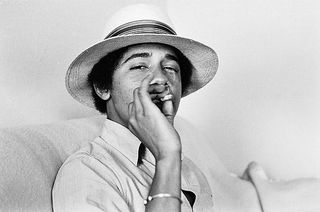
Notice the weasel words: "associated with addiction." I.e. nowhere near as addictive as alcohol, even using an expansive definition of "addiction." Exercize is also "associated with addiction," as Nick Kristof Barack_obama_smoking_weed_picture.0.0.0x0.611x404_i9mothere are, of course, vaporizers to avoid the smoke issue.
Cigarettes are related to "respiratory disease" in a much, much, much more dangerous way because so much more tobacco is smoked. Why is tobacco not illegal? Alcohol gives you cognitive impairment. How many visits to emergency rooms occur because of alcohol in some way? And how more serious than a freaked out stoner getting paranoid? None of the arguments manages to explain why marijuana, unlike nicotine or alcohol, remains illegal, with all the disastrous effects that has with respect to Prohibition. Marijuana arrests are also highly skewed to racial minorities. Again, there's no White House concern about this. This comes after the California federal crackdown on medical marijuana, even if it was not a function of direction from Washington, DC. Happily, Eric Holder now has a lawsuit on his hands over the matter.

What's infuriating is this administration's refusal to have a serious debate about this, to actually engage the salient arguments of legalizers. We just have a defensive crouch, and an insult to large numbers of Obama voters and supporters, who, unlike this nicotine-addicted president, do not take the question of prohibition as a joke.

The Pope Embraces Doubt

Benedict has included agnostics in his ecumenical gathering at Assisi, a meeting in the tradition of John Paul II. And his reasoning is powerful:

[Agnostics] are “pilgrims of truth, pilgrims of peace”. They ask questions of both sides. They take away from militant atheists the false certainty by which these claim to know 800px-TheosAgapethat there is no God and they invite them to leave polemics aside and to become seekers who do not give up hope in the existence of truth and in the possibility and necessity of living by it. But they also challenge the followers of religions not to consider God as their own property, as if he belonged to them, in such a way that they feel vindicated in using force against others …
[Agnostics’] inability to find God is partly the responsibility of believers with a limited or even falsified image of God. So all their struggling and questioning is in part an appeal to believers to purify their faith, so that God, the true God, becomes accessible. Therefore I have consciously invited delegates of this third group to our meeting in Assisi, which does not simply bring together representatives of religious institutions.

Rather it is a case of being together on a journey towards truth, a case of taking a decisive stand for human dignity and a case of common engagement for peace against every form of destructive force.

My italics. The full text is here, and Michael Potemra’s moving engagement with it is here at NRO. Many conservative Catholics keep telling me that I am misreading Benedict, that his concerns and theology are really not that far off the concerns and theological discussions we have been having on this blog for years. And there are times when this is clear. Deus Caritas Est, for example. The concern for liturgy, ritual, mystery in faith. The embrace of the church as a counter-cultural force in a depressingly materialistic mass culture. Benedict’s conservatism is, we are told, merely a defensive neo-conservatism born of the failure of the Second Council to give the faith a new birth in Europe and the West. It is not pure institutional reactionaryism.

But it is equally clear, is it not, that the project of mere assertion of papal authoritah, the purging of Catholics with doubts and questions, the doubling down on a theory of natural law that simply does not reflect what modernity knows of nature (and therefore refutes itself), the profound corruption that allowed for the rape and abuse of countless innocents across the world, the scandal of the Legion of Christ … these have led to an even steeper collapse of the church in the West where its fate as a living truth still lies.

Benedict is at his best as a theologian, opening arms to other faiths and agnosticism to commit to the core principles of caritas and pax.

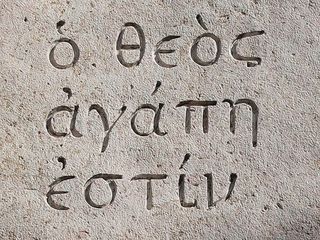
(Photo: “ὁ θεòς ἀγάπη ἐστίν” ó theòs agape estín (Greek; trans. “God is love”) on a stele in Mount Nebo. From Wiki.)

Has There Ever Been A Candidate Like Herman Cain?

Poll-of-polls

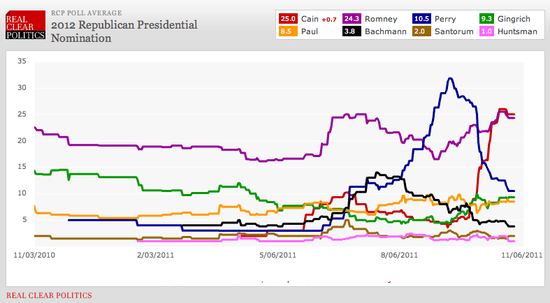
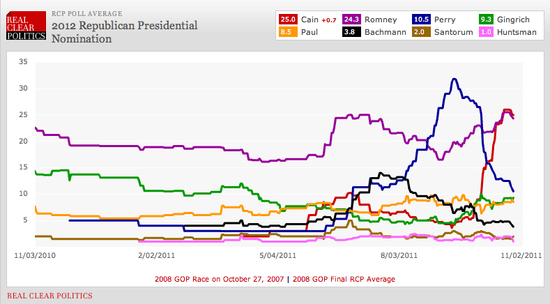
We're begining to see some signs of gravity: chaos in the campaign, an obvious strategy to run for president as a money-making proposition through book sales and vastly increased speaker fees, staggering policy ignorance, meta and campy web ads that appeal to twentysomething ironists but not exactly the Christianists he needs … and yet, there is no sign yet that Cain is about to implode. In the last two days, both the NYT and the Fox News polls have Cain as the front-runner, with a quarter of the votes. Romney in both is several points behind, and Perry is now behind Gingrich. More to the point:

Cain is particularly popular among Republican primary voters who identify as being a part of the Tea Party: he captures 32 percent to Romney’s 8 percent among this group. Cain also has a wide 15 percentage-point advantage over both Romney and Gingrich among white evangelicals.

Nate Silver can't find a historical parallel:

Not only do I not know how I would go about estimating the likelihood that Mr. Cain will win the Republican nomination —I’m not sure that there is a good way to do so at all. But I do know what an analyst should not do: he should not use terms like “never” and “no chance” when applied to Mr. Cain’s chances of winning the nomination, as many analysts have.

There is simply no precedent for a candidate like Mr. Cain, one with such strong polling but such weak fundamentals.

My own take on this is that Cain is a great performer – he makes a living as a motivational speaker, after all – and the rest of the field is hobbled by one glaring problem respectively, while Cain isn't. Perry is simply too dumb and lazy to be president. Romney too transparently opportunist for a purist party. Paul is disqualified because of foreign policy. Bachmann is a programmed bonkers-bot. Santorum is a frothy substance whose views of the world are frozen in place sometime around 1986. Gingrich is an asshole who could never win the presidency, and even those who like his permanent smirk/snarl understand that. Huntsman might as well be Al Sharpton, because of his views on climate change, gays and because of his working for Satan. No wonder Cain has a shot, given the debates. He is likable and brilliant at simple, effective presentation. He has the skills of an actor, and a roguish shamelessness that reminds me a little of Clinton. Even though you know he's a total charlatan, you still kinda like the guy.

He's black too, and one cannot help but feel that some of his support is really a way of expressing hatred for Obama, and proving that the Tea Party is not racist.

But Cain is a function, I think, of a deeper Republican reality. It has become a wing of the entertainment industry, and in that media-industrial complex, the money to be made is immense. You do not make that money or become a star in conservative circles by actually governing, by the process of compromise and negotiation with one's opponents, or by detailed policy knowledge. In the universe where conservatism is defined by Levin and Malkin and Limbaugh and Hannity, you have to be a great polemicist, you have to be partisan above all, you need to be outrageous at times, and you have to appeal to the gut, rather than the brain.

This is an entertainment company based around a religious identity politics and masquerading as a political party. Once you grasp that, you can see why a Mitch Daniels or a Richard Lugar or a Jon Huntsman are asterisks. They know things; they want to govern, not perform; and they are not in a permanent mode of marginalized and angry opposition.

I'm beginning to wonder if the GOP is heading for a defeat they don't see coming – even in an economic environment which should make the presidency theirs' for the taking. I hope it is. Something needs to wake them up from their increasing detachment from the reality of governance.

(Poll of polls screenshot from RCP)