A Poem For Monday

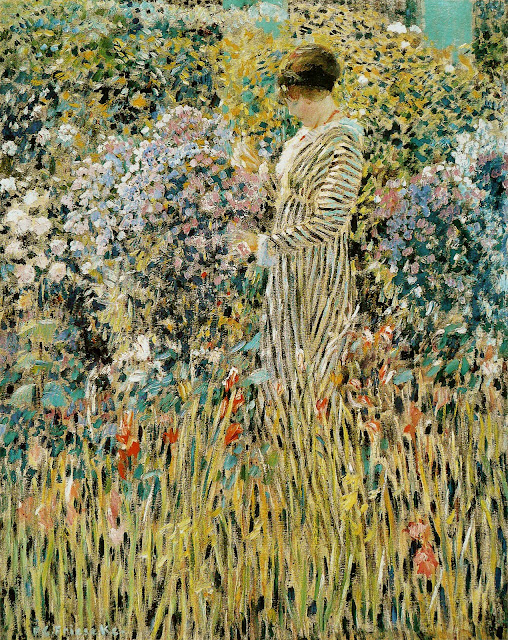
Frederick_Carl_Frieseke_-_Femme_dans_un_jardin

“Sonnet 64” by Edmund Spenser (1552-1599):

Coming to kisse her lyps, (such grace I found)
Me seemd I smelt a gardin of sweet flowres:
that dainty odours from them threw around
for damzels fit to decke their lovers bowres.
Her lips did smell lyke unto Gillyflowers,
her ruddy cheeks lyke unto Roses red:
her snowy browes lyke budded Bellamoures,
her lovely eyes lyke Pincks but newly spred,
Her goodly bosome lyke a Strawberry bed,
her neck lyke to a bounch of Cullambynes:
her brest lyke lillyes, ere theyr leaves be shed,
her nipples lyke young blossomd Jessemynes,
Such fragrant flowers doe give most odorous smell,
But her sweet odour did them all excel.

Spenser poems from over the weekend here and here.

(From Amoretti, published in London in 1595 by William Ponsonby. Lady in a Garden, circa 1912, by Frederick Carl Frieseke via Wikimedia Commons)


A Poem For Sunday

Dew_drops_on_spider_web

“Sonnet 71” by Edmund Spenser (1552-1599):

I joy to see how in your drawen work,
Your selfe unto the Bee ye doe compare;
and me unto the Spyder that doth lurke,
in close awayt to catch her unaware.
Right so your selfe were caught in cunning snare
of a deare foe, and thralled to his love:
in whose streight hands ye now captived are
so firmely, that ye never may remove.
But as your worke is woven all above,
with woodbynd flowers and fragrant Eglantine:
so sweet your prison you in time shall prove,
with many deare delights bedecked fyne.
And all thensforth eternall peace shall see,
between the Spyder and the gentle Bee.

(From Amoretti, published in London in 1595 by William Ponsonby. Photo via Wikimedia Commons)

A Poem For Saturday

Edmund_Spenser_oil_painting

The poet Edmund Spenser (1522-1599) was one of the greatest of Renaissance sonneteers. The Dish will be running three from his cycle Amoretti, first published in 1595, describing his courtship of and devotion to the woman he married, Elizabeth Boyle, who was of Anglo-Irish descent. First up is “Sonnet 70”:

Fresh spring the herald of loves mighty king,
In whose cote armour richly are displayd
all sorts of flowers the which on earth do spring
in goodly colours gloriously arrayd.
Goe to my love, where she is careless layd,
yet in her winters bowre not well awake:
tell her the joyous time wil not be staid
unlesse she doe him by the forelock take.
Bid her therefore her selfe soone ready make,
to wayt on love amongst his lovely crew:
where every one that misseth then her make,
shall be by him amearst with penance dew.
Make hast therefore sweet love, whilest it is prime,
for none can call againe the passed time.

Heads up, Renaissance fans: the New York Botanical Garden‘s summer exhibition is Wild Medicine, Healing Plants Around the World, featuring a stunning re-creation of an Italian Renaissance Garden. Renaissance poems will appear on placards on the garden grounds, including two by Edmund Spenser, and there will be three afternoons of Renaissance music and poetry on June 22, July 27, and September 7.  More details here.

(From Amoretti, published in London in 1595 by William Ponsonby. Portrait of Spenser via Wikimedia Commons)

A Poem For Monday

sea

“Staring at the Sea on the Day Of the Death of Another” by May Swenson:

The long body of the water fills its hollow,
slowly rolls upon its side,
and in the swaddlings of the waves,
their shadowed hollows falling forward with the tide,

like folds of Grecian garments molded to cling
around some classic immemorial marble thing,
I see the vanished bodies of friends who have died.

Each form is furled into its hollow,
white in the dark curl,
the sea a mausoleum, with countless shelves,
cradling the prone effigies of our unearthly selves,

some of the hollows empty, long niches in the tide.
One of them is mine
and gliding forward, gaping wide.

(From May Swenson: Collected Poems, Langdon Hammer, editor (The Library of America, 2013) © The Literary Estate of May Swenson. Photo by Flickr user echiner1)

A Poem For Sunday

two trees

“All That Time” by May Swenson:

I saw two trees embracing.
One leaned on the other
as if to throw her down.
But she was the upright one.
Since their twin youth, maybe she
had been pulling him toward her
all that time,

and finally almost uprooted him.
He was the thin, dry, insecure one,
The most wind-warped, you could see.
And where their tops tangled
it looked like he was crying
on her shoulder.
On the other hand, maybe he

had been trying to weaken her,
break her, or at least
make her bend
over backwards for him
just a little bit.
And all that time
she was standing up to him

the best she could.
She was the most stubborn,
the straightest one, that’s a fact.
But he had been willing
to change himself—
even if it was for the worse—
all that time.

At the top they looked like one
tree, where they were embracing.
It was plain they’d be
always together.
Too late now to part.
When the wind blew, you could hear
them rubbing on each other.

(From May Swenson: Collected Poems, Langdon Hammer, editor (The Library of America, 2013)  © The Literary Estate of May Swenson. Photo by Flickr user Craig Sunter)

A Poem For Saturday

merwin_swenson

2013 marks the centennial of May Swenson’s birth and to celebrate The Library of America has just published May Swenson: Collected Poems, the first comprehensive collection of her poetry ever published. There will be an event to mark the occasion next Tuesday, May 28th – Swenson’s birthday – at 7 pm at Poets House in New York City, co-sponsored by the Poetry Society of America, directed by the Dish’s poetry editor Alice Quinn. Participants include Jeanne Marie Beaumont, Sharon Dolin, Mark Doty, Jessica Greenbaum, Marilyn Hacker, Richard Howard, Jan Heller Levi, Gardner McFall, Willard Spiegelman, and Samantha Thornhill, each reading a favorite poem or two by this fetching poet. To add to the occasion, we will be featuring Swenson’s poetry this weekend, beginning with “Question”:

Body my house
my horse my hound
what will I do
when you are fallen

Where will I sleep
How will I ride
What will I hunt

Where can I go
without my mount
all eager and quick
How will I know
in thicket ahead
is danger or treasure
when Body my good
bright dog is dead

How will it be
to lie in the sky
without roof or door
and wind for an eye

With cloud for shift
how will I hide?

(From May Swenson: Collected Poems, Langdon Hammer, editor (The Library of America, 2013) © The Literary Estate of May Swenson. Photo © Larry Fink. Swenson is on the far right, speaking with W.S. and Paula Merwin.)

A Poem For Sunday

birdswiman

“2047 Grace Street” by Christian Wiman:

But the world is more often refuge
than evidence, comfort and covert
for the flinching will, rather than the sharp
particulate instants through which God’s being burns
into ours. I say God and mean more
than the bright abyss that opens in that word.
I say world and mean less
than the abstract oblivion of atoms
out of which every intact thing finally goes.
I do not know how to come closer to God
except by standing where a world is ending
for one man. It is still dark,
and for an hour I have listened
to the breathing of the woman I love beyond
my ability to love. Praise to the pain
scalding us toward each other, the grief
beyond which, please God, she will live
and thrive. And praise to the light that is not
yet, the dawn in which one bird believes,
crying not as if there had been no night
but as if there were no night in which it had not been.

(From Every Riven Thing © 2011 by Christian Wiman. Reprinted with kind permission from Farrar, Straus and Giroux, LLC. Photo by Flickr user jimw)

A Poem For Saturday

SONY DSC

“For D.” by Christian Wiman:

Groans going all the way up a young tree
half–cracked and caught in the crook of another

pause. All around the hill-ringed, heavened pond
leaves shush themselves like an audience.

A cellular stillness, as of some huge attention
bearing down. May I hold your hand?

A clutch of mayflies banqueting on oblivion
writhes above the water like visible light.

(From Every Riven Thing © 2011 by Christian Wiman. Reprinted with kind permission from Farrar, Straus and Giroux, LLC. Photo by Flickr user heycountryboy)

A Poem For Monday

gardengate

A third poem from Killarney Clary:

She was sick and we had gone ahead of her through the
gardens and attics, resting in a cool grotto. She couldn’t
have died, we reasoned, because she would have had to pass
us. We had gone ahead and left her in an easy chair—her
clothing unfastened, elastic braces around her stomach.
Then we must have looked back through the arbor and the
rooms over the garage.

I was alone when I found her. She was still my sister but
happier and she looked like someone else. I believed her
but knew my mother wouldn’t. And I forgave her anything;
she was only responsible to stay giddy and senseless.
No one should worry about her again.

Read her poetry we featured over the weekend here and here.

(From Who Whispered Near Me © 2013 by Killarney Clary. Used by kind permission of Tavern Books, Portland, Oregon. Photo by Flickr user bluebirdsandteapots)

A Poem For Sunday

kcpoem2

Another poem from Killarney Clary:

I want a solution. So, “God,” I pray, “finish this one un-
wavering note, at any cost, song or silence.”  I’m afraid
I don’t care; afraid someone might find out even in my
sore the wrinkle continues, the same future.  God’s familiar
with my tricks—precise requests, then total surrender–,
familiar with tomorrow, too, and my billion dreams.  He
will forgive me them, but forgiveness  is an added step.

I want to see the air itself dissolve, the colored powders
which are you or me scatter and fade, and no, I don’t care
for another try. It is kindness that puts the world in my
hands for me to hate; fortune that opens the surface which
is, after all, beauty.

I’m sure there are endless reasons and answers, methods
by which I might change. Give them to someone who deserves
them along with my good luck and what “science”
can put to use.

(From Who Whispered Near Me © 2013 by Killarney Clary. Used by kind permission of Tavern Books, Portland, Oregon. Photo by Flickr user T1m0thy77)