Hop On The Bus, Gus

Bus Travel

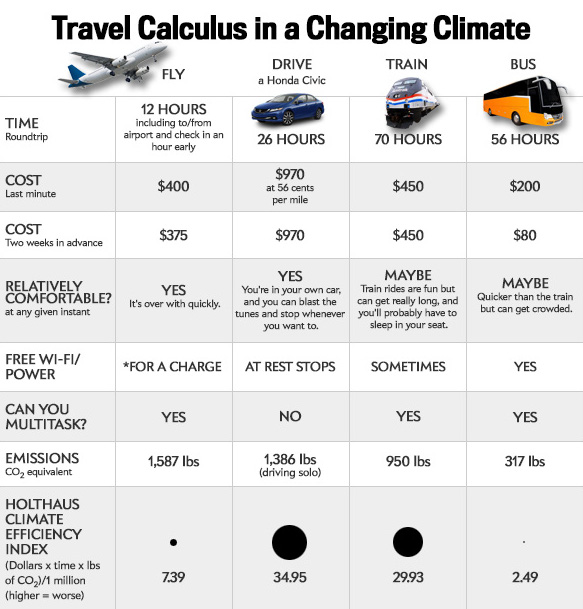
Eric Holthaus, who has vowed never to fly again so as to reduce his carbon footprint, took a bus from Wisconsin to Georgia in order to attend a conference. Why he thinks buses are the way to go:

From both a climate and financial standpoint, there’s a clear case to take the bus. From a butt-numbness standard, the bus isn’t quite there yet in the United States. However, the rise of limited-stop intercity operators like Megabus is helping the United States to quickly catch up to the rest of the world in terms of frequency and comfort on long-haul bus rides. In Chile, a spread-out country that has embraced long-distance buses, you can easily and cheaply snag a first-class quality experience with meals, Internet, live TV, and a lay-flat bed in every seat.

Buses are the most climate-friendly mode of transportation per passenger mile next to walking or riding a bike. This makes sense: There’s no need to accelerate hundreds of tons of aluminum to nearly the speed of sound, or to push thousands of tons of steel along 19th-century rail routes. Even a Prius is dragging along lots of extra weight just to move you down the road, especially if you’re solo, as most car trips are.

Socialized Law?

Noam Scheiber makes the case:

The idea would be roughly as follows: in criminal cases, we decide what the accused should be able to spend to defend themselves against a given charge—securities fraud, grand theft, manslaughter, etc. No one can spend more, even if she has the money, and those who can’t afford the limit would receive a subsidy for the full amount beyond what they would have spent on their own (say, beyond a certain percentage of their annual salary or net worth). In civil cases, we decide what the plaintiff should be able to spend to pursue an award of a particular amount, or to pursue a particular kind of claim, and what the defendant should be able to spend in response. The same subsidies would apply.

Posner calls the idea a “massive, unworkable nightmare”:

Suppose someone is charged with manslaughter after driving her car into a pedestrian and killing him. Suppose the government-set price for a manslaughter defense is $20,000. She uses most of her money to buy an excellent lawyer but nonetheless the jury convicts. She has some money left over for an appeal but in the meantime some new evidence emerges that the victim was at fault, or the prosecutor engaged in misconduct. Should she use the money to pay a lawyer to make a motion for a new trial? Save it for sentencing? Use it for appeal? One could complicate the regulatory scheme further by giving people the power to apply for new “grants” from the government for additional legal representation as unpredictable developments occur. But this would invite still more tactical behavior by clever lawyers skilled in gaming systems like Scheiber’s.

Kilgore is similarly unimpressed:

If it gets the buzz it’s intended to attract, perhaps Scheiber’s piece could stimulate some much-needed interest in the decline of subsidized legal services for the poor, one of the less-discussed victims of austerian budget policies. Or maybe it could help boost the already promising rise of bipartisan criminal justice reform initiatives, noting that unequal legal representation is one of the reasons we have prisons stuffed with poor people who are in many cases status offenders. But unless conservatives get excited about it as the Next Big Threat, I don’t think “socialized law” has much of an immediate future.

Facing The Boeremusiek

Trevor Sacks offers a primer on boeremusiek, a type of Afrikaner dance music “brought by the European to Africa and that the South African, in his isolation in remote districts and farms, kept up as part of his own culture”:

Boeremusiek usually has no vocals, and its central instrument is the crunchy, droning concertina, an originally European free-reed instrument replete with bellows—much like an accordion, but smaller and perhaps cuter. As with some forms of American folk music, guitar, banjo, occasionally violin, and bass or cello accompany it. It could be considered the bluegrass of South Africa, although perhaps it’s closer in sound to Cajun music, or polka mixed with Parisian cafe kitsch.

(Video: performance of “Sonop Vastrap”)

Theater Therapy

Ryan Jacobs highlights a cheaper form of couples therapy:

A recent study published in the Journal of Consulting and Clinical Psychology reveals that watching romance movies with your partner and then engaging in constructive discussions about the relationship implications afterward “can be just as effective” as more formalized “therapist-led methods.” A three-year analysis of 174 newlywed couples showed that those who participated in the “movie-and-talk” approach actually fared as well as those who completed the more rigorous “conflict management” and “compassion and acceptance” therapies. “All three methods halved the divorce-and-separation rate to 11 percent compared to the 24 percent rate among the couples in the control group,” according to a press release.

You Dream Like A Girl

A new study finds that men’s and women’s dreams, and particularly their nightmares, have distinctive themes:

Analyzing themes and emotional content, the researchers found that men were more likely to report having nightmares about natural disasters (floods, earthquakes, fires, volcanoes), chase or pursuit, and insects. Women’s nightmare records more often featured interpersonal conflicts, such as an argument with a spouse and more frequently involved feelings of humiliation, frustration, or inadequacy.

Why might this be? My first thought was that, while women may not mind admitting to researchers that an ex-boyfriend still haunts them, men were only reporting the more cataclysmic plots. (Tsunami!) On the other hand, “dream content is tied into waking concerns,” [researcher Antonio] Zadra explained over the phone. “For women, on average, social or interpersonal dimensions may be more emotionally salient.” As Zadra points out, an interpersonal focus also shows up in women’s erotic reveries. Whereas men often dream of sexual partners who don’t exist in real life, female sleepers are likelier to fantasize about specific acquaintances: spouses, former flames, co-workers, friends.

The Best Of The Dish Today

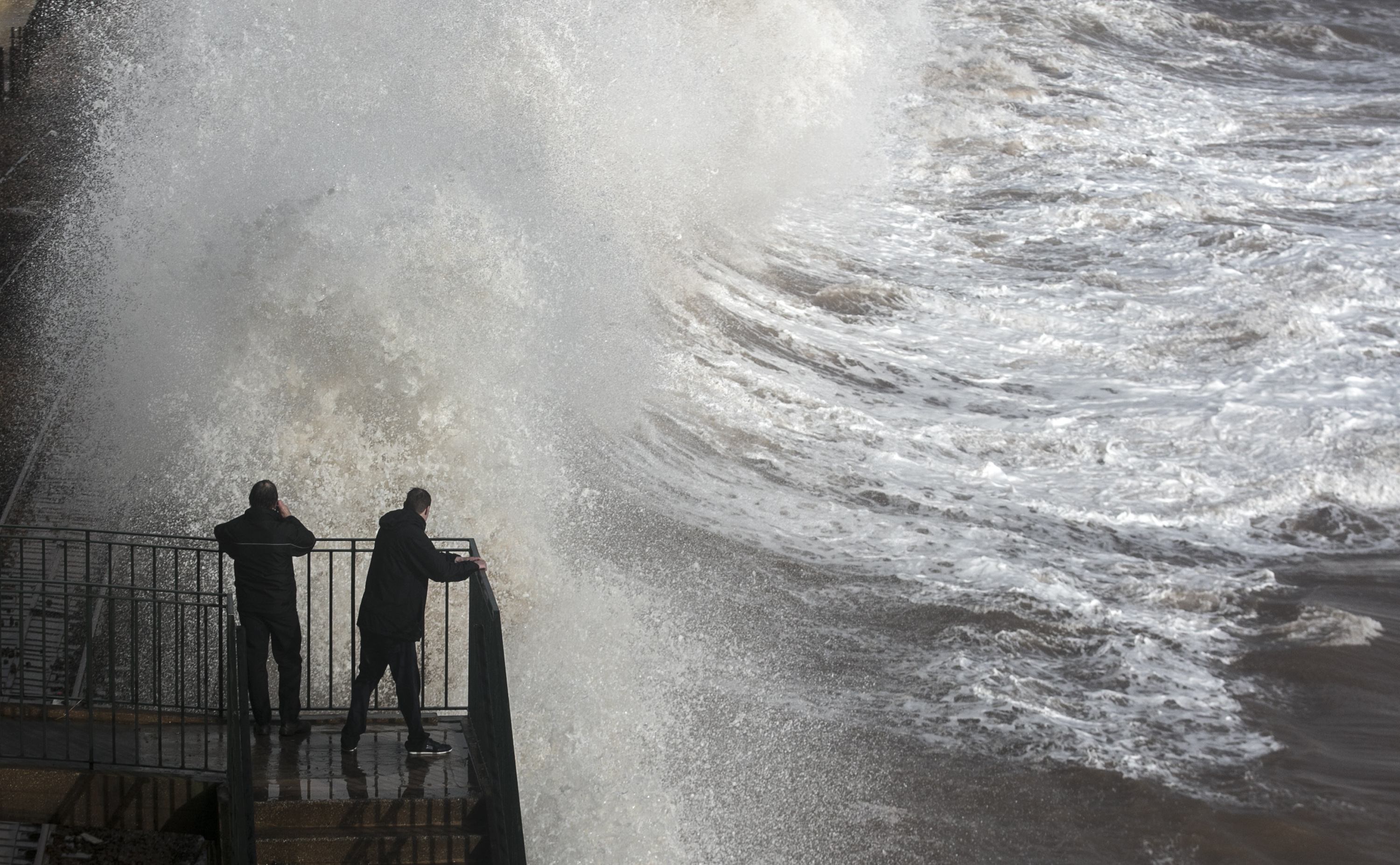
Storms Hit South West Of The UK

Five standouts: baked Alaska; Hillary Clinton’s close to non-existent record in twenty years of public life; cannabis’s non-proven relationship with schizophrenia; the promise of an anti-war Republican nominee; and the hideous abuse and violence against gay people in Putin’s near-fascist Russia. Oh, and Putin’s Olympic Potemkin Village.

The most popular post of the day remained Debating Woody Allen on Superbowl Sunday; followed by Where The Non-Believers Are.

See you in the morning.

(Photo: People watch as waves crash against the seafront and the railway line that has been closed due to storm damage at Dawlish on February 5, 2014 in Devon, England. By Matt Cardy/Getty Images.)

The Upside Of Being Down

Jonathan Rottenberg suggests that a “keen awareness of what has gone wrong and what can go wrong again can help a person avoid similar stressors in the future”:

In humans the value of low mood is put to the fullest test when people face serious situations in which current problems need to be carefully assessed. We might think of the groom who is left at the altar, the loyal employee who is suddenly fired from his job, the death of a child. If we had to find a unifying function for low mood across these diverse situations, it would be that it functions like a cocoon, a place to pause and analyze what has gone wrong. In this mode, we will stop what we are doing, assess the situation, draw in others, and, if necessary, change course.

A variety of experimental data have shown that low mood confers benefits to thinking and decision making. That lends credence to the idea that mood is part of a conservative behavioral guidance system that impels us toward actions that have been successful in the past—meaning, actions that helped our ancestors to reproduce and spread their genes. One way to appreciate why these states have enduring value is to ponder what might happen if we had no capacity for them. Just as animals with no capacity for anxiety were long ago gobbled up by predators, without a capacity for sadness, we and other animals would likely commit rash acts and repeat costly mistakes. Physical pain teaches a child to avoid hot burners; psychic pain teaches us to navigate life’s rocky shoals with due caution.

Godot’s Godlessness

Rob Weinert-Kendt praises it:

Beckett’s is not the blithe, hyper-confident, 21st-century atheism of Richard Dawkins, or the bland, self-satisfied scientism that constitutes a kind of default worldview in the educated West. It is instead the 20th century’s wounded, elegiac brand of letting-go-of-God—the entirely comprehensible incomprehension of intellectuals who felt poised between the Stygian maw of the Holocaust and the real probability of nuclear annihilation. For all its impish gallows humor, “Waiting for Godot” has, to my ears at least, an unmistakably valedictory timbre; it sounds like the lament of a one-time believer who once took the promise of faith seriously, or at the very least understood its high stakes. Put another way: Beckett’s is a voice that anyone conversant in the stark desert landscape of the Bible—anyone who has, so to speak, sat picking scabs with Job or eaten locusts with John the Baptist—will recognize in a heartbeat.

(Video: scene from Act 1 of a 1987 performance of Waiting for Godot)

From Kids’ Play To Poetry

Leafing through the Oxford Dictionary of Nursery Rhymes, Sandra Simonds wonders what poets can learn from the form:

The first thing is that sound itself intoxicates and that we connect sound, rhythm, and rhyme to form very early on, probably from infancy. The music of language forms our understanding of the world and that is why it seems so fundemental, in poems, to follow the music and sounds over sense, and to trust that your ear will take you where you want to go. We also learn that language is deeply connected to play—riddles, jokes, nonsense, and, for lack of a better word, fun. But it is also wedded to tragic losses, lost time, lost childhood, the loss of the child itself and the body of the child. Even when we survive childhood, some part of us has fallen through the ice never to return. Children are connected to that loss too. They are constantly warned about strangers, about the instability of their surroundings, constantly reminded about how small they are. As poets, we take that smallness with us into adulthood and turn it into poetry.