Jefferson and the Christianists

I asked what today’s religious right would think of the great Founding Father’s view of faith. The blog, Civil Commotion, fills the picture in. Today’s Christianists despise Jefferson, and the religious liberty and conscience he championed. Here’s Albert Mohler:

Jefferson‚Äôs confidence in his ability to extract a ‘real’ Jesus from the Gospels is supreme evidence of hubris and arrogance.

And here’s what American evangelicalism used to be about:

Sir David Frost: Is this still a Christian Country?

Billy Graham: No! We’re not a Christian Country. We’ve never been a Christian Country. We’re a secular Country, by our constitution. In which Christians live and which many Christians have a voice. But we’re not a Christian Country.

Bill Graham and Thomas Jefferson or Albert Mohler and James Dobson? I know which two I pick as true representatives of Christian faith.

The Biggies Weigh In I

The Washington Post review is here. Money quote:
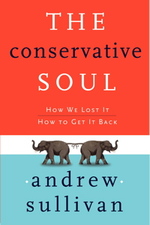
Tcscover_2 [If you] have ever read anything by Ann Coulter, this is not a book for you. It is written by a card-carrying intellectual and aimed at card-carrying intellectuals. Sullivan wades deep into the high grasses here; he is more interested in Hegel, Hobbes and Leo Strauss than anyone you’ve seen arguing on television, much less voted for. Further, the book doesn’t really explain how conservatism lost its soul, just that it did, and it doesn’t offer any real prescription for getting it back.

The only fair response is to say that he’s mistaken, in my view, about the first point about how conservatism lost its soul. I have a whole chapter devoted to the slow implosion of principled conservatism in the 1990s and under Bush – and the necon and theocon intellectuals who helped transform it. In fact, it’s the central, pivotal chapter.

But he’s right on the second point. I see no easy political way to get the soul of conservatism back in the near future. McCain is, at best, a tenuous hope. But I do try and describe a positive, skeptical conservatism that is a vibrant alternative to what "conservatism" has now become: a "conservatism of doubt" and a "politics of freedom". This is a book about ideas, not political prescriptions. But I do believe ideas matter in the long run. This is a philosophical and theological analysis, not a political manifesto. (Real conservatives don’t write manifestoes, by definition. Burke and Oakeshott wrote reflections and essays, not prescriptions.) It’s an attempt to start the long road back to conservative intellectual clarity. Before we can change anything, we need to be clear about what our principles are again. The book is an attempt to restate them in stark contrast to what they have become. If you still care about those first principles, and why they are more relevant today than ever, you can buy the book here.

I’m traveling and want time to absorb, mull over and respond to David Brook’s review in the NYT. I’ll try to comment tomorrow.

The Beginning of the End?

Iraqyurikozyrevtime

The Sunday Times of London reports the following:

American officials held secret talks with leaders of the Iraqi insurgency last week after admitting that their two-month clampdown on violence in Baghdad had failed.

Few details of the discussions in the Jordanian capital Amman have emerged but an Iraqi source close to the negotiations said the participants had met for at least two days.

They included members of the Islamic Army in Iraq, one of the main Sunni militias behind the insurgency, and American government representatives. The talks were described as ‘feeler’ discussions. The US officials were exploring ways of persuading the Sunni groups to stop attacks on allied forces and to end a cycle of increasingly bloody sectarian clashes with members of the majority Shi’ite groups.

According to the source, the key demand of the Islamic Army was the release of American-held prisoners in allied jails.

We’ll see. The Baker commission is studying various options, it would appear. My own take on the dynamic situation can be read here. At some point, Washington may have to talk to Iran and Syria – or face meltdown.

(Photo: Yuri Kozyrev for Time.)

Jonah Asserts

Here’s an aside Jonah Goldberg makes at NRO:

What is staggering here is that Bryan Burrough honestly thinks Christian conservatism or social conservatism actually represents something as goofy and intellectually illegitimate as Leonard Jeffries style Afrocentrism. That’s self-discrediting.

Really? Let’s leave aside personal insults, shall we, Jonah? Tell us why the notion that God made the world 6,000 years ago in six days is not as goofy and intellectually illegitimate as Afrocentrism? (Burrough doesn’t name Leonard Jeffries, so don’t misrepresent him) Tell us why the notion that a book that contradicts itself on countless occasions but is regarded as literally inerrant in every respect by fundamentalist Christians is not as goofy and intellectually illegitimate as Afrocentrism? Tell us why the notion that withdrawing from the West Bank is wrong because the Bible says so is less goofy than Afrocentrism. C’mon, Jonah. Back yourself up with argument. You don’t believe this nonsense either, do you? So stop pretending you do.

Quote for the Day II

"Imagine someone holding forth on biology whose only knowledge of the subject is the Book of British Birds, and you have a rough idea of what it feels like to read Richard Dawkins on theology. Card-carrying rationalists like Dawkins, who is the nearest thing to a professional atheist we have had since Bertrand Russell, are in one sense the least well-equipped to understand what they castigate, since they don‚Äôt believe there is anything there to be understood, or at least anything worth understanding. This is why they invariably come up with vulgar caricatures of religious faith that would make a first-year theology student wince. The more they detest religion, the more ill-informed their criticisms of it tend to be. If they were asked to pass judgment on phenomenology or the geopolitics of South Asia, they would no doubt bone up on the question as assiduously as they could. When it comes to theology, however, any shoddy old travesty will pass muster," – Terry Eagleton, defending my kind of Christianity, in the London Review of Books.