"May God damn you. You said in the past that civil war would break out if you were to withdraw, and now you say that in case of civil war you won’t interfere," – Moqtada Sadr, on Don Rumsfeld. The Shiite thug is finally learning what the rest of us have been forced to learn: Rumsfeld will say anything. And he has no clue what he’s doing.
Category: The Dish
The Bullies In Britain
Here’s an arresting quote:
"One of the fundamental notions of a secular society is the moral importance of freedom, of individual choice. But in Islam, choice is not allowable: there cannot be free choice about whether to choose or reject any of the fundamental aspects of the religion, because they are all divinely ordained. God has laid down the law, and man must obey. Islamic clerics do not believe in a society in which Islam is one religion among others in a society ruled by basically non-religious laws. They believe it must be the dominant religion – and it is their aim to achieve this. That is why they do not believe in integration. In 1980, the Islamic Council of Europe laid out their strategy for the future – and the fundamental rule was never dilute your presence. That is to say, do not integrate. Rather, concentrate Muslim presence in a particular area until you are a majority in that area, so that the institutions of the local community come to reflect Islamic structures. The education system will be Islamic, the shops will serve only halal food, there will be no advertisements showing naked or semi-naked women, and so on."
The quote is by Patrick Sookhdeo, director of the Institute for the Study of Islam and Christianity, in London. The quote was originally in a fascinating piece by Alasdair Palmer for the Daily Telegraph in Britain. The piece is now unavailable, and even its URL was altered. The webpage first explained that: "This story has been removed for legal reasons." Now, there’s a more generic message. But it has gone. Even the Google cache has been erased. Why? I must say it sounds suspiciously like self-censorship or, worse, government censorship.
WMDs and the Pre-War Consensus
It’s worth unpacking another element of the debate; and that is what "WMDs" actually meant before the war. I took the shorthand to mean chemical, biological or nuclear material that could be used either as weapons or given to terrorists to use. I think that’s pretty much in line with what most people assumed. But we may have been talking past each other. Only recently have I absorbed how so many on the anti-war left and right heard primarily "nuclear" when the term WMD came up before the war. And so we ended up debating different things. The nuclear case was always very weak, but then we had the experience of 1990 in our heads, when we seriously under-estimated Saddam’s WMD capacity. Markos Moulitsas, to take a pretty representative sample of the left, was right to question the nuclear part of the equation, but he took the existence of other WMDs for granted before the war:
"Iraq has weapons of mass destruction? Join the line. About a dozen nations have such weapons these days. Only the US has deigned to use them, and that was when it was the sole nuclear power. The threat of annihilation through retaliation has checked any subsequent use of such weapons.
Iraq will give weapons of mass destruction to terrorists? Would the secular Hussein give such weapons to religious fundamentalists? Doubtful. Terrorists are more likely to receive such weapons from Pakistan’s intelligence agency ‚Äî which has deep ties to the Taliban and Al Queda [sic]."
As I said, one of the more vocal arguments against the war was that an invasion was the only scenario in which Saddam would indeed use WMDs. Their existence was a premise of the anti-war case, and their non-existence dramatically reduced the risk of war. And so, while we’re playing the hindsight game, the U.S. casualties in this war, however awful, are still way below what most people expected. Here’s Kos again, from September 2002:
"Current plans seem to range from 50,000 to 250,000 invading troops. Of those, the vast majority are support troops, so say, 10,000 to 50,000 actually participate in a Baghdad assault. At 10 percent casualty rates, that could mean up to 5,000 US dead. And that’s assuming no use of WMD."
I remember fearing up to 10,000 casualties in taking Baghdad alone, so I’m not beating up on Kos. The point is: almost all of us were wrong, (while only a few made truly dumb predictions like 9/11 "will be off the evening news by Thanksgiving"). That’s the nature of history. And that, in retrospect, is why conservatives like me should have been more risk-averse, empirical and skeptical in the run-up to war in Iraq.
Pre-Post-Roe?
Abortion politics just got a lot more interesting. My take here.
“He Poisoned Himself”
Milosevic’s final gambit?
Fire Rumsfeld
We find out two important things about the Iraq invasion from the Gordon/Trainor de-briefing. They are the following:
"A United States Marines intelligence officer warned after the bloody battle at Nasiriya, the first major fight of the war, that the Fedayeen would continue to mount attacks after the fall of Baghdad since many of the enemy fighters were being bypassed in the race to the capital.
Instead of sending additional troops to impose order after the fall of Baghdad, Mr. Rumsfeld and General Franks canceled the deployment of the First Cavalry Division."
So from the beginning of the invasion, it became clear to many on the ground that the situation was 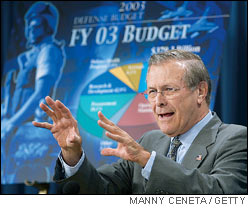 not as expected, that it was more complex, that there was an organized resistance that needed to be tackled, that many more troops were needed. Rumsfeld responded as he usually does to criticism: he attacks it and ignores it. Amazingly, he held on to this position, even as the coalition stood by and watched the country of Iraq being systematically looted. As is his usual position, he now denies any responsibility for the war plan and blames others. This is also the defense secretary who in his five years in office has trashed the reputation for decency and honor won by generations of American soldiers. Rumsfeld should have been fired within days of the invasion. That he is still in place is a critical sign that the president still isn’t taking winning this war seriously. No one who was committed to victory would still be retaining a man who has presided over the shambles that has been the occupation – and who still doesn’t even understand what a shambles it has been. Fire him.
The Results
Thanks for all your emails pointing out those who actually stated that it was their view, before the Iraq war, that Saddam had no WMDs and had been effectively disarmed. The answer is: virtually no one. I thought we had a winner in Scott Ritter, and then I read this. Two sources check out. The first is the late conservative maverick, Jude Wanniski. In this report in June 2002, Wanniski proffered rebuttals of the case that Saddam was in any way a threat to the U.S. Money quote:
"Report: Saddam Hussein has been relentlessly seeking weapons of mass destruction.
My Finding: While Iraq had nuclear, biological and chemical weapon development programs during the Iran-Iraq war, which ended in 1988, there is no evidence he has been hiding any such efforts from international view since November 1991, when Iraq completed the destruction of all such programs in compliance with the UN Resolutions passed at the end of the Gulf War.
Report: The UN weapons inspectors were responsible for finding Saddam’s weapons programs.
My Finding: The UN inspectors found nothing before or since November 1991 that they were not shown by the Iraqi government.
Report: Iraq has weaponized anthrax.
My Finding: Iraq tried to weaponize anthrax during the war with Iran but gave up. No government has succeeded in weaponizing anthrax, unless one means delivering dried spores in envelopes."
Paul Krugman hasn’t cited Wanniski as one of his anti-war clairvoyant confreres. You can see why here. Krugman thought Wanniski was a "lunatic."
The other credible source is an important one, however. That source is Robin Cook, Tony Blair’s former foreign secretary, who resigned over the war. Read his personal statement in the House of Commons on March 17, 2003:
"Iraq probably has no weapons of mass destruction in the commonly understood sense of the term‚Äînamely a credible device capable of being delivered against a strategic city target. It probably still has biological toxins and battlefield chemical munitions, but it has had them since the 1980s when US companies sold Saddam anthrax agents and the then British Government approved chemical and munitions factories. Why is it now so urgent that we should take military action to disarm a military capacity that has been there for 20 years, and which we helped to create? Why is it necessary to resort to war this week, while Saddam’s ambition to complete his weapons programme is blocked by the presence of UN inspectors? …
The longer that I have served in this place, the greater the respect I have for the good sense and collective wisdom of the British people. On Iraq, I believe that the prevailing mood of the British people is sound. They do not doubt that Saddam is a brutal dictator, but they are not persuaded that he is a clear and present danger to Britain. They want inspections to be given a chance, and they suspect that they are being pushed too quickly into conflict by a US Administration with an agenda of its own. Above all, they are uneasy at Britain going out on a limb on a military adventure without a broader international coalition and against the hostility of many of our traditional allies."
It stands up better than much of what I wrote at the time. But it is remarkable for one other thing: its rarety. The store is still open for latecomers, though, so if you find another example of a leading anti-war figure stating that Iraq had no more WMDs before the war, let me know.
How Bullies Succeed
The Islamist intimidation of free expression in Europe, and the craven response of Europe’s and America’s elites, is already yielding results. A festival in Valencia, which has always been known for its anti-clerical satire, is now pulling its punches. Money quote from a Spanish artist:
"We saw what happened in Denmark. Those artists may have had the freedom to draw Mohammed, but now they’re living as virtual prisoners. They have much less freedom than before. I felt responsible not just as an artist, but as a citizen of this city."
And so the silence spreads. The genius of using the threat of violence against writers and artists is that it can work quietly. We will never know what might have been said or written without the threat. That’s how they keep their doctrines intact. By silencing the questions. By killing the questioners.
Silencing Steyn?
I have no idea what’s behind the fact that Mark Steyn is no longer going to be published in Britain. But I sincerely hope it’s not political correctness. Steyn is no fan of mine, but he’s a wonderfully forthright and funny writer. Sure, he’s asinine at times, but he’s most often an enjoyable part of the conversation. Is there a back-story?

 The Dish