A Poem For Sunday

smith-letters

“Emily writes such a good letter” by Stevie Smith:

Mabel was married last week
So now only Tom left

The doctor didn’t like Arthur’s cough
I have been in bed since Easter

A touch of the old trouble

I am downstairs today
As I write this
I can hear Arthur roaming overhead

He loves to roam
Thank heavens he has plenty of space to roam in

We have seven bedrooms
And an annexe

Which leaves a flat for the chauffeur and his wife

We have much to be thankful for

The new vicar came yesterday
People say he brings a breath of fresh air

He leaves me cold
I do not think he is a gentleman

Yes, I remember Maurice very well
Fancy getting married at his age
She must be a fool

You knew May had moved?
Since Edward died she has been much alone

It was cancer

No, I know nothing of Maud
I never wish to hear her name again
In my opinion Maud
Is an evil woman

Our char has left
And a good riddance too
Wages are very high in Tonbridge

Write and tell me how you are, dear,
And the girls,
Phoebe and Rose
They must be a great comfort to you
Phoebe and Rose.

(From Best Poems: Stevie Smith © Stevie Smith 1937, 1972 and © New Direction Publishing Corporation 1988, 2014. Reprinted with kind permission of New Directions. Photo by Sandra Kharazashvili)

Questions Without Answers

Maria Popova digs into physicist Alan Lightman’s new volume of essays, The Accidental Universe, finding this gem on what distinguishes the sciences from the humanities:

At any moment in time, every scientist is working on, or attempting to work on, a well-posed problem, a question with a definite answer. We scientists are taught from an early stage of our apprenticeship not to waste time on questions that do not have clear and definite answers.

But artists and humanists often don’t care what the answer is because definite answers don’t exist to all interesting and important questions. Ideas in a novel or emotion in a symphony are complicated with the intrinsic ambiguity of human nature. …

For many artists and humanists, the question is more important than the answer. As the German poet Rainer Maria Rilke wrote a century ago, “We should try to love the questions themselves, like locked rooms and like books that are written in a very foreign tongue.” Then there are also the questions that have definite answers but which we cannot answer. The question of the existence of God may be such a question. As human beings, don’t we need questions without answers as well as questions with answers?

Lightman goes on to place this “tolerance for the unanswered” at the heart of faith:

Faith, in its broadest sense, is about far more than belief in the existence of God or the disregard of scientific evidence. Faith is the willingness to give ourselves over, at times, to things we do not fully understand. Faith is the belief in things larger than ourselves. Faith is the ability to honor stillness at some moments and at others to ride the passion and exuberance that is the artistic impulse, the flight of the imagination, the full engagement with this strange and shimmering world.

Connecting Through Chekhov

dish_cherryorchard

Brendan Mathews appreciates Chekhov for his descriptions of human empathy – or the lack of it:

It’s worth noting that Chekhov’s grandfather was a serf, his father was a hyper-religious tyrant, and he knew from the time he was in his twenties that tuberculosis would cut his life short (he died at 44). He didn’t believe in God or the reward of a joyous afterlife, and yet his stories affirm in ways large and small that the only hope we have lies in our relationships with other people. If the world is hell, it’s because we make it that way; if we are to be happy, it’s only by connecting with the people around us.

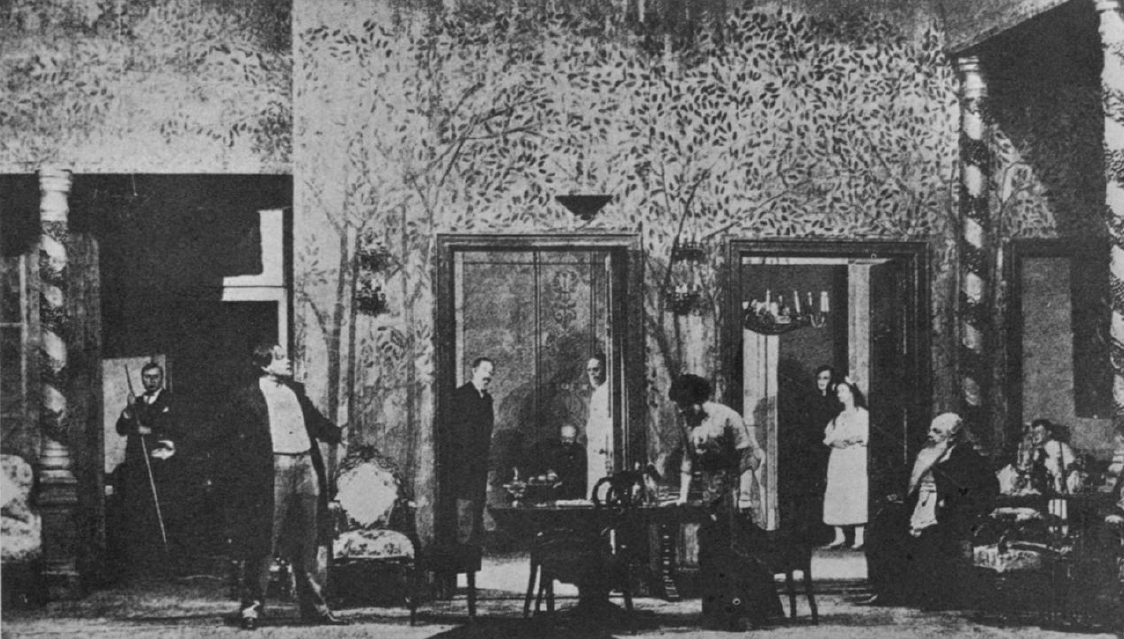
In Chekhov’s last play, “The Cherry Orchard,” — bracingly translated by Matthew Henry Heim in Chekhov: The Essential Plays — the young idealist Trofimov lectures his one-time patroness Lyubov Andreevna about her failings in love and money: she is a spendthrift whose estate is about to be auctioned; she has driven herself into debt for the love of a ne’er-do-well. Her response, a scorching indictment of Trofimov’s easy dismissal of all that she has suffered in life, climaxes with this demand: “Show a little generosity!”

Lyubov Andreevna is speaking to Trofimov; Chekhov is speaking to us. This writer who sought objectivity in all of his work and who was blasted by his contemporaries for being apolitical and amoral, condenses into this line a plea to us all. That before we judge, we understand. That we extend to each other the same compassion that we all seek.

(Image of scene from the first production of The Cherry Orchard in 1904 via Wikimedia Commons)

What Mormons Have Against Marriage Equality

With support for marriage equality is surging in Utah, it should come as no surprise that the LDS Church recently issued a memo directing congregational leaders to review “The Family,” which Neil J. Young describes as “a document the church produced in 1995 that has appeared at times of social crisis ever since.” He considers the implications for the fight against same-sex marriage:

“The Family,” issued as the church began these fights, linked the Mormon theology of salvation rooted in the traditional heterosexual family unit to the civil rights question of gay and lesbian Americans without even acknowledging their existence. Mormon salvation—or exaltation to the Celestial Kingdom—requires that male and female Saints enter into a temple-based marriage and enact, as “The Family” describes, the “divine design” of their respective gender roles. Men are to “preside over their families” while women are “primarily responsible for the nurture of their children.” Together, they are to fulfill their religious responsibility to reproduce, creating an extensive earthly family that will be joined together eternally in the afterlife.

Same-sex marriage, of course, challenges all of this. While Mormons agree with other opponents of gay marriage that its legalization is “unbiblical” and a threat to the traditional heterosexual family unit, LDS objections also arise from the core of Mormon theology and its particular interconnection of heterosexuality, marriage, and salvation. In short, same-sex marriage threatens the basic foundations of Mormonism.

He also notes that “Mormon acceptance of gay marriage challenges the church’s authority, a core component of LDS belief”:

This is a crisis the LDS Church faced when some of its members became vociferous critics of the church’s efforts against the Equal Rights Amendment in the 1970s. The church dealt harshly with those women not because they supported the ERA, church leaders explained, but because they had publically challenged the church president’s prophetic role—a key tenet of Mormonism. Increasing societal support for same-sex marriage suggests another crisis moment for the LDS Church could be coming.

When Doctrine Is Disregarded

Douthat continues the debate about Church reform sparked by Damon Linker’s recent column, which included NPR caller Trish’s comment that “Catholics do not care about doctrine”:

There are dangers in reading too much into an NPR caller, obviously, but Linker is putting his finger on a real tension within liberal Christianity today — or, if you prefer, a real fork in the road, with one path leading in the direction that he assumed dissenting Catholics wanted to take (which seeks to alter church teaching precisely because it still believes that teaching really matters), and the other leading toward a kind of Emersonian, therapeutic, basically post-ecclesiastical form of faith, in which “Roman Catholicism” just happens to be the name of the stage on which your purely individual spiritual drama is taking place.

He wrestles with where this discounting of doctrine comes from:

Now some of those would-be reformers would argue that Trish-ism (which as Linker describes it is basically a Catholic version of Sheila-ism, Robert Bellah’s Reagan-era gloss on individualistic spirituality) is what happens, more or less inevitably, when the church’s leaders hollow out their credibility by trying to enforce the unenforceable, and that a church that had evolved with the culture forty years ago would have actually preserved a sense that doctrine actually matters. This argument is problematic, though, because the (mostly Protestant) churches that did evolve along those lines often seem to be churches where Trish-ism is fully enthroned and all talk of traditional doctrine is a dead letter. Hence the appeal of the conservative counter-argument that actually Trish-ism is the fruit of the Catholic hierarchy’s inattention to doctrinal matters, its eagerness to soft-pedal the tough stuff, its attempt to keep everyone on board in an age of division and dissent: “It’s not that dissenting Catholics don’t care what the Church teaches,” Matthew Schmitz writes in a response to Linker’s piece, “it’s that the Church has taught them not to care. To that lesson, they’ve paid close attention.”

But I wonder if this argument doesn’t oversimplify things as well.

Dreher comments:

Even after I left the Catholic Church, I would find myself in the bizarre position of arguing with Catholics, and defending Catholic doctrine. The thing is, it was impossible to find common ground, because a) they knew nothing about doctrine, not even basics, and b) whatever the Church taught didn’t matter to them, because they didn’t see it as binding anyway; and c) they genuinely did not understand why this had anything at all to do with their status as Catholics. The freaky thing, to me, was that this wasn’t a pose; they were as sincere as they could be.

Faces Of The Day

dish_fotdsun19

Ellen Jacob snaps shots of nannies at work around NYC:

As a resident of Manhattan’s Upper West Side, photographer Ellen Jacob would often notice nannies pushing children around in strollers on the street. Eager to learn more about the lives of these women, Jacob spent four years photographing dozens of nannies and the children in their care for her series, “Substitutes.” “My work explores the social, racial and economic relationships that powerfully affect life and largely go unnoticed,” Jacob wrote in a statement.

(Photo by Ellen Jacob, who has an exhibit at Soho Photo Gallery, 15 White St until Feb 1. Gallery hours Wed-Sat 1-6 and by appointment. Follow her on Twitter here.)

After Evangelism

Megan Hustad was raised by overseas Christian missionaries. She describes adapting to life in NYC:

All I wanted was to listen carefully and master correct pronunciations. I wanted to take note of how the beautiful people held forks and chopsticks and admired certain books but never others, not unless they were trying to be funny, and I wanted to exploit the fact that my accent made me sound wealthier than I was and slightly smarter, too. Mainly I sought forgetfulness. For a long time I was happy to have outrun God, because he really wasn’t going to be much help here.

On occasion the subject would come up. My evangelical background. Wow, flushed faces at parties leaned in to ask, what was it like growing up with adults so hooked on fairy tales? My ability to quickly change the subject eventually outstripped my embarrassment, but not before I had internalized every critique of what faith in God now signified in America: intolerance, sanctimony, tut-tutting over Hollywood and the welfare office, a yawning void where curiosity and compassion could be.

But when I felt led to a conversational place wherein I was expected to confirm that everyone who takes part in the rituals of organized religion drags their knuckles on their way to stoning the town slut, I would stop. I couldn’t. That I would have to drop the word “soul” from my vocabulary I hadn’t expected.

Where Are All The Black Atheists? Ctd

Darrin Johnson created a short documentary (above) about the role of non-belief in the African-American community:

From slavery to the civil rights era, to the enduring role of the church in community life, African-American history is deeply entwined with Christianity. An increasing number of black Americans are choosing to reject religion, but they remain a largely invisible minority in the face of media-reinforced stereotypes that presume that African-Americans will hold firm religious beliefs.

Previous Dish on black atheists here and here.

When Did The Culture Wars Begin?

Molly Worthen traces them back to “the theological feuds of the seventeenth century” when Christians developed doctrines that continue to inform evangelical and fundamentalist critiques of evolution:

The basic idea of biblical inerrancy is ancient. Christians have always been eager to defend the Bible as a source of perfect truth. But they did not necessarily use scripture to explain the intricacies of the natural world. The Protestant Reformer John Calvin believed that God created the earth in six days, but at the same time he discouraged Christians from trying to extract scientific details from the Bible: “Nothing is here treated of but the visible form of the world,” he wrote in his commentary on Genesis. “He who would learn astronomy and other recondite arts, let him go elsewhere.”

A couple of generations later, conservative Protestant theologians—mostly Reformed Christians who followed the teachings of Calvin and his colleagues—found themselves hemmed in by intellectual challenges on both sides. Catholic theologians critiqued Protestantism using the relentless logic of scholastic theology, while philosophers and scientists of the Enlightenment debunked Christ’s miracles. These embattled Protestants responded by trying to out-rationalize both the scientists and the scholastics in order to solve the great epistemological problem of modern times: to keep faith and reason fused as one single way of knowing the world.

Recent Dish on creationism here.