What The Hell Just Happened In Pakistan?

by Dish Staff

Pakistan

Nine Taliban gunmen disguised as soldiers attacked an army-run school in Peshawar this morning, killing at least 145 people, mostly children, and holding hundreds more hostage before dying in an eight-hour gun battle with security forces:

The militants’ assault on the school started at about 10 a.m., when the gunmen entered the Army Public School and Degree College in Peshawar, the capital of Khyber Pakhtunkhwa Province. Local news reports said the gunmen were disguised as paramilitary Frontier Corps soldiers and gained entry by scaling a wall at the rear of the main building. The attackers then opened fire on students with guns and grenades and, in a chilling echo of the Beslan school siege in Russia in 2004, took dozens of people hostage in the school’s main auditorium, according to news reports. … By late afternoon, the army said it had cleared three sections of the school compound and that troops were pushing through the remaining sections. After the last of the militants was killed, officials said, soldiers were sweeping the compound for explosives.

In taking credit for the attack, the Pakistani Taliban (TTP) said it was in retaliation for a recent military offensive against the group in the lawless region of North Waziristan. Sami Yousafzai rang up a TTP commander to ask why exactly his comrades believed that the mass murder of children was an appropriate act of revenge:

[Jihad] Yar Wazir justified the killings as fitting retribution. “The parents of the army school are army soldiers and they are behind the massive killing of our kids and indiscriminate bombing in North and South Waziristan,” which are the TTP strongholds. “To hurt them at their safe haven and homes—such an attack is perfect revenge.” But the children are innocents, I said. What about them, I asked?

“What about our kids and children,” he said. “These are the kids of the U.S.-backed Pakistani army and they should stop their parents from bombing our families and children.” Yar Wazir went on: “Those kids are innocent because they are wearing a suit and tie and western shirts? But our kids wearing Islamic shalwar kamiz do not come before the eyes of the media and the west.”

To Juan Cole, the attack is indicative of the TTP’s desperation:

North Waziristan had always been protected by military intelligence and so had become a haven for al-Qaeda offshoots. But in the past 6 months Pakistani army troops have killed nearly 2000 fighters and deeply disrupted what is left of the Pakistani Taliban. The group that took over the school complains of the perfidy of the government’s bombing. So this school attack was the Pakistani Taliban taking revenge for the government’s disruption of their terrorist activities. This is not a sign of strength but of weakness, and they lashed out at a soft target. They are facing a major defeat. That is its significance.

And Samira Shackle expects that “the sheer brutality of the event will answer some of the internal political debates about how best to tackle the terrorist threat”:

As recently as spring, the Pakistani government was pursuing talks with the Taliban, even as violent attacks across the country surged. Many in the mainstream political right wing still agitate for appeasement and negotiations rather than a military operation. And amongst the wider population, there is a fault-line of people who explicitly or tacitly support the actions of the TTP and associated groups, even as they suffer the effects of this campaign of terror. Some commentators have suggested that the sheer brutality of this assault will undermine the arguments of those who would like to see negotiations with the TTP, and will perhaps reduce that element of support amongst the wider populace. The group is seeking the destruction of the Pakistani state as its minimum, and speaks only the language of violence. That is no starting point for a meaningful settlement.

(Photo: A view of the coffins at Lady Reading Hospital where the casualties of a Taliban attack on a school were carried in the northwestern city of Peshawar, Pakistan, on December 16, 2014. By Metin Aktas/Anadolu Agency/Getty Images)
Abolish Police Unions

by Will Wilkinson

There’s a solid leader in this week’s issue of The Economist on the need for reform in American law enforcement. The Economist endorses rolling back police militarization, more fastidious record-keeping about police killings, and the deployment of body cameras. There’s also this, under the heading of accountability:

[I]t must be easier to sack bad cops. Many of America’s 12,500 local police departments are tiny and internal disciplinary panels may consist of three fellow officers, one of whom is named by the officer under investigation. If an officer is accused of a crime, the decision as to whether to indict him may rest with a local prosecutor who works closely with the local police, attends barbecues with them and depends on the support of the police union if he or she wants to be re-elected. Or it may rest with a local “grand jury” of civilians, who hear only what the prosecutor wants them to hear. To improve accountability, complaints should be heard by independent arbiters, brought in from outside.

I agree with every bit of this, but none of it’s going to happen as long as police unions are allowed to exist. Just as teachers’ unions block almost every conceivable democratic reform to the public school system, police unions continually stymie attempts to resist the corrupt, praetorian tendencies of American law enforcement. Nationwide, police unions fight tooth-and-nail to keep even the most abusive cops on the streets. So good luck “sacking bad cops” with police unions in the way.

Other reforms face similar resistance. In Miami, the police union has opposed, and continues to oppose, a popular initiative to equip the police with body cameras. Or how about the ex-cop private investigators, working for a law firm representing more than 120 California police-officers’ unions, who tried to frame a Costa Mesa city councilman for drunk driving. Why? Because he tried to mess with police pensions. Steven Greenhut of the San Diego Union-Tribune asks:

This raises an important question: How widespread is this kind of behavior? At a Costa Mesa press conference last year, elected officials from other cities made allegations of police using disturbing tactics to achieve their political goals.

“What kind of world do we live in when the people we give guns and badges to hire private investigators to surveil public officials?” asked Righeimer. Calling it “unseemly,” OC prosecutor Robert Mestman said this case is significant because the victims “are democratically elected city council members.” Mensinger said it seemed Orwellian: “Public officials should not be extorted over public benefits.”

The Costa Mesa story may be about pensions rather than the conduct of routine police work, but it is indicative of the gangsterish anti-democratic pressure police unions routinely exert within the political system. In New York City, the Patrolmen’s Benevolent Association is currently sending a not-so-subtle “nice place you got here” message to Mayor Bill de Blasio in response to his failure to signal complete obsequious deference to the union after a grand jury declined to indict the police officer who was filmed killing the unarmed and submissive Eric Garner with a chokehold. The union has asked its members to fill out a form requesting that the mayor stay away from his or her funeral should he or she be killed in the line of duty. “Due to Mayor de Blasio and Speaker Mark-Viverito’s consistent refusal to show police officers the support and respect they deserve, I believe that their attendance at the funeral of a fallen New York City police officer is an insult to that officer’s memory and sacrifice,” the form reads.

Such drama! Such entitlement! All because the mayor publicly demonstrated some modest, measured sympathy for those protesting the crookedness of a system in which police are able to kill with impunity. Such disrespect for the uniform! The message the union is sending to the man duly elected to, among other things, oversee the city’s police is clear: fall in line or get out of the way.

I have long argued that government employees ought not be allowed to unionize. When public employees collectively bargain, who are they bargaining against? Their public employers, which is to say, the democratic public, which is to say, us. The point of a democratic government is to govern in a way that more or less tracks the public interest. The point of a government employee union is to organize against the public interest, to get in the way when the democratic public’s notions about its interests conflict with the interests of the union’s members. When a public-sector union is strong, government of the union’s domain is effectively ceded to the union itself. When that domain is the armed, business end of the law’s coercive authority, that’s a giant problem. It shouldn’t be allowed.

The political problem with abolishing police unions is obvious enough. Democrats reflexively defend unions, and Republican antipathy to public-sector unions disappears when it comes to cops and firefighters. Heroes, you know, every one. This rare bit of bipartisan concord leaves police unions spectacularly well-defended against reform. Until one party or the other begins to see the damage unions do, and becomes willing to fight it, anything more than superficial change is impossible.

A Republican Pop Quiz

by Dish Staff

A reader sent this in:

unnamed (25)

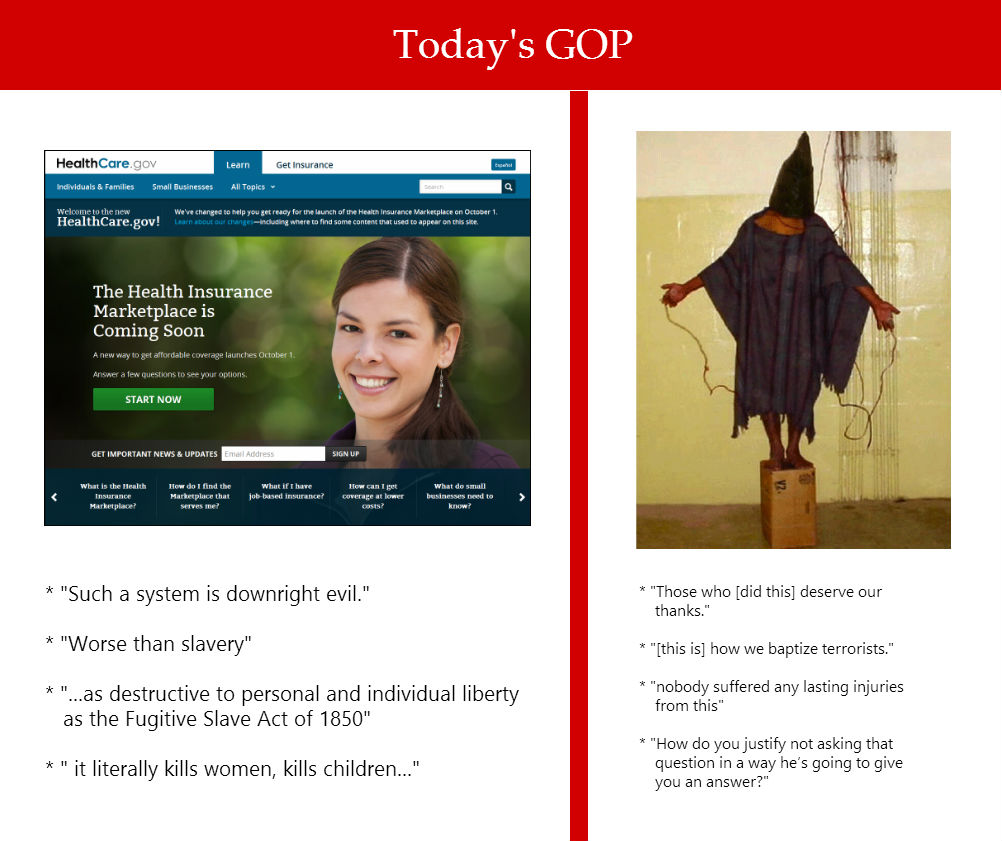
Can you answer which Republican figure said each quote? Answers after the jump:

On Obamacare:

1. Sarah Palin, former half-term governor of Alaska, vice-presidential nominee, reality show star

2. Ben Carson, surgeon and 2016 presidential contender. (Though his exact words were: “the worst thing that has happened in this nation since slavery.”)

3. Bill O’Brien, New Hampshire state representative

4. Michele Bachmann, congresswomen

On torture:

1. Marco Rubio, senator

2. Palin

3. Peter King, congressman

4. Steve King, congressman

(Though the following quote from Dick Cheney would have made a better pick: “What are we supposed to do kiss him on both cheeks and say ‘please, please tell us what you know’?”)

Those “Notable Books Lists”? They’re Useless

by Michelle Dean

Those end of the year book lists are lumbering around the internet right now, coming soon to a friend’s Facebook wall near you. NPR’s list of 2014 Great Reads numbers 250; the New York Times Book Review offers the slightly more conservative 100 Notable Books of 2014. The hugeness of these lists betrays something: their uselessness. My eyes always cross at lists that number above, say, 25. It certainly doesn’t narrow down the Christmas shopping list much.

Plus, these lists get to be disquieting documents of the Way We Publish Now. I would love to believe that we live in a publishing environment where we were producing at least a hundred well-edited, well-considered books a year. Unfortunately, as Ursula K. Le Guin recently put it to the shocked horror of most at the National Book Awards ceremony, writers instead work in an industry controlled by “commodity profiteers [who] sell us like deodorant, and tell us what to publish, what to write.” It’s not an amazing environment for the production of literature. Mostly, publishers are throwing all sorts of stuff at the wall to see what sticks. I find it overwhelming and kind of sad to receive as many bad galleys as I do, often bought by a publisher for a great deal of money, but landing on my doorstep with the undignified plop of thawed turkey.

Listing so many books as “notable,” given that context, smacks of desperation.

It’s certainly always been the case that publishers churn out tons of books a year that flame out and die in the remainder piles. But even the largest pinch of salt, 2014 has seemed particularly bad. Precisely three newly published books have managed to take up permanent residence in my head this year: Marlon James’ A Brief History of Seven Killings, Jenny Offill’s Department of Speculation, and Hermione Lee’s biography of Penelope Fitzgerald. And while other people might compose their lists differently, or count in their own findings five, ten, or even fifteen notable books, listing a hundred or more just feels… careless. It feels like the work of marketers, not of people who care about identifying good books.

If you are looking for new book recommendations, you’ll find yourself much better off consulting The Millions’ Year in Reading columns. There recommendations do not have to meet some insane artificial round number. No one is constrained by what happens to be on the publishers’ lists. In fact if anything the books they recommend tend to skew old. Michael Schaub, for example, wants you to read some Galway Kinnell. Jayne Anne Phillips has been re-reading Stephen Crane. Tana French got around to Strangers on a Train.

If someone asked me, for example, I would have told them that Words in Air: The Complete Correspondence Between Elizabeth Bishop and Robert Lowell, is the book that changed my life this year. I had to consult it for some book research and then never stopped quoting it. I’ve become quite annoying on the subject and am desperate for someone else to talk about it with. Isn’t that what you want to hear, anyway, from someone recommending a book to you, rather than two tossed-off lines of plot summary in a sea of 99 other books?

Warning: This Tomato May Contain Blood, Sweat, And Tears

by Dish Staff

Reporter Richard Marosi and photographer Don Bartletti spent a year and a half investigating the awful conditions under which farm workers in Mexico labor to bring fresh produce to the American market. The first installment of their massive four-part exposé in the LA Times outlines the numerous human rights violations they discovered and calls out major US retail and restaurant chains, including Walmart and Subway, for buying produce from the offending farms:

At the mega-farms that supply major American retailers, child labor has been largely eradicated. But on many small and mid-sized farms, children still work the fields, picking chiles, tomatillos and other produce, some of which makes its way to the U.S. through middlemen. About 100,000 children younger than 14 pick crops for pay, according to the Mexican government’s most recent estimate. During The Times’ 18-month investigation, a reporter and a photographer traveled across nine Mexican states, observing conditions at farm labor camps and interviewing hundreds of workers. At half the 30 camps they visited, laborers were in effect prevented from leaving because their wages were being withheld or they owed money to the company store, or both. …

The practice of withholding wages, although barred by Mexican law, persists, especially for workers recruited from indigenous areas, according to government officials and a 2010 report by the federal Secretariat of Social Development. These laborers typically work under three-month contracts and are not paid until the end. The law says they must be paid weekly. The Times visited five big export farms where wages were being withheld. Each employed hundreds of workers. Wal-Mart, the world’s largest retailer, bought produce directly or through middlemen from at least three of those farms, The Times found.

Part 2 focuses on one particularly Dickensian labor camp, where those too sick to work were reportedly denied food and medical care, and where asking for a few extra tortillas for her children could earn a worker a beating. Tom Philpott stresses how heavily Americans rely on Mexican farms for our cheap and abundant fruits and veggies:

The US now imports nearly a third of the fruit and vegetables we consume, and Mexico accounts for 36 percent of that foreign-grown cornucopia, far more than any other country. And we’re only growing more reliant on our southern neighbor—imports of Mexico-grown fresh produce have increased by an average of 11 percent per year between 2001 and 2011, the USDA reports, and now amount to around $8 billion. The Times investigations demonstrates, with an accumulation of detail that can’t be denied or ignored, that our easy bounty bobs on a sea of misery and exploitation.

These revelations, Erik Loomis argues, strengthen the case for an international legal framework to hold American companies accountable for doing business with human rights abusers:

As I argue in Out of Sight, these conditions are precisely why central to our demands for a just world must be international labor standards enforceable in U.S. courts. Anything else will keep workers in these conditions. If Subway wants to use tomatoes grown in Mexico, fine. But those tomatoes have to be produced in conditions that stand up to a basic test of human rights. If wages are stolen, workers threatened, bathing facilities not provided, etc., then workers should have the right to sue for recompense in American courts. Subway, Safeway, McDonald’s, etc., must be held legally responsible for the conditions of work when people labor in growing food for them to sell. This has to be a legal framework. Mass movements are useful only in the short term because we will move on to the next issue.

The Peril Of Yak Poop

by Dish Staff

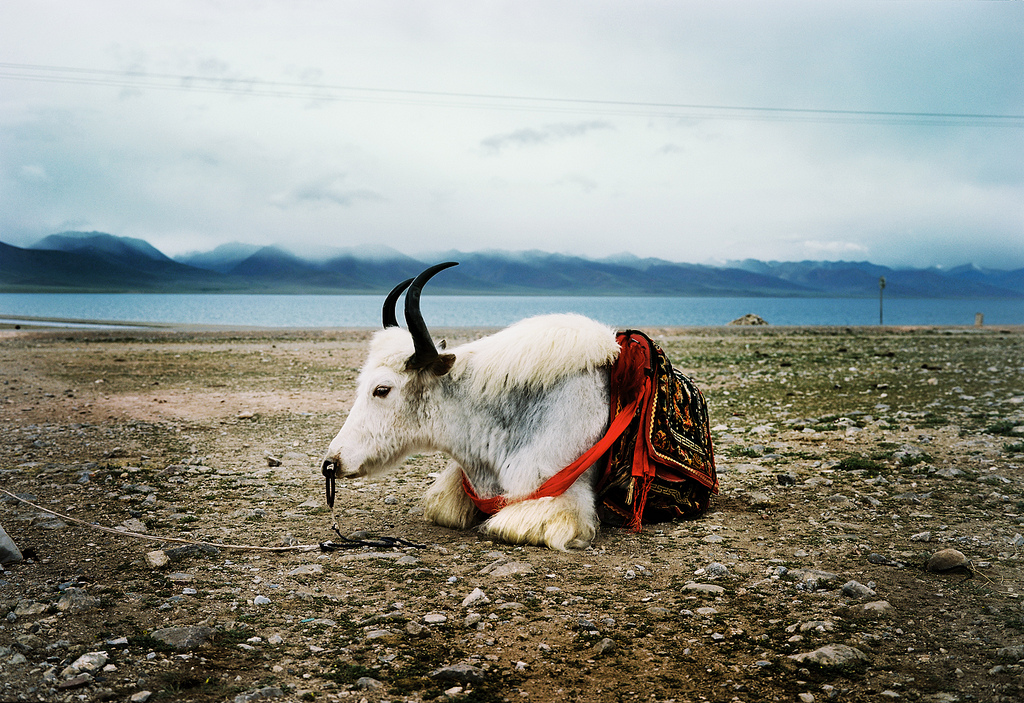
4782209145_dbce36fa23_b

Eric Holthaus explains:

Yak dung, when used as fuel, is arguably dirtier than coal but is definitely much cheaper. Particulate pollution from burning animal dung greatly increases the risk of lung cancer and other respiratory ailments, the occurrence of which can be slowed by switching to cleaner ways of heating homes. …

A new paper accepted for publication in the journal Atmospheric Environment provides some of the first quantitative data on both black carbon and indoor air pollution during the cool season in Tibet. Via air samples and a survey of households in the Nam Co region of Tibet—the name means “heavenly lake”—researcher Eri Saikawa and her team learned things were even worse than they suspected. Her survey admittedly had a small sample—just 23 households responded—but is nevertheless illuminating.

A majority of residents had access to improved cookstoves, even solar power, but yet every single respondent still used yak dung for heating. Saikawa explains this by noting that average annual income per household is just $890 a year. Yak dung is simply the cheapest fuel available.

Previous Dish on poo-based energy here and here.

(Photo by Lyle Vincent)

The Casual Classism Of “You Had One Job”

by Phoebe Maltz Bovy

As hashtag memes go, #YouHadOneJob (see also) seems like a lighthearted bit of fun. For the uninitiated: The hashtag is meant to collect instances of hilarious on-the-job fails:

https://twitter.com/swhammerhead/status/538064512235343872

Yes, I laughed. Then again, my sense of humor is such that an out-of-context roll of toilet paper on its own could also have that effect.

But the hashtag often gets used for more run-of-the-mill customer-service gripes, of the they-got-my-order-wrong variety. (I don’t wish to start a shaming cycle, so no specific links to those tweets. A glance at the hashtag will provide copious examples.) While these are indeed among the less clever uses of the meme, they’re not exactly out-of-place. After all, the butt of the joke is someone with a low-skilled job. More than that: Part of the joke is the job itself.

It’s supposed to be hilarious that someone’s honest-to-goodness job is lining up tiles properly or spelling a sign correctly; the ineptitude at the simple task is just icing. The “you” of the meme doesn’t refer to a readily identifiable worker (and thank goodness), but the implied worker would probably be – or perhaps was – fired for the mistake. On the rare occasions when it’s used to refer to a failure at a complex task, the joke falls flat, because clearly making a flu vaccine is not just “one job” in the sense the meme requires.

The question is, why this mean-spirited (if sometimes quite funny) meme, and why now? Aren’t we supposed to be living in an era of hypersensitivity? Why hasn’t the privilege of users of this hashtag been called out? (According to a few minutes of Googling, it has not.) Does #YouHaveOneJob tap into employment anxieties of those who are or have been un- or underemployed? Or is it just yet another example of the online quest for affirmation?

Illiberalism In The Art World, Ctd

by Dish Staff

Elizabeth Nolan Brown highlights a case of political correctness gone awry at the University of Iowa, where a sculpture of a Ku Klux Klansman was labeled “hate speech” and taken down because apparently the very shape of a racist symbol, even when used to make an anti-racist statement, is now deemed too offensive for college students to handle:

Created by Serhat Tanyolacar, a UI visiting professor and printmaking fellow, the klansman sculpture was decoupaged in newspaper coverage of racial tension and violence throughout the past 100 years. The piece was meant to highlight how America’s history of race-based violence isn’t really history and “facilitate a dialogue,” as Tanyolacar told university paper The Gazette. But no matter: After several hours, UI officials decided that the display was “deeply offensive” and needed to be removed. …

To me, this case provides a good reference point for why we shouldn’t curtail freedom of expression even when it comes from despicable groups like the Klu Klux Klan. When you start casting for exceptions to the First Amendment, you never know what kind of other speech—perhaps speech designed to address the very problems you’re fighting against—will get caught up in the net. Unfortunately, the kids and faculty at UI seem to have learned a different lesson: reacting to the statue as art or as a political statement was a reflection of cluelessness, insensitivity, and white privilege.

Tiffany Jenkins picks up on a similar trend of art censorship in Europe:

The travelling Exhibit B, by the white South African artist Brett Bailey, is a recreation of a human zoo from the 19th century that features 12-14 African performers from the host city and a choir of Namibian singers exhibited as artifacts. It’s meant to provoke a conversation about slavery, colonization, and present-day racism, but many protesters accuse it of being racist itself. In London in September, the Barbican pulled the entire run of Exhibit B after a petition calling on the arts center “not to display” the work achieved 22,988 signatories and criticized Exhibit B as “simply an exercise in white racial privilege.” …

Such debates aren’t new, of course, but there are important differences between the demands for censorship of the past and those of the present. Historically, those calling for censorship were often concerned that an artworkperhaps of a sexual naturewould have a coarsening effect and a negative moral impact. Today’s activists have a different rationale. They argue that they are the only ones who have the right to speak about the experience depictedand thus, have the right to silence those who have no comparable experience. So those protesting Exhibit B suggest they, as members of the black community, are the only ones who can create an artwork exploring slavery and colonization.

Previous examples of illiberalism in the art world here and here.

The Best Of The Dish Today

by Chris Bodenner

And the best Christmas card ever:

Andrew is off the blog for the week, but he may pop on to write a post or two on the torture report (his parting takedown of Cheney is here if you missed it). To help in his absence are guest-bloggers Michelle Dean and Will Wilkinson, whose introductory posts are here and here, respectively. Michelle today invoked her time as a corporate litigator to scrutinize the Sony hacking story and then commented on a few drunken Santas harassing a Garner/Brown protest. Will, meanwhile, tackled the SCOTUS ruling that just gave cops even more discretion to detain, search, and arrest people.

The most popular posts of the day remained Andrew’s takedowns of Dick Cheney on Meet the Press and Fox News. A reader’s take:

Dick Cheney is not a psychopathic evil “sith lord”; he is a moral relativist, which is actually much worse. If he were the former, it would be far easier for him to be sidelined by the press and all people of good conscience the way serial killers are. The right is so quick to claim their moral authority based on the Founding Fathers and their interpretation of the Constitution. In this context, it’s important to remember that George Washington was no moral relativist, when speaking about how the Continental Army should respond to rumors of British bayonetings at the Battle of Paoli:

Treat them with humanity, and let them have no reason to complain of our copying the brutal example of the British Army in their treatment of our unfortunate brethren who have fallen into their hand.

Many recent posts were updated with your emails – read them all here. You can always leave your unfiltered comments at our Facebook page and @dishfeed. Gift subscriptions are available here (you purchase one today and have it auto-delivered on Christmas Day). Dish t-shirts are for sale here and our new mugs here. 25 more readers became subscribers today. You can join them here – and get access to all the readons and Deep Dish – for a little as $1.99 month. A new subscriber writes:

Although a Northern CA lefty, I began reading the Dish before Obama’s first election. I was impressed by your dedicated adherence to “balanced” discussions and the willingness to expose epistemic closure. I have felt guilty for not subscribing before, but signed up to quantify my support of your stance on the historically significant damages this dark episode of torture has done to our nation.

Although an Obama supporter, I have, from the start of his administration – to the revulsion of my friends – decided that his unwillingness to even consider bringing to trial those responsible for this horror will far out weigh his accomplishments. My perspective on this comes from my 27 years as part of a nonprofit aiding veterans and their families from the generational impact of service to this country. The craven destruction of America’s code of honor regarding the treatment of our enemies has removed the shield that may protect our military personnel from comparable base and depraved actions when captured.

For that alone, even if they never face the justice they deserve, Cheney and all of the architects deserve, and, I believe, will be remembered as the true traitors to this country. Keep up the great work.

See you in the morning.

No Such Thing As A Good War

by Dish Staff

Bundesarchiv_Bild_183-08778-0001,_Dresden,_Tote_nach_Bombenangriff

With an eye toward recent history, Geoffrey Wheatcroft assails the usual distinctions made between the First and Second World Wars, asserting that “we have returned to fighting a kind of war grimly prefigured not by the supposedly evil Great War but instead by the seemingly noble Good War”:

The myth of the Bad War and the Good War has become very dangerous, insofar as it has conditioned our attitude to war as a whole. The notion that the second world war was finer and nobler than the first is highly dubious in itself, since it sanitises so much, from the slaughter of civilians by Allied bombing to the gang rape of millions of women by our Russian allies at the moment of victory.

And it may be that the sanctification of the later war has had more pernicious consequences than the anathematisation of the former. Any argument that the Great War was uniquely wicked and wasteful is plainly false in statistical terms, and the idea that the Good War was uniquely noble is absurd in view of its moral ambiguities.

Worse than that, the glorification of the second world war has had practical and baleful consequences. It has led us to an easier acceptance of “liberal interventionism”, founded on the assumption that we in the west are alone virtuous and qualified to distinguish political right from wrong – and the conviction that our self-evidently virtuous ends must justify whatever means we employ, lighting up a bomber flare path from Dresden to Baghdad to Tripoli.

(Photo of a pile of bodies awaiting cremation in Dresden, Germany, after Allied bombing in 1945, via Wikimedia Commons)