Ditch The Rock? Ctd

Readers join the diamond debate:

A marriage is fundamentally about the two people getting married. Their choice of engagement ring will reflect their shared values – whether it’s a giant diamond, an heirloom, a tattooed ring, or no ring at all.

When I proposed to my wife, I did it with my great-grandmother’s engagement ring, a family heirloom. A couple of years later, her mom gave her a ring with a large smoked diamond, and my wife was itching for a much bigger diamond, so she began wearing that ring instead. It always caused a bit of conflict between us – I even offered to buy her a ring with a bigger diamond – but she loved the ring from her mom and wore it all the time. The only time she would switch back was when my parents were in town visiting.

Fourteen years later, we’re now divorced. Not because of the ring, but the ring perfectly illustrated our disconnect.

Another:

Back in the early 1980s, I told my then-boyfriend that I didn’t want a diamond engagement ring. I’m not a diamond kind of gal; I didn’t want the flash or to spend money we could be saving for a down payment on a house. Plus, it was the height of anti-apartheid boycotting of the diamond industry. After a few months of this, my boyfriend angrily replied that he wanted to have the pleasure of giving me a ring, of having me ooh and ahh and show it to my friends.

In the end it all worked out, because his parents gave him a family diamond ring. It took me a good part of a year – long after we were married – to get used to having what felt like an enormous Bat Signal on my left hand.

Many more stories after the jump:

As a guy, I have to say the problem for me is the utility argument.

Other than being shiny, a ring is useless. (Yes, the symbol of marriage has to be portable – if you believe a symbol to ward off now-unwanted suitors is even necessary today.) My current girlfriend says she has no interest in getting a big ring. She would rather get something cheap for her finger so we could save for a mortgage down payment or splurge on something that we’d actually get use from, like a huge TV or a vacation. The whole thing just feels very retrosexual anyway.

Another is on the same page:

My favorite engagement-ring story involves my BFF. Her now-husband is a by-the-book kind of guy; he saved up that two months salary before asking her to go ring shopping. So they shopped and they shopped and they shopped. She hated everything. It was all so stereotypical, trendy, conventional – not her.

Then one day they were at the mall and walked by a Fire & Ice store. There, in the window, was a little gold and opal thing, and boom – she fell for it. It cost $75. So here was her fiancé, with $2,000 saved up and nowhere to spend it. What did he do? He bought her an engagement MacBook Pro. Best idea ever for an aspiring writer.

Another:

A friend of mine mentioned that a diamond ring was important to him not because his fiancée wanted one – I don’t think she cared – but because of the stability and seriousness it signified to her friends and somewhat traditional family. He was in the US on a J-1 Visa, so he had a bit of an uphill battle in that regard. I’d always felt rather self-righteous in my disdain for Big Diamond and its supporters, so his story was an eye-opener for me.

Another:

The diamond engagement ring is so cultural. My husband is Swedish, and I’m American. Wedding rings in Sweden tend to be very non-ostentatious, both for men and women, but he bought me a beautiful engagement ring. It’s an old ring, from a vintage jewelry dealer – a lovely Art Deco style, not too big, perfect in style for me. Swedes just do not do fine jewelry – and I am no stranger to Swedish culture, having lived there and become fluent in the language. But that my husband bought this ring for me meant the world. He loved me enough to do it my culture’s way.

Another:

My husband purchased my engagement ring in our last year of college while he put himself through school. He worked long hours at a menial job to be able to purchase the ring. Now, 20 years later, we’re both successful in our careers and he has wanted to replace it with a larger diamond. I’ve refused, because I didn’t marry him for how large a rock he could buy for me. If it’s about the status, I have my own money, thanks.

I know it sounds sappy, but seeing the not-huge-but-beautiful ring on my finger every day reminds me of what it felt like to be so young and in love – when we didn’t have much money, but we did have each other. It’s one of the many things that makes me fall for him over and over again. It’s not about the diamond; it’s about the commitment the diamond represents.

And another:

My rockhound husband has always argued that diamonds are extremely common and, as the old Atlantic piece says, manipulated by De Beers and others to create and manage demand. He wanted to give me a benitoite wedding ring instead. Benitoite is a sapphire-like dark blue stone that fluoresces under lights. “Sell it to me,” I said. He explained that it wasn’t a blood gem, as diamonds mostly are, and that it came from just one mine in California, making it very rare. (That mine is now closed.) He also said that benitoite is a titanium-related mineral, and at the time, he was doing titanium chemistry in the lab. I was sold. I love having something truly ours, truly special.

Another unconventional item:

When I decided to propose to my now-wife, I struggled briefly with how to do it exactly.  I knew that she wouldn’t want a diamond and I didn’t quite know where to begin on choosing a ring with a different kind of stone.  And if I got one she didn’t like she’d be too sweet to tell me it was ugly and she’d have been forced to wear it.  And even if I did get the ring right, what if I got the wrong size?  The moment would have been ruined if it were too small, and she didn’t wear any other rings for me to use as a gauge.  And so I decided to just throw the entire ring idea out the window and I took a chance with a necklace.  It was simple: just a thin chain with a large ring on it (so I managed to incorporate it somehow.)  She loved it.  She wears it on special occasions and opts for her simple gold wedding band alone on her ring finger.

One more reader:

When my husband proposed to me, it wasn’t much of a surprise since we’d already been together for seven years. What did surprise me, though, was the shiny diamond ring he pulled out of his pocket. I knew he couldn’t afford anything like it. I’m not even sure what I said first: “Yes” or “Where did you get that ring?!” Turns out, it was his mother’s – she had given to him many months before and he had somehow kept it hidden. His father had died a few years earlier and she felt like she was ready to pass it on to her oldest son.

Once I got over the initial excitement of being engaged, I soon realized I didn’t really like the ring. I just wasn’t my style, not ever something I’d look at twice in a store. It is gold and I prefer silver. It’s sort of a gaudy design. It’s not even that big, but it kept getting caught on everything. And, quite simply, it felt like someone else’s. It felt unfair, like I got cheated out of my dream ring and had to settle for someone’s hand-me-down. The sentiment of it being so important to the family was somewhat lost on me at that time in my life.

We’ve been married for more than 10 years now and I’ve gotten used to the ring, settled into a relationship with it that is not unlike my marriage itself. New love is shiny and sparkly and unexpected. Then the newness wears off and you wonder what you’ve gotten yourself into – what you are stuck with for the rest of your life. You start seeing all the things that irritate you. Then that settles down and you start to get comfortable, learn to live with what you’ve been given, and see joy in it. I’m looking at the ring now as I type and I see a long, intricate history there. For better or worse, I’ve made it my own.

The Best Of The Dish Today

U.S. Snowboarding and Freeskiing Grand Prix Breckenridge - Day 5

I seem to keep putting my foot in it over the horrible situation in Texas. I’ve now read almost all your enraged emails, thought about this some more, and yes, rethought as well. I still believe that the rights of the fetus do have some weight here – as they do in Roe vs Wade, and in almost all legal abortion regimes – alongside the rights of the mother over her own body. But, on reflection, and having read your emails closely, I see why the Texas law in this case over-steps. First and most important, the woman is not in a coma or a vegetative state; she’s brain-dead and kept artificially alive by a ventilator. She is no longer alive. And her explicit wishes were not to be kept alive in this kind of situation – and she had experience with this kind of thing as a paramedic. Her husband is clear on this; and if marriage is to mean anything, it must mean he has the legal power to end the ventilator. Reading more about the case, I came across this statement:

“All she is, is a host for a fetus,” said Mrs. Munoz’s father, Ernest Machado. “I get angry with the state. What business did they have delving into these areas? Why are they practicing medicine up in Austin [the state capital]?”

I don’t think I had fully reflected upon the grotesque indignity the state of Texas has enforced on this woman, or the extreme pain the family must still be feeling, until today. I apologize for that. At 14 or 20 weeks, I cannot see either how the baby can be successfully brought to term in any meaningful way. If a woman were pro-life and had insisted her child be born regardless of her own condition, it would be one thing. But turning a dead woman into a host for a non-viable fetus against her wishes violates some core principles – of limited government, of family rights, of human dignity. I see that more clearly now; and I’m grateful for being forced by the vehemence of your emails to rethink.

What I was expressing, however, is respect for life. And I do not believe that is somehow inappropriate. Can we agree, for example, that not only the death of this woman but the death of her unborn child are both tragedies? And that, with one fate decided, it is not insane to think of the one life still alive in some form? One need not endorse the Texas law to see the tragedy and the conflict here – a conflict largely created by medical technology unimaginable not so long ago. For me, all human life is precious. I believe in deferring to the family’s wishes in this case and to the power of attorney. But it is an excruciating moment in a horrible tragedy.

In other news, we covered a new drug that might be able to teach adults perfect pitch; I worried about the Clinton clique and its ability to distort a dynasty’s judgments; the Christie scandal metastasized some more; we offered various assessments of the life and career of Ariel Sharon; and Jake Weisberg recalled Roger Ailes’ briefly liberal past. On a more cosmic level, a few dogs tried to get their sticks past a few gates.

The most popular post of the day was A Clinton Never Forgets; followed by The Foundations Of Morality.

See you in the morning.

(Photo: Mike Riddle of Canada warms up ahead of the men’s freeskiing halfpipe final on day 5 of the U.S. Snowboarding and Freeskiing Grand Prix Breckenridge on January 12, 2014 in Breckenridge, Colorado. This image was made using a multiple exposure by Streeter Lecka/Getty Images.)

Life After Dementia

Richard Gunderman emphasizes that “a dementia diagnosis is not the medical equivalent of falling off a cliff”:

To provide the best possible care for dementia patients, we n eed to get past some important misconceptions about the disease. One is that Alzheimer’s, which accounts for about 80 percent of dementias, is strictly a disorder of memory. In fact, it usually involves many mental processes, including the abilities to focus attention, organize thoughts, and make sound judgments. Another is the notion that Alzheimer’s is strictly a disease of cognition. In reality, it can affect emotions and personality, as well. But perhaps the biggest misconceptions [occupational therapist] Theresa [Klein] encounters regards a dementia diagnosis as the end.

Naturally, being diagnosed with dementia represents an important change in life, but it is certainly not a death sentence. Some patients diagnosed with Alzheimer’s disease will live another 15 and even 20 more years, though others will progress more quickly. Nor does it represent the end of all that is good in life. Theresa and her colleagues have learned a crucial lesson that needs to be disseminated to caregivers everywhere: “We should dwell less on lamenting what dementia patients are incapable of and focus more on bringing out and celebrating what they are capable of doing.”

(Video: “My Little Friends” documents a program designed in a facility in Mt. Kisco, New York that connects elders with dementia and young children)

Arrested For Jaywalking

Brian Doherty discusses how citations for petty crimes, like Los Angeles’ renewed push to strictly enforce jaywalking laws, disproportionally target the poor:

[A]n earlier wave of jaywalking enforcement in Los Angeles began back in 2006, under the aegis of the “Safe Cities Initiative.”L.A. police had already been issuing over a thousand tickets per month for jaywalking in the name of homeless management. A 2007 study from UCLA law professor emeritus Gary Blasi, “Policing Our Way Out of Homelessness? The First Year of the Safer Cities Initiative on Skid Row,” found such jaywalking or other petty citations given at rates 48 to 69 times those in the rest of the city. It noted that “of the 1,000 people per month who receive citations and are unable to pay the fines, most will face subsequent arrest and jail, even though the original offense may have been littering or a pedestrian signal.”

Balko focuses on how cities use these petty citations to make money at the expense of their residents’ wellbeing:

I’ve written quite a bit about how cities have come to use traffic cameras not to maximize public safety, but to bolster city revenues. It’s gotten to the point where several cities have been caught shortening yellow lights to hand out more tickets, a practice that makes intersections significantly more dangerous. … Arguments against policies like primary seatbelt laws, jaywalking enforcement, traffic cameras, “distracted drivers” laws, and arbitrary speed enforcement are often met with derision. But these laws inevitably become more about revenue generation than public safety, and when local and state governments start to see motorists and pedestrians as piggy banks, you get policies like those above. For a good percentage of the population these fines can be devastating, and for them, there’s nothing petty about the aggressive enforcement of petty crimes.

Face Of The Day

Ribnovo Villagers Celebrate A Wedding

Bride Fatme Inus, her face painted white and decorated with sequins, emerges to present herself to villagers towards the end of her two-day wedding to Mustafa Sirakov on January 12, 2014 in Ribnovo, Bulgaria. The centuries-old tradition of painting the bride’s face white and decorating it with sequins and coloured paint is called “gelena” in Bulgarian and is unique to Ribnovo, located in the mountains of southern Bulgaria. Ribnovo weddings only take place in the winter and the entire village participates with group dances on the main square. Ribnovo is predominantly inhabited by Pomaks, a Muslim ethnic minority who are the descendants of Christian Bulgarians who converted to Islam during Ottoman rule. By Sean Gallup/Getty Images.

Tracing Jewish Surnames

Bennett Muraskin studies their origins:

In attempting to build modern nation-states, the authorities insisted that Jews take last names so that they could be taxed, drafted and educated (in that order of importance). For centuries, Jewish communal leaders were responsible for collecting taxes from the Jewish population on behalf of the government, and in some cases were responsible for filling draft quotas. Education was traditionally an internal Jewish affair.

Until this period, Jewish names generally changed with every generation. For example, if Moses son of Mendel (Moyshe ben Mendel) married Sarah daughter of Rebecca (Sora bas Rifke), had a boy and named it Samuel (Shmuel), the child would be called Shmuel ben Moyshe. If they had a girl and named her Feygele, she would be called Feygele bas Sora.

Jews distrusted the authorities and resisted the new requirement. Although they were forced to take last names, at first they were used only for official purposes. Among themselves, they kept their traditional names. Over time, Jews accepted the new last names, which were essential as Jews sought to advance within the broader society and as the shtetles were transformed or Jews left them for big cities.

Some of the names were derived from personal traits:

Alter/Alterman — old; Dreyfus—three legged, perhaps referring to someone who walked with a cane;

Erlich — honest; Frum — devout ; Gottleib — God lover, perhaps referring to someone very devout; Geller/Gelber — yellow, perhaps referring to someone with blond hair; Gross/Grossman — big; Gruber — coarse or vulgar; Feifer/Pfeifer — whistler; Fried/Friedman—happy; Hoch/Hochman/Langer/Langerman — tall; Klein/Kleinman — small; Koenig — king, perhaps someone who was chosen as a “Purim King,” in reality a poor wretch; Krauss — curly, as in curly hair; Kurtz/Kurtzman — short; Reich/Reichman — rich; Reisser — giant; Roth/Rothman — red head; Roth/Rothbard — red beard; Shein/Schoen/Schoenman — pretty, handsome; Schwartz/Shwartzman/Charney — black hair or dark complexion; Scharf/Scharfman — sharp, i.e  intelligent; Stark — strong, from the Yiddish shtark ; Springer — lively person, from the Yiddish springen for jump.

A few Jewish dudes got especially creative:

Update from a reader:

Interestingly, the word feygele (or feygela) is used in modern Yiddish to refer to a gay man. Most often, the word is spoken with some affection and is not typically used as a slur. Little did I realize that it was also a woman’s name.

Another:

Just a warning – you are likely to get a zillion emails about how sloppy and inaccurate the scholarship is in that piece on “Jewish surnames.” A good many of the names are misspelled (reversals of ei and ie being the most common error, but by no means the only one), and many of the derivations are patently wrong. I saw it in Slate and wrote it off as typical Slate shallow unresearched crap. Note that the original article is followed by a list of corrections as long as your arm (inexcusably not included in the Slate pickup).

Thanks for including.

Prison Wives On Instagram

Whitney Mallett delves into a thriving subculture:

It’s a three-hour drive from Mindy’s home to [Kern Valley State Prison in Delano, California] when there’s no traffic. When I talked to her on the phone, she’d already been in the car for four hours. eeab97ee7b2911e38f0612c570be8456_8She makes this trek every Saturday; once a month she gets a hotel room in Delano and visits Cody on both Saturday and Sunday. Her relationship is documented on her Instagram account, where she posts pre-visit selfies and screenshots of her recent call history after phone calls with Cody, shares letter-writing campaigns in support of allowing lifers conjugal and family visits, and regrams the prison photobooth pictures you can print with tokens during visiting hours—often hashtagged #highschoolsweathearts or #kvsp, for Kern Valley State Prison.
When Instagram is used this way, it’s more than mere vanity for women like Mindy and Alex. Hashtags like #prisonwife, #visitday, and #freemybaby help women connect and share stories and experiences. Mindy told me Instagram is somewhere she can find support without judgment, adding that in the rest of the world “there are too many negative comments and ideas about why I’m with a prisoner.”

Caption for the instagram seen above:

#visit #mylove #111613 #weremean #wife #prisonwife #cdcrblues #element #wearemadeforeachother #fukwhatuthink

A Macabre Marketplace

Jiayang Fan reports on efforts to curb China’s vast trade in human organs:

Even though China performs more transplants annually than any country except the United States, less than one per cent of the population in need of life-saving transplants receives them (as compared to about twenty per cent in the United States). According to China’s Ministry of Health, some 1.5 million people continue to wait for transplants. Traditional Chinese customs calling for bodies to be buried or cremated intact (so that a person may be reincarnated whole) discourage individuals from donating their organs. For the past three decades, the government has tried to make up the difference by harvesting organs from executed prisoners. Until 2007, nine-tenths of the country’s organ supply came from its tens of thousands of death-row inmates, whose executions have sometimes been expedited for the purpose of harvesting organs. …

Bowing to international pressure over the past five years, the Chinese have recently introduced measures to reduce the number of executions and to curb organ tourism, a practice that brings foreigners facing long waits for voluntary donations in their own countries to China, where they can pay to immediately obtain the needed organ. Although no official records are kept for such transactions, the tourists and donors have remarkably consistent profiles: the tourist, usually the citizen of a developed country, pays a substantial sum; the donor is a financially desperate Chinese citizen, or, in some cases, a permanently incarcerated one. …

Nicholas Bequelin, a senior researcher with Human Rights Watch in Hong Kong, told me that “the complete lack of transparency led to the emergence of a lucrative gray market, through which wealthy or politically connected individuals could source the organ needed for a transplant from scheduled executions.” According to Bequelin, the booming organ business has, in turn, led to a situation “in which unscrupulous criminals have started sourcing organs themselves, either by buying organs from sellers or even, in some cases, kidnapping and harvesting organs from their victims.”

The World Is Fat

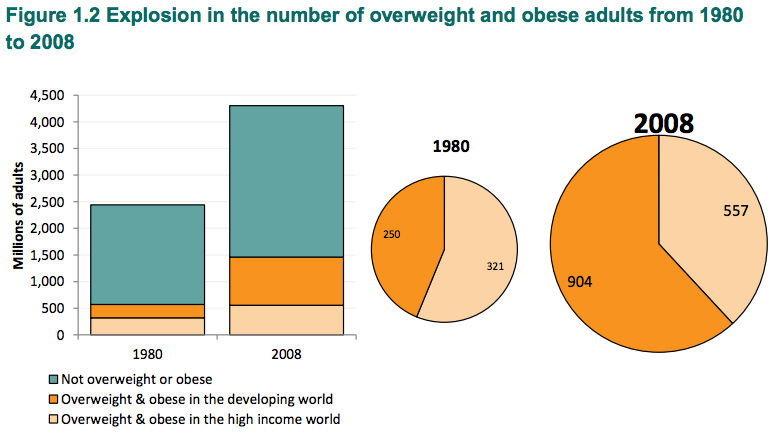
World Overweight

A new study (pdf) finds that obesity rates are skyrocketing in developing countries, such that “1.46 billion adults — or one third of the global adult population — are now overweight or obese”:

Between 1980 and 2008, the number of obese or overweight people in the developing world nearly quadrupled. Steve Wiggins, who co-authored the report, believes that’s a function of income growth in poorer nations. “As countries go from being low-income to middle-income, and heading towards high-income, people earn more [money], and they can eat the foods that they find tasty,” Wiggins explained to NPR. That doesn’t mean the obesity epidemic isn’t related to poverty; health disparities are still evident among different socioeconomic classes. Mexico provides one of the clearest examples of this dynamic. Mexico’s obesity rate surpassed the United States‘ this past summer, with the issue largely concentrated among the lower class. “The same people who are malnourished are the ones who are becoming obese,” physician Abelardo Avila with Mexico’s National Nutrition Institute told CBS News at the time. “In the poor classes we have obese parents and malnourished children. The worst thing is the children are becoming programmed for obesity. It’s a very serious epidemic.”

Sophie McBain examines the public health implications:

Over the past thirty years, wealthier individuals in low-income countries have been eating more, leading more sedentary lifestyles, and consuming a diet richer in meat, fat and sugar than ever before.  The proportion of overweight and obese people in North Africa, the Middle East and Latin America is now about the same as in Europe and North America. This places hundreds of thousands of people in these regions at heightened risk of heart disease and diabetes, many of whom will not have access to adequate medical care and advice. According to the World Health Organisation, for instance, 80 per cent of diabetes deaths occur in low to middle income countries, and by 2030 diabetes is projected to be the seventh leading cause of death worldwide.

Meanwhile, the World Food Programme estimates that 784m go hungry, and the ODI reports that a third of infants worldwide are stunted due to malnutrition.