A Franciscan Era?

The Dish is thrilled that a new online site has been formed to explore and examine the lives, minds and bodies of animals, and our relationship with them. It’s called “The Dodo” and it’s edited by the extremely talented Kerry Lauerman, formerly of Salon.

dish_fotdsun12Dish-readers know that this is an area we’ve been covering more and more – particularly as neuroscience and research in general is slowly breaking down the absolute boundaries between the human animal and our cohabitants on this planet, and as our manic compulsion toward greater material comfort leads to the transformation of our climate and seals the fate of so many species. I have to say I don’t regard this as some kind of side-issue in politics and culture. I think it’s in the vanguard of our moral evolution as a species.

Some introductory stories from the Dodo: Do Dogs Tilt Their Heads When Confused? And As Blackfish Soars, Will SeaWorld Sink?

It’s easy in the age of Upworthy to think the web cannot provide new, smart, engaging content which isn’t just linkbait or page-view whoring or social media p.r. The Dodo proves them wrong. Good luck, guys. We’ll be reading and linking.

(Photo: Tri Joko, photo-shopped)

Malkin Award Nominee

“That was [governor Cuomo’s] anti-gun legislation, which he had promised not to do, but then he had a little convenient massacre that went on in Newtown, Conn., and all of a sudden there was an opportunity for him,” – New York Post columnist Fredric Dicker, on his WGDJ talk-show in Albany, yesterday.

Quotes For The Day

“I am optimistic over the future. This is a first step to overcome extremism in both our countries,” – Heshmatollah Falahatpisheh, a former conservative member of Parliament who teaches political science at Tehran University.

“It just stands to reason if you close the diplomatic option, you’re left with a difficult choice of waiting to see if sanctions cause Iran to capitulate, which we don’t think will happen, or considering military action,” – Benjamin J. Rhodes, a deputy national security adviser to president Obama.

Despite a real breakthrough in negotiations with six world powers, despite a future option to reimpose sanctions if Iran fails to live up to its obligations in a final deal, there are now 59 votes in the Senate and a large majority in the House attempting to poison-pill the negotiations with threats of new sanctions while negotiations continue. 59! That includes a big tranche of Democrats. Where, one wonders, are the Democratic voices loudly supporting the best chance to avoid another war in the Middle East? Or the sane Republican ones?

We’re about to see who actually controls American foreign policy – a duly elected president or a lobby group.

Lena Dunham’s Skin In The Game

Girls Nudity

Last week, ahead of the Season 3 premiere of Girls, TV critic Tim Molloy asked Dunham why she does so many nude scenes. Molloy:

I don’t get the purpose of all the nudity on the show. By you particularly. I feel like I’m walking into a trap where you say no one complains about the nudity on ‘Game of Thrones,’ but I get why they’re doing it. They’re doing it to be salacious. To titillate people. And your character is often naked at random times for no reason.

Amanda Hess fires back:

Asking why Dunham regularly appears naked in the show was a legitimate question—in 2012. Dunham’s many answers on the topic—that pantlessness is inherently comedic, that showing average-sized women’s bodies in the media is so rare that it constitutes a radical act, and that the outsized attention and criticism she’s received for it wouldn’t be placed on a naked actress with “tiny thighs”—have demonstrated that there are copious and pointed reasons justifying the choice. For Molloy to approach the question from a place of total obliviousness to that discussion makes his statement not only lazy and dated, but ignorant.

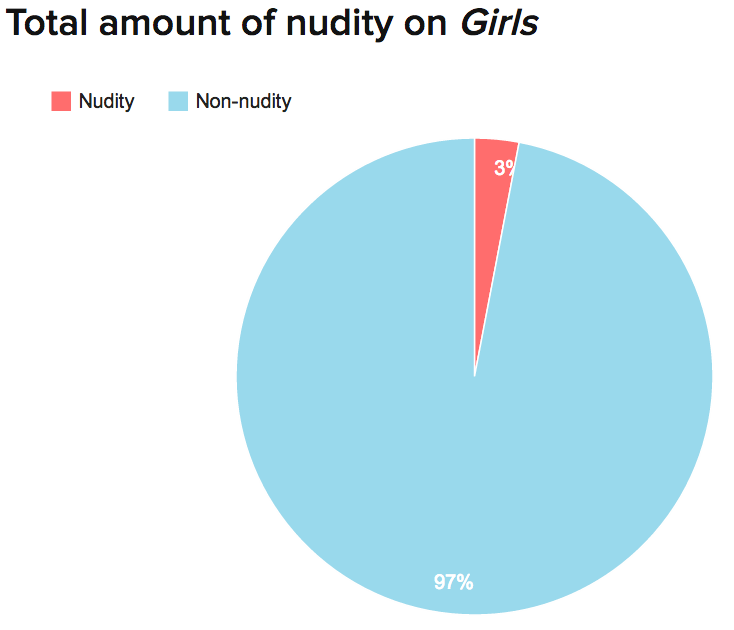
Louis Peitzman, who created the above chart, argues that “show is, by and large, less explicit than True Blood or Game of Thrones“:

Hannah is a full-figured woman, and while she looks a lot like the majority of people in this country, she is not the stick-thin, big-chested woman who often populate our TV screens. Because she deviates from the norm in that way, Hannah stands out. She seems, to some, gratuitously naked, even if she’s only naked for a very small percentage of Girls.

That’s why questions like Tim Molloy’s are met with such indignation. Whether or not his intention was misogynistic or a means of body policing — and I’ll give him the benefit of the doubt that it wasn’t — that is the connotation the question carries. It’s not about the nudity itself, which is nowhere near constant, but rather how it makes the viewer feel. And in this case, that feeling of “wrongness” is inextricably tied to Dunham’s body, making her defensiveness all the more valid.

So while Girls may indeed be too sexually explicit for some, the nudity question doesn’t merit the kind of serious response Molloy may have been looking for. The characters simply aren’t naked all the time, and when they are, it’s because Girls, as Dunham put it, is “a realistic expression of what it’s like to be alive.”

Emily Shire also defends Dunham:

Although I do find nudity gratuitous sometimes, Girls‘ use of it, especially Dunham’s, feels natural. Guess what? We sometimes walk around our apartments naked. When we pee or have sex, at the very least the important parts have to be naked for it to work, and if we’re hanging out with people who have already seen us naked, we may stay nakedish, as Dunham’s Hanna Horvath did during a much maligned ping pong scene in season two’s “One Man’s Trash.”

So, one answer to Molloy’s question about why Dunham is naked if not for the purpose of being sexually arousing is because the show is committed to a certain realism. And as Apatow later stated, “I have people naked when they’re willing to do it.” Not all the actresses on Girls are willing to be naked, but when they are, the show uses nudity to bring that extra touch of reality to their interactions.

Megan Gibson adds:

Girls is peppered with moments that are funny and poignant and Dunham often uses nudity, her own and her casts’, to emphasize these moments. Sure, not every viewer enjoys it, but then again not everyone likes the provocative nudity on Game of Thrones. But what’s really troubling is not the amount of skin that appears on either  show, but the reaction to it. For anyone who thinks that female nudity should solely be about titillation — and are subsequently confused or even angry when that’s not the case — has a disturbing view of women’s place onscreen. And if Dunham and Girls helps shift that view, I say bring on the nude scenes.

The Caudillo Of Cairo

As General Abdel Fattah Al-Sisi signals that he plans to seek the Egyptian presidency, Shadi Hamid compares his dictatorial style with that of Mubarak:

Mubarak was your run-of-the-mill autocrat, intent on restricting dissent, but also willing to tolerate a degree of opposition. He had no particular ideology except the preservation of power and, in his latter years, the accumulation of wealth. Sissi evinces no such modesty, hearkening back to the caudillos of Latin America with his populist paternalism. He is a compelling orator, comfortable speaking extemporaneously and with seeming conviction. Just weeks after his rise to power, Sissi, on state television, called for mass rallies to “authorize” him to do what was necessary in the fight against “terrorists.” A personality cult has grown accordingly, with Sissi-themed cupcakes and chocolates and even women’s nightwear featuring the general himself in dark sunglasses. …

Previously coy about his intentions, General Sissi appears to have made a decision. He has been driven by both personal ambition (a voice reportedly told him in a dream: “We will grant you what no one has had before”) and mounting public pressure. One pro-Sissi group filed a lawsuit in an attempt to “force” Sissi to run. Another pro-Sissi group, claiming 12 million signatures in support, would prefer to skip the formality of elections altogether.

Totten expects no good news from Egypt anytime soon:

The idea that Sisi would ever “restore” the democracy that went “off track” with Morsi, as so many activists claimed when he seized power, was always delusional. Egypt had no democracy to begin with. (A single election does not a democracy make.) Nor does the Egyptian military have a democratic cell in its corpus. Egypt’s choice is the same now as it has been for decades: Islamic theocracy or military dictatorship. It can’t be sustainably settled at the ballot box, so it will be fought over instead in the streets.

Peter Oborne looks glumly at this week’s constitutional referendum:

In no way can the referendum be called democratic. There are thousands of posters urging Egyptians to vote yes, but on my visit to Cairo last week I did not witness a single one urging them to vote no. The reason for this emerges from a very worrying report from Human Rights Watch out today. Campaigners against the constitution are being arrested and charged with “attempting to overthrow the regime”. The main opposition party, the Muslim Brotherhood, has been declared (on no evidence) a terrorist organisation. There are reports today that the political party Strong Egypt, which claims to be liberal, has been forced to suspend its no campaign because of the recent arrests. Meanwhile, General Sisi says that a successful vote this week will license him to run for the presidency in a poll later this year. This is very sinister. As Bruce Riedel powerfully points out here, the coup d’état which restored military rule in Egypt is being seen by al Qaeda as validation of their murderous ideology.

Boob-Tube Birth Control

A new study (NYT) suggests that MTV’s 16 and Pregnant may have prevented as many as 20,000 teen births in 2010 alone. Ben Richmond elaborates:

Is this really all that surprising? For much of the 80s and 90s, we all heard about MTV’s unstoppable ability to influence the young, but most of the time the people talking about that influence were right-wing religious groups who said that MTV would lead children straight to hell. Even these shows about teenage mothers were accused of glamorizing and therefore encouraging adolescents to have kids.

But, as the study’s author Melissa S. Kearney pointed out in a piece at the Huffington Post, the economists found that, even though the birth rate had been dropping steady for two decades, there was “notable evidence that the introduction of MTV’s 16 and Pregnant is responsible for a significant portion of the reduction in the teen birth rate in recent years.” The researchers looked to see whether larger reductions in the teen birth rate were occurring where more people were watching the show. They focused on changes in birth rates in places after the show went on the air and also looked at MTV’s ratings once it was introduced. They also looked at Twitter and Google trends, and found that tweets and searches about birth control and abortion spiked when the show was on, specifically in locations where it is more popular. It seems teen pregnancy isn’t that glamorous after all, even when it’s on MTV.

Aaron Carroll examines the paper:

Recognizing that this is not a randomized controlled trial, please don’t take any of this as proven “causal”. Nevertheless, the results are worth thinking about.

The show is popular, and tons of teens watched it and tweeted about it. But there was an associated increase in tweets and searches for things like “birth control” and “abortion”. This held true even in the third analysis.

Moreover, the authors found that the teen birth rate was 5.7% lower than expected because of the show. That’s about a third of the total decline in birth rates from June 2009 to the end of 2010. There was no increase in abortions, either, so it appears that the show is associated with a reduction in pregnancy, not an increase of terminated pregnancies.

I still won’t watch the show. But maybe I should stop judging others who do so harshly.

Jessica Grose points to another study, which finds that viewers of teen-mom shows develop incorrect impressions about teenage pregnancy – such as “teen moms earn a lot of money and that the fathers of their children are highly involved”:

Though superficially, the two sets of findings don’t seem to gel, when you look more closely, what may be happening is a reality TV phenomenon that affects all reality shows after their first seasons: The stars become famous. The first study, from the National Bureau of Economic Research, only looked at data from 2009 to 2010, the first year and a half after 16 and Pregnant hit TV screens. Back then, the depiction of teen moms—their financial and relationship struggles—was much more realistic, because there was no sense that getting on the show was a golden ticket to tabloid fame. “Imagine bein’ in prison. That’s what [motherhood is] like, bein’ in prison,” Jenelle, one of the featured moms on 16 and Pregnant said in 2010. No wonder viewers weren’t eager to replicate that experience.

Nicholas Tufnell provides more details on the second study:

The authors of the research are worried that as reality television becomes more prevalent, it will be increasingly difficult for younger audiences to differentiate between what is and isn’t real, perhaps not realising that most of the scenes are scripted and that the “stars” are frequently paid tens of thousands of dollars. It is estimated that the stars of Teen Mom receive more than $60,000 (£36,000) a year, a stark contrast to the $6,500 (£3,960) that is actually earned annually by many teen mothers in the first 15 years of parenthood.

When The Past Melts Into The Present

Climate change has been helpful for at least one group – archeologists:

The summer of 2003 was the hottest in Europe for 500 years. On the remote Schnidejoch pass, 2,750 meters above sea level in the Swiss Alps, an ice patch shrank by half its volume, leaving a wooden object high and dry. When hiker Ursula Leuenberger came across it, she realized it had no business there, so far above the tree line, so she picked it up and handed it over to the local archaeological service. It turned out to be part of a Neolithic arrow quiver, almost 5,000 years old. Since then, archaeologists have found more than 800 artifacts in the vicinity of the pass. …

Glacier archaeology, as the field is called, has been referred to as the silver lining in the cloud of global warming. Like underwater archaeology, it is exposing a dimension of humanity’s past that had been almost entirely neglected; one that has the potential to profoundly influence our understanding of our ancestors. But it is a race against time. As soon as organic material melts out of the preserving ice and is exposed to the elements again, it starts to decay. “It’s like this glimpse into a freezer that’s been left open for a couple of weeks,” says Craig Lee at the University of Colorado, Boulder. “You might find a few jars of fruit that are still viable, but the rest is gone.” The sheer amount of material now in this precarious condition – Swiss glaciers, for example, have lost a third of their volume since 1860 – means that archaeologists simply cannot reach it all in time, not least because it is often inaccessible outside the narrow window of summer at these altitudes. It’s a case of triage, says Lee.

The Real Victims Of Adolescence

Parents?

When prospective mothers and fathers imagine the joys of parenthood, they seldom imagine the adolescent years, which Nora Ephron famously opined could only be survived by acquiring a dog (“so that someone in the house is happy to see you”).

Gone are the first smiles and cheerful games of catch. They’ve been replaced by 5 a.m. hockey practices, renewed adventures in trigonometry (secant, cosecant, what the—?), and ­middle-of-the-night requests for rides home. And these are the hardships generated by the good adolescents. … Yet their parents are still going half-mad. Which raises a question: Is it possible that adolescence is most difficult—and sometimes a crisis—not for teenagers as much as for the adults who raise them? That adolescence has a bigger impact on adults than it does on kids?

Laurence Steinberg, a psychologist at Temple University and one of the country’s foremost authorities on puberty, thinks there’s a strong case to be made for this idea. “It doesn’t seem to me like adolescence is a difficult time for the kids,” he says. “Most adolescents seem to be going through life in a very pleasant haze.” Which isn’t to say that most adolescents don’t suffer occasionally, or that some don’t struggle terribly. They do. But they also go through other intense experiences: crushes, flirtations with risk, experiments with personal identity. It’s the parents who are left to absorb these changes and to adjust as their children pull away from them. “It’s when I talk to the parents that I notice something,” says Steinberg. “If you look at the narrative, it’s ‘My teenager who’s driving me crazy.’ ”

Literary Homesteading

A new initiative is trying to draw writers to the bankrupt city of Detroit:

In a contemporary, literary twist on old homesteading incentives, a new nonprofit organization called Write a House is refurbishing three two-bedroom houses in Detroit and accepting applications this spring for writers to move in, rent free. Poets, journalists, novelists, and anyone who falls somewhere in between are encouraged to apply. If the writers stay for the required two years and fulfill other obligations, such as engaging with the city’s literary community and contributing to the program’s blog, they’ll even get the deed to the place. As the group’s mission puts it, “It’s like a writer-in-residence program, only in this case we’re actually giving the writer the residence, forever.” …

For a renter feeling boxed in or left out in her current location, moving to Detroit might provide a creative spark. Write a House, however, is looking to draw people from not only America’s expensive coastal hubs but also from big or small towns all over the world. (They’ve already been contacted by several writers in Europe.) “Some communities are pricing people out, and other communities just aren’t that interesting,” [project co-founder Toby] Barlow said. “Detroit is affordable and fascinating, and that seems like a good combination for writers.”

Carolyn Kellogg notes that “24 hours after launch, more than 200 interested writers asked to learn more.”