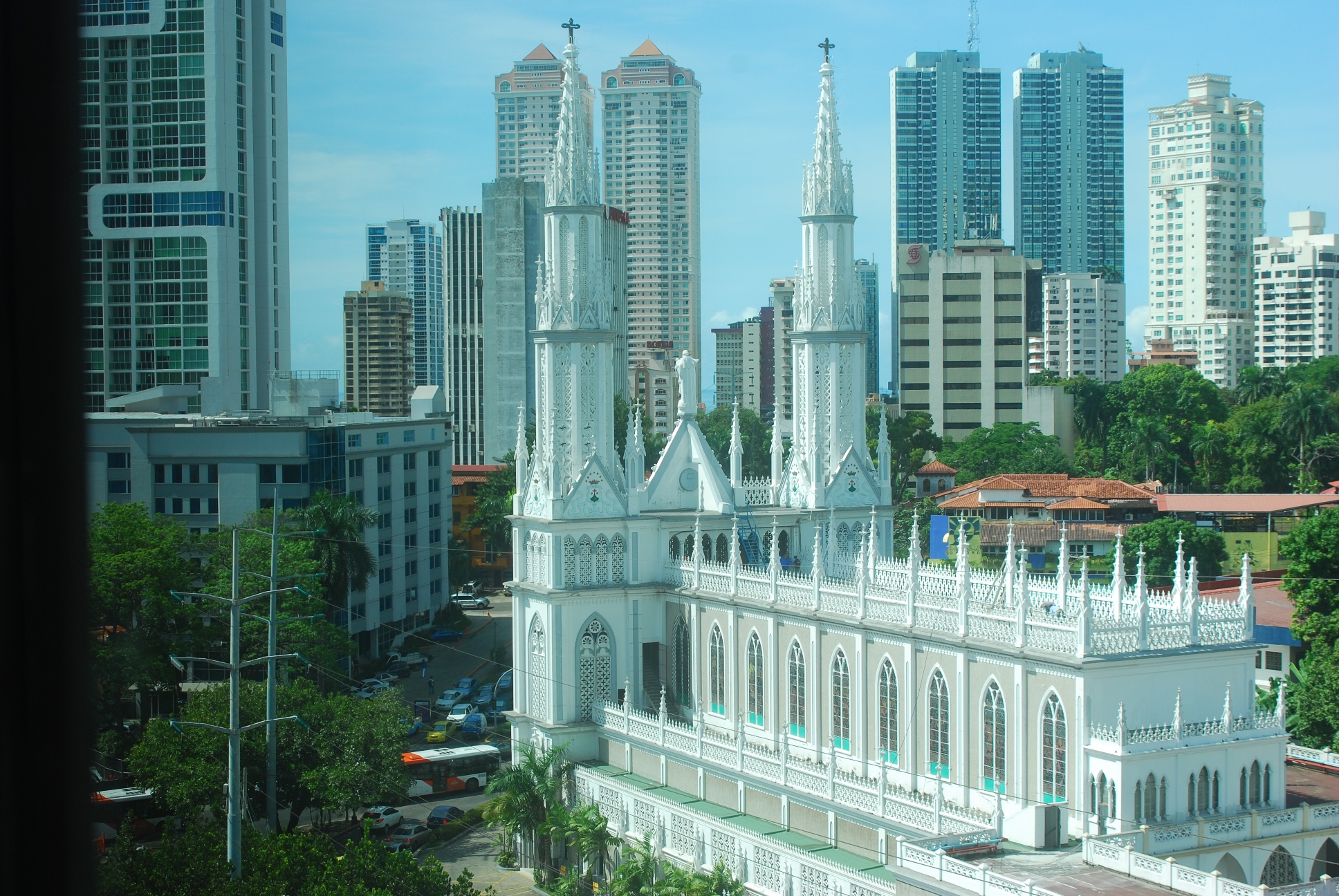
Panama City, Panama, 12 pm
In an interview about his new book, The Slavery of Death, Richard Beck thinks through the question:
The answer most of us would give, shaped as we are by the culture, is this: you’re a nobody. If you’re not someone who “stands out” you’re a nobody. Brene Brown calls this the “shame-based fear of being ordinary.” Nobody wants to be ordinary. We want to be extraordinary.
And why is that? Because of existential (death) anxiety. We want our lives to matter, to be noteworthy and significant in the face of death. We don’t want to fade away, we want to leave a dent in the universe. So we grasp at anything that makes us stand out from the crowd, that allows us to make and leave a mark. And so we get caught up in the neurotic social comparison game–online, at work, and in our social relationships. The main symptom of this “shame-based fear of being ordinary” is envy/jealousy fused with a feeling of inferiority and inadequacy. The trouble with this, and here is the pastoral turn, is that everywhere we see Jesus asking us to “take the last place.” To be a servant. To be the littlest, least, and last.
But that is impossible if our egos are being driven by a neurotic and shamed-based anxiety. Because the reality of Good Friday is that if you become like Jesus–if you carry his cross–nobody will pay attention, no one will say thank you, no one will recognize your work. That’s crucifixion. Of the ego, of the self, of our aspirations to be “a somebody.”
So that’s the rub. Jesus asks us to become a “nobody” in the eyes of the world. In our own eyes. But because of our death-infected neurosis–the shamed-based fear of being ordinary–we can’t accept Jesus’s offer. We don’t want to take up the cross. It’s too embarrassing. We don’t want to be a servant. No one will applaud or like us on Facebook.
The Dish previously has featured Beck’s work here, here, and here.
On February 4th, Bill Nye will debate Creation Museum founder Ken Ham at the Creation Museum in Petersburg, Kentucky. The question: “Is creation a viable model of origins?” Ham explains why he set up the event:
Because our ministry theme for 2013 and for 2014 is “Standing Our Ground, Rescuing Our Kids,” our staff thought that a debate on creation vs. evolution with a man who has influenced so many children to believe in evolution would be a good idea. Now, those of you who know me realize that I don’t relish public debates, so please pray for me. But this debate will help highlight the fact that so many young people are dismissing the Bible because of evolution, and even many young people who had grown up in the church decided to leave the church because they saw evolution as showing the Bible could not be trusted.
Jerry Coyne thinks Nye should stay away:
My worries are these. First, Nye is likely helping fund the Creation Museum and its mission to teach children Biblically based untruths about the origin and diversity of life. Had I been Nye, I would have suggested some other recipient of the money. Not only that, but why hold such debates in a Temple of Ignorance instead of on neutral ground? Second, Nye, by his very appearance, is giving some credibility to Ham and his views. After all, The Science Guy is known and beloved by many Americans as a popularizer of science. Why debase himself this way? My third worry, then, is this will look great on Ham’s curriculum vitae, but not so good on Nye’s. It is my practice not to debate creationists for reasons #2 and #3. Nye can attack creationism in his own talks and writings, as he has been doing with great effectiveness. Debates are not the way to help people accept evolution.
Tyler Francke is also strongly against Nye’s participation:
[A]ny modern-day public debate over the fundamental tenets of creationism is a sham, a mockery of real discourse. That’s because there is no scientific debate to be had over whether the earth is billions of years old, or whether life shows strong evidence of common descent, or whether a global flood occurred within the memory of modern man. These questions (particularly the first and third) were settled by the experts who are paid to study such matters long before any of the would-be “debaters” were even born.
Joe Hanson agrees the premise of the debate is flawed:
[W]ho is this going to convince?
Are there large numbers of people who are on the fence about whether evolution or creationism is the One True Way? And I mean really, truly “on the fence” in the sense that they could be tipped to one side by the words of either a hero of their elementary school afternoons and Tumblr memes and bow-tie-shipping, or … that other guy?
Chaplain Mike predicts the debate “will only serve to further separate a segment of very vocal Christians into their little cubbyhole of biblicism and obscurantism”:
By holding this “debate,” Ham continues to attempt to reinforce the impression that his opinion is the Christian worldview, that his organization is engaged in serious interaction with scientists, and that the way Christians should “engage and impact the culture” is through trying to defeat them publicly with arguments. And if you can stack the deck, hold the debate on your home field, and raise a lot of money for your cause in the meantime, all the better! Christianity’s reputation for hucksterism is taking a giant step forward with this event.
But James Kirk Wall thinks “the people against the debate are wrong”:
Bill Nye is absolutely right in doing this, and here’s why. If someone had a belief that human babies came from storks, we wouldn’t need a debate. If one third of the adults in this country believed that babies came from storks, as insane as it sounds, yes, we need to have the debate. And that’s where we are. … Bill Nye has an opportunity to valiantly promote science over creationist nonsense. I expect Bill is going to do very well.
Ham’s response to Nye’s video at the top of the page is here.
“I know I would not want a vision of art that is purely utilitarian—that would not be not art, it would be advertising or propaganda. A sonnet is neither a wrench nor a voting booth. And yet, even useless joy is not inconsequential. Joy is reasonless and “accomplishes” nothing, yet is an indispensable enlargement of measure in any life. Why do we want justice, or any other diminishment of suffering, if not for the increase of simple happiness it brings? Or why would we want what Buddhism might call a right sorrow, for that matter, as we—I at least—do want that? We know when a pool is clarified, when it is muddied. We know when a poem of darkness is opulent, in its saying, in its relationship to existence—Hopkins’s “Carrion Comfort,” for example—and that the existence of opulent grief, fully offered, is a counterweight even to despair.
I’m not saying that art is a matter of beauty, solace, or calmness, though it can be, and that can be welcome. I’m not saying that art is about rectification of character or making visible the existence of injustice, though it can be, and that can be welcome. I suppose I’m saying that good art is a truing of vision, in the way that a saw is trued in the saw shop, to cut more cleanly. And that anything that lessens our astigmatisms of being or makes more magnificent the eye, ear, tongue, and heart cannot help but help a person better meet the larger decisions that we, as individuals and in aggregate, ponder. That the rearrangement of words can re-open the fate of both inner and outer worlds—I cannot say why I feel this to be true, except that I feel it so in my pulses, when I read good poems,” – Jane Hirshfield.
(Hat tip: Jennifer Haupt)

“Evidence” by William Stafford:
First, this face—history did it,
winters, two world wars, long
days bent in the fields in the sun,
a few blows, fear, sorrow.This face is evidence left over
when those years denied what happened
and stole away, the shell still whispering
of treasure and wreckage in the sea.And then beyond this mask—that’s where
everything else begins to wake up:
what the wars were about, how the field boss
discovered a truth God had in mind.There’s a bell somewhere. This face
looks up, the way old people listen.
(From The Way It Is: New & Selected Poems by William Stafford © 1998 by the Estate of William Stafford. Used by permission of Graywolf Press. Photo by Pawel Maryanov)
Just before Christmas, Ross Douthat wrote a column (NYT) wondering how scientific materialism and its account of “a purely physical and purposeless universe” could provide the basis for liberal egalitarianism. Jerry Coyne took the bait:
I’m not sure what Douthat means when he says “cosmology does not harmonize at all” with the moral picture of secularism. Cosmology doesn’t give one iota of evidence for a purpose (it could!) or for God. Most of the universe is cold, bleak, airless, and uninhabitable. In fact, such a cosmology harmonizes far better with a secular moral picture than a religious one. Secularists see a universe without apparent purpose and realize that we must forge our own purposes and ethics, not derive them from a God for which there’s no evidence.
Yes, secularism does propose a physical and purposeless universe, and many (but not all) of us accept the notion that our sense of self is a neuronal illusion. But although the universe is purposeless, our lives aren’t. This conflation of a purposeless universe (i.e., one not created by a transcendent being for a specific reason) with purposeless human lives is a trick that the faithful use to make atheism seem dark and nihilistic. But we make our own purposes, and they’re real.
Douthat counters by noting that “if the only real thing is matter in motion, and the only legitimate method of discernment the scientific method, you’ll never get to an absolute ‘thou shalt not murder’ (or “thou shalt risk your life on behalf of your Jewish neighbor”)”:
I don’t think those of us who still embrace the traditional Western idea of God are crazy to suggest that our cosmology has at least a surface compatibility with moral realism that the materialist conception of the universe’s (nonexistent) purposes seems to lack.
So if you’re going to defend both materialism and modern rights-based liberalism, you have to actually address this point head-on. Make a case for a more limited, non-metaphysical form of moral realism, make a more thoroughgoing attempt to discern some sort of moral teleology in the Darwinian story (though of course Coyne has denounced efforts along these lines as “creationism for liberals”), go full relativist and make a purely aesthetic case for cosmopolitanism, I don’t care what — but give me something that doesn’t either beg the question (“we should help people because it helps people!”) or pretend that there are actually solid selfish reasons for the most costly, heroic, and plainly self-sacrificial forms of non-self-interested behavior.
Coyne goes another round:
I’ve often said that I don’t know how much of human morality comes from natural selection’s instilling in us certain behaviors and feelings, and how much is due to reason. But I am virtually certain that none of it is due to God.
I want to live in a world where people are treated fairly and in which, were I disadvantaged, people would try to help me. For it is only an accident of biology and history that has made me better off than others. I want to live in a world where people promote the well-being of our fellows. That is what I see as “moral” behavior. This kind of morality is justified by its results, but one thing it is not is circular. (Indeed, it is Douthat’s morality that is circular, for it ultimately rests on what he thinks God wants, and unless Douthat can further justify why God wants such behavior, that’s the end of the road.) Like all nonreligious brands of morality, mine comes down to a justified preference: a judgment call.
But it’s better to make a judgment call based on science, observation, and reason than on the dictates of an imaginary being.
Millman steps in and examines Douthat’s original question:
[W]hy be moral? If the universe has no point, and human beings are not here for a reason, why not be a hedonist? Or worse – a sociopath?
I’m always mystified by this question from theists. Douthat complains that Coyne’s argument is circular: “If my question is ‘what’s the justification for your rights-based egalitarianism?’ saying, ‘because it’s egalitarian!’ is not much of an answer.” But his own argument is equally circular: secular liberalism is “unjustified” because it lacks a foundation in belief in God, but a belief in God is “justified” because without it you don’t have a foundation for morality! I don’t know about Douthat, but I suspect that, at least some of the time, what I’m really hearing with this kind of argument is a species of Straussianism. To whit: yes, I know, and you know, that there isn’t really any arguing with a cold and empty cosmos. But most people can’t handle that kind of truth; they need to believe that there’s an objective meaning to their lives. So, for the sake of the greater good, we have to affirm publicly that there is such a thing, that God is the foundation of morality. I’ve always suspected that Strauss would have got on just fine with the Grand Inquisitor; in any event I’ve never liked this line of argument.
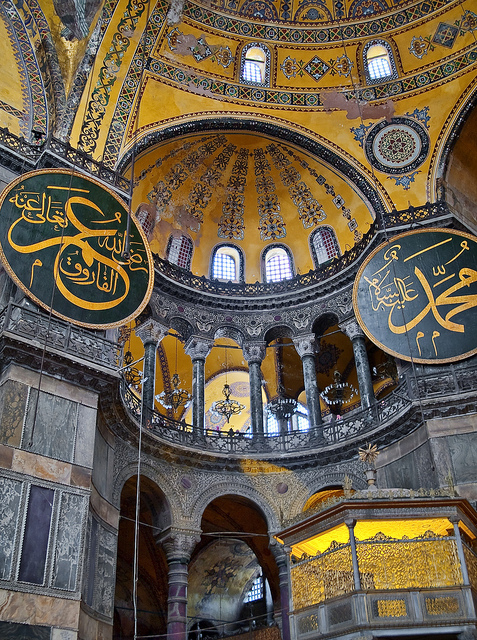
Last month the Dish noted efforts afoot in Turkey to turn the Hagia Sophia – formerly a Christian basilica, then a mosque, and currently a museum – back into a place of Muslim worship. Kaya Genc ponders a possible third way:
Although most people take an either/or stance, some have proposed opening Hagia
Sophia to both Islamic and Christian services. This is a welcome prospect to Christians, who have made a number of attempts to organize religious rituals. On one such occasion, in 2010, Turkey’s director of religious affairs said, “Turkey would not be a Christian country just because Christians performed their religious duties in a few churches.”
There’s precedent for such a hybrid, too. I came across numerous articles about the so-called church-mosques of Anatolia. Pazaryeri Camii, in the coastal city of Izmir, is one example: built for Christian service in 1874, it was repurposed as a mosque once Turkey became a republic. During the building’s renovation, the experts found Christian icons and decided to install a curtain system to cover them during Islamic prayers. Another church-mosque, in the Çardak village of Göreme, has been used by both Orthodox Christians and Muslims. Indeed, a Turkish columnist recommended a similar solution for Hagia Sophia: “We should allow Aya Sofya to become all three things at the same time!” she wrote. “Let’s keep it as a museum from Monday to Thursday, turn it into a mosque on Friday, close it for holiday on Saturday and use it as a church on Sunday. We can cover the floor with a carpet on Thursday nights and place chairs on Saturday nights.”
(Image of interior of Hagia Sophia via Flickr user MiGowa)
Julie Beck looked at a new study on the search for meaning in life. It doesn’t come with wealth:
A recent study in Psychological Science takes a global look at the quest for meaning, analyzing data from the Gallup World Poll to determine where people feel meaning, and how they found it. The survey data comes from 132 countries in 2007—the researchers specifically looked at self-reported meaning in life, religiosity, fertility rates, GDP, and suicide rates (from the World Health Organization). …
The Gallup data showed that countries with lower GDPs ranked higher for meaning. Toward the top were Sierra Leone, Togo, Laos, and Senegal, all of which were in the bottom 50 countries in the world for gross domestic product per capita in 2012, according to the International Monetary Fund. Poorer countries also had lower suicide rates.
This looks at first like another tally in the “money can’t buy happiness” column (though in a lot of ways, it can). But the data also showed that richer countries were less religious than poorer countries. The researchers found that this factor of religiosity mediated the relationship between a country’s wealth and the perceived meaning in its citizen’s lives, meaning that it was the presence of religion that largely accounted for the gap between money and meaning. They analyzed other factors—education, fertility rates, individualism, and social support (having relatives and friends to count on in troubled times)—to see if they could explain the findings, but in the end it came down to religion.
The founder of Critique My Dick Pic (NSFW, duh) describes what the tumblr has taught her about male vulnerability:
All in all, Critique My Dick Pic is proving to be an extremely positive and humbling project. It’s fun and light, but it’s also confirmed to me just how fragile men are; how crumblingly insecure and self-conscious so many of them are about their bodies. That’s very human and understandable, and it’s a terrain with which most women are familiar, but men in particular are exhorted to grin and bear their body issues rather than talk about them. Perhaps that’s why they’ve responded so openly to my project; an anonymous outlet for them to share their deepest vulnerabilities (and to swing their dicks around).
Previous Dish on the brilliant tumblr here.
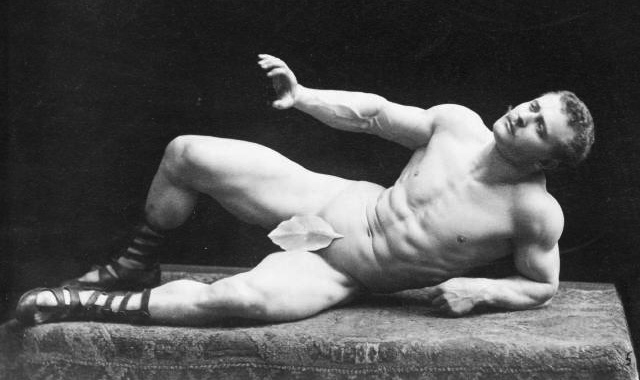
(Photo: Victorian-era strongman Eugen Sandow poses as The Dying Gaul in 1894. By Benjamin Falk)
Presenting the 300 Club:
The objective: to endure a temperature swing of 300 degrees Fahrenheit by warming up in a sauna, heated to 200 degrees, and then running, naked, to and around the Ceremonial South Pole when the outdoor temperature is below -100 degrees. …
One of the first things people wonder about when they learn of the 300 Club is the incidence of frostbite. [Club member Kris] Perry and others who have been there confirm that this is a valid concern. Perry remembers one unlucky couple from his second winter at the South Pole: “[They] both suffered some minor frostbite—she on her nipples and he on the tip of his weenie. Fortunate for her, I had gone outside to do a weather observation and saw them heading from the pole back to the station. She was moving very slowly and had probably become mildly hypothermic. I gave her my parka and helped her get back inside. I think there might have been one or two other incidents of mild frostbite on some guys’ weenies that winter.”
Some general advice for the rest of us:
Eating provides your body with fuel that can help you tolerate cold. Also, wear a windbreaker to prevent frigid gusts from stealing your body’s heat. If you start to feel pain or numbness, or notice your skin turning paler, go inside immediately: These may be early signs of frostbite. (And whatever you do, says [physician Henderson] McGinnis, don’t rub the affected skin—that increases the damage.)