Iranian Modern

Bustling scenes from Tehran in 1971:

Hrag Vartanian suggests the Tehran of 45 years ago looked a lot like the Abu Dhabi of today:

It may be hard for us to image the larger cultural renaissance that was taking place in Iran after the Second World War, when the CIA-backed coup in 1953 toppled Iran’s democracy and installed in its place the Shah, who in a major push for modernization invested in culture and tried to open up the country to the world. The internationally renowned Shiraz Arts Festival, one of his regime’s initiatives, welcomed such luminaries as Peter Brook and Robert Wilson from the West, and helped revive local interest in folk music. Epic productions in 1971 celebrated the history of Iran and the Shah’s achievements, and the Iranian elite was not secretive about their huge appetite for luxury and art of all types. By 1977, Iran even had an impressive center of modern art, Tehran’s Museum of Contemporary Art, which still contains a fantastic collection of works by Kandinsky, Duchamp, Pollock, Bacon, Warhol, and countless others standard bearers of Western modernism.

There are curious parallels between Shah-era Iran and the Arab Gulf states today, with their investment in culture (replete with global events, Shiraz Festival vs. Sharjah Biennial) and a lurking specter of severe human rights abuses, but what differentiates them is that Iran had a rich network of native institutions and a more developed art history upon which a modern identity was built.

Meanwhile, Ryan McCarthy visits the country’s Kish Island, another relic from the Shah’s rule that was once meant to be a Vegas-style resort:

In 1989, dismayed by the lack of international tourists, the government declared Kish Island a free zone. This new status meant there would be no taxes, no visas required to enter, and a more lax enforcement of moral laws. Women are allowed to wear their hijabs with a generous amount of hair showing, and swimming (although gender-segregated) and dancing are encouraged. All of these activities are verboten in most other parts of the country.

It didn’t work:

The whole island stands as a monument to another era. The closest thing you can get to liquor on Kish is a “non-alcoholic malt beverage.” I thought it would be a good idea to drink one ironically, but after my first sip I realized I would have to be drunk to continue downing the stuff, which tasted like rusty metal and artificial flavoring. Quite the paradox.

The dearth of international tourists created an eerie, abandoned feel to the place. The shipwreck known as “Greek Ship” is one of Kish’s most popular attractions and photo-op sites, just beating out the empty building in the shape of a ship.

Why So Few Black Women On SNL? Ctd

A reader puts the hiring of Sasheer Zamata – the fifth-ever black female cast member – into perspective:

Complaints about the lack of talent may be legitimate, since only about 10-15% of comedians are female. Assume that rate holds constant among the 12.6% of Americans who are black and you end up with about 1.5% of comedians being black women. With 137 cast members in SNL’s history, the 15 black performers and 4 black women is more or less what you’d expect if they simply cast the funniest applicant available. You could try to change the ratios to improve diversity somewhat, but at the end of the day you can only find so much elite talent from just 1.5% of any population.

Tanner Colby looks back at the history of black comedians on SNL. He separates them into three categories: “a) The disgruntleds, the washouts, and the walk-offs. b) The ones who stuck around. c) Eddie Murphy”:

The disgruntleds and the washouts are the largest group.

Black performers who joined the show, never found their niche, and typically left in very short order or on not-great terms. Most of these players—Yvonne Hudson, Danitra Vance, Dean Edwards, Jerry Minor, Finesse Mitchell—barely even lasted long enough to make an impression before fading from cultural memory. White cultural memory, at any rate. Two of these performers, Damon Wayans and Chris Rock, went on to great fame elsewhere after chafing at the racial confines of the show’s characters and subject matter. Wayans was famously fired after ad-libbing in sketches against the express wishes of an enraged Lorne Michaels, and Rock left after two seasons as a main cast member, having never hit the stride he would find later as a stand-up.

Ellen Cleghorne [seen in the above video], the only black actress to last more than one season before Maya Rudolph, may have had the rockiest tenure of all. Hailing from the black housing projects of Red Hook, Brooklyn, Cleghorne endured the show at the height not just of its whiteness but of its frattiness, going up against the sophomoric boys club of David Spade, Adam Sandler, Rob Schneider, et al. After four seasons on the show, Cleghorne notched just one entry in the entire index of Live From New York, a reference from Molly Shannon simply noting the fact that Cleghorne was, in fact, part of cast.

Carolyn Edgar hopes that SNL’s 0ther new black women have a real impact:

The addition of [LaKendra] Tookes and [Leslie] Jones to the “SNL” writing staff is a positive sign that, despite the clumsy way “SNL” has handled criticism of its hiring practices, the show is looking to do more than just silence its critics. The importance of diversity in the writing room cannot be overstated. As wonderful as Kerry Washington’s recent guest host turn was, the Miss Universe sketch  – in which Washington played Miss Uganda, relying on broad African stereotypes and a terrible Ugandan accent – might not have left the writers’ room had writers of color been there. One of the most damning critiques of “SNL” is that it is stale and unfunny. If Tookes and Jones are permitted to have full voice in the writing room to offer a diversity of perspectives on comic situations – and are not dismissed as mere “diversity hires,” the show as a whole will be better off for it.

A Poor Man’s Poverty Agenda

Beinart appreciates that the GOP is at least starting to focus on the problem of poverty but he’s still far from impressed:

[T]aken together, the new Republican anti-poverty speeches have a depressingly theological quality. They usually begin with a catechism: Washington can’t effectively fight poverty. “After 50 years, isn’t it time to declare big government’s war on poverty a failure?” Rubio declared in a warm-up video for his speech. “What Detroit needs to thrive,” added Paul, “is not Washington’s domineering hand but freedom from big government’s mastery.”

Rarely is serious evidence offered for these assertions, because they are not statements of fact; they are declarations of faith. In truth, there’s ample evidence that some Washington programs significantly reduce poverty. A 2011 National Bureau of Economic Research paper, for instance, found that Social Security “reduces deep poverty” among the elderly and disabled “almost to zero.” In 2011, according to the Center for Budget and Policy Priorities, the Earned Income Tax Credit and the Supplemental Nutritional Assistance Program (food stamps) together lifted almost 10 million Americans above the poverty line. That doesn’t mean Washington doesn’t waste money. But by denouncing federal-government programs per se, folks like Paul declare an entire category of anti-poverty tools illegitimate. It’s like beginning a speech on national defense by affirming your doctrinal opposition to tanks.

Sharon Parrott criticizes Rubio’s block-grant proposal:

[N]o block-grant proposal has ever been designed for these programs that provides a full, prompt, counter-cyclical response; a block grant simply cannot do that.  As a consequence, under the Rubio proposal, hardship would inevitably rise in many areas during recessions — likely by substantial amounts. The Rubio proposal also would wipe away important protections in current law that ensure, for example, that all poor children have access to nutrition assistance and health coverage.  States could shift federal funds from less popular groups to groups with more political clout, such as from very poor families to families with moderate incomes. In addition, block-granting key safety net programs could very well lead to funding cuts over time.  Politically, it’s much easier for policymakers to shrink a block grant that supports a vast array of purposes spread across 50 states — and claim that states can compensate by improving efficiency or rooting out “waste, fraud and abuse” — than to cut specific types of assistance for specific groups of people such as low-income children, seniors, or people with disabilities. The history of recent decades bears this out.  Funding for most major block grants focused on low-income households has eroded in inflation-adjusted terms, often by large amounts.

Jared Bernstein argues that Rubio’s plan would undermine the whole point of the safety net:

“Revenue neutrality” may sound technical and inoffensive, if not fiscally sound, but what it really means is the safety net will be unable to expand in recessions.  Let’s see the details, but typically under these arrangements, states will be unable to tap the Feds for unemployment benefits, nutritional assistance, and all the other functions that must expand to meet need when the market fails.  This would be a huge step backwards, essentially enshrining poverty-inducing austerity in place of literally decades of policy advancements to meet demand contractions with temporary spending expansions.

Pareene thinks the GOP’s poverty agenda is a scam:

Poverty is … a subject about which it’s incredibly easy to bamboozle most of the mainstream political press. You can get swell coverage merely for saying you care about the poor, as Paul Ryan recently has. Because political reporters are unable and unwilling to analyze policy, and curiously reluctant to speak to anyone who can, you can also claim any program at all will lessen poverty or help the unemployed. And for Ryan, “caring about the poor” is a good way to reestablish Seriousness: He becomes one of the Few Serious Republicans with plans to help the poor. Poverty is a better subject for this act than most other liberal issues — like, say, the environment — because Republicans are at least allowed to acknowledge that it is bad that some people are poor.

Finally, Patrick J. Egan explains why formulating a Republican poverty agenda is so difficult:

[T]herein lies the problem for Republican leaders seeking to claim ownership of the poverty issue: their voters aren’t particularly concerned about poverty.  Every January since 1997, the Pew Research Center has asked Americans to rate a series of issues as national priorities for the upcoming year.  …  Year in and year out, Democratic voters don’t just prioritize fighting poverty more than Republicans; it’s generally the issue on which Democratic enthusiasm is most likely to be higher — by 20 to 30 percentage points — than Republican enthusiasm.

This commitment gap between the two parties’ rank-and-file members will be difficult to close.  To begin to do so, GOP leaders like Ryan, Rubio and Paul will need messages that appeal to one of their toughest audiences when it comes to caring about poverty: Republican voters.

Earlier Dish on the GOP’s anti-poverty push here and here.

Faces Of The Day

HMS Illustrious Returns To Portsmouth After Typhoon Haiyan Aid Mission

Kayleigh Dawson kisses her boyfriend Sam Moysey after disembarking from HMS Illustrious in Portsmouth Harbor in Portsmouth, England on January 10, 2014. The ships returns with her 650 crew after a five month deployment to South East Asia delivering aid relief to victims of Typhoon Haiyan in the Philippines. By Dan Kitwood/Getty Images.

A Time Out For Zero Tolerance

New guidelines from the DOE seek to reduce zero tolerance policies. Jeff Deeney applauds:

As a social worker I’ve worked both in public schools and in the criminal justice system, so I’ve seen what it’s like at both ends of the pipeline. I remember arriving for the first time at the probation department and immediately thinking that it was uncannily similar to the public high school I worked in just before I took the job. The metal detectors, the barking security demanding removal of items of clothing and access to bags, beeping wands waved around in people’s personal space and the long line of black and Latino men and women stretching out the door all could have been transplanted from one institution to the other.  The bigger picture, from my perspective, concerns America’s continued struggle to get beyond its racially based fears and the impulse to monitor, control, discipline and punish black and Latino men for even the smallest infraction or else chaos will break loose in our cities. It starts as early as the first day of elementary school and for some will last until they get off parole. It makes one wonder how much of the problem we’re creating through the solutions we’ve crafted.

The guidelines are meant to address the disproportionate impact of over-discipline on black and disabled students. Nicole Flatow has the numbers:

One in five black boys have received an out-of-school suspension, according to 2012 Department of Education data. And black students with disabilities are three times more likely to be expelled, a punishment that sets kids in zero-tolerance systems up for later criminal punishment.

Other regional statistics tell a similar story. In Chicago, for example, three-fourths of kids arrested in public school were black. This disparate impact perpetuates a cycle of criminal justice over-exposure that follows many African Americans throughout their lives and yields astronomical incarceration rates. Research suggests almost half of all black males are arrested by age 23. Years of zero tolerance and over-policing policies have manifest themselves in data: an estimated 49 percent of all young black males now enter the job market with an arrest record, as well as 44 percent of Hispanic males. These arrests not only impose obstacles to a lifetime of success; they also clog the criminal justice system. In testimony before the Senate Judiciary Committee earlier this year, a juvenile county chief judge in Georgia lamented that one-third of cases before him were students arrested not because they posed a threat, but because they “make adults mad.”

Walter Olson, however, sees these guidelines as part of a pattern of government overreach:

The letter represents the culmination of a years-long drive toward imposing tighter Washington oversight on school discipline policies that result in “disparate impact” among racial or other groups. Policies that result in the suspension of differentially more minority kids, or special-ed kids, will now be suspect — even if the rate of underlying behavior is not in fact uniform among every group. (Special-ed kids, for example, include many placed in that category because of emotional and behavioral problems that correlate with a higher likelihood of acting out in misbehavior. Boys misbehave more than girls.) If the policy helps speed the correction of some overly harsh, mechanical school policies, both under the zero-tolerance rubric and otherwise, it may have some positive side effects. But the disparate-impact premise is a pernicious one that’s sure to create many new problems of its own.

Scott Shackford is also unimpressed:

[U]ltimately, this looks like a bunch of guidelines that will lead to the formation of school committees (funded with federal grants, perhaps?) that put more rules into place that will be pointed to the next time an official does something stupid like suspend a kid for chewing his Pop Tart into the shape of a gun. Can anybody provide an example of American jurisprudence where the institution of additional rules resulted in less callously managed punishment? Why should we expect any different from schools? What really needs to happen for significant change is that school districts need to be worried about the consequences to them for poorly managed school discipline. That’s why the Department of Justice’s emphasis on racial discrimination and the possibility of sanctions or lawsuits is so prominent – the DOJ has a stick to beat school districts with should they not comply. As for the “zero tolerance” nonsense, giving parents more choice and power on where their children attend school can serve as a useful pressure point to encourage school administrators to put an end to their petty tyrannies.

Yes, I Spell It With A “Z”

The Dish get emails like this one almost every day:

As a native American-English speaker, Dish subscriber and long-time editor at The Washington Post, I beseech you: Stop spelling “advertise” with a Z! Perhaps you are under the mistaken impression that “advertize” is the Americanized version of the word. It’s not. The British and American spellings are the same: ADVERTISE. Ugh.

I can’t really explain it. I’ve tried to stop it, and then it just comes out. An external memo to all my fellow Dishies: stop me before I do it again. Sometimes, I get spelling wrong because of what’s left of my British accent/vocab. Again, I never really decided one day to wake up and start speaking like an American. I just tend to pick up the pronunciations of those around me, largely because I want to be understood. It really shifted when I was hired to teach undergrads at Harvard. After saying the word “ArristOTTle” in almost one guttural English syllable to blank stares one day, I shifted gears. From then on, it was four syllables, took twice as long to say, and went something like this: “Aarristattle.” Suddenly they understood. Not the Nicomachean Ethics, just the name of the author.

But the spelling thing must be some kind of mental glitch I can’t quite shake. I realise that now.

Putin’s Prison State

Masha Gessen profiles Nadezhda Tolokonnikova and Maria Alyokhina, of Pussy Riot, in their new role as prisoners’ rights activists:

“I was worried that no one would be interested in prisoners’ rights,” Tolokonnikova says. “I thought this might be just something Masha and I want to work on because we have experienced it.” But prison is an object of almost universal fear and interest in Russia. The country has one of the world’s highest percentages of its population behind bars—not as high as the United States, but a key difference is that in Russia the risk of landing in prison cuts across class lines. No one knows the exact figures, but human rights advocates estimate that more than 15,000 and possibly more than 100,000 of Russia’s roughly 700,000 inmates are entrepreneurs sent to jail by competitors or extortionists. And then there are the political prisoners, a population that is growing despite recent high-profile pardons. Opposition activists are arrested seemingly at random; many of them are not leaders but ordinary grassroots activists or even one-time participants in a demonstration.

The goal of this tried-and-true Soviet tactic is to frighten people away from any and all opposition activity. It’s effective, but its flip side is that when Alyokhina and Tolokonnikova speak about the abuse of prisoners, they grab the attention of millions of Russians who fear winding up behind bars themselves.

In an interview with Cullen Murphy, Gessen discusses her new book, Words Will Break Cement: The Passion of Pussy Riot:

While I was writing this part of the book [on prison conditions], I was also watching Orange Is the New Black, which was very helpful for two reasons: it refreshed my vocabulary (I wouldn’t have produced the word “commissary” without it) and it also presented a picture of how most readers would be likely to imagine a women’s prison. So my goal was very clear: I had to show the difference between Orange Is the New Black and hell. The difference is, again, best summed up by the word “torture.” Most, possibly all, Russian correctional institutions for women run sewing factories. Maria sewed bedding, while Nadya, like many Russian inmates, worked on police uniforms. Prison factories get government jobs because they offer low prices—and this they can do because they use slave labor. Inmates do not get paid (though by law they are supposed to); they are forced to work 12-, sometimes 16-hour shifts seven days a week, using outdated equipment. If they object to the work hours or fail to meet their production requirements, they are beaten, deprived of food, locked out of their barracks, and sent to do additional back-breaking labor on facility grounds. When I visited Nadya in prison last June, she told me they had recently been shown an educational American film about the importance of getting enough sleep—and the women watching it, who routinely slept no more than three hours a night, were falling off their chairs from laughter. Or perhaps from exhaustion.

Women And Alcoholism

In discussing her experiences with rehab, Anna David contends that committing to getting help is harder for women:

[T]he way women respond to alcohol is fundamentally different than the way men do. “Women metabolize alcohol differently than men,” says Dirk Hanson, who wrote about the need for gender-specific treatment programs for Scientific American. “With less water and more fatty tissue in their bodies, blood alcohol levels are higher for women than for men. Women get drunk faster and have heavier hangovers.”

And yet it’s harder for women to pursue treatment than it is for men. Hanson cites a National Center on Addiction and Substance Abuse (CASA) book which says that for women with small children, “lack of childcare is a serious obstacle to seeking treatment … For some women, fear of losing their children to the child custody system upon admission that they have a problem makes them apprehensive about entering treatment.” And that’s not the only obstacle. “Women are stigmatized,” says Dr. Paul Hokemeyer, a marriage and family therapist in New York. “Because they breathe in the dominant cultural message that tells them they need to be ‘pretty and perfect,’ women often internalize enormous guilt and shame about their condition.” 

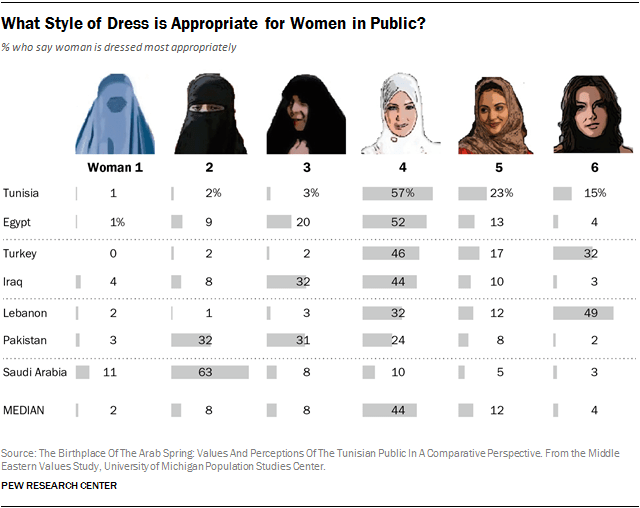
Veiled Judgments

Headgear

Fisher comments on the above chart showing how people in several Muslim countries think women should dress in public:

The result I found the most interesting is the one not on this chart:

how many people in each country say that women have a right to dress how they want. You might expect that countries where people answer “yes” to this would also be the ones where more people say women should go unveiled. But that’s not quite how it lines up. Saudis are much more supportive of this freedom for women than are Egyptians and Iraqis, for example, even though Saudis tend to approve of much more conservative clothing. Here’s how many poll respondents in each country said women should have a right to dress as they wish:

Tunisia: 52%
Turkey: 52%
Lebanon: 49%
Saudi Arabia: 47%
Iraq: 27%
Pakistan: 22%
Egypt: 14%

That last result should be a reminder for us that, even though we often equate the two in the West, a preference for veiling is not always the same thing as a belief that women shouldn’t have the right to choose their own clothing. Piety and feminism are not necessarily mutually exclusive forces. Still, it’s too bad that, even in the countries most supportive of this very basic freedom, only about half support it.