Work-Study Doesn’t Work

Jon Marcus notices that less than half of federal work-study funds actually go to students in need:

[R]esearchers at the Community College Research Center at Teachers College, Columbia University, have found that only 43 percent of students who receive work study meet the federal definition of financial need as determined by whether they also receive Pell Grants. Work study “disproportionately benefits the students who need it the least,” says Rory O’Sullivan, research and policy director at the youth advocacy organization Young Invincibles. A major source of the problem stems from the fact that the work-study program uses a fifty-year-old formula to determine how federal funds are allocated. Unlike other federal financial aid programs that distribute money according to how many students at a university actually need aid, money for the work-study program is based instead on how much a university received the previous year, and how much it charges for tuition. That perpetuates a system under which the universities that get the lion’s share of federal dollars are not the ones with the most low-income students but, rather, those that have been participating in work study the longest and charge the highest tuition. Consequently, nearly half of work-study recipients attend private, nonprofit universities and colleges.

How to fix the problem:

Reformers say the first step would be changing the formula so that work-study funds flow to schools based on how many low-income students they enroll, not how much money they got last year. The second would be allocating more funds, especially for students nearing graduation, to career-focused paid internships off-campus—positions that frequently lead to offers of full-time employment. The third step would be expanding the size of the overall work-study program, perhaps by asking companies that would benefit from more paid internships to underwrite part of the cost.
No One Should Die Because They Didn’t Repost This Meme

FBmeme

Rebecca Rosen highlights a study (pdf) of how one Facebook meme replicated and evolved over the course of two years:

Sometime around early September of 2009, someone decided to show their support for President Obama’s healthcare bill with a Facebook status. It read, roughly:

No one should die because they cannot afford health care and no one should go broke because they get sick. If you agree please post this as your status for the rest of the day.

And more than 470,000 people agreed verbatim. That’s how many people copied and pasted this precise formulation and reshared it. But while copy-and-paste is good enough for some, many people out there changed it. Over the next two years, the “no one should” meme, as Facebook data scientists refer to it in a new paper, would be posted 1.14 million times in more than 120,000 variants. …

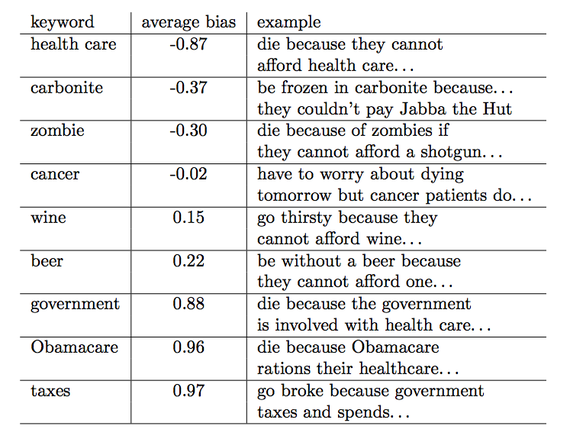
Not surprisingly, the researchers found that the popularity of the assorted “no one should” mutations varied across the political spectrum. Though the meme began as a show of support for President Obama’s health-care plan—a position favored by liberals—conservatives had their fun with it too, sharing status such as “no one should die because Obamacare rations their healthcare” or “no one should go broke because government taxes and spends.” Also popular among conservatives? Alcohol.

(Chart: Average political bias associated with various mutations of the meme. -2 = very liberal; +2 = very conservative; based on user-reported political affiliations in their Facebook profiles.)

The Arab Spring’s One True Success

Michael J. Totten touts the resignation of Tunisian prime minister Ali Larayedh as further evidence of the country’s progress:

Tunisia’s Islamist prime minister resigned [yesterday] and ceded power to a caretaker government. He was not overthrown by guerrillas or by the army, but by peaceful and legal means familiar to citizens raised in democracies. Tunisia is still the model for post-revolutionary politics in the Arab world. I expected as much at the outset and explained why three years ago. Morocco is the only Arab country in the entire world as politically mature. Egypt is an emergency room case, Libya could turn into a failed state if it’s not careful, and Syria is suffering near-apocalypse. Iraq is…well, it’s Iraq.

Noah Rayman is more cautious, pointing to the challenges ahead:

Under the plan, the Islamist-led government will relinquish power to a cabinet of technocrats ahead of a new round of elections. … But a government of technocrats is no panacea for a country at a crossroads. In one of his last moves before announcing his resignation, Larayedh suspended a new tax hike on vehicles after two days of protests in several cities that stirred clashes with police, the latest in a series of demonstrations fueled by the poor economy. More than 15 percent of Tunisians are unemployed, and that figure is even higher in the country’s interior — including the city of Sidi Bouzi, where a disgruntled street vendor set himself on fire in Dec. 2010 and instigated the initial wave of protests that sparked the Arab Spring. International lenders are all the while demanding more cuts to the government budget, which reached nearly 7 percent of GDP last year, according to Reuters.

Tunisian authorities are also combating extremist Islamists who have gained a foothold in the country since the end of the police state under Ben Ali. The military is battling militants in the remote mountains along the Algeria border, and the government has linked the Islamist group Ansar al-Sharia – which the U.S. designated a terrorist group Friday – to a rare suicide bombing in the resort town of Sousse and to two political assassinations in the past year that shook the nation. To make matters more difficult, the technocratic interim government will not have the electoral mandate to tackle Tunisia’s most pressing issues. That means that while Tunisia’s secular opposition will welcome the demise of Ennahdha rule, the country may have to hold out for new elections, still months down the line, before it sees the reforms it badly needs.

Don We Now Our E-Apparel

Daniel Gross doubts the staying power of wearable tech (such as the Dish-covered Google Glass, Pebble, Fitbit, and, most recently, Durr and Tikker):

The real money in technology lies in creating entirely new classes of products, forging new markets, and making people realize they have been missing certain things in their lives. But it’s not clear that wearable technology can be that thing. Sure, the young market could blow to become the next smartphone—a mass industry that creates its own economic ecosystem. Or it could be develop into a series of niche products that add up to a bunch of good businesses and a bunch of failed ones. Or it could be a fad that will fade like the Macarena.

My money’s on the second option. Consider the smartphone.

Sure, skeptics abounded that the expensive iPhone and its imitators would become the new standard. But smartphones represented important innovations to a series of mass behaviors. Before the iPhone came along, people were carrying music around, making phone calls and taking photos, sending email, playing games, and accessing information and services on the internet with hand-held devices. Hundreds of millions of people were accustomed to toting these objects around, plugging them in to recharge them, and using them. Smartphones were just a much better, more convenient, all-in-one version of a bunch of popular devices. Switching to smartphones didn’t require a big change in consumer behavior.

But wearable technology promoters are asking much more of their customers. They are asking them to develop new habits very quickly, and to stick with them. The idea behind many wearable tech products is not simply to sell the hardware, but also to sell services like, say, diet and exercise advice to go along with your Up band. But that requires people to incorporate these gadgets into their daily lives in a way that they haven’t before.

Marcus Wohlsen argues that work, not leisure, is where these devices will make a lasting impact:

Take Eyes-On, the smart glasses Epson made with Evena Medical [featured in the above video]. Designed especially for nurses, the Android-based system lets the wearer, in effect, see through the skin of patients to get a precise real-time map of their veins. Health care workers no longer have to guess where to stick the needle when they set an IV or draw blood.

“It comes down to being relevant by vertical, by job function,” [analyst J.P.] Gownder says, noting Eyes-On is “definitely not” a consumer device. As soon as businesses find a specific way wearables can enhance the work they do, he explains, they will rush to adopt such devices.

Those uses aren’t limited to things so serious as medical care. Gownder gives the example of the cable guy who comes to fix a faulty connection. If a technician can’t figure out the problem, he or she typically has to come back for a second visit. With Looxcie’s Vidcie head-mounted camera, the technician can send live streaming video of the problem to other technicians and get real-time advice on how to fix it. Suddenly, two annoying days spent waiting for the cable guy have been cut to one.

What Climate Change Threatens

Gingrich served up a moronic comment this week:

The age of the dinosaurs was dramatically warmer than this is right now and it didn’t cook the planet. In fact, life was fine.

Ben Adler gets a response from climate scientist Ralph Keeling:

Climate change is not about survival of life; it’s about survival of civilization. Sure, the planet has been warmer than anything we’re probably going to bring about, but that doesn’t mean it’s good.

It has to do with adaptation to a world that’s extremely different than the world today or anything civilization has experienced. [Gingrich] has misrepresented the threat. It’s not that the Earth is going to go up in smoke, or melt down. Life will survive and humans will probably survive. The question is whether the pillars of our civilization will survive: the ability to grow food, the ability to live in peace with your neighbors. If you neighbors can’t live on their land any more because the climate is intolerable, you have a problem. He’s assuming that the transition to a warmer world is harmless and it’s just like picking a flavor of ice cream in a store. You have to live with the transition.

And to my mind, there’s an obvious difference. Humans created this situation. We are devastating countless other species and precious ecologies. And we have absolutely no right to. Our duty is to pass on the planet to the next generation in as livable and beautiful a state as we inherited. Speaking as Gingrich did is to defend vandalism, not conservatism.

Update from a reader:

To be fair to Gingrich, Van Jones’ “cook the planet” was implying runaway climate change wiping out life, and it is an argument that exists out there.  It is kind of important to know that we’re unlikely to hit some sort of geological tipping point that destroys life on earth with global warming; the fact that CO2 levels were much higher in the past is relevant to that; the experiment has actually been performed before.  Climate change will still be catastrophic, but it is worth making the point that we aren’t going to become Venus here.

The New Egyptian Police State

EGYPT-POLITICS-UNREST-MORSI-TRIAL

Lynch shakes his head at Egypt’s growing collection of political prisoners:

Egypt’s security services were able to tap into well-cultivated mistrust of the Muslim Brotherhood at home and abroad to justify its initial crackdown. But the intense animosity between the Brotherhood and many activists shouldn’t mask the reality that the campaign against the “terrorist” Muslim Brotherhood and the campaign against other political activists and independent voices are manifestations of the same political project. Both aim at crushing the culture of protest which overthrew former President Hosni Mubarak and restoring the “normality” of a carefully managed authoritarian regime. The arrests and public defamation campaigns aimed at restoring the fear and disengagement which has always been so vital to maintaining authoritarian regimes. The architects of the coup hoped to rebuild that barrier of fear which had been so famously shattered by the January 25 uprising.

He worries about where things are heading:

Right now, Egypt’s roadmap leads not towards anything resembling democracy or even stability but towards greater repression, escalating insurgency, and continuing political failure. Egypt’s current leadership may dream of becoming a something like a big United Arab Emirates, devoid of Muslim Brothers, street protests, or democratic politics. Instead, it is turning Egypt into a new Bahrain: dependent on Saudi Arabia, controlled by unaccountable security services, riven by increasingly irreconcilable polarization, and with political opponents branded as a vast international conspiracy of terrorists. Meanwhile, the military government seems to think that its problems are best met with public relations campaigns rather than genuine political engagement. Can a highly publicized visit by Kim Kardashian ogling the Pyramids be far behind?

Meanwhile, Mohammad Fadel thinks Egyptian liberals will ultimately regret calling in the military to oust the Muslim Brotherhood:

Responsibility for the revolution’s failure lies primarily with Egypt’s non-Islamist opposition. By appealing to the military to remove the country’s first elected parliament and to exclude the Muslim Brotherhood from political life, instead of organizing to defeat it in peaceful elections, they have sent two profoundly anti-democratic messages to the Egyptian people. First, that only the military is capable of solving Egyptians’ political differences. Second, that the Egyptian people cannot be trusted to elect responsible political leadership. Both of these messages, even more than Islamists’ attempts to impose limitations on rights and freedoms in the name of religion, represent a categorical repudiation of democracy’s fundamental premise: that people are capable of governing themselves, not perfectly, but adequately, and that the people, over time, manage their public life better than any authoritarian institution—military, civil, or religious. Rather than a celebration of democracy, the third anniversary of the January 25 Revolution will be a day for somber reflection.

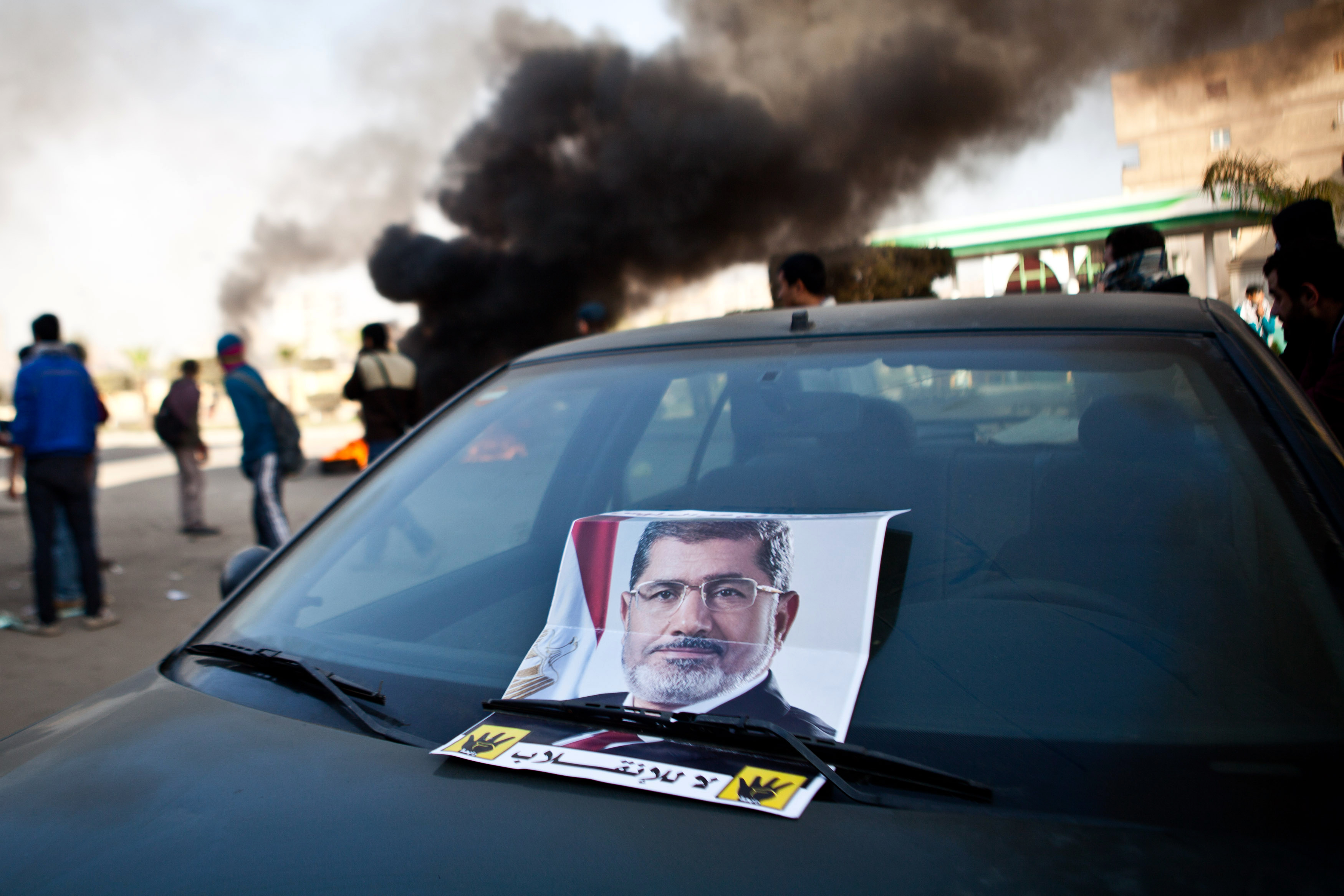
(Photo: A poster of ousted president Mohamed Morsi is seen on the windsheild of a car during clashes between his supporters and security forces in Nasr City, Cairo on January 8, 2014. An Egyptian court adjourned the murder trial of deposed president Morsi to February 1, citing ‘weather conditions’ that prevented his transport to court from prison. By Virginie Nguyen Hoang/AFP/Getty Images)

We Can Afford To Help The Unemployed

The deficit continues to fall:

The Congressional Budget Office this week published its estimates for the finances for the first three months of the fiscal year. Looking at what we know about the first two months, it looks like the government actually ran a $44 billion surplus for December. As a result, according to CBO, the estimated deficit for the first three months of fiscal 2014 was $182 billion—that would represent at 38 percent decline from $292 billion in the first three months of fiscal 2013.

Think about that. Through the first 13 weeks of the current fiscal year, the deficit has declined by $110 billion—or about $8.5 billion per week. The $6.4 billion needed to extend unemployment benefits represents about five days of deficit reduction.