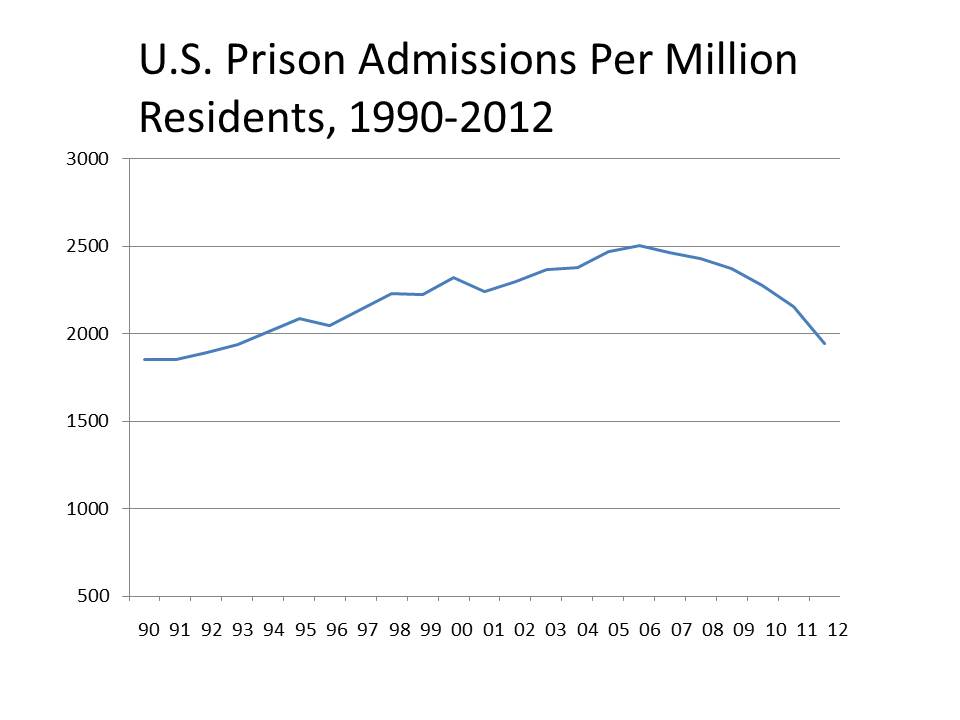
When President Obama was elected, the rate of prison admission was just 3% below its 2006 level, which was very probably the highest it has ever been in U.S. history. But by the end of Obama’s first term, it had dropped to a level not seen since President Clinton’s first year in office.
Drug-related imprisonments are especially down. In 1991, for example, 23% of the prisoner’s sentenced for more than one year were sentenced for drug related reasons (including 8.2% for drug possession). In 2011 only 16.6% of imprisonments for more than one year were for drug-related reasons (including 4.1% for drug possession.) This trend is likely to continue with further drug legalization.
Incarceration rates are way down for men in their teens and 20s, who grew up in the relatively lead-free post-1990 environment. But for older men, who grew up before then, incarceration rates are actually up. Lead did its work on them long ago.
In a lengthy profile of Evgeny Morozov, Michael Meyer devotes some space to criticism of his contrarian style:
Many of Morozov’s opponents dismiss him as a spoiled child, someone who sits in the corner refusing, as Tim O’Reilly once said, to be “useful,” shouting insults at the adults as they role up their sleeves and solve the world’s problems. Reviewing Morozov’s second book in The Washington Post, Columbia law professor Tim Wu spoke of Morozov’s “promise” as a thinker before lamenting, “One suspects he aspires to be a Bill O’Reilly for intellectuals.” Morozov faces similar criticism even among his supporters. He once defended his style by saying, “We’ve got too many priests and not enough jesters,” an explanation Joshua Cohen, the Stanford professor who brought Morozov to Palo Alto on a fellowship and published some of his earliest long-form work in Boston Review, told me is “bullshit. There’s a vast open field between priests and jesters.”
Morozov insists that his refusal to be useful is its own kind of usefulness—and even, as he recently wrote in one of his essays for German newspapers, an intellectual duty. Traditionally, this is an uncontroversial definition of the role of the critic in intellectual life. But not in the relentlessly sunny realm of the tech gurus, where such obstinance must be baffling, even perverse. The current discourse around digital technology is more nuanced than the caricature Morozov often presents, but its defining idea is that we are living through a benevolent revolution, and that we’re all united by good intentions as we search for new models for our economy and our lives. In this culture of mutual validation, Morozov’s targets are the makers, the innovators, and the disruptors—the people doing, as frequent Morozov punching bag Jeff Jarvis put it, “God’s work.”
Did you know the US has a “Space Fence” to keep debris from colliding with spacecraft and satellites? Or at least we had one …
The Space Fence – which, despite its name, consisted of operational facilities on the ground, across the southern United States – [has] been shut down. In more than 50 years of operation, it had played a key role in the Space Surveillance Network, set up by the U.S. military to track man-made debris, and help keep valuable satellites and spaceships from smashing into it. According to the Air Force Space Command, which ran the network, the shutdown was made necessary by the 2013 budget sequester and will save $14 million per year in operating expenses. But some argue that the shutdown has reduced the capability of an already imperfect surveillance system, potentially increasing the risk of a costly collision. …
To make up for the shutdown, the Air Force Space Command directed two other radars – in North Dakota and Florida – to pick up the slack. However, because these stations are each based in a single location rather than spread out across the country, they cover less of the sky than the Space Fence did. This reduced coverage has led to “a loss when it comes to detecting and characterizing events like breakups,” said [space security expert Brian] Weeden. “You can’t predict when those kind of events are going to happen. It may be that we don’t have any major collisions over the next five years, and therefore it’s not a big deal. It may be that we have a bunch of them, and it’s going to be a really big deal.”
Ann Hulbert questions whether the much-touted flexibility of community college education is doing students a disservice:
If you stop and think about it, the existing postsecondary educational hierarchy could hardly be more perverse. Students at the bottom, whose life histories and social disadvantages make them the most likely to need clear guidance and structure, receive astonishingly little of either. Meanwhile, students at the super-selective top, prodded toward high ambitions and disciplined habits by attentive parents and teachers ever since preschool, encounter solicitous oversight every step of the way.
Take Harvard, where the rising elite chart their paths within well-designed parameters: the college offers a bachelor’s degree in 48 academic fields only to full-time, residential students, who must also fulfill carefully articulated general-education requirements. Their first-year experience unfolds under the supervision of an entire team—a freshman adviser, a resident dean of freshmen, a proctor, and a peer-advising fellow. Residential house tutors and faculty advisers lend support later. Compare that with nearby Bunker Hill Community College, as Judith Scott-Clayton, a professor at Teachers College, Columbia University, has done. Students there choose from upwards of 70 full-time or part-time associate’s-degree or certificate programs, in more than 60 fields, then figure out their ideal course load, and how to best mix online and in-person classes. As to plotting a course of study and then staying on it, community-college students are largely on their own. Student-adviser ratios in the two-year sector are abysmal in many schools: they can run as high as 1,500-to-1. And while spending per student has risen over the past decade at every kind of four-year institution—private, public, research, undergraduate—it has remained all but flat in public community colleges. A surer formula for widening the gap between the haves and the have-nots—at least while still paying lip service to ideals like opportunity and meritocracy—would seem difficult to devise.
Readers continue to sound off on Peter Jackson’s The Desolation Of Smaug:
Charm is an essential secret to The Hobbit, and to some extent The Lord of the Rings. Tolkien’s myth depends on the response of ordinary creatures to horrific threats against their comfortable lives. The hobbits prove uncommonly strong and resistant to harm because they carry the warmth of their home inside them, and they repeatedly summon its charms in the darkest times, while facing the most dangerous foes. Surely Tolkien understood deeply the importance of such inner resources from his experiences as a soldier in the trenches of World War I.
Jackson’s Lord of the Rings conveys the very English charm of the Shire and its inhabitants beautifully and consistently. It helps that Jackson’s own love of his New Zealand home continually comes across in those movies. In contrast, the first Hobbit movie unsuccessfully tries to pack most of its charm into the first dorky meal with the dwarves, and the second film is practically bereft of charm. I could forgive all of Peter Jackson’s additions and vanity if it weren’t for this. In trying to fashion a more epic Hobbit, he lost the basic warmth at the heart of Tolkien’s work.
More readers get deep into the nerdom:
All these people talking about how The Hobbit movies are horrible but the LOTR movies were great are complete loons. The LOTR movies were terrible. Yes, they were lovely to look at, and the visuals were nicely done and accurate, and film isn’t print, accommodations for the different medium, blah, blah, blah. Fine. But Jackson was so obviously tone-deaf about what Tolkien was trying to do in his creation of a faerie land that he misses the really important things for the sake of his own grandiose vision of mayhem in Middle New Zealand. Three simple for-instances:
1) Faramir. For Tolkien, Faramir is the explicit anti-Boromir. Two brothers. One wants to wield the ring for himself; one refuses to touch the ring. Two brothers with different approaches, different relationships with their father, and different ends. It’s an important contrast in the novel that Jackson doesn’t merely elide, he actively destroys by making Faramir the same kind of ring-stealing power-monger as Boromir. Egregious assassination of an important moral compass point so that he can slip in footage of Osgiliath.
2) Aragorn. For Tolkien, Aragorn is a pure hero cut from the Anglo-Saxon cloth of Beowulf (of whom Tolkien was an eminent scholar). Remember Beowulf? “Hey, I hear you have a monster problem. I have the strength of 30 men. I’ll fix it for you.” So Tolkien’s Aragorn–a hero who never doubts his heritage or his calling, who takes the palantir to issue a direct challenge to Sauron, who wins and is crowned king. “I am Aragorn, son of Arathorn, heir of Isildur. I will claim what is mine by right.” Contrast Jackson’s maudlin, conflicted, postmodern, wimpy man. Every orc in the trilogy has more balls. Heck, his girlfriend has more balls.
3) Elrond. Ugh. By the blazing flames of Sammath Naur, how do you cast Agent Smith as Elrond?! If you want a scary psychopath, why not cast Jack Nicholson? I mean, what the hell? Do you have any idea who this character is? He’s not a bitter, racist, computer virus, that’s for damn sure. “He was as noble and as fair in face as an elf-lord, as strong as a warrior, as wise as a wizard, as venerable as a king of dwarves, and as kind as summer” (Tolkien, The Hobbit). GAH!
The LOTR movies were absolutely awful adaptations of Tolkien. The Hobbit movies, by contrast (well, I’m seeing the second tonight), at least have the characterization mostly right. I can live with interpolated ass-whuppins and all the Hollywood if you respect the characters. The Hobbit is a simpler story with simpler, less noble characters and so suffers less from Jackson’s ignoble depredations.
Another reader:
Count me enraged that Jackson didn’t stick to the text and show the barrels bobbing quietly down the river for a few minutes or even an hour. Who needs action in a film when there’s confined space and waterlogged dwarves to depict? And I’ll take my Tolkien films without any female roles, thank you very much – who needs romance or intrigue when you can wonder how all those sweaty beardos relieved their sexual energies? AND WHERE’S THE CRAM?! We got all kinds of lembas in LOTR, but Jackson chooses to discriminate against dwarven baking traditions and thereby defaces the Hobbit, which, by the way, corresponds exactly to a 52-minute film and not a moment longer. Boycott New Zealand!
One more:
First, I understand that people think this is a bad adaptation of The Hobbit. But Tolkien himself recognized that The Hobbit was inconsistent with his later works and tried to rewrite it. He made changes to “Riddles in the Dark,” turning Gollum from a fair-minded game-player to a cheating, evil sneak to reflect the corruption of the Ring. Things like Bilbo revealing the existence of the Ring, Smaug’s apparent ignorance of its presence (when even petty Orcs could detect its power in the Pass of Cirith Ungol), casual mentions of stone-giants, Beorn as a whole, the silliness of Dwarves in the early chapters … so much is dissonant with The Lord of the Rings and the legendarium in general.
What Jackson’s attempting to do is make a film that’s consistent with the Lord of the Rings films. That added bit where Bilbo goes berserk over the Ring, then claims it (“Mine”), and then nearly vomits? That is consistent with the Ring and its power. A plan for which a burglar makes sense (as Bilbo’s original role was going to be to steal all of Smaug’s horde, apparently one bag at a time over dozens of years)? Far more consistent with the Dwarves as we are shown them in LOTR and especially in the appendices to Return of the King.
Cory Olsen, a.k.a. the Tolkien Professor, has an excellent two-part podcast reacting to this. I think his first half, where he addresses many of the common criticisms (“X change was made to make money,” “They changed it and it sucks solely because it’s different,” etc.) is very valuable. I think his second half has a great perspective, even if I don’t agree with much of what he says, especially with regard to Tauriel. But his larger point that Jackson may have created a more thematically consistent work than Tolkien did is an interesting one. You can find the podcast on iTunes. I particularly recommend the Silmarillion seminar, as it brought me to a whole new appreciation of the work.
Daniel Gross cheers the hikes that just went into effect:
[S]tarting in 2014, the minimum wage will rise in a big chunk of America—in 13 states and four cities, to be exact. Let’s review. In New Jersey (population 8.9 million), a constitutional amendment approved in November bumps the stage minimum wage up to $8.25 an hour and stipulates that it should rise every wear with inflation. In New York State (population 19.95 million), the minimum wage is rising to $8.00. In Connecticut (population 3.6 million), the minimum wage is set to rise from $8.25 to $8.70 per hour. In Rhode Island (population 1 million), the minimum wage is going up to $8.00. In July, California (population 38 million) will increase the minimum wage to $9.00. In nine other states, where the minimum wage is indexed to inflation or the cost of living, the floor under salaries will also be rising by small amounts. These include places where lots of Americans live, like Florida, Ohio, Colorado, Washington, and Arizona.
Now, only a small minority of the American workforce works for the minimum wage. But these legislative acts are nonetheless important. They will force companies to pay some existing employees more – often significantly more. They’ll push companies to raise the wages of those earning just above the current minimum wage. Most importantly, they set a higher standard for businesses. In effect, these states are telling companies, large and small, that if they want to operate in certain very large jurisdictions, they will have to design their operations in such a way that allows for slightly more decent compensation.
Given the current level of the minimum wage, the result of a small increase probably would not be catastrophic. For example, a study by Michael Hicks of Ball State University looked at the impact of the July 2008 minimum-wage increase in the United States and concluded that a 10 percent increase in the minimum wage results in a roughly 0.19 percentage-point increase in unemployment, meaning the loss of about 160,000 jobs.
But it is also important to understand that an increase in the minimum wage would not be taking place in isolation. Many businesses are already having to absorb a de facto increase in the minimum wage because of Obamacare. In 2015, businesses with more than 50 employees will have to provide health insurance to their workers or pay a $2,000 – 3,000 penalty. For a midsize employer that doesn’t offer insurance today, that amounts to roughly a $1 per hour increase in a minimum-wage employee’s compensation. And even those employers that provide insurance today will find their per-employee costs increasing as Obamacare drives up their premiums and requires that they provide more comprehensive and expensive insurance than they do now. Increasing the minimum wage on top of this would almost certainly have a significant impact on employment.
Caroline Baum sees a natural experiment in the making:
One thing is certain: Academics of both political persuasions will be closely monitoring the results, adjusting the numbers and reporting their findings. It’s about time the 20-year old Krueger-Card study of the fast-food industry in New Jersey and Pennsylvania had some data competition.
I might as well use the occasion to mention a couple of things that really stood out for me over the Christmas season. The first is the Chinese government’s account of how the fat little tyrant in North Korea murdered his uncle. In the Hong Kong newspaper, Wen Wei Po, a mouthpiece for Beijing, this was the story:
Unlike previous executions of political prisoners which were carried out by firing squads with machine guns, Jang was stripped naked and thrown into a cage, along with his five closest aides. Then 120 hounds, starved for three days, were allowed to prey on them until they were completely eaten up. This is called “quan jue”, or execution by dogs. The report said the entire process lasted for an hour, with Mr Kim Jong Un, the supreme leader in North Korea, supervising it along with 300 senior officials.
I don’t know how substantiated this is, but it seems to be what the Chinese leadership believes, which cannot bode well for the vile mass murdering regime in Pyongyang.
Then an utterly unrelated small piece of courage in the face of nasty homophobia. Josh Barro is a friendly acquaintance of mine, and we’ve had him in for some Ask Anythings. He took on the moronic Duck Dynasty nonsense and received a bunch of emails, of a kind I used to get by the bucketful but have eased up of late. One Facebook commenter, Lynn, was a classic of the genre and Josh had the balls to take her on. Read the whole response here. Money quote:
“I assume you have sex with other men, right?”
You’re pretty insightful there, Lynn.
“What do you and your male partner do during sex?”
Most of the things you’re imagining and a number of things you probably haven’t thought of.
“Do you let them perform anal sex on you?”
Sometimes, sure.
“Do you perform oral sex on them? Do you let them cum in your mouth?”
I sometimes do all of these things, yes.
“I would think you’d feel degraded by these acts. On the other hand, if the roles were reversed, you might feel like you have power over them. Do you feel degraded or powerful or is it just as exciting either way?”
Sometimes sex has a significant power exchange component, which can be great in either the dominant or the submissive role. But usually it’s more egalitarian than that. Getting fucked can be degrading (in a fun way) but it doesn’t have to be.
I just want to say this kind of completely frank, unapologetic description of sex between two men really shouldn’t be so refreshing, but it sure is. Having Josh out there taking names makes the world a better place.
As for today, I took a sledgehammer to the current theocon/neocon nonsense that Pope Francis’ disdain for the false idol of ideologized market capitalism somehow only applies to Argentina. We celebrated the dawn of legal pot in Colorado and near-universal health insurance in the US. Charlie Brown got punk’d; mayo got its due; and America continued to tell tourists to go away.
(Photo: Winds whip snow from the beach across Winthrop Shore Drive January 2, 2014 in Winthrop, Massachusetts. An overnight blizzard is due to hit along the Northeast U.S. with six to twelve inches of accumulation expected in the Boston area along with coastal flooding. By Darren McCollester/Getty Images.)
Erik Vance reminds us of the enormous toll of cocaine trafficking:
I submit that the drug trade—and specifically cocaine—is among the worst things that the human mind ever invented (which is saying a lot, since we are especially good at inventing horrible things). No one has good numbers on the death toll of a given drug trade. I called and asked a few think tanks how many people cocaine has killed over the past 100 years and got mostly bemused laughs. Ioan Grillo, author of El Narco: Inside Mexico’s Criminal Insurgency, has thought about this as much as anyone. When I asked him, all he could guess was a number with nine figures in it.
Just for fun, let’s try a back-of-the-envelope calculation. Around 60,000 were executed as witches during 150 years at the height of the Spanish Inquisition. Mexico alone has seen perhaps twice that many deaths during its seven-year drug war. From 1990 to 2010, Colombia had some 450,000 homicides, overwhelmingly due to coke. Add all the rest of Latin America (counting all the military actions that were driven by efforts to control trafficking routes as much as by politics), the U.S. share (15,000 per year on the high side, counting all kinds of drugs and overdoses and such). Now add an estimate of all the uncounted murders and overdoses and track that carnage back to the 1960s when the modern drug war began. The number starts to be in the league of the atrocities of Nazi Germany or American slavery.
He concludes provocatively, “So yes, I say that paying for coke is equivalent to donating to the Nazi party.” Meanwhile, Russell Crandall wonders whether legalization is as good a solution as many critics of the drug war claim:
The big question is whether the legalization of marijuana provides a model for controlling other drugs, like cocaine. Should we legalize all drugs, everywhere? Or, as some other pot legalization supporters contend, should marijuana be legalized but not other harder drugs? If that’s the case, then, at least for now, do Colorado, Washington, and Uruguay fall into the category of boutique reform in that they represent a one-off solution to marijuana but little else? …
[T]here were legitimate reasons why the United States (and often its Latin American allies) clamored to escalate the war on drugs: because drugs destroy societies. Demilitarization and legalization might be the way out or at least certainly preferable to the status quo. But we should also be prepared for the consequences. Alcohol consumption decreased dramatically during Prohibition and increased again after its repeal. Alcohol-related deaths also plummeted during the dry years. This is not to argue that repealing Prohibition was not wise or preferable, but these statistics are a reminder that punitive approaches (the very core of the supply side strategy) cannot be blithely dismissed. The notion that the drug war can simply be reformed through legalization writ large remains fanciful until more specific details are developed and successfully implemented.
(Photo: Closeup on one of the corpses of two murdered men found near the Costera Avenue in Acapulco, Mexico, on February 5, 2011. By Pedro Pardo/AFP/Getty Images)
Speaking of plaques in space, you might be interested in the [above] video. It’s a little YouTube production I threw together using a radio interview I conducted during my undergrad days in J-school. I had taken a “History of Space Flight” course taught by Hans Mark at the University of Texas at Austin. That’s where I heard him recount the story of Carl Sagan calling him up and pitching the idea of fastening a plaque to Pioneer 10 to potentially someday communicate with an alien intelligence.
Another reader:
There is another name missing from both the moon plaque and the Space Mirror Memorial. And her death was known about at the time. Her name is Laika:
Laika, a stray dog from the streets of Moscow, was originally named Kudryavka (Кудрявка, Little Curly). She underwent training with two other dogs, and was eventually selected to be the occupant of the Soviet spacecraft Sputnik 2 that was launched into outer space on November 3, 1957.
Laika died within hours after launch from overheating, possibly caused by a failure of the central R-7 sustainer to separate from the payload. The true cause and time of her death were not made public until 2002; instead, it was widely reported that she died when her oxygen ran out on day six, or as the Soviet government initially claimed, she was euthanized prior to oxygen depletion.
The experiment aimed to prove that a living passenger could survive being launched into orbit and endure weightlessness, paving the way for human spaceflight and providing scientists with some of the first data on how living organisms react to spaceflight environments.