Chart Of The Day

Convention Against Torture

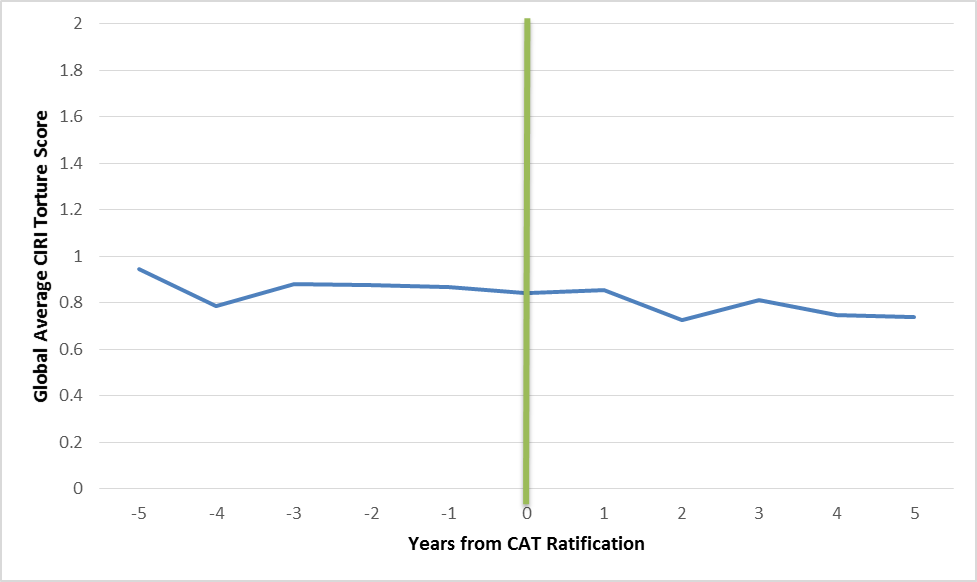
Eric Posner, writing at his new blog, presents a depressing graph on the effects of the Convention Against Torture:

The line shows the average torture score for countries during the five years leading up to ratification and the five years following ratification (where 0 refers to frequent torture and 2 refers to no torture). If the average country had reduced torture during this period, then the line would have sloped up.

But in this period, America became a torture camp on a hill, just as the Founders dreamed it would be.

You Can’t Program Creativity?

Alex Knapp declares that pursuing the arts is a far more useful way to develop creative skills than learning to program computers:

[T]he best way to harness the power of computers doesn’t reside in coding – it resides in letting computers do the grunt computational work that humans are bad at, so that humans can focus on the creative, problem solving work that computers are bad at. And if you want to foster those creative, problem solving skills, the solution isn’t learning to code – it’s learning to paint. Or play an instrument. Or write poetry. Or sculpt. The field doesn’t matter: the key thing is that if you want to foster your own innovative creativity, the best way to do it is to seriously pursue an artistic endeavor.

In the history of the Nobel Prize, nearly every Laureate has pursued the arts. According to research by psychologists Michele and Robert Root-Bernstein, “almost all Nobel laureates in the sciences actively engage in arts as adults. They are twenty-five times as likely as the average scientist to sing, dance, or act; seventeen times as likely to be a visual artist; twelve times more likely to write poetry and literature; eight times more likely to do woodworking or some other craft; four times as likely to be a musician; and twice as likely to be a photographer.”

Recent Dish on learning coding here, here, and here.

From The Annals Of Paranoia

The Egyptian government is investigating puppets:

On New Years’ Day, Vodafone, a mobile-phone operator, felt obliged to issue a statement denying that an advertisement it had produced, featuring Muppet-like dolls, carried any subversive messages. The denial followed allegations, aired on a television talk show, that the advert contained imagery and words suggesting that a coded message was being issued to Islamist terrorists.

Given an intensified campaign against the ousted Muslim Brotherhood by Egypt’s army-backed government, and given the loyalist Egyptian press’s fevered efforts to cheerlead the witch hunt, it was not surprising that many viewers took the allegations seriously. Some noted that a cactus that appeared briefly in the cheaply made three-minute clip had four branches, suspiciously similar to the four-fingered salute that became a symbol for Brotherhood supporters after hundreds were killed during police operations to clear a protest sit-in in Cairo. The cactus represented bitterness and resistance, asserted one commentator, while another remarked that a Christmas ornament hanging from the cactus suggested a bomb. …

By and large, Egyptians have poured scorn and ridicule on all this silly talk. Not, however, the government. The country’s prosecutor general has formally tasked the state security prosecution service, a feared branch that handles terrorist cases, with carrying out an urgent and thorough investigation.

Any translated summary of the ad from an Arabic-speaking Dishhead would be much appreciated. The suspect puppet – Abla Fahita, the one in the curlers – took to national television to defend herself yesterday. Juan Cole looks at the bigger picture:

The Egyptian state has long been peopled by people obsessed with weird conspiracy theories. That kind of thinking is encouraged by dictatorship. It is transparency that cuts down on paranoia. Unfortunately, Egypt’s brief fling with democracy did little to dispel the conspiracy theory mindset on the part of high officials and television hosts.

In early fall, there was the case of the spy stork, when a tracking tag was mistaken for an espionage device on a stork. Although the bird was exonerated from treason charges, it was nevertheless eaten in captivity. Then there had been in the last year of the Mubarak era the allegations that sharks attacking swimmers in the Red Sea might be Mossad agents of Israeli intelligence.

Mind you, the military government has jailed journalists for alleged incorrect reporting (three Al Jazeera correspondents were recently detained) and spreading false information is one of the grounds given for the recent ban on the Muslim Brotherhood.

Because Who Has Time To Read An Abstract?

Miles Klee is delighted by the tumblr LOL My Thesis, where students share bite-sized summaries of their scholarship:

A young lady of the history and gender studies departments at Smith, for example, delivered hard proof of this claim: “Basically, Beyoncé can do anything.” A cognitive scientist at Boston University, meanwhile, discovered that people “don’t like electrodes stuck to their head while you flash epilepsy-inducing lights at them.” As banal and depressing as these synopses seem, there are also plenty of profound statements to mull over. An student of English at the University of Victoria summed up an immersive literary experience in a fairly incredulous tone: “You can write a 120-page thesis on a 119-page book.” …

Thankfully, for the doggedly curious among us, some posts now include a link to the actual thesis. We just wish that were the case for one brave individual’s treatise on dinosaur poop.

Update from a reader:

LOL My Thesis is OK, but there’s a more refined version that’s existed for years: Dissertation Haiku. I think you have to work a little to get a haiku with more than 140 characters.

Face Of The Day

US-WEATHER-STORM

A boy pulls his cap over his face as he walks near Central Park bundled against the cold in advance of a winter storm on January 2, 2014. The northeastern United States prepared Thursday for snow, high winds and frigid temperatures, as a gust of wintry weather bore down on New England and surrounding states, cancelling flights. Temperatures in New York were expected to drop to 10 degrees Fahrenheit with a windchill factor of minus nine degrees Fahrenheit, according to national weather forecasts. By Stan Honda/AFP/Getty Images.

Death By Mental Ilness

How it kills:

“[Mentally ill patients] don’t die from drug overdoses or commit suicide—the kinds of things you might suspect in severe psychiatric illness,” said Sarah M. Hartz, the study’s lead author. “They die from heart disease and cancer, problems caused by chronic alcohol and tobacco use.”

The study looked at about 20,000 people, split down the middle between a healthy control population and people suffering from schizophrenia, bipolar disorder, schizoaffective disorders, and/or major depression. Probably the most striking numbers have to do with smoking: over 75 percent of patients with major mental illness smoke cigarettes, compared to 33 percent in the general population.

Continuing on down the line, 50 percent of the mental illness pool smoked pot, compared to 18 percent in the general population, while 50 percent of the mental illness group used other illicit drugs, compared to 12 percent in the control group. Binge drinking: 30 percent vs. eight percent.

Condi And Colin: War Criminals Too

Steve Coll leafs through the new memoir by John Rizzo, a former CIA lawyer familiar with the Bush administration’s torture program. I noted earlier how Rizzo claims the president had no idea what was being done to prisoners, which gives us a whole new level of presidential negligence in the Bush years. But so many others were briefed in detail. Coll is most interested in how “Rizzo provides an eyewitness account of how the early brutal interrogation sessions were described in detail to President George W. Bush’s leading national-security advisers in the Situation Room”:

As [CIA director George] Tenet described, case by case, how the C.I.A. used waterboarding and other harsh methods on its Al Qaeda detainees, the White House chief of staff Andy Card and General Richard Myers, the chairman of the Joint Chiefs of Staff, “would sit there stoically,” Rizzo writes. Attorney General John Ashcroft “was mostly quiet except for emphasizing repeatedly that the E.I.T.s were lawful.” Defense Secretary Donald Rumsfeld “was notable more for his frequent, conspicuous absences…. It was quickly apparent that Rumsfeld didn’t want to get his fingerprints anywhere near” the C.I.A.’s interrogation program. Condi Rice seemed “troubled by the fact that the detainees were required to be nude when undergoing some of the E.I.T.s. Colin Powell, on the other hand, seemed to view sleep deprivation as the most grueling of all the techniques.”

None of these senior Bush Administration decision-makers has yet provided a full or thoughtful account of their recollections, emotions, or practical analysis in endorsing the C.I.A.’s interrogations. This forgetting is a bipartisan phenomenon. Agency officials briefed Nancy Pelosi in September, 2002, about waterboarding that was then underway, notes of that meeting show, but Pelosi later claimed that she had heard no such thing. Other senior Democrats who were briefed about brutal C.I.A. interrogations in 2002 and 2003 have suffered from similar impairments.

At some point, we will find out how many of America’s leadership were fully apprised of and complicit in widespread war crimes that, if they had occurred in any other country, the US would now be prosecuting under the Geneva Conventions. Yes: Colin Powell sat there and was briefed on ending two centuries of the American prohibition of torture or anything even approximating it. And he, representing the finest traditions of the US military and its honor, did not resign. He, Pelosi and Rice are as deep in this as Rumsfeld, Cheney, and Addington. And one day, even if it’s posthumously, they will be brought to justice.

A New Era Of Freedom Begins Now

Legal Sale Of Recreational Marijuana Begins In Colorado

Two relatively muted stories – amid countless loud, alarmist, partisan distractions – shone through the new year’s haze for me, at least. They’re not “news” – both were highly expected. But they are what most will look back on in this period in history and take note of.

The first – and easily the most significant – is that millions of previously uninsured Americans can finally get some health insurance. Yes, there are going to be glitches; and yes, there are going to be costs, as well as benefits. Yes, the ACA is far from perfect. But for those without the ability to afford health insurance and not poor enough to be on Medicaid – i.e. the very struggling working poor both parties claim to care about – the relief must be simply overwhelming. One simple anecdote:

Kathy Hornbach of Tucson is not wasting any time before using her new health insurance coverage, which took effect on New Year’s Day. Ms. Hornbach, 57, has an appointment with a cardiologist on Thursday for a stress test. “I’ve had some heart palpitations, and my mom’s side has a history of heart problems starting early,” she said Wednesday in a telephone interview. “So it’s mostly just to double-check that everything is O.K.”

I may be biased, as I have long managed a chronic illness and know what it’s like to fear the loss of health insurance, especially if, like me, you’ve decided to go out on your own and start your own small business. So let me second that. The relief I personally feel as someone who is HIV-positive is overwhelming. I don’t want to put a price on it. Because it is actually a rare event that is priceless. The Obama administration has both repealed the HIV ban on travel and immigration – removing the most crippling psychological fear I labored under for close to twenty years – and also removed the chance that I could one day go bankrupt trying to stay ahead of a deadly virus.

But I’m also encouraged that I will no longer be punished for entrepreneurship with fear of losing health insurance, a punishment the Republican party apparently wants to restore indefinitely. I may also be biased, having grown up in a country with a once substandard and still far from ideal socialized system. But I love America’s free market in healthcare – and believe, despite Republican hostility, that this reform simply extends much of that to many, many more people. Why can we not celebrate that milestone? Politics does not always lead to a tangible increase in many people’s peace of mind, security and health. This time and this year – thanks to president Obama – it has.

Then we go to Colorado, which yesterday marked another astonishing step forward for humane sanity. Anyone can now walk into a dispensary and buy a plant less harmful than alcohol, far less dangerous than nicotine, and a boon to many people dealing with tough chronic illnesses. So fitting, I thought, that the first purchaser was a veteran of the Iraq War:

The first sale, orchestrated as a news media photo opportunity, was made to Sean Azzariti, an Iraq War veteran who has lobbied publicly for legalization and says pot helps mitigate problems stemming from his post-traumatic stress syndrome. Azzariti, who served six years in the Marine Corps and two tours in Iraq, spent about $60 at 3D Cannabis Center for an eighth of an ounce of “Bubba Kush” and a pot-laden truffle.

Now, of course, the Obama administration has next to nothing to do with this, and its reluctance to grapple with this issue has been Clintonian in its caution. But they have not stopped this, as a Romney administration would have. For me, both reforms mean a tangible increase, not decrease, in the freedom of Americans. Without your health, freedom to do anything is impossible. Without reliable health insurance, entrepreneurship is discouraged, job mobility is frozen, and economic dynamism is restrained.

And now, with Americans able to use a drug – already ubiquitous – without draconian, pointless and racially unjust prohibition, we have another small burst of freedom. Neither of these developments was inevitable. Both remain fragile. But if you care about real freedom – and not an abstract, ideological version of it – this is a day for celebration, not cynicism, for hope, not depression.

(Photo: Sam Walsh, a budtender, sets up marijuana products as the 3-D Denver Discrete Dispensary prepares to open for retail sales on January 1, 2014 in Denver, Colorado. Legalization of recreational marijuana sales in the state went into effect at 8am yesterday morning. By Theo Stroomer/Getty Images)