How To Repel Tourism

Require visas:

Looking at 188 countries around the world, [Robert] Lawson and [Saurav] Roychoudhury examined which ones require people to apply for a visa before they visit. Then they studied how many tourists travel from one country to another. Allowing for factors such as population, income, the size of bilateral trade, economic policies, a measure of democracy, and an indicator of world-class sites of cultural importance, they found that tougher visa requirements imposed on potential visitors from a given country are associated with considerably less tourism from that country. In short: Demanding a visa from a country’s travelers in advance is associated with a 70 percent lower level of tourist entries than from a similar country where there is no visa requirement. The U.S. requires an advance visa from citizens of 81 percent of the world’s countries; if it waived that requirement, the researchers estimate, inbound tourism arrivals would more than double, and tourism expenditure would climb by $123 billion.

This may seem trivial, but it isn’t with respect to American soft power. Most Dishheads are American citizens, so they don’t fully see what it is like to enter the US as a non-citizen. It’s a grueling, off-putting, frightening, and often brutal process. Compared with entering a European country, it’s like entering a police state. When you add the sheer difficulty of getting a visa, the brusque, rude and contemptuous treatment you routinely get from immigration officials at the border, the sense that all visitors are criminals and potential terrorists unless proven otherwise, the US remains one of the most unpleasant places for anyone in the world to try and get access to.

And this, of course, is a function not only of a vast and all-powerful bureaucracy. It’s a function of this country’s paranoia and increasing insularity. It’s a thoroughly democratic decision to keep foreigners out as much as possible. And it’s getting worse and worse. Since I first came here in 1984, it’s a different world. Clinton’s 1996 law made matters far worse; 9/11 did the rest; and the Obama administration hasn’t changed much of anything.

Hold The Mayo

While documenting the history of the anti-mayonnaise movement, David Merritt Johns considers the nature of taste and revulsion:

Mayonnaise contains an animal product, it is reminiscent of pus or semen, and it is remarkably slimy and jiggly. … But vanilla ice cream and pudding are also jizzlike slimes, and they arouse little animus; ketchup is cherished despite its likeness to blood. And scholars have long noted that revulsion can rarely be reduced to sensory factors alone. Charles Darwin commented on the social aspects of taste in his 1872 The Expression of the Emotions in Man and Animals: “In Tierra del Fuego a native touched with his finger some cold preserved meat which I was eating at our bivouac, and plainly showed utter disgust at its softness; whilst I felt utter disgust at my food being touched by a naked savage, though his hands did not appear dirty.”

Darwin’s observations hinted at an idea upon which revulsion scholars generally agree: Disgust is largely a cultural phenomenon. Infants don’t seem to experience it. Tiny children will tolerate unholy decay odors, and experiments show many will happily eat imitation feces (made with stinky cheese) or quaff glasses of juice in which (sterilized) grasshoppers bob like ice cubes. From centipedes to boogers, the grossout response is a learned one. Its latent purpose is often to distinguish friend from foe, and pass judgment on the habits of others. (To wit: As one informant bluntly told me, “Let’s be honest: Mayonnaise is a fat man’s food.” …

Journalism And Power

In an excerpt from his new book, The Watchdog That Didn’t Bark, Dean Starkman contrasts accountability journalism with access journalism. Perhaps the best way to distinguish between the two is that one form of journalism seeks access to power and the other kind of journalism seeks to make power uncomfortable. We all know which one is losing. Mike Allen loves the powerful and does all he can to broadcast their messages and stroke their egos. He is the icon of the new era of court stenographers masquerading as journalists. But if you’re looking for a journalism that holds the powerful accountable, you’ll have to look outside their circle of supine friends and suck-ups.

CJR’s editors chime in:

This debate is not about the use of hot words, like “torture.” It’s about whether journalism perceives as its core mission holding power to account. If it doesn’t, then the DealBooks and Playbooks of the world will always win the day. If it does, then the access-accountability polarity should be the defining measure of journalism’s merits.

Oh, for the days of disreputable hacks. No media elite dinners for them.

A Smaller, Broader Federalism

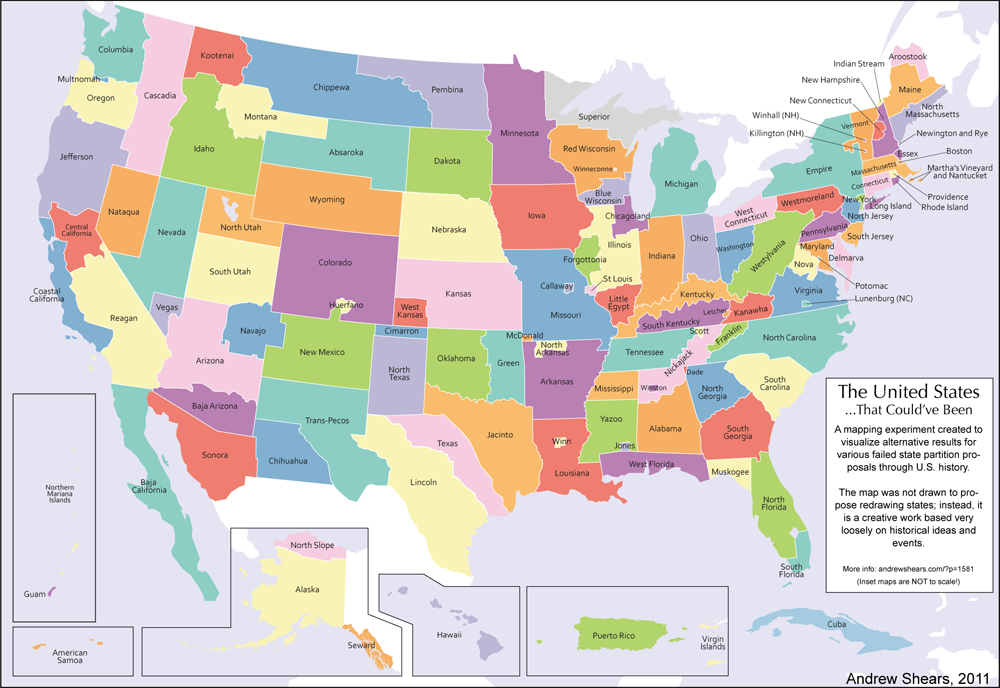
124states

This map, created by geography professor Andrew Shears in 2011, has been making the rounds. It imagines the US if its various secession movements, partition proposals, and other attempts to redraw state boundaries throughout our history had succeeded. Ozimek imagines the economic advantages of having 124 states instead of 50:

1. Competition between the states be higher as more people would be able to move to a different state and accompanying state government by moving much less distance, e.g. a lower cost of switching.

2. There would be more experimentation, and thus perhaps a greater ability to learn more about which policies work and which don’t.

3. The ability to redistribute would be lower, given point #1 above.

4. It would be easier in some places to redistribute since a larger number of states allows for more self-sorting into politically homogeneous states.

On a related note, Michael Greve makes the case for a strong contrast between red and blue states:

[T]he right, “competitive” kind of federalism requires a certain degree of polarization (or sectionalism). And the price may well be worth paying. Consider a few well-understood but underestimated advantages:

  • Competitive federalism reveals information. We can debate the abstract advantages of “red” or “blue,” “American” and “European” social models until the cows come home: there’s no substitute for observing the actual effects in real life.
  • Competitive federalism satisfies preferences. A thoroughly blue or red United States would leave one half of the country very unhappy. That’s not true under federalism—not when preferences are heterogeneous across states and (relatively) homogeneous within states. As, increasingly, now.
  • Competitive federalism reveals preferences and reduces ignorance. People move across states lines in response to a ton of factors (climate, jobs, housing costs…)—many of which are policy-dependent. “Foot-voting” is a pretty good political feed-back mechanism: sooner or later, (state) politicians will pay attention. And as my colleague Ilya Somin has argued in a recent book, there’s no incentive to cast an informed vote for the House, Senate or President; so people vote in near-total ignorance. They don’t vote that way with their feet, for obvious reasons.

You can’t have those sweet advantages without the bitter; the trick is to minimize the costs.

Update from a reader:

Is it just me, or has anyone else noticed that the ONLY state that doesn’t get shredded or sliced by state-level secession is South Carolina?  I mean, even Rhode Island has a partition to it, and that state’s barely three counties big. This is the wrong kind of irony …

Obamacare Arrives

Kliff heralds the dawn of the Obamacare era:

The next Obamacare fight is going to be about access. After three months of enrollment, January will be the first month when shoppers can see what they purchased. We know that the plans for sale on the marketplace tend to have relatively limited networks, as insurers restricted doctor access to hold down premium prices. New subscribers could find that a doctor they want isn’t in network, and get frustrated. Co-payments may seem alarmingly high — a byproduct of keeping premiums low. While the health-care system probably has the capacity to absorb a few million new insurance subscribers … there is still room for issues about access to specific doctors and the price tag that comes along with trips to the doctor’s office.

Kate Pickert also focuses on limited networks:

A recent study suggests limited provider networks could become more common in the years ahead as the ACA takes hold. A Dec. 13 McKinsey study of 20 U.S. metropolitan areas found that two-thirds of ACA plans analyzed had “narrow” or “ultra narrow” networks, with at least 30 percent of top 20 hospitals excluded for coverage. The medium premium for plans with narrower networks, according to the study, was 26 percent lower than comparable benefit packages with broad networks.

Cohn asked various health care wonks to make predictions about how the ACA will fare this year. Here’s Sean Parnell, author of The Self-Pay Patient, who is among the more pessimistic:

The biggest hurdle will be enrollment, particularly among the young and healthy. Deductibles are high, premium subsidies generally aren’t available except to the poorest, the tax for being uninsured is low, and the young have always been overrepresented among the uninsured. This will continue to be the case in 2014 and beyond.

Late in 2014, insurers will announce premiums for 2015. They will be higher, inflicting a political price on Democrats. Expect more creative interpretations and regulatory flexibility out of the Obama administration in order to smooth over more unintended consequences of the ACA.

There will be more Americans who pay directly for more of their health care. The ACA is projected by the Congressional Budget Office to leave 30 million people uninsured, and tens of millions more will get high-deductible plans through exchanges or their employers. These self-pay patients will demand price transparency and discounts for paying in full at the time of treatment, and innovative entrepreneurs will step up to cater to them while ignoring the traditional third-party payment system.

At the end of 2014, I expect to see many advocates of the ACA look back and conclude that while it’s too early to call the law a failure, the meager results fall far short of what was hoped for.

The View From Your Window

Chicago-416pm

Chicago, Illinois, 4.16 pm.

Below is a much more striking wintry scene captured in the Windy City yesterday (but it’s not a true VFYW because the window frame isn’t visible):

chicago

Update from a reader:

The view of the ice breaking on the Chicago river also includes the abandoned foundation for the Calatrava Chicago Spire (the circular hole in the ground in the top right of the frame), a building that if it had been built, would have been indubitably the tallest in the Western Hemisphere. Thus, this photo could qualify for a view from your recession because it would have been built but for the financing drying up in the recession.

Journalism’s Surrender, Ctd

A reader writes:

Thank you for continuing to cover the state of journalism today. I thoroughly enjoyed what you had to say about Time Inc’s remodeling – a development that I would not have known about were it not for the Dish – as well as your continued attention to the Mike Allen fiasco. It is disturbing that the media hasn’t covered the rise of revenue-based journalism more, and I’m glad that you keep drawing our attention to the issue.

To pile on, I just read the Playboy article by BuzzfeedBen about how social media – by which he really means Buzzfeed, with its tens of thousands of viral, share-worthy listicles – will “save journalism,” and I’m very much looking forward to your take on it. I say that not just because you’re mentioned briefly in that piece (as one of the pioneers of the political blogger revolution), but because he has some truly interesting defenses of Buzzfeed’s journalism/business model, including one section where he says that sponsored content is like the “beautiful, well-produced” advertizing one might see in Vogue and actually enhances the product rather than detracts from it. In another section, he seems to compare – bizarrely – the popularity of lists like “108 Reasons Corgis Really Are That Great” to the renewed interest in long-form journalism.

Of course, BuzzfeedBen doesn’t actually address any of the arguments against sponsored content (other than noting that it is “controversial” in some parts) or the virality-at-all-costs mindset of sites like Buzzfeed. The only criticism that he spends any time considering is the reader preference for sharing warm, fuzzy, inspirational news over more sobering items, but he also pooh-poohs that away as a “small-bore complaint” – because hey, in the end, Buzzfeed hires a lot of journalists and gets people to read a lot of “news,” and that’s what we all want for the industry, right?

To that end, I found Luke O’Neil’s Esquire essay, “The Year We Broke The Internet,” to be a great companion piece for the Playboy article. (O’Neil’s piece actually came out about a week before BuzzfeedBen’s, but I found it more informative to read Smith’s first, and then O’Neil’s.) Whereas BuzzfeedBen insists that Buzzfeed still values the same things old journalism valued – speed, hilarity, accuracy, originality – without ever acknowledging how that site’s business model has compromised the latter two values in favor of the first two, O’Neil skewers Buzzfeed’s hypocrisy (while admitting that he has also played a part in this race to the bottom). My favorite quote from his piece:

Among all the things I’ve written this year, the ones that took the least amount of time and effort usually did the most traffic. The more in-depth, reported pieces didn’t stand a chance against riffs on things predestined to go viral. That’s the secret that Upworthy, BuzzFeed, MailOnline, Viral Nova, and their dozens of knockoffs have figured out: You don’t need to write anymore – just write a good headline and point. If what you’re pointing at turns out to be a steaming turd, well, then repackage the steam and sell it back to us.

So much of the O’Neil essay encapsulates what bothers me about the accountability-free, pageviews-first mentality of Buzzfeed, even if the site does have some credible journalists who do good, original work (a point that O’Neil also addresses). I enjoy and am grateful for Chris Geidner’s tireless coverage of LGBT issues, for example, but I absolutely hate when he churns out some listicle whose sole effect is to pull eyeballs away from another journalist’s work, like his 13 highlights of Jennifer Senior’s New York interview with Justice Scalia – which was literally just a bunch of screenshots off the NYMag site, with no extra commentary.

Anyway, that’s the end of my rant. Happy New Year to you and the rest of the Dish Team! I’m really looking forward to another year of excellent coverage from you guys, and I’m definitely going to re-subscribe in February.

Meanwhile, another reader smells something fishy from another corner of the Internet:

Just in time for the new year, here’s another addition to the hall of shame of “sponsored content” posing as online journalism. The top spot on the new, confusingly re-designed website for the online magazine Slate features a story by one Jordan D. Metzl with the fast-breaking news that exercise is good for you. The story’s content usefully summarizes a new book on the subject by none other than … Jordan D. Metzl. In case the reader misses the mentions of the book in the article itself, or in the blurb about the author at the end (all with links to the book’s page on Amazon), the text is accompanied by a large photo of the book’s cover, which is also clickable to the Amazon page, and features a smiling photo of … Jordan D. Metzl.

Nowhere is this piece of blatant puffery tagged as “sponsored content,” yet it is impossible to believe that Slate paid money to its author.  And so the insidious infiltration of online journalism by prepaid material continues.  We should all resolve to exercise more in the new year.  But I’d like to hope that Slate, which was such an early pioneer of online journalism, would make a new year’s resolution to back away from this pernicious practice before its credibility with faithful readers like me is lost forever.

Update from a reader:

The reader who considers the Jordan D. Metzl article in Slate to be a kind of “sponsored content” is all wet. Authors summarizing their arguments or excerpting from their new books in periodicals are taking part in a time-honored practice that benefits everyone. The author gets a chance to sell a book. The magazine gets some potentially valuable content. Readers get the chance to learn about a book they may want to read in its entirety, or to learn after a few paragraphs that it is a turkey to be avoided, or to absorb the essence for free and decide that’s enough. No one is pulling the wool over anyone’s eyes. Such stories are a feature of the magazine form, now extended to the web.

Another also doesn’t seem a problem:

Oh, come on, this kind of promotion is at least the second oldest profession. Remember when so many featured articles in Tina Brown’s New Yorker were outtakes from upcoming Random House books, a company run by her husband Harold Evans?  It’s everywhere, all the time. I find it useful: it saves me buying, borrowing or even reading the book.

The Pope Speaks; The GOP Flails

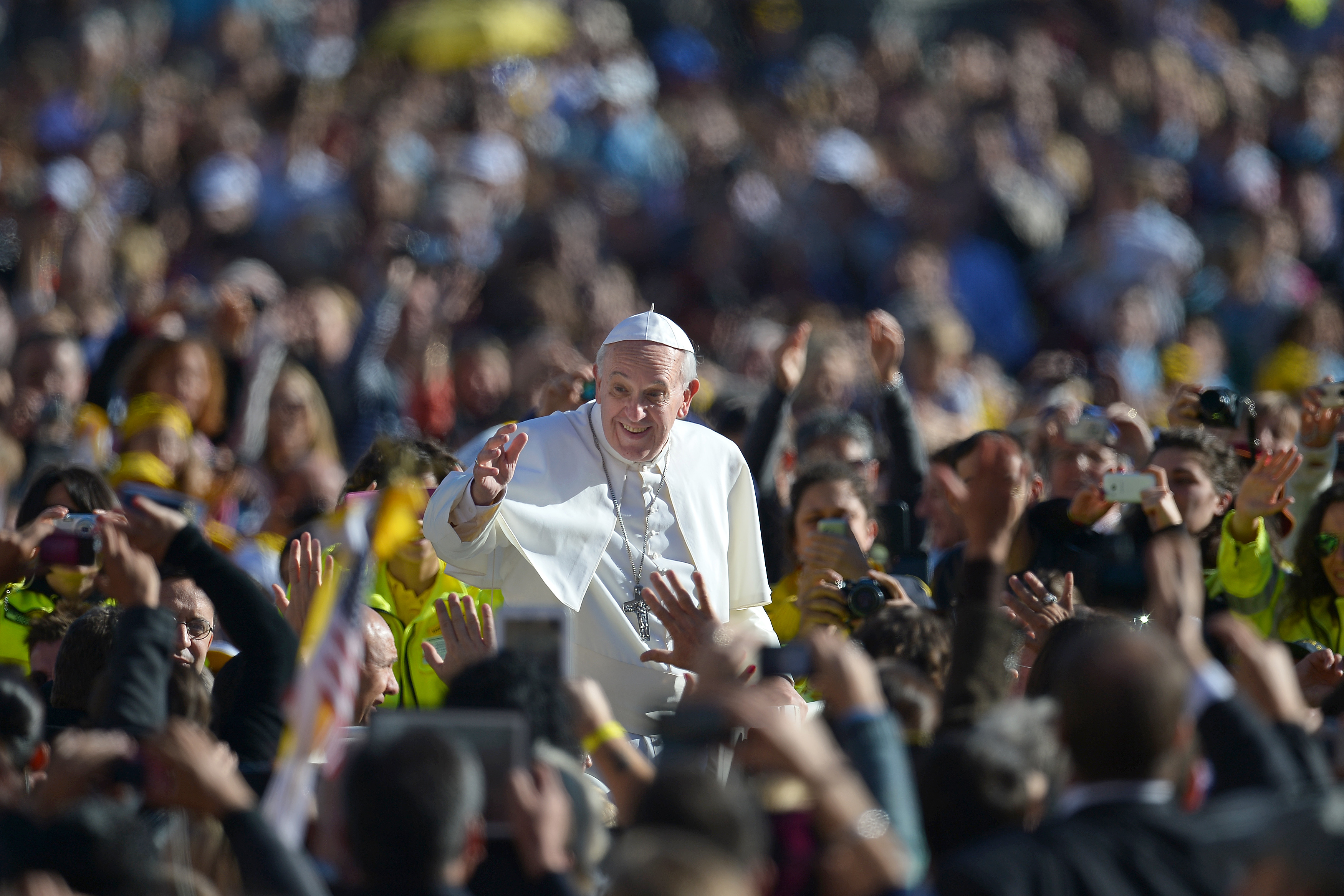
VATICAN-RELIGION-CHRISTIANITY-POPE-AUDIENCE

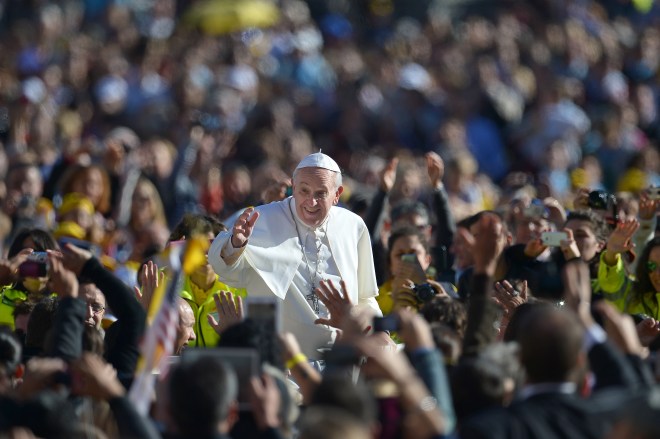
The new line, deployed against Pope Francis’ dismay at the materialism and ideological fixity of global market capitalism, is that the Pope was only referring to Argentina. Global capitalism in Argentina, according to the theocons and neocons, is so different than in the United States that Pope Francis’s critique is simply a regional one. In Argentina, he’s only referring to crony capitalism, entwined with government, combined with an entrenched lack of social mobility. If the Pope were to understand American capitalism better, he’d realize it was a truly free market, empowering social mobility, creating wealth and disseminating it on a massive scale. On CNN last week, that was essentially Newt Gingrich’s argument against the Pope’s Apostolic Exhortation (which I explore in considerable detail here).

A mega-rich donor to the American Catholic church is so offended by the Pope’s words on the importance of poverty that he is allegedly hesitant to pay for a large amount of the restoration of Saint Patrick’s Cathedral. Cardinal Dolan, the reactionary now left stranded by the new papacy, has struggled to rebut the implications of the Pope’s somewhat unequivocal words. Arthur Brooks, a Catholic running the American Enterprise Institute that favors torture, unfettered global capitalism, and pre-emptive war, makes the case as succinctly as he can:

Arthur Brooks … said he agrees that the pope’s beliefs are likely informed by his Argentine heritage. “In places like Argentina, what they call free enterprise is a combination of socialism and crony capitalism,” he said. Brooks, also a practicing Catholic who has read the pope’s exhortation in its original Spanish, said that “taken as a whole, the exhortation is good and right and beautiful. But it’s limited in its understanding of economics from the American context.” He noted that Francis “is not an economist and not an American.”

So America is so unlike Argentina that the Pope should not be taken seriously. The trouble with this assessment is that the Pope clearly was not restricting himself to Argentina in his Exhortation. His remit was much wider. Here’s a critical passage and it’s quite clear that the Pope is referring not to a single country but to the ideology of a global system, rooted in the economy of the United States and its unipolar power since the end of the Cold War:

The current financial crisis can make us overlook the fact that it originated in a profound human crisis: the denial of the primacy of the human person! We have created new idols. The worship of the ancient golden calf (cf. Ex 32:1-35) has returned in a new and ruthless guise in the idolatry of money and the dictatorship of an impersonal economy lacking a truly human purpose. The worldwide crisis affecting finance and the economy lays bare their imbalances and, above all, their lack of real concern for human beings; man is reduced to one of his needs alone: consumption. While the earnings of a minority are growing exponentially, so too is the gap separating the majority from the prosperity enjoyed by those happy few.

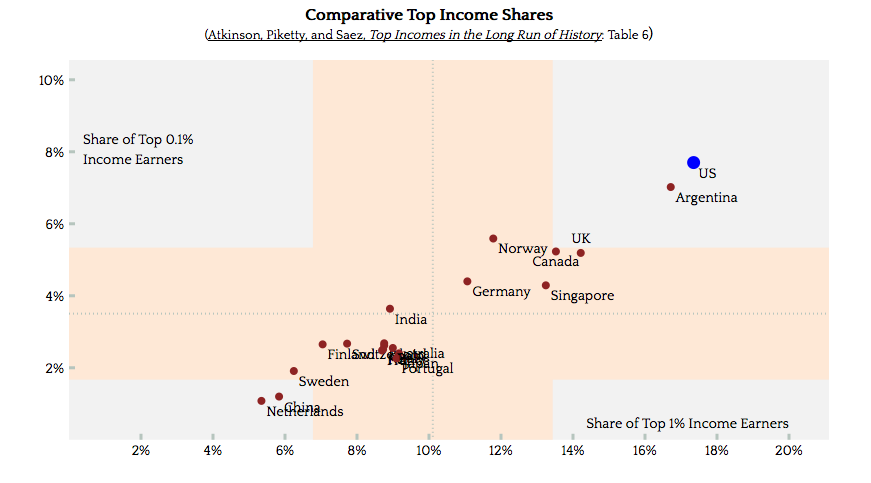
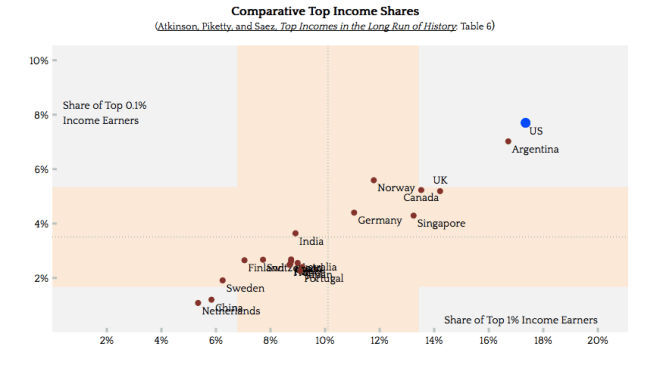
The question is: is this only true of Argentina and not of the US, as Arthur Brooks and Newt Gingrich claim? Let’s take a look at each countries’ one percent, and then the top 0.1 percent, and see how much of a country’s wealth they each represent. Here’s a graph from 2005 that shows where various countries fit on that scale:
Screen Shot 2014-01-02 at 10.27.20 AM

Funny, isn’t it, how utterly similar the US and Argentina are in terms of inequality? Since that date, the US’s top one percent have moved from earning around 17 percent to more than 20 percent.

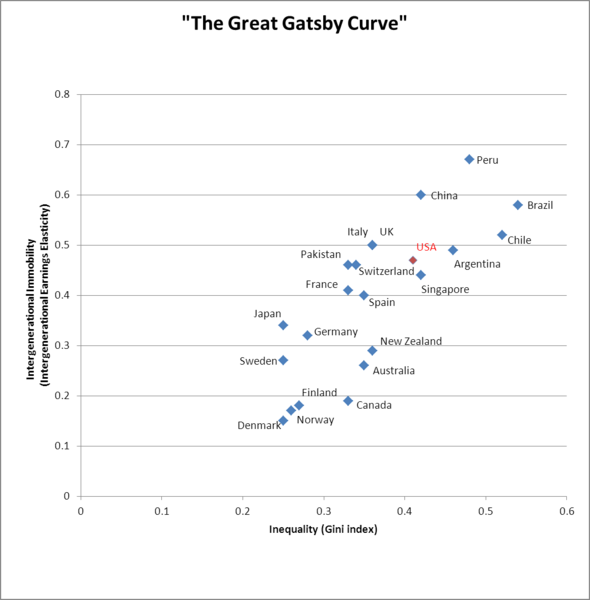
On the core question of social mobility, Argentina and the US are also very close together as the following chart shows:

590px-The_Great_Gatsby_Curve

So in terms of both income inequality and social mobility, the US and Argentina are basically the same country. So why does the Pope’s arguments apply only to Argentina and not to the US? I’m not an economist, so maybe there’s another dimension here that I’ve overlooked. As always, I’d be more than happy to post any correctives or clarifications to this basic reality. But right now, it seems to me that the Catholic right is simply wrong. Their American exceptionalism has morphed from a thoroughly admirable national pride at America’s achievements to a fixed and rigid idolization of a single country along with an idolization of wealth. Both, to put it mildly, are heresies. And perhaps the biggest impact of the new Pope on American politics will be more forthrightly denying the denialist, ideological right any Catholic crutch to peddle their snake-oil with.

(Photo: Vincenzo Pinto/AFP/Getty)