An Unhappy New Year For The Unemployed

Last Saturday, unemployment benefits expired for 1.3 million Americans:

A record-low 25 percent of unemployed Americans will receive benefits now that Congress has allowed the federal program to expire, according to data from the Department of Labor compiled by House Democrats on the Ways and Means Committee. The number is the lowest since the Department of Labor began keeping records in 1946. Before Congress let the federal unemployment benefit-assistance plan expire on Dec. 28, 38 percent of unemployed Americans who paid unemployment taxes were receiving unemployment insurance either through their state or the federal government.

Unless Republicans agree to extend benefits, the number will continue to fall:

Nearly 72,000 people will lose unemployment benefits each week on average in the first half of 2014, according to new estimates released by House Democrats. Roughly 1.3 million Americans no longer receive those benefits as of Saturday. In total, an additional 1.9 million Americans could lose their benefits in the first six months of the new year, according to the estimates, if Congress doesn’t vote to extend the Emergency Unemployment Compensation program. Congress has voted to extend the program 11 times since its inception in 2008.

Chait expects the GOP to do nothing about this crisis:

Both parties have fairly well-defined ideas about the general role of taxes, spending, and regulation. The difference is that the Democratic Party also has a policy agenda that is specifically related to the special conditions of high unemployment and low interest rates.

The Republicans are still merely asserting that their normal agenda applies just as well now as ever. The unique, dire conditions of the Great Recession shouldn’t be expected to undo all the party’s program, or to alter its general long-term ideas. (Democrats have not, and should not, given up their preference for universal health insurance, reduced greenhouse gas emissions, and so on, nor should Republicans have to abandon their preference for the opposite.) What they lack is any legislative response to the economic crisis. They just want to get back to normal, and since normality has not arrived, they’d just as soon pretend it has.

Barro made related points in the middle of last month:

As with many economic issues, there is a gap between conservative wonks and conservative policymakers. Many conservative economic policy wonks break with the Republican party by favoring one or more recession-specific economic policies. Economists Luigi Zingales and Glenn Hubbard have called for aggressive programs to modify mortgages. Scott Sumner, David Beckworth, Josh Hendrickson and others have promoted monetary intervention to combat recessions. Michael Strain has promoted a suite of reforms, mostly aimed at the labor market, that would aim to cut unemployment in recessions.

But acceptance of these policies among actual Republican policymakers is near zero. The standard Republican answer for what to do about a bad economy is the same as their answer about what to do about a good economy. As with health care and bank regulation, economic recessions are a policy question to which conservatives have not the wrong answer, but no answer.

The GOP Stops Evolving

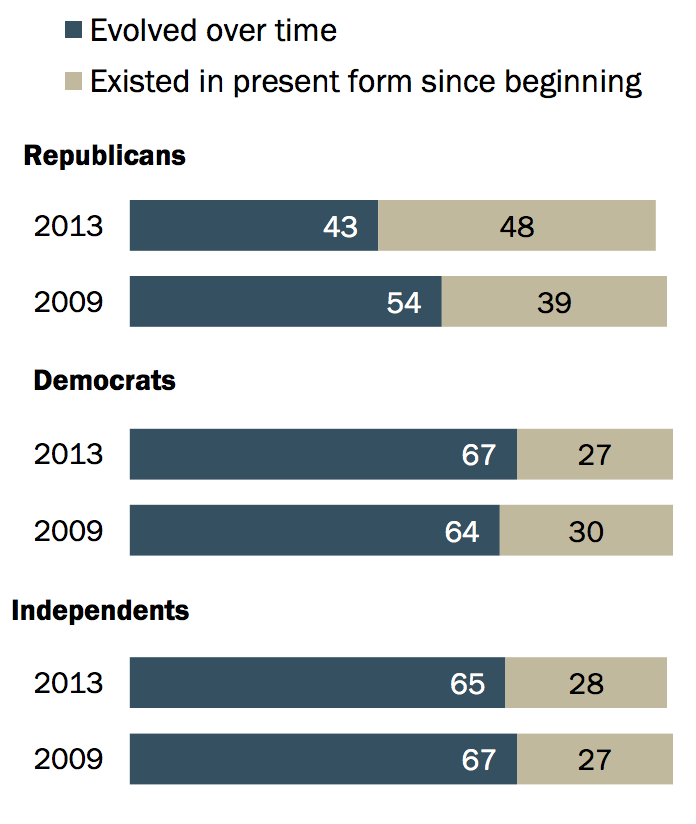
According to Pew, more Republicans deny evolution than they did five years ago:

Evolution By Party

David A. Graham ponders the cause of the problem:

One possibility is that respondents who identified as Republican and believed in evolution in 2009 are no longer identifying as Republicans. Fewer scientists, for example, are reportedly identifying with the GOP, and the overall trend is for fewer Americans to call themselves Republicans. But both Gallup and separate polling from Pew found approximately the same party ID in 2009 and 2013. Another is that the rise of “intelligent design” education has helped to swing younger Americans against evolution. Yet the age breakdown remains similar in 2009 and 2013, with respondents ages 18 to 29 most likely to believe in evolution.

What does that leave? Maybe the gap represents an emotional response by Republicans to being out of power. Among others, Chris Mooney has argued that beliefs on politically contentious topics are often more rooted in opposition to perceived attacks than anything else—an instance of “motivated reasoning.” Given that Democrats have controlled the White House and Senate since 2009, this could be backlash to the political climate, though it will be hard to tell until Republicans control Washington again.

Zack Beauchamp weighs in:

A wealth of research into political psychology shows that people’s partisan affiliations affect their beliefs on basic facts.

Republicans are overwhelmingly more likely to think the economy is doing well when Republicans hold the Presidency, and ditto with Democrats when their guy holds the White House. A recent experiment found that even basic math is contaminated by politics; people are much more likely to correctly solve basic math problems when, in context, solving them correctly helps rather than hurts their party.

In the evolution context, this suggests a feedback effect at work among Republicans. As the GOP becomes more associated with the creationist cause as a consequence of demographic shifts, Republicans start to feel more like being skeptical of evolution is their “team” position. So even Republicans who are demographically more likely to accept the basic science of evolution start to reject it, because that belief best harmonizes their beliefs with the perceived interest of their political party.

Allahpundit notes that “Gallup detected movement away from the creationist position among Republicans over roughly the same span that Pew was detecting movement towards it.” But he acknowledges that Pew’s numbers might be correct:

[M]aybe this is a simpler partisan impulse, where contempt for the political worldview as personified by the president bleeds over into some people’s judgments about perennial cultural disputes too. Wouldn’t surprise me to find support for evolution among Democrats rising a few points once the next Republican president takes office. It’s a defensive impulse against a political opponent who’s taken power, whether that impulse is really justified or not.

Tweaking While They Work

Anthropologist Jason Pine spent time in the trailer parks of Jefferson County, Missouri, getting to know the local meth culture:

Many of the people I met began meth on the job—concrete work, roofing, trucking, factory work. It’s a way to make the job easier, to work longer hours and make more money. Meth increases dopamine levels in the brain, which can cause people to engage in repetitive (and often meaningless) actions—a behavioral effect that syncs up well with ‘work you gotta turn your mind off for,’ as one cook told me. …

Physically, [people on meth are] very fidgety. They feel engaged and active and entrepreneurial. They’ll launch into many projects: tinkering with machines, repairing and re-repairing, inventing and re-inventing. It’s like you or me taking ADHD meds—a sort of legitimated form of speed. Adderall is middle-class meth.

Black And White Cinema, Ctd

Shani Hilton rejects the idea that 2013 – which saw the release of 12 Years a Slave, The Butler, Fruitvale Station, and Best Man Holiday – marked a watershed moment for black films:

[H]onoring the achievements of black filmmakers by declaring it “their” year does them a disservice. Lumping together heavy dramas with lighthearted romcoms simply because of the skin color of the actors or director prevents these films from being measured against the whiter counterparts that actually share their genre — inadvertently ghettoizing the former and protecting the latter from scrutiny. It’s difficult to imagine pulling, say, Blue Is the Warmest Colour, The Great Gatsby, The Hangover Part III, and The Fifth Estate into a story declaring 2013 the year of the “white movie.”

Aisha Harris calls for more focus on films that show that “there is much more to life as a modern-day black individual in America than the legacy of slavery and the struggle for civil rights”:

Several fictional films about contemporary black life were released this year, although most of them got little attention compared to the likes of Fruitvale Station, et al. Mother of George, The Inevitable Defeat of Mister and Pete, and Big Words, for instance, all received critical praise. … These are not nostalgic movies. And they are not about slavery, civil rights, or police brutality. But that doesn’t make these films any less thought-provoking. Maybe if we champion them today, more movies like these will get made tomorrow. I hope so.

Harris recommends Terence Nance’s An Oversimplification of Her Beauty (trailer above). Previous Dish on the subject here.

Male, Female, Or Neither?

Emily Greenhouse discusses the changing landscape of intersex rights in Germany:

In early November, Germany—which, in part to combat the legacy of the Third Reich, has deliberately asserted the rights of marginalized groups—became the first country in Europe to allow a third gender designation: X, for indeterminate or intersex. (Australia introduced a similar measure in July.) If a baby is born with ambiguous sex characteristics, it won’t be forced to undergo a normalizing operation just so that nurses can tick “male” or “female” on its birth certificate. The legal acknowledgment of a third category should mean that fewer doctors urge parents to have sex-assignment surgery performed on their newborns. Fewer children should suffer the plight described by one person quoted in a report that helped lead to the new law, a German born with ambiguous genitalia in 1965, who spoke of being a “patchwork created by doctors, bruised and scarred.”  …

While certain religious groups argue that sexuality is a choice (and certain sexual lifestyles are therefore sinful), no one makes that argument about biology, which might suggest a certain logic to granting rights to genetic difference before sexual preference.

Jacinta Nandi approves of the new law:

[T]he new policy regarding intersex children is a necessary attempt to remedy a situation that, up until now, has been horribly difficult.

Previously, German parents had just a week’s time to decide whether their intersex children were male or female, and register them appropriately at the standesamt or registry office. The pressure on parents meant decisions would often be made in a state of panic and frequently lead to forced medical operations in the genital area. … Now, the German government and legal experts are keen to stress that this third blank box isn’t an official third gender, or the “other” box – so it doesn’t actually mean that there are now three recognized genders in Germany. It’s seen as a temporary solution for very specific intersex cases – the children aren’t expected to live their lives as X’s, but to make a decision to be male or female at a non-specified point in the future. However, many people view this decision, based on a review by the German Ethics Council, as a huge victory for intersex children. And it really is quite a momentous decision, especially when you consider that up to this point in time, intersex people haven’t had any legal recognition on European birth certificates whatsoever.

Hida Viloria argues that the law gives intersex Germans fewer rights, not more:

While it’s been widely reported that the law gives parents a new “choice” or “option,” it’s clear that the designation is mandatory. As OII Europe, the European affiliate of the Organization Intersex International (the world’s largest intersex advocacy organization), elaborates: “Who determines that a child ‘can be assigned to neither the female nor the male sex’? According to current practice: only medicine. The power to define what sex is and who is assigned to which gender remains intact with the new regulation.” Some claim this will help by giving parents more time to decide whether to label their baby male or female, but since the law states that babies with intersex bodies can not be labeled male or female, the only way for parents to attain those labels for their child will be through the use of “normalizing” genital surgeries. Surgeries deemed so harmful that the United Nations Special Rapporteur on Torture recently called for all member states to ban them. Intersex people in Germany and around the globe have been calling for this ban for decades. However, rather than banning intersex genital mutilation, the German government instead created a law that local intersex advocates believe puts intersex babies at greater risk of being subjected to it.

Nelson Jones points out that intersex people’s challenges extend well beyond the legal:

This is the core of the problem. On one level, humanity has become a great deal more enlightened since Roman times, when the birth of a “hermaphrodite” might be interpreted as an omen of war or natural disaster and the child was liable to be exposed, or since the Middle Ages when such an “unnatural” birth could be seen as evidence of the sin and perversion of the parents. Modern science recognises that biology in its infinite complexity doesn’t care about the neatness of human thinking with its love of binary categories. Being of indeterminate gender is not in itself a disability. …

The problem with surgical intervention isn’t just the theoretical one that it violates the integrity of the body but the practical one that the doctors might well make a mistake. The answer, say campaigners, is to hold off both legal gender assignment and surgery until the child is old enough to make up its own mind as to whether it’s a boy or a girl – or something in-between. Yet such a child, in our gender-obsessed culture, is likely to feel confusion and face prejudice. The stigma of “abnormality” can cause deep psychological scars: every child has a right to feel normal, and social expectations of gender can make it difficult to feel normal in a body that is not unambiguously male or female. Tackling that will be a much larger problem than a simple bureaucratic fix.

Howling About Wall Street, Ctd

A reader rolls his eyes at the film’s critics:

The Wolf of Wall Street mocks its Masters of the Universe mercilessly. They’re dumb, they’re vulgar; even Jonah Hill’s teeth are tacky as hell. The film is a comedy and its characters are the butt of the joke. If someone looks at this film and thinks those guys with their vintage Quaaludes are cool, that’s on the viewer, not Scorcese. In the end, when the FBI agent is riding on the train, Scorcese isn’t mocking him; the director is telling us, the rest of society, that we’ve got it wrong.

That’s the biggest joke of all, really. People are so wired to respond to money and luxury that they can’t comprehend a picture of wealth and success might not be flattering. We’re in it so deep the humor is lost on us.

Another singles out Yglesias:

I’m not sure where he got the idea that it’s a Hollywood director’s job to make movies that educate the public about Wall Street dealings, but I thought it was pretty obvious that Scorsese’s film makes little or no distinction between legal and illegal thievery. The early scenes with Matthew McConaughey establish that everything his firm was doing was legal, but it was the same practice DiCaprio uses later: same mentality, same coke-fueling, same tricking of clients. It’s all thievery!

Another compares The Wolf of Wall Street to other Scorsese films:

The movie is vastly entertaining, a tremendous comedy. But I can’t imagine anyone leaving it and not saying “These are some fucking horrible people.”

On some levels they’re worse than the gangsters in Goodfellas, even though there are no bullets in the head in this one. But like Goodfellas, Wolf glamorizes a certain lifestyle not because it is a preferable way of life, but because it is a tempting one. Scorsese – ever a Catholic filmmaker – has made a career exploring the various forms of temptation. That could be flouting the law in Wolf or Goodfellas, turning to vigilante justice in Taxi Driver, or – like Jesus faced in Last Temptation of Christ – simply being a normal person.

Another is close to the subject:

First of all, let me admit to being a (completely drug-free, commuter-train riding) Wall Street employee. I must say that I’m incredibly annoyed by this whole debate about the movie and the question of what’s wrong on Wall Street. The fact that this “wolf” sold penny stocks is really not relevant to the story. He could have been selling oil royalties or timeshares or Nigerian lottery winnings. He’s a talented salesperson without any morals preying on people’s desire to get rich quickly. And it takes three loooong hours to depict this.

The real Wall Street debate is a very complex one: if our financial system takes no risk, there will be no growth capital for the economy, and if there’s too much risk, there is systemic risk to the taxpayer. How do we find the balance? How do we foster “normal risk” while containing “catastrophic risk”? Those are difficult questions. Given that the “Wolf” stopped himself when explaining what an IPO is, we can’t expect a lot of help from Mr. Scorsese, I’m afraid.

Another reader:

Jordan Belfort of the film is a masterful salesman; I imagine the real Jordan Belfort is no different. His book, and subsequently the film, are simply the next steps in doing what he does best. He pulled the wool over the eyes of investors, his employees, and the attentive audiences at the seminars he held. I cannot help but think that the film audience is simply the next in line.

And then what? A reality show? Another reader suggests he’s getting some help from a familiar face:

Take a look at the appalling YouTube video of DiCaprio [seen above] in which he personally endorses Belfort. Was this the price paid for access to the guy? The words spoken by DiCaprio sound like copy for an informercial. Very creepy.

A Poem For New Year’s Day

NYDpoem

“Prayer” by George Herbert (1593-1633):

Prayer the Churches banquet, Angels’ age,
God’s breath in man returning to his birth,
The soul in paraphrase, heart in pilgrimage,
The Christian plummet sounding heav’n and earth;
Engine against th’ Almighty, sinners’ tower,
Reversed thunder, Christ-side-piercing spear,
The six-days’ world transposing in an hour,
A kind of tune, which all things hear and fear;

Softness, and peace, and joy, and love, and bliss,
Exalted Manna, gladness of the best,
Heaven in ordinary, man well drest,
The milky way, the bird of Paradise,
Church-bells beyond the stars heard, the soul’s blood,
The land of spices; something understood.

Please consider supporting the work of the Poetry Society of America here.

(Photo by Isaac Bowen)

When Do The Obamacare Delays Stop?

Yuval Levin believes that “the individual mandate is probably done for”:

I would now assume that no one will pay the individual mandate fine for 2014. The administration may give up on the mandate in the course of the ongoing enrollment period if the political pressure is great enough, or they may keep up the pretense of it through the end of the enrollment period in March (when it will have finished its work, so to speak, since its purpose is to influence choices made during that period) but then exempt everyone from it as they did with the employer mandate for this year. Having now exempted from the fine people whose policies were canceled and who haven’t spent the money to get more expensive and less appealing new coverage, the politics of still applying the fine to everyone else who is uninsured this year will probably just not be sustainable, and the politics of exempting people from it (especially if they can hold out on doing so until after March 31) will be far too appealing for this White House to resist. They may claim the mandate will be back in 2015, but if they do exempt everyone from it in 2014 it will be hard to bring it back.

McArdle agrees:

If the administration had been resolute in the face of early complaints, and had stuck to the rules it wrote before October, then it would be in a stronger position to deny the next round of complainers. But it hasn’t.

And each round of special exceptions makes denying the next one harder: “The president was willing to help them, but not us! What’s wrong with us? Doesn’t the president care about people like me?” When you stick to the rules for everyone, you are not making any particular statement when you enforce them in an individual case. But when you start carving out exemptions on the fly, each individual case becomes a referendum on how much the Barack Obama administration cares about [the middle class/small-business owners/writers/early retirees/insert your group here]. And the president cannot afford to tell anyone that he doesn’t care about their problems. So I find it hard to believe that the mandate, or the clawback of overpayments, or any other rule that might upset people, will be enforced for 2014. And of course, that makes it more likely that none of them will be enforced, ever.

 Adrianna McIntyre weighs in:

The one thing that could still be a huge blow to the law is a full delay of the individual mandate, which HHS could maneuver by expanding the recent “hardship exemption” to include those who were uninsured. I’m not confident that’s off the table yet—especially considering that some state exchanges are still struggling—but if the administration does offer a blanket delay, I don’t think we’ll see it until the end of open enrollment. The reasons are both pragmatic and strategic: we can’t know the extent of “hardship” until enrollment wraps, but we also know that people tend to sign up just under the wire. Massachusetts illustrated this, and so did enrollments before the “soft deadline” this week, if the limited data we have so far is any indication.

A one-year mandate delay is also something the exchanges could probably recover from. I’m more bullish on this than others, but that possibility was the original context of my “risk corridors” post; the risk adjustment mechanisms are in place for three years. Moreover, the penalty is weak enough in the first year ($95 or 1% taxable income, whichever’s higher) that I’m not sure that enrollment will be meaningfully different with or without a mandate in the first year. This is doubly true if a mandate delay were to be announced late in the game, when most of the people who would have signed up will have signed up.

Sit, Stay, Helix

The DNA of a dog is 99.9 percent the same as a gray wolf’s, but “half of that minuscule genetic difference is a sophisticated interface for interacting with humans”:

Notably, dogs become attached to people. Wolves – even when raised as cubs in a home – do not. This is true to an extraordinary extent. A dog put in a stressful situation will relax if a familiar human is there, but a familiar dog, even his mother, will make no difference. … Dogs have an ability to read and interpret human faces that is unique among all animals. Their first instinct when faced with a problem is to look to a human for guidance, something wolves do not do. Dogs will also communicate by looking at a human, then at a target object, then back again.

Wolves are not very vocal: they generally reserve howling and barking for long-distance communication with out-of-sight animals. Dogs bark far more frequently than wolves. They do it to communicate aggressiveness, fear, despair, playfulness, and happiness. But, in most cases, dogs do not bark to communicate with each other; they bark to communicate with us.

Previous Dish on dogs and wolves here and here.

Brittle China, Ctd

As the Chinese government threatens to expel foreign journalists and warns domestic reporters not to air “wrong points of view,” it turns to the country’s universities:

Chinese academia has increasingly had to bend to the will of the party, which on Dec. 23 publicly announced a new wave of Marxist campaigns in schools and colleges which will incorporate “socialist core values” in the curriculum. In 2013 alone, several prominent Chinese professors have resigned or been fired for bucking the party line. In October, the prestigious Peking University in Beijing dismissed economics  professor Xia Yeliang, a noted advocate for multiparty elections, because of what it insisted was poor performance, leading Chinese netizens to question whether Peking University’s motto – “Follow the principle of freedom of thought with an all-embracing attitude” – still held true. Zhang Xuezhong, an outspoken legal scholar who championed free speech and constitutionalism, was fired in early December by East China University of Political Science and Law in Shanghai, one of China’s leading law schools. That ouster led netizens to ask how many more scholars the Chinese academy would lose if universities continued to cave to political pressure.