Robots will neither be common nor very good in 2014, but they will be in existence. The I.B.M. exhibit at the [1964 World’s] fair has no robots but it is dedicated to computers, which are shown in all their amazing complexity, notably in the task of translating Russian into English. If machines are that smart today, what may not be in the works 50 years hence? It will be such computers, much miniaturized, that will serve as the ‘brains’ of robots. In fact, the I.B.M. building at the 2014 World’s Fair may have, as one of its prime exhibits, a robot housemaid – large, clumsy, slow-moving, but capable of general picking-up, arranging, cleaning, and manipulation of various appliances. It will undoubtedly amuse the fairgoers to scatter debris over the floor in order to see the robot lumberingly remove it and classify it into ‘throw away’ and ‘set aside.’ ”
Disgruntled by news of a forthcoming David Foster Wallace biopic starring Jason Segel, John Gallagher worries that popular perception is corrupting DFW’s influence:
Maybe things started to change when Wallace went viral. His commencement address to a Kenyon College graduating class in 2005 was a massive hit online. Published as This Is Water: Some Thoughts, Delivered on a Significant Occasion, about Living a Compassionate Life, it’s a pitch-perfect exhortation to mindfulness in everyday life, and a challenge to practice “simple awareness; awareness of what is so real and essential, so hidden in plain sight all around us, all the time”. And it’s beautiful.
But Wallace isn’t an aphorist. For me, what makes his fiction so good is that it’s hard – not “difficult” in an elitist sense, but just in that it wants you to work with him, to dig towards something half-remembered and hard to grasp and maybe, just maybe, true. The Wallace of This Is Water – and the Wallace of popular culture – is a fortune-cookie merchant: the artist as life coach.
This is why the idea of a Wallace movie makes me so uneasy. Not just because it’s insensitive, and not just because there’s no way it won’t get twisted into some awful, jarring morality tale about genius and suicide. It’s because a Hollywood DFW feels like the final step in the canonisation – or maybe the Cobainification – of David Foster Wallace.
Ze Frank’s commentary on the natural world wins silver for Mental Health Break:
Paul Krugman was close second for the Dick Morris Award. He was nominated for his remarkably incorrect 1998 prediction about the Internet:
The growth of the Internet will slow drastically [as it] becomes apparent [that] most people have nothing to say to each other…. By 2005 or so, it will become clear that the Internet’s impact on the economy has been no greater than the fax machine’s.
The Chart Of The Year runner up shows the damage global warming is doing:
Joe Romm looks ahead to the future implied by Andy Haveland-Robinson’s “death spiral” chart of Arctic Ocean ice coverage over time:
Ian Bogost’s thoughts on McRib nearly won the Dish’s award for bad writing:
The McRib is like Holbein’s skull: we experience it as (quasi-)foodstuff, as marketing campaign, as cult object, as Internet meme, but those experiences don’t sufficiently explain it. To understand McRib fully, we have to look at the sandwich askew. … The McRib’s stochastic return mcdonalds-mcribmakes visible the relationship between the eater and the McDonald’s menu. It produces a stain, a tear in the order of things that reveals the object-cause of desire for McDonald’s, but only briefly before it evaporates like faux-cartilage. The fragile conditions that make the McRib possible also insure that desire for McDonald’s food more generally speaking is maintained.
Desire is a delicate system. For Lacan, the lover “gives what he does not possess,” namely the objet a that incites desire rather than sustaining it. Likewise, McDonald’s sells what it does not sell: the conditions of predictability, affordability, and chemico-machinic automated cookery that make its very business viable. … Industrialism is also a kind of magic, the magic of the perfect facsimile. Eating at McDonald’s—eating anything whatsoever at McDonald’s—connects us to that magic, allows us to marinate inside it and take on its power.
This comment by Richard Cohen almost earned him the Malkin Award:
People with conventional views must repress a gag reflex when considering the mayor-elect of New York — a white man married to a black woman and with two biracial children. (Should I mention that Bill de Blasio’s wife, Chirlane McCray, used to be a lesbian?)
Earlier this year, Copyranter wondered the Cool Ad Of The Year runner-up was “the best gun control commercial ever produced”:
This ugly comment made North Carolina State Representative Larry Pittman runner-up for the Hewitt Award:
Someone had posted something with a picture of Barack Obama and across it said ‘traitor.’ And, you know, I don’t always agree with the guy, I certainly didn’t vote for him but I gotta defend him on this one. I just don’t think it’s right at all to call Barack Obama a traitor. There’s a lot of things he’s done wrong but he is not a traitor. Not as far as I can tell. I haven’t come across any evidence yet that he has done one thing to harm Kenya.
Ramesh Ponnuru was the Yglesias Award runner-up for this admission:
[Republicans] have no real health-care agenda. Voters don’t trust them to look out for middle-class economic interests. Republicans are confused and divided about how to solve the party’s problems. What they can do is unite in opposition to the Obama administration’s scandals and mistakes. So that’s what they’re doing. They’re trying to win news cycles when they need votes.
And second place for the Moore Award goes to Mike Malloy for this rant against Limbaugh:
This guy, this Limbaugh, this is one of the most vile human beings ever to live! If Limbaugh had the power, he would open gas chambers! If Limbaugh had the power, he would line people up against the wall and execute them! If Limbaugh had the power, he would destroy children because he can’t have any! The only thing he sees in children is sex partners! This is a sick, degenerate, evil man!
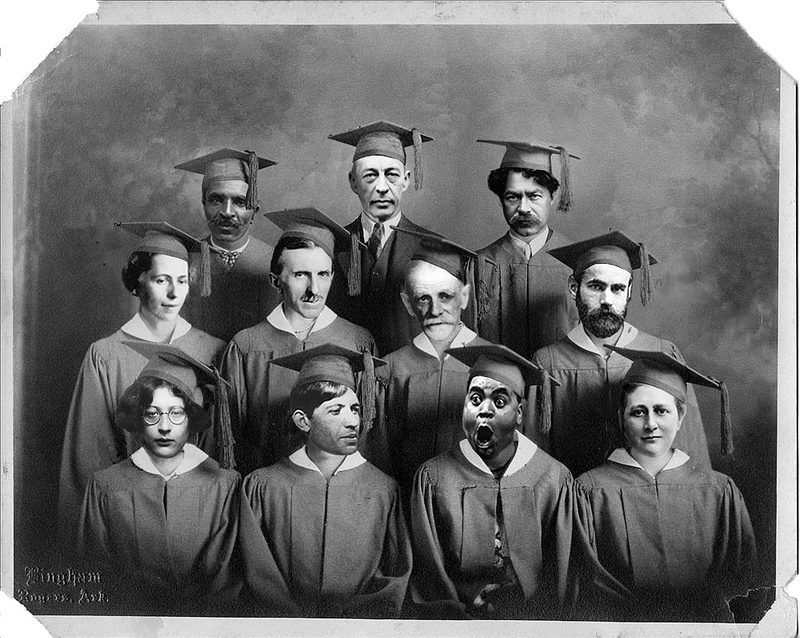
Each January 1, thousands of works are released into the public domain. This year, the Public Domain Review honors the “Class of 2014” (seen above):
As usual it’s an eclectic bunch who have assembled for our graduation photo – including two very different geniuses of the piano, a French mystic, the creator of Peter Rabbit, one of the 20th century’s most important inventors, a poet who penned the Olympic Hymn, and a man known as the “Black Leonardo” who pretty much single-handedly created the peanut industry. The unifying factor bringing them all together is that all died in the year of 1943, and so their works, in many places, will be given a new lease of life as they pass into the public domain.
But instead of celebrating, some are mourning what would have entered the public domain today, had we retained copyright laws from 1976. Duke University has assembled a list of such works, including Keroauc’s On the Road, Ayn Rand’s Atlas Shrugged, and Dr. Suess’s The Cat in the Hat. Citing Duke’s list, Adi Robertson zooms out:
The arguably bigger problem … involves books, films, and music that most people have never heard of, and that copyright holders aren’t going to bother preserving or reissuing — without a meaningful public domain, they can’t be archived in a way that makes them available to more than a privileged few.
(Image from The Public Domain Review. Top Row (left to right): George Washington Carver; Sergei Rachmaninoff; Shaul Tchernichovsky; Middle Row (left to right): Sophie Taeuber-Arp; Nikola Tesla; Kostis Palamas; Max Wertheimer; Bottom Row (left to right): Simone Weil; Chaim Soutine; Fats Waller; Beatrix Potter.)
Long-time New York restaurant critic finally reveals to readers his identity: Adam Platt. He calls the pretense of anonymity a “dated charade” since restaurants typically know who the “anonymous” food critics are:
Why do I (with the prodding and endorsement of my editors) choose this particular moment to come lumbering into public view? A better question might be “What took you so goddamned long?” Dining critics in London began running their photos above their columns some time ago, and several of New York City’s most reputable critics have been out of the proverbial closet for years. Craig Claiborne, who helped invent the myth of the discreetly “anonymous” critic at the Times, used to have promising chefs, like Daniel Boulud, come and cook for him outside of their restaurants. During my lunch with [former New York magazine critic] Gael [Greene], Alain Ducasse emerged from his kitchen to give her a warm greeting, a dramatic gesture that did not prevent her from gleefully slamming his restaurant in a blistering cover-story review.
Over the years, this myth of anonymity has served many useful purposes. It’s worked, in practice, for the mysterious Michelin inspectors, who return to dining establishments year after year to take away or bestow their stars. It can work, also, for local critics whose publications attempt to cultivate a similar illusion of omniscience, although it’s been my experience that the handful of grand restaurants that actually have stars to lose will make it their business to spot you. Mostly, though, anonymity has been a powerful marketing tool. It’s lent a sense of impartiality and Oz-like mystery to the dark art of restaurant criticism, and if members of the clubby fine-dining world didn’t always believe it, then at least the public sometimes did.
Even though Platt has gone public, he will “continue to book restaurant tables at odd hours, under a string of ridiculously random made-up names, because more than a wig or a set of false whiskers, the art of surprise has always been the critic’s most useful tool.”
Evgeny Morozov sees a “disturbing” trend in which “our personal information – rather than money – becomes the chief way in which we pay for services”:
No laws and tools will protect citizens who, inspired by the empowerment fairy tales of Silicon Valley, are rushing to become data entrepreneurs, always on the lookout for new, quicker, more profitable ways to monetize their own data – be it information about their shopping or copies of their genome. These citizens want tools for disclosing their data, not guarding it. Now that every piece of data, no matter how trivial, is also an asset in disguise, they just need to find the right buyer. Or the buyer might find them, offering to create a convenient service paid for by their data – which seems to be Google’s model with Gmail, its e-mail service.
What eludes Mr. Snowden – along with most of his detractors and supporters – is that we might be living through a transformation in how capitalism works, with personal data emerging as an alternative payment regime. The benefits to consumers are already obvious; the potential costs to citizens are not. As markets in personal information proliferate, so do the externalities – with democracy the main victim.
Jane Chong has a more sanguine view of the trend, but says the law is far behind the digital economy:
As Morozov observes, personal data has become part of an alternative payment regime in practice. [But] it is critical to recognize that our legal institutions have not yet evolved to acknowledge this shift. As far as the courts are concerned, consumers are using Facebook and (basic) LinkedIn for free. If we want to be serious about privacy and the broader repercussions of digital capitalism moving forward, we will need to change this cramped legal understanding of what consumers are giving up in exchange for “freebies” – and of what consumers are owed when that exchange turns out to be unconscionable at a macro level.
Edith Windsor, 83, acknowledges her supporters as she leaves the Supreme Court on March 27, 2013. The Supreme Court heard oral arguments in the case ‘Edith Schlain Windsor, in Her Capacity as Executor of the Estate of Thea Clara Spyer, Petitioner v. United States,’ which challenges the constitutionality of the Defense of Marriage Act (DOMA), the second case about same-sex marriage this week. By Chip Somodevilla/Getty Images.
Rep. Steve Stockman (R-TX) is the winner of this year’s Malkin Award, which is given for intemperate right-wing rhetoric. The winning rant:
Democrats do not want abortion to be safe or rare. Democrats oppose even the most basic of health and safety standards for abortion mills. Democrats don’t care how many women are maimed, infected with diseases or die on the routinely-filthy abortion mills. Democrats worship abortion with same fervor the Canaanites worshipped Molech.
The Moore Award, for divisive left-wing rhetoric, goes to Health And Wellness Publisher Maria Rodale for this remark:
Yes, Syria has undoubtedly used chemical weapons on its own people. Maybe it was the government; maybe it was the opposition; maybe you [President Obama] know for sure. But here’s what I know for sure: We are no better. We have been using chemical weapons on our own children – and ourselves – for decades, the chemical weapons we use in agriculture to win the war on pests, weeds, and the false need for ever greater yields. While the effects of these “legal” chemical weapons might not be immediate and direct, they are no less deadly. … We’ve been trying to tell you for years that chemical companies like Monsanto, Syngenta, Dow, DuPont, Bayer Crops Sciences, and others are poisoning our children and our environment with your support and even, it seems, your encouragement. Just because their bodies aren’t lined up wrapped in sheets on the front pages of the newspapers around the world doesn’t mean it’s not true.
Hathos is the attraction to something you really can’t stand; it’s the compulsion of revulsion. Below is this year’s Hathos Alert winner – by a mile:
So this is apparently a real thing from the Wall Street Journal. The Onion couldn’t top this. Whether it’s the sad faces of all these put-upon dejected rich people, or the elderly minority couple who is depressed despite not paying extra taxes (or was that the point?), or the distressed single Asian lady making $230,000 who might not be able to buy that extra designer pantsuit this year, or the “single mother” making $260,000 whose kids presumably have a deadbeat, indigent dad just like any other poor family, or that struggling family of six making $650,000 including $180,000 of pure passive income and wondering how to make ends meet, mockery is almost superfluous. The thing mocks itself.
Paul Ryan earns the Dick Morris Award for his stunningly wrong underestimation of the president:
Oh, nobody believes [Obama’s vows to not negotiate on raising the debt ceiling]. Nobody believes that. He himself negotiated Bowles Simpson on the debt limit with Democrats. That was Kent Conrad’s requirement. He himself negotiated the Budget Control Act with the debt limit. Graham Rudman. Bush Andrews Airforce Base. Clinton Gore ‘97. All of those major budget agreements were debt limit agreements. I see this time as no different and I believe he does too. I think most people believe he’s just posturing for now.
Colin McGin, a philosophy professor who resigned this year from the University of Miami following allegations that he sent sexually explicit emails to a female graduate student, won this year’s Poseur Alert, awarded for really bad writing intended to appear profound. The passage he was nominated for:
What kind of hand job leaves you cleaner than before? A manicure, of course. Why does this joke work? Because of the tension between the conventional idiomatic sense of ‘hand job’ (a certain type of sex act) and its semantic or compositional meaning (in which it is synonymous with ‘job done by or to the hand’). When you think about it, virtually all jobs are ‘hand jobs’ in the second semantic sense: for all human work is manual work—not just carpentry and brick laying but also cookery and calligraphy. Indeed, without the hand human culture and human economies would not exist. So really ‘hand jobs’ are very respectable and vital to human flourishing. We are a ‘hand job’ species. (Are you now becoming desensitized to the specifically sexual meaning of ‘hand job’? Remember that heart surgeons are giving you a ‘hand job’ when they operate on you; similarly for masseurs and even tax accountants.)
I have in fact written a whole book about the hand, Prehension, in which its ubiquity is noted and celebrated.
I even have a cult centering on the hand, described in this blog. I have given a semester-long seminar discussing the hand and locutions related to it. I now tend to use ‘hand job’ in the capacious sense just outlined, sometimes with humorous intent.
Suppose now a professor P, well conversant in the above points, slyly remarks to his graduate student, who is also thus conversant: ‘I had a hand job yesterday’. The astute student, suitably linguistically primed, responds after a moment by saying: ‘Ah, you had a manicure’. Professor P replies: ‘You are clearly a clever student—I can’t trick you. That is exactly the response I was looking for!’ They then chuckle together in a self-congratulatory academic manner. Academics like riddles and word games.
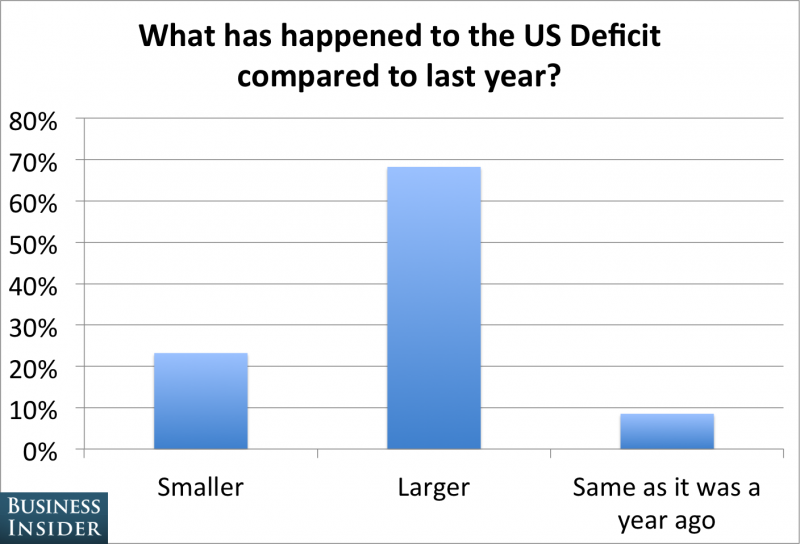
The Chart Of The Year goes to the simple bar graph below. It illustrates that most Americans have no idea that the deficit is falling:
The point isn’t that Americans are stupid. They have busy lives and concerns that have nothing to do with the annual gap between taxes and outlays. Instead, the point is that public-opinion polls don’t belong on the same plane as facts and informed analysis, because they qualify as neither. … Public polls are a fine gauge of public opinion, but they’re not to be treated as a barometer of reality. Pretending otherwise mixes up the regurgitated misinformation of readers with the careful analysis of people who are in the business of busting misinformation.
Jon Huntsman won The Yglesias Award, given for risking something for the sake of saying what you believe, for this statement supporting marriage equality:
While serving as governor of Utah, I pushed for civil unions and expanded reciprocal benefits for gay citizens. I did so not because of political pressure—indeed, at the time 70 percent of Utahns were opposed—but because as governor my role was to work for everybody, even those who didn’t have access to a powerful lobby. Civil unions, I believed, were a practical step that would bring all citizens more fully into the fabric of a state they already were—and always had been—a part of.
That was four years ago. Today we have an opportunity to do more: conservatives should start to lead again and push their states to join the nine others that allow all their citizens to marry. I’ve been married for 29 years. My marriage has been the greatest joy of my life. There is nothing conservative about denying other Americans the ability to forge that same relationship with the person they love.
The Hewitt Award is for egregious attempts to label Barack Obama as un-American, alien, and treasonous. Orson Scott Card was the top vote-getter for this “experiment in fictional thinking” that “sure sounds plausible”:
Where will [Obama] get his ‘national police’? The NaPo will be recruited from “young out-of-work urban men” and it will be hailed as a cure for the economic malaise of the inner cities. In other words, Obama will put a thin veneer of training and military structure on urban gangs, and send them out to channel their violence against Obama’s enemies. Instead of doing drive-by shootings in their own neighborhoods, these young thugs will do beatings and murders of people “trying to escape” — people who all seem to be leaders and members of groups that oppose Obama.
The last three of 22 Uighur detainees, held at Gitmo for over ten years despite the government’s knowledge of their innocence, have been freed after Slovakia agreed to repatriate them. Serwer explains how domestic politics enabled this miscarriage of justice:
“Let’s be clear: these terrorists would not be held in prisons but released into neighborhoods,” [Republican Congressman Frank] Wolf said. “They should not be released at all into the United States. Do members realize who these people are? There have been published reports that the Uighurs were members of the Eastern Turkistan Islamic Movement, a designated terrorist organization affiliated with Al Qaeda.” Former House Speaker Newt Gingrich said the Uighurs “instructed by the same terrorists responsible for killing 3,000 Americans on September 11, 2001.” He then urged Obama to send them back to China. One of the prisoners responded to Gingrichthrough their attorney: ”Why does he hate us so much?”
A U.S. federal court had ruled in 2008 that the detention of the Uighurs was baseless and that they were not terrorists or “enemy combatants” – something that, according to [Daniel] Klaidman, the government had already known for at least five years. The court also questioned the government’s designation of the East Turkistan Islamic Movement as an ally of the Taliban and Al Qaeda, which Mother Jones’ Stephanie Mencimer writes was motivated by the Bush administration’s desire to shore up Chinese support for the invasion of Iraq, itself based on a falsehood. Judge Ricardo Urbina, who ordered the Uighurs be resettled in the U.S. in 2008 after determining they posed no threat to America (a ruling later blocked at the request of the Obama administration) told the Miami Herald that “there was not a shred of evidence that they were disliked by anyone — anyone but the Chinese government.” Don’t forget Wolf and Gingrich.
The Bush Administration contacted more than 100 countries, almost all of whom refused to help either because they did not want to help the Bush Administration for political reasons, or because of Chinese threats to cut off trade relations. If other countries had been more willing to help close Guantanamo (rather than simply to criticize the United States), the Uighurs would have been released long ago. The Obama Administration’s first Guantanamo Envoy Dan Fried worked extremely hard to resettle the remaining Uighurs and succeeded in transferring another 14 in the Obama Administration’s first term. In 2009, I wrote that it would be helpful to resettle at least some of the Uighurs in the United States; I continue to think that they would not have posed any more of a threat to this country than to the six countries that have agreed to take them. The sad story of the Uighurs demonstrates why the issues surrounding both the opening and the closure of Guantanamo are more complex than many critics believe. Cliff Sloan and Paul Lewis should receive bipartisan support in Congress for their efforts to reduce the detainee population at Guantanamo, and Obama Administration officials should resist the temptation to politicize their work.
But Ryan Cooper places the blame primarily on the GOP:
When it was clear even to the Bush administration—Bush himself said the prison should be closed—that these people had been rounded up by mistake, and they were being deprived of their freedom for no reason, the response of the demagogues—and eventually the entire Republican establishment, and most of the Democratic one, was to deny the administration the funding to close Guantánamo. Make no mistake, the Democrats are no heroes here. But publicly denouncing out-groups known to be innocent of any crime is one of the most evil things it is possible for a politician to do.
Some linguists assert that swearing aided the evolution of language:
To understand why, consider a certain type of grammatical construction called an exocentric compound. This involves cramming a noun and a verb together to create a new term, but without one necessarily modifying the other. As [linguist Ljiljana] Progovac puts it, “A scatter brain is neither a type of scatter, nor a type of brain.” Conjuring the idea of this person’s disorganized thoughts requires an extra leap in logic compared to a phrase like “navy blue” – in which “navy” more straightforwardly modifies the description of the color. Exocentric constructions are rare now, but were thought to be more common in the past, leading some to consider them linguistic fossils of our first stabs at grammar.
But when [linguists John] Locke and [Ljiljana] Progovac examined these fossils in English and Progovac’s native Serbian, they found that they were often teasing or downright insulting.
“Fuckwit” and “shithead” are two examples that survive in English, while they found insults like “shit-sword,” “fart-rabbit,” and “no-wash-underpants” in Serbian. As a result, the researchers wonder if the construction first evolved in verbal duels, as our ancestors competed to come up with more creative curses. “What we are saying is that the ability to build abstract words was enhanced by the creation of these types of insults,” Progovac says.
They point out that the practice of “flyting” – exchanging humorous insults in public – has been recorded throughout history in works such as the Iliad and Beowulf. In some ways, they say, it is simply an extension of the vocal duels shown by other primates, in which the males size each other up with their calls. If the most creatively vulgar men were viewed as more dominant, sexual selection might have pushed us through further linguistic evolution.
Previous Dish on obscenities here, here, and here.