A Public Pet

Why are squirrels so common in American cities? You can thank those faddish Victorians:

[In the early 19th century], squirrels were just another animal running around the woods, mainly useful as a source of food for frontiersmen. If you saw a squirrel in the city, it was almost certainly Red Squirrelbeing kept as a pet. One escaped pet squirrel in New York City, circa 1856, drew a crowd of hundreds according to one of the city papers—which called the squirrel an “unusual visitor.”

Around the same time, a sea change in our relationship with squirrels was already underway in Philadelphia. The city had released three squirrels in Franklin Square in 1847 and had provided them with food and boxes for shelter – and the people loved it. One visitor is quoted as saying “it was a wonder that [squirrels] are not in the public parks of all great cities.” In the years that followed, the trend spread to Boston and New Haven, where squirrels soon grew so fat from humans feeding them that they were falling out of the trees. Cities even started planting nut-bearing trees so that the squirrels would have their own food source.

The squirrel fad really took off in the 1870s, thanks to Frederick Law Olmstead’s expansive parks. … A small number of squirrels planted in the park in 1877 soon grew into a sizable population. By the time it had reached an estimated 1,500 squirrels six years later, authorities even talked about culling the population so that it didn’t get out of control. At the same time, squirrel populations were growing around the country, with squirrels gracing the lawns of both Harvard Yard and Washington D.C.’s National Mall.
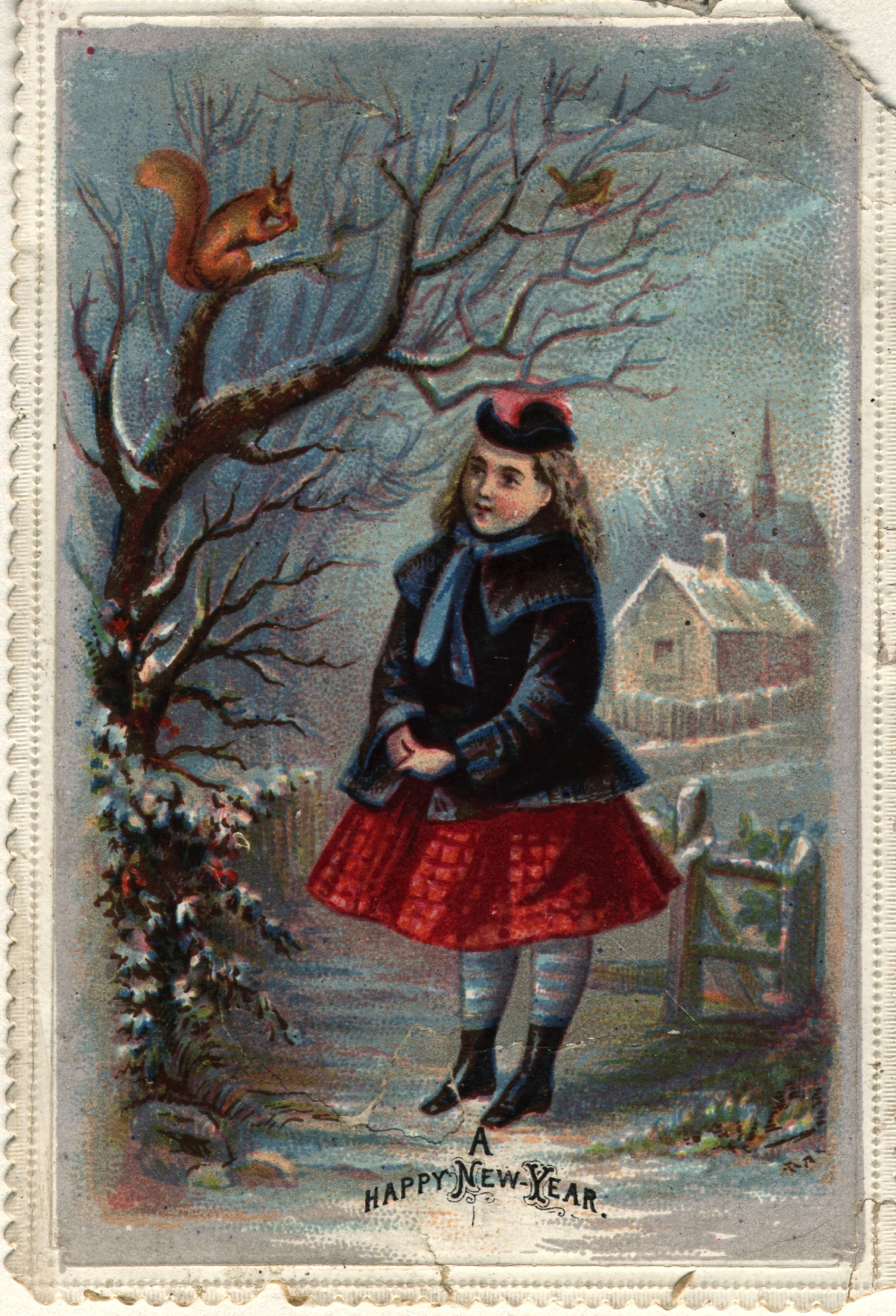
(Photo: A girl watches a red squirrel in a circa-1875 greeting card. By Hutton Archive)

Must We Defend Human Rights Everywhere?

John Allen Gay asks whether it makes strategic sense for the US foreign policy to concern itself with how other countries treat vulnerable minorities:

Those who advocate a prominent role for human rights in American foreign policy usually embrace a common argument—that disrespect for human rights at home is a warning sign that a country will promote instability beyond its borders, while countries pushed to respect human rights will behave more constructively. Thus, for instance, the Rwandan genocide was followed by a bloodletting throughout the African Great Lakes region, with the Rwandan government (drawn from the side of the victims) an active sponsor of violence in neighboring states. Thus, Saudi Arabia rules repressively at home and supports Islamic extremism abroad. Thus, Nazi Germany went from Kristallnacht to launching a continental war and an international campaign of genocide.

Yet human rights remain separable from international aggression.

Even a human-rights-free approach to international security is plausible—for example, if the United States were to ignore domestic human-rights violations altogether, but respond forcefully and resolutely to aggression across borders, the world would surely not come to an end. And human rights certainly deserve a role in U.S. foreign policy. Our closest allies share our values; relations with allies that don’t are testier and more reversible. We would like to think of ourselves as a force for good in the world, and our global leadership is strengthened when other states see us as a lawful, fair and generally benevolent power. Yet that doesn’t mean that we must make human rights a central priority, and it certainly doesn’t mean that we should be willing to put vital interests like stopping the spread of nuclear weapons on equal footing with them.

The City Of “Joyful Apocalypse”

Andrew Butterfield strolls through the National Gallery’s exhibit Facing the Modern: The Portrait in Vienna 1900, reporting that the show “offers a strong sense of the melancholy, the introspection, and the desperation that were characteristic of Vienna in that era”:

The first items in the show are Beethoven’s death mask and a post mortem painting of his hands Egon_Schiele_050turning grey and blue, and among other pictures in the room is von Amerling’s painting of his wife on her death bed (1843). Even the one seemingly triumphant picture here, von Amerling’s large and resplendent portrait of Cäcilie Freiin von Eskeles (1832), although depicting her dressed in luxurious clothing and posed in front of a red velvet curtain like a Baroque princess, emphasizes the keen sorrow of her gaze. Despite her wealth and status, like nearly everyone else in the room, she is shown alone with her sad thoughts.

The theme of painful solitude was everywhere in the culture of the city at the time. Indeed, the catalog of the 1905 exhibition spoke of today’s “isolating times”; and just two years later in his book, Vienna, Herman Bahr, referring both to artists of the past such as Beethoven and Waldmüller, and of the present such as Mahler and Klimt, wrote, “Real people are always kept in a cage of immense loneliness [in Vienna].” …

The most powerful image of dematerialization in the entire show is Egon Schiele’s haunting picture of his wife Edith, expiring from the Spanish Flu. Drawn in loose lingering lines of charcoal, she is turning to wisps of smoke right in front of you. Only her sad and penetrating eyes remain fixed in the slowly spinning cloud of disappearance. Schiele himself died of the flu three days later, on October 31, 1918—Halloween—the same day that the Austro-Hungarian Empire was dissolved. Halloween is an apt terminus of the show, for in a sense the entire exhibition is a danse macabre that begins with the Funeral March of Beethoven’s Third Symphony and ends with Mahler’s Kindertotenlieder. The somber music reaches its devastating climax in a gallery that includes not only Schiele’s image of his wife, but also Klimt’s drawing of his dead infant, and a posthumous portrait by Gyula Benczur of the beautiful but insane Empress Elisabeth, who was assassinated by an anarchist in 1898.

(Image: “Die Mutter” by Egon Schiele via Wikimedia Commons)

The Science Of Waking Up

Maria Konnikova presents research into “sleep inertia” – the reason why we’re all so miserable in the morning – and what can be done about it:

When [neuroscientist Kenneth] Wright asked a group of young adults to embark on a weeklong camping trip, he discovered a striking pattern: before the week was out, the negative sleep patterns that he’d previously observed disappeared. In the days leading up to the trip, he had noted that the subjects’ bodies would begin releasing the sleep hormone melatonin about two hours prior to sleep, around 10:30 P.M. A decrease in the hormone, on the other hand, took place after wake-up, around 8 A.M. After the camping trip, those patterns had changed significantly. Now the melatonin levels increased around sunset—and decreased just after sunrise, an average of fifty minutes before wake-up time. In other words, not only did the time outside, in the absence of artificial light and alarm clocks, make it easier for people to fall asleep, it made it easier for them to wake up: the subjects’ sleep rhythms would start preparing for wake-up just after sunrise, so that by the time they got up, they were far more awake than they would have otherwise been. The sleep inertia was largely gone.

Wright concluded that much of our early morning grogginess is a result of displaced melatonin—of the fact that, under current social-jetlag conditions, the hormone typically dissipates two hours after waking, as opposed to while we’re still asleep. If we could just synchronize our sleep more closely with natural light patterns, it would become far easier to wake up.

It wouldn’t be unprecedented. In the early nineteenth century, the United States had a hundred and forty-four separate time zones. Cities set their own local time, typically so that noon would correspond to the moment the sun reached its apex in the sky; when it was noon in Manhattan, it was five till in Philadelphia. But on November 18, 1883, the country settled on four standard time zones; railroads and interstate commerce had made the prior arrangement impractical. By 1884, the entire globe would be divided into twenty-four time zones. Reverting to hyperlocal time zones might seem like it could lead to a terrible loss of productivity. But who knows what could happen if people started work without a two-hour lag, during which their cognitive abilities are only shadows of their full selves?

The Best Of The Dish Today

Sorry for the missed posting last night. I won’t bore you with the various gruesome details of my current health issues, but I’ve been spending a lot of time in the bathroom. I’m grateful for the Dish team for holding down the fort while I’ve been a little preoccupied.

511SHZXK1TL._SY344_BO1,204,203,200_On the other hand, it’s a great opportunity to talk about toilet reading. Roger’s Profanisaurus is a blessed little tome from the authors of Britain’s most repellent adult comic, Viz. (Yes, my brother brought it to my attention.) I was so entranced by the first edition a few years’ back that I shared it with Hitch, who promptly refused to give it back. It’s probably still in his bathroom.  The original tome now has several updates, including 2005’s Profanisaurus Rex, 2007’s Magna Farta, and 2010’s Das Krapital. You probably get the general idea. The latest is called “Hail Sweary.”

It still staggers me that Anglo-Saxon renders so many potential terms for so few bodily fluids (and occasional painful solids). The definitions compound each other – and you can spend a lifetime chasing down the references – but I hereby offer a random sampling of what’s kept me sane the last couple of long nights:

jibbles n. The involuntary vibration of the jester’s shoes just before the custard pie gets thrown.

gesundsheit n. Ger. A simultaneous, albeit unintentional, sneeze and brown trout in the trousers. A cause for congratulation in Germany, that is.

gutbutt n. Affectionate epithet for an extremely obese person, the folds of stomach hanging down out of their t-shirt, resembling nothing so much as a pair of extra, frontal mudflaps. Also fruttocks.

pasturbation n. Dwelling on earlier glories whilst shaking hands with an old friend. Tosstalgia.

march of the penguins 1. n. What passes for a nature film in America, narrated by him off The Shawshank Redemption and them insurance ads. 2. n. An ungainly and seemingly endless waddle to the crapper whilst trying desperately to prevent the release of Bully’s special prize.

I could go on, but I think you have to have gone to an all-boys English school or a local rugby club to fully appreciate the genius of the oeuvre. I’d give you the Amazon link but I wouldn’t be forgiven in some households. Nor should I be.

Today we dissected the ground-breaking is-this-a-great-country-or-what? budget deal. A researcher in psychedelics explains that to his family. Is it me or is Paul Ryan becoming one big nose attached to a chin? And India takes a step back on sodomy.

The most popular posts of the day were Who’s Afraid Of The Truth? (I guess Dish readers aren’t) and Straight, Male and Lonely.

Back to passing another king-sized door-handle biter. See you, God willing, in the morning.

Why The Safety Net Matters

Poverty Rates

A new study (pdf) assesses the effects of anti-poverty programs over the past 45 years. Emily Badger comments:

If you’re a working mom of two making $18,000 a year, just below the poverty line, the government doesn’t consider in its own poverty rate whether the food stamps and rental subsidies it gives you effectively help pull your family above that threshold. To address this, the Census Bureau began to roll out in 2011 a supplemental poverty measure, a revised tool that tries to take these non-cash benefits into account (alongside other essential family costs). The supplemental measure, though, is primarily a resource for the curious. It’s not used in official poverty statistics or policy-making.

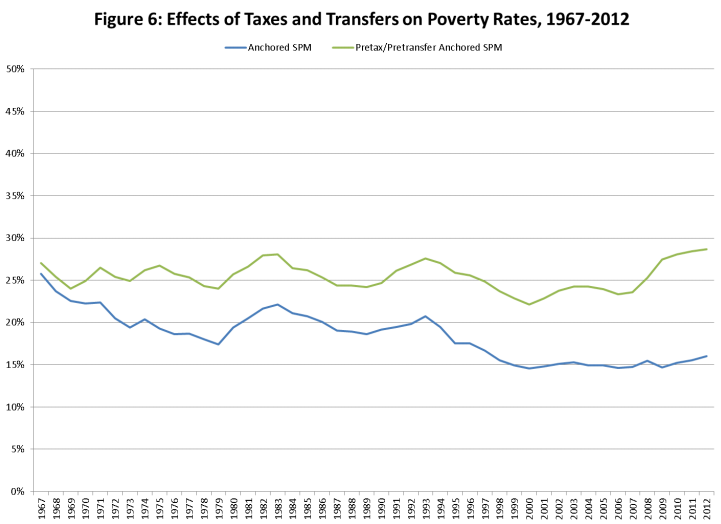
Researchers at Columbia University’s Population Research Center, however, have used it to make a powerful point about the real impact of all these government programs. Christopher Wimer and colleagues took the new supplemental threshold and carried it back in time, adjusting the 2012 supplemental poverty line for inflation … Take away those programs, and the poverty rate would have actually inched up from 1967 to 2011.

Brad Plumer sees the above chart in the context of the Great Recession:

There are a couple of ways to read this chart. One, if you don’t include safety-net programs, then poverty has actually risen from 26 percent in 1967 to 29 percent in 2012. There are more people dependent on safety-net programs to stay out of poverty than ever before. Or here’s another view: The green line shows that poverty rates would have soared during the most recent recession if there were no safety-net programs in place. But as the blue line shows, the poverty rate actually stayed fairly constant. The expansion of food stamps, unemployment insurance, and the Earned Income Tax Credit blunted a lot of misery.

Vauhini Vara adds:

Some politicians on the left might resist a measure that shows that poverty is much lower than it used to be: couldn’t this minimize the problem and make it harder to gain support for new anti-poverty programs? But it also may show that some anti-poverty programs of the past several decades appear to have achieved what they were meant for—which, one expects, should come as good news to everyone.

GTA: Tehran

http://www.kickstarter.com/projects/1817380887/1979-revolution-black-friday

Navid Khonsari, a videogame director known for his work on the Grand Theft Auto series, has created an open-world game that takes place during the Iranian revolution:

In fact, most of the game play in “1979 Revolution” is a battle of wits and ethical dilemmas, rather than the shoot-em-ups of Khonsari’s more notorious games. “Like the Arab Spring, [the Iranian revolution] was exciting and scary, but not overtly violent,” Khonsari noted. Though frustrated, Khonsari can understand the nerves he has touched. “For [Iranian exiles], 1979 was the quintessential moment when their lives were upturned,” he said. “I left Iran in 1979, and that was important for the rest of my life. A lot of Iranians want to bury this past. The younger [Irans emigrants] get it. They are disassociated enough from that event that they see the possibility of this being an amazing experience to learn what their uncles went through,” he continued.

A former history major, Khonsari hopes “1979” can inspire a genre of games that provide a ringside seat at major historical events. “My father warned me that nothing good could come out of doing things in politics,” Khonsari said. “He also supported us when he saw it wasn’t political, but part of what I’m doing is to be a template for his grandkids to learn about historical events, not through dates and facts, but through experiencing it.” He also hopes the game’s narrative depth, which features original audio recordings and photography from 1979, will resonate with youths in Iran and won’t be just a historical curiosity.

(Video from the game’s Kickstarter page)

Pharmaceutical Fish

With a new study showing that we are leaching more prescription drugs into our drinking water than previously thought, scientists are getting concerned:

We know how the drugs get there: Our bodies release them when we urinate or flush old drugs down the toilet. And it’s well known by now that pharmaceuticals are affecting fish, frogs and lobsters­—small amounts of estrogen cause male fish to develop eggs, for indexinstance…

So far, there have not been any studies showing effects on human health. It is particularly difficult to study the effects on the most vulnerable populations: pregnant women and the elderly. But [Shane] Snyder [co-director at the Arizona Laboratory for Emerging Contaminants] is frustrated that nothing has been done about the drugs that have already been found to be definitely problematic for aquatic life. “Look at estrogen and endocrine disruptors—here’s a case where there is compelling evidence that it has an effect on aquatic life and still nothing has been done,” said Snyder. Snyder said it would not be that difficult to figure out how to remove the compounds from the water, but it might be costly and the byproducts might be worse than the original contaminants.

Meanwhile, another study suggests that rising levels of oceanic acidity are also putting a strain on fish:

Scientists from UCSD’s Scripps Institution of Oceanography and Canada’s MacEwan University recently published this surprising finding in Proceedings of the Royal Society B: Biological Science. But what does it mean for fish to be anxious? According to this study, all it takes is observing how much time the fish choose to spend in dark versus light areas of their habitats… Previous studies have shown that fish dosed with anxiety-inducing drugs will, instead of moving continuously around their tanks, prefer to dwell in the dark spots. Turns out, putting fish in slightly more acidic water is just like administering an anxiety-inducing drug.

Sex And The Pagan City

Its not uncommon to see the spread of Christianity in the Roman Empire as, among other things, the triumph of sexual repression over a more swinging pagan culture. But reviewing Kyle Harper’s From Shame to Sin: The Christian Transformation of Sexual Morality in Late Antiquity, Peter Brown complicates this narrative with a troubling fact about just who was having all that sex:

So do we blame the Christians for bringing down the curtain on those merry scenes? Yes, but against a background that comes as a chill reminder of the lasting strangeness of the ancient Pompeii_-_Terme_Suburbane_-_Apodyterium_-_Scene_VIworld. If one asks if women in these scenes were free persons (and even how many of the men were free, for some might be slave gigolos), the unexpected answer would be: far fewer than we would wish to think. Many of the women were slaves. The jolly free-for-all, which we like to imagine as forming a timeless human bond between us and the ancients, was based upon the existence of a vast and cruel “zone of free access” provided by the enslaved bodies of boys and girls. Slavery, “an inherently degrading institution,” was “absolutely fundamental to the social and moral order of Roman life.” …

What mattered, in Roman law and in Roman sexual morality, had little to do with sex. It had everything to do with whose bodies could be enjoyed with impunity and whose could not be touched without elaborate formulas of consent.

(Image of a Roman mural via Wikimedia Commons)

Giving Diplomacy A Chance

The Senate won’t be passing new sanctions against Iran:

A deal in the Senate to impose additional sanctions on Iran has fallen apart, as Senate Democrats accede to requests from President Obama to delay new legislation while world powers negotiate a nuclear deal with Iran.

Earlier this week, Colin H. Kahl made the case that more sanctions would be counterproductive:

Suppose the Majles, Iran’s legislature, passed legislation tomorrow, over Rouhani’s objections, declaring that Iran would resume and escalate its nuclear activities in six months’ time if Washington failed to live up to its Geneva commitments and agree to a final deal that fully respects Iran’s nuclear rights. …

Suppose further that when asked by an Iranian reporter whether this legislation risked undercutting diplomacy, speaker of the Majles Ali Larijani pooh-poohed the notion, assuring the media that this in no way violates the terms agreed to in Geneva. After all, Larjani would say, “Iran is doing nothing now. We are simply creating a sword of Damocles as leverage to ensure the Americans live up to their end of the bargain and accept a final agreement that respects Iran’s red lines.”

How would U.S. lawmakers view such a move? Would they see it as consistent with the letter and spirit of Geneva? Would it enhance American support for diplomacy? Would the threatened Iranian escalation be helpful to Obama as he works to convince skeptics on Capitol Hill of the need to back continued negotiations and support future compromise? Or would it put the administration on the defensive, confirm the worst American suspicions about Iranian intentions, complicate diplomacy and make a confrontation over the nuclear program more likely?

Recent Dish on Iran here and here.