
Jerusalem, 5.11 pm
Jerusalem, 5.11 pm
The Economist relays the research of Vincent Showers about the spending habits of the religious:
Households “with a strong commitment to faith”— demonstrated by higher spending on religious activities—are less likely to be weighed down by excessive mortgage outgoings or loan payments for cars. Compared with other households, they are more likely to be home owners but their property tax burden tends to be less—suggesting that “some moderation in [the] selection of home in terms of extravagance or location….”
Devout households seem keener on mitigating risk and therefore spend more on life insurance and health insurance; they lay out less on alcohol and tobacco and more on domestic appliances, including cooking utensils. Such homely behaviour is most heavily correlated with religious belief in the American South and Midwest, which are also the regions with “the most conservative interpretation of scripture,” Mr Showers notes, in an article in the Interdisciplinary Journal of Research on Religion. (The research more-or-less conflates the term “religious” with “Christian” or “Judeo-Christian” which in the American context is only a smallish distortion.)
But religious families do allow themselves some earthly pleasures. Indeed, they are if anything a little more likely than other households to spend spare money on clothing or jewellery, although the amount each household splurges on jewellery is a bit less. Some of that jewellery, of course, might be devotional: silver crosses or stars of David. They are as likely as anybody else to be spending money on child support or alimony—a proxy for failed marriages—and they are as inclined as other folk to incur interest payments on credit cards.

David Rosenberg captions:
Sage Sohier’s series “At Home With Themselves: Same-Sex Couples in 1980s America,” was, in many ways, ahead of its time. Today, apart from a few dated fashion choices, the photos of gay couples in domestic settings don’t seem that shocking. But when Sohier began shooting the series in 1986, AIDS and sexual promiscuity seemed to be the only headlines about gay people.
“My ambition was to make pictures that challenged and moved people and that were interesting both visually and psychologically,” Sohier wrote via email about the project. “In the 1980s, many same-sex relationships were still discreet, or a bit hidden. It was a time when many gay men were dying of AIDS, which made a particularly poignant backdrop for the project.”
(Photo: Stephanie and Monica, Boston, Massachusetts, 1987, by Sage Sohier. Buy Sohier’s book here.)
Last month the Vatican hosted a colloquium on “The Complementarity of Man and Woman,” during which Pope Francis asserted, to the joy of both conservative Protestants and Roman Catholics, that “Children have a right to grow up in a family with a father and a mother.” Brandon Ambrosino unpacks the nuances that make the line anything but a simplistic defense of traditional marriage:
As many theologians and commentators are pointing out, the most important part of Francis’ lecture was this:
When we speak of complementarity between man and woman in this context, let us not confuse that term with the simplistic idea that all the roles and relations of the two sexes are fixed in a single, static pattern. Complementarity will take many forms as each man and woman brings his or her distinctive contributions to their marriage and to the formation of their children — his or her personal richness, personal charisma.
According to [Fordham theologian Patrick] Hornbeck, these words signal a departure from Francis’ predecessors. For one thing, Hornbeck notes, Francis didn’t go out of his way to condemn homosexuality. Second, Francis’ comments display a certain level of openness often lacking in discussions about complementarity.
“What Francis tells us in his address is complementarity is not about a rigid demarcation of gender roles,” said Hornbeck.
In other words, Francis has displayed a more nuanced understanding of sex and gender than we’ve seen from a recent pope. He understands that human sexuality is complex and that it resists easy categorization, which is why his lecture warns against simplistic, static, reductionistic ways of looking at it.
In an interview, Hornbeck further delineated a more expansive understanding of what complimentarity can mean, especially as it connects to gay relationships:
What I like about his statement is, first of all, how he uses Scripture. He uses I Corinthians 12 to talk about spiritual gifts: “Saint Paul tells us that the Spirit has endowed each of us with different gifts so that – just as the human body’s members work together for the good of the whole — everyone’s gifts can work together for the benefit of each.” Now, there’s no gender associated with those gifts. Those are unique to each individual.
The way those gifts complement each other is the second point. Francis says, “To reflect upon ‘complementarity’ is nothing less than to ponder the dynamic harmonies at the heart of all Creation.”
When we think about the harmony of sexuality, one of the fundamental aspects that defines that harmony is sexual orientation. So heterosexual relationships are harmonious for people with a heterosexual orientation. And homosexual relationships are harmonious for people with homosexual orientations. I think it’s correct to say, as Francis does, that all complementaries were made by the Creator, and sexual orientation is part of that creation. (Even though the Church uses the language of “disordered,” I and many other theologians would challenge that language.) But I think there can be harmony for gays and lesbians in sexual relationships, just like there can be harmony for heterosexuals in sexual relationships.

“The Good Life” by Mark Strand:
You stand at the window.
There is a glass cloud in the shape of a heart.
There are the wind’s sighs that are like caves in your speech.
You are the ghost in the tree outside.The street is quiet.
The weather, like tomorrow, like your life,
is partially here, partially up in the air.
There is nothing you can do.The good life gives no warning.
It weathers the climates of despair
and appears, on foot, unrecognized, offering nothing,
and you are there.
(From Selected Poems by Mark Strand © 1979, 1980 by Mark Strand. Used by permission of Alfred A. Knopf, an imprint of the Knopf Doubleday Publishing Group, a division of Random House LLC. All rights reserved.Random House, LLC. Photo of Mark Strand with his 80th birthday cake surrounded by friends on October 9th, 2014, courtesy of Lawrence Schwartzwald.)
“Do I really want it, this self, these scattered fingerprints on the air, to persist forever, to outlast the atomic universe?
Those who scoff at the Christian hope of an afterlife have on their side not only a mass of biological evidence knitting the self-conscious mind tight to the perishing body but a certain moral superiority as well: isn’t it terribly, well,selfish, and grotesquely egocentric, to hope for more than our animal walk in the sun, from eager blind infancy through the productive and procreative years into a senescence that, by the laws of biological instinct as well as by the premeditated precepts of stoic virtue, will submit to eternal sleep gratefully? Where, indeed, in the vast spaces disclosed by modern astronomy, would our disembodied spirit go, and, once there, what would it do?
In fact we do not try to picture the afterlife, nor is it our selves in our nervous tics and optical flecks that we wish to perpetuate; it is the self as window on the world that we can’t bear to think of shutting. My mind when I was a boy of ten or eleven sent up its silent screams at the thought of future aeons – at the thought of the cosmic party going on without me.
The yearning for an afterlife is the opposite of selfish: it is love and praise for the world that we are privileged, in this complex interval of light, to witness and experience. Though some believers may think of the afterlife as a place of retribution, where lives of poverty, distress, and illness will be compensated for, and where renunciations will be rewarded – where the last shall be first, in other words, and those that hunger and thirst shall be filled – the basic desire, as Unamuno says in his Tragic Sense of Life, is not for some otherworld but for this world, for life more or less as we know it to go on forever: ‘The immortality that we crave is a phenomenal immortality – it is the continuation of this present life,'” – John Updike, Self-Consciousness: Memoirs.
(Hat tip: John Benjamin)
The sociologist of religion Peter Berger posits that modern atheism emerged as “a rebellion against the monotheistic faiths that originated in the Middle East – Judaism, Christianity, Islam,” and that, as such, it “makes much less sense in a non-monotheistic environment”:
The rebellion is triggered by an agonizing problem: How can God, believed to be both all-powerful and morally perfect, permit the suffering and the evil afflicting humanity? This is the problem called theodicy, which literally means the “justice of God”; in the spirit of the rebellion it is also a demand that God has to justify himself. The most eloquent expression of this atheist rebellion in literature is by Dostoyevsky’s Ivan Karamazov rejecting God, because he allowed the cruel murder of one child.
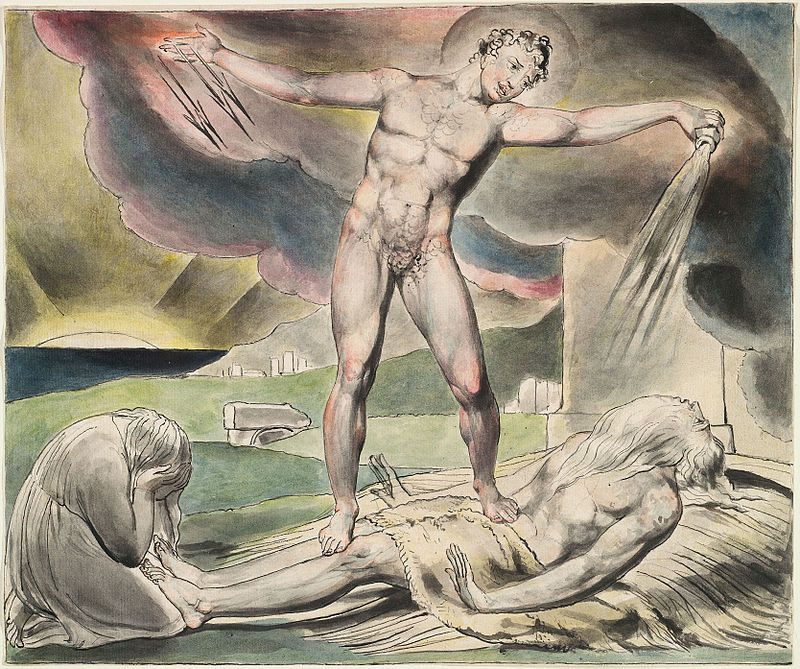
Within the Hebrew Bible the problem of theodicy is of course confronted in the Book of Job. Its happy ending (Job’s restored good fortune) is probably a later redaction, intended to assuage the outrage at Job’s innocent suffering. If one brackets the ending, the message is one of submission to God’s will, whatever it may be. The most radical version of this theodicy (if one can call it that) in the history of Christianity is that of Calvinism. God, in his inscrutable will, has ordained from eternity who will be the elect destined for heaven, and who the damned going to hell–and nothing an individual can do or fail to do can change the divine edict. There is a certain (if perverse) grandeur in such faith.
On a related note, Shalom Carmy reviews Mark Larrimore’s The Book of Job: A Biography, which marks when the problem of evil came to dominate readings of that Biblical text:
For Larrimore the medieval and early modern periods mark the rise of the Book of Job as disputation, with Maimonides, Thomas Aquinas, and Calvin as his chosen representatives. These writers see the book through the prism of the question of evil. Maimonides is the first of them to ascribe specific philosophical views to Job and to the other speakers in the dialogue. For the sake of argumentative consistency and focus, Maimonides dismisses many powerful emotional passages as philosophically irrelevant digressions. Other theologians, in the service of Job’s pious image, play down his pungent sayings. Calvin, for whom Job is a vehicle for communicating the transcendence and inscrutability of God, cites some of Eliphaz’s utterances as if they were Job’s, assuming, as did other Jewish and Christian writers, that all Scripture delivers the same message, irrespective of the speaker.
With the modern problem of theodicy, the readings of Job that attract Larrimore’s attention are increasingly embedded in larger philosophical, literary, or academic projects. Perhaps the most thought-provoking element in this book is Larrimore’s emphasis on the importance of Kant, more than Leibniz, as the hinge around which the history of theodicy revolves.
(Image: Satan pours on the plagues of Job in William Blake’s The Examination of Job, via Wikimedia Commons)
Nick Ripatrazone riffs on Andre Dubus’ essay on the craft of short story writing, “The Habit of Writing,” in which he reveals how and why he “changed his method while writing a story, ‘Anna,'” which is told from the perspective of its eponymous female character:
“At my desk next morning I held my pen and hunched my shoulders and leaned my head down, physically trying to look more deeply into the page of the notebook. I did this for only a moment before writing, as a batter takes practice swings while he waits in the on-deck circle. In that moment I began what I call vertical writing, rather than horizontal. I had never before thought in these terms. But for years I had been writing horizontally, trying to move forward (those five pages); now I would try to move down, as deeply as I could.”
Horizontal writing is focused on amassing pages and words.
When Dubus wrote horizontally, he wrote convinced that fiction was created through aggregation. Vertical writing, in contrast, values depth over breadth. Stories are written when they are ready to be written; they are not forced into existence by planning or excessive drafting. Horizontal writing seeks to move across the page; vertical writing seeks to dig into the page, to value the building of character and authenticity over the telegraphing of plot. The folly of horizontal writing is that it convinces writers that fiction writing operates on a production model. If they simply sit at the desk and pound out page after page, the story will come. That might be true, but Dubus argues that such forced work creates a lot of “false” fiction. Curiously enough, by seeking to undermine the stereotype that writing is the result of inspiration, writers have fallen for the other, no less romantic opposite: that writing is factory work, and daily devotion is rewarded with final drafts. Both approaches are magical thinking. Vertical writing is no less work, but it is better work, work at the right time. It requires patience in the willingness to wait for a story to feel ready to be written, as well as the attention and focus necessary to inhabit the story once gestated.
Read last weekend’s Quote For The Day from Dubus here. Check out all the Dish-love for Dubus here.
NSFW, but safe for NSFW Saturday:
Adam Sternbergh asks why there’s a “tendency in modern mainstream movies to treat sex as something that happens elsewhere, offscreen and unspoken of”:
Part of the reason is because of the internet, that perpetual digital orgy, which has busted the movies’ monopoly as the place where we go to glimpse naughty things. (That sexy scene in Moscow on the Hudson? The whole movie’s currently streaming on Hulu.) And part of the reason is because Hollywood, in the blockbuster age, has succumbed to the self-neutering gospel of the four quadrants — by which the world is split up into increasingly gory R-rated action and horror films; fun-for-the-whole-family superhero epics (superheroes, it’s well known, have no genitalia); animated films for the kid in all of us; and movies by Nicholas Sparks.
In the era of Top Gun, The Big Easy, Body Heat, or other steamy Hollywood thrillers, the goal was to appeal to both men and women with the promise of (among other things) onscreen sex.
(Ergo the fabled “date night” movie.) Now the goal is to appeal to adults and their 12-year-old kids with the promise of the absence of sex. As for more serious films, flipping back through the Best Picture nominees from the last few years — films like Argo and The King’s Speech and Inception — the only ones with truly memorable sex scenes are Black Swan and The Wolf of Wall Street. Yet in the former, the sex (between Natalie Portman and Mila Kunis) plays out like a nightmare; and in the latter, the sex feels like a porno directed by Hieronymous Bosch.
But the real cultural shift — as any with a pay-cable subscription will tell you — is that the small screen has finally steamed over. After decades spent as Hollywood’s prudish country cousin, TV now brings televised sex of near-Caligulian variety and inventiveness into our homes. There’s even a term, sexposition, created specifically for moments when characters are communicating information while also having, or watching, sex. TV, in particular pay cable, has claimed this ground in part because it can — there’s no MPAA threatening to slap censorious NC-17s on True Blood every week.
Of course, Dan Savage has been trying to reverse this trend for years with his amateur porn festival:
In fiction, anyway. This year, Ben Okri has been awarded the Literary Review Bad Sex in Fiction award for a passage in his tenth novel, The Age of Magic:
“When his hand brushed her nipple it tripped a switch and she came alight. He touched her belly and his hand seemed to burn through her. He lavished on her body indirect touches and bitter-sweet sensations flooded her brain. She became aware of places in her that could only have been concealed there by a god with a sense of humour.
Adrift on warm currents, no longer of this world, she became aware of him gliding into her. He loved her with gentleness and strength, stroking her neck, praising her face with his hands, till she was broken up and began a low rhythmic wail … The universe was in her and with each movement it unfolded to her. Somewhere in the night a stray rocket went off.”
Okri faced some, er, stiff competition for this year’s award:
The winner of this year’s Booker, Richard Flanagan, with The Narrow Road to the Deep North, was a contender with: “Hands found flesh; flesh, flesh. He felt the improbable weight of her eyelash with his own; he kissed the slight, rose-coloured trench that remained from her knicker elastic, running around her belly like the equator line circling the world.”
Haruki Murakami’s Colorless Tsukuru Tazaki and His Years of Pilgrimage resorted to naturalistic metaphors: “Shiro’s were small, but her nipples were as hard as tiny round pebbles. Their pubic hair was as wet as a rain forest. Their breath mingled with his, becoming one, like currents from far away, secretly overlapping at the dark bottom of the sea.”
Pulitzer Prize-winner Michael Cunningham’s The Snow Queen weighed in with: “He hears himself gasp in wonder. He falls into an ecstatic burning harmedness, losing, lost, unmade. And is finished.”
 The Dish
