[I]f you are a liberal internationalist, a humanitarian interventionist, you better be out there beating the drum for this reform every day. You better be going on cable news, spending all of your political capital trying to make this happen. You better take to the op/ed pages and Twitter and every other way you have to communicate. And when you do, you better use all of that same moralizing language you do when you’re making your constant calls for war. You better be just as aggressive in suggesting that people who oppose your preferred policy just don’t care about the lives of people who could be saved, as you do when you are advocating for cruise missile strikes. You better follow through.
Because one of the most straightforward, direct, achievable, and cheapest forms of humanitarian intervention is to welcome people with open arms into our country. The fact that this kind of humanitarianism is so rarely considered, when people are looking for ways to save the world with violence, tells you a lot about them and what they really care about.
The essayist and critic George Scialabba has produced an absorbing account of his long struggle with severe depression – simply by reproducing selected intake reports and treatment notes from four decades of therapy and medication, adorned only with a very short introduction. It’s a granular, intimate look at what it is like to live with depression, made all the more notable by the place of religious faith in his story. As one psychologist put it, after Scialabba lost his faith as a young man, “the pieces of his life never came back together.” Here’s an excerpt from a 1987 entry from the document:
Mr. Scialabba dates his psychiatric symptoms back to age 17 when he developed incapacitating anxiety when he had any sexual impulse and he would have guilty ruminations that disrupted his usual activities.
He went to a priest who told him he would be responsible to God for the patient’s sexual impulses, and the anxiety episodes stopped. Mr. Scialabba also joined a very devout all-male Catholic organization called Opus Dei, and he became very involved in that organization during his undergraduate years at Harvard. He felt a missionary zeal about converting others and involving them in Opus Dei. Mr. Scialabba describes his commitment as “intense, demanding, and lifelong.” After four years of college he “lost all belief in Catholicism.”
Mr. Scialabba describes his leaving the church and Opus Dei as extremely difficult, and he described an episode of confusion and perhaps of depersonalization in which he didn’t know what he was going to do, but he went into a meeting of Opus Dei and tried to speak about his loss of faith. Instead he became agitated and had to be led from the room. Mr. Scialabba feels he has never recovered from this emotional upset. He describes the time leading up to his departure from Opus Dei as the most intensely meaningful, exciting time in his life, when he felt that all of life and intellectual and philosophical pursuits were open to him.
Damon Linker riffs on Scialabba’s story, thinking through what faith can mean for a person – and what happens when that faith is lost. The despair Scialabba endures seems to complicate our secular-religious divide, drawing attention to those “who are unceasingly restless for God, whose deepest and highest hopes point toward transcendence of the merely mortal world, but who either never manage to acquire faith — or, perhaps even worse, enjoy it for time but then lose it”:
For someone like that, unable to reconcile himself to the disenchantment of his own world, faith — its promise, its withdrawal, its absence — can become a source of the purest misery. Even a curse.
Worse, a curse backed up by a taunt, echoing continually in the former believer’s mind: “You’ve seen the Truth. If you now reject it and turn your back on God, the fault is yours alone, and you will suffer for your sins. Indeed, your depression is merely a finite taste of the agony you will reap in a hellish afterlife of eternal punishment.”
Against these existential-spiritual agonies, modern medicine deploys talk therapy and Prozac. No wonder the results are mixed.
As for the rest of us, secularists seemingly so much more content than George Scialabba with our lack of faith, we are left with a puzzle worth pondering: Was Augustine deluded about the ultimate source and aim of our unceasing, anxious restlessness?
Virginia Hughes looks at the science on why people have pets:
If pet-keeping were a purely (or even largely) biologically driven trait, it would be difficult to explain why its popularity has spiked in the last 200 years, and particularly since World War II — a tiny blip on the timeline of human evolution. As a rough marker of this change [psychology professor Harold] Herzog turns to Google Ngram, a tool that tracks the frequency of words published in books. If you put the word “pet” into Google Ngram, you’ll see a sharp rise since about 1960.
Similarly, if pet-keeping were biological you’d expect all human cultures to do it. While it’s true that most human cultures have pets in their home, the way they interact with them is remarkably variable. Herzog cites a study published in 2011 comparing pet-keeping practices in 60 societies around the world. The study found a large variety of species of pets, including some that seem quite odd from a Western perspective: ostriches, tortoises, bears, bats. The most common pet species is the dog, but even then, people are very different in the way they keep dogs.
Of the 60 cultures surveyed, 53 have dogs, but only 22 consider dogs to be pets. Even then, pet dogs are usually used for specific purposes such as hunting or herding. Just seven cultures regularly feed their dogs and let them live inside the house, and only three cultures play with dogs. The study’s general conclusion, as Herzog puts it: “The affection and resources lavished upon pets in the United States and Europe today is a cultural anomaly.”
Meanwhile, Kaleigh Rogers flags research on the role of animals in helping humans overcome addiction:
Animal-assisted therapy (AAT) is not a new concept. Most of us can imagine how having a therapy dog wagging around a group session helps chill people out and enables them to open up (and there’s plenty of research to back that up). But do we really think that Lassie can help us kick a crack addiction? And when expensive, in-patient treatment facilities are upgrading from a golden retriever to a tank full of dolphins, is it based on research evidence or just a marketing gimmick to stand out from the pack?
Research on the effects of AAT specifically in the treatment of substance dependency is limited, but there is a bit of scientific evidence to back up the claims addiction centers make. In 2009, Dr. Martin Wesley, dean of the School of Counseling at the University of the Cumberlands in Kentucky, was inspired to study the effects of animals on addiction therapy while working at a residential treatment center. He noticed how much his patients took an interest in the critters around the facility. “I would see how the clients would respond to squirrels outside and the cats that would come by and even raccoons,” he said in a recent phone chat. “Someone would bring their dog and these hardened individuals would melt.”
I have to say I understand. My dogs do one thing for me every day: they break my spell of narcissism; they take me out of an exclusively human sphere and force me to see the world, even briefly, from the point of view of another species – which seems, as each day goes by, vastly superior to my own. For this, they trip us out of our ruts of thought as surely as meditation does. Because they are themselves a kind of permanent, living form of meditation: that the universe is about far more than us, if we look up a little, and if, occasionally, we also look down.
The idea that in a free society absolutely everything should be open to debate has a detrimental effect on marginalised groups. Debating abortion as if it’s a topic to be mulled over and hypothesised on ignores the fact that this is not an abstract, academic issue. It may seem harmless for men like Stanley and O’Neil to debate how and if abortion hurts them; it’s clearly harder for people to see that their words and views might hurt women.
Access to abortion impacts the lives of women, trans and non-binary people every day, and the threat pro-life groups pose to our bodily autonomy is real, not rhetorical. If you don’t believe me, visit any abortion clinic and witness the sustained aggressions of pro-life pickets. In organizing against this event, I did not stifle free speech. As a student, I asserted that it would make me feel threatened in my own university; as a woman, I objected to men telling me what I should be allowed to do with my own body.
The context for this is the inability of a group called Oxford Students For Life to find a place on campus for a debate on abortion between two men. They were planning an event in Christ Church’s Junior Common Room, a typical place for a small-scale discussion. The group has had similar debates including women in the past. The pro-choice side was represented. But men, it seems, are not allowed to debate abortion at all, according to a fem-left group at my alma mater. Because: men. Even pro-choice men. In a country where pro-choicers greatly outnumber pro-lifers, and where the right to an abortion is deeply rooted in law. And their contempt for even the idea of free debate is palpable:
This Tuesday Oxford Students for Life are putting on a super cute debate with two cis guys on whether people with uteruses deserve to have any choice over their own bodies. We don’t think this is okay so (assuming the event is still going ahead) we thought we should go and say hi! … We are still hoping this gets shut down by the college (Christ Church).
The college canceled the debate in part due to concerns about “physical security” of the students – the danger that the college would be mobbed by protestors, making a debate impossible – and their “mental security” as well. What on earth does “mental security” mean? This apparently:
Mental security here refers to students’ emotional well-being, avoiding unnecessary distress, particularly for any residents who may have had an abortion. With a 300 person protest expected, the event could not have been self-contained and it would have been impossible for those in the closest staircases (at a minimum) to avoid being made acutely aware of the event.
Let me put this simply enough: Once free speech is made contingent on no one’s feelings being hurt, we no longer have free speech. Once that applies even within a university – the one space in our culture where free speech should be absolute – we have left liberalism behind on the march toward progressivism. That’s why the logic of “hate crimes” is so pernicious; that’s why the language of “micro-aggressions” leads to a public sphere in which some individuals, simply because of their gender or sexual orientation, are deemed unworthy of being allowed to debate. And those of us who speak out against this are damned in the same way: our integrity as human beings impugned, our characters wantonly besmirched, our views dismissed, and our arguments made to look as if they are mere prejudices.
Any movement that seeks to win this way is not a movement I want to be a part of. And feminism is too vital a cause and too integral part of our discourse to be hijacked in this fashion.
The latest damning evidence in the Cosby saga is this post-interview AP footage:
Amanda Hess blames the culture of entertainment journalism for allowing the allegations to go under the radar for so long, pointing to that AP interview as a prime example:
Entertainment journalists require access to rich, famous people, and rich, famous people require favorable press. How news organizations and celebrities negotiate that exchange depends on their relative status in the marketplace. When Cosby granted the AP interview at the beginning of the month, he believed that he was powerful enough to demand positive coverage, and ultimately, it appears the AP agreed.
But just ten days after the piece aired, Cosby’s stock had dropped considerably: In that time, Netflix, NBC, and TV Land had all cut ties, meaning that he had fewer friends, less influence, and very little leverage. As the power differential shifted, the AP’s complicity with Cosby in producing the art-related video and scuttling the rest began to pose a reputational risk to the news organization. (The AP notes in the new video that it decided to publish the additional footage in the new context of the “backdrop” of his shuttered business deals.) So: The AP rolled the tape of its interview touching on the rape allegations, and also included the tense off-the-cuff conversation that followed. The postscript contained the interview’s juiciest bits, but it also served as a sly explanation for why the AP failed to release the video earlier: The implication is that Cosby and his people intimidated the AP into silence.
But the video shows that the Associated Press reporter was not eager to approach the topic in the first place, and unwilling to justify his line of questioning when Cosby challenged him.
The odd thing about Cosby’s downfall is that nothing had changed in the last decade; there was no suggestion that any of the events described by his new accusers had happened since the first allegations and an accompanying civil case, which was settled. The initial lack of followup by influential outlets created a sort of reverse pack mentality—a reinforcing silence. No one mentioned it, because no one else had.
This was helped along by the feel-good nature of much arts writing: If the point of the story is to promote a comedy appearance, or a new book or other product, a digression into allegations of drugging and sexual assault was buzzkill.
Others reflect on how one should approach Cosby’s work now that he’s widely seen as a rapist. Despite being “100 percent in favor of NBC yanking his sitcom,” Pilot Veruet laments TV Land’s removal of the show that made Cosby famous:
The Cosby Show may have been about a family that happened to be black, rather than about a black family, but that doesn’t negate the huge strides the show made. Most importantly, it doesn’t negate the fact that for many people, myself included, this was one of the first times I was seeing myself — my family, my skin, my hair — represented on television in a way that actually made me feel good. …
Aside from the show’s legacy, TV Land’s decision brings up a whole slew of questions that are impossible to answer: What are the rules when it comes to public erasure of a prominent figure and his work? What makes Cosby different from Roman Polanski or Woody Allen — two filmmakers who continue to work and get their films distributed, and whose movies still regularly air on television (I can’t imagine them ever getting yanked) — or any other terrible person who has also contributed something of value to society? Is it the sheer number and volume of victims, or something else at work here? And what does this mean for everyone else who worked, for so many years, on The Cosby Show and will now fail to get their share of the residuals? Will all of Cosby’s past work eventually see the same fate?
The thing that strikes me the most about TV Land’s choice is that it doesn’t seem to have anything to do with righteousness or respect for the victims; it appears to be a panicked business decision, a preemptive strike to ensure the network doesn’t receive any of the backlash that Netflix and NBC were getting prior to pulling their respective Cosby projects.
Separating art from the artist — or condemning art made by terrible people — is never a zero sum game. You can find Cosby’s alleged actions so appalling that you can’t watch his show at all. You can also find his alleged actions appalling, yet find they don’t impact your ability to watch anything he’s ever done — or even appreciate his stand-up.
If you fit into that latter category, don’t worry that you’re tossing piles of cash his way if you fire up a favorite Cosby Show episode on Hulu. But if you find Cosby to be a monster and want to monetarily punish him somehow, you don’t really have a lot of recourse, unless you were planning to see him perform live soon and now won’t. Cosby’s considerable fortune — the one that made it possible for him to settle allegations against him out of court, the one that made it necessary to try him in the court of public opinion — was made long, long ago, and there’s little to be done about it now.
And Tim Teeman sums up much of the response over the question, “How could the guy who played Cliff Huxtable do this?”
Bill Cosby, it seems, can only be seen in two registers: sainted family man of a much-loved sitcom, or fallen, tarnished villain. There is no middle ground. There is no understanding that on The Cosby Show, Bill Cosby was playing a role, and playing it so well that America happily conflated character and actor. The conflation was so total that now America apparently feels cheated, or tricked somehow, that this person is not the character he played.
But Cosby never was, and it is not his failing that America took him to their hearts as so (indeed, ironically, that confidence trick was solely down to his acting brilliance). Cosby’s alleged crimes are horrific, but America’s infantile deification of celebrity, its crazy melding of the fictional and the real, underpins Cosby’s present position in the public stocks, as much as his alleged crimes.
Myron May, the man who shot and wounded three people at the Florida State University library yesterday morning before police killed him, was mentally disturbed:
May’s Facebook page shows he posted mostly Bible verses and links to conspiracy theories about the government reading people’s minds. Records show May was licensed to practice law in Texas and New Mexico. According to a Las Cruces, New Mexico, police report last month, May was a subject of a harassment complaint after a former girlfriend called to report he came to her home uninvited and claimed police were bugging his house and car. Danielle Nixon told police May recently developed “a severe mental disorder.” “Myron began to ramble and handed her a piece to a car and asked her to keep it because this was a camera that police had put in his vehicle,” the report said. The report also said May recently quit his job and was on medication.
In the wake of this latest tragedy, Beth Elderkin wants to talk about how almost all such “active shooters” are male:
[T]here’s no way to deny that almost all active shooters of the past decade have been men. Even Paul Elam, founder of men’s-rights site A Voice For Men, called the FBI’s statistics “reasonable” in an interview with the Daily Dot. But does that mean masculinity is, or should be, part of the conversation? According to researchers, the answer is yes. An increasing number of sociologists, including [Michael] Rocque, who authored a study on school shootings in 2011, say gender should be treated as a key component in how we address active shootings and other violent acts. And we’re not just talking about mass shootings; FBI statistics show that in 2012, more than 80 percent of arrests for violent crimes were men.
Update from a reader:
So can we acknowledge now that male brains work differently from female ones? Obviously I don’t mean that it’s always for the better! But then couldn’t these differences also partially explain the lack of gender parity in certain professional fields? Testosterone is powerful stuff.
Tyler Lopez, meanwhile, blasts the NRA’s position on these incidents and how to stop them:
The gun lobby acknowledges the problem of mass-shooting incidents in the United States. Its solution calls for arming more people who could potentially stop a shooter and for rapid-response training focused on minimizing casualties. This is part of an increasingly pervasive, insidious gun culture that accepts mass shootings as inevitable. But by this logic, the first victims—friends, loved ones, children—are expendable. The first victims of a mass shooting are a mangled human sacrifice on the altar of Second Amendment rights.
Until a shooter pulls the trigger to begin his slaughter, he is merely a guy with a gun. The gun lobby insists that the government should allow people to carry firearms into all public places. (Gun advocates continued to push for expanded open-carry legislation the morning after the Tallahassee shooting.) After all, who are we to judge a man simply because he is proudly displaying a gun by his side? In this world, the first victim is merely an alarm for others to respond.
He will be a refreshing presence on the campaign trail. He doesn’t talk like a politician. He can be blunt and combative. He has taken strong populist economic stands and was a strong opponent of the war in Iraq. In fact, Webb goes in strong whenever he takes a stand. He’ll certainly be fun to watch during debates (he was a boxer at Annapolis).
You’d have to call him a longshot, of course. But I suspect he’ll be one of those long shots who have the power to shape a campaign with new ideas and sharp arguments. He will certainly cause Clinton some populist agita, should she run.
It has all the trappings of a campaign as vanity project, the type of presidential exploration designed not to excite convention delegates but to boost a candidate’s name ID before cable-TV bookers.
Webb, after all, would come into a Democratic primary with considerable baggage—never mind that he would likely be squaring off against Hillary Clinton, the most overwhelming favorite in an open Democratic primary in history. There is the fact that Webb used to be a Republican, a point he proudly points to in the video when he mentions his service in the Reagan administration. Or the fact that Webb, who decided not to run again after only one term in elective office, doesn’t seem to have the stomach for the degradations of politics. And the fact that Webb’s base of support lies among working-class whites, who are a diminishing constituency in a party made up more and more of liberals, minorities, and the professional classes.
Jonathan Bernstein opines that Webb “isn’t so much a serious candidate for a presidential nomination as he is an interesting person who has chosen to enter the contest”:
In that, he reminds me of Bill Bradley in 2000 or perhaps Eugene McCarthy in 1968. Interesting people can be excellent (or so-so) senators, but they never get close to presidential nominations. For that, the requirement is almost insane ambition.
Nevertheless, on the surface Webb looks like a viable candidate (he fits my criteria of having convention qualifications and fitting in the mainstream of his party on policy). He also appears to be well-regarded by many in the national press corps. So even if he polls badly six months from now and has little in the way of the organization that real candidates need, it will probably be easier for Clinton to accept at least a couple of debates with him than to freeze him out.
If nothing else, Webb can show how empty Clinton’s message may be. He can turn her insistence on inevitability into a portrait of entitlement, which in fact it is. And if he starts getting attention, it might stir other Democrats to get in and steal some of the limelight.
Noah Millman hopes Webb will force Clinton to debate foreign policy. But he fears Webb will get tripped up by the culture war:
Webb’s campaign is going to be severely under-funded, and Webb himself is going to start out of the gate a terrible campaigner, so it may be that Clinton will simply ignore him and we won’t get any debate at all. But if she wants to make him instantly irrelevant, the last thing she’d do is engage him. Rather, all she – or, rather, her surrogates – need to do is to position him as a culture war conservative, someone who is at best iffy and at worst outright hostile on women’s equality, gay rights, affirmative action, immigration, and so on down the line. Once that becomes the story, that will likely be the only story – the only one that matters, anyway. And then, either he sinks without a trace or, if he gets a little bit of traction, it’ll be another story about how culturally conservative working class whites who rejected Obama are rejecting Clinton as well. Which, in turn, will further facilitate their consolidation as a GOP voting bloc – precisely the opposite of what Webb intends to achieve. …
Webb is never going to be the great progressive hope – and that’s fine. Indeed, it’s better than fine. It’s better for Clinton to be challenged on foreign and economic policy by a Jim Webb than a Bernie Sanders. People who aren’t the usual suspects might just listen. But he needs to avoid being defined by the cultural signals he gives off.
[T]he conservative message machine has gone on at length about the “constitutional crisis” the president is instigating. The right has compared Obama to a monarch (see here and here), a Latin American caudillo, even a conspirator against the Roman Republic. (Ever melodrama much?) The rhetoric gets a little thick. But if you boil it down, the critique is mostly about Obama’s usurpation of power and contempt for democratic norms, not the substance of his policy change. Some Republicans no doubt believe it.
And yet, try as they might to stick to the script, there’s something about dark-skinned foreigners that sends the conservative id into overdrive.
Most famously, there’s Iowa Congressman Steve King’s observation last year that for every child brought into the country illegally “who’s a valedictorian, there’s another 100 out there who weigh 130 pounds and they’ve got calves the size of cantaloupes because they’re hauling 75 pounds of marijuana across the desert.” While King tends to be especially vivid in his lunacy, he’s no outlier.
Substantively, Obama’s executive order gives him less than he hoped to gain with a bipartisan law. But politically, he has ceded no advantage. Indeed, he has gained one. Not only does immigration remain a live issue, it is livelier than ever. The GOP primary will remorselessly drive its candidates rightward and force them to promise to overturn Obama’s reform, and thus to immediately threaten with deportation some 5 million people — none of whom can vote, but nearly all of whom have friends, family, co-workers, and neighbors who can. …
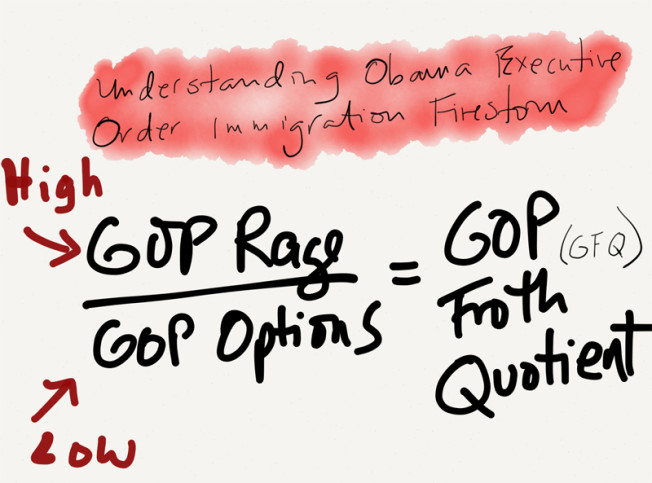
The emotional momentum in the Republican Party now falls to its most furious, deranged voices. Michele Bachmann has denounced what she calls “millions of unskilled, illiterate, foreign nationals coming into the United States who can’t speak the English language.” Rep. Mo Brooks of Alabama has even presented the most sympathetic slice of the immigrant community — the ones serving in the military — as a source of insidious competition and even treason. (“I don’t want American citizens having to compete with illegal immigrants for jobs in our military … These individuals have to be absolutely 100 percent loyal and trustworthy.” Steve King, a regular font of nativist outbursts, is setting himself up as a power broker in Iowa, which will command center stage in the GOP primary for months and months on end.
The idea that the immigration plan just announced by President Obama is a lawless power grab is absurd. As the Justice Department legal analysis that was just released amply demonstrates, much of the advance criticism of the president’s action has been uninformed and unwarranted. The opinion is well-reasoned and at times even conservative. The president is not acting unilaterally, but pursuant to his statutory authority. Wide discretion over deportation priorities has long been conferred on the executive branch by Congress, and it is being exercised in this case consistent with policies such as family unification that have been endorsed by Congress.
The piece is by far the best I’ve read on the subject, and calms my fears a lot. This is the best response to Ross’s point that if the president can do this for 4 million, why not every undocumented immigrant:
The lawyers here were cautious. They gave approval for deferred actions for parents of citizens and lawful permanent residents, finding that Congress had demonstrated support for permitting people who are lawfully in America to be united with their parents, spouses, and children. They did not, however, believe that they could approve a similar program for parents of those who are in the United States under the deferred action for childhood arrivals, or DACA, program. Because the Dreamers remain in the country based on discretion, not on the basis of a legal entitlement, OLC reasoned that without a family member with lawful status in the United States, there was not the same grounding in congressional policy to justify classwide relief.
But, again, the ability of the Obama administration to make its best case seems to be in doubt. They put out a long legal paper – but back it up with no aggressive messaging in the broader public square. That way, they win the argument but somehow lose the debate. Which is the story on the ACA as well. Here’s Dellinger’s strongest point, it seems to me, and one critical to understanding the debate about executive discretion:
There are 11.3 million people in the United States who, for one reason or another, are deportable. The largest number that can be deported in any year under the resources provided by Congress is somewhere around 400,000. Congress has recognized this and in 6 U.S.C. 202 (5) it has directed the secretary of homeland security to establish “national immigration enforcement policies and priorities.” In the action announced tonight, the secretary has done just that, and the president has approved.
Drum, for his part, is somewhat surprised to find that “both liberal and conservative legal scholars—as opposed to TV talking heads and other professional rabble-rousers—agree that Obama has the authority to reshape immigration enforcement in nearly any way he wants to”:
It’s an open question whether Obama’s actions are politically wise. It might force Republicans into an uncomfortable corner as they compete loudly to denounce Obama’s actions, further damaging their chances of appealing to Hispanics in future elections. Alternatively, it might poison any possibility of working constructively with congressional Republicans over the next couple of years, which might further degrade Democratic approval ratings. There’s also, I think, a legitimate question about whether liberals should be cheering an expansion of presidential power, whether it’s legal or not.
That said, Obama’s actions really do appear to be not just legal, but fairly uncontroversially so among people who know both the law and past precedent.
Marty Lederman dispels “some of the more commonly heard myths about the DHS enforcement priorities and ‘deferred action’ policies that the President just announced.” One myth he busts:
It does not “cut out Congress”—indeed, it relies upon statutory authority. Nor does it contradict what Congress has prescribed. Neither the President nor the Secretary nor OLC has said anything to suggest that Congress could not, by statute, require a different enforcement scheme—to the contrary, OLC specifically acknowledges (pp. 4, 6) that Congress could legislate limits on enforcement discretion that the agency would be obliged to follow. Moreover, and of great significance, OLC specifically concludes that, because enforcement priority decisions must be “consonant with, rather than contrary to,” Congress’s policy decisions as reflected in the governing statutes (pp. 5, 20), it would not be permissible for DHS to afford deferred action status to one category of aliens that the agency had proposed to cover (parents of children who have received deferred action status under the so-called “DACA” program): Offering deferred action status to such aliens, OLC opined, would be unlawful because it would “deviate in important respects from the immigration system Congress has enacted and the policies that system embodies” (p. 32).
I am no fan of the Obama administration’s approach to constitutional interpretation. In too many instances, the president really has acted illegally and undermined the rule of law – most notably by starting wars without congressional authorization. But today’s decision isn’t one of them.

 The Dish