Ferguson On Edge

Protest Outside Ferguson Police Department

Protesters were arrested last night. And a court decision could drop tomorrow:

The grand jury hearing evidence on the Michael Brown shooting is preparing to meet Friday for what might be its final session, and a decision on whether to charge Officer Darren Wilson could come the same day, law enforcement officials briefed on the plans said.

On Monday, Governor Jay Nixon declared a state of emergency and activated the National Guard. Jamelle Bouie disapproves of such actions:

[W]hile many Ferguson residents were disturbed by the damage done during the earliest protests, there’s anger over the choice to declare a state of emergency, and rightfully so.

Remember, the initial Ferguson protests—which began the afternoon Brown was killed—weren’t violent. Instead, at first dozens, then hundreds of people gathered to peacefully protest the shooting and demand answers for why Brown’s body was allowed to lie in the sun for four hours before police took action. If there was unrest that day, it was less because of the protesters and more because of police.

As soon as residents met to protest Brown’s death that day, police brought scores of reinforcements. The Ferguson Police Department called in more than 100 officers from other jurisdictions, with some officers wielding dogs and shotguns. Given the circumstances—an angry community that wanted answers over the death of a teenager—it was an overreaction that engendered mistrust and worsened the situation.

Amy Davidson argues along the same lines:

The grand jury may surprise those who expect it to let Officer Wilson walk away. Those who are watching the people of Ferguson with such worry now may be asked to comprehend them in ways they haven’t before. It is treated as somehow exceptional that there were no riots after the acquittal of George Zimmerman in the shooting death of Trayvon Martin, in Florida. But what is often forgotten there is that what Martin’s parents asked for, first and foremost, was simply a trial of some kind, a chance for their son’s story to be heard in open court—at first, it looked as if it never would be. They got that, if not the full measure of accountability they hoped for. The fearfulness of the authorities in Missouri has been seen as an insult to the black community and a preëmptive strike against perfectly legal peaceful protests. Both of those elements are there, and both, counterproductively, increase tensions and reduce trust.

Paul Cassell hopes for transparency from the grand jury:

Several weeks ago, Bob McCulloch (the St. Louis County prosecuting attorney supervising the grand jury) issued a little-discussed news release, promising that if the grand jury decides not to charge, he will then seek to have the grand jury’s information made publicly available: “If the grand jury does not return an indictment, then I will ask the court to order that the evidence be released to the public as soon as possible if not immediately.”  (McCulloch has also pointed out that if the grand jury makes a decision to return charges, no such motion will be required because the facts will naturally emerge during the criminal trial.)

… It is hard to imagine a court turning down McCulloch’s request to release the grand jury information.  This will make the Michael Brown shooting investigation far more “transparent” than just about any other high-profile criminal investigation.

(Photo: A protestor in a Guy Fawkes mask, raises his hands in front of a line of police outside the Ferguson Police Department as part of continued demonstrations in regards to the shooting death of Michael Brown by police officer Darren Wilson in Ferguson, Missouri on November 19, 2014. By Samuel Corum/Anadolu Agency/Getty Images)

The Payoff Of Amnesty

Alex Nowrasteh claims that the “economic impact of this legalization will be positive”:

In the wake of the 1986 Reagan amnesty, wages for legalized immigrants increased – sometimes by as much as 15 percent – because legal workers are more productive and can command higher wages than illegal workers.[i]  Being legal also allows these immigrants to invest in U.S.-specific human capital, like learning English, which will increase their productivity and wages.  Unlawful immigrants are less likely to make these investments in human capital because they could be deported, thus wiping out such investment.  We will likely see a similar increase in the wages of many of the unlawful immigrants legalized today.  This benefit would likely accrue to all of the working unlawful immigrants who would be legalized under this executive order.

Professor Raul Hinojosa-Ojeda of UCLA wrote a paper for Cato in 2012 in which he employed a dynamic model called the GMig2 to study comprehensive immigration reform’s impact on the U.S. economy.  He found that a full legalization of unlawful immigrants will increase U.S. GDP by about $700 billion dollars over the next ten years, primarily by allowing the legalized workers to be more productive.  Any impact of legalizations on GDP would be smaller under an executive order because many of them would be temporary and it would not cover the entire unlawful immigrant population, but it would still produce hundreds of billions of dollars of more GDP within ten years.

In a piece we cited earlier today, Carl Hampe outlined other potential economic benefits:

Many U.S. companies provide goods and services that are purchased by the estimated 11 million undocumented. If half of them obtain work authorization, their purchasing power should increase, and this would benefit the U.S. economy generally. Many U.S. companies hire unskilled workers, and some of these companies expend significant resources ensuring that they do not knowingly hire undocumented immigrants when doing so. If the pool of authorized workers were expanded by 5 million people, some U.S. companies would have a larger pool of authorized labor from which to recruit, and their liability concerns would be diminished. Indeed, the president’s proposal would benefit compliance-minded U.S. companies that would now be able to attract newly work-authorized individuals away from companies that paid less competitive wages and were not as mindful of the hiring rules. This should benefit all unskilled U.S. workers, not merely those who are undocumented.

Marriage Equality Update

Screen Shot 2014-11-20 at 2.43.26 PM

It comes from a reader this time:

I just thought I’d pass a note that earlier today, the Supreme Court blocked a final effort by South Carolina’s Attorney General in requesting a delay in the issuance of marriage licenses for same-sex couples.  Today at noon, South Carolina became the first state in the Deep South to not only recognize same-sex unions in other states, but allow its courts to issue certificates to same-sex couples. Charleston – which is like Austin, a blue spot in a red state – naturally lead the way, with their judge issuing certificates a day ahead of schedule.

However, today’s rejection of the stay means that all counties in the state can no longer withhold their objections.  Of course, this can be deeply unpopular in this conservative state, but a growing number of Lowcountry-based Republicans, including my state senator Tom Davis (R-Beaufort), have begun to realize that this is as much of interest to libertarian sensibilities, and have thus given up their objections on principles of governance, despite their personal convictions. Wishful thinking for the Bob Jones-inspired “conservatives” that dominate in the Upstate. No matter… they have now lost.

When Harvey Gantt integrated Clemson University peacefully in 1963, he had a great quote: “If one cannot appeal to the morals of South Carolinians, one should appeal to their manners.” In the ensuing months and years ahead, you will find the angry attitudes found by many who oppose this gradually wash away as their co-workers, friends, and, yes, family members earn dignity in the ability to marry the one they love.

South Carolina’s state motto is Dum Spiro Spero – “while I breath, I hope.” Today, we can know hope in the Palmetto State.

A Democrat Finally Steps Up

Senate Holds Cloture Vote On Immigration Bill

Jim Webb just launched a presidential exploratory committee, the first Dem to do so. Tim Murphy quips that Webb’s announcement video “looks like it was filmed by the people who make commercials for personal-injury attorneys.” Regardless, Larison is pleased by the news:

Assuming that Webb is able to drum up some substantial support in the coming months, his entry into the race should be very good and healthy for the Democratic Party and the country. There had to be someone in the primaries ready and able to hold Clinton accountable for her poor judgments on policy, and there needed to be someone qualified to make her earn a nomination that has so far been treated as her dynastic inheritance. Even an unsuccessful challenge will force Clinton to face up to the mistakes on her record, and it will offer Democratic voters a serious alternative to the establishment favorite.

Kos dismisses Webb’s talk of bipartisanship:

He was a great candidate for us in Virginia in a different time. Talk of “bringing America together” rings hollow given the realities of the modern GOP. And it’s unnecessary given the realities of America’s modern demographics.

Kilgore also isn’t taking Webb seriously:

I really, really don’t think the average potential primary supporter of Webb against Clinton is going to kick out the jams for a candidate who thinks the real problem in Washington is insufficient bipartisanship. Been there, done that, with Obama, and even Obama struggles to pay lip service to the idea, particularly now on the eve of an intensely partisan fight over immigration policy.

But Enten argues that running to center is a smart play:

Clinton has less support among moderate and conservative Democrats than she does among liberal Democrats. Additionally, three CNN surveys have asked Democratic primary voters whether they prefer Clinton, a “more conservative Democrat” or a “more liberal Democrat.” Clinton has averaged 67 percent in these surveys. The more liberal Democrat has averaged just 11 percent. The more conservative Democrat, on the other hand, has averaged 18 percent. Again, Clinton is the heavy favorite, but anti-Clinton voters prefer a more conservative option.

Morrissey finds it “difficult to figure how seriously to take this bid”:

He doesn’t have much of a following any longer, having been all but absent for the last two years. He didn’t campaign significantly for Barack Obama in 2012, if at all, nor did he do anything for Democrats in this cycle — even though Webb tried grabbing attentiona couple of times this year about his 2016 aspirations. Webb seems to think that it’s still 2006 and the Left will draft him again without having to do any of the party-building work necessary for most serious contenders, such as Hillary Clinton. She may not have been effective in this cycle, but she and Bill hit the campaign trail and tried to get Democrats elected, as did Warren, Joe Biden, Martin O’Malley, and other Democrats who might be looking at a bid. Webb’s sat out campaigning since the 2008 election for Obama.

Philip Klein expects Webb’s opposition to women in combat to doom him:

In the 2016 context, given the Democratic Party’s recent emphasis on pushing the “war on women” narrative and the fact that Clinton has a good chance to become the first female president, Webb will be skewered as a fossil for having held these sorts of views.

But Michael Tracey insisted last week that Webb is Hillary’s most formidable challenger:

During his 2006 Virginia Senate run — back when Clinton and Obama still fervently insisted that marriage was “between one man and one woman” — Webb opposed a state constitutional amendment on the ballot that banned all same-sex unions. The measure still passed by 14 percentage points, which means that many social conservatives voted for both the victorious Webband the ban, indicating his unique ability to garner support from non-conventional Democratic constituencies.

Democrats who are seeking a better way forward — and who want to avoid the dangerous “Clinton inevitability trap” — should turn their gazes to Webb.

(Photo by Jamie Rose/Getty Images)

Quote For The Day

“I wish that all nations may recover and retain their independence; that those which are overgrown may not advance beyond safe measures of power, that a salutary balance may be ever maintained among nations, and that our peace, commerce, and friendship, may be sought and cultivated by all. It is our business to manufacture for ourselves whatever we can, to keep our markets open for what we can spare or want; and the less we have to do with the amities or enmities of Europe, the better. Not in our day, but at no distant one, we may shake a rod over the heads of all, which may make the stoutest of them tremble. But I hope our wisdom will grow with our power, and teach us, that the less we use our power, the greater it will be,” – Thomas Jefferson, June 12, 1815, in a letter to Thomas Leiper.

Dan Drezner notes how alien Jefferson’s views are to the liberal interventionists and neoconservatives of today. Larison adds:

Neoconservatives and many other hawks and hard-liners along with them view these things as former Secretary Albright did when she reportedly asked Powell, “What’s the point of having this superb military you’re always talking about if we can’t use it?” The idea that the U.S. ought to conserve its strength, husband its resources, and exercise restraint gets in the way of activism and meddling overseas, and so they’ll have none of that.

What they also miss and will never concede is that our activist meddling in Iraq dramatically weakened the US, by exposing the very limited utility of its military power alone. Restraint can mean the maximizing of power; intervention can merely prove its ineffectiveness. Deterrence is thereby weakened. In my view this president has done a dogged, careful job of restoring US credibility through much more limited and focused military action, combined with a more robust diplomatic arm. And yet he is blamed for the loss of power that his predecessor ensured. That paradox may well be seen as a microcosm of Obama’s entire, pragmatic and severely under-rated presidency.

Is Another Shutdown Brewing? Ctd

Lauren Fox reports on the thinking of Republicans:

Many rank-and-file Republicans see an upcoming funding bill that must pass by Dec.11 as the party’s best shot to stop Obama from implementing his immigration plan. Boehner has signaled that “no option” is off the table, and more than 60 House Republicans have already sent a letter advocating the approach. In the Senate, top Republican Mitch McConnell has attempted to squash any shutdown banter, but some in his right flank still might push for a funding showdown.

Members of the Republican Conference say they don’t want the confrontation over government funding to come down to a government shutdown, but many don’t see how, even if that does happen, they could lose politically.

Erick Erickson is itching for a shutdown:

Sure, the GOP may get blamed. But so what? And that is key here — so what. They got blamed last time and the public rewarded them with the biggest election wave in modern American political history from the local level to the federal level.

Bill Scher suspects Obama is trolling the GOP:

Despite the strong sense coming from the House Republican leadership that it has far more control over its caucus now than it did during the Tea-Party-fueled insurgency of 2010, no issue has more potential than immigration to ignite the hard-right base and embarrass Speaker John Boehner—especially after the speaker’s post-election warning to Obama not to “play with matches”—or to cause headaches for the GOP heading into the 2016 elections.

The White House knows this. Thus, we could be witnessing the deployment of a strategy in which the president does indeed play with matches, quite deliberately, and he’s about to throw one right into the tinderbox of the House GOP caucus.

The prospective shutdown is such an insanely bad idea that it is worth diagnosing what mental breakdown led the party to a place where this course of action has received serious consideration. One possible answer is that it stems from a congenital aggressiveness. Tom Edsall, a Washington reporter and longtime denizen of bipartisan poker games, once observed that the two parties display notably different approaches toward risk. “Conservative poker players are more willing to go for the kill,” while liberals “will simply check and turn over their cards to collect a more modest amount.”

There are times when the all-or-nothing play makes perfect sense. This is not one of them. A government shutdown does not give Republicans leverage — it gives Obama leverage. They have no winning move here. The only play is to cut their losses and muddle through while sustaining as little damage as possible.

Previous coverage of the possible shutdown here.

Uber Creepy

This embed is invalid


I’ve long been a fan of Uber. For someone who doesn’t know how to drive, it’s been a godsend. The cab industry deserves all the competition it can get. It empowers individual entrepreneurs and uses technology in ways that improve everyone’s lives. But it sure does appear that the company’s management is more than a little douchey. My suspicions began when, after I first approved a surge-pricing fare increase, suddenly every subsequent car request came with such a surcharge – even on a quiet Sunday morning. Last night, a driver canceled a trip two minutes after informing us that he was “arriving now”. I’ve had to get out of two Ubers in the past year because the driver was an asshole. And, of course, the rumors and stories of its unethical and puerile hounding of its competitors are legion.

And now its senior vice president, Emil Michael, was dumb enough to get all frank and intimate with Ben Smith at the Waverly Inn last Friday suggesting that the company hire opposition researchers to dig up dirt on journalists who criticize its business practices, specifically citing legendary PandoDaily journalist, Sarah Lacy, who had accused the company of “sexism and misogyny”:

At the dinner, Michael expressed outrage at Lacy’s column and said that women are far more likely to get assaulted by taxi drivers than Uber drivers. He said that he thought Lacy should be held “personally responsible” for any woman who followed her lead in deleting Uber and was then sexually assaulted. Then he returned to the opposition research plan. Uber’s dirt-diggers, Michael said, could expose Lacy. They could, in particular, prove a particular and very specific claim about her personal life.

Uber wouldn’t be the first tech company to investigate journalists who report on it, but the incident didn’t do much for Uber’s public image as a hyper-aggressive firm with loose ethics. Uber CEO Travis Kalanick took to Twitter soon after the story broke to apologize to Lacy, denounce Michael’s “lack of humanity”, and stress that the company has no plans to doxx journos it doesn’t like. Michael himself also apologized. These mea culpas – in fourteen separate tweets – don’t quite cut it for Alison Griswold, though:

Kalanick thinks Michael’s comments were “terrible.” He says those comments display a “lack of leadership, a lack of humanity, and a departure from our values and ideals.” He says Uber should be focused on building a positive narrative to “inspire” riders and drivers, to show the “positive principles that are the core of Uber’s culture.” He promises to do “everything in my power” to earn trust from Uber’s community. So as many Twitter users have already pointed out: Doesn’t that start with firing Michael?

Lacy herself is furious:

Uber’s dangerous escalation of behavior has just had its whistleblower moment, and tellingly, the whistleblower wasn’t a staffer with a conscience, it was an executive boasting about the proposed plan. It’s gone so far, that there are those in the company who don’t even realize this is something you try to cover up. It’s like a five-year-old pretending to be Frank Underwood. Only one with billions of dollars of assets at his disposal.

And lest you think this was just a rogue actor and not part of the company’s game plan, let me remind you Kalanick telegraphed exactly this sort of thing when he sat on stage at the Code Conference last spring and said he was hiring political operatives whose job would be to “throw mud.” I naively thought he just meant Taxi companies. Let me also remind you: This is a company you trust with your personal safety every single time you use it. Let me also remind you: The executive in question has not been fired.

Josh Marshall is mystified at how Uber’s executives can be so tone-deaf:

Separate from the details of this incident, it’s been quite a while since I’ve seen what is by any measure an amazingly successful startup manage to generate this much negative publicity based fairly narrowly on the behavior of its top executives. … But what is so odd is that Uber, at the end of the day, is in a business where the basic project is about reliability and safety. And yet the guys running the company seem kind of reckless and even a bit nuts. Unlike the men and women you’d hope would be driving your Uber ride (and, in my experience, they often are those people), the guys running Uber seem like the result of some genetic experiment marrying up the 17th century Caribbean pirate with the 21st century North American Bro.

To Alexander Howard, the incident raises serious privacy concerns, given that Uber collects enough data about users to infer, say, where they slept last night, or with whom:

With great data comes great power, and therefore responsibility. That means culture and ethics matter. The reason Michael was angry at Sarah Lacy appears to be because of her excoriating post about Uber’s culture.

Now, imagine if powerful members of Congress decide that they don’t like Uber’s labor practices, or surge pricing, or its approach to flaunting regulatory strictures, or the way it lobbies city governments not to be subject to reporting on compliance with accessibility laws. What then? Will the same executives who have shown a limited “God View” at launch parties choose not to use more powerful internal analytics to track who is going where and when? What policies and code would stop them from looking at the profiles of Senators and Representatives and drawing conclusions about where and when they go? Or for that matter, my profile, or yours?

I can’t imagine Uber regaining minimal trust without firing Michael. Tim Lee is not far off the same page:

There’s no evidence that Uber has ever misused its data in this way, and Uber says it has strict policies designed to safeguard customer privacy. But policies are only as trustworthy as the people enforcing them. When an Uber executive openly muses about intimidating reporters with sensitive personal information, that’s a sign that he might not be sufficiently committed to ethical behavior to be a senior executive at a powerful company like Uber. And the fact that Kalanick sat silently through Michael’s comments, and then chose not to fire him when the comments became public, suggests he might not take ethical considerations seriously enough, either.

It’s also worth talking about whether Uber’s customers should have legally enforceable rights protecting the privacy of their travel data.

In response to these concerns, Uber published a post on its company blog Tuesday night clarifying that it has “a strict policy prohibiting all employees at every level from accessing a rider or driver’s data”, with exceptions for “a limited set of legitimate business purposes” such as facilitating payments or detecting fraud. Meanwhile, Katie Benner reminds the Uberites that they won’t be the only game in town forever:

Remember, Uber is special because it was the right company at the right time. It’s the most elegant expression of how real life, mobile devices and payments are coming together to make our phones a remote control for the way we live.

Yet Uber’s underlying software is replicable. Uber refuses to make its drivers actual employees, and those drivers can always go to a competitor that offers a better deal. Consumers aren’t locked in either. So if a mass group of consumers (not just those that obsess over industry blogs like TechCrunch and Valleywag) now see Uber as a company that doesn’t respect their safety, their data or their drivers, they can drop Uber from their trusted group of apps. Other options are available.

And Neil Irwin declares that it’s time for the company to grow up:

The idea of a showing up to a meeting with a JPMorgan executive and hearing, “I notice you were late on your mortgage payment last month,” is just unfathomable, so great are the protections in the financial industry between access to consumer data and the executives and public relations people who tend to deal with reporters. The same could be said for any number of other industries where big companies have access to private data. Hotel chains? Retailers? This is just not the way things work.

And the reality for Uber is that, much as it may still see itself as a start-up, its scale and ambitions mean that it is rapidly becoming an important company, operating in 48 countries with thousands of drivers. … It’s great to have employees exhibit “fierceness” and “super-pumpedness,” two qualities on which Uber reportedly evaluates its workers. But the bigger you get, the more you also need qualities like discipline and wisdom.

What Do Americans Want On Immigration?

Immigration Polling

Aaron Blake tries to square the circle:

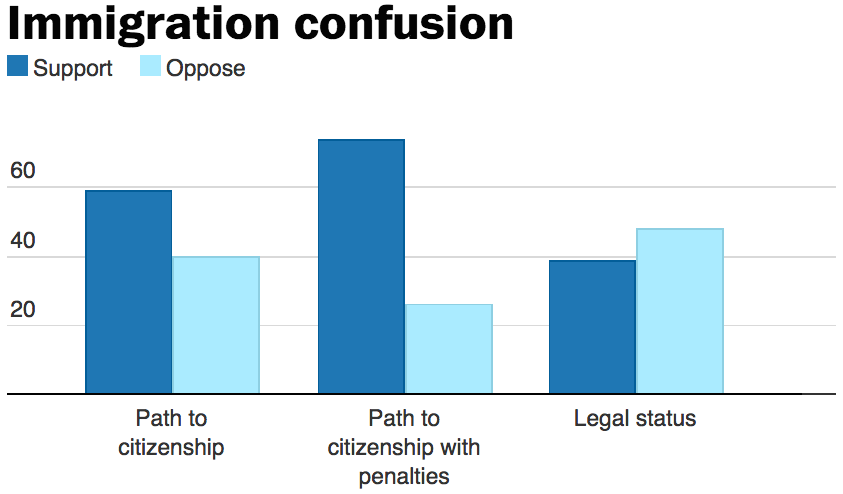
While polling has long shown a clear and strong majority of Americans support a path to citizenship, some recent polls have shown far less support for legal status. While the NBC/WSJ poll shows Americans oppose legal status 48-39, a Washington Post-ABC News poll in September showed Americans opposed legalization 50-46. Among registered voters, it was 53-43.

Why the support for citizenship but not legal status? Your guess is as good as ours. Maybe people don’t like the idea of two classes of Americans. Maybe they think of citizenship as something that is earned, and legal status as something that is bestowed without cost to the beneficiary.

Whatever the reason, it bears emphasizing that Obama’s announcement tonight has much more to do with legal status and nothing to do with citizenship.

Kevin Drum focuses on the partisan split:

According to a USA Today poll,Democrats want action now; Republicans want him to wait; independents are split down the middle; and the overall result is slightly in favor of waiting, by 46-42 percent. In other words, pretty much what you’d expect. Politically, then, this probably holds little risk for Obama or the Democratic Party.

But Jonathan Cohn is unsure how the executive action will play out:

[A]s Greg Sargent notes, congressional action really isn’t an option right now. And the Obama Administration is likely to frame its action in ways that polls suggest the public likesby emphasizing that people who go through the new programs will have to go through background checks and, afterwards, will have to start paying taxes. Will these arguments play well? Will the image of a president getting something done assuage those frustrated by Washington gridlock? Your guess is as good as mineand I guess we’ll start to find out tonight.

Previous speculation about the popularity of Obama’s forthcoming executive order here.