Why Is Obamacare Unpopular?

ACA Knowledge

Bill Gardner reviews research on the question:

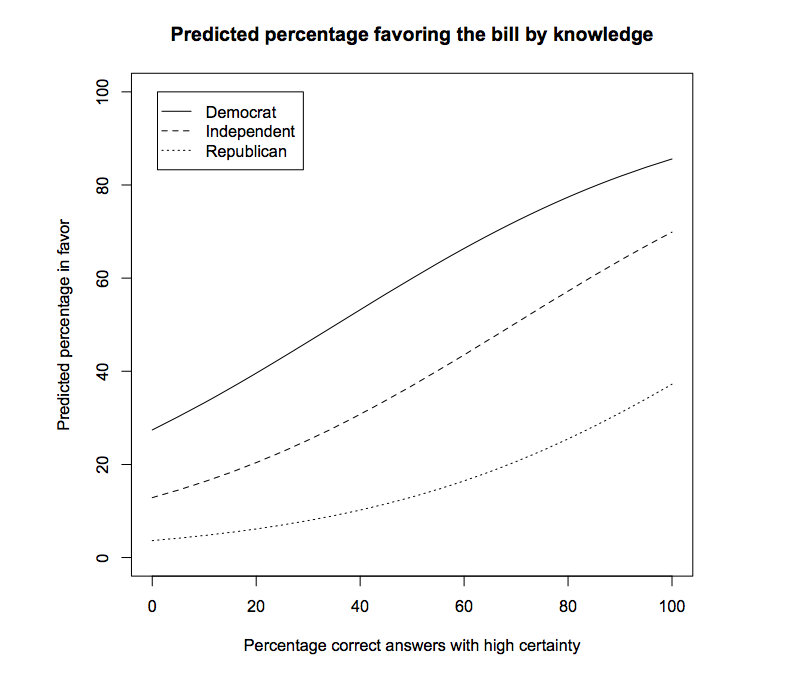
Jon Krosnick, Wendy Gross, and colleagues at Stanford and Kaiser ran large surveys to measure public understanding of the ACA and how it was associated with approval of the law. They found that accurate knowledge about what’s in the bill varied with party identification: Democrats understood the most and liked the law the most, independents less, and Republicans understood still less and liked the law the least.

However, attitudes were not just tribal. Within each party, the more accurate your knowledge of the law, the more you liked it.

Krosnick and colleagues found that most people favor most of the elements of the ACA, but not everyone recognized that these elements were all in the plan. Many people also have false beliefs about the plan. For example, only 42% of Americans correctly understood that the law does not provide free treatment for illegal aliens. Only 21% of Americans approve of this imaginary feature of the plan.

This suggests that if the public understood the ACA perfectly, support for the law would be higher. Based on their model for how knowledge about the ACA is associated with approval for the law, Krosnick and colleagues project that in the unlikely case in which the public had perfect understanding of the law,

the proportion of Americans who favor the bill might increase from the current level of 32% to 70%.

Keep in mind, however, that Krosnick’s survey can’t show us that change in knowledge would cause change in approval. Perhaps causality runs the other way and it is approval of the law that drives people to seek information about what is in it.

But all of this is a huge indictment of the president’s and the Democrats’ approach to talking about the law. In my view, they should have been using every single opportunity to explain what the law actually does, compared with the system it replaced. Yes, there has been a mountain of propaganda against it. But that doesn’t excuse political malpractice in defending it. This is the Democrats’ most significant piece of domestic legislation in decades. And yet they cannot manage to make the case for it. That tells you so much about why that party remains such a shit-show, rescued temporarily by this president, but still wallowing in its own dysfunction, inability to communicate and pusillanimity.


How Seriously Should We Take Christie?

Compared to most other GOP presidential contenders, Christie isn’t well liked by Republicans:

Favorables

Despite such numbers, Mark Leibovich sees the logic of a Christie run:

There is a theory in presidential politics that electorates will gravitate to the candidate who represents the biggest departure from the incumbent, especially if they have grown weary of that incumbent. “That’s the argument people make to me about why I should run,” Christie told me during one of our conversations. “They’re like: ‘No one could be more the opposite of Barack Obama from a personality standpoint than you. Therefore, you’re perfect.’ ” Yet one of the more compelling aspects of a Christie candidacy would be his ability to start an overdue fight within his own party.

In 2012, Mitt Romney never took on the G.O.P.’s far right, which has more than its own fair share of bullies. He was content to run right in the primaries, tout his “severe conservative” stripes and hope it would not end up costing him with swing voters in the general election. (It did.) In a brief period of reckoning after the 2012 election, Republican leaders spoke of their need to expand their shrinking base and appeal to Hispanics, African-Americans, women and younger voters rather than bow to unrelenting hard-liners. Christie could be the candidate with the best shot of pulling this off. “Christie’s strength is that people think he is being straight with them,” said Tom Kean, a former New Jersey governor and one of Christie’s political mentors. “If he kowtows to anyone, and people stop believing that he’s saying what he means, he’s going to kill the brand.”

Kean told me that Christie “is the best politician I’ve seen since Bill Clinton.” [Haley] Barbour said he “has a strong starting place in 2016.” But for all of the noise he has made, there is a difference between being an operative and being a national politician. Christie’s positions on immigration reform, foreign policy and certain social issues remain very much a black hole, not to mention an object of great suspicion, on the right. Running in a Republican presidential-primary campaign would be considerably harder than showering cash on his fellow governors and being dubbed by the media as a “winner” of this cycle. On some level, Christie might be just the latest intriguing moderate for the small media-obsessed wing of the Republican Party that gave us Presidents Giuliani and Huntsman.

The Best Judge Of SCOTUS

He has no formal legal training:

Jacob Berlove, 30, of Queens, is the best human Supreme Court predictor in the world. Actually, forget the qualifier. He’s the best Supreme Court predictor in the world. He won FantasySCOTUS three years running. He correctly predicts cases more than 80 percent of the time.  … I told [law professor Theodore] Ruger about Berlove. He said it made a certain amount of sense that the best Supreme Court predictor in the world should be some random guy in Queens. “It’s possible that too much thinking or knowledge about the law could hurt you. If you make your career writing law review articles, like we do, you come up with your own normative baggage and your own preconceptions,” Ruger said. “We can’t be as dispassionate as this guy.”

We Might Be Over Ebola, But Ebola Isn’t Over, Ctd

kathy1

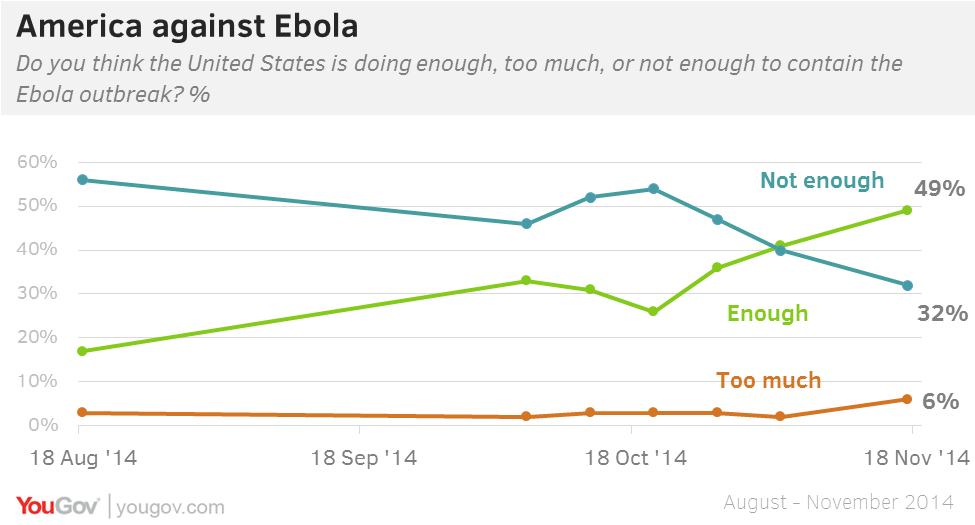
The latest YouGov poll illustrates how quickly Americans have moved on from freaking out about the disease and the government’s response to it, indicating that media sensationalism and partisan politics infected far more Americans than Ebola ever will:

Republicans have exhibited the greatest change.  At the end of October, 67% of Republicans said the government wasn’t doing enough to contain the Ebola outbreak.  That percentage has dropped 28 points.  Just 39% of Republicans now say the government isn’t doing enough. There is also less interest in increasing government spending to deal with the outbreak.  Just one in four today would increase government spending on Ebola research, down from 36% at the end of October.

But perhaps the most striking example of public satisfaction with the government’s performance is the change in the way Americans evaluate the President’s performance.  For the first time in two months, more Americans approve of the way Barack Obama is handling this situation than disapprove.

Josh Marshall even suspects that Christie has quietly retired his draconian quarantine policy for health workers returning from West Africa, though he can’t seem to get a straight answer out of the state of New Jersey. There’s also some good news on the international front:

the World Health Organization reports that the number of Ebola cases has stopped increasing in Guinea and Liberia, though they are still on the rise in Sierra Leone, while Mali seems to be keeping its second minor outbreak under control.

But even if outbreaks have peaked, that doesn’t mean these countries’ troubles are over. Last week, Abby Haglage called attention to warning signs of an “Ebola famine” in Liberia:

[Last] Tuesday, Mercy Corps published (PDF) a shocking finding: 90 percent of Liberian households are reducing the amount of food they eat at each meal, and 85 percent are actually eating fewer meals than they were before the health crisis. In a country where food was already scarce, slimmed-down portions could be the difference between life and death. A vendor in Monrovia told Mercy Corps investigators that she and her eight children can no longer afford to eat 10 cups of rice a day. They’ve cut rations down to eight. Simultaneously on Tuesday, the UN Human Rights campaign released a statement warning that West Africa may be “on the brink of a major food crisis” due to Ebola.

A new World Bank report confirms just how much damage the epidemic has done to Liberians’ livelihoods:

To measure the economic impact of that devastation, the World Bank, Liberian Institute of Statistics and Geo-Information Services and the Gallup Organization conducted phone surveys and found that not only is a massive part of the country’s work force out of job, but food insecurity is worsening. Wage workers and the self-employed have taken the biggest hit, the report finds. Prior to the epidemic, more than 30% of working household breadwinners were self-employed, but now that rate is just above 10%. Many people lost jobs because their business or government offices closed.

Quotes For The Day

“The framers of our Constitution, wary of the dangers of monarchy, gave the Congress tools to rein in abuses of power. They believed if the president wants to change the law, he cannot act alone; he must work with Congress.   He may not get everything he wants, but the Constitution requires compromise between the branches. A monarch, however, does not compromise …” – Ted Cruz, 2014.

“I don’t think what Washington needs is more compromise, I think what Washington needs is more common sense and more principle,” – Ted Cruz, 2012.

Yglesias Award Nominee

“The reasons for rethinking the intervention go beyond Libya itself. I had placed a great deal of emphasis on the demonstration effects of an intervention. My hope had been that the intervention would act to restrain other autocrats from unleashing deadly force against protesters and encourage wavering activists to push forward in their demands for change. Unfortunately, this only partially panned out and had unintended negative effects. U.S. cooperation with the Gulf Cooperation Council states in Libya compelled it to turn a blind eye to the simultaneous crushing of Bahrain’s uprising.

The worst effects were on Syria. The Libya intervention may have imposed a certain level of caution on Syrian President Bashar al-Assad, leading him to search for just the right level of repression to stay beneath the threshold for international action. But that didn’t last for long and his violence quickly escalated,” – Marc Lynch, in a bracing reflection on his misjudgments in the fast-moving era of the Arab Spring.

I await the other advocates of the Libya debacle to approach this kind of intellectual honesty. Larison, meanwhile, notes that

the demonstration effect and deterring-dictators arguments never made much sense, as I said many times back in 2011.

What I found the most troubling was the argument that such a major move, with unforeseeable consequences, was justified urgently to avoid a potential massacre. In other words, a humanitarian emergency was used to brush away all the usual weighing of the pros and cons of such a grave decision as to go to war. Which, to my mind, only underlines the necessity of restoring the Congress’s full control of war powers.

The Dish Mug Is Here!

bowie-mug

A reader wrote recently:

I haven’t bought a t-shirt because that’s not so much my thing. I eagerly await a coffee mug though. A mug with a beagle on it would make my mornings brighter.

We looked and labored over a dozen different mug options and chose what we think is the perfect one:

mugs

This navy-colored coffee mug is very high quality, holds a generous 15oz, and, during our caffeine-addled test phase, it proved very durable. So the sturdy mug should last a long time in any Dishhead’s kitchen or office (and yes, it’s microwave and dishwasher safe – we tested that too). As a serious coffee-addict, I love it.

The Dish mug can be yours for $15 plus shipping and handling. Just click here [sold out] and follow the simple prompts to order yours today. We only have a limited number of mugs for sale, so get yours before someone else does. And send us a photo when it arrives; you might see it on the blog.

Update from a reader:

Hubby has been told that it better be going in my stocking this year.  Thank you!

The Tweet That Backfired

It’s a very big day in British politics, as the polls close in the Rochester by-election, where the anti-immigrant and anti-EU party, UKIP, is poised to score another huge victory over the Tories in what should be a supremely safe Conservative seat. But the news today is about the Labour Party MP’s tweet seen above. It feeds into a popular shorthand for working/middle class white voters who are turned off by the metropolitan elites. They’re known as “white van” men, for their unprepossessing vehicular choices. And, in this case, as you can see, they’re also patriotic. Hence the massive gaffe from Labour today – which will also intensify the doubts about party leader Ed Miliband’s leadership as the next election approaches.

Think of the flap as similar to the “cling to their guns and religion” kerfuffle, a sign for some that the British left has long since lost an appeal to white non-college-educated men, and now reflexively mocks them and their view of the world. Hence this tweet:

These are combustible, populist times in which political elites are under immense pressure. If UKIP win this one tonight, the divide between Westminster and much of England outside London will only grow; and the chances of a sharp turn to the anti-immigrant, anti-European right more likely.