Being Conscious Of Your Own Circumcision, Ctd

More readers share their stories:

My heart goes out to your reader. We opted not to circumcise our son, only to have him develop the same non-retraction problem at age three. We tried a variety of topical treatments and visited a number of doctors. We were told that the problem might resolve with time, but if it didn’t, we’d be looking at circumcision of an even older child. That seemed untenable to us, so we went ahead with the procedure, which required a visit to an outpatient facility, general anesthesia, and several hundred dollars out of pocket.

He’s now almost seven and doing just fine, but it was a sad experience for all of us. To this day he talks about the time “when Mommy was crying so hard.” I’d tried to put the antibiotic ointment on his incision and he ran away screaming. I was emotionally worn out and worried about infection but also hoping and praying that he wouldn’t get a complex from having a wound on his penis that his parents had to slather with ointment several times a day.

As much as my husband and I couldn’t stomach the thought of a newborn undergoing this procedure, what our son experienced was more traumatic. Would we have done it differently had we known? Probably, but that’s the problem – there’s no way to know ahead of time if your child will develop this issue.

Another got his penis sliced much later than age three:

Having read about your reader’s dilemma regarding his child’s circumcision, I’d recommend that he go ahead and do it. I had issues with phimosis in adolescence and actually needed a circumcision, but I had to wait until I had health insurance to get one. I remained a virgin through college because I was too afraid of something bad happening during sex, which I will forever regret, even though I am happily married now.

One of the first things I did after getting healthcare coverage through a job was to get a circumcision. I was 24 then, and I can attest as to how terrible it is. Imagine getting multiple shots of local anesthetic on your johnson, feeling the sutures being sewn because the anaesthetic is wearing out, and having the whole thing witnessed by four nurses, presumably because of the sheer novelty of an adult circumcision. The recovery is equally horrendous, with painful mid-sleep boners and the skin of my glans getting chapped and flaking off. I took three days off work when I was told one would suffice.

When all was said and done, I had a scarred dick that lost a lot of its sensitivity, but that was mitigated by the lost fear of actually using my penis.

So having experienced circumcision as a grown man, I can attest that it is a barbaric experience. Performing it on a newborn child does not change that. I do not plan on having my children circumcised, if I have any. Still, if it is an issue of medical necessity – which it can be – the sooner it gets dealt with, the better. Once puberty hits and shame becomes inevitably correlated with private parts, a lot of damage can be done.

Another suggests a novel solution:

Why do stories on circumcision never discuss the “dorsal slit” procedure, which leaves the foreskin intact? This simple procedure combines the health benefits of circumcision with all the pleasure of remaining intact. While I do not advocate routine mutilation, this neatly resolves the issue for anyone with retraction problems.  Those seeking middle-ground might consider this compromise.

A colleague of a reader seems to have done just that:

The image that came to me when I read your post was when I was working in a very busy neonatal unit. The head of the department did the circumcisions if the child did not have a pediatrician yet. I came on to work one morning and was so shocked when I pulled back the diaper to reveal something – to my eyes – that was horribly wrong. It looked like a mutilation, and I have seen lots of circs (performed by the pediatricians on their patients – this was the first one I saw that the neonatologist had performed).

I immediately went to find him and asked him to come and take a look. I thought he would really want to know – thinking that there was swelling or infection or some thing gone awry. He made a rather sniping comment – that I had been to Paris and seen the best or something to that effect. What I learned about this doctor is that he did not like to do circumcisions and so he performed a “mini circ” – essentially just nipping a bit off. Everybody is happy.
The Keystone Jobs Plan

Keystone Jobs

It’s underwhelming:

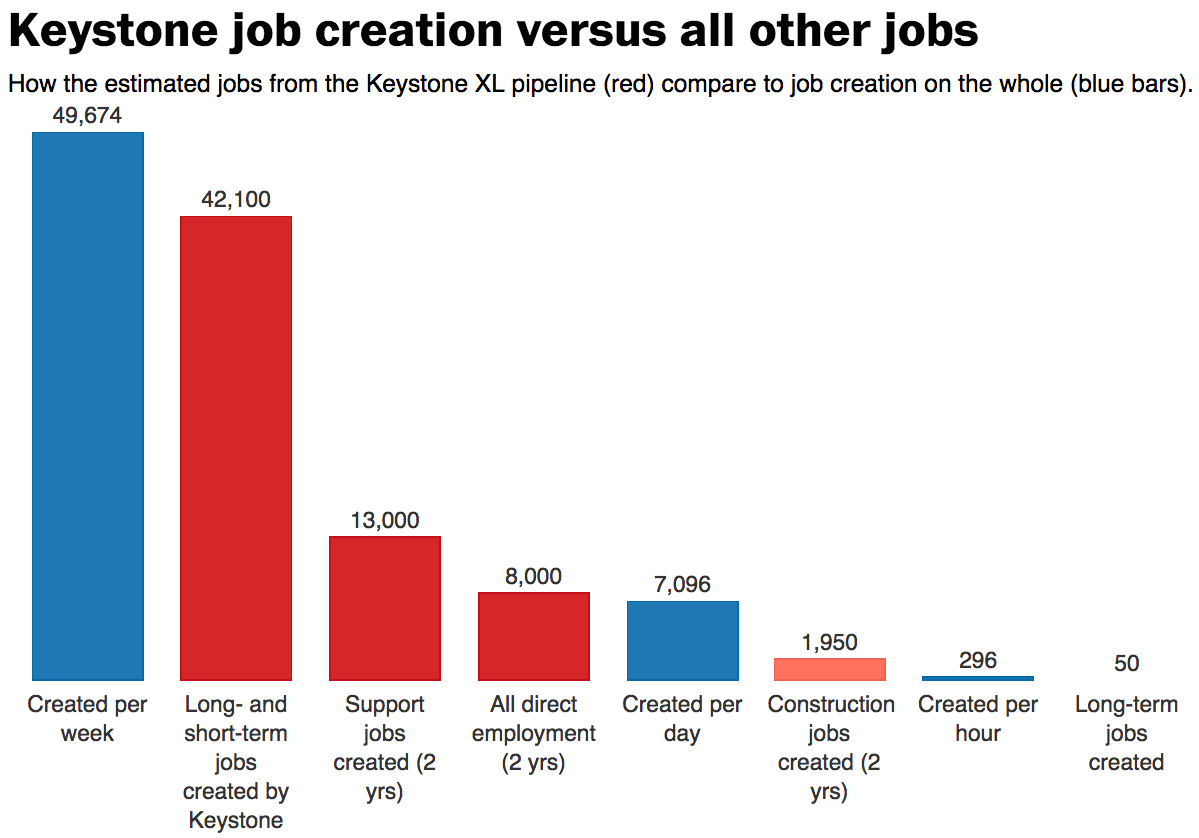
Citing the State Department final environmental impact statement, the lawmakers say the project would create 42,000 jobs. But it takes the economy less than a week to create that many permanent jobs. What’s more, these pipeline jobs wouldn’t be permanent. The State Department report uses the notion of “job years.” So the project, which is expected to take two years to build, requires 3,900 job years for the construction workforce, or 1,950 jobs that last over a two-year period. Another 26,000 jobs (or 13,000 over twoyears) would go to suppliers of goods and services.

Once the project is completed, operations would require 35 permanent employees and 15 temporary contractors, the State Department report says.

Philip Bump illustrates those numbers with the above chart:

For those out of work — a difficult and frustrating experience — the creation of any job that could offer a salary and benefits is worthwhile. The question for lawmakers is how to balance the jobs that would be created by the pipeline — either 42,000 or 50, depending on your feelings about the project — with other considerations, such as the environmental effects of increasing tar sands oil production. If we’re talking about adding the same number of jobs by 2017 that would be added by building a Target, for example, that likely shifts the calculus.

Chait sees the GOP’s Keystone fixation as a way to avoid having a real jobs plan. Which puts Obama in a bad negotiating position:

Republicans need to have a jobs plan. They’re much better off blaming Obama for standing in the way of the huge number of construction jobs that would be made available to hardworking Americans being blocked by the left-wing environmental agenda than they are taking credit for the pipeline. Republicans don’t like cutting deals with Obama even when he offers them something they want. In this case, the trade value of Keystone is negative. Which is to say, Republicans aren’t going to give him squat.


The Failure Of NSA Reform

The USA Freedom Act was voted down last night. Ronald Bailey is disappointed in Rand Paul, who voted against the bill because it didn’t go far enough:

Paul and the rest of his fellow citizens may well come to rue the day that he allowed the perfect to get in the way of the merely better.

Julian Sanchez likewise finds it “hard to see how blocking this particular set of reforms makes it any more likely that other important changes to the law will be passed”:

Ending the bulk collection of communication records under one group of authorities may only be the first step on a long road to more comprehensive surveillance reform, but taking that step enables privacy groups and civil libertarian legislators to devote their full focus to building consensus around subsequent steps, like amending (if not eliminating) the general warrant authority created by §702 of the FISA Amendments Act of 2008.

Sen. Paul’s primary objection thus far has been that the USA FREEDOM Act “reauthorizes the PATRIOT Act,” which is rather misleading. The vast majority of the PATRIOT Act is, alas, permanent and in no need of reauthorization. Three provisions will, in fact, expire in 2015: The §215 business records authority under which the NSA’s bulk telephony program is operating, the never-used “lone wolf” provision blessing the use of intelligence tools against foreigners suspected of terrorism but unaffiliated with any larger group, and the “roving wiretap” authority giving analysts discretion to intercept a target’s communication across multiple communications channels without specifying them in advance to a court.

However, Trevor Timm anticipates that “the the USA Freedom Act’s failure could backfire on its biggest supporters”:

As I’ve mentioned before, Section 215 of the USA Patriot Act – the law that was re-interpreted in secret to allow for mass phone metadata surveillance in the first place – comes up for renewal next summer. It has to be reauthorized before June, or it will disappear completely.

And even though the Republicans will be in control next year, they won’t be able to pull the same stunts they did on Tuesday. Everyone knows getting “no” votes is a lot easier than getting a “yes”. And this time they’ll need 60 “yes” votes, plus the support of the House of Representatives, where we know already there are likely enough votes to kill an extension of the Patriot Act.

Ed Morrissey also looks ahead:

The USA Freedom Act is now dead until the next session. Leahy moves to the minority, which means Chuck Grassley will have to take up NSA reform starting in January, putting its direction under Republican control. Rand Paul will probably like that result less than this effort, and it will be interesting to see whether Republicans can make up whatever votes they lose in the Democratic caucus from within their own without Paul’s endorsement.

Greenwald, meanwhile, believes “the last place one should look to impose limits on the powers of the U.S. government is . . . the U.S. government”:

The entire system in D.C. is designed at its core to prevent real reform. This Congress is not going to enact anything resembling fundamental limits on the NSA’s powers of mass surveillance. Even if it somehow did, this White House would never sign it. Even if all that miraculously happened, the fact that the U.S. intelligence community and National Security State operates with no limits and no oversight means they’d easily co-opt the entire reform process. That’s what happened after the eavesdropping scandals of the mid-1970s led to the establishment of congressional intelligence committees and a special FISA “oversight” court—the committees were instantly captured by putting in charge supreme servants of the intelligence community like Senators Dianne Feinstein and Chambliss, and Congressmen Mike Rogers and “Dutch” Ruppersberger, while the court quickly became a rubber stamp with subservient judges who operate in total secrecy.

Cool Ad Watch

CR-1

Copyranter spots a “great ‘disruptive’ print ad”:

The Wikipedia entry for “Disruptive Innovation” is well over 4,000 words. Native Advertising is considered a Disruptive Innovation.

That’s rich. And ironic. Because it is designed to not be “disruptive”. It is designed to blend in, deceive. And it is not an “innovation”. Branded “native” print editorial content has been around for over 100 years.

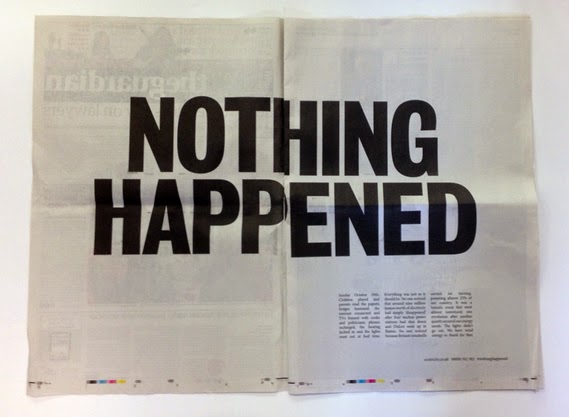
This ad [above and below] ran in the November 7th issue of the Guardian (click to enlarge):

nothinghappened

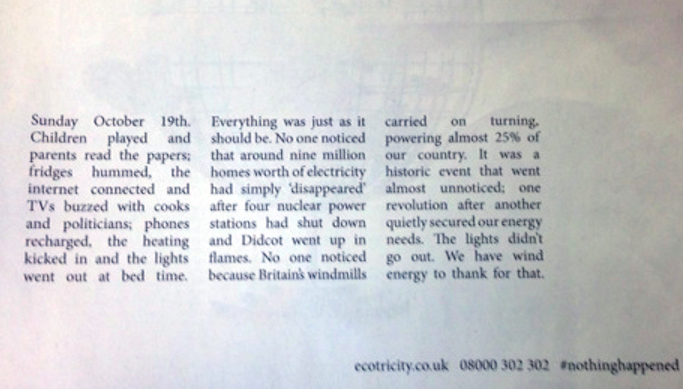
In case you don’t understand what you’re looking at, that’s a double full-page spread ad (you know, the paper kind). How many people—do you think—who saw that headline didn’t read the copy? Sorry digital gurus, there are no exact metrics for you to study and put into one of your priceless decks. But let me give you a ballpark figure: ZERO.

This is a brilliant example of what social media dipshits try—and fail at—every day: newsjacking. Except, ecotricity (Britain’s leading green energy supplier) actual had some pretty big news to report, as I’m sure you’re reading about right now.

I see something like this, and I think—momentarily and warily—that just maybe, advertising creativity might survive this stupid generation.

Passing Down PTSD

Judith Shulevitz explores the growing evidence that trauma can be inherited – yes, biologically. The controversial implications:

At the frontier of this research lies a very delicate question: whether some people, and some populations, are simply more susceptible to damage than others. We think of resilience to adversity as a function of character or culture. But as researchers unravel the biology of trauma, the more it seems that some people are likelier to be broken by calamity while others are likelier to endure it.

For instance, studies comparing twins in which one twin developed PTSD after trauma, and the other never had the bad experience and therefore never received the diagnosis, have uncovered shared brain structures that predispose them to traumatization.

These architectural anomalies include smaller hippocampuseswhich reduce the brain’s ability to manage the neurological and hormonal components of fearand an abnormal cavity holding apart two leaves of a membrane in the center of the brain, an aberration that has been linked to schizophrenia, among other disorders. Researchers have further identified genetic variations that seem to magnify the impact of trauma. One study on the mutations of a certain gene found that a particular variation had more of an “orchid” effect on African Americans than on Americans of European descent. The African Americans were more susceptible than the European Americans to PTSD if abused as children and less susceptible if not.

Another theory, even more uncomfortable to consider, holds that a particular parental dowry may drive a person to put herself in situations in which she is more likely to be hurt. Neuropsychologists have identified heritable traits that push people toward risk: attention deficits, a difficulty articulating one’s memories, low executive function or self-control. The “high-risk hypothesis,” as it is known, sounds a lot like blaming the victim. But it isn’t all that different from saying that people have different personalities and interact with the world in different ways. As Yehuda puts it, “Biology may help us understand things in a way that we’re afraid to say or that we can’t say.”

How Much Does Keystone Matter?

Activists In NYC Protest Against Keystone Pipeline Ahead Of Senate Vote

The Keystone XL vote came up short last night:

If just one more Democrat had voted for the measure, it would have gone to President Obama’s desk—and likely been promptly vetoed. The bill was already going to die. The suspense was simply over the identity of the executioner.

Rebecca Leber wonders about the significance:

In the end, most Americans wouldn’t notice Keystone’s impactboth good and bad. Landrieu’s own constituents have no direct stake in the project either, since it does not run through the state. It won’t noticeably impact gas prices and only creates a few dozen permanent jobs. Americans certainly won’t notice the greenhouse gas pollution associated with Keystone and the crude oil it will carry from the Canadian tar sands. Keystone has become a rallying point for climate activists precisely because of this invisible impact (the troubling image of a massive pipeline running through six states helps, too).

The irony is that, after six years of debate and deliberation, the Keystone decision comes when the economics surrounding the pipeline have largely made the issue irrelevant. Oil prices have dropped sharply, an American boom in natural gas and oil production have lessened foreign demand, and companies have proposed alternative pipelines and rail transport to carry the oil from Canada.

Keith Johnson contends that “Keystone has proved crucial neither to the development of Canada’s tar sands nor to getting it to market”:

Despite the years of delays on Keystone, Canadian oil sands production has continued steadily upward. In 2008, Canada produced about 1.2 million barrels a day from its tar sands. Last year, even without Keystone, production had jumped to 2 million barrels a day. Most forecasters expect Canadian tar sands to top 3 million barrels a day by 2020.

Plumber looks at other ways Canada is getting its oil to market:

These projects don’t mean the Keystone XL pipeline is pointless. TransCanada insists that Keystone XL would still be the cheapest way to ship Alberta’s oil to refineries in the Gulf. And if it’s blocked, that could ultimately constrain the size of the oil sands industry somewhat. An analysis by Maximilian Auffhammer of UC Berkeley estimated that blocking Keystone XL would force Canada’s oil-sands producers to leave 1 billion barrels underground by 2030 — even if rail expanded and all the other pipelines got built.

But Keystone XL isn’t the only game in town.

(Photo: Protesters participate in an anti-Keystone pipeline demonstration in New York’s Foley Square on November 18, 2014 in New York City. By Spencer Platt/Getty Images)


Chewing Over Executive Action On Immigration, Ctd

A reader provides “some perspective from a Midwestern family”:

Our college age son is expecting a baby and his 19-year-old girlfriend is undocumented. She has lived in the USA since she was four and is a high school graduate. She’s bright, mature, goal oriented, and resilient – but has had little opportunity to advance economically or attend post secondary school due both to her undocumented legal status and the fear that has prompted her parents to limit their overall assimilation. Being undocumented, neither she nor her parents have ever held jobs providing health insurance or had bank accounts. She’s grown up moving continually as her parents follow work.

Being undocumented, she can not obtain even unsubsidized health insurance through the ACA. Being undocumented she can not obtain a drivers license/state ID or credit. Should she live in our home state of Indiana, she is ineligible for any Medicaid coverage for prenatal or post natal medical care. In California, her home state, where my son now lives, MediCal provides basic prenatal care but only for 30 days at a time – so, our son takes a day off of work (unpaid) every month to escort her to a social service department so she is approved for the next 30 days of prenatal care. She is eligible for WIC but her family can not apply for food stamps.

Both my husband and I have always believed that we live in a big country with room for everyone, and morally we believe this teenager has the right to this nation’s opportunities just as our ancestors did – but it’s been an abstract position until now, and our position was never the norm in our Midwestern suburban community.

Now we’re terrified to think that this lovely girl could be deported pregnant with our son’s child, or that as a parent, she could be consigned to living on the scraps of a menial labor force. The issue is no longer abstract, as I’ve spent the last several weeks researching immigration law and the benefits of President Obama’s 2012 executive orders affecting Dreamers. We’re facilitating and paying for our son’s girlfriend’s DACA application (not an inexpensive or easily documented endeavor), and after the baby arrives, we will retain an immigration attorney to initiate the long and uncertain process for her to perhaps acquire ultimate residency.

My husband I have been slapped by the realization of what being undocumented means to our family. In the last few months, we’ve frequently wondered how many American babies will be born to mothers without access to reasonable prenatal care? How much will state Medicaid programs spend on NICU support for unnecessarily premature infants? How much will school systems spend for special education programs to support children born with preventable learning or developmental disabilities? How many Dreamers grow up in the U.S. without memory of their home countries but are denied access to state tuition at public universities, or just simply can’t be hired for jobs that provide a basically livable wage and dignified entry onto the labor force? How much of a contribution to social security and Medicare would an additional 10 million wage earners provide today? In 20 years as their often large families exponentially hit the payrolls?

I suspect that our family represents the precipice (at least in our corner of the cornfield) of what will eventually impact many Americans who are currently hostile to immigration reform. Because their kids, like our kids, are meeting, marrying, and socializing with a hugely diverse generation of peers. And when things hit home and people open whatever closet door they’ve forced others into, light seeps in.

Another reader:

I am a native-born American.  Over the years as a pastor, I’ve worked with any number of immigrants from several different countries. Republican rhetoric is always about securing the border and what to do about the “illegals.” They seem not to realize the immigration system is SO MUCH MORE than border security and people in the US without permission.  And our entire immigration system is badly broken. Refugees are immigrants.  International students are immigrants.  International business persons are immigrants.  Foreign-born spouses of US citizens are immigrants.  Foreign-born family members of US citizens are immigrants.

A member of my church is married to a French national.  They were married in the US.  He wants to represent his father’s business in the US.  It will take two years and hundreds of dollars in fees for them to be considered for a visa for him.  Her parents are working on it from this end and they are so frustrated.

As I understand it, a significant percentage of “illegals” are students and tourists who have overstayed their visa.  Could we not establish a readable card issued upon arrival or at a consulate?  Set up card readers in post offices, libraries, public buildings.  Once a week you have to swipe your card.  The reader reports your location to a regional or national monitoring center.  It also tells you how many days you have left, or gives instructions about contacting INS/ICE.  This is not difficult. But as long as immigration is a way to scare people and raise money for your campaign, we won’t have a solution.

My favorite immigration story is from a friend in Belgium.  He met a man in Oregon over a social network website and they fell in love.  My Belgian friend visited the US to see his love once a quarter and stayed for a month.  On the third trip in a year, the immigration officer at the airport began to question him.  It appeared to the officer that my friend was coming to conduct business on a tourist visa.  My friend was concerned that if he revealed that it was a male-male relationship, he would not be allowed in.  He tried two or three not-quite-false-but-not-full-disclosure explanations.  They were not working.  Finally he told the officer he had fallen in love with a man in Oregon.  All these trips were to see him and make plans for him to move to Belgium where they could get married.  He waited.  The officer stamped his passport, handed it back, and said “Good luck to you both.”

They are now married and living in Brussels.  My Belgian friend simply cannot move his business to the US, even if they wanted to.  The immigration hurdles are simply too high.

Another lends his expert input:

I’m an immigration attorney. We’ve all been discussing much of what POTUS may do. Here are my two cents:

(1) Whatever Obama does, it will necessarily be very very limited. In essence, all he can do for the undocumented is formally state that he’ll defer acting to remove a certain class of such individuals.  He is free to change his mind, or a future president is free to reverse that order.  That’s not much in the way of legal protection, especially since to benefit from this decision, an undocumented immigrant must present themselves to the government.  Imagine if the Mayor of New York said “for a period of two years, we’ll not prosecute anyone who engages in casual acts of prostitution, provided this person comes forward and registers with us.”

(2) If the GOP truly is outraged at Obama on the grounds that he is abusing his authority and should be enforcing the law much more, there is an “easy” fix.  Just pass a bill which (a) details the enforcement they want and (b) appropriates the money for it.  Then Obama has no more discretion. But I’m not holding my breath …

My complicated views on the matter here and here. Blogger input here.

Trapped By Trash, Ctd

4-8-nrc-evaluates-nasas-orbital-debris-programs

Boer Deng updates us:

Fretting over space junk is universal among people who care about satellites or space travel. Even partisans in Congress agree that it is a problem. “The scientists who predicted climate change started the same way I did,” [space-junk expert and astrophysicist Don] Kessler muses. “They were thinking about what would happen if we keep dumping things into the air around us. I was thinking about what happens if we do it in space.”

Yet space pollution talks have not been poisoned by political division.

Rep. Dana Rohrabacher, a Republican from California and a climate change skeptic (“CO­2 is not a pollutant,” he has opined), has grimly warned that space pollution is “getting to a point of saturation now, where either we deal with it or we will suffer the consequences.” Donna Edwards, his Democratic colleague from Maryland, thinks Congress should devote more money to tracking the detritus.

A plan to clean up space is held back by different kind of political paralysis than partisanship. In the United States, three separate agencies handle licensing for various aspects of a commercial satellite launch. Another set of rules governs military activities, with yet another for civilian government research. Who has authority to enforce rules or mete out punishment is murky. Moreover, some Defense Department satellite orbits are classified, as is the reason the department deployed an anti-satellite weapon of its own in 2008 after China’s test the previous year. Any discussion about space regulation, such as one held during a meeting of the House Committee on Science, Space, and Technology in May, is filled with bureaucratic verbs that end in -ize (legitimize,compartmentalize, theorize). Too much remained unknown, lawmakers concluded, so they weren’t “ready to legislate yet.”

Previous Dish on space junk here.

(Image by NASA)

Is Screen-Time Bad For Babies?

Lisa Guernsey reads through a guide on the subject:

For years, the [American Academy of Pediatrics] has told parents to avoid using screens with children younger than 2. It’s a recommendation based on an understandable concern that parents will substitute screen-watching for the warm, real-world interactions children need. But it doesn’t allow for the possibility that cuddle moments might be possible with a screen on the lap.

Worse, the “no screens” dictates have led to confusion.

As a journalist who has spent a decade reviewing research on screentime and young children, I have spoken with families across the country about how they use technology with their children. Parents have told me about exhausting maneuvers they have attempted to keep their baby’s head turned away from screens when their older children are watching. One mother in Portland, Ore., was visibly upset when she approached me after a public forum on the subject. She and her 1-year-old had been Skyping with her mother in China, and she desperately wanted to keep doing so because they all loved the interactions, but she worried that something emanating from the screen would harm her baby. In fact, a 2013 study in the research journal Child Development shows the opposite: Webcam-like interactions with loved ones can help young children form bonds and learn new words.

The Best Of The Dish Today

And so the branding begins …

Meanwhile, a quip from the in-tray about this post:

So, in 2014, it’s “lumbersexual” and “bears”. In 1991, when I was in Montana, it was just called “Missoula”.

And another reader who, I think, may be onto something:

Do you feel like we’re in the midst of something big, and potentially ugly, in the ‘gender wars’ you referenced in today’s post?

I do.

The video made by FckH8 with little girls screaming the F-word, the video of the woman getting harassed in New York, #GamerGate, and now, a scientist’s loud bowling shirt — this has all gone viral in the past month. Add in the California rape laws and the fact that the midterms gave us an enormous gender discrepancy between the parties, with the problems Republicans are having with women perhaps getting overshadowed by the problems Democrats are having with men, and I feel like something big is brewing.

To my eyes, I think the ‘gender wars’ are heating up primarily because women have outpaced men in the economic recovery following the 2008 meltdown. Many men don’t want to be told they are systematically oppressing women when they see women doing so much better than men in school and the workplace.

Among millennials in particular I feel like men have had it with the message that they are oppressors in a patriarchal society, which is a message they have heard in one form or another since their first day of kindergarten, only to reach adulthood and find the women all around them better equipped to deal with the modern world. They push back, and that angers the feminists who have had the language of victimhood all to themselves for decades now.

I foresee these ‘gender wars’ only getting hotter, perhaps even becoming a defining feature of the second decade of the 21st century.

Which means some, er, lively Dish in the years to come.

Today, I gave some air to the arguments that Obama’s possible deferral of deportations is indeed unprecedented and we offered a snapshot of the debate as it now stands; suggested some common ground in the gender wars; and declared the arrival of lumbersexuals as the triumph of the bears. We took stock of Obamacare’s continuing success; posted some “bad kids jokes“; and appreciated the horniness of the Victorians.

The most popular post of the day was Gruberism and Our Democracy, Ctd, followed by my post on lumbersexuality.

Many of today’s posts were updated with your emails – read them all here.  You can always leave your unfiltered comments at our Facebook page and @sullydish. 23 more readers became subscribers today. You can join them here – and get access to all the readons and Deep Dish – for a little as $1.99 month. One long-time holdout writes:

Just wanted to drop a note and say the guilt finally got the better of me; I’ve paid my 25.00 and can sleep easy at night now. Thank you for doing what you do, and I hope you keep doing it for years to come.

See you in the morning.