Where Are The Widespread Wonder Drugs?

Dan Hurley investigates. Why a focus on genetics hasn’t paid off as much as hoped:

Gleevec, used since 2001 to treat chronic myelogenous leukemia (C.M.L.) and a variety of other cancers, is often pointed to as one of the great gene-to-medicine success stories. Its design followed logically from the identification of an abnormal protein caused by a genetic glitch found in almost every cancer cell of patients with C.M.L.

Many of the drugs developed through target-based discovery, however, work for only single-mutation diseases affecting a tiny number of people. Seventy percent of new drugs approved by the F.D.A. last year were so-called specialty drugs used by no more than 1 percent of the population. The drug Kalydeco, for instance, was approved in 2012 for people with a particular genetic mutation that causes cystic fibrosis. But only about 1,200 people in the United States have the mutation it corrects. For them it can be a lifesaver, but for the tens of millions of people suffering from more widespread diseases, target-based drugs derived from genomics have offered little.

However, he acknowledges that an “overreliance on genomics is not the only factor slowing down the discovery of new drugs”:

One challenge is that the industry is the victim of its own previous successes. In order to thrive, it must come up with drugs that work better than blockbusters of the past. After all, old drugs don’t fade away; they just go generic. Scannell and Warrington have dubbed this the “Better Than the Beatles” problem, as if every new song in the recording industry had to be bigger than “Hey Jude” or “I Want to Hold Your Hand.

At the same time, the demand for proof of safety and efficacy, not only from the F.D.A. but also from trial lawyers and the public at large, is far higher than in years past. The days when drugs like the original insulin could be sold within a year of their discovery by chemists are long gone, and rightly so.
Was Van Gogh Murdered?

Vincent_Willem_van_Gogh_106

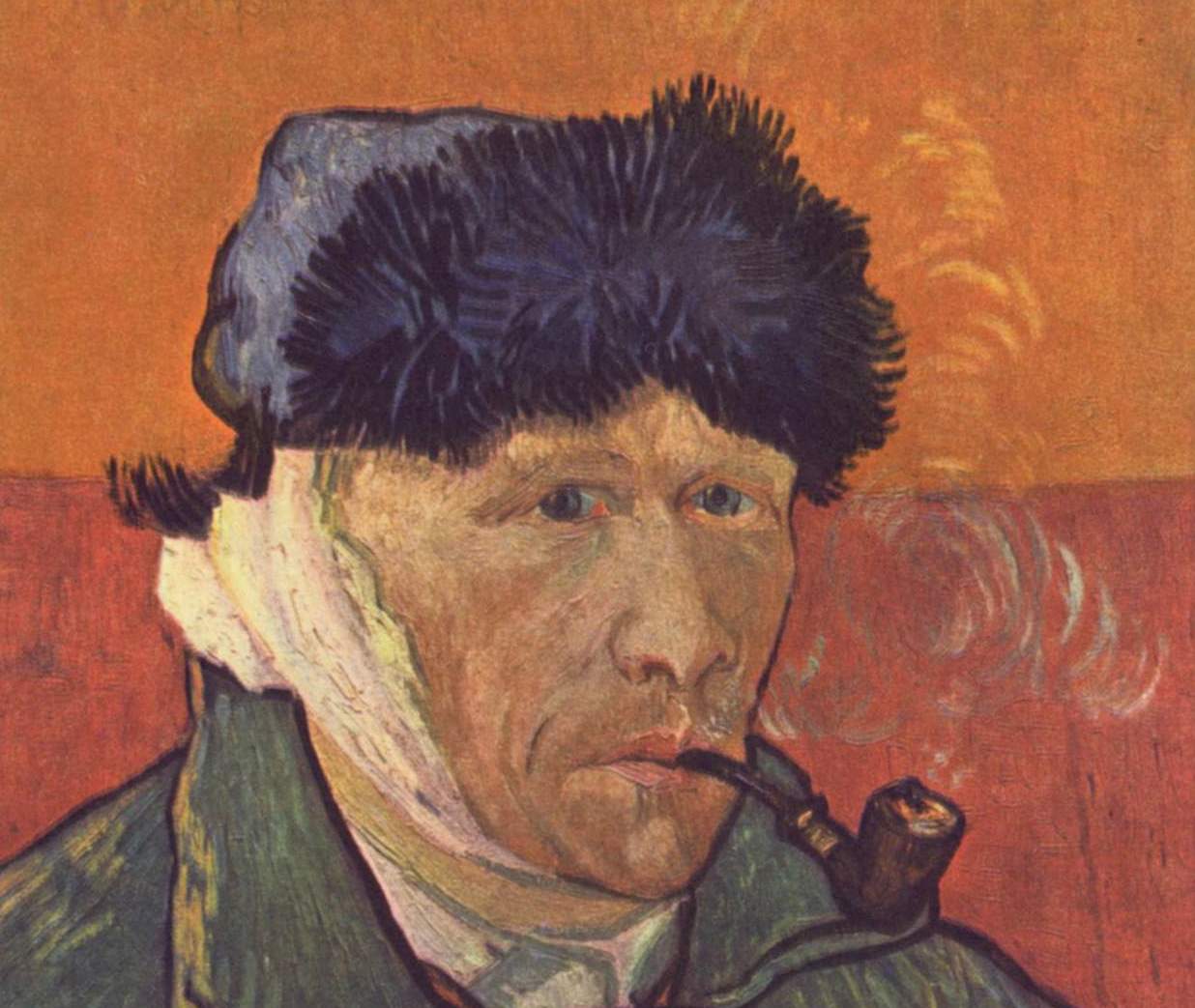
That’s the case Steven Naifeh and Gregory White Smith make in their fascinating investigation into the painter’s death, which unsettles the familiar story of a mad artist killing himself. The entire essay is worth reading, but it begins with these questions:

Van Gogh himself wrote not a word about his final days. The film [Lust for Life] got it wrong: he left no suicide note—odd for a man who churned out letters so profligately. A piece of writing allegedly found in his clothes after he died turned out to be an early draft of his final letter to his brother Theo, which he posted the day of the shooting, July 27, 1890. That letter was upbeat—even ebullient—about the future. He had placed a large order for more paints only a few days before a bullet put a hole in his abdomen. Because the missile missed his vital organs, it took 29 agonizing hours to kill him.

None of the earliest accounts of the shooting—those written in the days immediately after the event—mentioned suicide. They said only that Van Gogh had “wounded himself.” Strangely, the townspeople of Auvers, the picturesque community near Paris where he stayed in the last months of his life, maintained a studied silence about the incident. At first, no one admitted having seen Van Gogh on his last, fateful outing, despite the summer crowding in the streets. No one knew where he would have gotten a gun; no one admitted to finding the gun afterward, or any of the other items he had taken with him (canvas, easel, paints, etc.). His deathbed doctors, an obstetrician and a homeopathist, could make no sense of his wounds.

And, anyway, what kind of a person, no matter how unbalanced, tries to kill himself with a shot to the midsection? And then, rather than finish himself off with a second shot, staggers a mile back to his room in agonizing pain from a bullet in his belly?

(Image: Van Gogh’s 1889 self-portrait, via Wikimedia Commons)

Face Of The Day

CHINA-ANIMAL-SHOW

A man grooms his mini poodle after competition at the 2014 China International Pet Show in Beijing on November 17, 2014. The China International Pet Show (CIPS) will take place from November 17 to 20. By Wang Zhao/AFP/Getty Images.

A reader writes regarding Friday’s FOTD:

While I know you posted that white tiger with the best of intentions, I wish you might have accompanied it with some education about the white tiger, which occur in nature, but which zoos usually acquire by breeding a father white tiger to his female white tiger offspring – resulting in a wide variety of health issues that plague these animals throughout their lives. White tigers may seem exotic, but they are actually a representation of animal cruelty. Here is a link with some more information.

The Perils Of Political Poetry

David Wojahn considers them:

If you set out simply to write a poem of social criticism or invective, the results are almost invariably going to be mere agitprop. And that problem afflicts much of the work of even some of our greatest poets of invective—Neruda and Brecht come to mind. Finding a way to blend the personal and the social is a complex and tricky imaginative problem—you have to ask yourself what right you have to address an injustice you yourself have probably not experienced; you have to find a form that allows the personal and the political to commingle in a way that seems effortless and serendipitous; you can’t rely on the same old lefty pieties any more than you can rely on the equivalent pieties that make for a poetic period style. But one of the principal functions of poetry is to preserve and protect human dignity, and if you are sufficiently loyal to that function you find a way to navigate through all the pitfalls, both pitfalls of inadequate craft and of fuzzy political thinking.

How Wojahn describes writing one of his own political poems, “For the Honorable Wayne LaPierre, President, National Rifle Association,” which borrows from Dante and places the gun-rights activist in the seventh circle of Hell:

It’s interesting that Dante seems again and again to encounter his contemporaries in hell and purgatory—people he knew in Florence, often his political adversaries. It’s an incredibly clever way to get back at the people who he felt wronged by. A few years back, I came across a very smug and self-satisfied interview with LaPierre, given right after the Supreme Court had declared the DC handgun ban unconstitutional. It occurred to me that LaPierre was exactly the sort of reprobate Dante placed in the furthest circles of inferno. In one of the rings of Circle Seven he situates “the violent against their neighbors,” and that label seemed to me to aptly fit people like LaPierre and George Zimmerman. To try to re-describe and contemporize Dante’s punishments while still being faithful to his spirit was an exciting challenge, and I think having to focus on that helped me to avoid making the poem simply a diatribe against the NRA.

Why Your Screenplay Needs A Rewrite

hickey-feature-scripts-21

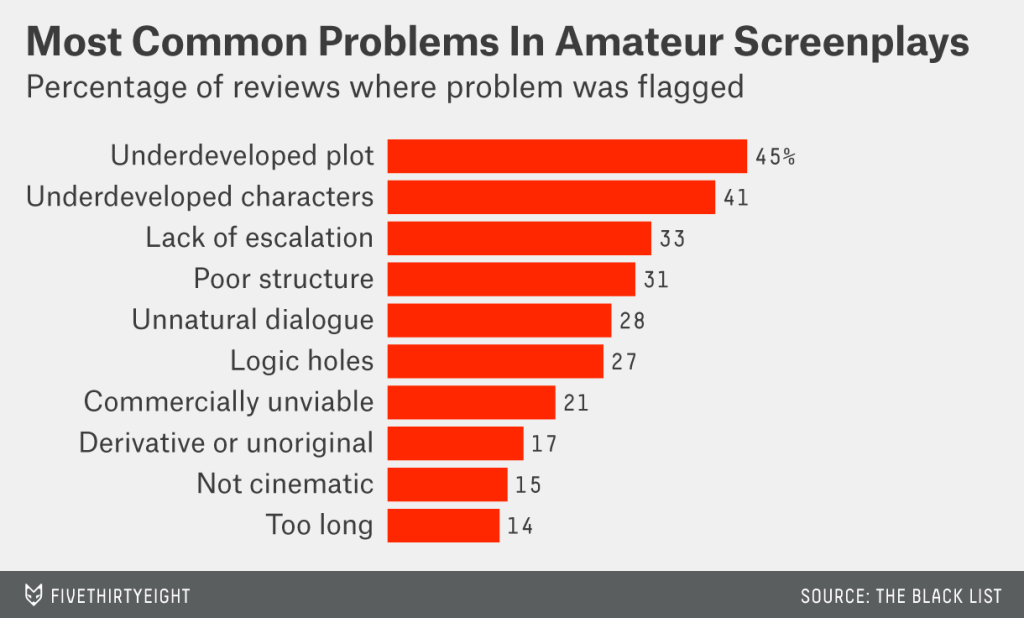
Walt Hickey found a way to quantify the most common problems facing screenwriters:

The Black List offers aspiring screenwriters the chance to have their work evaluated by professional script-readers who work within the industry.1 The readers are drawn from agencies and studios. When scripts are rated highly, the site promotes the screenplays to potential buyers. As a result, The Black List has thousands of script evaluations — grades based on plot, premise, characters, setting and dialogue — from dozens of genres. I asked for a look at those reviews, and they sent over an anonymized record of 4,655 evaluations of 2,784 scripts by 2,221 writers, submitted from March to July of this year. When a script is evaluated, the reader assigns any number of genres to it — from simple drama to prehistoric fantasy — and we can use these to uncover different trends.

First-time writers tend to go one of two ways, said Kate Hagen, a former reader who now oversees the hundred or so readers at The Black List. They write a deeply personal, pseudo-autobiographical screenplay about nothing in particular. “Everybody basically writes that script at first,” Hagen said. “You have to get it out of your system.” Or they swing for the fences and go in the opposite direction, thinking, “I’m going to write a $200 million science fiction movie,” and plan an entire universe and mythology. Those scripts, Hagen said, tend to fail for entirely different reasons.

Quote For The Day

“In the case of Frank Conroy’s ‘essay,’ Celebrity Cruises is trying to position an ad in such a way that we come to it with the lowered guard and leading chin we reserve for coming to an essay, for something that is art (or that is at least trying to be art). An ad that pretends to be art is – at absolute best – like somebody who smiles at you only because he wants something from you. This is dishonest, but what’s insidious is the cumulative effect that such dishonesty has on us: since it offers a perfect simulacrum of goodwill without goodwill’s real substance, it messes with our heads and eventually starts upping our defenses even in cases of genuine smiles and real art and true goodwill. It makes us feel confused and lonely and impotent and angry and scared. It causes despair,” – David Foster Wallace, eighteen years ago, on “sponsored content.”

Back then, an essay sponsored by a cruise line was a rare excrescence. But this excrescence is now the business model for almost all online journalism. It is the business model for the New York Times!

Greece Is Growing

Greece

Finally:

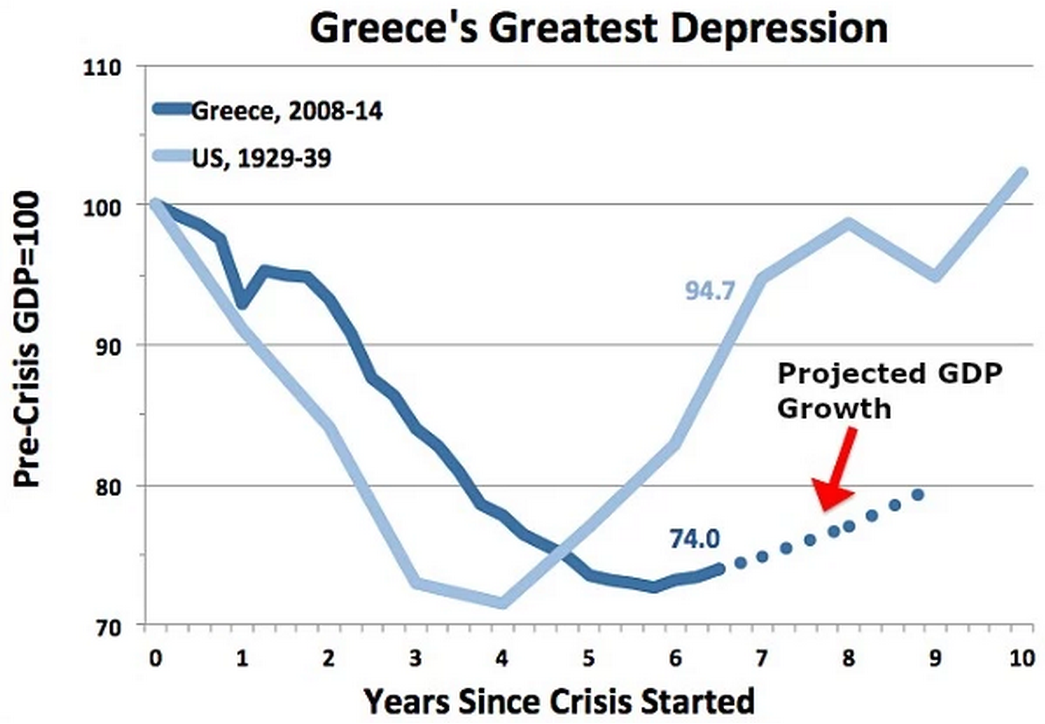
Greece’s crisis-stricken economy has returned to growth following six years of recession, official data showed Friday, marking an end to one of the steepest and longest economic contractions in postwar European history.

But Matt O’Brien warns that “Greece’s comeback, like its collapse, will be nasty, brutish, and long”:

Greece’s depression … is still nowhere near done. You can see that easily enough in the chart above, which I’ve modified from The Economist. It compares Greece the past few years with what used to be the gold standard of economic catastrophe: the U.S. during the Great Depression. Now, Greece’s economy fell marginally less than America’s did back then — around 27 percent at its worst — but the biggest difference between the two is the slope of the recovery. The U.S., as you can see, rocketed back once FDR devalued the dollar and started spending more. Only the double whammy of premature fiscal and monetarytightening knocked it off track in 1937.

Greece, though, has gotten nothing but fiscal and monetary tightening.

Prepared For The Worst

Chris Morgan surveys the “severe and fatalistic” aphorisms of the the neglected Colombian writer Nicolás Gómez Dávila, which he believes exemplify the reactionary, rather than conservative, approach to politics:

Conservatism’s appeal has always rested in its professed unwillingness to compromise in pursuit of its causes. A reactionary distinguishes himself or herself from the movement conservative by being committed and uncompromising to a degree that discomforts the latter. The conservative embraces democracy to the extent that the conservative can direct it in reaching his or her goals. The reactionary merely resigns him or herself to its existence. “I am an aristocrat,” said early 19th-century Virginia congressman John Randolph of Roanoke, “I love liberty, I hate equality.”

If conservatives are characterized by nostalgia, reactionaries are characterized by decadence. Conservatives build networks and speak in sound bites; reactionaries build mausoleums and speak in epitaphs. Reactionaries are aesthetic rather than practical thinkers. They play alongside, if not across, the border of tragedy and fatalism. Civil debate is meaningless to the side that has already lost.

“If the reactionary concedes the fruitlessness of his principles and the uselessness of his censures,” Gómez Dávila wrote in his essay “The Authentic Reactionary,” “it is not because the spectacle of human confusion suffices for him. The reactionary does not refrain from taking action because the risk frightens him, but rather because he judges that the forces of society are at the moment rushing headlong toward a goal that he disdains.”