No, as much as national pundits like to bemoan Christie’s demeanor and as much as events like Bridgegate have underscored Christie’s reputation as a bully and a back-room brawler, his biggest campaign trail albatross is a more fundamental challenge—one he can’t fix with a smart made-for-YouTube put-down. Chris Christie’s greatest challenge as he contemplates moving onto the national stage is that his own state looks to be in rough shape.
What doesn’t play well on YouTube? As many as 10,000 people unemployed because of the closure, in a matter of months, of at least a third of the casinos in Atlantic City. What doesn’t play well on YouTube? The second worst credit rating among states in the nation. What doesn’t play well on YouTube? Unlike the nation as a whole, which has more than recovered the jobs it lost during the recession, New Jersey has yet to recover half of its lost jobs. Christie once declared a “New Jersey Comeback,” but he has since abandoned that narrative. Opponents in 2016 will want to tell Americans why.
Yesterday, the DEA pounced on several NFL teams for inappropriate use of prescription painkillers:
The unannounced visits by the Drug Enforcement Administration were spurred, in part, by reports of widespread abuse of painkillers that were included in a class-action lawsuit against the N.F.L. The suit, which is being heard in federal court in California, claims that team doctors routinely dispensed Percocet, Toradol, Novocain and other drugs to energize players before games and relieve pain afterward. … [In 2011], a dozen former players accused the league and its teams of repeatedly administering the painkiller Toradol before and during games, worsening high-risk injuries such as concussions. The players also contend that the league and its teams failed to warn them of the consequences of taking the drug, a blood thinner that, according to the suit, “can prevent the feeling of injury” and therefore made it harder for players to recognize when they had concussions.
The question then is, after decades of treating everyone that pulls on a helmet and pads like so much disposable meat, could this be the scandal-du-jour that proves to be the tipping point? Will the viewing public come to realize that football isn’t really an All-American national pastime, but more closely resembles a bloodsport that leaves an ever-growing list of casualties in it’s wake?
The short answer is, no. It won’t. Despite all of the negative press and worse behavior over the last few months, attendance is at a five-year high, and television ratings are holding steady.
All teams need to do is have reciprocity in access to home-field dispensaries staffed by a doctor or nurse practitioner, while team doctors who travel on road games consult with the home-team staff. In fact, it’s so simple that I’d be surprised if teams aren’t already doing that — which may be why we didn’t hear about arrests last night.
Adam Waytz of Northwestern University and Kelly Marie Hoffman and Sophie Trawalter of the University of Virginia report the results of several studies on this subject in an upcoming issue of Social Psychological and Personality Science. In one experiment, white Internet users were shown a white face and a black face and asked to decide:
1) Which person “is more likely to have superhuman skin that is thick enough that it can withstand the pain of burning hot coals?” …
5) Which person “has supernatural quickness that makes them capable of running faster than a fighter jet?”
6) Which person “has supernatural strength that makes them capable of lifting up a tank?”
Blacks were selected 63.5 percent of the time, significantly more than whites. The only two items that did not differ significantly were the ones about reading minds (52 percent blacks) and falling from a plane (54 percent).
While most people are familiar with the idea of seeing different ethnic or religious groups as subhuman, the researchers write that “the phenomenon of superhumanization has received virtually no empirical attention in psychology.” So what should we make of the fact that white people appear to “implicitly and explicitly superhumanize” black people? The authors state that more work is needed, but they suggest that superhumanization bias could help explain why black patients are undertreated for pain, for example, or why “people consider Black juveniles to be more ‘adult’ than White juveniles when judging culpability.”
Your take on Matt Taylor is that he was “convicted merely of being a clueless dude, who just happened to have helped land a fricking spacecraft on a comet”. So, why should guys get a pass for being clueless? Of course, there will always be clueless men (and women), but is that really something we should just wink at and let pass without comment? And we’re not talking just about him – he can’t have been the only person involved in filming that announcement. Did no one tell him to change his shirt or put on another layer? If not, why not??
The next part of this seems to imply that because he did something legitimately impressive (“helped land a fricking spacecraft on a comet”) we shouldn’t worry about the shirt. I’m sorry, but what he accomplished is irrelevant to this discussion. Are you saying that people with less impressive CVs can be held to a higher standard? I assume that isn’t what you wanted to imply. It sucks that this has overshadowed his accomplishments for a bit, but well, he could have thought about that beforehand.
My point is about the lack of proportion. The hideously inappropriate attire is worthy of a smile or a grimace or a comment – but not of a twittalanche of ideological contempt and outrage. I wonder, for example, what the response would be if a fundamentalist Christian had objected to the shirt on the grounds of sexual immorality and made a big stink out of it. The sins of today are not the sins of yesterday, but the clerisy enforcing proper morals is just as unforgiving.
Another reader reacts at length:
I feel a bit annoyed by your brief comments about Matt Taylor’s apology, and I’m positively flummoxed by Boris Johnson’s column about the incident.
What baffles me is that the shirt is so obviously inappropriate that I’m confounded by the people like you who describe Taylor as merely a clueless dude and Boris who calls Taylor blameless. It’s not some mysterious convention of society that shirts depicting women in leather fetish wear are inappropriate for professional scientists doing press interviews as a part of their job. If Dr. Taylor was unaware of this, he’s not clueless; he’s willfully ignorant.
And he’s willfully ignorant in a way that makes women who are scientists, like Katie Mack, uncomfortable. Mack is the astrophysicist who has been at the center of much of the commentary on Taylor’s shirt, and her name is curiously absent from much of the discussion that seems to focus on the angry, anonymous hordes of people. Except that most of these feminist critics aren’t anonymous. They’re named scientists and science journalists or women in other professional academic fields who are tired of having the “eccentricity” of their male colleagues excused as the price of genius. They don’t care about how many tattoos Taylor has or the fact that he made his apology while wearing a hoodie or that he’s an incompetent driver. But they rightly care about the quality of their workplaces.
As for Boris, what drives me nuts about it is the sheer hypocrisy of the way he charges Taylor’s critics with hypocrisy. He writes:
It’s the hypocrisy of it all that irritates me. Here is Kim Kardashian – a heroine and idol to some members of my family – deciding to bust out all over the place, and good for her. No one seeks to engulf her in a tweetstorm of rage. But why is she held to be noble and pure, while Dr Taylor is attacked for being vulgar and tasteless? I think his critics should go to the National Gallery and look at the Rokeby Venus by Velázquez. Or look at the stuff by Rubens. Are we saying that these glorious images should be torn from the walls?
I think it’s hilarious that Boris, who is emphatically not a space scientist, is here telling all the women scientists who believe that clothing with women in lingerie is inappropriate workplace attire that they are wrong. Also, Boris’s befuddlement about why the shirt is inappropriate is so hard to understand. Does he seriously not understand the difference between Kim Kardashian and Rubens, or that a shirt covered in women in leather fetish wear is inappropriate in a professional setting even if there are no exposed nipples or buttocks?
His choice of Kim Kardashian is especially clueless because she is currently involved in her own storm of unfavorable feminist coverage due to her replication of the racist, heavily sexualized Hottentot Venus. The only reason Johnson is able to charge Taylor’s critics with hypocrisy is that he hasn’t even taken a few moments to see who is talking about his shirt. It doesn’t take long to discover people like Katie Mack or Rose Eveleth, women in serious professional roles who aren’t singing hymns to the glories of the Kardashians while they’re critiquing Taylor’s shirt.
Taylor wasn’t blameless, but he didn’t deserve abuse (nor did the women like Mack who called attention to the shirt’s inappropriateness). Wearing the shirt was a bad idea and sent a bad message to women in the sciences, and he’s apologized for it. Some people overreacted, sure, but the basic criticism was justified.
I guess one solace from this is that Kardashian has run afoul of the culture police as well. It reminds me how the Hollaback video makers got creamed by the femi-left for their racism. Whatever you do, wear or say, there’s an ism you’re now guilty of – and need both confession and absolution from the Twitter mob to recover from.
Here are the key details from that blog post in the tweet embedded above:
Dr. Matt Taylor is an amazing, kind, loving and sensitive person. I never expected him to wear my gift to him for such a big event and was surprised and deeply moved that he did. I made that shirt for his birthday last month as I make clothes just as a hobby and he asked if I would make him one.
The man just obviously hates women, no? Like all the other sinners out there. Now where’s my Tom of Finland t-shirt?
Yesterday, ISIS released a video showing that they had beheaded 26-year-old American aid worker Abdul-Rahman (né Peter) Kassig:
In the clip released early Sunday, the Islamic State displays the head of Mr. Kassig, 26, at the feet of a man with a British accent who appeared in the previous beheading videos and has been nicknamed Jihadi John by the British news media. Unlike the earlier videos, which were staged with multiple cameras from different vantage points, and which show the hostages kneeling, then uttering their last words, the footage of Mr. Kassig’s death is curtailed — showing only the final scene.
One possible explanation is that Kassig, a former Army Ranger, resisted his captors at the end. We may never know what happened for sure. One thing that is for sure, however, is that Kassig’s embrace of Islam during his captivity didn’t spare his life.
As Terrence McCoy notes, other captives of Islamist militant groups who converted, such as James Foley, didn’t reap any benefit from doing so either. Fawaz Gerges stresses that killing a convert “is an extremely serious violation of the well-established consensus in the Islamic community on the sacredness of life for converts to the religion”. He sees Kassig’s sloppy killing as a sign that the group is on the defensive:
Abu Muhammed al-Maqdsi, a mentor to many al Qaeda leaders, had called for mercy — not only because Kassig was a convert to Islam, but because he had given up so much to move to Syria and help victims of the war. Militant Islamists in the country also went public with a request for mercy. They said Kassig, a trained medic, had treated them when they were injured in battles against Syrian government forces.
It was inevitable that these calls would fall on deaf ears. Beheading Western hostages is one of the only tools ISIS has at its disposal to retaliate against the American-led airstrikes that are beginning to land serious blows on the group. … While it is difficult to keep track of the latest developments on the ground, what we do know is this: The momentum, at least in Iraq, is shifting. The group’s leaders are being hunted down, and they’re feeling the pain.
Now, according to Shane Harris, the jihadists hold just one American prisoner: a young woman, the same age as Kassig, who also went to Syria as an aid worker and was kidnapped in August 2013:
U.S. officials and the woman’s family have requested that her name not be made public, fearing that further attention will put her in greater jeopardy. No news organization has published her name. But the general circumstances of her capture and captivity have been known and widely reported for more than a year now. ISIS’s intentions for its remaining American prisoner are unclear. But current and former U.S. officials told The Daily Beast that it was notable she doesn’t appear at the end of a video, released Sunday, that shows the aftermath of Kassig’s beheading. That breaks with ISIS’s pattern of showing the next hostage it intends to kill.
Reflecting on better days when he could interview Taliban leaders without fearing for his neck, Goldblog worries about these beheadings prompting journalists (and, one might add, humanitarians like Kassig) to think twice before heading to war zones:
Why have some groups rejected the notion of journalistic neutrality? For one thing, the extremists have become more extreme. Look at the fractious relationship between al-Qaeda and ISIS, which is an offshoot of al-Qaeda but which has rejected criticism from Qaeda leaders about its particularly baroque application of violence. Another, more important, reason relates to the mechanisms of publicity itself. The extremists don’t need us anymore. Fourteen years ago, while I was staying at the Taliban madrasa, its administrators were launching a Web site. I remember being amused by this. I shouldn’t have been. There is no need for a middleman now. Journalists have been replaced by YouTube and Twitter. And when there is no need for us, we become targets. …
Today, even places that shouldn’t be dangerous for journalists are dangerous. Whole stretches of Muslim countries are becoming off-limits. This is a minor facet of a much larger calamity, but it has consequences: the problems of Afghanistan and Pakistan and Syria and Iraq are not going away; our ability to see these problems, however, is becoming progressively more circumscribed.
President Obama is expected to announce his executive action on immigration reform this week, promising a partisan bloodbath. Fox News is already talking about the i-word, of course:
Josh Voorhees revisits what exactly Obama’s action will probably be:
The most sweeping action the president will likely take is to extend DACA-like reprieves to particular groups of unauthorized immigrants, the largest of which will probably be parents of children who are U.S. citizens or permanent residents. Such a reprieve would temporarily protect them from the threat of deportation, but it wouldn’t remove that threat forever. Despite what conservatives are suggesting with their talk of “executive amnesty,” the president doesn’t have the unilateral power to make someone a U.S. citizen or permanent legal resident. …
There is one group for whom Obama’s actions could have a more lasting impact:
those unauthorized immigrants whose spouses are U.S. citizens or legal residents. Most people in that group are technically eligible to apply for a green card already, but only if they first leave the country and wait out what’s typically a lengthy separation from their family. Obama could offer what is known as “parole in place” to that group, allowing them to stay in the country legally while the green card process plays out. He did a similar thing last November for undocumented individuals with immediate family members serving in the U.S. military. Anyone who has a green card in hand before the president leaves office in early 2017 wouldn’t have to worry about losing it if the next president changes course.
Outlining why Obama is moving ahead with this controversial power play, Dara Lind attributes his eagerness to the “smashing success” of DACA:
DACA beneficiaries say they’re no longer afraid to excel in school or become leaders in their communities, because they’re no longer worried that getting noticed will lead to getting deported. Advocates see the success of the DACA program as evidence that the administration has the ability to remove the threat of deportation from larger numbers of people if it really wants to. That’s why they’ve continued to push for affirmative relief, rather than being willing to rely on administration promises about passive protection of immigrants.
Unless the rumors about what Obama’s about to do are wildly wrong, it looks like the advocates’ argument has been persuasive. The White House has been convinced that if it really wants to remove the fear of deportation from unauthorized immigrant residents, it’s going to need to let them apply for relief themselves.
Also, Scott Clement and Peyton Craighill observe, there’s some evidence that the public would support the action Obama plans to take, if not the means by which he’s taking it:
[D]espite Obama’s low approval ratings (especially on immigration) and Democrats’ “(butt-)whuppin‘” in the midterm elections, he has something on his side: Public support for allowing undocumented immigrants to stay in the country. The 2014 national exit poll found 57 percent of midterm voters say most illegal immigrants working in the United States should be offered a chance to apply for legal status. Just less than four in 10 support deportation instead. And majority support on this issue isn’t all that surprising given national polling in recent years.
But Ian Gordon points out one thing Obama’s action apparently won’t address:
Still, given this year’s border crisis, it’s notable that the president’s plan seems to make little to no mention of the folks who provoked it: the unaccompanied children and so-called “family units” (often mothers traveling with small kids) who came in huge numbers from Central America and claimed, in many cases, to be fleeing violence of some sort.
The administration has been particularly adamant about fast-tracking the deportation of those family unit apprehensions, whose numbers jumped from 14,855 in fiscal 2013 to 68,445 in fiscal 2014, a 361 percent increase. Meanwhile, ICE has renewed the controversial practice of family detention (a complaint has already been filed regarding sexual abuse in the new Karnes City, Texas, facility) and will soon open the largest immigration detention facility in the country, a 2,400-bed family center in Dilley, Texas—just as Obama starts rolling out what many immigration hardliners will no doubt attack as an unconstitutional amnesty.
Tomasky, brimming with righteous indignation, claims that the Senate immigration bill “could have passed the House of Representatives, and probably easily, at any time since the Senate passed it in June 2013”, if not for Boehner’s decision never to let it come to a vote:
It’s been 16 months, nearly 500 days, since the Senate passed the bill. The House could have passed it on any one of those days. But Boehner and the Republicans refused, completely out of cowardice and to spite Obama. Insanely irresponsible. And on top of that, Boehner told Obama in June that he was not going to allow a vote on it all year. In other words, the Speaker told the President (both of whom knew the bill had the votes) that he was not only going to refuse to have a vote, but that he was going to let the Senate bill die. And now, when Obama wants to try to do something about the issue that’s actually far, far more modest than the bill would have been, he’s the irresponsible one? It’s grounds for impeachment?
Still, Danny Vinik worries about the consequences if Obama and the Democrats take the low road to immigration reform:
The president’s supporters argue that it’s the Republicans who have violated democratic norms, by refusing to even allow a bipartisan immigration bill that passed in the Senate to come to a vote in the House. It’s also unlikely that a move on immigration would set a precedent for future Republican presidents to undermine laws that Democrats support. I haven’t been able to imagine a comparable scenario where a Republican would have considerable legal authority to make a unilateral policy change. Immigration is a unique issue.
Still, Democrats could also lose some of their ability to claim the moral high ground on such issues. And that could matter very soon, because some Republicans are so angry about a potential immigration order they are considering using a government funding bill to block it, possibly setting up another shutdown.
Brian Beutler contemplates the Republican response:
There are three tools Republicans can use to stop Obama, but toxic Republican politics preclude the only one—a pledge to vote on comprehensive reform—that would actually work. That leaves the spending and impeachment powers. If, like Boehner, Republican hardliners truly believe the president is preparing to violate his oath of office, and an appropriations fight won’t stop him, then suddenly Krauthammer’s option becomes the last arrow in their quiver.
It won’t succeed either. But Boehner knows that this is where many of his members’ minds are already starting to wander. It’s why he’s once again floating the possibility of suing Obama instead.
Rachel Roubein also previews the Republican response:
If Obama announces his executive order next Friday at noon, the House could stay in session for as long as needed rather than beginning the planned Thanksgiving recess. The chamber could pass a resolution rejecting the president’s actions. Then House Republicans would focus on appropriations.
The current funding bill is set to sunset Dec. 11, and lawmakers are jockeying over passing another short-term continuing resolution or a longer-term package. The House could attach a rider prohibiting enforcement of Obama’s order, or it could not provide money to departments that would respond to executive action.
Lastly, Francis Wilkinson wants to know just what Obama’s opponents propose as an alternative:
There are, after all, a finite number of answers to the question of what to do about millions of undocumented immigrants living in the U.S.:
1. You can offer them a path to legalization and/or citizenship.
2. You can deport them.
3. You can maintain the status quo, in which the undocumented remain in the U.S. without legal rights or recognition (and perhaps “self deport” in accord with the wishes of Mitt Romney). …
[Senator Jeff] Sessions, who along with Republican Senator Ted Cruz of Texas represents the hard end of anti-immigrant views in the Senate, shrinks from saying he supports deportation. He loudly condemns the status quo. And he’s virulently opposed to amnesty.
Back in September, the Justice Department announced “a new series of pilot programs in cities across the country to bring together community representatives, public safety officials and religious leaders to counter violent extremism”. While the DOJ avoided using the words “Muslim” and “Islam” in its press release, the targets of these programs are obviously American Muslim communities. Naureen Shah, who grew up in such a community, decries the initiative as way too broad:
There is tremendous risk of abuse and mistake in any program that tries to predict future criminals, including terrorists. Empirical studies show that violent threats cannot be predicted by any religious, ideological, ethnic, or racial profiling.’
The evidence suggests that there is no direct link among religious observance, radical ideas, and violent acts. Some of the theories underlying the government’s approach caution just that, but they nevertheless advise law enforcement—and now, American Muslim community “partners”—to connect the dots linking an individuals’ noncriminal behavior, his ideas, and his attitudes. That kind of monitoring shrinks the space for free expression by creating an atmosphere where people fear they must watch what they say and how they act, lest it be reported.
It also denies what it is to grow up. As a teenager, I became angry and difficult. I disappeared on weekends. I chatted online for hours as my family ate dinner downstairs. I wasn’t a violent terrorist in the making. But under the government’s program, community members will be encouraged to monitor these behaviors and intervene with teens who engage in them.
Writing from the UK, where authorities have taken a similarly community-based approach to addressing radicalization, Arshad Isakjee objects to the assumption that there is such a thing as a “Muslim community” in the first place:
It is tempting to readily accept the warm notion that Muslims collectively behave like characters in Eastenders, buzzing around Asian Albert Squares across the country, their families constantly interacting at the local mosque – their version of the Queen Vic. We would never accept similar notions of Christian communities or white communities – but when applied to minorities, the idea sounds authentic and credible. …
Look closer though, and the Muslim community is far more elusive. Until the Salman Rushdie fatwa affair, Muslims in the UK were not conceptualised by religious identity. Ethnic groups such as Pakistanis, Bangladeshis and Indians were the more legitimate conceptions of migrant communities. Even today, in most British towns and cities with Muslim populations, different ethnic groups will have their own mosques and religious institutions, and in some instances membership of those establishments remains exclusive to those specific ethnic groups.
On Saturday, Ukrainian President Poroshenko ordered his government to withdraw all state services, including funding for hospitals and schools, from rebel-held provinces in the country’s east:
Poroshenko told his cabinet to take steps within a week “to terminate the activities of state enterprises, institutions and organisations in the various territories where anti-terrorist operations are being conducted,” a statement on his website said. “This is a decisive step, the games have stopped,” the security official added. “All the structures that the state finances will be withdrawn from there. Ukraine will no longer finance them.” The decree also proposed that Ukraine’s central bank take steps over the next month to withdraw all banking services for businesses and individuals in the regions.
But “if anyone thought this was an abdication and a letting go of the unruly region,” Jamie Dettmer underlines, “they need to think again”:
In the decree, he asked the country’s new parliament to revoke a law granting self-rule to the Donetsk and Luhansk regions—in effect rescinding September’s “special status” law granted under a ceasefire allowing the two mainly Russian speaking eastern region some autonomy.
The National Security Council recommended Poroshenko revoke the special status law following the November elections in the separatist Luhansk People’s Republic and Donetsk People’s Republic—polls that broke the conditions of the Sept. 5 Minsk ceasefire agreement. That ceasefire allowed for local elections in Donbas in December, but under Ukrainian supervision. The separatist polls amounted to a direct challenge to Kiev’s authority. But the decision now to sever economic ties with the eastern regions was a surprise—and a gamble.
Rebel leaders quickly decried the order as an act of “genocide”. Poroshenko had already cut off the separatist regions from pensions and other state funds last week. Alexander J. Motyl supports putting economic pressure on the rebels and their backers in Moscow, but he acknowledges that there will be serious consequences:
The [Donbas] enclave is an economic mess, having experienced dramatic drops in GDP and employment and rises in business closures, food shortages, and inflation. And conditions will get much, much worse as subzero winter temperatures envelop the enclave. People will die not only from the fighting, but also from hunger and cold. Even Nikolai Levchenko, the young Regionnaire hotshot from Donetsk who distinguished himself a few years ago by insulting the Ukrainian language, brazenly flaunting his ill-gotten wealth in Jakob Preuss’s documentary film The Other Chelsea, and preposterously claiming to have read Leo Tolstoy’s War and Peace seven times, says he’s worried: “More than 3.5 million people who have remained in the zone of direct conflict will suffer from the cold and will be placed on the verge of survival under conditions of a wintry humanitarian collapse.”
This weekend was also an eventful one for Putin, who got such a chilly reception at the G20 summit in Australia that he ducked out early:
Western leaders piled huge pressure on the Russian president at the Group of 20 meeting in Brisbane, with host Tony Abbott calling on Putin to “atone” for the shooting down of Flight MH17 over rebel-held eastern Ukraine and Britain’s David Cameron branding him a “bully”. Analysts said Putin’s apparent anger at his treatment by his fellow leaders could worsen the crisis in Ukraine. “If he is leaving irritated, just wait for the fighting in Ukraine to intensify,” independent analyst Stanislav Belkovsky told AFP. Putin, who prides himself on his stamina, cited the “need to sleep” and a long flight home as his reasons for leaving the summit before the final communique was issued.
Leonid Bershidsky criticizes the G20 leaders who gave Putin the cold shoulder, arguing that such passive-aggressive behavior serves no purpose:
What were the Western leaders trying to achieve? Putin already knows they resent his meddling in Ukraine. Not inviting him at all would have sent a clearer signal that the West is prepared to isolate Russia from international decision-making, as it once did the Soviet Union. That message would have been misleading, however, because, despite Putin’s stubborn and increasingly ridiculous denials that Russia is taking action in Ukraine, the West still wants to talk with him: German Chancellor Angela Merkel, French President Francois Hollande, Italian Prime Minister Matteo Renzi and European Union President Jean-Claude Juncker, not to mention the leaders of BRICS countries, all held meetings with him in Brisbane. Taunts and angry looks only make such conversations more difficult.
But Doug Mataconis wonders whether “Putin showing up at the summit wasn’t some kind of stunt for domestic consumption to begin with”:
The Russian and Ukrainian leaders continued their war of words in interviews published yesterday and today. While both leaders claim to want a peaceful resolution to the conflict, Poroshenko now says Ukraine is “prepared for a scenario of total war” while Putin drops hints that he is fully prepared to continue propping up the rebels:
In response to a question about whether Russia was arming the rebels, as contended by both Kyiv and the West, Putin said merely that “anyone waging a fight that they believe fair will find weapons.” He stressed that without such arms the rebels would be quickly destroyed by the Ukrainian forces – something Russia “does not want, and will not allow.” While Putin stopped short of acknowledging Russia’s material role in the conflict, his comments went further in emphasizing Moscow’s willingness to support the separatists than ever before.
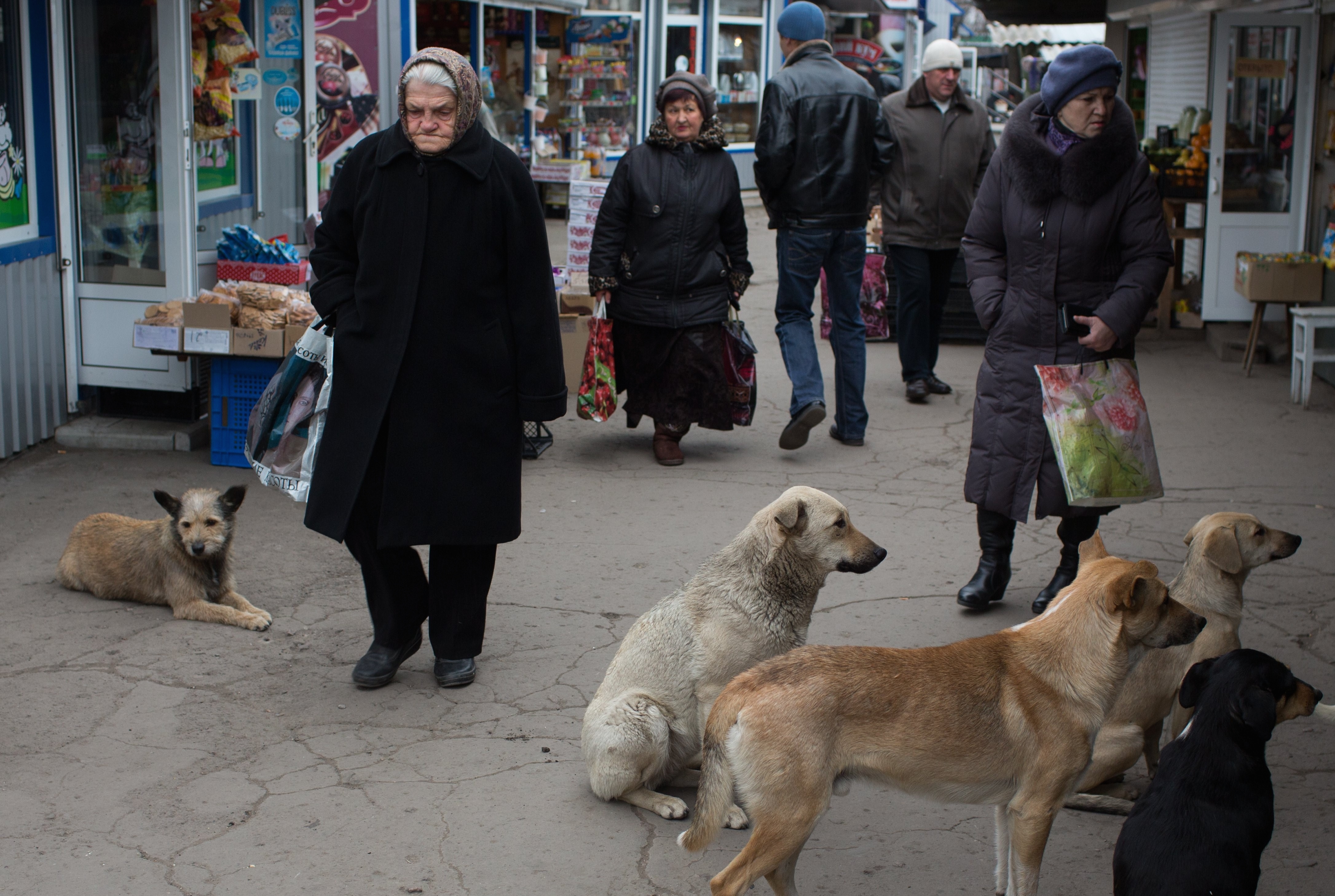
(Photo: People shop at the market in the Eastern Ukrainian city of Donetsk on November 17, 2014 as artillery fire continues to rock the eastern Ukraine’s pro-Russian rebel bastion. Fresh bloodshed between pro-Kremlin rebels and Kiev’s forces added to the tensions after Russian President Vladimir Putin left a G20 summit in Brisbane early amid criticism from fellow leaders. By Menahem/AFP/Getty Images)
That’s how Jonathan Freedland describes the Rosetta space mission:
The narrow version of this point focuses on this as a European success story. When our daily news sees “Europe” only as the source of unwanted migrants or maddening regulation, Philae has offered an alternative vision; that Germany, Italy, France, Britain and others can achieve far more together than they could ever dream of alone. …
Even that, as I say, is to view it too narrowly. The US, through Nasa, is involved as well. And note the language attached to the hardware: the Rosetta satellite, the Ptolemy measuring instrument, the Osiris on-board camera, Philea itself – all imagery drawn from ancient Egypt. The spacecraft was named after the Rosetta stone, the discovery that unlocked hieroglyphics, as if to suggest a similar, if not greater, ambition: to decode the secrets of the universe. By evoking humankind’s ancient past, this is presented as a mission of the entire human race. There will be no flag planting on Comet 67P. As the Open University’s Jessica Hughes puts it, Philea, Rosetta and the rest “have become distant representatives of our shared, earthly heritage.”
That fits because this is how we experience such a moment: as a human triumph.
When we marvel at the numbers – a probe has travelled for 10 years, crossed those 4bn miles, landed on a comet speeding at 34,000mph and done so within two minutes of its planned arrival – we marvel at what our species is capable of. I can barely get past the communication: that Darmstadt is able to contact an object 300 million miles away, sending instructions, receiving pictures. I can’t get phone reception in my kitchen, yet the ESA can be in touch with a robot that lies far beyond Mars. Like watching Usain Bolt run or hearing Maria Callas sing, we find joy and exhilaration in the outer limits of human excellence.
Instead of landing on its planned target, Philae took a dramatic double bounce into the shadows of the comet, where only a tiny bit of sunlight can reach its solar panels. The battery, which lasts for two and a half days, was intended to power Philae during its first planned sequence of data collection. After the battery ran out, Philae was to rely on the sun.
Despite Philae’s precarious position on a cliff, it managed to collect all the data that mission controllers had planned for—images, information on the comet’s chemical composition and its surface properties, for example. The spacecraft even managed to drill into the comet’s surface. Mission controllers also rotated Philae 35 degrees in the hopes of getting its solar panels in a more favorable position. It remains to be seen whether the maneuver will pay off.
Joseph Stromberg explains the importance of comet research:
All this data is so valuable because the comet likely formed 4.6 billion years ago, from material leftover asEarth and the solar system’s other planets were coalescing. As a result, understanding the composition of this comet — and comets in general — could help us better model the formation of the solar system. Moreover, many scientists believe that in the period afterward, when the solar system was still a chaotic, collision-filled system, comets and asteroids were responsible for bringing water and perhaps even organic molecules to Earth. By analyzing data collected by Philae on ice and other substances on the comet’s surface, we could gather important clues as to whether the hypothesis is correct.
Several missions in the near future will take us to asteroids, the slower-moving (and easier to chase down) cousins of comets. In 2016, NASA’s OSIRIS-REx will use a spacecraft with a robotic arm to pluck some asteroid off and take it home. And while we wait for another Philae-like comet trip – which probably won’t come in the next 10 years – we still have Rosetta. The spacecraft will follow its comet for a year, studying it as it passes the sun. And during that time, if enough light hits its solar panels, Philae could even make a comeback – reuniting the world’s new favorite pair of space buddies.
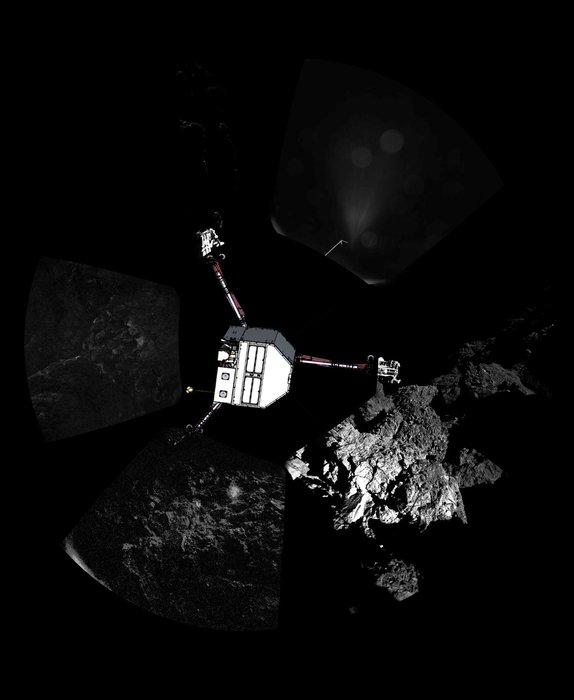
(Photo: Rosetta’s lander Philae has returned the first panoramic image from the surface of a comet. The view, unprocessed, as it has been captured by the CIVA-P imaging system, shows a 360º view around the point of final touchdown. By ESA/Rosetta/Philae/CIVA)
“I think a resolution of disapproval is unlikely,” says Bill Piper, director of national affairs at the Drug Policy Alliance. “Overturning a ballot measure passed by 70 percent of the voters doesn’t really look good for the incoming Republican Congress. If the council transmits [the initiative] in January, I think that pretty much reduces or eliminates the chance that Congress will overturn it outright. It just doesn’t fit with what they’re talking about doing, which is rebranding themselves as not being obstructionists.”
Yay! Why defunding the initiative is unlikely to work:
Unless Congress is still working on appropriations for the current fiscal year come January, [anti-marijuana Congressman Andy] Harris would have to wait until spending is authorized for fiscal year 2016. “They could do an appropriations rider that might take effect in September, October, November, December,” Piper says, “but Initiative 71 will already be in effect by then.”
Since the District already will have eliminated penalties for marijuana cultivation, possession, and sharing within the limits set by the initiative, telling it not to spend money on doing so will be ineffectual.
W. James Antle II wants Republicans to stand aside:
Congress would have to move quickly on a resolution of disapproval, making it one of the new majority’s earliest priorities. They would probably have nothing to show for it in the end, as President Obama has suggested his signature won’t be forthcoming. Even the frequently PR-challenged Republicans can likely sense this would be bad symbolically.
Where opponents could do the most damage is attaching riders defunding legalization’s implementation to must-sign appropriations bills. While it’s probably too late to stop legalization’s initial rollout, putting together the necessary tax and regulatory regime will take a couple of years. That’s plenty of time to gum up the works.
 The Dish