The Numbers On Rape

Ingraham highlights how few cases get resolved:

In the most recent crime data released by the FBI, only 40 percent of documented rape cases ended in “clearance.” Clearance indicates that officers were able to close a case, either via an arrest, or in some cases due to victim non-compliance – this latter method is called an “exceptional” clearance. This percent of rape cases cleared has declined sharply since 1995, while clearance rates for murder and aggravated assault have held steady.

But the reality is far more troubling than these numbers suggest.

Earlier this year, law professor Corey Yung released a lengthy paper providing evidence that police departments are systematically undercounting rape in large cities across the country. His numbers, which he calls “conservative,” suggest that “an additional 796,213 to 1,145,309 forcible rapes of women have been reported to authorities, but police have hidden them from the public record, thereby feeding the myth of the ‘great decline’ in rape.”

On Monday, Amanda Hess hoped that reporting will soon improve:

Last year, the FBI finally updated the definition for the modern era. Rape is now defined as “penetration, no matter how slight, of the vagina or anus with any body part or object, or oral penetration by a sex organ of another person, without the consent of the victim.” Now, the FBI hopes that the statistics will finally reflect “a long list of sex offenses that are criminal in most jurisdictions, such as offenses involving oral or anal penetration, penetration with objects, and rapes of males” that had previously been erased from the big picture. The new definition also drops the “forcible” qualifier in favor of “without the consent of the victim,” encouraging jurisdictions to report rapes perpetrated without a show of physical force.

Today, the FBI released Crime in the United States 2013, its first annual report to rely on this more inclusive definition of rape. The agency estimates that when crimes involving male victims, oral and anal rape, and sexual assaults committed with objects are included, the numbers of sex offenses reflected in the UCR program could increase by more than 40 percent. That hasn’t happened yet: Because “not all state and local agencies have been able to effect the change in their records management systems” to reflect the new terminology, the 2013 numbers actually reflect an estimated 6.3 percent decrease in rapes, as calculated by the old definition.

Dara Lind further unpacks what the definition change means:

[T]he FBI now has to consider unreported rape of men. Rape of men is a tremendous problem, especially in US prisons. Some estimates have indicated that, because of prison rapes, more men are actually raped in the US than women. But prison rape is especially likely to go unreported, and it looks like that’s a huge issue for the FBI. Among the 14 states that sent detailed reports to the FBI last year, there was one rape of a male for every 44 rapes of females. So if the FBI’s definition of rape is going to include rapes of men in practice, not just in theory, it’s going to have to figure out how to get a better handle on prison rape.

Recent Dish on rape statistics here.

Who Supports The War On ISIS?

386cf27f-c4e4-4128-831e-4c55fb42b68d.0

Arabs do, according to a new regional survey:

The poll comes from the Arab Center for Research and Policy Studies, which asked 4,800 randomly selected people from around the Arab world about US foreign policy and ISIS. When asked “how would you evaluate the foreign policy of the United States towards the Arab region,” 73 percent of respondents answered negative or “negative to some extent.” This makes the broad support for the anti-ISIS campaign even more surprising. When asked if they supported the US-led airstrikes against ISIS, a majority in every single country said they support the campaign[.]

What’s that about? Well, the poll also asked about attitudes toward ISIS and found them to be overwhelmingly negative in most Arab countries, so supporting a war against the group follows somewhat logically. But as Beauchamp notes, that support “isn’t necessarily durable”:

At the beginning of the 2011 US-led intervention in Libya, for instance, there was a fair amount of Arab support for the campaign. By November, after the intervention ended, a plurality of Arab respondents in one poll thought toppling Qaddafi had been the wrong thing to do. It’s also possible to over-interpret these results. You might look at the Iraq numbers and assume that ISIS is losing the battle for popular opinion in Iraq — and for a group that depends on popular support to survive, that’s deadly. But it’s probably very hard to sample Sunni Iraqis in ISIS-controlled territory, who are really ISIS’s base.

The Two-State Dissolution?

If you haven’t already, take some time this weekend to read David Remnick’s article on Israeli President Reuven Rivlin, the shaky status of the two-state solution, and the resurgent chatter about an alternative. Remnick explores the history of the one-state idea and interviews a wide range of Israeli and Palestinian figures – from Sari Nusseibeh to Caroline Glick – on why it’s in the headlines again. No excerpt quite captures the substance of the piece in its entirety, but here’s the gist of it:

The one-state/two-state debate is highly fraught not least because of proximity. Too much history, too little land. This is not India and Pakistan; the map of Ireland is a veritable continent compared with Israel and the Palestinian territories. Gaza is about as close to Herzliya as Concord is to Hanover; the West Bank, as Israelis are quick to point out, is seven miles from Ben Gurion Airport. Any two-state solution with a chance of working would have to include federal arrangements not only about security but also about water, cell-phone coverage, sewage, and countless other details of a common infrastructure. Talk of a one-state solution, limited as it is, will never be serious if it is an attempt to mask annexation, expulsion, or population transfer, on one side, or the eradication of an existing nation, on the other. Israel exists; the Palestinian people exist. Neither is provisional. Within these territorial confines, two nationally distinct groups, who are divided by language, culture, and history, cannot live wholly apart or wholly together.

Meanwhile, escalating violence in Jerusalem and elsewhere – centered as usual on the Temple Mount/Haram al-Sharif – has raised fears that a third Intifada may be afoot.

The situation in the city got precarious enough last week that Israel temporarily restricted access to the holy site, leading to widespread protests and prompting an emergency meeting of Netanyahu, John Kerry, and Jordan’s King Abdullah (the restrictions were lifted today):

Jordan recalled its ambassador to Israel last Wednesday in protest at what it described as “the increasing and unprecedented Israeli escalation in the Noble Sanctuary and the repeated Israeli violations of Jerusalem,” the Jordanian state news agency reported. Netanyahu called Abdullah last Thursday, assuring him that Jordan’s special status regarding the Temple Mount and the Muslim holy places in Jerusalem, as specified in the peace agreement between the two countries, would be preserved.

Like many of Remnick’s sources, Daniel Gordis is bearish on prospects for peace at the moment, especially after the latest Gaza War:

There is simply no incentive for Israelis to compromise. What’s in it for them? they ask. Would a deal neutralize Iran’s quest for a nuclear weapon? Would it stop Islamic State? Then why move the border closer to Israel’s capital and international airport? France may soon recognize a Palestinian state, as Sweden recently has, but none of that will change life for ordinary Palestinians. Israelis and Palestinians have lost all goodwill. The Israeli administration detests Obama and believes that a renewed poisonous attitude to Jews and Israel in Europe makes European capitals anything but fair arbiters. And with the Arab street ever more radicalized, the other side is no more inclined to be accommodating.

And Mazal Mualem wonders how long Netanyahu’s popularity can last, given the state of things:

The Protective Edge campaign that lasted 50 days and undermined the personal security of Israeli citizens from the Gaza envelope to the Tel Aviv area put the veteran prime minister in a new situation. He can no longer flatter himself that there was no war during his term of office, versus Olmert, who fought two. Netanyahu is now responsible for the longest round of fighting in Gaza, a campaign that brought no clear victory and did not tilt the balance.

Netanyahu faces what is emerging as a third intifada. Soldiers and young Israelis are being murdered in central Israeli cities in stabbing and vehicular terror attacks; Jerusalem is burning while concrete blocks and police are posted in bus and train stations. The atmosphere in Arab localities within the Green Line is tense, explosive. What will Netanyahu tell Israeli citizens in the coming election campaign that will probably take place in 2015? That he defeated Hamas? That he brought security? That he “forged a secure peace”?

The Reversal Of Red And Blue States

1896_2000

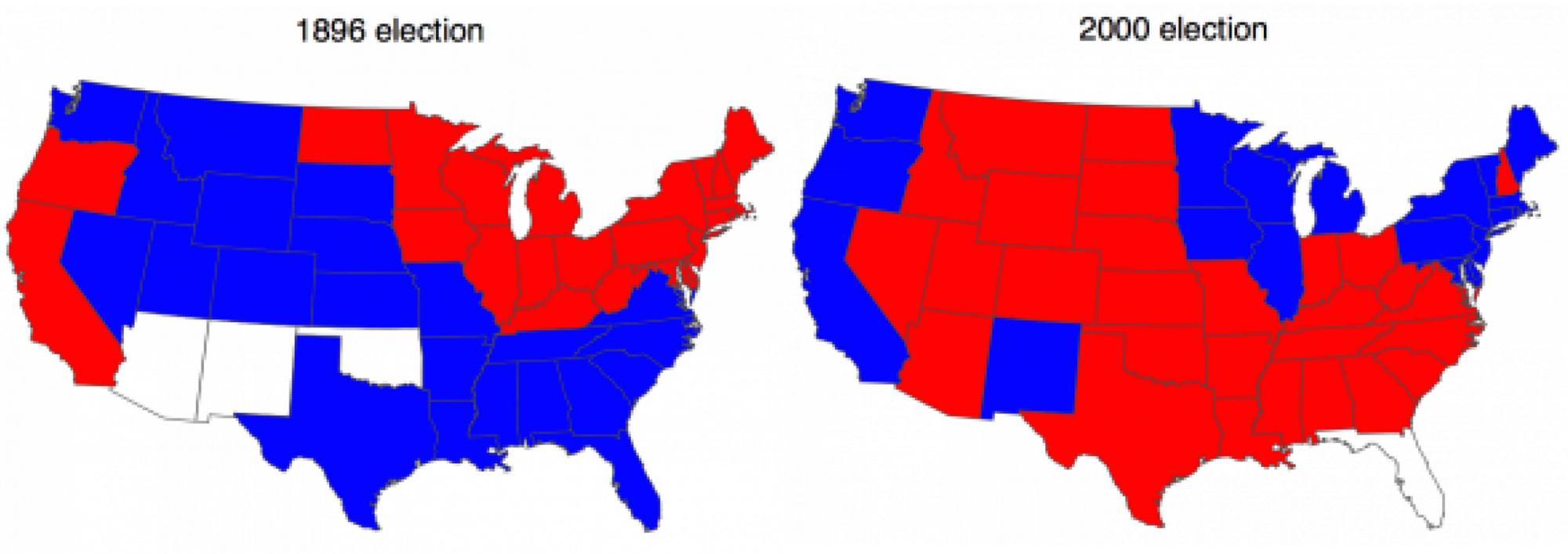
In a new paper (pdf), Andrew Gelman scrutinizes that reversal:

We are used to our current political divides, but in many ways the political alignment of 1896 also makes economic sense, with the richer northeastern states supporting more conservative economic policies. Even in a world in which parties have static positions on issues, there is no obvious way that liberal New Yorkers, say, should vote: should they follow the 1896 pattern and support business-friendly policies that favor local industries, or should they vote as they do now and support higher taxes, which ultimately redistribute money to faraway states with more conservative values? A similar conundrum befalls a conservative Mississippian or Kansan in the other direction.

In that sense, it perhaps is plausible that, although economic issues have been and remain most important in any particular election, social issues can be the determining factor that can, over a century, reverse the electoral map.

Superhero Social Justice, Ctd

btflesmiyaana8m-large

No, nothing to do with Social Justice Warriors; the Dish has covered the subject of diversity in the superhero genre since the summer. The latest: Breaking Bad director Michelle MacLaren is in top contention to direct the upcoming Wonder Woman movie. Jesse David Fox notes that “MacLaren would be the first female director in the recent history of major comic-book movies.” Homeland’s Lesli Linka Glatter and The Babadook‘s Jennifer Kent are also in contention. Sean O’Connell speculates on the challenges a female director could face with the project:

The pressure to deliver on the superhero front is being given as a reason why one female director, Lexi Alexander, says she’d never accept the Wonder Woman gig that’s currently being set up at Warner Bros. Alexander hasn’t been offered the job, even though her name is frequently attached to wish-list features (like one we ran recently) because of the work she did on the gritty, bloodthirsty Punisher: War Zone. But in an interview with Fast Company, she spells out why the pressure to deliver on the first female-driven superhero film would be too much to get her into the director’s chair:

We finally get Wonder Woman with a female director: imagine if it fails? And you have no control over marketing, over budget. So without any control, you carry the fucking weight of gender equality for both characters and women directors. No way.

Not exactly a profile in courage. O’Connell continues:

Who will fanboys blame if Wonder Woman isn’t good? If Lexi Alexander feels this way and willingly shares this concern, is it possible that other qualified contenders like Jane Goldman or Michelle MacLaren share this early concern and don’t want to step off of that ledge? I certainly hope this isn’t the case.

I’d like to believe that there are big enough ideas at play in a possible Wonder Woman movie that any director – male or female – could dial in and turn the material into a hit. Audiences are extremely receptive to superhero films, at the moment, and even “failures” like The Amazing Spider-Man 2 earn north of $700 million at the global box office. Wonder Woman seems destined to succeed, just off the curiosity factor, alone. If the studio goes ahead as planned and makes it a period piece – a la Captain America: The First Avenger – the interest level could even be higher than expected.

At the same time, any director contemplating the solo Wonder Woman movie has to deal with a handful of unknowns at the moment. They haven’t see [lead actress] Gal Gadot in action. They don’t know, fully, how the character will be introduced in Zack Snyder’s Batman v Superman: Dawn of Justice. And they don’t know how the movie landscape will change between now and 2017. But that isn’t about being a female director trying to get a foot in the door of the comic-book genre. That’s about being part of the mysterious process of building a Cinematic Universe… and that comes with it’s own unique forms of pressure.

Linda Holmes comments:

There’s no rule that says that a Wonder Woman movie being about a woman means it has to be directed by a woman. Down that road lies ache; down that road lies “well, then I guess Kathryn Bigelow can’t direct an Aquaman movie, nyah.” The issue is more, for me, that I’ve lost all belief that they’re anywhere close to entrusting a male superhero to a female director, so it’s either this or nothing for the indefinite future.

More Dish on the broader subject here.

What Is Native Advertising?

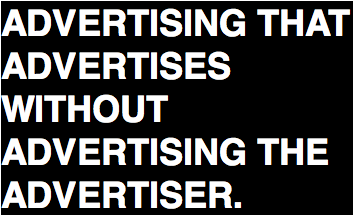
Copyranter, the ad critic too quirky for Buzzfeed, puts it simply enough:

definition

And adds:

Anybody tells you different, politely get up and excuse yourself from the room, walk briskly to the elevator, and then sprint out of their building (unless the person is your boss, then just sit there and nod your head like one of those toy dogs in the back of a car).

One other explanation:

Josh Marshall makes the point that he didn’t set out to specifically execute a content marketing strategy. That push came after looking at the marketplace. It’s about something all good journalists know, what he calls “high information,” even if the ad information is plainly commercial: “Content marketing is something we fit into this concept. Content marketing is part of high information messaging, and high information ad creation.”

If you have any idea what he’s talking about, you’re, well, far more worldly and better informed than I. But it’s winning:

Native Ads

Walking On The Backs Of Poor Stoners

Making good on a base-baiting campaign promise, Wisconsin Governor Scott Walker plans to push forward with a law that would impose stringent drug testing requirements on welfare recipients:

In Wisconsin, an estimated 836,000 people receive FoodShare benefits, about 40 percent of them children, according to the state Department of Health Services. As of last week, 39,958 people had filed weekly unemployment compensation claims, according to the Wisconsin Department of Workforce Development.

Gillespie calls Walker’s crusade morally repellent, but that’s not the half of it:

Walker is supposed to be tight with a penny, right? That’s part of his, er, charm. Yet his sort of drug-testing is not only repellent on ethical grounds, it’s a clear waste of money.

If a recent program in Missouri is any indication, Wisconsin will be collecting urine by the bucketful to catch very few bad actors (and that assumes smoking dope, say, should be a reason to pull somebody’s benefits). Last year, Missouri started testing suspected drug users (note: suspected, meaning there was at least some hypothetical reason to think a person was using drugs). The state ended up spending $500,000 to test 636 people, of which 20 were found to be using. So around 3 percent of suspects tested positive and each test cost around $786. Before courts ruled Florida’s drug-testing regime illegal, the Sunshine State spent $115,000 on piss tests and ended up coughing up $600,000 in reimbursements to applicants who had been denied benefits.

The Dish has previously covered why these drug testing laws are terrible ideas. Alan Pyke reviews further evidence that they have no basis in reality:

While food stamps recipients are a bit more likely to use drugs casually than the general population according to one study, age is a far better predictor of drug use than economic status or public assistance enrollment. And the raw numbers are too low to justify a dragnet policy of testing everyone who applies, according to critics at the American Civil Liberties Union (ACLU) and the Centre for Addiction and Mental Health in Canada. Just 3.6 percent of welfare recipients qualify as having a drug abuse or dependence problem according to 2011 data. About 8 percent of Americans and 9 percent of Wisconsin residents used drugs in the past month, according to the National Survey of Drug Use and Health.

A federal judge struck down Florida’s infamous drug testing law in January on the grounds that it violated the Fourth Amendment. Even Noah Rothman admits that what Walker is proposing is likely unconstitutional:

Unlike Walker’s union reforms, which inspired a similar level of apoplexy in his Democratic opponents, these reforms may be a legitimate violation of constitutional rights. The state Supreme Court vindicated Walker’s collective bargaining reforms, but the conservative reformer may be setting himself up for a rebuke from the courts with his latest move. While states have slightly more freedom to experiment with similar reforms, federal law prohibits drug testing prospective beneficiaries. In September, Walker told the Milwaukee Journal-Sentinel that he welcomes a fight with the federal government over his proposed reforms. “We believe that there will potentially be a fight with the federal government and in court,” Walker said.

Why would Scott Walker want to set up a fight with the courts and the federal government? The answer seems clear. These reforms are rather popular with base Republican voters, and the institutions which would oppose Walker’s reform are not. This is a pretty clear indication that Walker is interested in translating his successes in Wisconsin into the Republican presidential nomination.

Stirring The Pot

Justin Jones profiles pseudonymous edibles expert “Jeff the 420 Chef”:

Jeff, who began his foray into pot gastronomy as a hobby, is rapidly turning it into a full-time pot-repreneurial business. He’s been traveling from coast to coast since early 2013 catering to celebrities (he won’t say who) and the upper echelons with a penchant for delectable edibles. His cannabis-infused menus range from truffle tuna casserole and coconut chicken to French toast and omelets. Every meal is included, including desserts and yes, even wedding cakes. The possibilities of the types of cuisine that can be made are endless once you turn pot into butter (or oil) to cook with. …

I had one, small bite of a chocolate cupcake, and was on my ass in an hour. The presence of marijuana was almost unrecognizable. Had I never had an edible before, I wouldn’t have known it was baked with THC. Jeff had warned me that it was a strong batch—and I’m already a lightweight—so when it hit, I could only stay vertical for a short time before I had to call it a night.

Would I eat it again? Hell yes. The taste was that good.