Getting To The Head Of The Class

Carl Chancellor and Richard D. Kahlenberg argue that when it comes to education, economic segregation is worse than racial segregation:

African American children benefited from desegregation, researchers found, not because there was a benefit associated with being in classrooms with white students per se, but because white students, on average, came from more economically and educationally advantaged backgrounds. All-black schools that included the sons and daughters of doctors and lawyers and teachers alongside the offspring of less-advantaged parents often provided excellent educational environments because the economic, not racial, mix drives academic strength.

The solution, they say, is school choice:

School officials today emphasize public school choice – magnet schools and charter schools – to accomplish integration, having long rejected the idea of compulsory busing that gave families no say in the matter. In Hartford, Connecticut, for example, magnet schools with special themes or pedagogical approaches often have long waiting lists of white middle-class suburban families who are seeking a strong, integrated environment.

While many charter schools further segregate students, some are consciously seeking to bring students of different economic and racial groups together. The Denver School of Science and Technology, for example, uses a lottery weighted by income or geography to ensure a healthy economic mix in its seven middle schools and high schools. …

Today, more than eighty school districts, from Cambridge, Massachusetts, to Raleigh, North Carolina, to Champaign, Illinois, promote socioeconomic integration, almost always relying on choice. These districts educate more than four million students nationally.

But as Sara Neufeld notes, charter schools around the country are struggling with a separate problem – teacher turnover:

Since the “no excuses” movement began in the mid-1990s, its schools developed a reputation for attracting teachers who are young, idealistic and often white, available to families around the clock until they leave after a few years. Sometimes they’re ready to have children of their own or move on to more lucrative career prospects; other times they’re just tired. The phenomenon has been blasted for depriving students of stable adult relationships and creating mistrust in minority neighborhoods when white teachers serving black and Hispanic students come and go. So now the focus is sustainability.

The Best Of The Dish Today

Happy reunited 25th, Berlin:

A reader comments on our WAM/Twitter coverage:

I should clarify that I have disagreed with you many, many times before, but I have still enjoyed your writing and thinking on whatever issue. However, on this topic, I’ve found your approach very disheartening. Especially as you have frequently acknowledged your “outsider” status in this topic (video game culture, Twitter discourse between men and women, women in formerly “male” spaces, the objectification of women, etc.), I’ve found it disappointing that you wouldn’t attempt at least some more empathy and observation before jumping into the middle of the fray. I think this is a very important cultural discussion happening right now, and I feel you’re not treating it with the nuance and respect it deserves. I appreciate the reply, and thank you for all of your great writing and advocacy for many great causes over the years.

I never expect readers to agree or even sympathize with what I have to say, which is why almost everyone who comes up to me on the street begins any words of praise with “I don’t agree with everything you have to say, but …” It’s also why the Dish has been publishing lots of reader input and other voices challenging me – edited and curated by my colleagues. For example, there’s the long tough dissent posted today. Another from a woman on my gamergate blogging can be found here. Many more smart readers here, herehere. Our airing of other bloggers’ views different from mine can be found hereherehere and here. Much of it is extremely nuanced, and it’s the overall mix you should judge the Dish on – not my peculiar emphases or blind spots.

Still, I’m not budging from my basic position: first against harassment, threats, and stalking, but secondly also against the attempt to police the discourse in the name of social justice. Sticks and stones and all that …

Some light relief: I’m loving the thread on literary hangovers; and this parody of the Hollaback video is a hoot. Two heavy hitters: my dissent against a war we cannot win in a place we need to leave; and the growing threat of an increasingly reckless Putin.

The two most popular posts of the day were both about Twitter’s recourse to a “gender justice” group to nominate tweeters for suspension.

Many of today’s posts were updated with your emails – read them all here.  You can always leave your unfiltered comments at our Facebook page and @sullydish. 22 more readers became subscribers today. You can join them here – and get access to all the readons and Deep Dish – for a little as $1.99 month. Gift subscriptions are available here. Dish t-shirts are for sale here, including the new “Know Dope” shirts, which are detailed here.

See you in the morning.

What Washington Refuses To Admit

[Re-posted from earlier today]

Let me put this as baldly as I can. The US fought two long, brutal wars in its response to the atrocity of September 11, 2001. We lost both of them – revealing the biggest military machine in the history of the planet as essentially useless in advancing American objectives through war and occupation. Attempts to quash Islamist extremism through democracy were complete failures. The Taliban still has enormous sway in Afghanistan and the only way to prevent the entire Potemkin democracy from imploding is a permanent US troop presence. In Iraq, we are now confronting the very same Sunni insurgency the invasion created in 2003 – just even more murderous. The Jihadism there has only become more extreme under a democratic veneer. And in all this, the U.S. didn’t just lose the wars; it lost the moral high-ground as well. The president himself unleashed brutal torture across all theaters of war – effectively ending any moral authority the US has in international human rights.
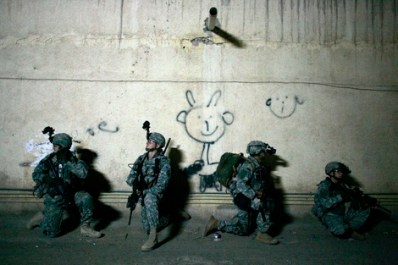
These are difficult truths to handle. They reveal that so many brave men and women died for nothing. And so we have to construct myths or bury facts to ensure that we maintain face. But these myths and amnesia have a consequence: they only serve to encourage Washington to make exactly the same mistakes again. To protect its own self-regard, Washington’s elite is prepared to send young Americans to fight in a war they cannot win and indeed have already lost. You see the blinding myopia elsewhere: Washington’s refusal to release the Senate Intelligence Committee’s report on torture merely proves that it cannot face the fact that some of the elite are war criminals tout simple, and that these horrific war crimes have changed America’s role in the world.

What infuriated me about the decision to re-start the Iraq War last August – by a president explicitly elected not to do any such thing – was its arrogance, its smugness, and its contempt for what this country, and especially its armed forces, went through for so many long years of quagmire and failure. Obama and his aides revealed that their commitment to realism and not to intervene in Syria could be up-ended on a dime – and a war initiated without any debate in Congress, let alone a war authorization. They actually believed they had the right to re-start the Iraq War – glibly tell us it’s no big deal – tell us about it afterwards, and then ramp up the numbers of combat forces on the ground to early Vietnam levels.

This is not just a Republican fixation. It’s a function of the hegemony reflexively sought by liberal internationalists as well. Just listen to Jon Stewart calling Samantha Power’s smug bluff last night:


It was one of Stewart’s best interviews in a long while. One telling moment comes when Stewart asks Power why, if the threat from ISIS is “existential”, the regional powers most threatened by it cannot take it on themselves. She had no answer – because there is none. The US is intervening – despite clear evidence that it can do no real good – simply to make sure that ISIS doesn’t actually take over the country and thereby make president Obama look bad. But the IS was never likely to take over Kurdistan or the Shiite areas of Iraq, without an almighty struggle. And our elevating ISIS into a global brand has only intensified its recruitment and appeal. We responded, in other words, in the worst way possible and for the worst reasons possible: without the force to alter the underlying dynamic, without a breakthrough in multi-sectarian governance in Baghdad, without the regional powers taking the lead, without any exit plan, and all to protect the president from being blamed for “losing Iraq” – even though “Iraq” was lost almost as soon as it was occupied in 2003.

My point is this: how can you behave this way after what so many service-members endured for so long? How can you simply re-start a war you were elected to end and for which you have no feasible means to achieve victory?

The reason, I fear, is that the leadership in both parties cannot help themselves when they have a big shiny military and see something they don’t like happening in the world. If they can actually decide to intervene in a civil war to suppress an insurgency they couldn’t fully defeat even with 100,000 troops in the country, without any direct threat to national security, they can do anything. Worse, our political culture asks no more of them. The Congress doesn’t want to take a stand, the public just wants beheadings-induced panic satiated by a pliant president (who is then blamed anyway), and the voices that need to be heard – the voices of those who fought and lost so much in Iraq – are largely absent.

That’s why I found this op-ed in yesterday’s NYT so refreshing. A former lieutenant general in Iraq reminds us of the facts McCain and Obama both want to deny:

The surge in Iraq did not “win” anything. It bought time. It allowed us to kill some more bad guys and feel better about ourselves. But in the end, shackled to a corrupt, sectarian government in Baghdad and hobbled by our fellow Americans’ unwillingness to commit to a fight lasting decades, the surge just forestalled today’s stalemate. Like a handful of aspirin gobbled by a fevered patient, the surge cooled the symptoms. But the underlying disease didn’t go away. The remnants of Al Qaeda in Iraq and the Sunni insurgents we battled for more than eight years simply re-emerged this year as the Islamic State, also known as ISIS.

To go back in and try to do again with no combat troops what we could not do with 100,000 is a definition of madness brought on by pride. It is to restart the entire war all over again. It makes no sense – except as political cover. I was chatting recently with an officer who served two tours of duty in Iraq, based in Mosul. I asked him how he felt about ISIS taking over a city he had risked his life to save. And I can’t forget his response (I paraphrase): “Anyone who was over there knew right then that as soon as we left, all this shit would happen again. I’m not surprised. The grunts on the ground knew this, and saw this, but the military leadership can’t admit their own failure and the troops cannot speak out because it’s seen as an insult to those who died. And so we keep making the same fucking mistakes over and over again.”

At what point will we listen to those men and women willing to tell the ugly, painful truth about our recent past – and follow the logical conclusion? When will Washington actually admit its catastrophic errors and crimes of the last decade – and try to reform its own compulsive-interventionist habits to reflect reality rather than myth? Not yet, it appears, not yet. Washington cannot bear very much reality.

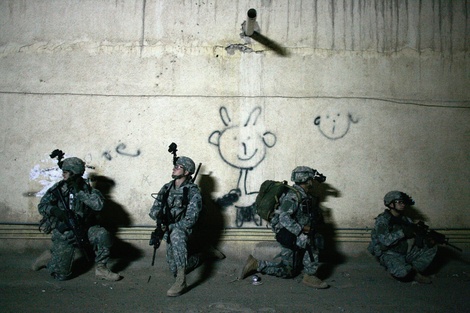
(Photo: U.S. Army soldiers of the D-CO 2/325 AIR 82nd Airborne Division during a dismounted movement to conduct early morning raids on homes in Baghdad, Iraq on April 26, 2007. The soldiers are part of the United States military surge as they try to help control the violence plagued city. By Joe Raedle/Getty Images.)

Is John Oliver A Journalist? Ctd

It seems quite obvious to me that he is: an entertaining journalist. Matt Zoller Seitz nods vigorously:

Last Week is doing what media watchdogs (including the Peabody Awards) keep saying that The Daily Show does — practicing real journalism in comedy form — but it’s doing it better, and in a simpler, yet more ambitious, ultimately more useful way. If Stewart’s show is doing what might be called a reported feature, augmenting opinions with facts, Oliver’s show is doing something closer to pure reporting, or what the era of web journalism calls an “explainer,” often without a hook, or the barest wisp of a hook. …

If Oliver’s show hadn’t come along, it seems possible that The Daily Show and its time-slot partner (come January, it’ll be former Daily Show correspondent Larry Wilmore’s The Minority Report) would have become televisual furniture, another thing that’s just mysteriously Still On, and that the habituated audience keeps watching without ever feeling dissatisfied.

Oliver’s show threw a wrench into that possible outcome by taking core bits that once were the sole province of The Daily Show (the punny/smart-assed headlines, the “gotcha” deconstructions of political chicanery, the “Does this person I am interviewing know I am putting them on?” segments, the occasionally surreal imagery) and putting them at the service of education. I’ve watched every installment of Last Week since its debut. Every time, I’ve come away feeling that I’ve truly learned something. In an increasingly degraded journalistic landscape, that’s an astonishing achievement.

Recent Dish on the show here and here.

Yglesias Award Nominee

“Joe Biden is what you see. You know, he’s genuine. Yes, he’s prone to gaffes publicly, and he’ll admit that. He’s very self-deprecating like that. And I’m certainly not one who agrees with Joe Biden on all things—we probably disagree more than we agree—but from a human and relationship standpoint, the guy’s awesome,” – Eric Cantor.

Yes, he probably had to lose his seat before he could say that, but still …

Senseless Style, Ctd

A reader shakes his head at Nathan Heller’s harsh appraisal of Steven Pinker’s The Sense of Style :

Heller seems entrapped in conventional but uninformed assumptions about language that don’t really endure being questioned well. Language is not a fixed, absolute thing.  In a way, language is the ultimate free-market commodity.  It changes in accordance with the whims and interests of its speakers, heeding no regulation. (Just observe the futile efforts of L’Académie française to tell the French how to speak French.) School-taught standard languages and rules such as those that Professor Pinker takes issue with try to freeze a language at an arbitrary point in time, or even a mishmash of several arbitrary points, that has no practical reason to be taken as authority. English went from “Oþlice on þam dagum wæs geworden gebod fram þam casere Augusto,” to “And it came to passe in those dayes, that there went out a decree from Cesar Augustus,” in about 500 years. Even that later translation looks a little funny to a modern reader, and it the gulf would seem greater if we heard if spoken using early-17th-century pronunciation.

Another takes issue with Robert Lane Greene’s criticism of Heller:

It doesn’t follow from simply saying “logic” and “consistency” mean different things to different to people that therefore there is no correct meaning of “logic” or “consistency” independent of anyone’s feelings about it.  To admit a pluralist logic is to forfeit the ability to make any arguments for or against anything that rise above sheer expression of will.

Another reader snarks on a related post about writing style:

Ben Myers may be “laboring to achieve good short sentences,” but with sentences like this, he’s got plenty left to do:

At any rate, whatever the source of this malaise, the symptoms are evident in the tendency of students to obfuscate simple ideas through a complexification of syntax, a multiplication of imprecise verbs instead of the selection of the one strong verb, and a deliberate substitution of polysyllabic words whose meanings are often vague and slippery for smaller ones whose meanings are plain and solid.

A more cynical reader:

Mr. Myers advocates simplicity and clarity in writing without demonstrating any of these qualities in his own prose, which he duly acknowledges in his self-effacing close. That said, may I suggest that simplicity, clarity, and explanation in writing mean very little without simplicity, clarity, and understanding in thought?

Most education today is driven by a market mentality. Why wouldn’t teachers want to help students learn to “obfuscate simple ideas through a complexication of syntax,” when that’s exactly what will gain one access to any of the white-collar professions? The entrance to the door of the legal, medical, political, financial, and scholastic professions could easily read: “Enter those who have mastered the implementation of  a multiplication of imprecise verbs instead of the selection of the one strong verb, and a deliberate substitution of polysyllabic words whose meanings are often vague and slippery for smaller ones whose meanings are plain and solid.”  It seems Mr. Meyers is unaware of his own egalitarian impulses, as he speaks of students class-based shame, but has not reached the clarity in his on mind before putting pen to paper.

Cheap Gas Is Costing The Planet

Fossil fuel subsidies continue to rise:

In 2009, G20 leaders agreed to phase out fossil fuel subsidies by 2020. But it’s clear that most countries are going in the opposite direction, especially the U.S. The government provided $2.6 billion in subsidies for exploration in 2009, which nearly doubled to $5.1 billion by 2013, thanks to a boom in domestic oil and gas production. That means American drilling and investment tax breaks outrank subsidies in Australia, Russia, and Chinacountries not generally known for their aggressiveness on climate change. And yet, President Barack Obama has adopted climate change as a part of his agenda and hopes to convince the rest of the world to do the same.

In fact, according to the International Energy Agency’s World Energy Outlook, released today, governments worldwide spend a mind-boggling $550 billion on fossil fuel subsidies each year. As Chris Mooney notes, that’s four times the amount of subsidies directed toward renewables:

[That] partly explains why despite an overall greening of world energy patterns in the next 25 years, the IEA says we are going to miss climate goals and end up with quite a lot of warming (barring a very significant course correction). The agency cites “the failure to transform the energy system quickly enough to stem the rise in energy-related CO2 emissions (which grow by one-fifth to 2040) and put the world on a path consistent with a long-term global temperature increase of 2°C.” (It was not immediately clear how much the just announced U.S.-China deal to jointly reduce greenhouse gas emissions changes this picture.)

We have some 1000 gigatonnes of carbon left to emit to the atmosphere before locking in a dangerous amount of warming above 2 degrees, and on the current course we’ll use it all up by 2040, says the IEA. In order to stop that, we’ll need four times the current investment in renewable energy — an increase up to $ 1.5 trillion annually around the world

David Roberts shakes his head:

It’s a little crazy. As the Carbon Tracker Initiative has shown in some detail, if the world is to have a chance of limiting temperature rise to 2C, 60 to 80 percent of current fossil fuel reserves have to stay in the ground. That means companies and countries with fossil fuel assets face an enormous potential devaluation, a “carbon bubble.” Exploration for new fossil fuels at this point is just stockpiling stranded assets, at great cost, with money that could far more profitably be spent accelerating the energy transition. Or maybe, as this kind of insane-but-routine set of facts demonstrates, the world won’t get serious about climate change. Then stranded assets could be the least of our problems.

The First Spacecraft Has Landed On A Comet

And naturally, it’s already tweeting:

Gautam Naik details the exciting news:

Rocket scientists at the European Space Agency’s mission control here erupted in cheers as they received the first signal that the Rosetta mission’s probe, called Philae, had touched down more than 300 million miles away on the forbidding landscape of a small comet known as 67P/Churyumov-Gerasimenko. There were even more cheers, hugs and handshakes when it became clear that it had done so safely.

The landing follows a decade long trek through the solar system to get the up-close-and-personal visit with a comet for a lengthy period of time as it hurtles closer to the sun. “We made history today,” said Matt Taylor, project scientist for the Rosetta mission, who sported a pair of shorts revealing a tattoo on his thigh depicting a successful Philae landing. “I can’t see anyone doing this again anytime soon.”

But Victoria Bryan and Maria Sheahan have some sobering details:

[A]n anchoring system problem may hamper planned investigations into the origins of Earth and the solar system. The 100-kilogram (220-pound) lander – virtually weightless on the comet’s surface – touched down on schedule at about 11 a.m. ET after a seven-hour descent from its orbiting mothership Rosetta, now located a half-billion kilometers (300 million miles) from Earth. But during the free-fall to the comet’s surface, harpoons designed to anchor the probe, named Philae, failed to deploy. Flight directors are considering options to ensure the lander does not drift back into space.

Meanwhile, Dave Gilbert describes the probe:

Built by a European consortium, led by the German Aerospace Research Institute (DLR), the landing probe has nine experiments. According to details on ESA’s Rosetta website, sensors on the lander will measure the density and thermal properties of the surface, gas analyzers will help to detect and identify any complex organic chemicals that might be present, while other tests will measure the magnetic field and interaction between the comet and solar wind. Philae also carries a drill that can drive 20 centimeters (8 inches) into the comet and deliver material to its on-board ovens for testing.

Joseph Stromberg voxsplains the landing’s potential significance:

[T]he comet is believed to have formed 4.6 billion years ago, from material leftover as Earth and the solar system’s other planets were coalescing. As a result, understanding the composition of comets could help us better model the formation of the solar system. Moreover, many scientists believe that in the period afterward, when the solar system was still a chaotic, collision-filled system, comets and asteroids were responsible for bringing water and perhaps even organic molecules to Earth. If water ice is present on this comet, as scientists hope, Philae will calculate the ratio of different sorts of hydrogen isotopes present in it — information that could provide an important clue as to whether the hypothesis is correct.

In other words, data collected by a tiny robot on this lopsided, spinning comet, millions of miles away, could provide a window into the history of all life on earth.

Rachel Feltman and Terrence McCoy discuss the mission’s circuitous journey to the comet:

It’s no easy thing to land on a comet’s surface: These chunks of rock and ice are constantly spinning, and Comet  67P/Churyumov-Gerasimenko, which was discovered in 1969, orbits the sun at a speed of about 85,000 mph. It’s irregularly shaped — like a toddler’s play-dough impression of a duck, or something — and its surface is uneven and pitted. And in a universe of unimaginable proportion, Rosetta’s target is just 2.5 miles in diameter — smaller than Northwest Washington’s Columbia Heights neighborhood.

So Rosetta has taken an onerous journey to get in sync with the comet’s orbit, which would allow it to drop down a lander. In 2004, the spacecraft began what would be three looping orbits around the sun, altering its trajectory as it skimmed Mars, just 150 miles from the surface, and enduring 24 minutes in the planet’s shadow to align with Churyumov-Gerasimenko. The cumulative distance traveled by the craft – with all its looping and gravity assists – is a stunning 4 billion miles. “When the Rosetta signal reappeared after the passage behind Mars, shortly after the end of the ‘shadow’ period, there was a collective sigh of relief,” ESA said. At one point in 2011, the spacecraft even had to hibernate for nearly three years. It flew so far from the sun — nearly 500 million miles — that its solar panels couldn’t leech enough energy to keep the spacecraft operational. But in January of this year, Rosetta woke up, and quickly approached its target.

Meanwhile, Victoria Turk perks up her ears:

We recently found out what [the comet] smells like: space farts. And now we know that it’s “singing” this percussive little ditty as it goes. As one commenter put it, it kind of sounds like a dolphin. ESA announced the observation on its Rosetta blog, and explained that the “music” is produced “in the form of oscillations in the magnetic field in the comet’s environment” picked up by the mission’s magnetometer experiment from a distance of around 100 kilometers.

Scientists were delighted by the discovery:

“This is exciting because it is completely new to us. We did not expect this and we are still working to understand the physics of what is happening,” Karl-Heinz Glaßmeier, head of Space Physics and Space Sensorics at the Technische Universität Braunschweig, Germany, explained on the RESA Rosetta blog. The “song” – as the scientists themselves refer to it – was in fact outside the normal range of human hearing range and has to be boosted in volume by a factor of 10,000. According to scientific theory, the comet releases neutral particles into space where they collide with high-energy particles and that’s what makes the sound. However, “the precise physical mechanism behind the oscillations remains a mystery,” according to the blog.