A Poem For Sunday

9779177515_7e45834603_b

“Saint Francis and the Sow” by Galway Kinnell (1927-2014):

The bud
stands for all things,
even for those things that don’t flower,
for everything flowers, from within, of self-blessing;
though sometimes it is necessary
to reteach a thing its loveliness,
to put a hand on its brow
of the flower
and retell it in words and in touch
it is lovely
until it flowers again from within, of self-blessing;
as Saint Francis
put his hand on the creased forehead
of the sow, and told her in words and in touch
blessings of earth on the sow, and the sow
began remembering all down her thick length,
from the earthen snout all the way
through the fodder and slops to the spiritual curl of the tail,
from the hard spininess spiked out from the spine
down through the great broken heart
to the sheer blue milken dreaminess spurting and shuddering
from the fourteen teats into the fourteen mouths sucking and blowing
beneath them:
the long, perfect loveliness of sow.

(From A New Selected Poems © 2000 by Galway Kinnell. Used by permission of Houghton Mifflin Harcourt. Photo by Sonny Abesamis)

Don’t Fear The Reaper

Caitlin Doughty (of “Ask A Mortician” fame) explains why she believes Americans live in a “‘death denial’ culture”:

[W]e’re not engaging with death as a very natural part of life. We’re not treating it like it’s a very obvious endpoint to all of our activities. We’re trying to act like it’s not in many ways, and even more than that, we’re trying to act like the dead body doesn’t exist in culture. We just don’t see it. It’s hidden.

I think there’s a couple reasons why that happened. In the 1930s, there was a rise in both the medical industry and the funeral industry. Both of those industries said, “Hey, we’re the professionals. You shouldn’t die at home and you shouldn’t have the dead body at home. We’re equipped to do both of these things better than you would do yourself.” And the public, because there were growing cities and growing industrialization in all areas, really went along with it. So, we’re at the point now where we completely question whether we’re even able to die at home or have the body at home and take care of it ourselves. We rely on medical and funeral professionals as professionals.

Doughty also makes the unpopular claim that “death [is] a good thing”:

Death might appear to destroy the meaning in our lives, but in fact it is the very source of our creativity. As Kafka said, “The meaning of life is that it ends.” Death is the engine that keeps us running, giving us the motivation to achieve, learn, love, and create. Philosophers have proclaimed this for thousands of years just as vehemently as we insist upon ignoring it generation after generation. Isaac was getting his PhD, exploring the boundaries of science, making music because of the inspiration death provided. If he lived forever, chances are he would be rendered boring, listless, and unmotivated, robbed of life’s richness by dull routine. The great achievements of humanity were born out of the deadlines imposed by death.

Previous Dish on Doughty here and here.

Just How Reliable Is The New Testament?

Sinaiticus_text

According to Craig L. Blomberg’s Can We Still Believe the Bible?: An Evangelical Engagement with Contemporary Questions, perhaps more than you think. Reviewing the book, Louis Markos highlights areas where Blomberg pushes back against well-known critics of the Bible’s reliability, such as Bart Ehrman, arguing its trustworthiness “does not depend on its living up to logical positivist standards that would have meant nothing to Moses, David, Luke, or Paul”:

In chapter one, Blomberg puts Ehrman’s claim (from Misquoting Jesus) that “there are four hundred thousand textual variants among the ancient New Testament manuscripts” in the proper context. As he demonstrates, there are only two lengthy passages in the entire New Testament (the extended ending to Mark’s Gospel; the woman caught in adultery in John 8) that are sharply contested, and that do not appear in the oldest and best manuscripts. Neither of these passages contains vital theological or historical points that do not appear elsewhere in the Bible, and in all modern translations they are clearly marked as being questionable.

As for Ehrman’s 400,000 variants, Blomberg explains, they are “spread across more than 25,000 manuscripts in Greek or other ancient languages. … This is an average of only 16 variants per manuscript”. And of those variants, only “about a tenth of 1 percent . . . are interesting enough to make their way into footnotes in most English translations”. And the ones that do make it there offer no challenge to the authority of scripture on matters of faith and practice. “It cannot be emphasized strongly enough,” Blomberg concludes, “that no orthodox doctrine or ethical practice of Christianity depends solely on any disputed wording. There are always undisputed passages one can consult that teach the same truths”.

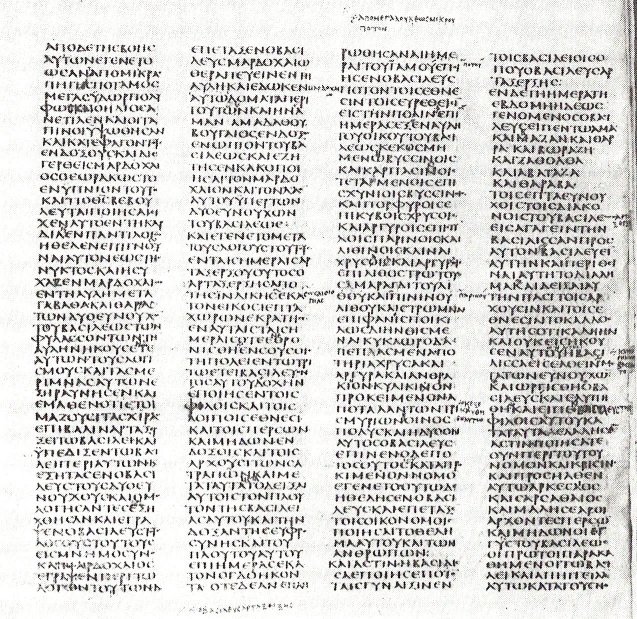
(An image of the Codex Sinaiticus, circa 350 A.D., containing the oldest complete copy of the New Testament, as well as most of the Greek Old Testament, known as the Septuagint, via Wikimedia Commons)

Peak Islamism?

Screen Shot 2014-10-30 at 3.16.29 PM

Looking over Arab Barometer data from the past decade, Michael Robbins and Mark Tessler find that throughout the Arab world, “support for democracy remains high but support for political Islam has decreased” while “Islamic democrats – those who support both democracy and political Islam – are becoming scarcer across the region”:

Arab publics continue overwhelmingly to support democracy. In all but one country surveyed, three-quarters or more of respondents in the third wave of surveys (late 2012-2014) agree or strongly agree with the statement “A democratic system may have problems, yet it is better than other political systems.” …

Support for political Islam is substantially lower. In no country do more than half of respondents say religious leaders should have influence over government decisions.

It is often far less support, including just 34 percent in Algeria, 27 percent in Tunisia, 20 percent in Egypt and 9 percent in Lebanon. Moreover, support for political Islam declined over the past decade. Algeria has witnessed the most dramatic decline, with support for political Islam falling from 60 percent in 2006 to just 34 percent in 2013. A similar decline has occurred in Egypt, where 37 percent supported political Islam in June 2011 compared to 18 percent in April 2013, a 19-point decrease. Most other countries witnessed a similar decline, including Palestine (-15 points), Iraq (-11), Lebanon (-9) and Yemen (-7).

In Saudi Arabia, Caryle Murphy profiles the “post-Islamist generation” of young people who are fed up with religious politics:

Young Saudis “are looking for individual freedom and rights, not for religion,” said Mohammed al-Abdulkareem, an assistant professor of Islamic jurisprudence at Al-Imam Muhammad Ibn Saud Islamic University, a conservative religious university in Riyadh. This “big change” began after the Arab revolutions, he said. “It’s clear to me that from the Arab Spring, people discovered the ideas of human rights and individual freedom and that these ideas were more effective and more successful to get a change in their governments,” he said. “Why would you expect that people would return to religious trends when … these trends and religious institutions didn’t pay attention to human rights and the freedom of the people?” …

The trend is encapsulated in a 27-year-old Saudi woman I met in Riyadh. Raised in a traditionally religious family, she wears the Islamic headscarf and is religiously devout — but she dislikes how her government has used her faith for its own ends. “Islam came to free people. Islam didn’t come to put them in jail,” she said. “And the government uses it to put people in jail and under their control. So they control us by Islam…. That makes a lot of people not even want Islam.”

The Exploring Never Ends

Reviewing Matthew Lee Anderson’s The End of Our Exploring: A Book about Questioning and the Confidence of Faith, Timothy King criticizes his understanding of doubt’s place in the Christian life, asserting that faith “is grown not by the removal of doubt but by acting in its presence”:

If we do not experience a deep sense of uncertainty as to how the question we are asking may or may not be answered, then we are not, I would argue, in full exploration of the question. Anderson argues that our questions should occur “within the borders of faith” and that when we question “we do not weigh Christianity in the balances.” These sorts of presuppositions can not only make the questions we ask anemic, they also leave us open to the great danger of assuming that what we believe today as a “border of faith” should actually be a “border of faith.” A growing faith quite likely means that what we think it means to “weigh Christianity in the balances” at one point in our life, will not mean the same thing later. And that’s a good thing.

Anderson and I would agree that good questions have a role in the growth of our faith throughout the life of a believer. We always live with the knowledge that we might one day discover that a belief we have held is wrong, insufficient, or able to be improved upon. But Anderson believes this ongoing pursuit of better questions and answers can continue without doubt. I disagree. Without truly doubting and opening yourself to the possibility that even many of your most deeply held tenets of faith could be wrong or inadequate, questioning will remain a mental exercise that does not reach its potential for personal transformation. Doubt, I would argue, is that state of change that allows for the questions to continue and faith to grow. And as the husks of beliefs that were wrong, too small, or in other ways insufficient fall aside, they join in the process of fertilizing a more perfect faith through their own decomposition.

Quote For The Day II

“To those who know a little of Christian history probably the most moving of all the reflections it brings is not the thought of the great events and the well-remembered saints, but of those innumerable millions of entirely obscure faithful men and women, every one with his or her own individual hopes and fears and joys and sorrows and loves — and sins and temptations and prayers — once every whit as vivid and alive as mine are now. They have left no slightest trace in this world, not even a name, but have passed to God utterly forgotten by men. Yet each one of them once believed and prayed as I believe and pray, and found it hard and grew slack and sinned and repented and fell again. Each of them worshipped at the eucharist, and found their thoughts wandering and tried again, and felt heavy and unresponsive and yet knew — just as really and pathetically as I do these things. There is a little ill-spelled ill-carved rustic epitaph of the fourth century from Asia Minor: — ‘Here sleeps the blessed Chione, who has found Jerusalem for she prayed much’. Not another word is known of Chione, some peasant woman who lived in that vanished world of christian Anatolia. But how lovely if all that should survive after sixteen centuries were that one had prayed much, so that the neighbours who saw all one’s life were sure one must have found Jerusalem! What did the Sunday eucharist in her village church every week for a life-time mean to the blessed Chione — and to the millions like her then, and every year since then? The sheer stupendous quantity of the love of God which this ever-repeated action has drawn from the obscure Christian multitudes through the centuries is in itself an overwhelming thought,” – Dom Gregory Dix, The Shape of the Liturgy.

(Hat tip: Wesley Hill)

Face Of The Day

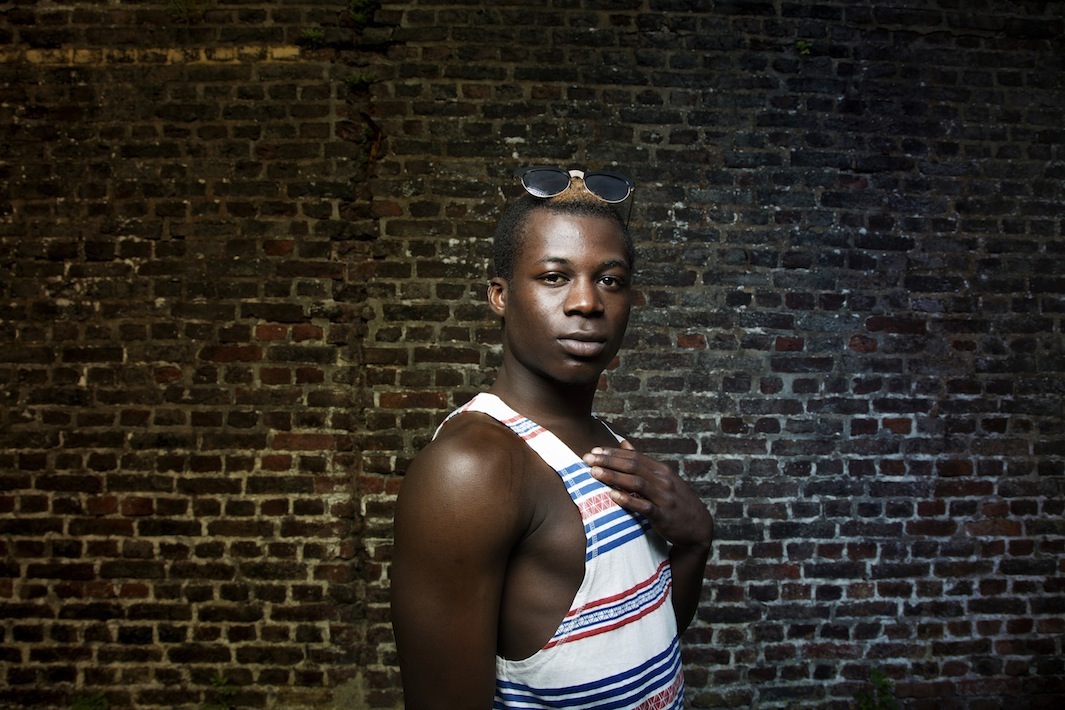
Leroy, Brussels, Belgium, 2013.

American photographer M. Sharkey captured images of young gay Belgians, including Leroy, above, for his 2013 series “Brussels Is Burning.” According to Jordan G. Teicher:

[Sharkey] found a “totally different youth culture” where queer youths were “not as open about their sexuality at such a young age as Americans are.” “Western Europe is an incredibly modern and connected culture, but the young people—the 14-, 15-, 16-year-old kids—still don’t have a community the way that American kids have,” he said.

See more of Sharkey’s work here, or catch his exhibit “Queer Kids” at the Stonewall National Museum and Archives through January 4.

Worshipping With Warhol

Mark Judge reminds us that the artist was a serious Catholic:

Andy Warhol’s family was Byzantine-Ruthenian, and in the early 20th century they came to America, settling in a Catholic section of Pittsburgh. Warhol’s mother Julia was deeply pious, attending St. John Chrysostom Byzantine Catholic Church. She took her children to Mass, and encouraged Andy, who was sick a lot as a child, to learn how to draw. Warhol drew pictures, went to church, and cut out magazine pictures of movie stars. In those three elements we find his entire life’s work.

Warhol moved to New York in 1949. He then went on to become the most famous artists of the latter 20th century. Warhol is associated with irony, disco, Pop Art paintings of everyday objects like Campbell’s soup cans, and cool. But he never lost the faith. Even during his high-flying Studio-54 days, Warhol would appear at Mass at St. Vincent Ferrer several mornings a week — and as a volunteer at soup kitchens. When his mother moved to New York to live with him, Warhol would warn visiting guests not to curse. Warhol also paid for his nephew to go through seminary and become a priest.

A good, if rare, overview of Warhol’s faith is Jane Daggett Dillenberger’s book The Religious Art of Andy Warhol. There is an entire section dedicated to the over one hundred drawings Warhol made of the Last Supper. When Warhol died in 1987, his eulogist John Richardson said that there were “two Andy Warhols” — the whimsical Pop Art celebrity and the shy and pious Christian.

Previous Dish on the subject here.

(Video: Warhol biographer Bob Colacello discusses the reissue of his Factory memoir, Holy Terror: Andy Warhol Close Up)

The Force Is With Them

In the UK’s 2001 Census, 390,127 people, or just under 1% of the population, identified their religion as “Jedi” – though it’s fair to assume not everyone who replied that way was serious. Tom de Castella updates us on the trend, claiming that what began “as an intellectual exercise by fans adding to the movies and filling in the gaps, has become an attempt to build a coherent religious code”:

Beth Singler, a researcher in the Divinity Faculty of Cambridge University, estimates that there are about 2,000 people in the UK who are “very genuine” about being Jedi. That’s roughly the same number as the Church of Scientology, she says. Jediism is not a joke for them but an inspiration. They don’t believe in “A long time ago in a galaxy far, far away…”, says Singler quoting the opening text that fills the screen of Star Wars. “It’s somewhere between metaphor and literal truth.”

“Feel the force” has become a rather tired cliche. But behind it is a New Age mysticism similar to many of the “holistic” ideas that emerged in the 1960s and 70s. “The Force is what gives a Jedi his power,” says Obi-Wan Kenobi, played by Alec Guinness, who initiates young men into Jedi tradition. “It’s an energy field created by all living things. It surrounds us and penetrates us. It binds the galaxy together.”

The Jedi belief system is a patchwork quilt of Taoism, Buddhism, Catholicism and Samurai, says Singler. Often the ideas offer a simple dualism of good and evil, light and dark. “Fear is the path to the dark side,” Yoda tells Anakin Skywalker. “Fear leads to anger. Anger leads to hate. Hate leads to suffering. I sense much fear in you.”