Stalling For Time

Stacey D’Erasmo waxes nostalgic for the days before the Internet ushered in a sort of “virtual eternity”:

I feel weird—sometimes giddy, sometimes nauseous—about time these days. Like many people, I stood in line for hours to become immersed in Christian Marclay’s 2010 art installation, “The Clock,” a twenty-four-hour montage of film clips that synchronized onscreen time—conveyed via images of various timepieces—with actual time. Oddly, vertiginously, although the time onscreen was identical to the time on the street, no matter if one watched for an hour or five one left the theatre feeling as if time had come unsprung, as if one had been plunged into another dimension, a great vertical depth, that made real time seem mysteriously thin and weightless. Lines snaked around blocks to see “The Clock”; some people camped out in sleeping bags overnight outside venues where it was to be shown in order to be first on line. It was a brilliant work of art, but the overwhelming hunger for it suggests that there is a widespread nostalgia for the dominance of clock time, akin to the rise of the nature special as species were disappearing at a rapid rate from the planet. There are more clocks than ever—clocks on computers, on cell phones, on televisions, on any screen available, telling time to the digital second—but they all seem to matter less. Sometimes, the time looks like one more graphic element on a buzzing surface crammed with them, a vestigial bit of design, like watch pockets on jeans.

(Video: Excerpt from Christian Marclay’s “The Clock”)

Darwin And The Divine

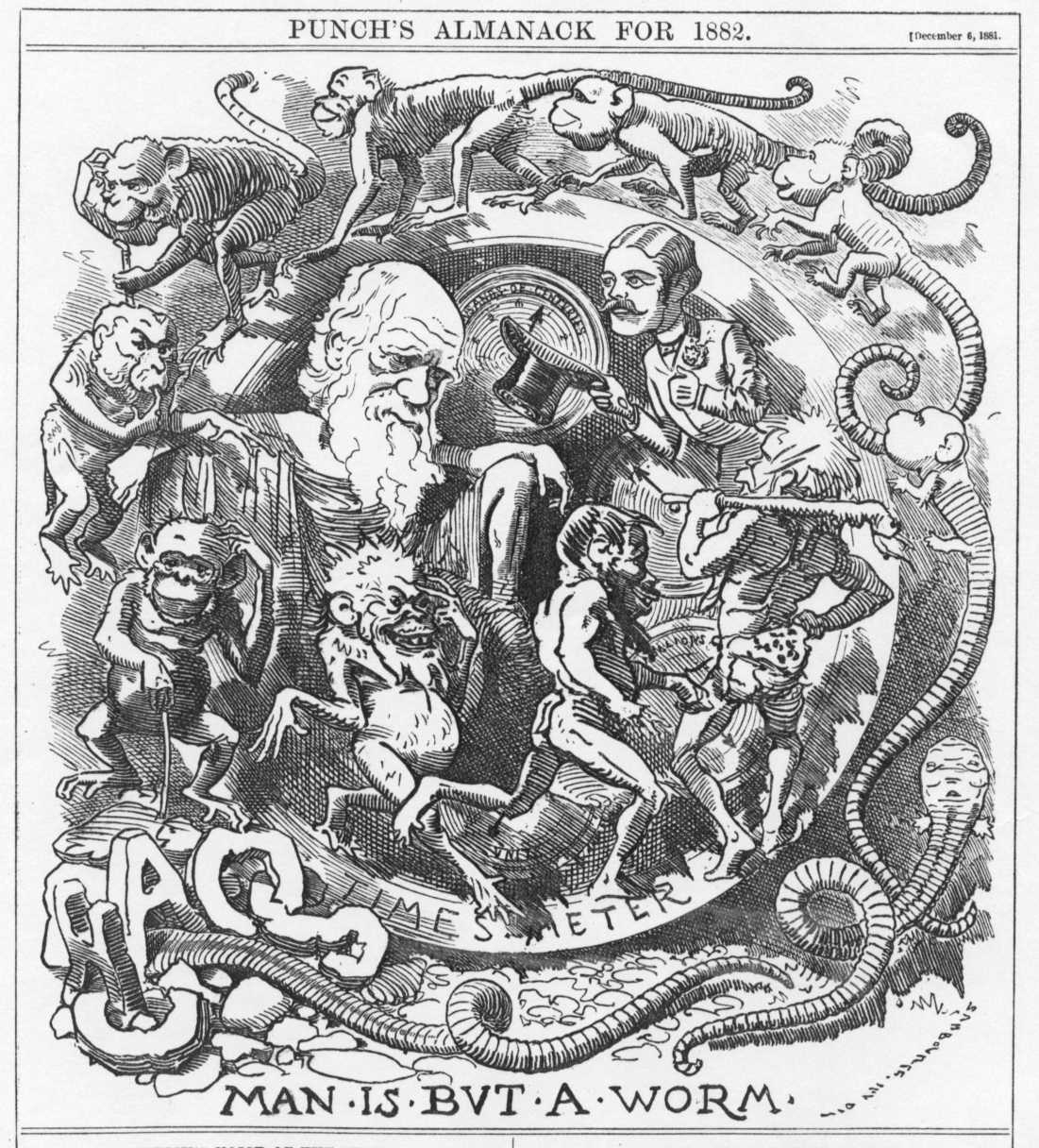
Man_is_But_a_Worm

Drawing from his new book, Darwin’s Dice: The Idea of Chance in the Thought of Charles Darwin, Curtis Johnson pushes back against an understanding of Darwin’s thinking about God that holds “he gradually shifted from ‘early orthodoxy’ to a ‘liberal form of theism,’ and then in later years ‘into an agnosticism tending at times toward atheism'”:

It seems probable that his departure from Christian faith was earlier, more abrupt, and more complete than this view indicates. The reason for thinking so stems from the same source that so many of Darwin’s contemporaries rejected a role for chance in nature’s workings: a chance-governed world seems tantamount to a godless world. Einstein made this very connection himself 75 years later when he famously said, “God does not play dice with the universe.” Darwin undoubtedly understood this implication of his theory, but rather than conclude that chance plays no role in nature he appears to have concluded instead that God does not have much to do with nature at all.

He goes on to excerpt a telling letter Darwin wrote to the Harvard botanist Asa Gray in May 1860, just a few months after the publication of The Origin of Species:

With respect to the theological view of the question; this is always painful to me.—I am bewildered.—I had no intention to write atheistically. But I own that I cannot see, as plainly as others do, & as I shd. wish to do, evidence of design and beneficence on all sides of us. There seems to me too much misery in the world. I cannot persuade myself that a beneficent & omnipotent God would have designedly created the Ichneumonidae with the express intention of their feeding within the living bodies of caterpillars, or that a cat should play with mice. Not believing this, I see no necessity in the belief that the eye was expressly designed. On the other hand, I cannot be contented to view this wonderful universe, and especially the nature of man, & to conclude that everything is the result of brute force. I am inclined to look at everything as resulting from designed laws, with the details, whether good or bad, left to the working out of what we may call chance. Not that this notion at all satisfies me. I feel most deeply that the whole subject is too profound for the human intellect. A dog might as well speculate on the mind of Newton.—Let each man hope and believe what he can.

(Image: Punch’s almanac for 1882, published shortly before Darwin’s death, depicts him amidst evolution from chaos to Victorian gentleman with the title “Man Is But A Worm,” via Wikimedia Commons)

Not With A Bang, But A Bubble

3876072412_405e4a7cc3_b

That’s how cosmologist Alex Vilenkin explains the way the universe will end:

All of a sudden a tiny little bubble will appear. It can appear anywhere—under your chair, or somewhere in Andromeda, very far away—and this little tiny thing starts growing at a speed that’s pretty close to the speed of light. And as it expands, all things that it engulfs turn into an alien form of matter. It may be approaching us right now. Say it nucleated at Andromeda some millions of years ago, it may be expanding toward us at the speed of light. But we don’t get much of a warning. So the good thing about it is you don’t really have to worry about it.

So what would happen to the Earth? It would just go, “FLOOP!” and not exist anymore?

Yeah. Inside of this bubble, ordinary matter as we know it does not exist. It’s made up of different kinds of particles. So everything will be turned into some other stuff that we just don’t know about. But aside from the fact that the end will come very quickly, the other piece of good news is that the probability of the universe ending at any given moment is extremely low.

Like how low?

We can’t really tell. It depends on particle physics at very high energy, so we can’t reliably calculate it. But back-of-the-envelope estimates give you extremely low numbers, like trillions and trillions of years from now. The probably of it occurring while our sun is still active and burning is almost nil. So most likely it will happen when the sun is already gone and, you know, we might not be around.

(Photo by Jim Trodel)

Evangelical Heresies

Kevin P. Emmert relays the results of a new survey showing that “most American evangelicals hold views condemned as heretical by some of the most important councils of the early church.” One example? 22% claim God the Father is “more divine” than Jesus:

No doubt, phrases like “only begotten Son” (John 3:16) and “firstborn of all creation” (Col. 1:15) have led others in history to hold these views, too. In the fourth century, a priest from Libya named Arius (c.250–336) announced, “If the Father begat the Son, then he who was begotten had a beginning. … There was a time when the Son was not.” The idea, known as Arianism, gained wide appeal, even among clergy. But it did not go unopposed. Theologians Alexander and Athanasius of Alexandria, Egypt, argued that Arius denied Christ’s true divinity. Christ is not of similar substance to God, they explained, but of the same substance.

Believing the debate could split the Roman Empire, Emperor Constantine convened the first ecumenical church council in Nicaea in A.D. 325. The council, comprising over 300 bishops, rejected Arianism as heresy and maintained that Jesus shares the same eternal substance with the Father. Orthodoxy struggled to gain popular approval, however, and several heresies revolving around Jesus continued to spread. At the second ecumenical council in Constantinople in 381, church leaders reiterated their condemnation of Arianism and enlarged the Nicene Creed to describe Jesus as “the only-begotten Son of God, begotten of the Father before all worlds, Light of Light, very God of very God, begotten, not made, being of one substance with the Father, by whom all things were made.” In other words, the Son is not a created being, nor can he be less divine than the Father.

Matthew Block, commenting on these findings, blames the prevalence of such heresies on the way many Protestants read the Bible:

Too many Christians mistake “Scripture alone” as if it were a license for them to read the Bible alone—to read it apart from other people. You know the idea: “All I need is me and my Bible.” But that’s not what it means. It means that Scripture is alone authoritative, not that your personal (“alone”) interpretation of Scripture is authoritative.

While Scripture itself is clear on matters of salvation, it nevertheless can be (and often is) misinterpreted by sinful people. Jesus Himself faced this danger when the devil suggested to him misinterpretations of the Word of God (Matthew 4:5-6). We fool ourselves if we think we are somehow exempt from this danger. Christ, of course, did not fall for the devil’s suggested misreading. Unsurprisingly, the Word of God made Flesh knows the written Word of God better than does Satan. But we on the other hand can and do fall into such error—be it error suggested by our own sinful minds, the errant teachings of others, or, indeed, by the devil himself.

Personal piety and a desire for truth are not guarantees that we always read Scripture aright. Consequently, we must rely upon our brothers and sisters in the faith to correct and rebuke us when we err, demonstrating our errors by Scripture (2 Timothy 3:16). And this reliance on brothers and sisters refers not merely to those Christians who happen to be alive at the same time as us. Instead, it refers to the whole Christian Church, throughout time. We rely on those who have gone before us. They too get a say in the matter. As G. K. Chesterton has wonderfully put it, this sort of tradition is a “democracy of the dead.”
Getting Schooled On Athens

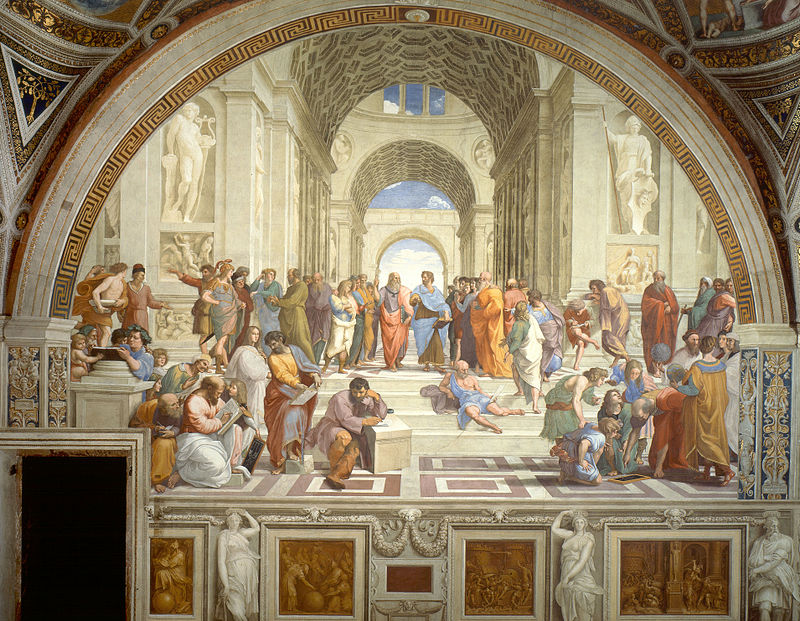
800px-Sanzio_01

Mary Elizabeth Podles walks us through the characters and meaning of Raphael’s brilliant fresco, giving it a theological gloss:

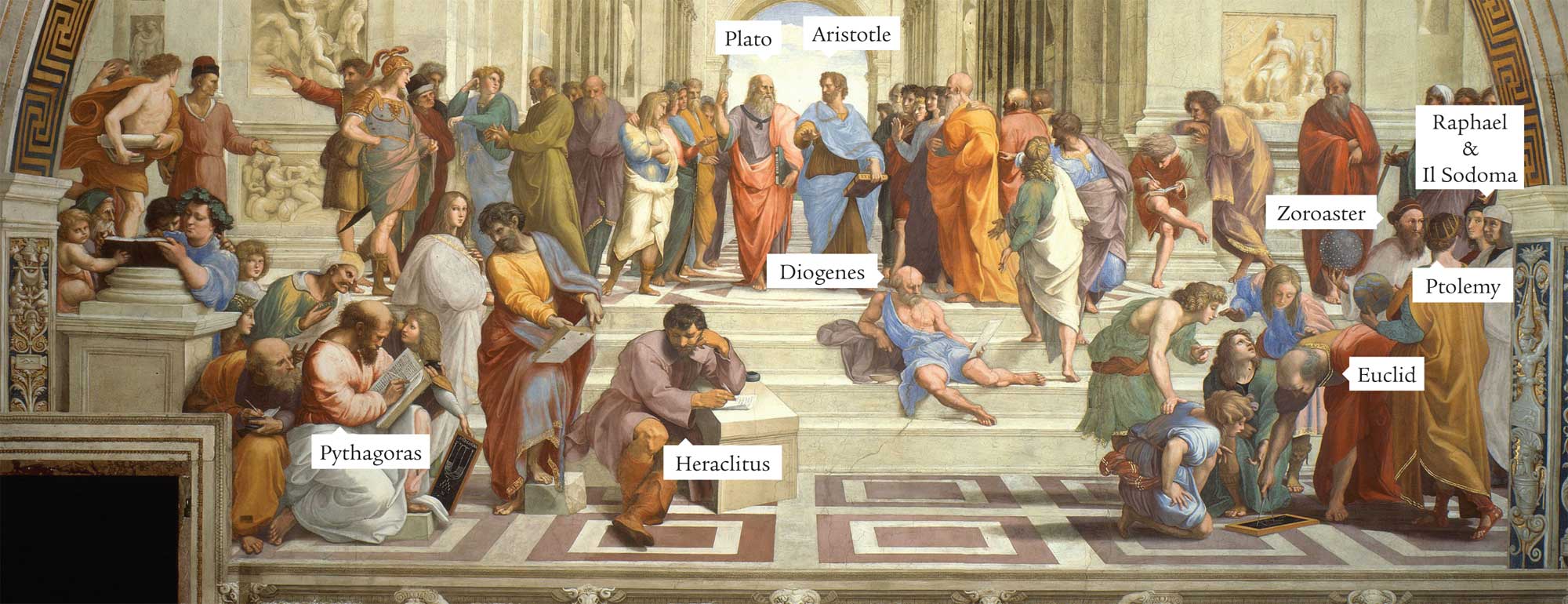
Plato points to heaven; Aristotle points to earth. Plato’s drapery swirls around him on the diagonal; Aristotle wears the colors of earth and water, and his folds fall in a much more orderly pattern of horizontals and verticals. Plato is old; Aristotle is a man in his prime. Plato stands almost on tiptoe; Aristotle is firmly planted on the ground, perfectly balanced but, like a Classical statue, full of potential movement. Plato’s followers are young and passionate; Aristotle’s are older and more sharply contoured, more precise.

So the poetical and heavenly strain of Platonic discourse is balanced by the lucid clarity of Aristotelian investigation. But still, they are linked, the two streams merge:

Plato, whose main concern was ethics, holds a discourse on nature, and Aristotle, whose main interest was the natural world, holds his treatise on ethics. They stand in an archway in a colossal, unfinished building: is this overarching architecture a portrait of the new St. Peter’s rising next door?

The School of Athens is on the opposite wall from the Disputa, and so would have been read as the other side of the dialectic: Classical philosophy, the highest manifestation of the natural religions on one side, and Christian theology on the other. If the Disputa is the apse of a basilica, is this picture not the nave, so that the philosophy of the ancients becomes the path that leads to the altar where philosophers and theologians meet, where all human thinking finds fulfillment?

You can see a close-up of the work, including labels for all the key figures depicted, here.

(Hat tip: Micah Mattix. Image of Raphael’s The School of Athens, circa 1510, via Wikimedia Commons)

Quote For The Day

“Uncertainty is the very essence of Christianity. The feeling of security in a world ‘full of gods’ is lost with the gods themselves; when the world is de-divinized, communication with the world-transcendent God is reduced to the tenuous bond of faith, in the sense of Heb. 11: 1, as the substance of things hoped for and the proof of things unseen. Ontologically, the substance of things hoped for is nowhere to be found but in faith itself; and, epistemologically, there is no proof for things unseen but again this very faith. The bond is tenuous, indeed, and it may snap easily. The life of the soul in openness toward God, the waiting, the periods of aridity and dulness, guilt and despondency, contrition and repentance, forsakenness and hope against hope, the silent stirrings of love and grace, trembling on the very of a certainty which gained is loss – the very lightness of this fabric may prove too heavy a burden for men who lust for massively possessive experience,” – Eric Voegelin, The New Science of Politics.

Human-Cyborg “Relations”

A.I. expert David Levy, the author of Love and Sex with Robots, expects that sex – or even an intimate relationship – with cyborgs will be considered perfectly normal within the next few decades:

“I believe that loving sex robots will be a great boon to society,” he says. “There are millions of people out there who, for one reason or another, cannot establish good relationships.” And when does he think this might come about? “I think we’re talking about the middle of the century, if you are referring to a robot that many people would find appealing as a companion, lover, or possible spouse.”

Spouse? “Yes.”

Michael Brendan Dougherty shakes his head:

The truth that Levy has lost is that healthy sexual desire does not take as its object a mere sensation or state, but a person.

We also know this, instinctively. If the hand that is discreetly caressing you is revealed to belong to someone other than your lover, the pleasure the hand gives is instantly poisoned and felt as a desecration. We have words for bestiality, pedophilia, and necrophilia, acts where the sexual object lacks personhood. The existence of anti-fap boards on reddit, as well as the recognition of pornography addiction as a serious problem, is more evidence that something goes wrong when sexual desire is directed away from people.

What healthy sexuality desires is a person. We don’t want mere sensations, but to be wanted and accepted by another. We want another persons’ conscious intentions for us acted upon our bodies, and for our intentions to be received as well. Lovers may use games that temporarily disguise consent and even pleasure itself, but their desire is to be freely wanted and freely given as persons, not as nerve endings. We call perverse those sexual encounters in which people intentionally and radically efface their own or another’s personhood.

A Whale Of A Film

Freddie Moore lovingly reviews 2010: Moby Dick, ranking it alongside other “great man-versus-beast bad movie classics, like Deep Blue Sea or Snakes on a Plane.” It is, she suggests, the “worst adaptation of all time”:

On the surface, the film is based on the book: It’s the ultimate story of revenge sought by a captain who’s had his ship and leg taken from him by a giant sperm whale. As a modern retelling, though, Ahab is a submarine captain and his strikes against the whale involve torpedos, machine guns and nukes. (Yes, nukes.) Not only that, but 2010’s version of the whale doesn’t stick to the ocean; he “swims” over mountains and even flies to attack Ahab and his crew.

She offers a drinking game for brave viewers. Drink up when:

1. Submarine emergency sirens sound;

2. Ahab says the word “whale”;

3. Race awkwardly enters the story (same thing goes for any time something sexist is directed at Dr. Herman);

4. Someone listens to sonar whale sounds;

5. Moby Dick makes rabid bull noises;

6. Someone says the word “hunt”;

7. Anyone tries to say anything remotely scientific.

Sex Shop Talk

3621698248_2b6981e7bc_o

After working in a gay fetish store for several years, Russell Dean Stone shares the “enduring truths” he’s learned about the job:

First, lesbians are the nicest customers. Without exception. Second, the last people you’d imagine buying a particular item will, without question, always be the first ones to buy that item. Tiny leather thongs bought by hugely overweight men, for example, or adult diapers snapped up by tall, hot, ripped biker men who you really, really wish didn’t have a fetish for shitting themselves. Third—and finally—that you must accept that a large portion of your day will be spent fielding prank phone calls and voicemails.

He goes on to ruminate about other occupational hazards, which include lots of TMI from customers:

Mind you, when those specifics are questions like, “I want to get fisted but have my hands free—do you have any harnesses that can accommodate a plastic fist?” you do sometimes have to reconsider the professional choices you’ve made.

(Photo by Corey Doctorow)