Sam & Mattie are teenagers from Rhode Island. They are BEST friends. They met at Special Olympics while they were in grade school and have been pretty much inseparable since. For the most part, they’re normal teenage dudes. They like to skate and play video games and talk about girls and stuff, but the one thing they both LOVE is cinema. They love to go to the movies, talk about movies, brainstorm movie ideas, and act out their favorite scenes.
Three years ago, they started brainstorming their own Teen Zombie Movie (a favorite genre). This was nothing out of the ordinary — they are constantly hatching zany schemes to “launch their careers.” But something about this zombie movie has stuck with them. For three years. Honestly, they won’t shut up about it.
Every time they get together, they draw up storyboards, practice fight scenes, film with their iPhones (then pair those scenes with dream soundtracks), and endlessly debate celebrity cameos. They have been so passionate about this film for so long, that their friends and family decided it was time to help them make it happen FOR REAL.
A reader sums up a “bizarre race” in one district:
The race in Massachusetts’s 6th Congressional District is getting strange. The National Organization for Marriage, which opposes same-sex marriage, is urging supporters to vote for Democrat Seth Moulton rather than an openly gay Republican, Richard Tisei. Meanwhile, the Human Rights Campaign is staying out of the race completely, despite having previously endorsed in the district.
Asked whether Moulton would welcome or reject votes cast in his favor by NOM supporters, a spokesperson for Moulton responded, “Reject.” “Seth Moulton fundamentally disagrees with everything NOM stands for and has long said that equality is the civil rights fight of our generation,” said Carrie Rankin, Moulton’s communications director. “Fighting against groups, like NOM, that deny equality as a basic human right will be a priority of Seth’s in Congress.” Rankin noted that Moulton has a gay brother and Moulton has said, “It’s fundamentally wrong that he and I don’t share the same rights just because of who he is.”
The nation’s largest LGBT-rights organization is not expected to get involved in the Massachusetts congressional race between openly gay Republican Richard Tisei and pro-LGBT Democrat Seth Moulton, Metro Weekly has learned. …
HRC, which has a policy of endorsing pro-LGBT incumbents, previously endorsed Rep. John Tierney (D) in Massachusetts’s 6th Congressional District. In September, Tierney suffered a surprising primary defeat to Moulton, a young Marine veteran vowing to keep the seat in Democratic control. Two years prior, Tisei lost narrowly to Tierney 47.1 percent to 48.3 percent. Many credited the win by a vulnerable Tierney, whose wife was mired in a federal tax scandal, to President Barack Obama and Senate candidate Elizabeth Warren being at the top of the 2012 ballot. In that race HRC also endorsed Tierney.
The Gay & Lesbian Victory Fund, which seeks to increase LGBT representation, has endorsed Tisei the past two election cycles.
Tisei is one of two men seeking to become the first openly gay Republican elected to Congress. In California, Carl DeMaio is attempting to unseat Democratic Rep. Scott Peters for the state’s 52nd Congressional District. HRC has endorsed Peters in that race and representatives of the organization have been critical of DeMaio’s commitment to LGBT issues.
Previous reader dispatches from Texas here and South Dakota here.
NATO reported an “unusual burst of activity” by Russia’s nuclear-capable strategic bombers on its borders this week. While none of the flights violated NATO airspace, they are emblematic of the increasing tensions in Europe over the conflict in Ukraine:
In all, Nato said, its jets intercepted four groups of Russian aircraft in about 24 hours since Tuesday and some were still on manoeuvres late on Wednesday afternoon. “These sizeable Russian flights represent an unusual level of air activity over European air space,” the alliance said. A spokesman stressed there had been no violation of Nato air space, unlike a week earlier when a Russian spy plane briefly crossed Estonia’s border. But so many sorties in one day was unusual compared with recent years. … Nato said it had conducted more than 100 such intercepts of Russian aircraft this year so far, about three times as many as in 2013 before the confrontation with Moscow over separatist revolts in Ukraine soured relations.
Last month, Estonia accused Russia of kidnapping an Estonian intelligence agent. Swedish defense officials now speak of a fundamentally altered security paradigm in the Baltic after Russian planes carried out a mock bombing of Stockholm and violated Swedish airspace in the region.
Groll says such actions “bring relations between Moscow and the West to their lowest point since the end of the Cold War.” Marc Champion also finds that “a version of the Cold War is returning, but its rules and parameters aren’t clear”:
A defining aspect of the Cold War was that, for the most part, deterrence kept each side from meddling in the other’s sphere: The U.S. and NATO stood by during the uprisings in Hungary in 1956 and Czechoslovakia in 1968. Putin wants a similar kind of tacit agreement with the U.S. now. … So Putin may see testing NATO as a form of shoe-banging. The danger of this new Cold War is that there is complete disagreement between Russia on one side and the U.S. and European Union on the other as to the dividing lines are and the rules of the game.
Dave Majumdar solicits the opinions of some military experts, who see the Kremlin pushing NATO’s buttons but probably not rehearsing a nuclear attack:
Analyst Rebecca Grant, president of IRIS Independent Research, said that the recent display of Russian air power was just another provocation in a long line of similar antagonistic moves by Russia. The Russian strategic bomber foray into the Atlantic is also reminiscent of a September incident where two nuclear-capable Tu-95s bombers, two Il-78 tankers and two MiG-31 Foxhound fighters were intercepted near Alaska.
“This reminds me of the exercises Russia has been flying in the Pacific for a few years now, just transferred to the European theater,” Grant said. “I don’t read this as a specific nuclear or conventional scenario practice, rather an exercise in long-range navigation and provocation. It’s clearly designed to annoy NATO but from a purely tactical perspective, this was still a pretty small display of airpower.”
In these circumstances, Keating worries less about deliberate acts of war and more about accidents:
This doesn’t necessarily mean Russia is preparing for war, and open conflict between Russia and NATO countries still seems pretty unlikely. It probably has more to do with Russia seeing how much it can get away with, and making it clear that it disapproves of Europe’s pro-Ukraine stance. But as June’s shootdown of a Malaysian airliner demonstrated, tragedies can happen when there are itchy fingers on the triggers of anti-aircraft missiles.
How much does masculine culture depend on women and femininity as a reference point? To what extent does asserting what it means to be a man necessitate pointing out and denigrating what men are not and what masculinity is not supposed to be?
If cheerleaders suddenly vanished from the sidelines of NFL games, would those contests suddenly be less fun? In action movies, do you find the hero’s bona fides less credible if a woman contributes to his successes, or if she rescues him? If you are playing video games, how much of your enjoyment has to do with opportunities to treat women in-game in ways that are not available to you in real life?
It occurs to me that I am somewhat (ahem) deficient in personal experience to address this point, which is why I encourage straight male readers to respond. And even when I have been immersed in masculine culture – such as a rowdy, rugby-loving, all-male high school – I wasn’t very attuned to how heterosexual attraction and views of women contributed to the atmosphere. I couldn’t bond with other adolescent boys over their difficulties with and longing for the opposite sex. I had no real struggle to date women, no frustrations or anxieties about the opposite sex, and so was oddly neutral – to the extent of having a real blind spot – in this eternal hetero-dilemma.
But I don’t want to duck Alyssa’s point, so let me think of it another way: to what extent can hetero male culture retain its quintessential maleness while losing its homophobia?
One way is to hope and pray that every cool straight dude ends up like Chris Kluwe and totally gets that it’s not kosher – and actually immature – to demean or demonize those men who do not fit into the classic male macho archetype. Another is to reassure straight men that gay men do not want to change the core part of male culture, but merely want to be accepted as fully part of it.
I think we’re making a lot of progress on both fronts. From the mainstreaming of gay culture to the emergence of openly gay men in highly masculinized cultures – think Tim Cook in nerdland or Michael Sam in sports – the sharper edges of homophobia have been rounded a bit. But that is partly because of a strategy of engagement rather than confrontation. My own inclination from the 1980s on – and it was not shared very enthusiastically by many on the gay left – was to emphasize what gay men and straight men have in common: a need for emotional commitment and stability as well as to get our rocks off from time to time; the desire and will to serve one’s country in the military; the commonalities of sports and drinking and the gym and dirty jokes. And part of our success, I think, is that we absolutely constructed this as a non-zero-sum project. I think a feminism that started with a love and appreciation for classic male culture – and then sought to persuade men that it doesn’t have to be sexist toward women – would be more productive than treating all men as inherently suspect or privileged, and attempting to police their culture from the outside.
But – and here’s the thing – I don’t think we’ll ever live in a world where homophobia is absent among many men, especially younger ones. Our primate nature – exacerbated by cresting levels of testosterone in the teen and early adult years – will always trend toward loyalty to in-groups and disdain of out-groups. We can mitigate this, but it’s utopian to think we can abolish it. So, yeah, I can live with the word “fag” as something that will always be a part of hetero-male culture. I can live with religious groups demonizing me. I can ignore the insults and smears – on the street or online. It’s just part of the price for living in a free society.
Equally, the young testosteroned male’s desire for and incomprehension of the opposite gender can be mitigated, it seems to me, but not abolished. And in the case of male attitudes toward women, of course, the “other” is also the object of often-crippling and overwhelming sexual desire. These are powerful – often internally conflicting – forces and they will not easily be constrained by abstract rules or “social justice warriors”.
And so I think we just have to live with a certain amount of straight-very-male homophobia and sexism, and leave it be. Young men want to live out fantasies of rescuing big-boobed women while being encased in a steroidal muscle culture (precisely because, for so many, it is utterly beyond their actual day-to-day lives). And my inclination is simply: give them a break. Sure, offer alternatives – but the most appealing ones should work with the grain of masculinity rather than against it. Keep the cheer-leaders – but add some dudes to the mix. Don’t insist that straight men have to change their way of life; suggest ways in which it can become more inclusive of others within its own rules and ethos. Do not pathologize some deep parts of human nature – because you are pathologizing human beings simply for being who they are, which means that the level of coercion to change them for the better can be dangerously high. I don’t think Alyssa and I are that far apart on this.
What I think is counterproductive is precisely an agenda that refuses to see real, biological differences, physical and mental, between men and women, whose first item on the agenda is to get men to “check their privilege”, and who want to police speech and urgently stamp out sexism and homophobia. This will often compound the problem, create a zero-sum environment, and in a world where Twitter gives everyone a completely unaccountable megaphone, generate levels of public toxicity we can all live without.
My position on this is therefore, essentially, conservative-libertarian. It sees human nature as something to be enjoyed and not always reformed, or fully reformable. It revels in the differences between groups of people, rather than being terrified by them. It does not traffic in either the delusion that we can never make our society in general less bigoted or prejudiced or hateful (we can and we have) or the delusion that such emotions will ever be abolished or eradicated. It seeks coexistence of various, often contradictory, subcultures, rather than the imperative of “social justice.” And it tends to prefer anarchic and sometimes ugly freedom to well-intentioned and admirable attempts at social control.
There is a happy medium here. But it appears that our ideological polarization is making it increasingly impossible to sustain, even as we have an amazing example – our progress on gay rights – that shows just how fruitful it can be.
Nate Silver calculates that the “GOP’s chances of winning the Senate are 68.5 percent”:
Which states to watch over this final weekend? I’d point to three: Alaska, Iowa and Kansas. Any polling at all in Alaska would be helpful. Iowa, depending on the final few polls there, could wind up anywhere from a true tossup to a case more like Colorado. In Kansas, Roberts’s position is improved from a few weeks ago, but it isn’t clear whether he’s gaining ground or has stalled out. In most of the other states, the possibility of a runoff limits how much the polls can tell us, or we have so much polling that no one further poll is going to move the needle that much.
Nate Cohn examines early voting numbers. He finds that “Democratic efforts to turn out the young and nonwhite voters who sat out the 2010 midterm elections appear to be paying off in several Senate battleground states”:
More than 20 percent of the nearly three million votes already tabulated in Georgia, North Carolina, Colorado and Iowa have come from people who did not vote in the last midterm election, according to an analysis of early-voting data by The Upshot. … But so far, there have not been enough new Democratic votes to erase the Republicans’ expected turnout advantage. It remains to be seen whether turnout among new voters will continue at these rates. The Upshot’s model, Leo, still gives the Republicans a 68 percent chance of taking the Senate.
And Sam Wang determines “that key races to watch are…Kentucky and New Hampshire”:
The polls will be off, on average, by some amount in one direction or the other. Let’s call that average amount Delta. On Election Night, I will be watching returns carefully for clues about how large Delta is. In particular, I’ll be watching Kentucky and New Hampshire. Even though both races have a clear favorite, they have the advantage that voting ends fairly early in the evening. If either party outperforms polls in these states, that might indicate a broader trend nationwide.
John Hudson explains what a GOP Senate might mean for the torture report:
If the Nov. 4 elections deliver a GOP-controlled Senate, the chairmanship of the powerful Senate Intelligence Committee is likely to go to a North Carolinian whose unwavering support for the CIA and NSA could radically transform the committee’s oversight agenda.
Sen. Richard Burr (R-N.C.), an outspoken defender of enhanced interrogation techniques and broad government surveillance powers, is next in line for the chairmanship. Unlike the current Democratic head of the committee, Dianne Feinstein of California, Burr has been harshly critical of a yet-to-be-released report on the Bush administration’s post-9/11 torture practices — a view shared by many in the agency.
And although Burr’s views about NSA data collection largely mirror Feinstein’s, his distaste for publicity and devotion to secrecy could fundamentally alter the way the committee operates on a day-to-day basis.
For the first time in 14 years, Israeli authorities yesterday closed off the Temple Mount/Noble Sanctuary in the Old City of Jerusalem and prevented men under 50 from praying there this morning, out of fear of escalating tensions in the city amid whispers of a third intifada:
Palestinian leaders had called for a “day of rage” because of the closing on Thursday and the killing by Israeli forces of a Palestinian man suspected in the assassination attempt Wednesday night against Yehuda Glick. Mr. Glick is a right-wing activist who promoted increased Jewish access and prayer at the site, known to Jews as the Temple Mount and to Muslims as the Noble Sanctuary. By midafternoon, Israel Radio reported that there were “riots” at several locations in the occupied West Bank, including Rachel’s Tomb in Bethlehem and the often-tense city of Hebron.
The situation remained mostly calm today but tensions remain high, and the situation could get worse before it gets better. Daniel Gordis describes the Israeli public’s reaction to the attempt on Glick’s life and the killing of the alleged shooter:
“How had he been found so quickly?” people wondered.
Then came the disturbing news that the gunman had worked in the restaurant located in the Begin Center. To complicate matters, it was soon reported he had ties to the Islamic Jihad, had attacked jailers while in an Israeli prison, had made a video in which he boasted of wanting to be a thorn in the throat of Zionists — and despite all that, was not under surveillance and was allowed to work in a place frequented by public figures. It was, popular mood quickly decided, a shocking security blunder. Blunder or not, the attack on an unarmed rabbi (who, though right wing, had advocated that Jews and Muslims pray together on the Temple Mount, a hugely significant site for both religions) in a supposedly safe place crossed an unspoken red line.
Anshel Pfeffer fears that Glick’s once-extreme views on the Temple Mount have gone mainstream, with predictably disastrous consequences:
Make no mistake, the campaign to reestablish a more permanent Jewish presence on Mount Moriah is dangerous. Their Judaism is one that exalts sacred stones and hallowed soil above human life, and threatens to take the Zionist endeavour down a dark alley where it was never intended to go. Many of those involved are blatantly trying to provoke exactly the kind of violent Muslim reaction that will lead to a downward spiral of bloodshed, that they believe will once and for all end any possibility of a territorial compromise between Israelis and Palestinians. That was the express intention of Yehuda Etzion and his Jewish underground, who tried in the early 1980s to blow up the mosques in the hope it would derail the Camp David Accords.
Elhanan Miller calls the low-level unrest that the city has seen over the past four months the “Jerusalem intifada”:
Sparked by the July 2 kidnapping and murder of Palestinian teenager Muhammad Abu Khdeir, apparently by Jewish extremists, the disturbances consist mainly of throwing stones and Molotov cocktails — haphazard activities reminiscent of the largely spontaneous First Intifada launched in late 1987 across the Israeli-controlled West Bank and Gaza. But the “Jerusalem Intifada” has its own unique characteristics, experts say. Namely, it has scarcely spread beyond the confines of the capital, and lacks the grassroots leadership that characterized the two previous Palestinian uprisings.
Talking to some experts on the conflict, Zack Beauchamp weighs the chances that the tensions will spiral out of control:
The situation is very bad. Even a slight provocation by either side could set off a wider conflict. But is this already a Third Intifada — another Palestinian mass uprising against Israel, like the First Intifada beginning in the late 1980s, and the far deadlier Second Intifada of the early 2000s? It’s tough to say. “Simmering tension/violence is not the same thing” as an intifada, [Brent] Sasley argues, “though it could well develop into [one].” Rather, he says, “what’s going on now feels more like a demonstration of frustration, rather than an uprising.”
Moreover, the pressure is largely concentrated in Jerusalem, and hasn’t yet spread to Gaza or the West Bank. “One of the reasons it’s getting out of hand is precisely because there’s no Palestinian Authority there to keep a lid on it,” [Matt] Duss writes. In his view, it’s easier for Palestinian security forces to contain popular outrage than for their Israeli counterparts to do the same. The PA stands “between the people and the occupation” in the West Bank, but not in Jerusalem.
But Keating doubts another genuine intifada is afoot, for a number of reasons:
The Palestinian leadership isn’t as united and the populace is less well armed than in 2000. Other Arab governments, distracted by a myriad of other crises, aren’t as focused on the Palestinian issue as they used to be. (Though the al-Aqsa closure is likely to irritate the government of Jordan, the official custodian of Jerusalem’s Muslim holy sites, which has been coming under increasing pressure over its relations with Israel.) There has also not been much enthusiasm among Palestinian leaders for another intifada given that the violence of the previous two didn’t do much to advance the cause.
Another big difference is that Abbas is president today, not Yasser Arafat. The Palestinian foreign minister has gone on record saying, “as long as [Abbas] is in charge, there will be no third Intifada.”
The unrest also comes at a moment when Israel is increasingly isolated on the world stage, facing a chill in its relationship with the US (e.g. chickenshitgate). Sweden’s decision to recognize a Palestinian state on Thursday has not gone over well in Jerusalem either. “Yet none of this,” Gregg Carlstrom laments, “has prompted new thinking”:
Netanyahu has nothing to offer the residents of Jerusalem beyond throwing an additional 1,000 police at the problem; Abbas is encouraging unrest that he has no means to control; and Hamas, keen to discuss anything other than the disastrous conditions in Gaza, held a rally in the strip earlier this month urging Jerusalemites to follow its “successful example” and revolt. All three parties are still acting as if the status quo of the past seven years remains intact. “It’s a deadlock everywhere,” said Mukhaimer Abu Saada, a Gaza-based political analyst. “Nobody is serious, not Hamas, not Fatah, not the Israelis. And it is making people more and more pessimistic … it’s an unsustainable situation.”
Because journalists will make far more money from it than the old, ethical variety. Because no one has come up with a business model that can compete with it for moolah. And, above all, because readers don’t really give a shit:
If people are offended by content marketing, why would a single Purina brand, Beggin’ Strips, have nearly 1.2 million Facebook fans, as Michael Meyer reports in his provocative piece on the subject, when Purina’s hometown paper, the St. Louis Post-Dispatch, can boast a relatively modest 120,000 fans? What’s more, some of the larger corporate newsrooms are producing exponentially more content each day than traditional news outlets.
That doesn’t mean this content is all good, or accurate, or honorable in its alleged attempt to serve its audience. But then again, plenty of work coming out of actual newsrooms doesn’t meet that standard either.
You know, I wish this could be supplemented by videos of what it’s like for women to walk down the street who don’t conform to “pretty” norms. Quite frankly, plain women, or ones not compliant with “available chick” visual norms, get just as many cat calls – often more aggressive because “ugly women should be both available and grateful for the attention” and have added in an equal or greater load of criticisms. Dog barks, bitter comments about how ugly they are, suggestions where they should go and what they should do – many obscene, and many suggesting that a man approaching them would be doing them a favor screwing them or letting them go down on the idiots.
If you’re beautiful, it’s bad. If you’re NOT beautiful, it’s hell: all the come-ons, then a layer of vicious critique, all of it from sulky men insisting on their entitlement to women: their bodies, their attention, their sexual favors, even the right to insist on the “right” appearance. Jeez-Louise, it gets old.
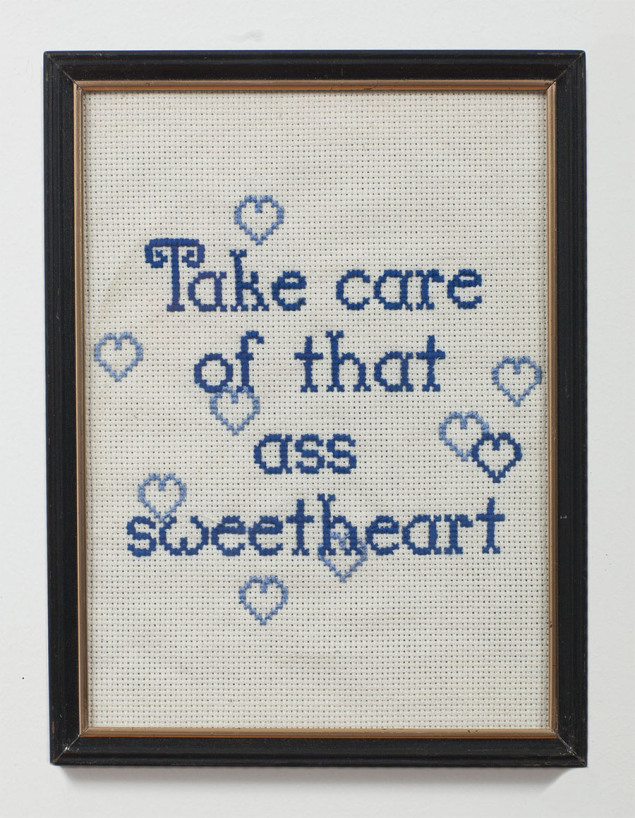
Another references the above image:
The reader who wrote “It all smacks of white privilege to me” might be interested in Tatyana Fazlalizadeh’s art project “Stop Telling Women To Smile.” Would that reader tell her portrait subjects (who are largely women of color) that they’re in neighborhoods where they don’t understand the social mores?
Much more commentary below:
I think a very important point has been missed, thus far, in the discussion of the catcall video.
The problem (for many women, at least) is not with the words themselves. The words themselves, as other commenters have pointed out, are First Amendment expression whether we like them or not. The problem is the context in which they are being spoken. I’ve never bristled at a “Looking good today, baby” or “Smile, honey!” comment when I’m at the post office or walking through a mall.
However, catcalls are incredibly threatening (or at least feel that way) while walking by myself or in a sketchy area or at nighttime. In those situations, my goal is to move as quickly and as unnoticed as I can through the environment. Being noticed brings with it the threat of assault, violence, or something worse. In those situations, therefore, a “Looking good, baby!” is not just a “Looking good, baby!” It’s implicitly saying, “You have been noticed. I am watching you. I am looking at your body.” The communication has a very predator-prey feeling to it regardless of how it is intended by the speaker.
Another remarks on the complex mix of feelings involved:
When I get catcalls on the street, I’m not reacting to the actual interaction most of the time. What I am reacting to is the power dynamic that is happening and the possibilities of future violence. My stress levels rise when I imagine what is going to happen next, whether I ignore the words or whether I engage. I feel powerless and afraid. I feel pissed off at them for bothering me and at myself for “letting” them. I feel a flush of pleasure at being complimented, and then guilty that I should actually like that kind of attention. I feel afraid of opening myself up to the guy who really does just want to say “Good morning” because then the next guy I smile at will take that as an opening to talk about my big juicy tits.
And this happens to me ALL THE TIME. It’s a whirlwind of fear, anxiety, relief, pleasure, and mindlessness.
Another turns to the “elephant in the room,” as our reader put it:
In response to those worrying that the catcalling is mostly done by black men: The first catcall I ever received was from a white man in a suit. I was twelve years old, wearing a miniskirt, on my way home from a party in lower Manhattan. I was also lost, and I was grateful to find a subway station. As I walked into the subway, a man in his 20s or 30s coming up the stairs whispered, “Sexy.” I had no idea how to react. I was so alarmed at being sexualized by this adult that I turned around, left the subway, and took a cab home.
I have been catcalled countless times since then. Sometimes it’s truly offensive, and occasionally, rarely, it’s flattering. (A man once yelled at me, “This is why I love New York! The most beautiful women in the world, and you’re one of them!”) Mostly, it’s just tiring. It becomes one more thing to deal with: Should I respond to that guy, or ignore him? Is he honking because there’s an emergency, or is he just trying to get my attention? Is he scary or just a nuisance?
The value of the flawed Hollaback tape is that it shows men how pervasive catcalls are. For a lot of women, they are just a fact of life – and we forget that men don’t see that. I don’t think catcalling should be criminalized (would that even be constitutional?) or that it’s anywhere near the most serious issue facing women. But it’s worth noticing how often catcalls happen.
More on the racial angle:
Your reader who is concerned about the “inconvenient truth” revealed in the video – that the majority of the catcallers were Black and Latino men – needs to confront an inconvenient truth, as well: he or she (despite the caveats that were offered) is overreading it. First of all, a number of the white guys were edited out of the video. Second, let me tell you something: Right now, I live in South Dakota, and the men who have catcalled me, to a person, are white. If Hollaback had shot a similar video here, and if the overwhelming majority of the woman’s catcallers had been white, I wonder if your reader would have characterized the problem along racial lines. I suspect that the answer is “No.”
Another reader:
As a mixed-race woman, living in NYC for over 15 years, I can testify from personal experience it is the United Nations of Perverts out there. I have been harassed in similar ways (and worse) as the woman in the video, by men of EVERY race. So have most of my female friends in this city. Where I lived previously (Florida), I was also unfortunately harassed by men of all races (from white rednecks to white men in sportscars to Latin and black men). But in New York, the incidence of harassment is higher because it’s a walking city, and our population is more diverse than most public spaces in America.
This is probably a good moment to post a trailer for the classic documentary of street harassment, “War Zone.” It’s filmed in Chicago. Plenty of white harassers on the video, which makes sense given the population there:
And another:
I worked on a garbage truck for the County Parks Maintenance Department one summer when I was in college. All the guys in the shop were Archie Bunker types, and I worked with two drivers – one Irish, one Italian (the Italian guy assumed I was also; when I told him I’m Jewish, he thought about it and said “there’s nothing wrong with that”). The Irish driver would whistle and call women from the truck as I was riding shotgun while I’d squirm, since the last thing I wanted was to call to the attention of pretty women the fact that I was riding shotgun in a garbage truck.
During one whistle/catcall event towards the end of the summer, he turned to me as I was sinking down in my seat and said, “What’s the matter with you, don’t you like girls?”. It was just kind of taken for granted that this is what you do if you like girls. Clearly this man in his 60s with a strong brogue, who’d been a laborer all his life and looked it, couldn’t have hoped for any kind of positive reaction from the women, and I don’t think he meant to harass or threaten. It’s just what you do to express your appreciation for the female form.
He and the other guys had no idea how dumb they made themselves look doing this. Telling them how threatening they are is probably futile, since they don’t see themselves as threatening and would say that you should just lighten the F up. A better strategy might be to help them realize how completely ridiculous they look.
One more:
It seems to me that part of what women are saying is the constant everyday-ness of the catcalls. It’s like African Americans who say it’s not the OPEN discrimination, it’s the thousand tiny cuts, i.e., being followed in stores, being asked for ID along with your credit card when your white friend does not get asked, being stopped by cops for no seeming reason, etc etc. It just wears you down after a while and I suspect young women feel the same.
Read the whole discussion thread here. Another long thread on catcalling from 2012 is here. More reader feedback on our Facebook page. Update from a reader:
I haven’t read through all the commentary, but as a woman I naturally am very glad to see it being discussed. I’m not sure if this has been sent your way, but rather than catching the catcalls on camera, a Brooklyn artist found another unique way of catching them – she does it in cross stitch:
And it’s really discomforting to see the “compliments” or the insults captured in this medium. Sort of perverse folk art.
Another reader:
You know, Andrew, your female readers are reacting to racial aspect of the video (by insisting that white men catcall too, which I’m sure is true) but utterly and completely ignoring the class aspect – or in some cases, as with the story of the Irish guy on the garbage truck, actually making the case that this may indeed be class thing.
I live in a middle class/upper-middle class suburban (and yes, mostly white) neighborhood, and women are not being catcalled here. It’s just not happening. My 13-year-old son has several friends who live in a newer neighborhood with sidewalks and lots of pedestrians about a half-mile away; women are not being catcalled there, either.
The suggestion by your readers seems to be that if a woman were to walk around these neighborhoods she’d get just as many “Hey, baby” catcalls as the woman in the video did. I’ll tell you right now, that suggestion is false.
What we have, then, are women who legitimately feel creeped out or even threatened when something like this happens, but who in turn attempt to suggest that “all men” are either guilty of such behavior, or at least responsible for it in some way. And I reject that; I don’t do collective guilt. I don’t teach my sons to behave this way, the people I hang out with tell their children that this behavior is wrong and offensive. I’m responsible for my behavior, for my kids’ behavior, maybe even to an extent my neighbors’ behavior. But the guys in that video, catcalling the woman? I’m not responsible for their behavior. It’s not my responsibility to change it.
Or should it be my responsibility to tell them they’re wrong – me, the upper middle class white guy, telling impoverished blacks, Latinos and whites that they’re being boorish? That’d be received real well, don’t you think?
But first, a Halloween movie mashup to get you in the spirit:
Samira Kawash details the rise of Halloween candy:
Would you believe the earliest trick-or-treaters didn’t even expect to get candy? Back in the 1930s, when kids first started chanting “trick or treat” at the doorbell, the treat could be just about anything: nuts, coins, a small toy, a cookie or popcorn ball. Sometimes candy too, maybe a few jelly beans or a licorice stick. But it wasn’t until well into the 1950s that Americans started buying treats instead of making them, and the easiest treat to buy was candy. The candy industry also advertised heavily, and by the 1960s was offering innovative packaging and sizes like mini-bars to make it even easier to give out candy at Halloween. But if you look at candy trade discussions about holiday marketing in the 1920s and 1930s, Halloween doesn’t even get a mention.
She elaborates on another reason for the rise of branded sweets:
One of the biggest casualties of the poison treats scares of the 1970s was homemade sweets.
In the 1960s and before, it was totally fine to give out something you’d made yourself. But once people got it in their heads that maniacs were out there trying to kill their children with Halloween treats, everything homemade was suspect. After all, you didn’t know whose hands had touched that cookie and what scary ingredients might be hidden under the chocolate chips. Same for unwrapped candies and off-brand candies: If it wasn’t sealed in a recognizable, major brand factory label, then it was guilty until proven innocent. National advertised candy brands were familiar and trusted, unlike that spooky neighbor who just might be an axe murderer. It’s one of the huge successes of processed food marketing, to make us trust and feel good about the factory food, and to distrust and denigrate the homemade and the neighborly.
I think this is starting to swing back in the other direction though, at least in urban areas. Today, consumers are pretty obsessed with the artisanal and the small batch, and will pay a huge premium for candy that is nothing like Hershey or Mars. On the other hand, every year the candy that’s wrapped for Halloween treating gets more and more homogeneous, and the national brands rule.
Elsewhere, The Daily Meal dished out an infographic comparing the unhealthiness of different candies.


 The Dish