The Chemical Weapons We Uncovered

Earlier this week, CJ Chivers reported that US troops were exposed to decaying Iraqi chemical weapons on multiple occasions (accompanying video above):

In all, American troops secretly reported finding roughly 5,000 chemical warheads, shells or aviation bombs, according to interviews with dozens of participants, Iraqi and American officials, and heavily redacted intelligence documents obtained under the Freedom of Information Act.

The United States had gone to war declaring it must destroy an active weapons of mass destruction program. Instead, American troops gradually found and ultimately suffered from the remnants of long-abandoned programs, built in close collaboration with the West.

Murtaza Hussain pushes back on Iraq war supporters claiming vindication:

The inconvenient truth is that the U.S. was aware of the existence of such weapons at the Al Muthanna site as far back as 1991. Why? Because Al Muthanna was the site where the UN ordered Saddam Hussein to dispose of his declared chemical munitions in the first place.

Those weapons that could not safely be destroyed were sealed and left to decay on their own, which they did. The site was neither “active” nor “clandestine” – it was a declared munitions dump being used to hold the corroded weapons which Western powers themselves had in most cases helped Saddam procure.

The fact that people thoroughly invested in supporting the war apparently had no idea about this is in many ways emblematic of their complete cluelessness about the country which they helped destroy.

Jessica Schulberg argues along the same lines:

If the post-2003 discovery of a decaying chemical weapons program could serve as proof that the invasion was justified, the Bush White House would have seized the opportunity to proclaim so. By 2005, CIA weapons inspectors concluded in a 92-page report that the WMD investigation had “gone as far as feasible” and found no evidence of an active weapons program. The CIA report included an addendum: “military forces in Iraq may continue to find small numbers of degraded chemical weapons most likely misplaced or improperly destroyed before the 1991 Gulf War.”

Despite that, Abe Greenwald claims that the NYT report “partially vindicates” Bush. He insists that “Saddam’s old chemical weapons were always cited as a danger in the run-up to the war”:

The 5,000 undeclared chemical weapons constitute one of the administration’s few intelligence victories in Iraq. Why, then, the secrecy? Perhaps because Iraq was a leaderless country swarming with jihadists and roiled by civil war, and advertising the amounts and whereabouts of chemical weapons would have made things much worse.

Kevin Drum, on the other hand, suspects the administration was acting politically:

Iraq had no active WMD program, and it was an embarrassment to the Bush administration that all they could find were old, rotting chemical weapons originally manufactured by the West. So they kept it a secret, even from troops in the field and military doctors. But lies beget lies, and American troops are the ones who paid the price. According to Chivers, “The government’s secrecy, victims and participants said, prevented troops in some of the war’s most dangerous jobs from receiving proper medical care and official recognition of their wounds.”

Today, the consequences of our lies continue to haunt us as the rotting carcasses of these weapons are apparently falling into the hands of ISIS.

Fusion To The Rescue?

Lockheed Martin has announced a major breakthrough in nuclear fusion. Kevin Drum sizes up the stakes:

If Lockheed Martin can actually pull this off, it would mean huge amounts of baseload power using existing grid technology. It would mean cheap power from centralized sites. It would mean not having to replace every building in the world with high-efficiency designs. It would mean not having to install wind farms on millions of acres of land. It would mean not having to spend all our political efforts on forcing people to make do with less energy. More generally, it would mean gobs of green power at no political cost. That’s huge.

Mark Kleiman calls out skeptics on the left:

Of course the Lockheed Martin folks could turn out to be wrong about the physics (though that doesn’t seem especially likely), or (much more plausibly) one of the ancillary problems such as materials development could turn out to be insoluble or too expensive to be economically practical. But the only reasonable reaction to this from someone not invested in Exxon or Koch Energy or Putinism is a (somewhat hesitant, because the idea is still more likely to fizzle than to work) “Yippeeeeee!!!!”

Therefore, I find it frustrating (and only wish I found it surprising) that ThinkProgress, run by people who consider themselves “progressives,” is rushing to pour cold water on the idea because the timeline can’t meet the arbitrary deadline someone in the global-warming PR business has dreamed up. (Really, of course, because cheap non-polluting energy would help reduce the relevance of a bunch of Green ideas about regulating this and subsidizing that, and because at some point after 1973 gloom and fear got to be the official emotions of the progressive movement, when by rights they belongs to conservatives.)

Over at Wired, Kathleen Palmer runs through the scientific skepticism. Her bottom line:

If they can iterate fast enough, they may just be the first to get to a functional nuclear reactor… probably in about 10 years.

The Math On The Midterms

Election Leads

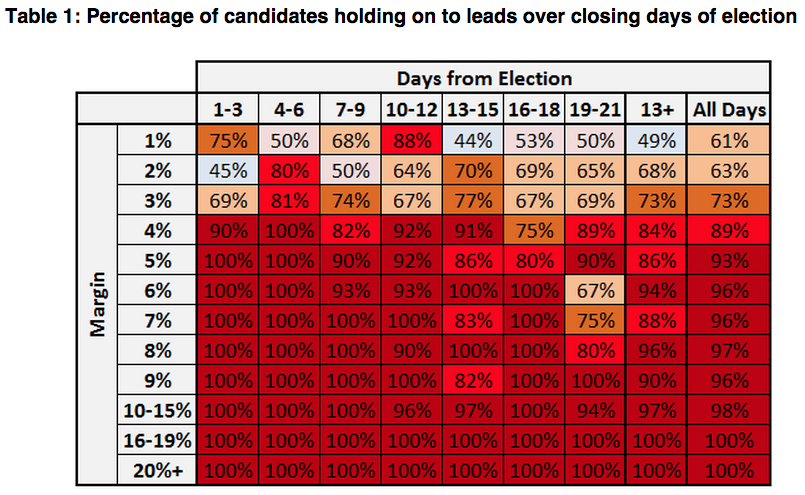
Sean Trende created the above table to answer a question: “At any given number of days out, if a candidate has a lead of a certain size, how often does that candidate win?”:

An example of how we would read this chart with respect to current polls: Assume that as we get polls from the North Carolina race that concluded Tuesday, Wednesday, or today, they confirm Sen. Kay Hagan’s (D) lead of roughly two points. Candidates who lead by two points 19-21 days out win about 65% of the time. So we’d conclude that Hagan is the favorite, but her lead is not insurmountable.

Like other poll watchers, he calculates that Republicans are favored to take the Senate:

To predict Democrats retaining Senate control, you basically have to bet on (a) Democrats sweeping South Dakota, Iowa, Colorado, and North Carolina; (b) picking off enough Republican seats in very red states like Kentucky, Kansas, or Georgia to offset any losses in (a) or; (c) systemic polling failure. You can make a plausible case for each of those scenarios, with (b) probably being the most likely. Regardless, given the current state of polling and knowing how races have behaved over the past few cycles, those really do appear to be the options left for Democrats.

However, the 538 forecast only gives Republicans a 60.1 percent chance of winning the upper house. Harry Enten explains:

How is that possible, even as some other models have seen Republican chances climb higher and higher? The FiveThirtyEight model is relatively conservative: It takes more evidence to convince the model a race has shifted and more evidence to convince it a state is totally out of play.

The model views a larger group of states as competitive compared to other forecasts. So movement in the more marginal battleground states — the Democrat solidifying his lead in Michigan, or the Republican pulling away in Kentucky, for example — matters more. If you consider those states as mostly out of play, the favorites improving their position there won’t affect your overall outlook as much.

Sam Wang speculates about the polls being off:

If every front-runner today were to win, the Senate outcome would be 52 Republicans and 48 Democrats and independents. But history tells us to expect two or three of the current leaders to lose. Democratic wins in the key states of Iowa and Colorado would give a 50-50 split, with Vice President Joe Biden breaking Senate ties in his party’s favor. (This assumes that Kansas independent Greg Orman would caucus with Democrats and the other independents, which is not a sure bet.) Of course, if the opposite were to happen North Carolinawith Republican Thom Tillis defeating Democratic Senator Kay Hagan, who leads narrowlythe GOP would end up with a convincing 53-47 majority.

Regardless, Americans aren’t paying much attention to the midterms. And Dylan Matthews observes that, “according to a Wall Street Journal/NBC poll, Americans are actually losing interest as the race progresses.”

Ebola In The Air

Amber Vinson, the second nurse to contract Ebola after treating Thomas Eric Duncan in Texas, took a commercial flight from Cleveland to Dallas on Monday, one day before she entered the hospital with symptoms. Now we learn that Vinson had called the CDC to ask whether she could fly – and wasn’t told not to:

CBS News reports that Vinson called several times before boarding the flight, and reported that she had a temperature of 99.5 degrees. She was allowed to fly because only a fever of 100.4 degrees or more is considered “high risk.” “I don’t think we actually said she could fly, but they didn’t tell her she couldn’t fly,” an anonymous federal health official told the New York Times. “She called us,” he said. “I really think this one is on us.” While her symptoms did not appear until she returned home, the CDC is interviewing the 132 passengers who flew with her on Monday.

Amy Davidson is none too impressed with how CDC Director Thomas Frieden has handled this situation:

His account of how Vinson got on the plane, related in the conference call on Wednesday, was at least evasive and, depending on what he knew and what exactly Vinson was told, may have been worse. He was asked three different ways if Vinson had been told not to fly, and each time dodged the question in a way that left the impression that Vinson was some sort of rogue nurse who just got it into her head that she could fly wherever she wanted. He talked about her “self-monitoring,” and that she “should not have travelled, should not have been allowed to travel by plane or any public transport”—without mentioning that his agency was who allowed it.

Dreher is alarmed:

Do you know how many people in Texas Presbyterian hospital became exposed to Ebola via Thomas Duncan?

According to the AP, “about 70.” How many people want to have anything to do with that hospital today? Doctors, nurses, staffers, they all have to show up there to work, but patients? Would you go to an appointment in that hospital right now, knowing how lax it was with the Ebola patient? … How many other patients in that hospital were exposed inadvertently through the nurses doing “normal patient care duties” after having been shat and vomited on by Duncan? Those patients, do we know their travel schedules? And on and on.

Kent Sepkowitz tries to calm everyone down:

Speaking of air travel, the single most important epidemiologic fact arguing for the public’s safety is this: Patrick Sawyer, the American who flew from Liberia to Nigeria while sick with Ebola, spread infection to absolutely no one who shared the plane with him. This information should go a long way to assuring those Frontier Airlines passengers who accompanied the second infected nurse from Cleveland to Dallas this week.

And still more: Spain, where a nurse caring for two repatriated patients dying of Ebola herself developed the disease, has not seen a second case related to these men’s care or the ill nurse’s, despite what has been reported by local groups as a complete lack of preparation and appropriate supplies to minimize the risk of transmission. Despite a raging, unconscionable epidemic in West Africa, no other cases other than Duncan have appeared unexpectedly outside of Africa. Europe: Zero cases. USA: No further cases three weeks since Duncan’s illness began. Obviously past performance does not predict future returns and the world is not out of the danger zone but for now, the infected traveler is a rare event.

And Alex Davies notes that “despite the common belief, airplanes are not flying petri dishes … because the air in the plane is much fresher than you may think, and constantly scrubbed by high quality filters”:

When the air is pulled into the grills in the floor, pilot Patrick Smith writes in Cockpit Confidential, about half is expelled from the plane. The rest is filtered and recycled with fresh air from the compressors. High efficiency particulate air filters, installed on every commercial airliner made since the late 1980s, remove up to 99.97% of all microbes, and “there’s a total changeover of air every two or three minutes,” Smith writes. According to the WHO, “under normal conditions cabin air is cleaner than the air in most buildings.”

The highest risk of catching something nasty from your fellow travelers comes when you’re sitting on the ground. The engines aren’t running, so fresh air isn’t being pulled in. That’s why WHO recommends airlines ensure “adequate cabin ventilation” during ground delays of 30 minutes or more.

In any case, the revelation has raised the possibility of an Ebola no-fly list and sent airline stocks falling:

As of 2:50 pm on Wednesday, no doubt in response to the news, virtually every major air carrier had seen its stock drop. Shares of American Airlines had fallen nearly 1.5 percent (though they have since recovered, and closed half a percentage point up on the day), Delta had dropped by almost 2 percent, United Continental had dipped by more than 3.6 percent on the day, and Spirit Airlines had tumbled by roughly 3 percent. The dip, though particularly pronounced today, actually spans back to the beginning of the month–tracking pretty closely with rising concerns about Ebola continuing to spread. 

Codifying Consent, Ctd

I haven’t weighed into the debate over California’s sexual consent law or the new regulations in many colleges, including my alma mater, Harvard, that defines any sex without vocalized continuous consent as sexual assault or rape. One reason is my lack of any real experience of male-female sex where the power dynamics can often be very different from gay sex. But what does concern me a great deal is the lack of any due process for the accused in these unfortunate and often deeply contentious circumstances. Mercifully, some of the faculty at Harvard – specifically the law school – have now risen up against what look to me like kangaroo courts, designed to instill fear into one gender alone. In an open letter, published in the Boston Globe, the law profs write:

Harvard has adopted procedures for deciding cases of alleged sexual misconduct which lack the most basic elements of fairness and due process, are overwhelmingly stacked against the accused, and are in no way required by Title IX law or regulation. Here our concerns include but are not limited to the following:

■ The absence of any adequate opportunity to discover the facts charged and to confront witnesses and present a defense at an adversary hearing.

■ The lodging of the functions of investigation, prosecution, fact-finding, and appellate review in one office, and the fact that that office is itself a Title IX compliance office rather than an entity that could be considered structurally impartial.

■ The failure to ensure adequate representation for the accused, particularly for students unable to afford representation.

Ezra Klein – in a remarkable column that we featured yesterday – actually defends the lack of due process as a positive aspect of the new regulations, because their inherent bias against accused men will create a climate of fear that is necessary to curtail male sexual violence and assault:

To work, “Yes Means Yes” needs to create a world where men are afraid … Critics worry that colleges will fill with cases in which campus boards convict young men (and, occasionally, young women) of sexual assault for genuinely ambiguous situations. Sadly, that’s necessary for the law’s success. It’s those cases — particularly the ones that feel genuinely unclear and maybe even unfair, the ones that become lore in frats and cautionary tales that fathers e-mail to their sons — that will convince men that they better Be Pretty Damn Sure.

Jon Chait and Charles Cooke both note the profound illiberalism here – and it’s enabled by the pomo gender ideologues who now control most discussion of sex and sexual identity in the academy. But what’s also impossible to ignore is how the social left is now trying to micro-manage what goes on in the bedroom with almost as much assiduity as the social right – and to do so in order to target one gender alone.

When all men are regarded as potential rapists, and when you have bought into the argument that the patriarchy is so entrenched that only radically illiberal procedures to punish, stigmatize and shame them will suffice, you have embraced a new Puritanism almost as troubling as the old. Play out this scenario: If a judicial process were set up that assumed that all women reporting sexual assault and rape were liars until somehow proven truthful, there would be an outcry. But if an identical judicial process is established that assumes all men accused of sexual assault and rape are guilty until proven otherwise – with no due process allowed – that is, apparently, a progressive move.

And it may well be a progressive move; but it sure isn’t a liberal or fair one. This does not mean that I don’t take the issue of sexual assault and rape seriously. In fact, it’s precisely because I do take it seriously that I’d support laws and regulations that allow real justice to be done, in which the accused have some basic right to defend themselves. The rest is a function of a leftist academic culture in which men are somehow inherently a problem; and almost anything is justified to make sure their “privilege is checked” and their gender stigmatized. At some point, the sexism inherent in this needs to be confronted as well.

A Virtual Physical

James Hamblin makes the case for telemedicine:

If some basic needs were addressed remotely, doctors could focus on more dire cases during their busy office hours. Patients could ask simple questions without needing to take an afternoon off work for an office visit. As of last year, only 12 percent of Americans had ever texted or e-mailed with a doctor, according to a survey conducted for The Atlantic. But about a third of people under 30 were open to having their primary communication with their doctors be online. …

Under the current model, doctors don’t see patients on an ongoing basis. As a result, a patient is inevitably getting advice from a doctor who, because she hasn’t seen what he looks like when he’s not sick, can’t tell whether he really “looks sick”—a gut valuation that remains crucial to effective primary care.

Yet, with the American Association of Medical Colleges projecting a national shortage of more than 90,000 doctors by 2020—especially in rural areas—there simply may not be enough doctors to provide this kind of ongoing care. Telemedicine could play a crucial role in addressing basic needs, particularly in settings where long-term relationships don’t come into play, like emergency rooms. Already, to take one example, a company called Avera Health makes physicians in cities available via video to hospitals in small towns, where they are remotely helping to staff emergency rooms overnight. (They work in concert with people who are on-site. So, for instance, a nurse might perform hands-on work at the direction of an onscreen doctor until a local doctor can arrive.)

Previous Dish on telemedicine, as applied to abortion, here. Update from a reader:

Haven’t we had telemedicine for like a decade now?

Heh. Another reader:

Personal anecdote: the Fortune 100 company I work for rolled out a telemedicine option (“free for 2014!”), so I tried it for a persistent cough I’ve had this week. The doctor told me that in most states you’re required by law to have a webcam, so the doctor can see you and look down your throat, I guess. After hearing my symptoms, she wrote a prescription to my local pharmacy for a strong cough suppressant. Pretty handy, huh?

I decided to get a second opinion. After being told to wear a mask in the office, the Nurse Practitioner did a nose swab (just as much fun as it sounds), diagnosed me with Influenza B, and signed me up for Tamiflu

I have an 18-month-old daughter. I’m sure telemedicine will have it’s place, but I’m gonna stick with the clinic for now.

Does Voter ID Inherently Discriminate?

Screen Shot 2014-10-15 at 12.48.54 PM

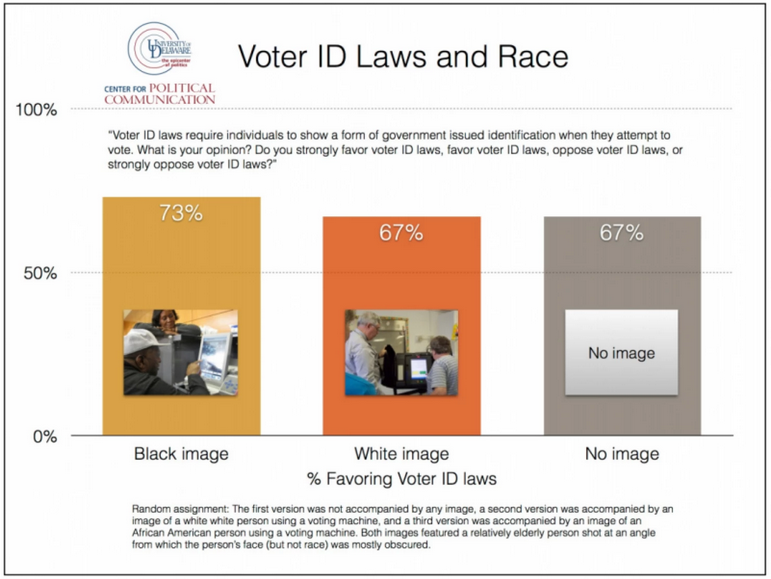
Dara Lind highlights a new study illustrating the subtle ways in which race influences white Americans’ opinions of voter ID laws:

The study, which was conducted by two University of Delaware professors and a Pennsylvania high school student, was fairly straightforward. It asked people whether they supported or opposed laws that required people to show a form of government-issued ID at the polls.  Some respondents were shown a picture alongside the question, of either a white voter or a black voter, and others weren’t shown a picture at all. The researchers found that black and Hispanic respondents were about equally likely to support or oppose the laws regardless of who was featured in the picture. And white respondents were as likely to support the law when they saw a picture of a white voter as they were when they saw no picture at all. But when the picture alongside the question showed a black voter, more whites supported voter ID .…

The study isn’t too surprising. Similar research has shown that whites are more likely to support harsh criminal justice policies, like stop-and-frisk, when they see images of or hear statistics about black prisoners. And voter ID is like stop-and-frisk in one important respect: it’s a race-neutral policy in theory, but in practice it ends up disproportionately harming people of color.

Bouie puts the study in context of a growing body of evidence that voter ID laws have discriminatory effects, even though that may not be their intent:

Likewise, a 2013 study from researchers Keith G. Bentele and Erin E. O’Brien found a tight relationship between race, Republicans, and voter ID. If a state elected a Republican governor, increased its share of Republican legislators, or became more competitive while under a Republican, it was more likely to pass voter ID and other restrictions on the franchise. Moreover, states with “unencumbered Republican majorities” and large black populations were especially likely to pass identification laws.

For Bentele and O’Brien, this comes down to partisanship. “These findings demonstrate that the emergence and passage of restrictive voter access legislation is unambiguously a highly partisan affair, influenced by the intensity of electoral competition,” they write. Even with the context of the other studies, I think this is right. Voter ID boosters don’t hold anti-minority animus as much as they want to maximize political advantage.

Chris Ingraham hopes the tide is turning against these laws:

The legal justification for voter ID laws stems from a 2008 Supreme Court ruling that the laws are generally applicable and nondiscriminatory, meaning that they’re not meant to reduce turnout among a particular group. But studies this year have demonstrated strong evidence for discriminatory intent behind the laws. The University of Delaware study adds to this body of evidence. It also seems that the judiciary is starting to agree: Courts have blocked the enactment of voter ID requirements in Wisconsin and Texas this year, citing these disproportionate impacts.

Even more notably, Judge Richard Posner, the Ronald Reagan appointee whose 2008 ruling in favor of voter ID was upheld by the Supreme Court, has had a change of heart. In a blistering opinion released last week, he concludes that the case for voter ID laws is at odds with the evidence.

Michael Hiltzik digs into Posner’s opinion and explains why it’s such a BFD:

Posner’s dissent in the Wisconsin voter ID case is especially telling, because he wrote the so-called Crawford decision in 2007 upholding Indiana’s voter ID law, in which he was upheld by the Supreme Court. But he has since recanted. In a 2013 book, he accepted the view that such laws are properly regarded as “a means of voter suppression rather than fraud prevention.” That’s the view that informs his latest opinion.

“There is only one motivation for imposing burdens on voting that are ostensibly designed to discourage voter-impersonation fraud,” he writes, “and that is to discourage voting by persons likely to vote against the party responsible for imposing the burdens.” More specifically, he observes, photo ID laws are “highly correlated with a state’s having a Republican governor and Republican control of the legislature and appear to be aimed at limiting voting by minorities, particularly blacks.” In Wisconsin, according to evidence presented at trial, the voter ID law would disenfranchise 300,000 residents, or 9% of registered voters.

On the other hand, Noah Feldman argues that Posner’s heart hasn’t changed – the evidence has:

A close reading of Posner’s opinion indicates that the judge hasn’t so much reversed his earlier view as he has taken seriously data that were unavailable in 2007. The numbers, as Posner now interprets them, do strongly suggest that the purpose of voter ID laws is to make it more difficult for poor people, especially blacks and Latinos, to cast votes. According to Posner, he wasn’t wrong in 2007. It’s just that then, there was no basis to assume that Indiana was trying to exclude minority voters. Now, there’s evidence in favor of that view.

HBO Cuts The Cord

Linda Holmes summarizes the news:

Beginning in 2015, HBO will offer a streaming service to cord-cutters and other nonsubscribers on an a la carte basis. It should be noted that the announcement HBO released to the media does not explicitly say the service will be HBO GO (or that it won’t), only that it will be “a stand-alone, over-the-top, HBO service.” And, of course, it doesn’t say how much the service will cost. It doesn’t even say it will carry every HBO show, let alone what archival material will be available — HBO GO has a lot. Those who are currently jumping up and down and declaring their independence from their cable provider may or may not be as happy when more details emerge.

The move, though, would seem to be a big one, given that requiring a cable subscription is standard on many services besides HBO that provide streaming access to cable programming (without requiring episode-by-episode purchase through services like iTunes or Amazon).

Derek Thompson imagines the target audience:

It seems that the audience most likely to pick up an HBO “Go-It-Alone” product today are mostly the young, lower-income Internet-savvy viewers who weren’t cable customers, anyway. That suggests that HBO Go-It-Alone will restrain cable’s growth by preventing new sign-ups, rather than hurt cable by creating more cord-cutters.

Brian Merchant declares that HBO has “killed cable”:

I’m not worried that the death of cable TV will deprive of us of future Mad Men. We’ve already seen that the likes of Netflix and Amazon are more than willing to pay for thoughtful, elaborate productions; Transparent is the best show I’ve seen this fall, and everyone seems to love House of Cards and Orange is the New Black. The shows themselves are still better than ever, hence the success of Walking Dead—which, by the way, counted plenty of internet users among its record-breaking viewership—and there’s indisputably a market for them. Now, plenty of niche shows may fall by the wayside without the help of subsidies from the big packages—but ultimately, I think that means less crappy TV and more time-wasting on the internet.

I’m planning on returning to internet-only TV. More and more people are following suit—the number of households without satellite or cable TV has grown 44 percent over the last four years. That oft-uttered phrase “Oh, I don’t have a TV” is no longer an affected hipsterism but a practical choice.

McArdle asks, “how much will this actually benefit cord cutters in the end? ”

At first blush, the answer is “a lot” — they can get HBO without paying for ESPN! Over the long term, however, as this becomes a bigger revenue source, I’d expect to see the cable networks stop selling their content to other streaming services, crack down on login sharing, and otherwise make sure that if you personally are not paying the cable company, then you personally will pay HBO, not your old roommate who forgot to change his password. I’d also expect to see them offer significant bonuses for longer-term contracts to discourage viewers from signing up, binging for a month or two, then moving onto some other network like harvesting crews moving north.

Zachary M. Seward checks in on the HBO-Netflix rivalry:

HBO now says it can easily pick up additional revenue in the US from people who don’t pay for TV but would subscribe to a standalone HBO package. It’s not yet clear how that will affect the rivalry with Netflix. They can certainly coexist, but more heated competition could put pressure on their prices. Netflix blamed its slower-than-expected subscriber growth on its price increased to $9 a month; HBO’s internet-only service is likely to cost significantly more than that.

James Poniewozik sees HBO’s big news as “a potentially exciting development for TV viewers tired of watching their cable packages swell into bloated, gold-laden barges of tied-together offerings topping $200 a month”:

If big player HBO sees that it can offer a cable-free package and survive, that may lead the way for companies in other pricey TV sectors–live sports, for instance–which you’ve had to agree to buy a giant cable package to get.

Along those lines, CBS announced its own stand-alone web subscription today:

The new “CBS All Access” service, costing $5.99 a month, is the first time that a traditional broadcaster will make a near-continuous live feed of its local stations available over the web. … In a notable carve-out, National Football League games will not be available on the service. CBS executives said they now are in discussions with the N.F.L. and that other live sports already are available for streaming. A similar service from Showtime, the premium cable network owned by CBS, is likely in the “not too distant future,” [CBS CEO Leslie] Moonves said.


Ebolanomics

Screen Shot 2014-10-15 at 12.23.13 PM

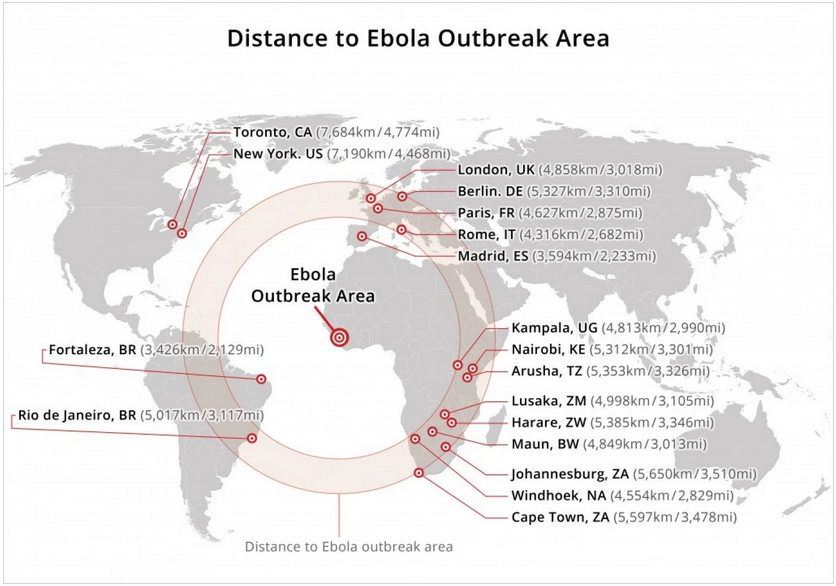
Kim Yi Dionne and Laura Seay discuss how Ebola panic – coupled with ignorance of geography – is doing economic damage to African countries thousands of miles away from the outbreak:

Estimates of the economic damage to be caused by Ebola are as high as $33 billion. Whatever the ultimate cost, everyone agrees that Guinea, Sierra Leone, and Liberia’s economies will be deeply and negatively impacted. Much of that damage is likely unavoidable because people in heavily affected countries engage in “aversion behavior” — or taking actions driven by fear alone (e.g., employees not going to work for fear of being exposed to Ebola).

But this Ebola outbreak is wreaking havoc on African economies beyond the three most heavily affected by Ebola, and that damage is completely avoidable.

The East and Southern African safari industry provides a good example. Bookings for safaris there — including for the famed Great Migration in Kenya and Tanzania — have plummeted due to the Ebola outbreak. In a survey of 500 safari tour operators, SafariBookings.com found a majority of respondents had a decrease in bookings and an increase in cancellations. These actions are based in fear, not reality. We are faced with risk every day, and would be better suited to understand our relative risks if we appreciated where in the world some places are.

Ylan Q. Mui zooms in on Liberia, where the epidemic threatens to turn back the clock on the economic progress the country has made in recent years:

With critical public works projects in limbo and businesses struggling, the virus is threatening Liberia’s chance to escape generations of poverty and join Africa’s rising prosperity. “Liberia was moving,” said Estrada Bernard, chairman of the International Bank in Liberia and the Liberian president’s brother-in-law. “The whole thing hinges upon how well we can get this virus under control.” The best-case scenario compiled by the World Bank predicts Liberia’s economic growth will still plunge by more than half this year. Rubber, one of the nation’s biggest exports, is expected to fall 20 percent this year. Gold and diamond mining have also dropped off. Beer production plunged 30 percent during the first quarter.

And that’s not to mention the human toll of the virus in a country that currently has 2.3 million fewer boxes of sterile examination gloves than it needs. Worse still, Abby Haglage reports, thousands of children have been orphaned in the epidemic:

Of the more than 8,000 people infected with Ebola in West Africa, an estimated 20 percent of them are under the age of 18. Without solid health or proper nutrition, the chances of recovery in this demographic are even lower than for the epidemic at large. “Three out of four of children infected with Ebola in West Africa are dying—that’s a 75 percent mortality rate,” says [Save The Children president and CEO Carolyn] Miles. “These kids are already malnourished, they’re not in the best of health. They’re just not able to survive this.”

Those that do survive, or are lucky enough to have escaped infection, meet a shadowy future. According to data from UNICEF, upwards of 3,700 children have lost one or both parents to Ebola in Sierra Leone, Guinea, and Liberia thus far. Miles, who met with four different groups of orphans in Liberia on her visit, suspects the number is much higher. “I think there are thousands we don’t even know about,” she says.