Nature Is Free

Well, that’s not quite right. But as of next month, the journal’s sister publication Nature Communications will be. In light of the news, The Economist deems the rise of open-access academic publishing “unstoppable”:

All seven of Britain’s research councils, for example, now require that the results of the work they pay for are open-access in some way. So does the Wellcome Trust, a British charity whose medical-research budget exceeds that of many scientifically successful countries. And by 2016 every penny of public money given to British universities by the government will carry the same requirement.

Elsewhere, the story is the same.

In 2013, after years of wrangling in America’s Congress, the White House stepped in to require federal agencies that spend more than $100 million a year on research to publish the results where they can be read for free. Countless universities, societies and funding bodies in other countries have similar requirements.

Publishers, though they have often dragged their feet, are adjusting. This week the oldest, the Royal Society, and arguably the most prestigious, Nature Publishing Group (NPG) – both based in London – joined in. Each will now publish a journal that readers do not have to pay to look at.

Fiona Rutherford lauds Nature‘s move:

Receiving over 1,500 submissions a month, Nature Communications is one of NPG’s fastest growing titles. It first launched in 2010 as a digital journal, publishing both subscription content and open access. Last year, the Thomson Reuters’ Journal Citation Report ranked it third among all multidisciplinary science primary research journals, behind the multi-disciplinary Science and Nature. … For researchers who choose not to publish open access, quality is usually their main concern. Therefore, the decision for Nature Communication to fully embrace the idea by offering more options is a huge step in the right direction for the progression of scientific communication.

Face Of The Day

Secret Service Director Julia Pierson Testifies To House Committee On Recent Security Breaches At White House

Secret Service Director Julia Pierson prepares to testify to the House Oversight and Government Reform Committee on the White House perimeter breach at the Rayburn House Office Building on September 30, 2014 in Washington, DC. Pierson is giving an account of an incident involving a security breach at the White House after a man jumped the fence and was not subdued until after he had entered the mansion, deeper into the building than what it was previously reported. By Chip Somodevilla/Getty Images.

“Yes Means Yes” Becomes Law

On Sunday, Jerry Brown signed California’s controversial affirmative-consent bill. Amanda Marcotte welcomes the news:

This means that during an investigation of an alleged sexual assault, university disciplinary committees will have to ask if the sexual encounter met a standard where both parties were consenting, with consent defined as “an affirmative, conscious and voluntary agreement to engage in sexual activity.” Notice that the words “verbal” or “stone sober” are not included in that definition. The drafters understand, as most of us do when we’re actually having sex, that sometimes sexual consent is nonverbal and that there’s a difference between drunk, consensual sex and someone pushing himself on a woman who is too drunk to resist.

She calls out what she views as “misrepresentations of the bill,” explaining:

The law has no bearing on the vast majority of sexual encounters.

It only applies when a student files a sexual assault complaint. And all it does is help the disciplinary board craft its line of questioning to get to the important facts. Now, instead of starting the investigation by asking if the victim said no—and how she said no and whether her no was good enough to get her out of unwanted sex—the investigation focuses on the actions of the accused. Example questions could include, “Did she want to have sex with you?” or “Did she want to do everything you two did?”

Maya Dusenbery is really encouraged by the new law:

This paradigm shift has been a long time coming and is desperately needed. The idea that mutual desire, not the mere absence of “no,” should perhaps be the standard for an activity that’s generally agreed to be pretty fun hardly seems radical. And there’s nothing that makes me sadder about the state of our sexual culture than the fact that this bill was met by such resistance.

Others, including some on the left, are more skeptical. Michelle Goldberg is among them:

The law might force couples into dialogue about their desires—obviously a good thing—but it’s hard to see how that alone will address rape. It is, after all, a right-wing canard that acquaintance rape cases tend to stem from misunderstanding rather than predation. Research at one campus by the scholars David Lisak and Paul M. Miller shows that most rapists are serial offenders who have committed other acts of violence as well. “This portrait is more consistent with the data on recidivism among sex offenders than with the still-prevalent image of a male college student who, under the influence of alcohol, mistakenly crosses the line between sexual pressure and rape,” they write. Yet California’s law treats the campus rape crisis as a communication problem, even as it blurs the parameters of what sexual assault is.

Laurie Essig also objects to the law:

Like the antiporn laws, “yes means yes” is a bad romance between feminism and the state for two reasons: pleasure and danger. The statute equates good sex with a legalistic definition of consent rather than with the pleasures had by the parties involved. It also expands notions of criminality at a time when the criminal-justice system is regularly committing horrific acts of race- and class-biased violence.

Freddie piles on:

Even the people who show up in my comments to advocate for these policies seem to have little confidence that they will actually make it easier to prosecute sexual assault, rather than make it more confusing, more messy, more ambiguous, and more likely to produce abuse or evasion. Many who support these policies seem to do so out of a desire to be deeply committed to opposing sexual assault in an abstract sense, rather than out of the sincere conviction that these policies will reduce sexual assault in fact.  It’s not enough to want to prevent rape; you’ve got to articulate why a reduction in rape is the most likely outcome of the adoption of these policies.

The controversy seems perfectly indicative of the enduring question for today’s left: are we in the business of being good or the business of doing good?

Meanwhile, Amanda Hess illustrates how the culture of “yes means yes” is spreading – to an absurd extent, in this case:

Here’s how [the new app] works: After deciding that you would like to have sex with someone, launch the Good2Go app (free on iTunes and Google Play), hand the phone off to your potential partner, and allow him or her to navigate the process to determine if he or she is ready and willing. “Are We Good2Go?” the first screen asks, prompting the partner to answer “No, Thanks,” “Yes, but … we need to talk,” or “I’m Good2Go.” If the partner chooses door No. 1, a black screen pops up that reads “Remember! No means No! Only Yes means Yes, BUT can be changed to NO at anytime!” If he or she opts instead to have a conversation before deciding—imagine, verbally communicating with someone with whom you may imminently engage in sexual intercourse—the app pauses to allow both parties to discuss. …

When I tried this process out with a partner, it took us four minutes to navigate through all the screens, mostly because he kept asking, “Why are we using an app for this?” and “Why do I have to give them my phone number?” (More on that later.) I was confused, too: As the instigator, I wasn’t asked to confirm that I wanted to have sex or to state my own intoxication level for my partner’s consideration. (A promotional video modeling the process begins by announcing how “simple” it is, then snaps out instructions for three minutes, but questions remain.)

Perhaps the process is deliberately time-consuming: The app provides the “opportunity for two people to pause and reflect on what they really want to do, rather than entering an encounter that might lead to something one or both will later regret,” the app’s FAQ reads. Or maybe I’m just old: At 29, I find it much easier to just talk about sex than to use an app for that.

A Warm Welcome For Narendra Modi, Ctd

A reader writes:

The United States should feel some pressure to enhance relations with India and Prime Minister Modi. Chinese President Xi Jinping visited India this month andUS-INDIA-DIPLOMACY-MODIsigned signed three pacts meant to boost trade and investment between the two nations. Setting aside the economic impact, the visit indicated a significant trend in two ways: It was the first time India has welcomed a Chinese head of state with a public reception since the Sino-Indian War in 1962. The leaders were said to have had an easy chemistry and seem to be looking to ease border tensions through the pragmatism of economic trade. The other aspect worth noting is that the trade pacts weren’t signed in Delhi, setting aside the tradition of making international agreements in the capital. Prime Minister Modi’s tenure as Chief Minister of the western state of Gujarat saw rapid industrial growth. He clearly was aiming to highlight the impressive development the region has made since 2001.

The Obama Administration’s outreach toward the new Prime Minister has been circumspect. There was an understandable caution given Modi’s unabashed Hindu nationalism and the Gujarat religious riots in 2002. However, a détente between India and China would certainly complicate Obama’s “Asian Pivot”. The diplomatic dance over waivers on the Iranian sanctions certainly hasn’t helped matters. The “champagne and roses” probably aren’t a bad idea.

On a shamelessly self-promoting note, I recently covered these matters in their relation to the burgeoning Asian space race. There has been a good deal of discussion about India’s recent success with the Mars Orbiter, Mangalyaan. India is the only country to have delivered on its first Mars mission. There is undeniable prestige that comes with besting China and Japan in the race to Mars. However, this has overshadowed another important development from President Xi Jinping’s trip to India: There was an agreement to forge a closer bond regarding space activities. If this does indeed come to fruition, there would be tremendous consequences for the commercial space industry and for the geopolitical balance in Asia.

But Shikha Dalmia is worried about the fate of Indians under Modi:

The Obama administration has been working to normalize relations with Modi – as it must and should – now that he is the duly elected leader of the world’s most populous democracy. As such, the White House singled him out for a dinner with the president (although Modi declared that he won’t eat anything because he’s observing a nine-day religious fast, a flamboyant display of his fabled austerity).

But such quiet gestures were not enough for Modi who has the autocrat’s instinct to be the star attraction. His gaudy displays – literally unprecedented for visiting leaders – are not merely unbecoming. They are also deeply disturbing, because they highlight Modi’s need for self-aggrandizement. That does not bode well for the massive economic decentralization – the hands-off approach – that he himself touted as essential for offering a decent standard of living to all Indians. Maybe he’ll learn to keep a lid on this tendency as he grows in office. Right now, however, it seems to pervade his economic decisions, making even many of his cheerleaders nervous about his ability to lead India’s socialist, centrally planned economy to a free-market one.

Pankaj Mishra also views the prime minister with concern:

One of Modi’s political feats is to have tapped into the complex insecurities of rising Indians with his potpourri of fantasies tinged with defiant, if under-educated, Hindu nationalism. Thus, climate change, on which India rejects all compromise, can be tackled with the help of yoga, as he put it in his speech at the United Nations, and India, which was a “golden bird” before being enslaved for a thousand years by foreigners (read Muslims and the British), will regain its glory with “make in India” manufacturing. …

It’s not too early to worry about the pernicious fallout from the ambition to turn India into a golden bird in double-quick time. For Modi’s plan to redeem India’s thousand years of slavery through labor-intensive manufacturing may be about as realizable in these days of increasing automation as Mao Zedong’s project of overtaking America’s industrial production by making steel in backyard furnaces. Scapegoats are already being sought in India just three months after Modi’s ascent. A member of Modi’s own coalition protested last week that while “discrimination and the distrust of the Muslim were covert” in the past, “now the gloves are off and the hatred is in-your-face.”

But Reihan Salam isn’t counting Modi out. He focuses on how Modi “attracted 19,000 cheering fans to a rally in Madison Square Garden on Sunday”:

There are no guarantees that Modi’s strategy will work. To become a manufacturing powerhouse, India will have to reform its ridiculously stringent labor laws, which are very much the third rail of Indian politics, and spend vast sums of money on roads and power plants and all of the other basics of industrialization. This will be an issue, as the Indian bureaucracy is famously terrible at spending money wisely.

If Modi succeeds, however, India will do more than alleviate poverty, important though that is. It will become the “big, powerful country” of Naipaul’s dreams—the kind of place that can afford to ignore Pakistan, its hostile, dysfunctional neighbor, and that won’t get pushed around by China. So you can see why Modi attracted support not just from India’s urban middle class, but also from hundreds of thousands of people of Indian descent in countries around the world, including the United States: He is promising that all of these people will be able to walk a little taller in a world that has long dismissed India as a land of “hunger and snakes.”

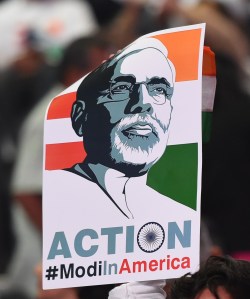
(Photo: A crowd of US-based supporters await the arrival of Prime Minister Narendra Modi of India for a community reception September 28, 2014 at Madison Square Garden in New York. By Don Emmert/AFP/Getty Images)

Foodies Are Fools

The evidence mounts:

Paying $27 for a burger might seem extortionate. But the chefs behind the most expensive burger in Washington, D.C. – a wagyu skirt steak burger at BLT Steak – can take comfort in new research suggesting that inflated prices can translate into inflated enjoyment:

new paper, forthcoming in the Journal of Sensory Studies, has found that we enjoy food more if we spend extra money on it. A team of researchers at the Cornell Food and Brand Lab, led by David Just, carried out an experiment on 139 unwitting diners at an Italian restaurant in upstate New York. Customers were charged either $4 or $8 for an all-you-can-eat lunch buffet of pizza, salad, breadsticks, pasta, and soup; the researchers stopped them on their way out and asked them to fill out a short questionnaire on the amount they ate, the quality of the pizza, and their enjoyment of the whole experience. Diners who paid the higher price rated the whole lunch more highly, and judged the pizza more favorably on measures of taste, satisfaction and enjoyment. “The way people appreciate taste,” said Just, is tied into “expectations based on the presentation of the food or what other people have said. They interpret taste through that lens.”

Update from a reader:

I may be a foolish foodie, but the phenomenon Alice Robb describes is, I think, that of the Veblen Good, whereby the demand for (the conspicuous consumption of) a thing is driven by its price. That must surely be universal across any luxury category, so at least we foodists (my preferred term) are in good company.

A Sunny Energy Future

Rebecca Leber spotlights two reports suggesting that “the world could be largely powered by the sun, instead of coal, within decades”:

The reports come from the International Energy Agency (IEA). It focuses on two kinds of solarthe kind that’s commonly seen installed on homes and businesses in the U.S. (solar photovoltaic) and the kind that generates heat to power (solar thermal). Within 35 years, according to the reports, they could account (respectively) for 16 and 11 percent of the world’s electricity generation.

It wouldn’t be easy to get to this level. Today, solar accounts for less than 1 percent of global energy consumption and 0.2 percent in the United States. To hit the levels IEA projects, there would have to be substantial investment upfront. But advances in technology, in addition to taxpayer subsidies, have helped solar panel costs come down some 80 percent in the last five years. If the IEA is right, costs may shrink another 65 percent by 2050.

Dave Roberts highlights the fact “that solar costs are plunging so fast that even the stodgy IEA is scrambling to keep up”:

At virtually every point in time over the last several decades, IEA has been behind the curve, underestimating the growth of renewables. Raise your hand if you think this is the last time it will reassess and upgrade solar’s potential contribution.

Relatedly, Brad Plumer analyzes the fight between solar and electric utilities. The core issue:

Rooftop solar generation has roughly tripled since 2010. By some estimates, a new solar system is installed every four minutes in the United States.

To electric utilities, this poses a dilemma. As rooftop solar becomes more popular, people will buy less and less electricity from their local power company. But utilities still have plenty of fixed costs for things like maintaining the grid. So, in response, those utilities will eventually have to raise rates on everyone else. Trouble is, those higher electricity rates could spur even more people to install their own solar rooftop panels to save money. Cue the death spiral.

Sound far-fetched? This was the doomsday scenario laid out by the Edison Electric Institute, an industry trade group, back in January 2013. Even a relatively modest increase in rooftop solar power could cause havoc. David Crane, CEO of NRG Energy, has called these trends “a mortal threat to the existing utility system.”

China vs #OccupyCentral

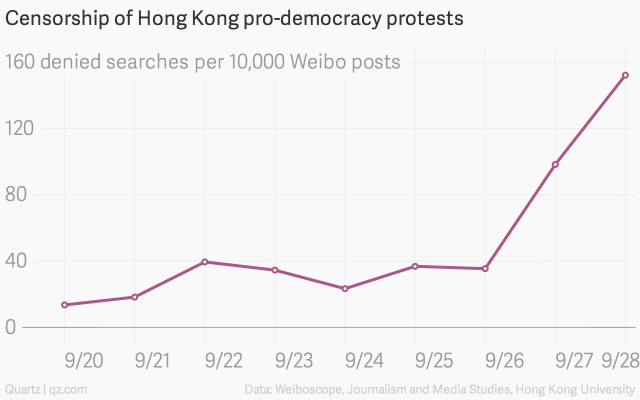
censorship-of-hong-kong-pro-democracy-protests-permission-denied-per-10-000-weibo-posts_chartbuilder

Beijing’s censors have been working overtime to scrub coverage of the Hong Kong protests from social media:

Weibo censorship hit its highest point this year at 152 censored posts per 10,000, according to Weiboscope, an analytics project run by the University of Hong Kong. (“Hong Kong” and “police” were the day’s top censored terms.) To put that in perspective, the Sept. 28 censorship rate was more than double that on June 4, the 25th anniversary of the crackdown on the Tiananmen student movement — an event so meticulously censored in both traditional and social media that many of China’s younger generation are largely ignorant of the event. …

Despite 2014’s many politically sensitive and potentially destabilizing events — including a March 1 terrorist attack at a busy train station, the July 29 announcement of an investigation into former security watchdog Zhou Yongkang, and the Sept. 23 sentencing of prominent Uighur scholar Ilham Tohti on charges of separatism — the three most censored days on Weibo nevertheless all related to Hong Kong. Beijing’s official rejection on August 31 of open nomination of candidates in Hong Kong came in second, while the annual July 1 pro-democracy march in Hong Kong took third.

Alexa Olesen monitored the reaction after China blocked Instagram on Sunday:

A handful of Chinese Weibo users blamed the Hong Kong protestors for getting their Instagram service axed. But many Chinese appeared oblivious to the situation in Hong Kong, unsurprising given the current mainland news blackout on the escalating situation and the scrubbing of Weibo messages that mentioned Hong Kong. Weibo also was blocking searches for the keyword “Instagram,” forcing users to resort to calling the service “Ins” in order to grouse about the shutdown.

Most mainland Chinese still likely know nothing of the Hong Kong protests, now continuing into the early hours of the morning. But online chatter about the Instagram blackout could backfire on Beijing, leading otherwise indifferent Chinese web users to feel the personal impact from events transpiring far away — and to begin asking why yet another popular online tool has, at least for now, been taken away.

And Lily Kuo looks at how Chinese netizens are getting around the censors:

Bloggers are findings ways to get around the censors by searching for the English transliteration of blocked Chinese phrases—substituting “xianggang” for Hong Kong or “zhanzhong” for “Occupy Central,” for example. Entering a space in between the two Chinese characters for Hong Kong is another way around the restrictions, [Chengdu resident] Li said. Censors are adapting swiftly. Searching for the phrase “zhanzhong” already prompts a notice on Weibo that results cannot be displayed. Even posts critical of the protesters are being removed, including a comment that read, “So violent like this, and you tell me you want democracy. I don’t want this kind of democracy!” was deleted.

(Chart via Lily Kuo)

Going Viral

Kalev Leetaru considers the role that online data – even blogs – could have in halting diseases like Ebola:

It turns out that monitoring the spread of Ebola can teach us a lot about what we missed — and how data mining, translation, and the non-Western world can help to provide better early warning tools.

Earlier this month, Harvard’s HealthMap service made world headlines for monitoring early mentions of the current Ebola outbreak on March 14, 2014, “nine days before the World Health Organization formally announced the epidemic,” and issuing its first alert on March 19.  Much of the coverage of HealthMap’s success has emphasized that its early warning came from using massive computing power to sift out early indicators from millions of social media posts and other informal media.

As one blog put it: “So how did a computer algorithm pick up on the start of the outbreak before the WHO? As it turns out, some of the first health care workers to see Ebola in Guinea regularly blog about their work. As they began to write about treating patients with Ebola-like symptoms, a few people on social media mentioned the blog posts. And it didn’t take long for HealthMap to detect these mentions.”

The unfortunate flip side:

But there was some great news today:

Update: Some not-so-great breaking news:

Meanwhile, Maryam Zarnegar Deloffre assesses the latest US role in combatting the Ebola epidemic – boots on the ground:

Last week, President Obama announced the deployment of the U.S. Africa Command (AFRICOM), which will set up a joint force command in Liberia to coordinate the activity of 3,000 U.S. forces; expedite the transportation of equipment and supplies; and train an estimated 500 health-care workers per week. …

The AFRICOM and UNMEER missions are not your typical militarized humanitarian intervention. Defining the Ebola crisis as a human security issue is a game changer. There is no conflict in the West African countries most heavily affected by Ebola (at least not yet), thus the security threat highlighted by the UNSC is a threat to people and their humanity — the right to life with dignity. Humanity is a universal principle, one that transcends and orders all the other humanitarian principles, one that NGOs, states and international organizations can all get behind. Viewed through this lens, it is no wonder that NGOs, such as Doctors Without Borders, that typically refuse to work with national militaries are calling on militaries to provide logistical support to address the Ebola epidemic.

Ezra, in an interview with the director of the CDC, underscores the connection between West Africa and the US:

Ezra Klein: One thing that has been striking here is the degree to which weak health-care systems in poor countries can be a real threat to rich countries. How should we think about that?

Thomas Frieden: Yes. We are all at risk. But it’s not health systems so much as public-health systems. Do you have a system in place to find when there’s a cluster of unexpected illness, whether it’s Ebola or MERS or SARS or the next HIV? Do you have a system in place to get the lab tests done? Do you have trained disease investigators?

This is not going to come by creating some great global entity to do all this for us. We need to build the capacity of countries to find, stop, and prevent global health crises. We are all vulnerable to the weakest link in the chain. And it is not that expensive to strengthen those links. But it does mean you need to train public-health workers. It does mean you need a lab-reporting network. It means you have more than a public-health system you pull out in case of emergencies. It means you have one you’re using every day to fight disease, and so you can scale it up in the event of an emergency.

Follow all our Ebola coverage here.

Parody For Profit

David Hajdu charts the rise of the satirical music video:

Song parodies now generate more revenue than official videos, according to YouTube data provided in the 2014 Annual Report of the International Federation of Phonographic Industries (IFPI), a music-recording trade group. While YouTube once discouraged parody videos on the dubious grounds of copyright infringement – its attorneys must have skipped the readings on Berlin v. E. C. Publications in law school – YouTube now welcomes music parodies, because it has figured out how to make money from them. YouTube is helping record companies and rights administrators to hit up parodists (and others who employ copyrighted music in their content) for licensing fees.

He finds himself ambivalent about the genre. On the one hand, parody amounts to “critique in creative form, and as such it provides a service essential to society”:

These benefits are real and important, particularly at a time when mainstream popular music is subjected to so little serious criticism, and when serious criticism has so little traction in mainstream culture.

On the other:

There is something disconcerting about the dominance of parody in the YouTube musical sphere today. The true purpose of parody is the making of jokes rather than the making of critique. The final test of a parody is its ability to get laughs; it is not the depth, nor even the accuracy, of its insights.