How Do You Enforce An Abortion Ban?

That has always been the question hovering around abortion politics – and the pro-life forces have often danced around it. My general sense is that doctors would be penalized in some way, while adoption policies would be greatly expanded – because many pro-lifers are against the best defense against abortion there is, contraception. But executing the mother? At first I thought this was a joke of some sort – or had some context I was missing:

And for some reason, this is the treatment Williamson has in mind:

I have always found Williamson – even when I’ve disagreed with him – a stimulating writer. And maybe this sentiment is simply a function of Twitter wars getting out of hand. But it seems to me, as a leading writer for National Review, he needs to articulate how his favored abortion scheme would work with the hanging of sinful women. How would they be found guilty of using Plan B, for example? What kind of police state would be required? And as for hanging, why not stoning? Williamson is, indeed, as he puts it, old-fashioned.

What Are Ted Cruz’s Chances?

Yesterday, I wrote, “I expect Cruz to run, and I would not be surprised if he won.” Jonathan Bernstein, on the other hand, gives him the “longest odds” of any “viable candidate”:

Not just because he’s an irresponsible demagogue, or because he’s made enemies in the Senate. And not just because he’s almost certainly a weaker general election candidate given that he’s by far the one most likely to be perceived by voters as an ideological extremist. The biggest reason Cruz’s nomination bid would be unlikely to succeed is that Republican party actors mostly identify him with the October 2013 government shutdown, which, apart from a small number of radicals, is perceived as a hugely damaging unforced error. Remember, not only were Republicans widely blamed for the shutdown, it also had the side effect of distracting the press from the disastrous first weeks of the Obamacare exchange rollout. Even party actors who are itching to nominate a real conservative after suffering through Mitt Romney and John McCain (and in many cases having decided that George W. Bush was no conservative after all) are unlikely to choose a candidate whose strategic judgment has proved to be suicidal for the movement.

But Michael Tracey isn’t writing off Cruz. One reason:

I would implore all readers to watch a full Ted Cruz speech if he or she has not already. The man is simply a performative marvel. He manages to strike some sort of preternatural balance between fiery Southern Baptist sermon and stand-up comedy routine, invariably bringing crowds to their feet. In the era of the tweet-sized soundbite, Ted Cruz’s mastery of the one-liner and the pun are not trivial; they are integral to his success.

Another factor:

In the post-Citizens United landscape, traditional donor class support is becoming less and less important. Multi-billionaire casino magnate Sheldon Adelson was able to bankroll Newt Gingrich’s 2012 presidential bid as nothing more than a personal vanity project. Gingrich went onto win the South Carolina primary. That unpredictable dynamic will only have been heightened by 2016. Ted Cruz may be disliked by elements of the GOP elite, but he doesn’t have to rely on their support to prevail, as likely would have been the case in years past.

Instead, Cruz can lean on what I’ll term the “para-establishment”—a constellation of advocacy groups, media entities, individual mega-donors, and others who have long ago thrown their lot in with Cruz.

Allahpundit imagines how the primaries might shake out:

Cruz isn’t really running against the entire field, at least in the early states. He’s running against Paul. If he can finish ahead of Rand in Iowa and New Hampshire, the thinking goes, conservatives who prefer Rand will abandon him as a lost cause and line up behind Cruz for South Carolina. If Cruz can get to that point, he’ll take his chances against the centrist champion, no matter who it is. If it’s Jeb, Cruz will add an anti-dynastic note to his broader “return to Reagan” message. If it’s Romney, he gets to pound Mitt for having blown his and the GOP’s chance of regaining the White House once before. And if it’s Christie, he’ll count on the right’s disdain for the big guy plus Christie’s personal abrasiveness to alienate voters. All of which makes me wonder if the donor class won’t decide to skip those three and back Rubio instead.

Treating The Anti-Vaccine Moment With Kindness

Amanda Schaffer contemplates Eula Biss’s new book about vaccination:

Biss sympathizes with parents who fear vaccines, and she understands the cultural roots of their hesitation, which include an insistence on bodily independence; an obsession with physical purity, free from chemicals; and even a kind of pre-industrial nostalgia that casts vaccines as newfangled and SWITZERLAND-HEALTH-EBOLA-WAFRICAunnatural. She focusses on the historical antecedents to today’s shots, complicating the view that immunization is modern and therefore scary. In the eighteenth century, farmers observed that those who were exposed to cowpox tended not to develop smallpox later on. The physician Edward Jenner tested this connection by transferring fluid from a milkmaid’s pustule to the skin of a young boy, who then developed immunity to smallpox. Historical figures, including Cotton Mather, Mary Wortley Montagu, and Voltaire, championed the practice of variolation, in which individuals were infected with a mild form of smallpox to protect them from a more severe version of the disease.

If variolation had been more widely practiced in France, Voltaire wrote, “twenty thousand persons whom the smallpox swept away at Paris in 1723 would have been alive at this time.” Biss acknowledges that these practices were far less safe than the highly regulated shots administered in pediatricians’ offices today. Yet she seems to take comfort in the idea that “vaccination is a precursor to modern medicine, not the product of it.” But even if shots against some childhood diseases, like measles, mumps, rubella, and polio, have not changed substantially in recent decades, the leading edge of vaccine development—against pandemic flu, cancer, or Ebola, for instance—benefits enormously from advances in genetics and immunology.

Despite some misgivings, Schaffer sees an advantage to the book’s tone:

Biss’s gracious rhetoric and her insistence that she feels “uncomfortable with both sides” of the rancorous fight may frustrate readers looking for a pro-vaccine polemic. Yet her approach might actually be more likely to sway fearful parents, offering them an alternative set of images and associations to use in thinking about immunization.

Mark Oppenheimer has mixed feelings about the book:

Biss comes not to rail against the vaccine skeptics, but to understand them. She is pro-vaccine, but she’s not an op-ed writer: she’s a high-style essayist, elliptical like Joan Didion, aphoristic like Susan Sontag, familiar like Anne Fadiman. Biss comes down on the side of science and reason, but in such an MFA-ish fashion that maybe some of the educated white women who are, alas, the main constituency for anti-vaccine nonsense, will be persuaded that they can trust Biss. Because she either has no animus toward those parents who withhold vaccines from their children, or because she hides that animus so very wellshe’s a grandmaster of judgment-withholdingthis may be the perfect book to hand to that mother or father of a newborn who is on the fence.

But if Biss has scored a minor success, we still have to bemoan that she succeeded where public science education failed. Vaccinating children should not be up for debate, so to read an elegant, incisive book that takes the debate seriously is bound to be an ambivalent experience. This is a book fair to both sides of a debate that, among people who know the evidence, does not exist. That there’s a market for it makes it a curiosity, a time-capsuled bit of evidence for a hysterical fad that surely must pass.

(Photo: A statue representing a child receiving a injection of vaccine is seen at the World Health Organization (WHO) headquarters on September 5, 2014 in Geneva. By Fabrice Coffrini/AFP/Getty Images)

A History Of Neglected Teeth

Olga Khazan considers why the ACA and most Medicaid plans don’t cover dental care:

The partition between dentistry and the rest of medicine dates back to the dental profession’s roots as an offshoot of hairdressing.

Until the 1800s, barbers served as rudimentary dentists, pulling painful teeth and lancing abscesses after they finished trimming whiskers. In earlier centuries, people would see barbers for occasional bloodletting (thought to be therapeutic at the time)—hence the red-and-white striped pole. If there was a flesh wound, the barber could also play surgeon in a pinch. He, after all, was the one with the sharp knives.

“In the early days of medicine, surgery and medicine were two distinctly different professions,” says Burton Edelstein, a professor of dental medicine and health policy at Columbia University and founder of the Children’s Dental Health Project. “This is before anaesthesia, so surgery was rough. It was not regarded as sophisticated.” …

This minimization of dentistry persisted when Congress was crafting the public health insurance programs in the 1960s. During the original 1965 formulation of Medicaid, the dental market wasn’t very robust and policymakers didn’t value it as highly as other forms of medical care, Edelstein says. In 1960, only 2.3 percent of Americans had some kind of dental insurance.

“Both Easy And Difficult To Look At”

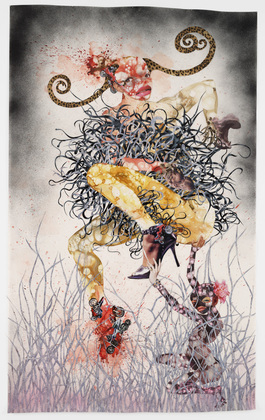
Teju Cole also describes the work of artist Wangechi Mutu as “seductive in their patterning, grotesque in their themes”:

[Mutu] calls herself “an irresponsible anthropologist and irrational scientist.” Charged with historical misuses of science, her images Mutu_Hundred_Lavish_Months_of_Bushwhack_2004underscore the way female bodies can act as measuring devices of any society’s health. Her women respond to their environments with both intelligence and agony. Some are skinless, the rush of veins and colours alarmingly visible. Many are powerful, muscular, lithe, in heels, half-cyborg at times, often erotic, sometimes dangerous. Some are influenced by real women: Sarah Baartman (the so-called Hottentot Venus who was shown in European fairgrounds), Josephine Baker, Eartha Kitt, Grace Jones and Tina Turner. It’s an all-star line-up of black women who had fiercely ambiguous relationships with the racial and gender tropes imposed on them.

Mutu’s work is sensual, delighting in the materiality of its media (paper, paint, mica, wool, Mylar). Seen in a gallery, the organic forms, hybrid anatomies, wild hair, machine-like forearms, delirious patterns and compound eyes coalesce in a way that no digital reproduction can quite match. And what is true of the pictures is doubly true of the sculptures and installations, which also make use of smell and sound: dripping bottles, fermenting wine, rotting milk.

The Best Of The Dish Today

Ted Cruz, some supporters are arguing, is dead-set on a presidential campaign for 2016 and determined to make foreign policy his focus. It does not appear, it would seem, that this comes from a long mulling over the state of the world today, but instead as a response to the current very Republican-friendly re-animation of the post 9/11 hysteria about Jihadist terror that Josh has now noted. And his position is not neoconservative. He has no illusions about the ability of developing countries, especially in the Middle East, to find a way forward to democratic stability with American help. And so he would be as skeptical as I am that Obama’s new war in Iraq will somehow prod the sects there to overcome their differences and construct a functioning broad-based government. Instead he just wants to bomb the crap out of places from the air – or engage in massive military efforts to quell enemies – and then run away. Or, in his words:

“If and when military action is called for, it should be A) with a clearly defined military objective, B) executed with overwhelming force, and C) when we’re done we should get the heck out. I don’t think it’s the job of our military to engage in nation-building. It is the job of our military to protect America and to hunt down and kill those who would threaten to murder Americans. It is not the job of our military to occupy countries across the globe and try to turn them into democratic utopias.”

Well, I’m with him on that last p0int. But I’m not sure that the “rubble makes no trouble” paradigm really works in practice. If you’re dealing with Islamist terror, brutal bombing raids, which would inevitably involve civilian casualties, could very well provoke more resistance, more anti-Americanism and more terrorism. Even an occupation designed to quell an insurgency, as in Iraq from 2004 – 2010, failed to do that. And such a policy would be very hard to sell to allies – as even the current containment policy toward ISIS suggests. Then there’s his softer belligerence: much tougher sanctions against Russia and Iran. As if sanctions against the one government policy supported by the Iranian people – a peaceful nuclear program – would somehow resolve the problem. Or as if Obama hasn’t done both those things already.

But I expect Cruz to run, and I would not be surprised if he won. In the current mood – with the right returning to outright panic over Islamism, despite no terror attacks from any of the putative deadliest foes – the atavistic strain is tumescent. The GOP base wants revenge and bombs and bombast – preferably against Muslims. And the symbol of all this will be Greater Israel – the state that bombs its enemies with ruthless abandon, and with no apology. Just as Obama has adopted the Likudnik policy of “mowing the lawn” in the Middle East, Cruz will take that even further. The world will be our Gaza!

Today, I wondered whether the administration cared any more about whether a terror threat was imminent or non-existent before going to war against it; I tried to makes sense of the president’s apparent conviction that the Shi’a, Sunnis and Kurds will at some point decide they love Iraq more than they hate each other; I outed John Oliver as a journalist; and Jake Weisberg penned a tart review of Rick Perlstein’s history of the right. Man, I miss Jake’s writing.

The most popular post of the day remained this Chart Of The Day on how successive recoveries have benefited the rich more and more; followed by this reflection on how envy kills mid-life friendships.

Many of today’s posts were updated with your emails – read them all here.  You can always leave your unfiltered comments at our Facebook page and @sullydish. 24 more readers became subscribers today. You can join them here – and get access to all the readons and Deep Dish – for a little as $1.99 month. Gift subscriptions are available here. Dish t-shirts and polos are for sale here. A new subscriber writes:

Just wanted to let you know, I’ve been wanting to subscribe to The Dish for what seems like ages now, but promised myself I wouldn’t until I found a job (internships notwithstanding). Well, I finally found one! So, after getting my first paycheck and a credit card, it seemed about time to ante up. There was only one last hurdle: being told I was “part of the smartest, most diverse and open-minded community on the web,” without throwing up. You might as well put up a sign, “You must be this pretentious to enter.”

But subscribing to The Dish is a big deal to me. I’ve wanted to do it for so long. Because of the deal I made myself, it’s come to signify that I’m actually going somewhere in my life, that I finally have some income I can dispose of. So I was thrilled for this to be the first purchase made on my new card.

We’re all as thrilled as our slightly nauseated reader.

See you in the morning.

Dunham, Reviewed

Reviews are in for Lena Dunham’s new essay collection. Helen Lewis focuses on Dunham herself, and her advantaged upbringing:

DunhamDunham’s first appearance in print came in 1998, when Vogue story on New York tweens quoted her thoughts about big-name fashion designers“I really like Jil Sander, but it’s so expensive”and her attempts to re-create them on a $5-a-week allowance. She was 11.

Within five years, she was already on her second appearance in the New York Times, after a reporter was despatched to a vegan dinner party she gave for her private-school friends. “A crunchy menu for a youthful crowd”, records the headline. The 16-year-old Lena found that “meat was easy to give up, cheese, almost impossible.” But: “One year into a totally vegan diet, she has become a soy connoisseur.”

Not exactly the kind of up-bringing I had. I was munching on liver and bacon and mash and gravy at that point – and loving it. Lewis does eventually get to the book itself:

This book is emphatically not a feminist polemic. There is one chapter where she imagines the memoir she’ll write at 80, in which she will name the names of all the creepy male directors who have propositioned her, and one letter (in a collection of “emails I would send if I were one ounce crazier/angrier/braver”) that smacks of real, rather than posturing anger, at having her feminism derided. But everywhere else, perhaps from a desire to separate art from activism, the focus is relentlessly inward. (Her sister, Grace, is arranging for representatives of Planned Parenthood to campaign at events on Lena’s book tour; the book does not mention abortion.)

She writes in the book: “When I am playing a character, I am never allowed to explicitly state the takeaway message of the scenes I’m performingafter all, part of the dramatic conflict is that the person I’m portraying doesn’t really know it yet.” The same applies to most of the book: Her whole life is a performance art piece where she plays a noxious brat with great skill, and poses herself, either eerily like one of her mother’s dolls, or sexually, like her father’s nudes. And as the carapace of fame around her has expanded, she has shrunk within it, leaving only gnomic statements about granola and blowjobs. Reading this book, you realize that Lena Dunham has been playing “Lena Dunham” for a long time. She is not real.

Michiko Kakutani, for her part, refuses to conflate Dunham with her “Girls” protagonist:

In fact, the differences between Ms. Dunham and Hannah help fuel this book. A young woman in search of a comic road map to love and sex and work and “having it all” would hardly benefit from consulting the self-sabotaging Hannah (or, for that matter, Marnie, Jessa or Shoshanna) for advice. But the author of this memoir — that’s another matter. Ms. Dunham doesn’t presume to be “the voice of my generation” or even “a voice of a generation,” as Hannah does in the show. Instead, by simply telling her own story in all its specificity and sometimes embarrassing detail, she has written a book that’s as acute and heartfelt as it is funny.

Jessica Kasmer-Jacobs agrees that Dunham isn’t Hannah, but not about the quality of the book:

What surprised me most about Ms. Dunham’s memoir is that one of the funniest voices of my generation has written a book that isn’t very funny. …

One suspects that Ms. Dunham did not quite know what she wanted this book to be. It reads like a memoir, divided by sections titled “Love and Sex,” “Body,” “Friendship,” “Work” and “Big Picture,” but it is packaged like a self-help book, something of a nostalgic tribute to Helen Gurley Brown’s “Having It All” (1982), the Cosmopolitan editor’s “passionate program” for “women who won’t settle for less than the best.” Ms. Dunham harbors a respect for Gurley Brown, she reports, despite what she calls the latter’s “demented theories” on attracting men, family planning and crash dieting, “which jibe not even a little bit with my distinctly feminist upbringing.” Herself “a girl with a keen interest in having it all,” Ms. Dunham says she feels obliged to pitch in with “hopeful dispatches from the frontlines of that struggle.”

Laura Miller shares her views:

“Not That Kind of Girl” is a book in which stories peter out. The advice theme wanders off and gets lost in the long grass. There is a strong chapter on Dunham’s relationship to her younger sister, followed by a pointless and predictable list of things she likes about New York. Some passages are general when they need to be specific and others are close-ups when they need to pan out to take in a bigger picture.

Contrary to what some critics might assert, self-absorption per se isn’t a deal-breaker in a writer. It has worked for everyone from Saint Augustine to Anne Sexton. But it requires a particular form of discipline, an ability to distinguish signal from noise that Dunham has yet to achieve on her own. I’m not sure I want her to, at least not yet, because while she lacks Allen’s precision, she exceeds him in courage and vulnerability by miles. The most fascinating bits of “Not That Kind of Girl” are the handful that describe Dunham’s approach to her work, the revolutionary, liberating way she has used her own naked body (not to mention her naked psyche) as “simply a tool to tell the story.” What she doesmatters more to her than anything she can merely be, which is millennia of traditional femininity turned on its head, granny panties showing, right there.

The Enduring Appeal Of Bullshit

Meet the

Brendan Nyhan considers why absurd claims spread so quickly on the Internet:

[T]ake the bizarre but instructive example of the woman who claimed to have had an implant to add a third breast – clearly an example of an implausible story that was too good to check. Initial reports circulated widely on social networks, totaling over 188,000 shares according to Emergent’s data. The story was quickly discredited after it was reported that a three-breast prosthesis had been previously found in the woman’s luggage, but the articles reporting that it was false never attracted even one-third as many shares as the initial false reports.

That hoax may seem silly, but it’s instructive about the problem with rumors –  they’re often much more interesting than the truth. The challenge for fact-checkers, it seems, is to make the facts as fun to share as the myths they seek to replace.

(Screenshot from the New York Post)

Not Minding The Gap

Alice Robb discourages excessive gender-gap-awareness:

The “bike gap” is the latest in a small spate of “gender gaps” that don’t seem worth our concern. At New York’s “The Cut,” Ann Friedman says women don’t feel “at home in the world of weed.” It’s not entirely clear that Tracie Egan Morrissey, writing for Jezebel, is joking when she urges women to “close the gender gap on being potheads.” She cites research suggesting that nearly twice as many men smoke weed (or at least admit to it). The only possible explanation, according to Morrissey, is sexism. “When it comes to cultural representations, it’s generally accepted that the world of weed is a guy thing,” she writes. …

“No one bemoans the gender gap in female dominated activities,” points out journalist Jessica Grose in an email. “Where are the men in knitting or flower arranging?” Or, for that matter, where are the men in Soul Cycle? Marcotte admits that indoor cycling is dominated by women; she estimates that women make up “80 to 100 percent” of most spin classes. Yet she sees no problem.

Friedman dissents:

Closing a gender gap for the sake of closing the gap is going about it all backwards. Usually gaps are symptomatic of other problems. It is important to interrogate why a gap exists, and address that problem. I don’t think you can argue that women are naturally less interested in cycling or video games or weed than men are—our choices are shaped by the culture and society we live in. That society is pretty sexist!

Instead of looking at the world with all its many group differences and appreciating that, one kind of liberal sees it all as a problem to be fixed. Let me just reiterate my own view: vive la différence! Amanda Marcotte agrees with Friedman:

I don’t think the fact that men smoke more pot than women is a problem, in and of itself, that needs fixing. But the fact that men don’t feel guilty about firing up a joint and playing Call of Duty while women think they should be spending that time on “worthwhile” activities perhaps bears a little more interrogation.

Michael Barone inserts evolutionary theory into the debate:

There are salient differences between men and women, on average, as the natural result of the evolutionary process, and those differences are reflected in different behavior and different career choices, again on average. We want a society where people can make the choices they want, but we fool ourselves if we think that in such a society men’s and women’s choices would be statistically indistinguishable.

Ya think?