Is Baseball A Religion?

As October nears, George Will answers the question this way:

Part of the beauty of baseball, and sport generally, is that it doesn’t mean a damn thing. It’s valued for itself. Now, it can be the pursuit of excellence. dish_baseballprayer It is competition tamed and made civil by rules. It is aggression channeled in a wholesome direction. These are all virtues. They tiptoe up to the point and stop well short of giving baseball meaning. It’s a game. It’s a very pretty, demanding, and dangerous game.
I do think that baseball satisfies a longing in people, particularly urban people. There is a vestigial tribal impulse in all of us. For instance, when you get on the L and the cars begin to fill up with people wearing their Cub blue and you’re all going to the same place for the same reason, for about three hours a little community exists. It disperses after three hours, but it will come back tomorrow.

Daniel Patrick Moynihan talked about what he called the “liberal expectancy.” He said that with the coming of modernity the two drivers of history, religion and ethnicity, would lose their saliency. Sport caters to this and entertains this desire for group identification. But there’s nothing transcendent about baseball.

Update from a reader:

George Freaking Will and baseball? Seriously? Any post about Will and baseball should be accompanied by this SNL skit.

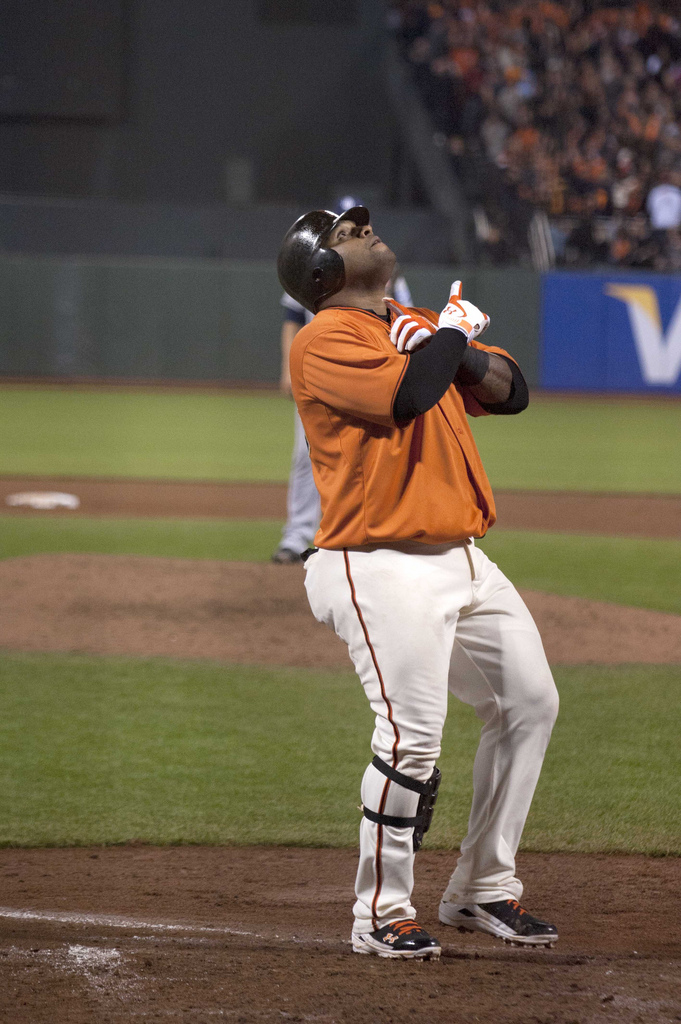
(Photo from 2012 Giants-Padres game by Joel Henner)

Poor Choices

Linda Tirado, author of Hand To Mouthexplains why the poor often make terrible decisions:

I smoke. It’s expensive. It’s also the best option. You see, I am always, always exhausted. It’s a stimulant. When I am too tired to walk one more step, I can smoke and go for another hour. When I am enraged and beaten down and incapable of accomplishing one more thing, I can smoke and I feel a little better, just for a minute. It is the only relaxation I am allowed. It is not a good decision, but it is the only one that I have access to. It is the only thing I have found that keeps me from collapsing or exploding.

I make a lot of poor financial decisions. None of them matter, in the long term. I will never not be poor, so what does it matter if I don’t pay a thing and a half this week instead of just one thing?

Dreher, who was initially sympathetic to Tirado, had second thoughts after a reader dug up a 2013 hit piece on her. In an interview with Danielle Kurtzleben, Tirado defends herself against such attacks:

DK: You were accused of being a hoax after that “Poverty Thoughts” essay came out. Is that flaring up again now, with your book coming out? What’s your response to all that?

LT: I’m a published author at this point, and The Nation did a very, very good job of reporting on that. But most of the criticism I’ve seen centers around my decision-making processes. What I see a lot of is people talking about like things I have to explain — like why did you do this or why did you do that? A lot of people are confused about how I couldn’t, for instance, feed myself when I could pay my electric bill.

The Guardian also caught up with Tirado:

[Q.] Were you expecting what happened after your essay was published?

[A.] Oh, God, no! I was just on a message board. I was just talking to my friends the same way I’d done for many years. Then I went to bed, and then I went to work. It took me about two weeks to realise I was awake because I was pretty sure I was having a really fucked-up dream. There is no processing what happens when the internet looks at you and says: it’s your turn. It was insane: people were outside my house, they were calling my elderly relatives, I got 20,000 emails in a week. I still have no idea why it was this piece at this moment; it’s nothing me and my friends haven’t been saying for years. I don’t understand why it was controversial. Period.

Meanwhile, Andrea Louise Campbell, author of Trapped In The Safety Net: One Family’s Struggle, shares another harrowing story of poverty:

In February 2012 my sister-in-law Marcella was in a car accident on her way to nursing school, where she was working towards a career which she hoped would catapult her and my brother Dave into middle-class security. Instead, the accident plunged them into the world of American poverty programs. Marcella is now a quadriplegic, paralyzed from the chest down. She needs round-the-clock personal care and assistance.

The only source – public or private – for a lifetime of such coverage is Medicaid. But because Medicaid is the government health insurance for the poor, she and my brother must be poor in order to qualify. (Medicare does not cover long-term supports and services, and private long-term care insurance is time-limited and useless to a 32-year-old who needs decades of care). Thus, Marcella and Dave embarked on a hellish journey to lower their income and shed their modest assets to meet the state limits for Medicaid coverage.

To meet the income requirement, my brother reduced his work hours to make just 133 percent of the poverty level (around $2,000 per month for their family). Anything he earns above that amount simply goes to Medicaid as their “share of cost” – a 100-percent tax.

Face Of The Day

HONG KONG-CHINA-POLITICS-DEMOCRACY

A man takes a picture with his mobile phone of a pro-democracy protest on Nathan Road, a major route through the heart of the Kowloon district of Hong Kong, on September 29, 2014. Police fired tear gas as tens of thousands of pro-democracy demonstrators brought parts of central Hong Kong to a standstill on September 28, in a dramatic escalation of protests that have gripped the semi-autonomous Chinese city for days. By Alex Ogle/AFP/Getty Images.

Take It As Unread

Mallory Ortberg kicks offToast thread by coming clean about the books and TV shows she’s only pretended to know:

I will get the ball rolling: I have never seen The Wire. I have seen the pilot for Friday Night Lights three times and the pilot for The West Wing four; I have never seen any other episode for either show. I have never gotten more than three chapters into Lucky Jim because it wasn’t funny and also I hated it. At least two separate friends have lent me their cherished copies of Mary McCarthy’s The Group and I have returned their copies to both of them unopened. I have never read Octavia Butler and I’ve gone for so long without admitting it, I don’t know how I’ll get on after confessing. …

I have read two Chelsea Handler autobiographies. This is not germane to the topic, but I felt the need to confess. I read the first half and the last chapter of The Brothers Karamazov but skipped most of the important stuff. I do not know if I have ever read Camille Paglia. I have a vague idea of who she is — in my mind she is a little bit connected with Fran Leibowitz? — and I know a lot of my friends get mad about her. That’s pretty much it.

I have never read Infinite Jest. I have done my best to give the impression that I have in conversation without ever actually making outright claims, but I have not read even a single word of David Foster Wallace’s fiction. I have never read A Tree Grows In Brooklyn, and I do not believe that I ever shall.

The Case For Slow And Steady

Olga Khazan explains why being in a hurry can be so counterproductive:

Do you park in the first spot you see, even if it means a longer, grocery-laden walk back from the store later? When unloading the dishwasher, do you quickly shove all the Tupperware into a random cabinet, thereby getting the dishes-doing process over with faster—but also setting yourself up for a mini-avalanche of containers and lids?

In a recent study published in Psychological Science, Pennsylvania State psychologists coined a new term for this phenomenon: Precrastination, or “the tendency to complete, or at least begin, tasks as soon as possible, even at the expense of extra physical effort.” … Why do we do this? Holding a goal in our minds taxes our working memory, the authors write, and just doing something—anything—allows us to dump that memory faster. Last year my colleague Julie Beck explained how this works with unpleasant experiences: We’ll want to get it over with faster in order to lessen our feelings of dread.

A Gloomy Take On Global Democracy

John Gray finds a sobering message in Francis Fukuyama’s latest book, Political Order and Political Decay, about what it takes to make democracy work:

One of the merits of this ambitious and wide-ranging book is that it recognises the daunting difficulties of creating an effective state – democracy’s most essential precondition. ‘Before a state can be constrained by either law or democracy’, Fukuyama writes, ‘it needs to exist. This means, in the first instance, the establishment of a centralized executive and a bureaucracy.’ Much of the book is a catalogue of the vicissitudes of state-building, and Fukuyama recounts in impressive detail the disparate results in countries such as Prussia, Italy and the United States. Part of the book is given over to examining semi-failed states, with an instructive chapter devoted to Nigeria. Here Fukuyama’s analysis is incisive: ‘Lack of democracy is not the core of the country’s problems.’ What Nigeria lacks is ‘a strong, modern, and capable state … The Nigerian state is weak not only in technical capacity and its ability to enforce laws impersonally and transparently. It is also weak in a moral sense: it has a deficit of legitimacy.’

In some ways Political Order and Political Decay may be Fukuyama’s most impressive work to date. The upshot of his argument is that functioning democracy is impossible wherever an effective modern state is lacking. Since fractured and failed states are embedded in many parts of the world, the unavoidable implication is that hundreds of millions or billions of people will live without democracy for the foreseeable future. It’s a conclusion that anyone who thinks realistically is bound to accept. It’s also a view that runs counter to nearly all currents of prevailing opinion. Perhaps it’s not surprising that Fukuyama – who is not known for challenging ruling orthodoxies – makes little of this aspect of his analysis. At the same time, it is a conclusion that is hard to square with his continuing talk of ‘the globalization of democracy’.

A Warm Welcome For Narendra Modi

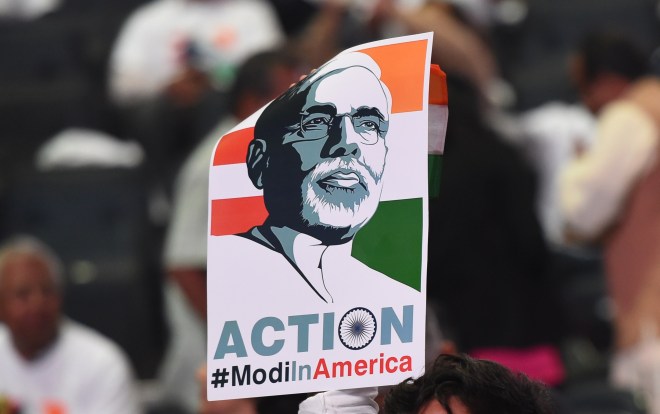
US-INDIA-DIPLOMACY-MODI

The prime minister of India, who was once denied entry to the United States for apparently turning a blind eye to deadly anti-Muslim riots during his tenure as chief minister of Gujarat, will be meeting with President Obama at the White House tonight. Somini Sengupta considers the significance of Modi’s visit:

Mr. Modi is visiting at a time when India and the United States are each seeking big things from the other. Theirs was supposed to be what Mr. Obama once called the defining “partnership” of the 21st century. The relationship has withered since then, though, and both Washington and Delhi are trying urgently now to repair it, showering each other with the diplomatic equivalent of Champagne and roses during Mr. Modi’s five-day visit to America.

He has met with two mayors and three governors, and more than two dozen members of Congress attended his event at [Madison Square] Garden. He is scheduled to meet on Monday with 11 chief executives from companies like Boeing, Google and Goldman Sachs, and then to speak at the Council on Foreign Relations. An intimate dinner is planned with Mr. Obama on Monday (though Mr. Modi’s aides have let it be known that he is fasting for a Hindu festival called Navratri), as well as lunch on Tuesday at the State Department and tea with Speaker John A. Boehner. His itinerary also includes a meeting with Hillary Rodham Clinton.

Raghav Bahl argues that “Modi’s rapid transformation from persona non grata to esteemed White House guest signals a momentous shift, not only in India’s prospects but also in its relationship with the United States”:

Despite India’s long-time policy of non-alignment, Washington has fitfully pursued a closer strategic partnership with Delhi over the past decade. China’s runaway rise and the scourge of large-scale Islamic terrorism have pushed the United States and India into unprecedented strategic cooperation, erasing years of political differences, mistrust, and miscommunication. An economically robust India could muster the confidence and gravitas to become the assertive strategic ally the U.S. has always hoped for. When CNN’s Fareed Zakaria asked Modi, in his first post-election interview, whether such a relationship was possible, the prime minister responded firmly: “I have a one-word answer: Yes.”

Adam Lerner believes that Modi “could turn out to be a tremendous boon to Washington, so long as the relationship doesn’t turn sour”:

Should India emerge from the inflation and slowed growth of the past few years and become an Asian dynamo, its success will inherently promote the oft-stated American goal of a vibrant, growing and democratic continent. In the long run, the biggest threat to unfriendly regimes in the region is not the U.S. military—it is a democratic, secular and growing India, embodying fully the ideals that framed the country’s independence in 1947. Modi provides a fresh start for Indians after the last administration’s corruption and indecision. So long as he avoids the sort of counterproductive Hindu nationalism that many fear is in his bones, there is reason to be optimistic that Modi could help fulfill this promise.

However, Rebecca Leber notes that the US and India may find themselves butting heads on climate change:

When President Barack Obama said “nobody gets a pass” on fighting climate change in a speech last week, he might as well have been speaking directly to India. India’s willingness to reduce greenhouse gases is a major wild card in negotiations for a global climate treaty next year. It’s difficult to imagine a meaningful agreement that doesn’t include some kind of commitment from what is, after all, the country with the second largest population in the world. But Indian officials haven’t been very enthusiastic about the prospect. Just a day after Obama spoke, India’s environment minister Prakash Javadekar told the New York Times“What cuts? That’s for more developed countries.”

Addressing those differences will be a major topic of discussion on Monday, when Obama and newly elected Indian Prime Minister Narendra Modi hold their first-ever meeting in Washington. It’s easy to see why India’s emissions are so important. India is already the world’s fourth-biggest polluter — after China, and the U.S., and European Union combined.

Meanwhile, William J. Antholis puts Modi’s visit to the US in the context of his four-month “diplomatic whirlwind”:

First, he invited leaders from neighboring Pakistan, Sri Lanka and Bangladesh to his inauguration – amidst tense relations with all three.  He then set off to a summit with Japan’s Shinzo Abe and hosted a state visit by Australia’s Prime Minister Tony Abbott. Mr. Modi seemed intentionally to be setting the stage for his two most important summits – welcoming China’s Xi Jinping to India last week, and then travelling to the United States this week to attend the UN General Assembly meetings and then meet with President Obama.

Across the country – north, south, east and west – his election has uncorked an intoxicating optimism. His summer of summitry has been popular because trade and economics have been his core message. In my own recent trip across India in early September — traversing six cities in 12 days – I met with government officials, BJP and Congress Party members, business leaders, journalists, policy analysts, academics and students. Even Mr. Modi’s opponents concede that the nation’s mood is changed, and many are willing to help seize the moment to advance India’s future, at home and abroad.

In contrast, Hartosh Singh Bal isn’t so taken by Modi:

In India, there is already evidence that his political honeymoon is over. One of the few polling agencies to monitor voter sentiment in the country continuously, Cvoter, has aggregated the answer over time to the question: “Which party can best manage/handle problems facing our country today?” Since Modi was sworn in as India’s prime minister in late May, the levels of trust in his ruling Bhartiya Janta Party (BJP) have declined rapidly to where they were a month before the elections, and the BJP—after a national victory that ensured one-party parliamentary rule in India for the first time since 1984—has lost a series of important local elections. The party appears to have misread the votes it got in May as support for its far-right nationalistic tendencies, rather than its economic priorities.

(Photo: A crowd of US-based supporters await the arrival of Prime Minister Narendra Modi of India for a community reception September 28, 2014 at Madison Square Garden in New York. By Don Emmert/AFP/Getty Images)

Poseur Alert

“Actually, there was one time I had graduate students participate with the inmates in a joint reading of Michel Foucault’s Discipline and Punish. I got permission from the prison administration to have fifteen students come, and the prisoners prepared punch and cookies for our meeting, and we just sat down together and talked Foucault. We had also read Goffman’s Asylums and one other book in that vein, and the interesting thing was that in discussing each of those books, the Foucault in particular, the inmates were very upset about the construction of subjectivity, the way in which institutions create a subjectivity,” – Michael Hardt.