Why Chinese Cops Are More Dangerous Now

In the wake of March’s Kunming train station terrorist attack, in which 33 people died, the Chinese government decided to provide guns to the country’s previously unarmed patrol officers. William Wan warns that “the flood of newly armed police — combined with poor training and the government’s take-no-prisoners attitude – could become as fearful a problem as the terrorism it is intended to combat”:

China’s removal of a ban on police guns came in response to a gruesome attack on a train station several hundred miles from here, but it has given the police almost blanket authority to shoot whenever they see fit. … In the latest police-related violence, at least 40 people died [two Sundays ago] in China’s restive Xinjiang region, according to state-run news media, which attributed the incident to terrorists and identified the deceased as “rioters” shot by police or killed in explosions. By contrast, the sleepy village of Luokan is about as remote and unlikely a place for terrorism as can be found. Yet when police fatally shot a man recently in the middle of a busy market here, they declared him a terrorist as well and abruptly closed the case.

Wan and Xu Jing observe that many newly armed officers express “a surprising aversion” to their guns:

“I’ve never liked guns,” said one nine-year veteran. Until this year, guns were forbidden to most police – except for SWAT units and teams on special missions. “Even in past special operations, when we were ordered to have guns, I let co-workers take them instead. You have to worry about it misfiring, about it getting stolen or someone dying improperly.”

A retired officer from Hangzhou City suggested there’re tricky issues of pride at play. In the past, police were praised for daring to confront criminals without firearms, he said. And whenever bad guys got away or a situation spiraled out of control, police could always fall back on the excuse that they were unarmed, unlike police in many countries. “Now that they have guns, they’re in a tighter spot,” said the retired officer. “If you shoot, the public may question whether it was necessary. If you don’t, they may say, ‘You can’t even control criminals with the power of  a gun?'”
Quote For The Day II

This embed is invalid


“Well, I think there’s going to be a generational challenge. I don’t think that this is something that’s going to happen overnight. They have now created an environment in which young men are more concerned whether they’re Shiite or Sunni, rather than whether they are getting a good education or whether they are able to, you know, have a good job. Many of them are poor. Many of them are illiterate and are therefore more subject to these kinds of ideological appeals. And, you know, the beginning of the solution for the entire Middle East is going to be a transformation in how these countries teach their youth. What our military operations can do is to just check and roll back these networks as they appear and make sure that the time and space is provided for a new way of doing things to begin to take root. But it’s going to take some time … But in the meantime, it’s not just buy them time, it’s also making sure that Americans are protected, that our allies are protected …

With the allies, with their ground troops, and if we do our job right and the Iraqis fight, then over time our role can slow down and taper off. And their role, reasserts itself. But all that depends, Steve. And nobody’s clearer than I am about this. That the Iraqis have to be willing to fight. And they have to be willing to fight in a nonsectarian way. Shiite, Sunni and Kurd alongside each other against this cancer in their midst,” – president Obama, Sixty Minutes.

Well, if anything can calm me down, it’s this no-drama president carefully explaining what his strategy is. It’s not about transforming the Middle East, or unseating Assad, or directly intervening to try and achieve in the future what we couldn’t achieve in the past. It appears to be about minimally containing the threat of Jihadist networks so as to create some space for “a new way of doing things to begin to take root”. This is, as Krauthammer put it, containment-plus.

But the same worries persist. What if it becomes impossible to roll back a network like ISIS? What if air bombing campaigns – with civilian casualties – actually galvanize ISIS and empower it with a new global identity with which to draw recruits? What if the broken Iraqi state can never be put back together as a multi-sectarian democracy? What if a “new way of doing things” is actually decades in the future? Are we really going to be bombing for decades? And in how many countries does that formula apply?

The key thing for the president is that the Iraqis fight in a non-sectarian way.

But we already constructed a multi-sectarian government, we already trained a massive Iraqi army, we already ousted a Shiite prime minister – and there are precious few signs of such non-sectarian fighting, least of all in a region now convulsed in either a cold or hot Shi’a-Sunni war. A couple weeks ago, the Iraqi parliament could not overcome sectarian divisions to fill the interior and defense ministries even as an insurgency was nearing Baghdad! If they cannot get there in a real emergency, what chance if the Americans are busy saving their collective asses?

I can see what the president would like to happen. But even he implies it won’t happen for a long, long time. Which means we will be bombing for exactly that long time. And there are unintended consequences to all such wars which he doesn’t even seem to contemplate. Those are my worries – an indefinite military commitment, with no way to achieve the underlying changes that would end such a commitment, with the real possibility of blowback.

The Natural Gas Hype

Natural Gas

Rebecca Leber deflates it:

If you thought of natural gas as a useful “bridge fuel” to help America transition from dirty to clean energy, a new study published in Environmental Research Letters has some disappointing news: Natural gas won’t cure our greenhouse-gas affliction. Rather, the study finds, abundant and cheap gas would cause people to consume more electricity, and since gas competes directly with renewables, it will delay the transition to clean power. The result: natural gas does not noticeably lower emissions.

Brooks Miner adds that “natural gas does have a dark side: It is composed primarily of methane, which has a much stronger climate-warming effect than carbon dioxide.”

Quote For The Day

“Some would say, it is not fair or it is unjust to deny same-sex partners the civil “right” to marry. In reality, it is not unjust at all because marriage and same-sex unions are essentially different realities. Justice actually requires society to maintain its long standing definition of marriage. To uphold God’s intent for marriage, in which sexual relations have their proper and exclusive place, is not to offend the dignity of homosexual persons. Of course, a central issue with many same-sex partners are the social benefits that are received through marriage … In trying to think of an analogous situation that could cause a pastor to deny Communion, one might think of an involved Catholic parishioner who was then ordained as a Protestant minister. They would likely be acting according to their sense of conscience and they would probably be a very good person, but they would have broken their communion with the Catholic Church in a very fundamental way,” – Bishop Michael Warfel of Montana, explaining why he stripped an elderly gay couple of their communion after they got a civil marriage license.

My italics. One wonders how a Protestant minister would be able to attend mass regularly at a local Catholic church as well. The hierarchs had better find a better analogy than that – and I wonder if they actually can. Heterosexuals can privately commit sodomy all the time within a public marriage and never arouse any suspicion of scandal; devout gays who simply want to protect themselves in civil marriage – and who are in their sixties and seventies – have no such lee-way.

Which is to say that the church is no longer penalizing heterosexual parishioners for sin; they are uniquely penalizing homosexual parishioners for love. How much longer can this specific discrimination and persecution of a minority be sustained without wider and wider revolt? How many of the next generation will find it possible to belong to a church which singles out a small minority for persecution in this way?

Why Did America Turn Right?

Jacob Weisberg pans Rick Perlstein’s The Invisible Bridge: The Fall of Nixon and the Rise of Reagan, the latest installment of his history of how conservatism came to dominate American politics in the second half of the twentieth century:

As a political history, The Invisible Bridge suffers from more serious deficiencies: a lack of interest in character, and a failure to engage seriously with ideas. Both Nixon and Reagan appear here as flat figures, for whom the author musters no human sympathy and about whom he offers no fresh understanding. At various points Perlstein calls Reagan a “divider” and accuses him of telling lies. Every politician surely divides and misleads to some extent, but these loaded terms fit his subject badly. They jar because they’re in conflict with Reagan’s fogginess, his lack of cynicism, and with what he accomplished politically, which was to unify divided strands in his party, win over an entire class of Democratic voters, and achieve more bipartisan consensus in Congress than any politician has in the 34 years since he was first elected. The lack of any apparent inner life, about which Edmund Morris expressed his frustration in his Reagan biography, Dutch, makes the fortieth President a confounding biographical subject. But unlike Morris, Perlstein doesn’t wonder about what made Reagan tick. He doesn’t find him an enigmatic figure at all.

The second, more serious problem is the author’s tendency to pathologize conservative views rather than reckon with them.

Perlstein builds his Nixon-Reagan bridge not out of Reagan’s policies, domestic or international, but out of the nostalgia-clouded vision of American life he embodied. He believes Reagan triumphed not because he proposed reining in government but because he told Americans they were fundamentally good and decent and didn’t have to face up to their collective misdeeds. Perlstein writes almost as if Reagan had won the general election in 1976, instead of losing the nomination to Ford. The seeds of Reagan’s appeal may have been planted during his losing campaign. But there was a lot more of the 1970s ahead—four more years of energy shocks and disco infernos—before Reagan triumphed by challenging an incumbent President who told Americans that they weren’t perfect and that they would have to accept limits. Reagan’s broad vision of renewed national possibility made for a powerful contrast with Jimmy Carter, to be sure, but he won in 1980 running on a nationalistic, anti-government platform that was more popular than his opponent’s.

In an interview, Perlstein does his best to explain his understanding of Reagan – which is as the son of an alcoholic father:

Once you wrap your mind around the adult children of alcoholics trying to negotiate the chaos of their lives, they form their characters around that. That’s a very strong foundation for understanding. Most people who cover up their inner wounds with this hard shell of fantasy, once that shell faces adult reality, it cracks, and the result is often trauma and neurosis. I call Reagan an “athlete of the imagination.” He worked out in that mental gymnasium ten times harder than us mortals, right? His shell ended up going all the way down.

He was able to use that set of resources and skills he brought in order to do some pretty powerful things, in order to manage and negotiate and the political and social situations around him in a strikingly effective way, and lead quite effectively. I think previous biographers thought they could crack the shell open and get at the real Reagan. I think this is the real Reagan. There are people like that.

I’m haunted and struck by a story that Ron Reagan tells in his wonderful memoir, My Father at 100. He said that, when his dad was toward the end and wracked by dementia and Alzheimers, he’d wake up in the middle of the night with a start and say “the guys need me, the guys need me.” As Ron points out, it wasn’t that the guys needed him on the set of a Warner Brothers film, or the White House situation room, it was the guys in the locker room needed him on the football film. It really just kind of shows that, at the deepest levels of his being, this projection of himself as a hero on the field of battle went all the way down, for good or ill.

Recent Dish on the book here.

The Friend Of Our Friend Is Our Enemy

The “moderate” Syrian rebels aren’t happy about us bombing their extremist allies:

Thousands of civilians and rebels across Syria protested allied airstrikes against extremist militants that continued on Saturday, underscoring the challenge the U.S.-led campaign faces in dealing with complex ties among rival rebel factions.

Jacob Siegel remarks that “America is competing with al Qaeda for the support of those rebel groups. And so far the momentum is on Qaeda’s side”:

The alliance between America and rebel forces has been strained by the U.S. refusal to directly attack the Assad regime. In some ways, the U.S. and its chosen proxies are fighting different wars, despite sharing a common enemy in ISIS.

The rebels consider the Assad regime, which has slaughtered tens of thousands of Syrians over years of brutal attacks, their primary enemy, while the U.S. has condemned Assad but focused its attacks only on ISIS and al Qaeda.

That tension led to a symbolic break last week when Harakat Hazm, one of the few vetted rebel groups to receive American weapons and training, called the U.S.-led airstrikes “an attack on national sovereignty” that would only strengthen the Assad regime.

Larison saw this coming:

Supporters of expanding the war against ISIS into Syria seem to assume that “moderate” rebels will pursue Washington’s goals, but that isn’t going to happen. Like any proxy group, the “moderate” opposition was always going to pursue its own agenda, and there was never going to be much that the U.S. could do about this, especially when it was so intent on trying to “shape” events. These opposition protests confirm what opponents of arming Syrian rebels have taken for granted from the start: providing arms to rebels isn’t going to gain the U.S. the influence or control that Syria hawks want, and the belief that the U.S. can build up a “moderate” alternative to both the regime and jihadists has always been a fantasy.

Is John Oliver A Journalist?

I have to agree with Asawin Suebsaeng: of course he is.

On some critical public issues – take the scourge of “native advertising” – he has done more to bring the question to light than any other media source (I try but the Dish doesn’t have the mega-reach of a “comedy” show on HBO). That story was almost quintessentially journalism: it took on established interests – the whoring media industry – and called them out on it. It shamed the New York Times for their “re-purposed bovine waste”. That it did so with humor and wit and jokes is neither here nor there. Great journalism should be entertaining. It doesn’t all have to be vegetables. Was Mark Twain merely a humorist? Is Michael Lewis not our finest contemporary non-fiction writer?

Jon Stewart comes close – but the one frustrating aspect of his show is his meek interviewing. It’s as if once he has to enter a more conventional interactive piece of journalism, he panics and turns it into light comedic banter. Or he recoils when he needs to put the boot in – and apologizes for being too mean. Colbert pulls it all off through irony – he plays a fake journalist, but nonetheless exposes real truths and real phonies. But Oliver has taken all this a step further. His extra eight minutes give him a chance for relatively long-form investigative journalism – such as the wonderful bit on the Miss America pageant and its bullshit claim that it grants fellowships to far more women than it does. Yes, it’s funny; yes, it ended with a live comedy skit with Oliver as a losing pageant contestant. But its methods – tracking down massive amounts of documents to prove that Miss America is full of it – were classically journalistic.

And Oliver has a position each time: sponsored content is a massive scam betraying every ethical principle of journalism; the Miss America pageant is an utterly preposterous dinosaur engaged in comedic attempts to cover up its fathomless sexism. It’s opinion journalism at its entertaining best. The closest to it is arguably Real Time with Bill Maher – a comedy show that contains a serious broadcast about current events and ideas.

My own view is that Americans seem unlikely to tune into a weekly, lively show about the week’s events or news – of the kind you get in Britain. They want to be entertained – especially if the show is about the news. But what the brilliance of Maher and Oliver suggests is that there might be room for shows not unlike theirs’ but with less of an escape clause to claim it’s all jokes, never mind, move on … Why not a show that does what Oliver does but a few inches closer to opinionated and witty journalism? A show in which the punchlines are not always jokes but also key arguments to shift the public debate? I suspect Oliver and Maher and Colbert and Stewart have opened a door. Who will go through it?

The Question Of Scotland Isn’t Settled

Scotland Decides - The Result Of the Scottish Referendum On Independence Is Announced

Peter Geoghegan keeps tabs on the situation:

Concerns about Westminster’s ability to deliver on its devolution promises is one of the factors behind the huge surge of people joining pro-independence parties in the wake of the referendum defeat. In one week, more than 35,000 people have joined the SNP, making the nationalists the third-largest party in the United Kingdom. Demand to join the SNP has been so great that the party’s website crashed over the weekend. An emergency hotline has been set up and a dedicated team assigned to cope with the numbers seeking to join. The Scottish Green Party has seen its numbers more than triple too.

Many of these new recruits are people who delivered fliers and tried to convince friends, neighbors, and colleagues to vote yes in the largest grassroots campaign Scotland has ever seen.

In a more recent dispatch, Geoghegan continues:

Far from defeat destroying Scotland’s independence movement (as many thought it would) the disappointment of losing has quickly given way to renewed political engagement, says Michael Rosie, a sociologist at the University of Edinburgh. At the same time, the major pro-UK forces—Conservatives, Labour, and the Liberal Democrats—have quickly descended into in-fighting about what powers should be offered to Scotland’s devolved parliament at Holyrood in Edinburgh.

“The side that lost is acting like the side that won by being energized, and the side that won is acting like the side that lost by falling into bits,” says Dr. Rosie.

(Photo: A discarded Yes sticker lies on cobble stones along the Royal Mile after the people of Scotland voted no to independence on September 19, 2014 in Edinburgh, Scotland. By Christopher Furlong/Getty Images)

The “Unbreakable Bond” Between Israel And America

This cliché, amplified by president Obama, placing the state of Israel in a unique place in all our history with respect to US foreign policy, is something that would have horrified George Washington – or indeed any realist on foreign policy. It effectively means that no pressure can or will ever be brought to bear on an ally, even if its interests diverge considerably from ours. A permanent, unbreakable alliance is not an “alliance”; it is a fusion. That must mean that Israel can, at the very least, constrain America’s entire Middle East policy – as it consistently does – and no elected American president can really push back. And this connection is reinforced year after year by the huge financial lobbying machine recently detailed by Connie Bruck in the New Yorker. But a journalist, it seems to me, should at least attempt to fight against this reflexive support somewhat – or to disclose why he or she has a particular bias for another country which is at the center of public debate, when writing about it.

Can there be any stronger conflict of interest when writing about another country’s war than the fact that your own son is fighting for that foreign country? But that is the case with David Brooks. He divulged it recently in a Hebrew language interview in Ha’aretz. No, he’s not a reporter, like the NYT’s Ethan Bronner, assigned to cover Israel fairly even as his son was fighting for the Jewish state. (Bronner was assigned to a domestic beat until his son had finished his service to a foreign country.) And Brooks is a very decent man who is one of the best columnists in America. But still. Here’s what Brooks said about it:

“‘It’s worrying,'” says Brooks, ‘But every Israeli parent understands this is what the circumstances require. Beyond that, I think children need to take risks after they leave university, and that they need to do something difficult, that involves going beyond their personal limits. Serving in the IDF embodies all of these elements. I couldn’t advise others to do it without acknowledging it’s true for my own family.'”

Why not serve in the US army? Because “every Israeli parent understands this is what the circumstances require.”

The Senate Swings Toward The GOP

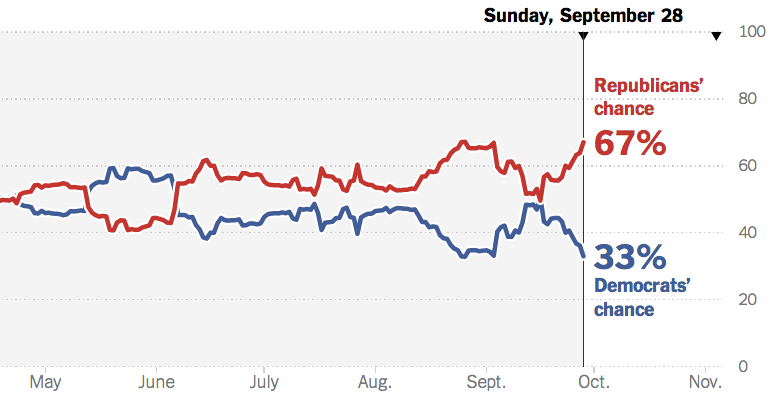
At least that’s what the NYT’s forecast shows:

NYT Forecast

Nate Cohn analyzed the state of affairs on Friday:

Four consecutive surveys have shown Cory Gardner, the Republican candidate in Colorado, in the lead. Two nonpartisan polls — the only two of the last three weeks — showed Dan Sullivan, the Republican candidate in Alaska, also in the lead. The Republicans have not held a consistent lead in Iowa, but the Democrats haven’t led any of the last three polls there, either. As a result, Leo now makes Republicans slight favorites in these states — and that’s the main reason the fight for Senate control has drifted toward the Republicans.

Silver asks, “So what conditions would merit outright panic from Democrats?”:

They should keep a close eye on North Carolina and Kansas. These states have been moving toward Democrats in our forecast, helping them offset Republican gains elsewhere.

But these are also races in which the Democrat is doing better than the “fundamentals” of the states might suggest. The Democratic incumbent in North Carolina, Kay Hagan, is pretty clearly ahead in the polls today (including in a CNN survey that was released on Sunday). However, two other states with vulnerable Democratic incumbents, Colorado and Alaska, have shifted toward Republicans. Perhaps if the Republican challenger Thom Tillis can equalize the ad spending in the Tar Heel State, the polls will show a more even race there as well.

And the Kansas race is still in its formative stages.

Molly Ball profiles Greg Orman, the independent running in Kansas:

Control of the Senate could hinge on this unlikely contest between an insistently nonpartisan, Ivy League-educated former consultant and a Republican incumbent who’s spent 33 years in Washington. If elected, Orman says he would caucus with whichever party has the majority. But if there are 50 Republicans and 49 Democrats, he would play tiebreaker: Joining the GOP would give them 51 votes; joining Democrats would give them 50 votes plus the vice president. In that case, Orman says, he would ask both parties to commit to issues like immigration and tax reform, and join the one that agreed. “We’re going to work with the party that’s willing to solve our country’s problems,” Orman said in an interview.

Almost every ballot has an independent or third-party candidate who blames the two major parties for America’s problems. Most of them are flakes or gadflies who go unnoticed. But Orman has money, he’s run a smart campaign, and he seems to be in the right place at the right time. A weak Republican incumbent, a Democrat willing to get out of the way, and a state whose Republican majority has been badly split by years of toxic intraparty battles—all these factors have made Kansas uniquely receptive to Orman’s message.

Andrew Prokop watches as the various forecasts come into agreement:

In early September, there was an evident split among the six main Senate forecasts. Those that used only polls of individual races — HuffPost Pollster, Daily Kos, and Princeton Election Consortium — showed a small Democratic advantage. But those that also incorporated factors called “fundamentals” —FiveThirtyEight, the Upshot, and the Washington Post — gave the GOP a lead. (These “fundamentals” can include both state-level factors like candidate fundraising and how the state voted in the 2012 presidential race, as well as national factors like the generic ballot.)

Now, though, that split is gone — two of the polls-only models also give the GOP a lead …