Face Of The Day

Syrian Kurds fleeing from clashes crossing into Turkey

A Syrian Kurdish woman holds her baby in her arms as she waits at the border line in the Suruc district of Sanliurfa, southeastern province of Turkey, on September 25, 2014. Syrian asylum seekers fleeing the conflict between Islamic State of Iraq and Levant (ISIL) and Syrian-Kurdish Democratic Union Party (PYD) in the Tell Abyad district of Ar-Raqqah are coming to border line in the Suruc district of Sanliurfa, Turkey. By Ibrahim Erikan/Anadolu Agency/Getty Images.

Who Will Fill Holder’s Shoes?

Ed Morrissey ponders the timing of Holder’s resignation:

The White House is apparently worried that a Republican takeover of the Senate will make confirmation of Holder’s replacement very difficult unless Obama appoints someone Republicans like. Resigning now allows Obama to appoint a replacement soon, and Senate Democrats to schedule the hearings during the lame-duck session (and don’t forget Harry Reid’s rule change on filibusters for presidential appointments, too, which expires at the end of this session).

But naming a replacement for Holder carries significant political risks if it happens ahead of the midterms, too; if Obama picks someone too radical, Republicans will jump all over the choice in Senate races, and warn that the Democratic incumbents (or challengers, as the case may be) will be a rubber stamp for confirmation. It really puts the rubber-stamp issue front and center in the Senate races, which is exactly what Democrats who are trying to distance themselves from Obama didn’t need.

Scott Lemieux runs through a handful of possible replacements. The one currently getting the most attention – even for his facial hair:

Some administration sources have suggested that the Solicitor General is already a top candidate to replace Holder. [Don] Verrilli, a corporate lawyer without [Massachusetts Governor Deval] Patrick’s civil rights experience before becoming the nation’s top lawyer, is far from an exciting choice (that mustache notwithstanding). He’d also seem particularly unlikely to demonstrate any independence whatsoever from his boss. But having already gone through the Senate confirmation wringer and as a well-known Obama confidante, he’d be a safe choice who would require a minimum of political capital to get confirmed, something that (for better or worse) has always been important to Obama.

Dylan Matthews provides some background on Verrilli:

Perhaps Verrilli’s most significant private client was the Recording Industry Association of America, and he worked on a number of copyright-related cases on the side of copyright holders. He successfully argued MGM Studios v. Grokster, in which the Supreme Court held that entertainment companies could sue peer-to-peer services like Grokster for copyright infringements committed by their users. Before joining the Obama administration as associate deputy attorney general in 2009, he coordinated an infringement lawsuit by Viacom against YouTube that has since been settled after a number of court rulings in favor of YouTube and its parent company Google.

So it’s not too surprising that copyright reform activists are skeptical of Verrilli.

Waldman expects fireworks at the confirmation hearings:

[T]here’s no doubt that the fact that [Holder] has been involved in so many racial controversies is the key reason why he is the second-most-hated member of the Obama administration among conservatives.

When Republicans get a chance to question the person nominated to replace him, each and every one of those issues is going to come up. The nominee is going to be asked to repudiate everything Eric Holder did. And when that doesn’t happen, Republicans in Congress will turn on the nominee with everything they can muster, in a demonstration to their base that they feel their anger.

In 2009, Holder got confirmed in the Senate by a vote of 75-21. It’s going to be a lot closer, and a lot uglier, this time around.

Relatedly, Harry Enten points out that “the confirmation of an attorney general has been the most contentious of any Cabinet position”:

Attorney general nominees are by far the most likely to face serious resistance. The average number of “no” votes for all Cabinet position is just 4.5. AG nominees average 13 more than that — 17.4 “no” votes — far ahead of labor secretary nominees at No. 2, who have averaged 10.3 votes.

A lot of these averages, though, are skewed by one or two confirmation votes in which the nominee was particularly controversial. For example, defense secretary nominees would average half as many “no” votes if we didn’t count John Tower’s 1989 confirmation — 53 senators opposed him.

That’s why the median column is quite instructive. The median attorney general nominee received 21 “no” votes. That is, the majority of AG nominees since 1977 have faced combative hearings.

Follow all of our Holder coverage here.

What The Hell Is Happening In Yemen? Ctd

YEMEN-UNREST-ANNIVERSARY

The State Department ordered some US embassy workers to leave the country today, following this weekend’s Houthi takeover of the capital. Adam Baron says the events in Sana’a reveal the myth of the so-called “Yemen model,” which he describes as “a general steamroller of a narrative casting the United States’ intervention in the country as a multifaceted success”:

Yemen’s internationally-brokered transition, we were told, was a model for a region in post-Arab Spring upheaval; the Obama administrations cooperation with the Yemeni government, Obama trumpeted roughly two weeks ago, had lead unparalleled progress in the battle against the Yemen-based Al Qaeda in the Arabian Peninsula (AQAP). Both narratives have come to a head with an increasingly disparate reality as of late, as rebel fighters belonging to the Zaidi Shi’a lead Houthi movement managed to seize virtual control of Sanaa, the Yemeni capital, with little resistance from the Yemeni military, raising immediate questions regarding the utility of hundreds of millions of dollars in US military aid and a US-sponsored program of military restructuring, to say nothing of the viability of Yemen’s already fraught transition. …

Regardless of the ultimate fallout – which remains unclear – the fact remains that such issues as the battle against Al Qaeda in the Arabian Peninsula (AQAP) cannot be dealt with as separate issues from the larger challenge facing Yemen at the moment:

the establishment of inclusive, accountable governance and the shoring up of state authority – which, at the moment, verges on nonexistent – across the country. As the US-supplied military equipment currently being paraded in the streets of Sanaa by jubilant Houthi militants demonstrates, a counter-terrorism centered policy risks missing the forests for the trees.

The UN humanitarian news agency IRIN suggests the turmoil in Sana’a will have “significant” consequences for the Yemeni government’s fight against AQAP:

In recent months the group, the virulent local franchise of the extremist organization, has been stepping up its activities and rhetoric, with at least 20 people killed in attacks on military outposts by the group in August. Earlier this year the military launched a major campaign against AQAP, but it has struggled to make gains; the offensive has not been able to significantly weaken the group, which has even expanded its presence in the eastern province of Hadramawt.

There are also fears that the Houthis’ power play could encourage the Sunni Islam AQAP to increase violence in Sana’a as they seek to fight back against the Shia group.In mid-September a regional leader of Ansar al-Sharia, an AQAP offshoot which does much of its work on the ground, announced that the group was increasing its presence in Sana’a in preparation for a fight with the Houthis. Government officials say the standoff and fighting with the Houthi rebels distracted the military – which is both weak and divided – from the fight. “I think the Salafists and Al Qaeda will use the opportunity to strengthen their presence in Sana’a; that would be logical for them,” said a senior government official. “Al Qaeda are attacking the army and the PSO [intelligence agency] … This is a good environment for Al Qaeda.”

Meanwhile, a reader responds to our previous post with some personal history:

How fitting that this week of turmoil and chaos in Yemen is also the 52nd anniversary of the Great Revolution. Well, there have been government changes, and coups d’etat, and uprisings since then, but this one was the most significant, since it ended the centuries long monarchy and propelled Yemen into a Republican state. There have been subsequent Great Revolutions, and not many of the young people know much about the one in 1962.

The monarch, Imam Ahmad, died Sept 18, 1962, and his son Muhammed al-Badr assumed power. My family arrived in Taiz on September 23, where my father would take up his new post as political officer in the US Embassy. Communication in those olden days meant that, between the time we left Washington, DC (which was in the throes of the Cuban Missle Crisis), then sailed across the Atlantic and the Mediterranean to Athens, from whence we flew to Cairo, and then to Aden (then a British Colony), and then drove a jeep up the rough unpaved roads to the mountain lair of Taiz, a whole revolution had occurred.

Egypt’s Gamal Abdul Nasser, wishing to set up a puppet government that he could control in his conflicts with Saudi Arabia, appointed a Yemeni Army Colonel named Sallal to head the government. The heir Muhammed al-Badr could not get the support of Yemeni Army officers, so he disappeared from Sanaa and escaped to the northeast, near the Saudi border, where his tribal supporters gathered. I heard rumors that al-Badr couldn’t get enough support from tribes because he was believed to be a homosexual, but I’ve found very little documentation to that effect, outside of my own late mother passing along gossip, and the beliefs of Arabists who knew all of the monarchs in the 1950s and 1960s.

That Revolution ended up being a disaster for Yemen and even moreso for Egypt, which was committing 50,000 soldiers a year for the conflict, plus it was very expensive. It was subsequently known as “Egypt’s Vietnam”, since there was never any real resolution, despite the presence of UN Peacekeeping forces.

Sadly, things just got worse for Yemen. The new dictators, especially Saleh, were really mediocre rulers, only interested in extracting graft for their relatives. The Saudi oil boom from the 1970s on meant that working-age Yemeni men were leaving in huge numbers to work all over the kingdom, as well as in the Gulf States, which meant that Yemen’s former excellent agricultural infrastructure collapsed, and farmers resorted to growing more khat and less food. The birth rate was, at one point in the past 20 years, the highest in the world. Urbanization, overcrowding, political chaos, religious chaos, and then add jihad on top of it, and it’s a really sad country.

I’m so sorry to see it deteriorate even further. The Yemenis were the kindest, most pleasant nationality I encountered in my life as the daughter of a Foreign Service Officer, and Yemen had a special place in my heart. It’s devastating to realize that the people of this country are living among such violence and chaos, and there is no end to it in sight.

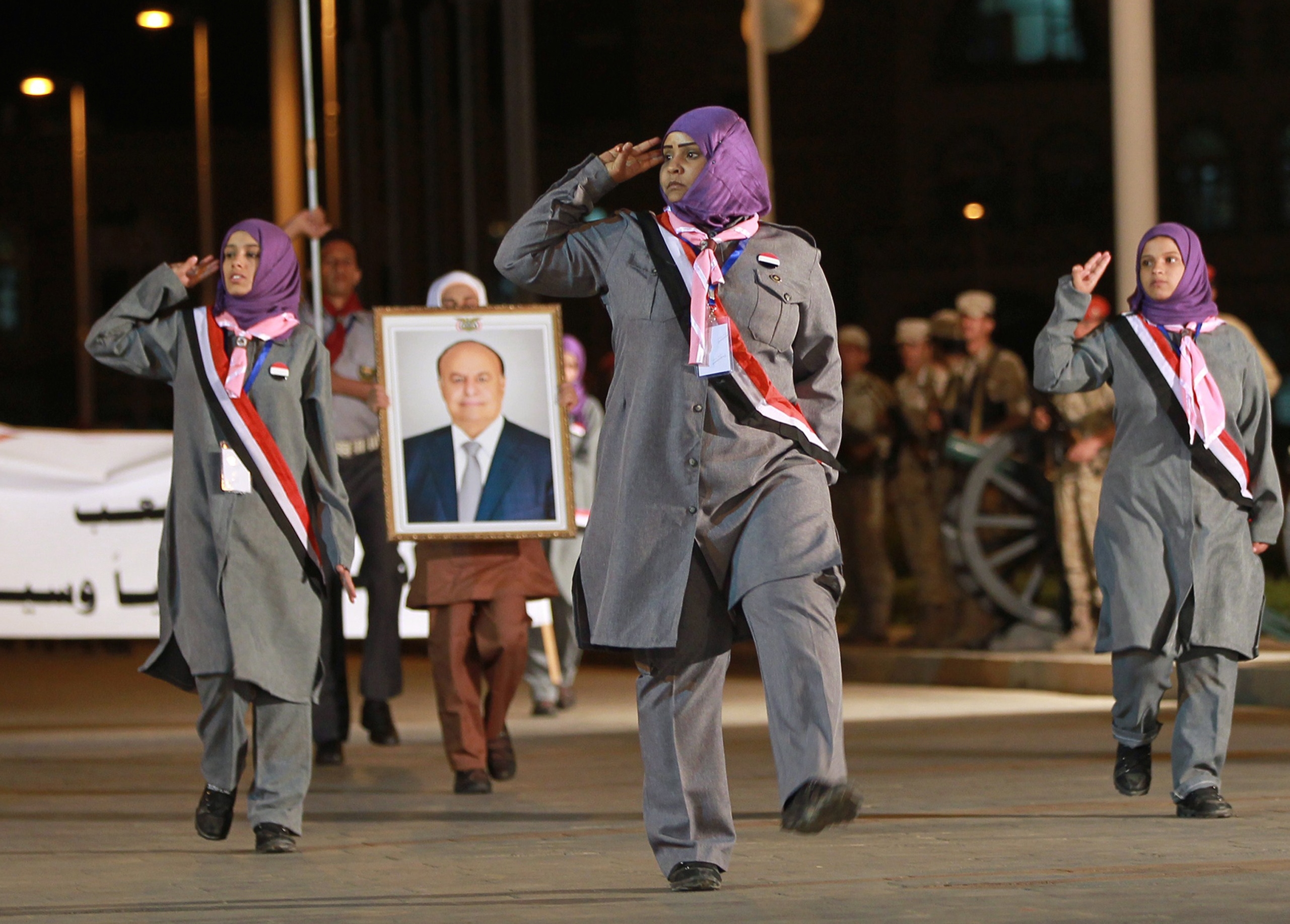
(Photo: Yemeni girls scouts salute as they take part in a parade marking the 1962 revolution that established the Yemeni republic, in the capital Sanaa on September 25, 2014. President Abdrabuh Mansur Hadi warned earlier this week of “civil war” in Sunni-majority Yemen, vowing to restore state authority, as Shiite rebels cried victory over their apparent seizure of much of the capital. By Mohammed Huwais/AFP/Getty Images)

The Fight Holder Didn’t Pick

Danny Vinik wishes the soon-to-be-ex AG had taken on Wall Street:

Prosecuting the banks with their well-funded legal teams for criminal crimes wouldn’t have been easy. But the DOJ has a lot of legal firepower as well. Holder simply never tried to use it to hold Wall Street executives accountable. That is a major blemish on Holder’s record. Bankers sleep easier at night thanks to his decisions. And when the next financial crisis hitsand when we discover that financial fraud was a major cause of itHolder will deserve blame as well.

Wonkblog explains Holder’s reluctance to tackle the banks:

In defense of his agency, Holder has stressed the difficulty of bringing criminal charges against top-level executives who are rarely involved in the day-to-day operations of their firms. Prosecutors, he has said, need evidence of culpability, the kind of proof that often comes from cooperating witness or whistleblowers. Just last week, Holder called for Congress to increase the whistleblower award as an incentive for Wall Street executives to come forward with information.

Danielle Kurtzleben adds more rationales:

There are all sorts of reasons why the department might have been timid — going up against banks’ well-funded legal defense teams would be tough, particularly when trying to prove wrongdoing to a jury in the byzantine world of finance, says James Angel, associate professor at the Georgetown University McDonough School of Business. In an article in the July/August edition of Politico Magazine, Glenn Thrush writes that a test criminal case against bankers ended in an acquittal, which scared Holder away from actual prosecution against individual bankers.

In addition, the Justice Department simply had a lot of other things on its plate in the last few years: terrorism and voting rights, for example. But if the Obama DOJ simply doesn’t have the manpower to handle all of the problems thrown at it, that may signal that it’s time for a new structure, says one expert.

If You Think Today’s Concussion Crisis Is Bad

1385662546-1

Take a trip to 1905:

Like the recent Time magazine cover featuring a 16-year-old who died playing the game, Americans are starting to ask, “Is football worth it?” Football has been here before, at a time when it was actually much more vicious. In 1905, 19 college football players died from injuries sustained while playing the sport; with five times as many college players participating today, the modern equivalent would be 95 on-field deaths. The San Francisco Call listed off the year’s fatalities: “Body blows, producing internal injuries, were responsible for four deaths, concussions of the brain claimed six victims, injuries to the spine resulted fatally in three cases, blood poisoning carried off two gridiron warriors, and other injuries caused four deaths.”

That year, amid calls for the abolition of football, Roosevelt hosted “an extraordinary private meeting” at the White House with the coaches of the three largest college teams:

Some say Roosevelt gave the coaches an ultimatum: Change the game or I’ll abolish it by executive order. But [historian John J.] Miller says that Roosevelt, characteristically, spoke softly, merely asking the leaders to save the sport by reducing the violence in whatever manner they could figure out among themselves. Given the fact that Roosevelt elevated the issue to the level of a presidential meeting, however, his implication was clear: It was time to fix football. “He didn’t have to say anything like a read-between-the-lines threat,” Miller says. “He wanted to nudge them in a direction.”

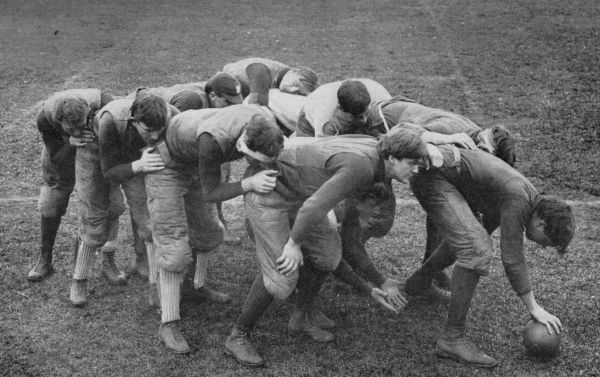
Miss Cellania notes, “Though he never played the game, partially due to his reliance on glasses, Roosevelt was a devoted fan.” She also provides context for the above image:

During the late 1870s, American “foot ball” resembled a combination of soccer and rugby with a riot mob mentality. Almost anything went: Players could carry the ball, kick it, or pass it backward. Starting in 1880, Walter Camp, a Yale player now known as the father of American football, introduced a series of changes to make the game more strategic. Unfortunately, some ended up making the game more dangerous. The most infamous example was Harvard’s “Flying Wedge,” inspired by Napoleonic war tactics: Offensive players assumed a V-shaped formation behind the line of scrimmage, then converged en masse on a single defensive lineman. “Think of it—half a ton of bone and muscle coming into collision with a man weighing 160 or 170 pounds,” wrote The New York Times in 1892.

For lots of Dish on today’s concussion crisis in football, go here. Update from a reader, who reiterates a key point about physics discussed throughout our coverage:

The issue with today’s concussion crisis – and why I personally think the NFL is in very, very bad shape long-term over it – is the intractable problem of F = dp/dt.  Simple physics, really.  Force is the first derivative of momentum with respect to time.  The intractability of the problem is that the object with the momentum in this equation is the player’s brain, and the thing which is rapidly inhibiting the brain’s momentum is the player’s skull.  The inside of their skull.

Football helmets are designed to prevent skull fractures and they do so quite well.  I don’t know that I’ve ever heard of an NFL player getting a skull fracture in my viewing life, from about 1980 to the present.  Maybe there’s been one I can’t remember, and perhaps there have been some in college football, which I have never followed very closely.  But they cannot lessen the kinetic impact of the brain, once it has been given a certain velocity, upon the inside of a rapidly decelerated skull.  Nor can they lessen it when a stationary brain is struck by a rapidly accelerating skull.  I don’t know if there’s any helmet or other device that we could design that ever could.

Lawsuits by former NFL players are such a threat to the league that it has changed its rules and settled for untold billions of dollars.  That an entity with as much power as the NFL flinches at the prospect of these lawsuits gives you an idea of how dangerous they are, but former high school and NCAA players have not sued their leagues and schools for the damage they likely suffered.  Not yet, at least.  I assume that some day they will, and I also assume that it will only take one or two judgments in their favor to create panic among university presidents and school board administrators – and the insurance companies that insure them.  These programs will either be unable to obtain insurance or it will become too expensive for only the richest programs to afford.

Not only that, but a large proportion of parents of high school-age boys will bar them from playing football, seeing the damage the plaintiffs in these cases have suffered.  Schools will no longer field teams and those that do will have a dearth of players to pick from.  The NFL’s talent pipeline will slow to a trickle, the product on the field will degrade, and sponsors and TV networks will balk at the prices the NFL and colleges demand for broadcast rights.

This may take the next 40 years to play out, but unless someone can come up with a solution to the problem of F = dp/dt, I don’t see how the league survives it.  They could of course keep changing the rules, making violent hits ever more rare, but diehard NFL fans are already distressed over the “wussification” of football already.  Much more and they’ll abandon it.  There might be an upstart league that gets started, promising all the hits from the good ol’ days of the NFL, and it will try to indemnify itself from the issue, but the problem is going to be with the high schools and the colleges, not the professional league.

Another physics nerd:

I love your work too much to let you get bamboozled by some bad physics logic. A reader wrote that helmets do not help to prevent concussions because of basic physics. He or she cites the right foundational formula, Newton’s 2nd Law in the calculus-snob form F = dp/dt, then fails to apply it properly.

First, let’s drop the calculus, because we don’t need it to understand this collision problem, and rearrange terms to get delta-p = F delta-t, or change in momentum during a collision equals force (the thing that cracks skulls and concusses) times the time elapsed during the collision. The change in momentum is roughly the same regardless of whether a helmet is worn: brain is moving before collision, brain stops moving after collision. So the left side of the equation is fixed which means the product on the right must also be fixed. The job of a helmet (or airbag, or baseball glove, or iPhone case) is to decrease the average force, F, by increasing the collision time. The right side of the equation must stay fixed, so by whatever factor we increase time we also decrease F.

That explains why a helmet prevents skull fractures: the cushion in the helmet provides a longer collision time which means less average force on the skull at any given instant, and therefore less risk of exceeding the minimum force required to cause a break. Now we just need one more important bit of logic to protect the brain: force transmission, which is really just a combination of Newton’s 2nd and 3rd Laws. The skull, being pretty solid, transmits the force from the helmet directly to the skull. So if the average force on the skull is decreased during the collision, then so is the average force on the brain. QED.

Drop me a line if you ever want some science fact checking. It’s what I do.

Holder’s Civil Rights Legacy

African American Activists Call For Justice In Shooting Deaths In Ferguson And NYC

Jeffrey Toobin declares that after Obama was reelected, “Holder found himself—or rediscovered himself”:

He decided to embrace civil rights as his cause. His civil-rights division filed lawsuits against the voting restrictions imposed by the legislatures in Texas and North Carolina. He began the process of reducing the number of nonviolent offenders in the federal prison population. He went to Ferguson, Missouri, to assure its citizens that there would be a full and fair investigation into the death of Michael Brown, a teen-ager shot dead by a police officer. It is tempting, even hopeful, to believe that this was the real Eric Holder.

Holder also spoke multiple times about the discrimination he believed he had experienced as a black man.

“I am the attorney general of the United States, but I am also a black man,” he said during a visit to a community meeting in Ferguson, Mo., this year, where he recounted his anger at being stopped by police while running down the street in Washington, D.C., and while driving on the New Jersey turnpike. “I remember how humiliating that was and how angry I was and the impact it had on me.”

Like many other efforts, he spoke these words not just as a cabinet secretary but as a social activist, urging the country to be better. “The same kid who got stopped on the New Jersey freeway is now the Attorney General of the United States,” he said in Ferguson. “This country is capable of change. But change doesn’t happen by itself.”

David Graham adds:

With Holder’s departure, Obama will lose a close friend—an apparently rare breed—and an essential ally on issues close to the president’s heart. Who Obama nominates to succeed him, and whether the nomination is successful, will offer some hint of how the president intends to close out his term in office. But the new attorney general is unlikely to have as eventful a term as Eric Holder.

But Eric Posner argues that Holder’s record is not one “that a civil-rights-promoting attorney general can be proud of”:

But two things can be said in Holder’s defense. First, the attorney general just doesn’t have much power to compel a president to comply with civil rights. The attorney general is merely the president’s legal adviser; he doesn’t have any authority to force the president to obey the law. In principle, Holder could have resigned in protest of these civil rights violations, but he surely thought that he could do more for civil rights by staying in office and picking his battles, and rightly so.

Second, while Holder’s decisions disappointed civil libertarians of all stripes, they were not obviously wrong. Indeed, they were mostly right. “In times of war, the law falls silent,” said Cicero. This is something of an exaggeration in the United States today, but it remains true that the rights of people considered a threat to a country tend to diminish as the magnitude of that threat increases, for good reason. Holder, like his Bush administration predecessors Alberto Gonzalez and John Ashcroft, adopted a pragmatic rather than rigidly legalistic position on civil rights, human rights, and the laws of war. That pragmatism will be his legacy.

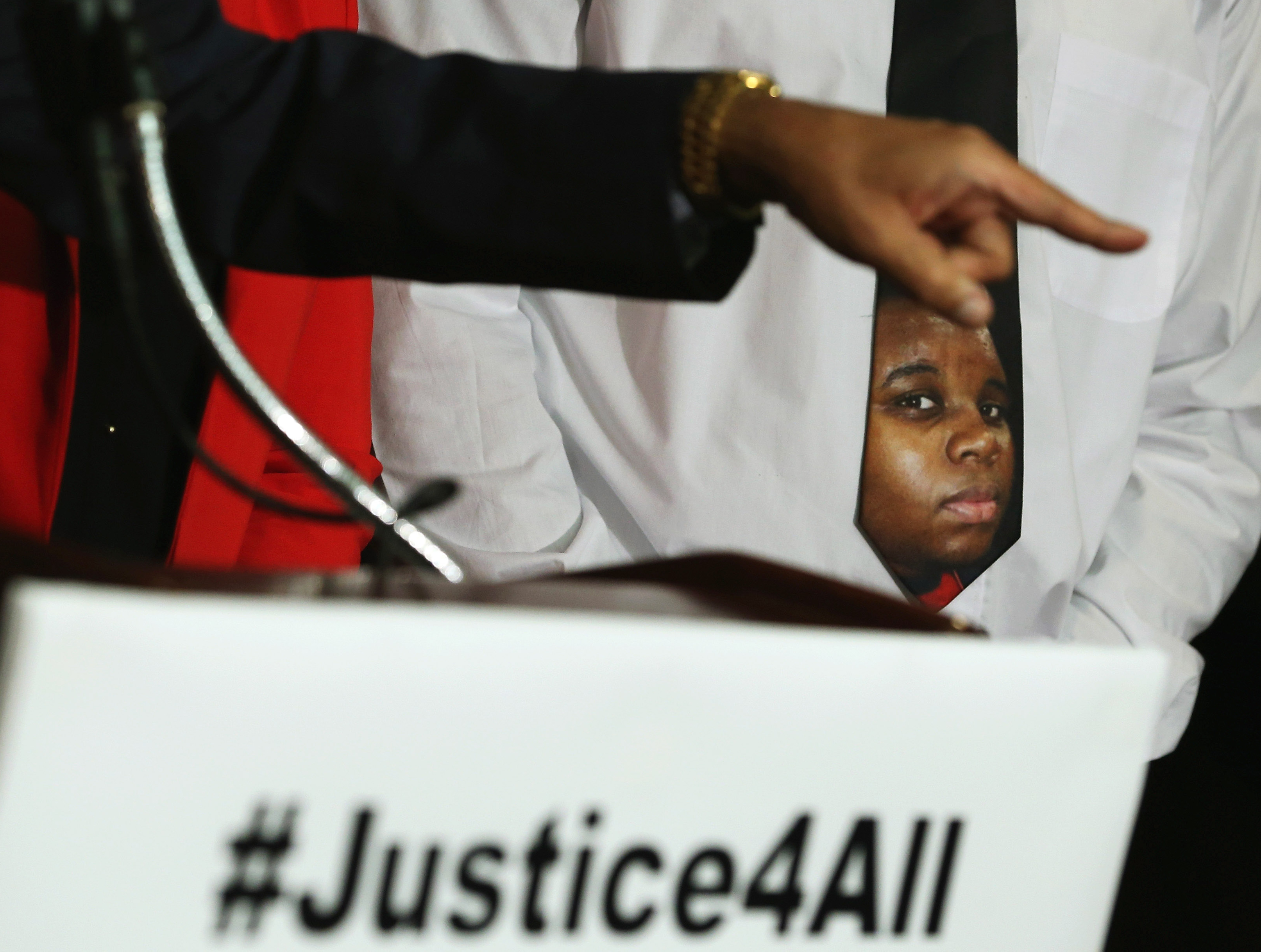
(Photo: Michael Brown Sr., father of Michael Brown, who was killed by police in Ferguson, Missouri, wears a tie with his son’s image on it during a news conference at the National Press Club in Washington, DC on September 25, 2014. Rev. Al Sharpton called for federal review of racial violence and discrimination in the law enforcement community. By Mark Wilson/Getty Images)

The State Of The Secret Service

Peter Grier looks ahead to next week’s Oversight hearing on the Secret Service, scheduled soon after an intruder dashed across the White House lawn and made it into the building:

Among the questions sure to arise: Why wasn’t the White House front door locked? Why didn’t the uniformed Secret Service agents on the grounds unleash their trained defense dogs, or fire at Mr. Gonzalez before he reached the White House threshold? Had the Secret Service heard about Gonzalez beforehand? After all, he’d been arrested in rural Virginia on July 19 for erratic driving. In his vehicle, law-enforcement officials found three rifles and two handguns, ammunition, and a map of Washington with a circle around the White House grounds.

Ambinder says the Secret Service’s problems run much deeper than unlocked doors and text-happy agents:

After the Sept. 11, 2001, attacks, the Secret Service found itself overburdened, under-resourced and undermanned. Agents who might not have passed muster in previous eras – including several involved in the recent alcohol-fueled scandals overseas – not only survived, they became supervisors. Ignoring, for the most part, the Secret Service, the government focused instead on building the Transportation Security Agency and the Federal Air Marshal Service, added thousands of agents and officers to the Border Patrol and to the Immigrations and Customs and Enforcement service, and dumped it all inside the new Department of Homeland Security.

And last year’s budget cuts have had consequences:

The current White House Security Plan, which is supervised by the Presidential Protective Division and executed by the Uniformed Division, is based in large part on a classified 2010 study of the complex. Its results were shared with congressional overseers, and appropriators programmed more money for specific functions: counter-surveillance, technical counter-measures (such as infrared cameras) and better barricades. But most of the money to fund those enhancements and to staff the White House security apparatus at an appropriate level did not survive the automatic budget cuts of 2013. The Uniformed Division is now short at least 100 sworn officers. Officers work overtime. Perhaps that much overtime stretches them thin and dulls response time.

Meanwhile, Ronald Kessler contends that “while agents are brave and dedicated, Secret Service management perpetuates a culture that condones laxness and cutting corners”:

Under pressure from White House political staffs or presidential campaign staffs, Secret Service management tells agents to let people into events without magnetometer or metal detector screening. Assassins concealing grenades or other weapons could theoretically enter an event and easily assassinate the president or a presidential candidate. When it comes to firearms requalification and physical fitness, the Secret Service either doesn’t allow agents time to fulfill the requirements or asks agents to fill out their own test scores. All this has led to poor morale and a high turnover rate. Tired agents and officers are forced to work long overtime hours, contributing to the sort of inattention that took place when Gonzalez scaled the White House fence.

Jeffrey Robinson traces the cultural shift back to the George W. Bush’s first term, “as leadership changed and institutional memory of the Reagan assassination attempt faded”:

The first sign of this came in 2003, when Bush became the first president in history to land on an aircraft carrier in a fixed-wing plane. The president’s entry by Navy jet provided a flashy visual opening to his “Mission Accomplished” speech. But it was a very dangerous maneuver and an unnecessary stunt made simply for the sake of becoming the lead story on the evening news. A person close to the agency told me that the Secret Service originally objected to the plan, but eventually relented, given an agent would be in the plane with Bush – even though, if something had gone wrong, the agent couldn’t have done anything.

Under Reagan, the Secret Service never would have permitted it. Former agents told me they would have fought the idea tooth and nail. They would have thrown their Commission book on the table, refused to take responsibility and resigned.

But Matt Farwell suggests that the Secret Service deserves credit for its restrained treatment of a man who by all accounts struggles with mental illness:

Of all law-enforcement agencies in the United States, members of the Secret Service are among the most experienced at dealing with mentally ill individuals – because they have to as a routine part of the job. Mentally ill individuals come up to the gates demanding to speak to the president on a near daily basis. …

Agent training in Beltsville, Maryland, features classes in psychology and role playing various scenarios agents might encounter in the course of their duties. These lessons are derived from an exhaustive longitudinal study of assassins and near-assassins completed in 1998. The study focused on the thoughts and behavior of suspects before their attacks and near misses. It found that more than one-third of those assassins and near assassins appeared to hold delusional ideas (the atmosphere collapsing, covert spy satellites beaming signals directly into the brain, or a nonexistent relationship), three-fifths had been evaluated or treated for mental illness, and two-fifths had been hospitalized for psychiatric reasons.

Romney 2016: Greater Than Zero

Will Mitt take another run at the White House? According to Byron York’s reporting, the answer is absolutely yes – uh, maybe! “Definitely more than zero.” Larison somehow managed to type while banging his head on his desk:

If it was Romney’s “turn” in 2012, he has had it and squandered it, and there won’t be many interested in giving him another one. Indeed, almost every faction of conservatives would be unhappy with another Romney campaign.

For reformist conservatives, Romney’s last campaign was the embodiment of the party’s complete failure to adapt to the present. Romney’s agenda was the antithesis of almost everything libertarians and small-government conservatives support. Republicans that are concerned primarily with winning elections can’t be pleased by the idea of a Romney return, since he represented everything most non-Republicans loathe about the party between his corporate business background, his condescending attitude towards working-class and poor Americans, and his outdated economic agenda. He topped that off with a foreign policy worldview that was by turns ignorant and frightening. His supporters have desperately been trying to rehabilitate Romney’s foreign policy over the last two years without success, but nothing would be worse for the GOP’s foreign policy than to accept the false notion that “Romney was right” about anything in 2012.

Finally, it doesn’t make any sense for Romney to do this. He is a terrible politician and he isn’t well-suited for what presidential campaigning requires. There must be things that he would rather spend him time and energy on than mounting a third failed bid, and he has no good reason to undergo the scrutiny and mockery that he would inevitably face if he ran again.

Suderman piles on:

[T]he case for Romney in 2016 is rather like the case for Romney in 2012: Romney, who was in the GOP primary fray in 2008 as well, would still like to be president, there are some party bigwigs who see him as their best shot, and some campaign professionals would like to cash in on yet another sure-to-be-pricey run. That’s not an argument for why Romney should run. It’s an argument for why he shouldn’t.

A reluctant Drum takes the bait:

[A]s long as we’re supposedly taking this seriously, let’s put on our analytical hats and ask: could Romney beat Hillary Clinton if they both ran? On the plus side, Hillary’s not as good a campaigner as Barack Obama and 2016 is likely to be a Republican-friendly year after eight years of Democratic rule. On the minus side, Romney has already run twice, and the American public isn’t usually very kind to second chances in political life, let alone third chances. Plus—and this is the real killer—Romney still has all the problems he had in 2012. In the public eye, he remains the 47 percent guy who seems more like the Romneytron 3000 than a real human being.

Still, snark aside, if you put all this together I guess it means Romney really would have a shot at winning if he ran. We still live in a 50-50 nation, after all, and for the foreseeable future I suspect that pretty much every presidential election is going to be fairly close. And Romney certainly has a decent chance of winning the Republican nomination, since he’d be competing against pretty much the same clown show as last time.

Beutler argues that Republicans could do worse than Romney:

Conservatives can be forgiven for being sick of Romney and wanting fresh blood. But they should hope (perhaps quietly hope) that someone like Romney throws his hat in fairly soon. Otherwise they’ll be stuck with a candidate who carries all the baggage of the congressional party, and a down-ballot catastrophe. A Romney-ite would have a hard time beating Hillary Clinton, but a much better chance than any of the conservatives who have all but declared their candidacies already.

Looking to history, Kilgore wishes Mitt luck:

Three losing major-party nominees have managed to win a second nomination the next cycle: William Jennings Bryan (1896-1900), Thomas Dewey (1944-48) and Adlai Stevenson (1952-56). Bryan and Stevenson were beloved figures among their party’s activists. And so we come to the obvious analog to Mitt, Tom Dewey. Like Romney, he ran unsuccessfully for the presidential nomination the first time out (in 1940), and lost to an incumbent president second time out. His 1948 campaign was a struggle, as he lost a couple of primaries to Harold Stassen (don’t laugh—Stassen was a real force that year) and only overcame Stassen and Robert Taft on the third ballot at the convention. Dewey did, however, have something going for him in 1948 that Mitt could not match: he won landslide re-election as governor of New York in 1946.

The rest, of course, is well-known history, as Dewey managed to lose what was considered a huge lead over Harry Truman, whose Democratic Party had fractured to the right (via Strom Thurmond’s Dixiecrat campaign) and the left (with Henry Wallace running on the Progressive ticket).