The Long, Twilight Struggle For Independent Journalism, Ctd

Go here and here to catch up on our coverage of the Simmons-Goodell row. Sports fans from the in-tray have the floor:

Your take on Bill Simmons as a fight over journalistic independence is largely misleading.  Does ESPN have a stake in the economic success of the NFL?  You bet.  Does that mean that ESPN is going to stop criticizing the NFL or muzzle its journalists?  Absolutely not.  Don Van Natta, Jr. and Kevin Van Valkenburg, two ESPN writers, wrote the single best piece of investigative journalism in the Ray Rice affair.  Their carefully researched and written article was sharply critical of the Ravens and Goodell.  Not only did ESPN publish the piece – making it the lead story on their website for most of a day – but ESPN defended it on air, while other ESPN journalists and broadcasters praised it on twitter. That doesn’t wash with your conspiracy theory.

The problem for Simmons is that he wants to be both a journalist and an entertainer.

It is fine for radio shock jocks to call Goodell a liar (and most people would probably agree), but it is not ok for a journalist to make that kind of bald and inflammatory statement. You can criticize ESPN for trying to draw a line between journalism and entertainment when the network has frequently has blurred that line in other contexts, but that issue is a lot different from journalistic independence.  In the long run, ESPN needs legitimacy even more than it needs the NFL.

But Simmons was saying this on an avowedly free-floating podcast where the style is “anything goes” (see below). That context is relevant, I think. It’s possible to be a chatty entertainer in one media form and a sober journalist in another. Another reader pushes back in the opposite direction:

You write that Simmons was suspended because “Simmons out-and-out named Goodell as a liar – without proof.” At this point, we have four sources that verify that Goodell was told about the contents of the video. In addition, we have a source that says that the NFL received a copy of the video and has a voice message confirming his story. Further, we have multiple sources saying that at the very least the NFL was offered a copy of the video. Finally, we know for a fact Goodell lied when he said New Jersey law forbid him from getting a copy of the tape. What more proof do you need that Goodell is a liar? Do you need a video of him watching the video?

Bill Simmons spoke the truth and now he is being punished, while the most incompetent, immoral commissioner in sports continues in his job. The longer this continues on, the less I start to care about the NFL. I do not think that I am alone.

Another:

I’m a long-time Simmons reader/listener, and I want to give you some context and also contend that this is a blow for independent journalism, not a harbinger of its death.

I don’t think this was a spontaneous rant, as you say. Bill had a bee in his bonnet and he needed to get it out. The rant came in the middle of a weekly podcast he does during football season with his Cousin Sal where they talk about betting lines and generally ridicule themselves and all degenerate sports gamblers. It’s pretty light and funny. He stopped Sal in the middle of that to make his statement. He knew what he was saying was going to get his bosses’ attention, and even dared them to call him on it. He may not have anticipated the three-week suspension, but he knew there would be consequences.

That he did it despite knowing the consequences tells you everything you need to know about the power relationship between Simmons and ESPN/Disney. He knew they would have to take disciplinary action to kowtow to the NFL, but that the likelihood of them firing him was very low, and even if they did, there would be a slew of large offers from other media outlets bidding for his services, much in the way Nate Silver was wooed. He has the upper hand, not ESPN.

Had anyone else at Grantland said what Simmons said, they would likely have been sacked. During podcasts, when someone else takes a pregnant pause while discussing a controversial subject, Bill interjects: “Don’t get fired.” But he knows that doesn’t apply to him.

Another reader:

I don’t have a dog in this fight, but I rather suspect that Simmons‘ suspension by ESPN resulted from several factors you failed to note in your coverage, e. g., use of terms such as “fuck” and “fucking liar” in his rant filled harangue against Goodell and his acknowledgement that he had no evidence or proof that the commissioner was “lying.”

But another knocks that theory down:

Simmons‘ podcast begins with the disclaimer: “The B.S. Report is a free-flowing conversation that occasionally touches on mature subjects . . .” Ever since adding that disclaimer, and particularly since the advent of Grantland, foul language is common on the B.S. Report.  And the discussion frequently involves “mature” subjects.  Simmons referring to Goodell’s press conference as “fucking bullshit” is tame compared to the recurring discussions involving sex and drugs.  Not to mention, articles on Grantland routinely use swear words.

Another reader backs me up a bit:

I am a freelance sports reporter, journalism teacher, and avid Dishhead, so I feel I am uniquely positioned to riff about this Bill Simmons thing in context for a bit, so forgive me if I blabber.

First, I am also a Simmons/Grantland fan, and I listened to the podcast minutes after it was released. I thought his take was strong, but even I was a bit like, “Whoa, there. Careful.” The reason why is exactly what you stated: He called Goodell a liar without proof, and more importantly, without providing himself an out. Keith Olbermann, who has a show on ESPN TV nowadays, has also consistently championed Goodell’s resignation, but for all his blowhardiness, Olbermann cleverly leaves himself an out each time, saying for example (and I’m paraphrasing poorly here), that Goodell is either incompetent or lying, and therefore should resign. But never did he say Goodell is a liar, full stop. So that’s where Bill got into trouble with ESPN’s Journalistic Standards police: Lack of parsing.

But here’s the thing – I personally find even that laughable. Simmons isn’t a journalist per se; he’s an opinion-maker and a columnist, and also a pretty good, if homer-ish, NBA analyst. ESPN has no problem playing the journalism card on him in this case, but it’s totally cool with allowing fellow opinion-maker, columnist and NBA analyst Stephen A. Smith participate in Oberto beef jerky ads with Richard Sherman of the Seattle Seahawks. That, apparently, is totally cool in Bristol.

It should also be noted that I personally believe the aggressive coverage of the Ray Rice case has partially been a reaction by all the networks to what they have long-viewed as heavy-handedness by the NFL in TV and advertising contract negotiations in the Goodell era. It’s no secret in the sports business world that the NFL has a very difficult reputation in negotiations. It’s as if the networks mutually decided when they found out that their reporters were lied to publicly that they would go open season on the league. And now that the story is waning a bit, and the league is regaining some ground (largely thanks to the consumption of its regular product every weekend), ESPN is pulling the reins in a tad.

I think there’s a bit more inside baseball going on here, since it’s in the networks’ interest to try to devalue the NFL as a commodity for the next round of negotiations by, well, doing their jobs and reporting facts. The NFL appears on ALL of the major networks – FOX, CBS, NBC and ESPN (which is owned by ABC/Disney), so whatever they can do to rein the NFL’s negotiating power in is  gravy to them, I’m sure, since it also owns the ratings for the dying major networks across the board.

I hope that helps at least a bit. Thanks again for all you and your team do!

The Gender Gap On The Big Screen

Female Characters

Alyssa Rosenberg flags new research on female characters in film:

[W]hen a new study from the Geena Davis Institute on Gender and Media, produced by the scholars at the Media, Diversity and Social Change Initiative at the University of Southern California Annenberg, rounded up the representation of women in movies from the world’s top-ten markets outside of the United States, I was curious. Are audiences in Australia, Brazil, China, France, Germany, India, Japan, Russia, South Korea and the United Kingdom accustomed to see women on screen in numbers and in ways that might force the heavily-male American movie industry to cater to their preferences?

She explains the “mixed” results:

The study’s authors looked at the movies that played in those countries’ theaters between the beginning of 2010 and May 1, 2013. During that time, 29.3 percent of characters in American movies were female. Seven countries had a higher percentage of female characters in movies–Australia, Brazil, China, Germany, Korea, Russia, and the United Kingdom. But the numbers were not dramatically higher. The United Kingdom had the highest overall percentage of female characters at 37.9 percent, a figure that hardly suggests a yawning gap between what the U.S. provides and what international audiences are accustomed to at home.

Molly Mirhashem takes a closer look at the study’s findings:

Less than a fourth of all characters with jobs were female, while in reality women represent 40 percent of the global workforce. Beyond that, very few female characters held powerful roles in any field; leadership and “prestigious” positions, like judges, doctors, executives, and professors, skewed overwhelmingly male. Only 10 percent of workers in STEM (Science, Technology, Engineering, Math) fields were women, as compared to about 25% in actuality. …

The team further surveyed the levels of revealing clothing, nudity, thinness, and implications of attractiveness for female characters across age groups. For example, in the German films, 40 percent of all female characters wore revealing clothing (defined as “tight and alluring”). In American films, for comparison, 29 percent of the female characters were scantily clad. And in perhaps the most disturbing finding, teenage girls as young as 13 were as likely to be sexualized as women in their thirties.

Pessimism Inc.

Bourree Lam tracks Westerners’ dim hopes for corporations:

In developed economies of North America and Western Europe only 44 percent of the public see corporations as a source of hope, compared with 57 percent of executives. 55 percent of the public polled in developed markets feel that corporations have not been humbled by the recession, and haven’t been acting more responsibly either. In the U.S. last year, the SEC announced a record $3.4 billion in fines, and 2011 was the year with the most actions filed in the agency’s history.

Compared with China, where 84 percent of people consider corporations a source of hope, the U.S. is not very optimistic about corporations making the economy stronger—only 36 percent feel hopeful toward them. Interestingly, the U.S. general public is more than 10 times as likely as the Chinese general public to say that corporations have more power than the government. 95 percent of those surveyed in China say the government has more power than corporations in their country, compared to just 51 percent in America. Nearly half of Americans surveyed feel that corporations have too much influence on the future of the U.S. economy.

Neil Irwin interprets the survey’s findings:

When it comes to business exerting power over the economy, Americans have mixed views but are generally comfortable. But when it comes to business exerting power over government, they are much more exercised.

Americans aren’t antibusiness, in other words. They’re just against business having what they see as too much power in Washington.

Compare that with China, where citizens seem to view businesses as less powerful in terms of lobbying (only 19 percent seeing a lot of influence by corporate lobbyists, a full 40 percentage points lower than in the United States) but are more likely to believe it is good for companies to be strong and influential. One might imagine that Chinese citizens see less a phenomenon in which business overly influences government and one more in which government overly influences businesses.

Black-ish Is Beautiful

Alyssa Rosenberg declares the ABC sitcom “the best new comedy pilot of the fall television season”:

The series focuses on an upwardly-mobile black Los Angeles family, headed by Andre (Anthony Anderson), an advertising executive, his doctor wife Rainbow (Tracee Ellis Ross), Andre’s father (Laurence Fishburne) and their four children. Andre appreciates the opportunities that are open to him, including a nice home and a possible promotion at his firm, but when “Black-ish” begins, he is also gravely concerned that his kids are drifting from his own sense of what it means to be black, in part because they have grown up in such relative comfort. …

But the tension Andre is feeling does not simply play out in his own family, where he and Rainbow–who is mixed-race–have radically different perspectives on everything from their own children’s choice of sports and attraction to Judaism to an ongoing disagreement about whether O.J. Simpson is actually guilty. Instead, the great insight of “Black-ish” is that everyone has a relationship to black culture now, as well as to issues of class and gender, and that there is great comedy and great insight to be mined in looking at the fine-grained differences in the perspectives everyone brings to blackness (and whiteness), family life and money.

While watching the first episode – available in full here – Judnick Mayard felt a pang of recognition:

The pilot, which airs this week on ABC, follows “Dre” on the day he is promoted to senior vice president at the ad agency where there are no folks of color on the management team. To his surprise, he is named SVP of the Urban Division, essentially boiling his job down to black man in charge of black stuff. His boss insults him further by requesting that he also keep it real on his first pitch, which incenses Dre into a mad spiral of reaffirming his blackness to himself and his family. Dre’s anger and antics throughout the rest of the episode come from feeling like his blackness (and his family’s blackness) is being attacked. It’s a feeling that many of us can understand.

Linda Holmes contends that “while the racial politics of Black-ish are interesting and feel pretty fresh … what’s even more unusual is Dre’s mention of money”:

What makes the show interesting and the comedy more pointed, for me, is that there’s a candor about the way that having money affects Dre and Rainbow’s sense of who they are and how they’re raising their kids that’s very uncommon in a world where the obviously rolling-in-dough families on Modern Family, for instance, almost never discuss it. That’s not to even mention, of course, the many much-maligned examples of people living in palatial New York apartments they would never be able to afford in their proffered professions, from everyone on Friends to Carrie Bradshaw on Sex and the City, who was somehow supporting herself in high style and hot shoes by writing one column for one outlet, rather than living in a closet with four roommates and a cockroach infestation. Black-ish concerns itself largely with the way Dre’s sense of racial identity intersects with the introduction of wealth.

Willa Paskin adds, “What ultimately gives Black-ish so much warmth – a warmth reminiscent of, yes, The Cosby Show – is its optimism that audiences, of all colors, will not be turned off by its specificity”:

Black-ish is about the affluent black experience, no apologies, no soft-pedaling. And that experience, of course, encompasses the anxiety of raising your children, the sustaining of a great marriage, and the ongoing project of being the person you most want to be. Like the many, many sitcoms about the affluent white experience, this is a show that is meant to be seen and enjoyed by everyone.

But Kellie Carter Jackson longs for more all-black casts:

How is it that in the “Age of Obama,” there is even less black programming on TV, save the ratchet reality TV shows of Love and Hip Hop, Basketball Wives, and the Real Housewives of Atlanta? Not only are these reality shows a false and horrible representation of black culture, but they are essentially made for pennies on the dollar when compared to a network drama or comedy.

Of course, if reality TV such as Love and Hip Hop was about authentic, complex characters, I’d watch it. I’d watch a show about drug dealers, if it were authentic and thoughtful. Who didn’t love The Wire? Who doesn’t love a good anti-hero? Black TV isn’t always about the politics of respectability. What American television should be about is presenting America with a world as diverse and complex as it really is. TV’s visual binary should not consistently be limited to that of black success or black struggle: Most of us live somewhere in between.

Perhaps in the age of Obama, the decline of all-black casts is simply because African-American actors are more woven into the fabric of TV overall. If anyone knows of any demographic data pointing either way, email us at dish@andrewsullivan.com.

Tech’s New Political Charge

In an analysis of the “long, awkward relationship between Silicon Valley and American politics,” Ben Smith sees tech industry on the brink of a new era:

The relationship between tech and politics is “radically changing,” said Ace Smith, a San Francisco political consultant whose clients have included the biggest names in both Democratic politics and technology. The startups jangling transportation, housing, and an array of other consumer areas have “opened the tech world’s eyes to needing a broader perspective, and it’s opened every one else’s eyes – it’s really brought them much more into the world of politics and government and communications.” Indeed, 2014 feels like the end of one era and the beginning of another.

A generation ago in Silicon Valley, “you didn’t even think about government until you were a public company – and even then it was a culture of avoidance,” said Matt Mahan, who has worked for a decade at the intersection of politics and tech and now runs Brigade, a startup aimed at reforming U.S. politics. … Now Uber, in particular, is winning more fights than it’s losing in an endless series of tussles with local regulators. The same is true for Airbnb, whose spokesman, Nick Pappas, had previously been selling Obamacare from the West Wing press office. (Two other former top Democratic staffers also work there.) These companies carry the confidence (at times, arrogance) and sense of destiny that has driven Silicon Valley’s burst of innovation; they also are being shaped by urgent battles with regulators of the sort that Microsoft, for instance, didn’t quite see coming (on a far larger scale) until the Department of Justice came calling. They are showing a new willingness to compromise the purism that sometimes made tech companies leery of dirtying themselves up in Washington.

Relatedly, Daniel Ben-Ami praises urbanist Joel Kotkin’s recent book The New Class Conflict, which tracks the ascent of tech power elite, as “an innovative attempt to rethink the main contours of US society”:

[Kotkin] sees the American elite as split between two mutually antagonistic oligarchies. On one side is a new elite based largely on information technology, although with substantial support from Wall Street. On the other is the old plutocracy centered on sectors such as agribusiness, construction, energy and manufacturing. The new oligarchy differs from the old in important ways. Its technology wing is concentrated in and around San Francisco, with a secondary cluster in Seattle, and it employs far fewer people than traditional industries. Kotkin estimates that in 2013 the leading social media companies together directly employed fewer than 60,000 people in the US. By contrast, GM employed 200,000, Ford 164,000 and Exxon more than 100,000. The different nature of technology firms, with far less dependence on cheap energy, helps explain why they are predisposed to green thinking. They also tend to be both geographically and emotionally distant from middle America.

A Grim Update From Libya

Sign of clashes near 27th Bridge of Tripoli

The situation is increasingly chaotic:

Leaders of the Islamist militias that have been wreaking havoc across Libya have unleashed an army of loyal, unemployed, and mostly uneducated followers to carry out a campaign of intimidation.

They are threatening, kidnapping, and targeting the relatives of politicians and civil society activists. “Militia leaders are now using an army of young people who will carry out their orders without any questions,” said prominent activist Ahmed Ghedan, who had to flee Libya to Tunisia after he spoke out against the militias. These foot soldiers have been bribed into joining the militia-gang culture. For activists, dealing with this army of brainwashed criminals is much harder than dealing with the militia bosses, who are leading from behind. The new recruits are clueless about the intent and consequences of their actions, and their loyalty simply lies with those who pay their checks. Political groups with links to the militias are taking advantage of this chaos to take out their opponents one by one.

These same groups are also targeting journalists and activists, who have found their lives and livelihoods threatened in myriad ways. For example, their movement is being restricted, and they have been unable to travel around or out of the country, since airports are still under the control of the militias. Not only does this threaten their reporting ability – a blow to press freedom – but the detours require them to travel by land through areas in which they could be stopped, identified, and either prevented from traveling or kidnapped.

(Photo: Empty cases, sign of the clashes, are seen near 27th Bridge in Tripoli, Libya on September 24, 2014. By Hazem Turkia/Anadolu Agency/Getty Images)

McEnglish

In an excerpt from The Language of Food, Dan Jurafsky considers the logic of junk-food brand names:

Across most languages of the world, front vowels tend to be used in words for small, thin, light things, and back vowels in words for big, fat, heavy things. It’s not always true, but it’s a tendency that you can see in any of the stressed vowels in words like little, teeny, or itsy-bitsy (all front vowels) versus humongous or enormous (back vowels). Or Spanish chico (front vowel, meaning “small”) versus the gordo (back vowel, meaning “fat”). Or French petit (front vowel) versus grand (back vowel). …

Since ice cream is a product whose whole purpose is to be rich, creamy, and heavy, it is not surprising that people seem to prefer ice creams that are named with back vowels. Eric Yorkston and Geeta Menon at New York University found that participants asked about a hypothetical ice cream named either Frish (front vowel) or Frosh (back vowel) rated Frosh as smoother, creamier, and richer than Frish.

Do manufacturers make use of this subconscious association of back vowels with richness and creaminess? I checked to see whether commercial ice creams (like Häagen-Dazs and Ben & Jerry’s) were more likely to use back vowels in their flavor names, and conversely whether thin, light foods like crackers would have more front vowels in their brand names. The result? Lots more back vowels in ice cream names: Rocky Road, Jamoca Almond Fudge, Chocolate, Caramel, Cookie Dough, Coconut. And lots more front vowels in cracker names: Ritz, Cheese Nips, Cheez It, Wheat Thins, Krispy, Triscuit, Thin Crisps, Chicken in a Biskit, Ritz Bits.

The Best Of The Dish Today

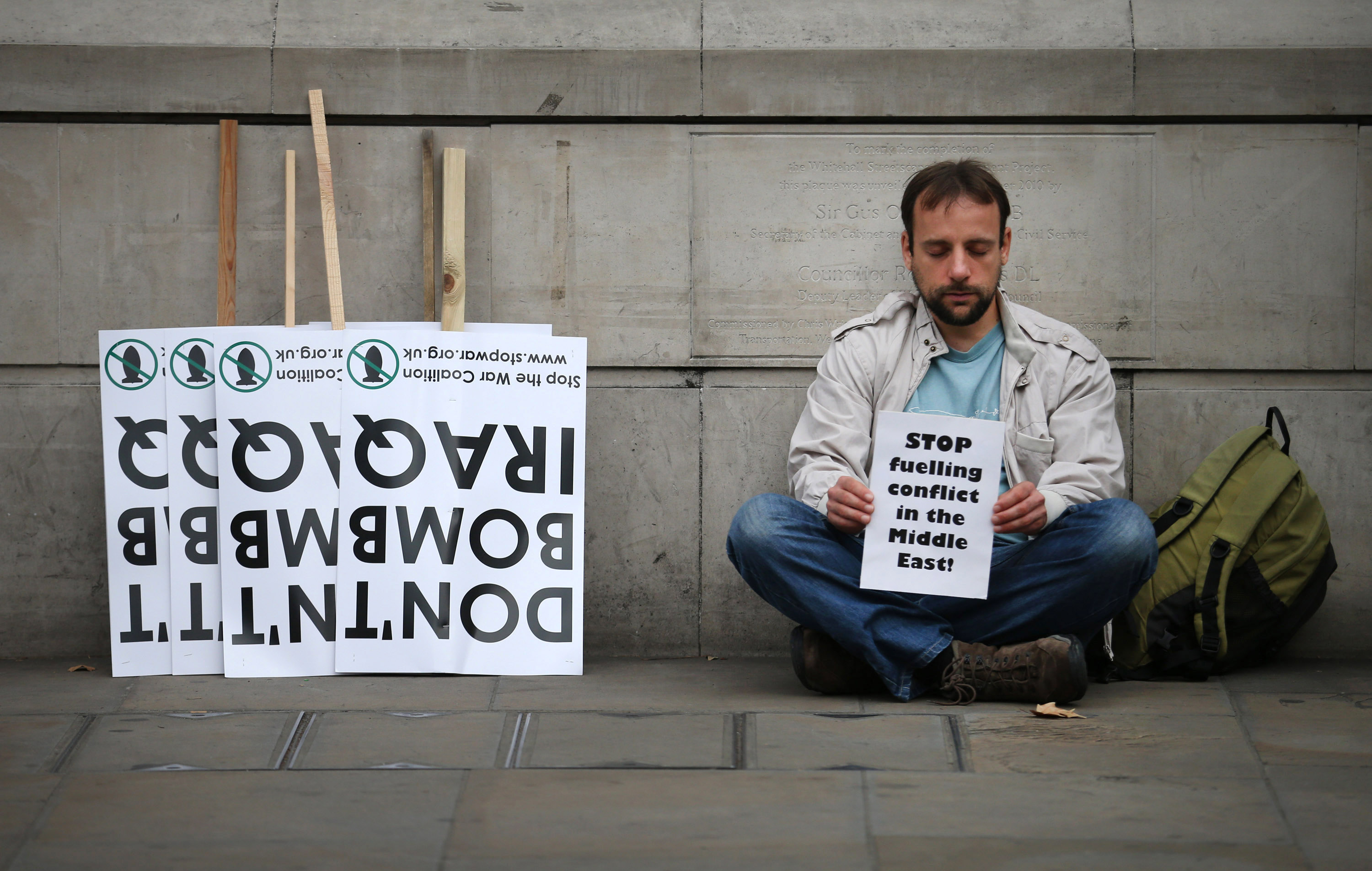
Anti-War Demonstration Outside Downing Street

The debate we had today about the new war in Iraq was one of the reasons I’m still doing this after fourteen years. I get to make an argument and have the smartest critiques come back at me pretty damn quick. It’s like my own personal interactive Wikipedia of ideas. I’m not persuaded by most of the emails, but I have shifted a little bit toward a less deeply bleak mood. I hope Dish readers realize that what matters is not what I have to say but what the Dish itself slowly unearths after my sundry provocations.

And they lead to further questions. Mulling some of this over this afternoon, I think much of my misgivings comes from the fact that I see no way to put “Iraq” back together. I’m not simply emotionally reacting to being so wrong in the early stages last time around; I’ve internalized some of the things I thought I had learned. Among them: sectarianism matters. In 2003, we thought we were going there to depose a dictator and establish a democracy. What Iraqis saw was the removal of a Sunni dictatorship in favor of a Shiite autocracy. To move a country like Iraq from one sectarian column into another is a huge event in the long-running Shi’a-Sunni battleground.

Bill Kristol, among others, insisted that sectarianism no longer existed in Iraq. But we discovered it was by far the most powerful thing in Iraq once the dictatorship ended. Which brings me to a simple point: I don’t believe the Sunnis will ever give up the struggle. With a weak Shiite government, a Sunni insurgency is now permanent. The only way this will be resolved is through a struggle between the Sunni autocracies and Shiite Iran in a contest to forge a new boundary for the sectarian divide. And that struggle will go on for a very long time. The idea that the US can intervene to end this, instead of merely exacerbating it in the medium term, goes against the entire experience of the 2003 – 2011 occupation.

Maybe the forces of global order have to be brought to bear. But my fear is that those forces do not ultimately bring order. They brought about ISIS in the first place. Is this far too pessimistic? Maybe. I wonder if there has been a previous example of a major Middle East state switching its sectarian allegiance from Sunni to Shi’a. But pessimism in the Middle East is often merely realism. And what we’re trying to do now is surreal.

You can follow the full debate here and here and here. My further thoughts here. We covered the suspension of Bill Simmons from ESPN – and the future of independent journalism – here and here. We also noted that the NFL’s current crisis has a real historical precedent. Plus: talking zombies!

Many of today’s posts were updated with your emails – read them all here.  You can always leave your unfiltered comments at our Facebook page and @sullydish. 24 more readers became subscribers today. You can join them here – and get access to all the readons and Deep Dish – for a little as $1.99 month. Buy a gift subscription for a friend here. Dish t-shirts and polos are for sale here.

A reader cheers us up more than he knows:

I just want to say the Dish has been great the last few months. Even during your time off as the world crumbled, we got great insight from the people who guest-blogged and general staff. It was great seeing such a focus on climate change, and really was awesome to get a woman’s touch on the blog and talking about abortion from a perspective different than yours. Since you’ve been back, you’ve rightly been critical of Obama and this nonsense going on in the Middle East. I’m fully inclined to agree with your assessment of his actions, while I hold out a Howler Beagle (tr)sliver of hope that this doesn’t escalate, and he finds some excuse to cut the strikes off after allowing the hawks to get their beaks wet.

But the reason I want to write you most of all, is I’m amazed at how much more I read the Dish compared to other websites I enjoy (Vox, Slate, Salon, Mother Jones). Do you know why I read the Dish more? It’s not because I don’t want to read articles on those sites. I’m not too turned off by the tone of stupid articles that occasionally appear (all publications have articles I find stupid).

No, it’s because of their god damned ADS! I could deal with banner ads. I could deal with rollovers that cover the entire screen until I hit “X” and push the ad back to the top of the page. But now, every single one of those sites runs video ads that launch when you open the site. In the side of the page, a video plays. Guess what happens next? My fucking Internet browser freezes or crashes. As much as I want to read these sites, the people running the sites are making it impossible for me to do so. So impossible, in fact, I find myself reading them less and less.

I work in digital ad sales. User experience matters to us at our site. You know what website has the best interface that I can hang out on all day? It’s the Dish of course. Thank you for being ad-free.

See you in the morning.

(Photo: An anti-war demonstrator sits near Downing Street on September 25, 2014 in London, England. Parliament will vote on possible military action against Islamic State when it meets on Friday. By Peter Macdiarmid/Getty Images.)

Unflattering Photos Are Forever

Maureen O’Connor tried to remove every old, embarrassing photo of herself from the Cloud. She describes the experience as “the most arduous thing I have ever done on the Internet”:

More arduous than navigating Con Edison’s bill-pay website. More arduous than an Obamacare insurance exchange. (The fact that I had to request something like a dozen username reminders, then reset as many passwords, did not help. If Sisyphus lived today, he would be chained to a computer clicking hyperlinks to reset his password and sign back in, all day long.)

In the age of cloud-computing, deleting pictures is like slaying the hydra: Every time you kill one archive, you discover two more. Photos were hiding not just in my iPhone’s Camera Roll, but in every photo-editing, messaging, and dating app I’d ever downloaded. Photos were lingering in ancient text-message threads. Shared photo albums I’d forgotten had been updating without my knowledge. I felt like the Donald Rumsfeld of selfies: There were known knowns (caches I knew to review) and known unknowns (apps I suddenly realized might be saving photos) and unknown unknowns that I could not anticipate but will surely terrorize me later (a fear that the Xbox Kinect motion camera will someday unleash hours of clumsy Dance Central 3 footage keeps me up at night).

I long ago gave up any interest in controlling any aspect of my physical appearance in photographs. Like everything on the web, the only way to stay sane is to let it go. So there are photos of me with a big black beard, a big brown beard, a big grey beard, hunched over in a Subway, lolling about in Dupont Circle, wading into water looking like a fat-ass, and all those ghastly TV screen shots. One of the most popular was taken when I was at a libertarian conference in Amsterdam and got a weird beard-cut under the influence of God knows what, and presto! I was re-branded, even as my eyes could barely open. And then there’s the infamous butt scratch. At some point, I reminded myself that all of this was merely a minor form of mortification and it is good for the soul to endure it. The humiliation is particularly acute in my case because there are many photos of me from 20 years ago and in retrospect, most people would think I was way cuter back then. That 1993 Annie Leibovitz Gap-ad shot hangs over me like some reverse Dorian Gray – forever young, while my actual head turns into a mildly ravaged potato.

But every now and again, someone will say something, and I will even be flattered. It can still happen.

Takedown Of The Day

Larison shows how it’s done:

[Ted] Cruz’s view is more or less what Paul Miller described as “killing lots of people and then going home,” except that the approach Cruz favors would make it unlikely that the second part–going home–ever happens. Cruz really does represent the worst of both worlds in that he wants to intervene in the affairs of other countries while remaining oblivious and indifferent to their political realities. That isn’t a “middle ground” between Bush and Obama or between McCain and Paul, but rather a dangerous and mindless foreign policy of “shoot first and don’t ask any questions.” It’s as if Cruz looked back at the caricature of Reagan that Reagan’s opponents created and chose to become that caricature in real life.

Beinart raised similar concerns earlier this week. Cruz increasingly strikes me as a menace on a national scale.